
1. The Paralysis of Cortisol: The Science of Absolute Terror
To fundamentally understand Zenitsu Agatsuma is to look past the superficial veneer of comedic cowardice and analyze the agonizing, physiological reality of his existence. Zenitsu is not merely “scared” in the traditional sense; he is a biological paradox suffering from a crippling, clinical anxiety disorder that weaponizes his own endocrine system against him.
In the face of a demonic threat, the average human experiences a standard fight-or-flight response. Zenitsu, however, experiences a catastrophic biological system failure. His conscious mind acts as his greatest weakness, creating an impenetrable neurological blockade. The moment he perceives danger, his amygdala—the brain’s fear-processing center—hyperactivates, triggering the Hypothalamic-Pituitary-Adrenal (HPA) axis into a state of permanent red-alert. This floods his nervous system with lethal, paralyzing doses of cortisol and adrenaline.
This is not simple hesitation; it is a full-scale amygdala hijack. The massive influx of stress hormones aggressively binds to the receptors in his neuromuscular junctions, effectively severing the communication between his conscious intent and his physical motor skills. This phenomenon, known in clinical circles as “freezing behavior,” is an evolutionary primitive response, but in Zenitsu, it is amplified to a pathological degree.
His muscles lock, his breathing hyperventilates into an asthmatic rhythm, and his conscious mind becomes a prisoner trapped within a body rigid with clinical terror. The cognitive “noise” of his panic creates a feedback loop; the more he fears, the more his body freezes, and the more he freezes, the more his panic escalates. He is immobilized by the sheer weight of his own self-preservation instincts.
To survive this fatal flaw, his body was forced to evolve the ultimate, paradoxical biological failsafe: forced unconsciousness. When the terror reaches an unsustainable, fatal threshold—a point where the heart rate threatens to induce cardiac arrest—his brain deliberately short-circuits to protect its own circuitry, shutting down his conscious awareness entirely through a process of psychogenic syncope.
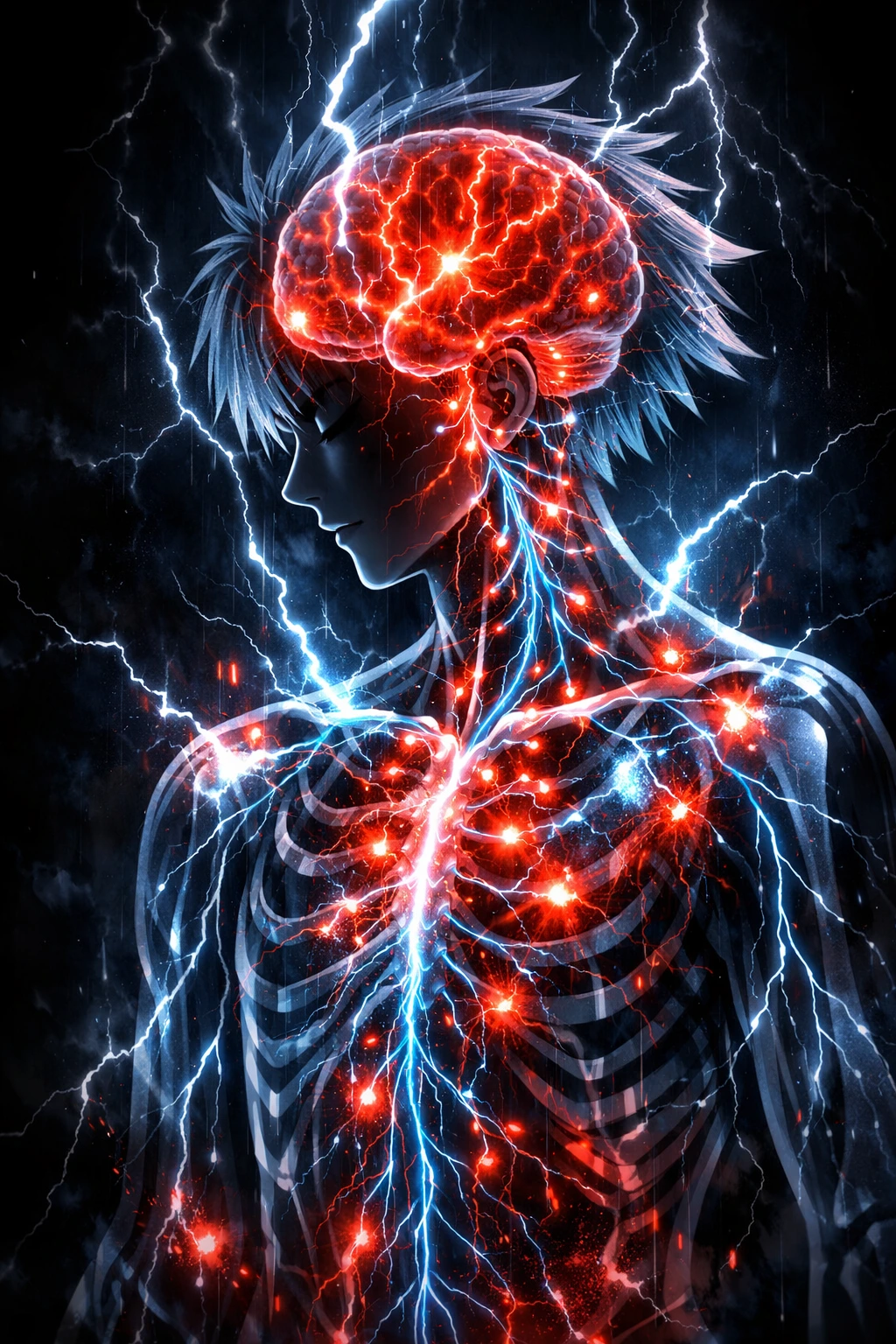
However, this biological anomaly did not develop in a vacuum; it was catalyzed by one of the most extreme traumatic events a human body can endure. We must medically break down the sheer physical trauma of his origin: surviving a direct strike from lightning.
A standard lightning bolt carries roughly 300 million volts of electricity and superheats the surrounding air to 50,000 degrees Fahrenheit—five times hotter than the surface of the sun. For Zenitsu, this was not a tragic accident; it was a miraculous, brutal metamorphosis. The massive, instantaneous surge of voltage ripped through his nervous system, causing “Lichtenberg figures” to etch across his internal tissues and permanently altering his cellular structure.
The most visible symptom of this trauma was the sudden hyper-pigmentation and alteration of his hair—a localized cellular mutation known as poliosis, caused by the extreme electrochemical shock to his melanin-producing follicles. But the invisible, internal alteration was infinitely more profound.
The electrical surge acted as a literal, high-voltage jumpstart to his central nervous system and fast-twitch muscle fibers. It permanently rewired his neuro-electrical pathways, lowering the electrical resistance of his nerves (a biological reduction of Ohmic resistance) and allowing action potentials—the electrical impulses that trigger muscle movement—to travel at unprecedented, superhuman velocities.
The lightning did not just leave him with yellow hair; it forged his internal anatomy into a highly conductive, biological battery waiting to be discharged. His cowardice is the safety switch; his unconsciousness is the trigger that releases the stored kinetic potential.
2. Somnambulism as a Weapon: The Autonomic Nervous System
The core mechanic of Zenitsu’s power is a masterpiece of evolutionary survival, rooted deeply in the medical realities of somnambulism (sleepwalking) and REM Sleep Behavior Disorder (RBD), pushed to superhuman extremes. When confronted with a demon, the sensory input of terror overwhelms his prefrontal cortex—the logical, decision-making center of the brain responsible for complex planning and impulse control.
The resulting surge of cortisol creates a systemic overload, prompting the brain’s reticular activating system (the network responsible for regulating wakefulness and sleep-wake transitions) to trigger an emergency shutdown. Zenitsu literally passes out from fear. But this is not a traditional faint; it is the activation of a weaponized biological failsafe.
In a normal human sleep cycle, the body enters a state of REM atonia—a natural, temporary paralysis mediated by the glycine-releasing neurons in the brainstem that prevents individuals from physically acting out their dreams. In Zenitsu’s case, the lightning strike and his subsequent grueling training completely shattered this biological safety mechanism.
Once his conscious mind goes dark, his brain entirely bypasses the paralyzed, fear-ridden amygdala and the stuttering prefrontal cortex. It hands one hundred percent of his physiological control over to the autonomic nervous system, the basal ganglia, and the spinal cord. He enters a state of hyper-somnambulism, functioning as a pure, biological machine operating entirely on predatory reflex and deeply ingrained, sub-cortical conditioning.

This transition explains exactly why he is exponentially more dangerous while asleep. The human conscious mind is inherently slow and burdened by “processing lag.” Every intentional movement requires a complex, multi-step neurological process: the eyes perceive a threat, the signal travels to the visual cortex, the brain processes the information, formulates a plan, sends a signal down the spinal cord to the peripheral nerves, and finally, the muscles contract.
This process, while seemingly instantaneous to us, takes vital milliseconds—milliseconds that cost lives in a battle against demons. Furthermore, conscious thought brings the heavy burden of emotional baggage: hesitation, doubt, the calculation of pain, and the overwhelming fear of death. These are cognitive “bottlenecks” that slow down physical output.
When Zenitsu sleeps, all of this neurological “noise” is violently silenced. There is no hesitation because there is no conscious entity present to hesitate. The agonizing, repetitive muscle memory drilled into his very marrow by his master, the former Hashira Jigoro Kuwajima, is unleashed without the interference of the cortex. The basal ganglia—the brain structure responsible for habit formation and automatic motor behaviors—takes total command. This is a state of “unconscious competence” taken to its absolute physiological limit.
Under the control of the autonomic nervous system, Zenitsu’s body executes martial techniques flawlessly, functioning with the terrifying, unthinking efficiency of a falling guillotine. He does not “decide” to dodge a demon’s claw; his body registers the acoustic shift in the air and his spinal cord executes the evasion via a monosynaptic reflex arc before the signal ever has to reach his brain.
His physical form becomes a perfectly tuned instrument of war, unburdened by the cowardice of its owner. He is reduced to his most fundamental, lethal components: breath, muscle, and steel. This weaponized sleepwalking turns the greatest detriment of the human condition—fear—into the ultimate catalyst for survival, creating an assassin who is never more awake than when he is dead to the world.
In this state, his movements are governed by the mesencephalic locomotor region of the brainstem, allowing for a level of fluid, predatory grace that is impossible to achieve when the conscious mind is trying to “steer” the body.
3. The Physics of Iaijutsu and Fast-Twitch Muscles
To understand the absolute devastation of Zenitsu’s signature technique, Thunder Breathing, First Form: Thunderclap and Flash, one must look past the visual spectacle of the anime and delve deeply into the terrifying biomechanics and physics at play. The First Form is not merely a sword slash; it is the absolute, unadulterated pinnacle of Iaijutsu.
Iaijutsu is the traditional Japanese martial art centered entirely on drawing the sword from its scabbard (saya), striking an opponent, and returning the blade in one fluid, continuous, and devastatingly fast motion. It is a counter-attack philosophy designed to kill in a single heartbeat. Zenitsu has taken this historical martial art and injected it with physics-breaking, explosive kinetic energy.
The secret to this explosive acceleration lies hidden within the microscopic anatomy of his legs. Human skeletal muscles are generally divided into two types: slow-twitch (Type I) fibers, built for endurance and aerobic stability, and fast-twitch (Type II) fibers, built for short, explosive bursts of strength and anaerobic power.
Through a combination of the genetic mutation caused by the lightning strike and the torturous training regimen of Jigoro Kuwajima, Zenitsu’s lower body possesses a localized, hyper-concentration of Type IIx fibers—the fastest and most powerful muscle fibers in the human body—that defies standard human physiology.
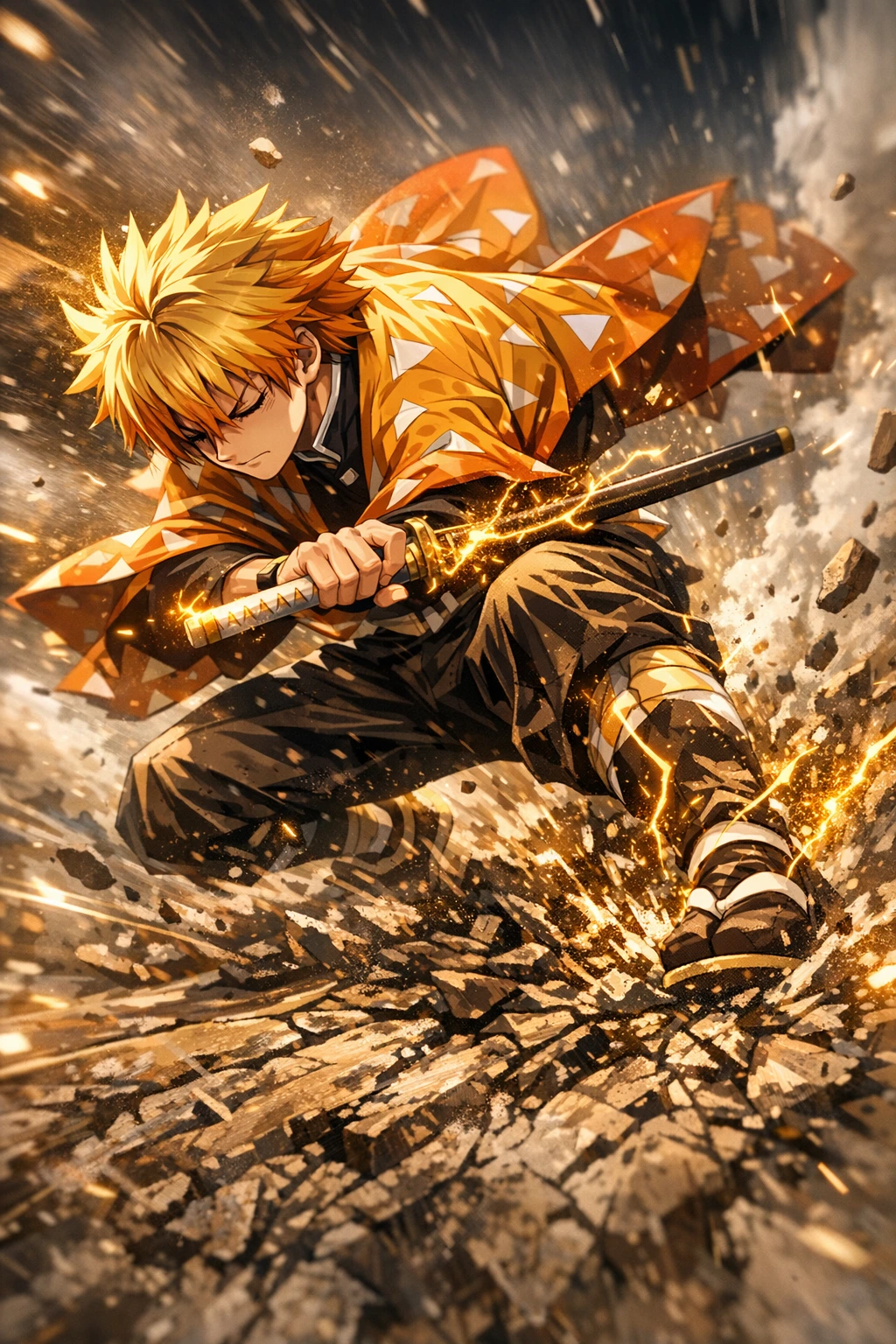
When Zenitsu drops into the exceptionally low, coiled stance of the First Form, he is effectively turning his body into a tightly compressed kinetic spring. Utilizing Total Concentration: Thunder Breathing, he forcibly hyper-oxygenates his bloodstream. He directs this massive influx of oxygen entirely into the musculature of his legs. This process triggers an immediate, hyper-accelerated rate of anaerobic respiration.
His body generates a massive, localized buildup of lactic acid and ATP (adenosine triphosphate), the primary energy carrier in cells. The muscles in his thighs and calves contract to their absolute maximum limit, creating a level of kinetic tension so severe that it threatens to snap his own tendons. This is the “loading phase” of the strike, where his body accumulates enough potential energy to level a building.
Then, the release.
The “thunder” associated with Zenitsu’s strike is a frequent point of misunderstanding; it is not supernatural magic, nor is it an illusion created by “breathing styles.” It is the literal, physical sonic boom created by his body violently breaking the sound barrier (Mach 1, approximately 767 miles per hour at sea level).
When he pushes off his back foot, the explosive release of that stored kinetic energy propels his body forward at hypersonic velocities. The “kinetic chain” starts at the big toe, travels through the ankle, explodes through the quadriceps, and is channeled through the core into the sword arm.
The sword acts as the projectile, and the scabbard acts as the barrel of a railgun, providing the initial friction and guidance required for a perfectly linear trajectory. The draw itself is so fast that the friction between the blade and the scabbard generates enough heat to momentarily ionize the air, creating the golden “sparks” seen during the strike.
The physical toll of this acceleration is apocalyptic. We must analyze the extreme physical friction and G-forces generated by this movement. As he breaks the sound barrier, the sudden displacement of air creates a high-pressure shockwave—the thunderclap. The sheer mechanical force exerted by his feet against the ground literally shreds the earth beneath him, creating craters and tearing up floorboards through pure, brutal Newtonian physics. Every Newton of force he uses to propel himself forward is met with an equal force pushing back into his skeletal structure.
If a standard human attempted to generate this level of force, the sudden acceleration would liquefy their internal organs and cause immediate skeletal fragmentation. Even for Zenitsu, the margins are microscopic. The stance must be executed with mathematical perfection.
If the angle of his foot is even a millimeter off, or if his center of gravity shifts by a fraction of a degree during the acceleration, the immense shear force generated by the launch would snap his femurs in half and shatter his pelvis instantly. The First Form is a biological miracle balanced on a razor’s edge of self-destruction.
4. Acoustic Radar: The Neurology of Hyper-Hearing
The visual aesthetic of Zenitsu fighting with his eyes closed is a striking image, but the neurological reality behind it is a fascinating study in sensory substitution and bio-acoustics. How does a swordsman navigate complex, three-dimensional combat spaces, evade hypersonic attacks, and pinpoint the vital organs of demonic entities without the use of his optic nerves?
The answer lies in a profound, neurological mutation of his auditory cortex. Zenitsu processes sound the exact same way that standard humans process sight. He has developed a highly advanced, biological form of echolocation and acoustic spatial mapping, effectively “seeing” with sound.
In a standard human brain, the visual cortex occupies a massive portion of processing power. When Zenitsu is unconscious, his closed eyes remove all visual stimuli, freeing up an immense amount of neurological bandwidth. His brain seamlessly reroutes this computational power entirely into his auditory cortex via a process called cross-modal plasticity.
The physical anatomy of his inner ear—specifically the cochlea and the microscopic stereocilia (hair cells) that detect sound waves—is hyper-evolved, capable of picking up frequencies and decibel levels far beyond the human threshold, extending into the infrasonic and ultrasonic ranges.
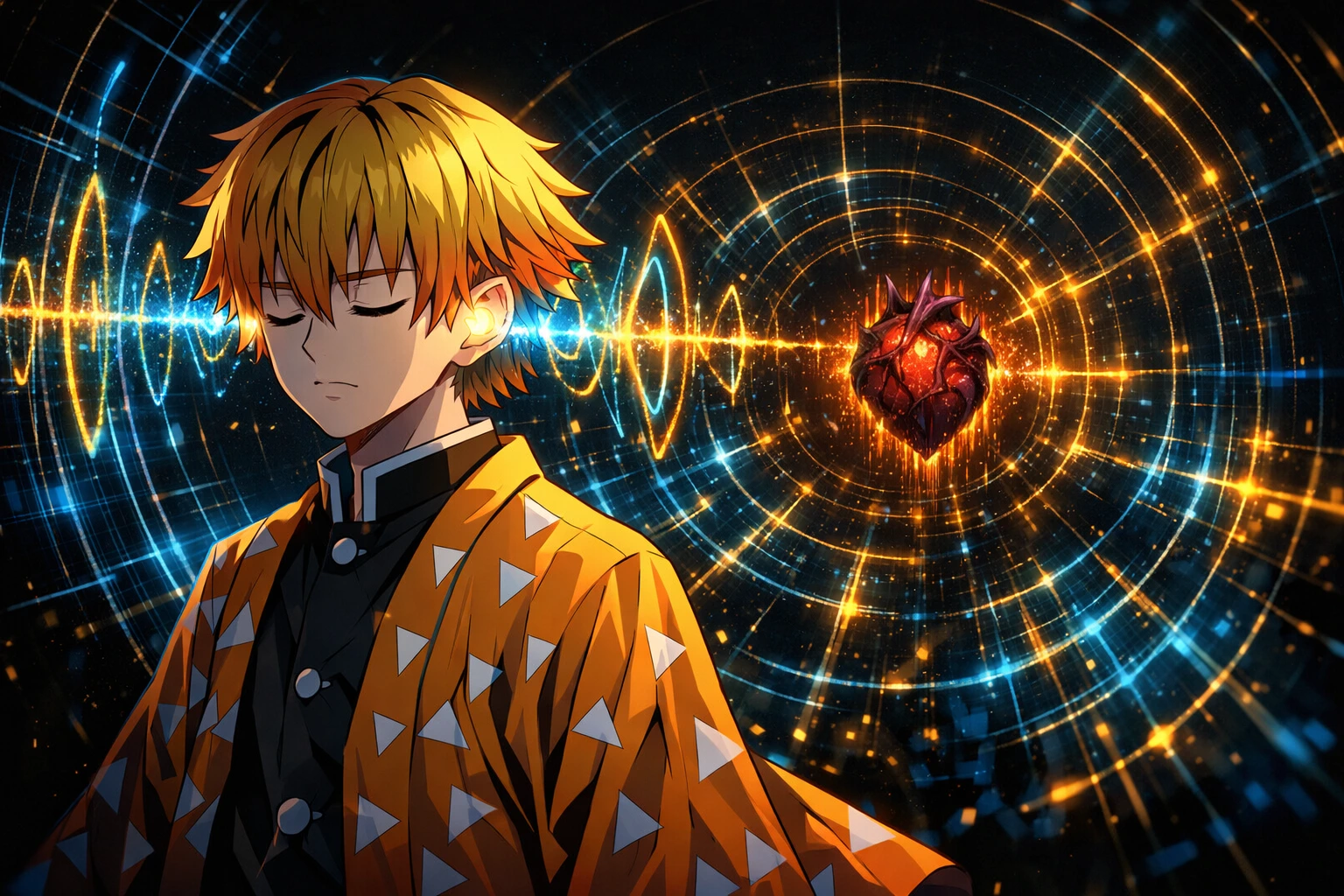
However, he is not merely listening to the macroscopic sounds of combat, like the clash of blades or the thud of heavy footsteps. Zenitsu is performing a real-time Fourier analysis of the environment, deconstructing complex sound waves into their individual frequencies to map his surroundings. His acoustic radar is so violently precise that he can hear the microscopic, rhythmic vibrations of blood pumping through a demon’s vascular system.
He can listen to the subtle, wet friction of their muscle fibers contracting before they even launch an attack—a precursor sound that acts as a telegraph for their movements. He can map the exact skeletal structure of his opponent by hearing the microscopic shifting and grinding of their joints as they adjust their weight.
In a dark room, a demon might believe they are hidden because they cannot be seen, but to Zenitsu’s auditory cortex, a beating heart sounds like a war drum, and the expansion of lungs sounds like a bellows. He constructs a perfect, 360-degree topographical map of the battlefield in his mind, painted entirely in the medium of sound waves and vibration.
Furthermore, this hyper-hearing extends far beyond physical combat; it functions as an inescapable, psychological lie-detector. Humans and demons alike are biologically incapable of completely suppressing their autonomic physiological responses when engaging in deception.
When a person lies, there is a physiological dissonance—a conflict between the conscious intent to deceive and the body’s natural stress response. It triggers a microscopic stress response mediated by the sympathetic nervous system. Zenitsu’s auditory cortex is so incredibly refined that he can hear the exact moment a lie is spoken. He hears the slight, erratic spike in the speaker’s heart rate (tachycardia).
He detects the momentary, involuntary hitch in their breathing pattern, the subtle change in the pitch of their vocal cords caused by throat tension, and even the rush of blood to the capillaries in their face.
This creates a tragic irony in Zenitsu’s waking life. He is constantly bombarded by the acoustic evidence of the world’s deceit, malice, and hidden agendas. He hears the hypocrisy in people’s voices and the predatory intent of demons long before they act.
This overwhelming influx of auditory truth contributes massively to his conscious anxiety. Imagine living in a world where every “I’m fine” is accompanied by the sound of a shattering heart, or every “I’m your friend” is underscored by the rhythmic thumping of betrayal.
He is a boy who can hear the ugliest parts of the human and demonic soul vibrating in the air, making his forced unconsciousness not just a combat mechanism, but a necessary psychological refuge from a world that is far too loud and far too honest.
5. The Single Synaptic Pathway: Mastering the One Form
A frequent point of critique regarding Zenitsu’s combat repertoire is his severe lack of versatility. Out of the six fundamental forms of Thunder Breathing, he is only capable of performing the First Form: Thunderclap and Flash. To a layman, this appears to be a failure of talent.
However, from a neurological and martial perspective, it is a masterclass in the science of neuroplasticity and deadly efficiency. There is a famous axiom in martial arts: “I fear not the man who has practiced 10,000 kicks once, but I fear the man who has practiced one kick 10,000 times.”
Jigoro Kuwajima understood that Zenitsu’s cowardly, panicking brain could not handle the complex cognitive load of memorizing and switching between six different combat philosophies.
Instead of spreading Zenitsu’s brain’s plasticity thinly across a wide spectrum of techniques, his master forced him to engage in torturous, repetitive drilling of a single movement. Neurologically, this continuous repetition triggers a process called myelination. Every time Zenitsu practiced the First Form, a fatty substance called myelin wrapped around the specific neural pathways controlling that exact movement.
Myelin acts as an insulator, much like the rubber coating on an electrical wire. Thicker myelin sheaths allow electrical impulses to travel exponentially faster and more efficiently, preventing signal “leakage” and ensuring that the command to strike reaches the muscles with zero latency. By practicing the First Form tens of thousands of times, Zenitsu literally burned a single, perfect synaptic highway into his central nervous system.
The neural pathway for Thunderclap and Flash became so thick and frictionless that his body could execute it faster than his own conscious thought could interrupt it. He sacrificed versatility for absolute, peerless mastery—an extreme example of “biological specialization.”
Because he is neurologically locked out of learning the other five forms, Zenitsu was forced to adapt mathematically. He took the flawless foundation of the First Form and began stacking it upon itself, creating the variations: Sixfold, Eightfold, and ultimately, Godspeed.
If the First Form is breaking the sound barrier once, the variations are a sequence of consecutive, ricocheting sonic booms. He uses the environment—walls, trees, the ground—as “jump points,” using his hypersonic velocity to create a geometric pattern of destruction. The complexity of calculating these angles at Mach speeds is handled entirely by his cerebellum, which has become a biological supercomputer dedicated to the trajectory of a single strike.
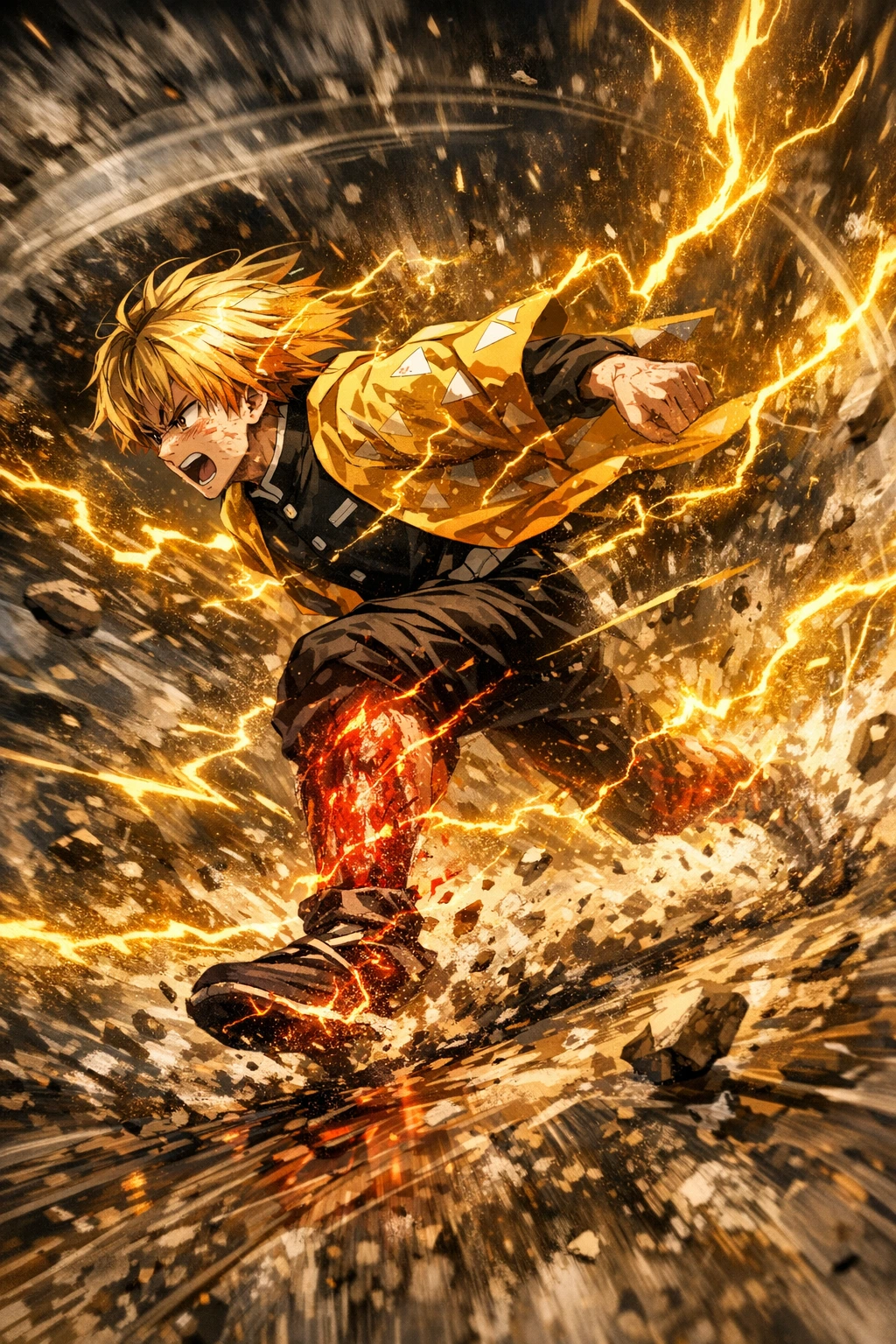
Godspeed represents the absolute, suicidal zenith of his capabilities. It is not just an attack; it is a calculated act of biological self-mutilation. To achieve the terrifying velocity of Godspeed, Zenitsu must “overclock” his cardiovascular and muscular systems far past their genetic failure points.
The kinetic output is so extreme that forcing his legs to move at that velocity literally ruptures the microscopic blood vessels (capillaries) in his lower body. The violent contractions tear the muscle fascia (the connective tissue surrounding the muscles) and induce severe micro-tears in the sarcolemma (the muscle cell membrane). The friction generated by the movement is so intense it burns the skin of his feet and calves, leaving behind charred tracks.
This is why Godspeed is a hard-capped, finite weapon; it is a move he can only perform a maximum of two times before his legs undergo catastrophic structural failure, resulting in shredded tendons and shattered bones, effectively crippling him for the duration of the war.
This intense, singular specialization creates a profound and tragic psychological friction with his senior disciple, Kaigaku. Kaigaku represents the exact inverse of Zenitsu’s martial philosophy. Kaigaku possessed the talent and the malice to master forms two through six, but lacked the foundational patience and humility to master the First Form.
This created a perfect, tragic thematic and martial duality between the two lightning users. Kaigaku was a jack-of-all-trades, wielding black lightning born of versatility and demonic compromise, fundamentally lacking a core. Zenitsu is the master of one, wielding pure, golden lightning born of singular devotion, trauma, and a single, perfectly myelinated neural pathway. One is a storm of many strikes that ultimately lacks the speed to kill; the other is a single, inescapable flash of execution that cannot be dodged or countered.

6. Conclusion: The Awakening of the 7th Form
The true culmination of Zenitsu Agatsuma’s character arc—and the ultimate resolution of his neurological anomaly—occurs within the shifting, labyrinthine walls of the Infinity Castle Arc. Up until this point, Zenitsu’s terrifying lethality was entirely dependent on his conscious mind being absent.
He was a passenger in his own body, relying on his autonomic nervous system to wage war while his ego slept in the darkness of his subconscious. However, the revelation of Jigoro Kuwajima’s seppuku—a ritual suicide committed in agonizing shame because Kaigaku, his pupil, defected to the demons—acts as a psychological shattering of Zenitsu’s foundational cowardice. The shame and guilt of his senior’s betrayal act as a catalyst for a forced maturation.
The grief and profound, cold rage he experiences in that moment achieve what years of training could not: they override his clinical fear. The trauma of his master’s death acts as an ultimate neurochemical reset. The immense influx of cortisol that previously paralyzed him is suddenly eclipsed by an overwhelming surge of norepinephrine and dopamine, sharply focusing his conscious mind into a state of chilling, absolute clarity.
This is the “flow state” achieved through trauma. For the first time in his life, as he steps up to face the newly ascended Upper Moon 6, Kaigaku, Zenitsu stops fighting in his sleep. His eyes are wide open, and his heart rate is steady. The amygdala hijack has been conquered by the sheer force of his will.

This conscious awakening leads to the creation of his masterpiece: the 7th Form, Flaming Thunder God. This technique is not simply a faster version of the First Form; it is a monumental evolutionary leap in his combat biology.
By staying awake, Zenitsu finally manages to merge his hyper-evolved autonomic reflexes and perfect muscle memory with his conscious, tactical mind. He combines the raw, unthinking speed of his sleeping state with the deliberate, lethal targeting of a waking assassin. This is the synthesis of the man and the machine.
The physics of Flaming Thunder God defy comprehension. Drawing upon every ounce of his hyper-oxygenated fast-twitch muscles and the flawless synaptic pathway he spent his life burning into his brain, Zenitsu launches a strike accompanied by the visual manifestation of a golden dragon.
This “dragon” is not a spirit; it is the visual distortion of superheated air, ionized dust, and the sheer atmospheric pressure created by his movement. The velocity is so violently fast that Kaigaku—a demon whose demonic blood art drastically enhanced his own kinetic vision and reaction time—could not even optically process the movement.
Zenitsu essentially exploited the “refresh rate” of the demon’s eyes, moving between the frames of Kaigaku’s perception. The strike severs the Upper Moon’s head before the nerve endings in his neck can even register the pain of the cut, effectively killing him before he realizes he has been hit.
In the final analysis, Zenitsu Agatsuma must be fundamentally re-evaluated by scholars of the Demon Slayer Corps. He is not the comic relief, nor is he merely a cowardly boy who occasionally gets lucky through a quirk of biology.
He is a biological marvel, a master of acoustic radar, and a practitioner of hypersonic physics whose entire life was a preparation for a single, perfect second of combat. He is a warrior who survived the wrath of lightning only to weaponize the very terror that paralyzed him.
Zenitsu stands as the most lethal, highly specialized assassin of his era—a boy whose greatest weapon was his own unconscious mind, right up until the exact moment he chose to open his eyes, accept his pain, and become the storm itself. His legacy is proof that even a single, “weak” technique, if polished to the point of neurological perfection, can topple gods.