
1. The Biological Engine: The Science of Total Concentration
To understand the phenomenal feats executed by the Demon Slayer Corps, one must first strip away the illusion of mysticism. Breathing Styles do not magically summon elements out of thin air, nor do they rely on supernatural incantations.
At their core, these techniques are supreme biomechanical disciplines that manipulate the user’s blood oxygen levels to temporarily mimic the physical properties of nature. They are the pinnacle of human anatomical engineering, transforming the fragile mortal body into a biological engine capable of generating localized kinetic anomalies. Total Concentration Breathing is not magic; it is an extreme, forced evolution of the human cardiovascular and respiratory systems, weaponized against the immortal biology of demons.
The human body operates on cellular energy known as Adenosine Triphosphate (ATP), generated through the process of cellular respiration. Under normal physiological conditions, the human respiratory system only utilizes a fraction of the lungs’ total capacity, keeping blood oxygen levels stable for ordinary metabolic functions.
Total Concentration Breathing shatters this biological safety limiter. By forcefully overriding the autonomic nervous system, a Slayer expands their diaphragm and alveoli to their absolute ripping point, often enduring micro-tears in the pulmonary tissue just to maximize volume. This extreme inhalation floods the bloodstream with unprecedented volumes of oxygen, triggering a hyper-oxygenation state that drastically accelerates ATP synthesis across all muscle groups.
The result is an instant, massive spike in available cellular energy, allowing the body to perform feats of strength, speed, and endurance that would theoretically tear standard muscle tissue apart. This state demands an astronomical caloric intake; a Hashira must consume exponentially more calories than a normal human just to ensure their body doesn’t cannibalize its own muscle mass during combat.
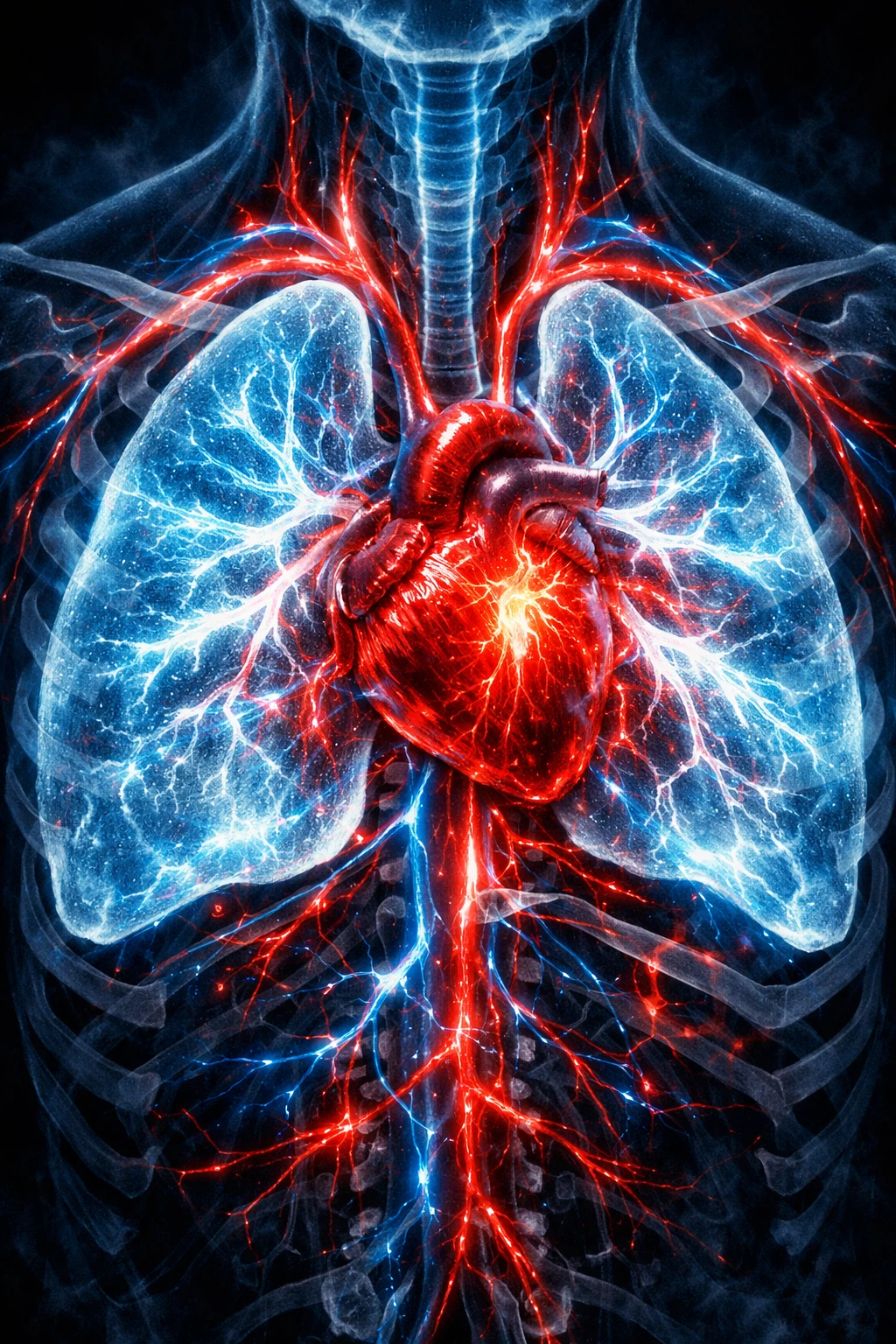
This biological engine relies heavily on what we can define as the “Hemoglobin Highway.” Medically analyzing this hyper-oxygenated state reveals the sheer terror of what is occurring inside a Slayer’s chest. To deliver this massive influx of oxygen to the fast-twitch and slow-twitch muscle fibers, a normal human heart must pump blood at a velocity that borders on the fatal.
The resting heart rate skyrockets, pushing the sheer volume of blood flow to such immense pressures that it fundamentally alters the body’s hemodynamics. Extreme vasodilation occurs, widening the blood vessels to prevent instantaneous bursting under the pressure. This hyper-accelerated circulation is exactly how high-ranking Slayers can clot severed arteries instantly—they manipulate the pressure and coagulation factors in their blood through sheer muscular contraction and controlled breathing rhythms, effectively sealing wounds with internal tourniquets.
Furthermore, this intense oxygen delivery system fuels the kinetic output necessary to rival demonic muscle density. Demons generate power through cellular regeneration and unnatural mass; Slayers match this force by maximizing the explosive potential of their own anatomy, turning their cardiovascular system into a supercharged reactor that burns oxygen as its primary fuel. It is a suicidal tightrope walk between achieving superhuman performance and experiencing total cardiac rupture.
2. Water Breathing: Fluid Dynamics and Kinetic Redirection
If Total Concentration Breathing is the engine, the specific Breathing Styles are the transmission systems that dictate how that power is expressed. Water Breathing, famously utilized by Sakonji Urokodaki and Giyu Tomioka, is perhaps the most misunderstood.
It is not the creation of water, but rather the absolute mastery of fluid dynamics and kinetic redirection. To a trained observer, a Water Breathing swordsman is not generating a river; they are turning their own physical form into a masterclass of fluid mechanics, embodying the principles of perpetual motion, laminar flow, and the conservation of momentum.
The physics of flow dictates that water will always find the path of least resistance, maintaining its mass while endlessly adapting its shape. Water Breathing translates this into martial biomechanics. The user’s footwork and blade trajectory are designed to eliminate all wasted energy, transitioning smoothly between static and sliding friction.
Forms like the First Form: Water Surface Slash or the Fourth Form: Striking Tide rely heavily on the concept of surface tension and angular momentum. When a Water Breathing user swings their Nichirin blade, they do not just use the muscles in their arms. They utilize the rotational torque of their hips, the grounding of their ankles, and the twisting of their spine to build an unbroken chain of kinetic energy.
The visual phenomenon of water trailing the blade is a localized disruption of air moisture and light refraction caused by the incredibly smooth, continuous velocity of the sword. It mathematically mimics the unstoppable, heavy pressure of a crashing wave because the kinetic energy is never lost; it is simply transferred from the ground, through the body, and into the edge of the blade without any structural “leaks” or jerky, energy-bleeding movements.
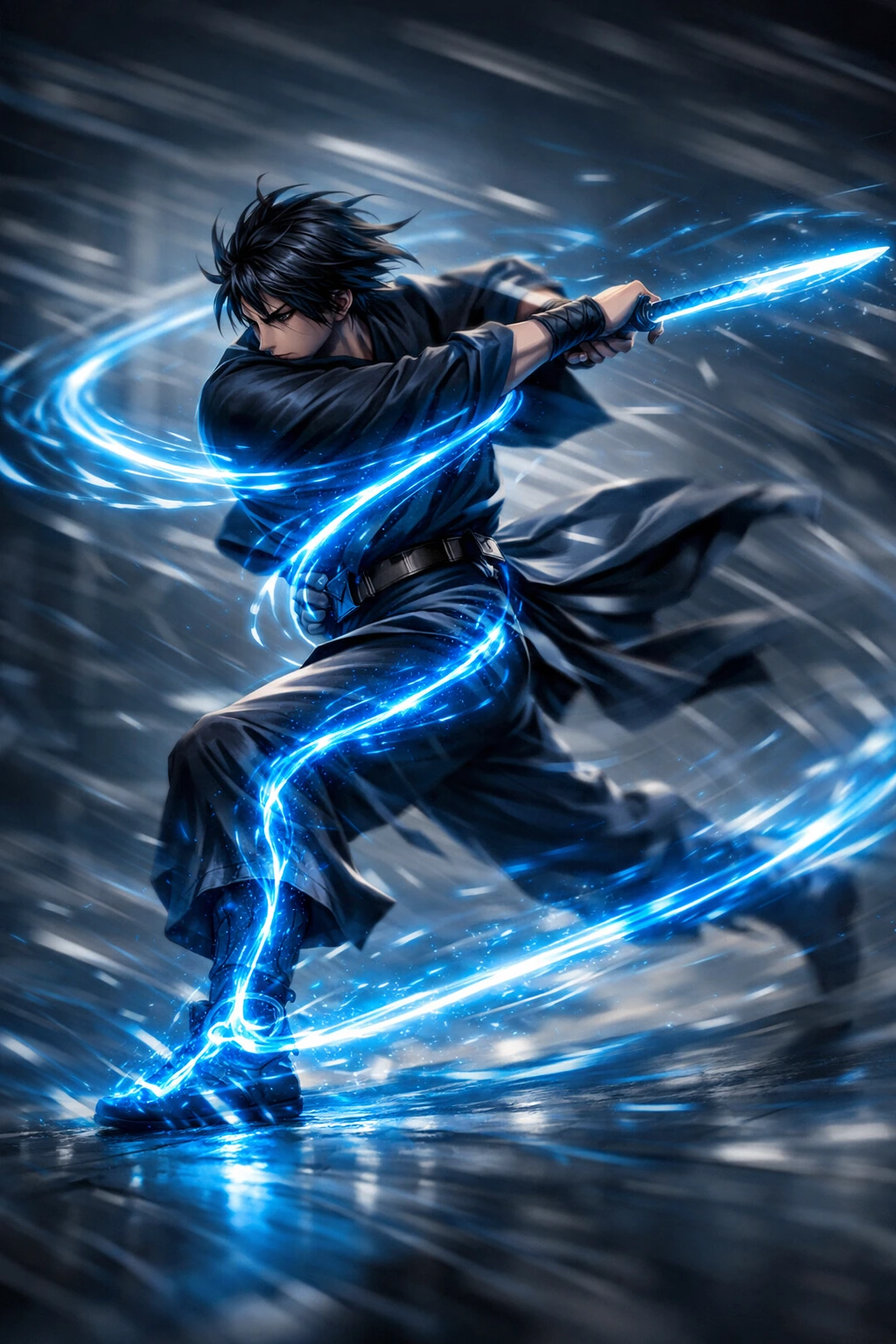
The Tenth Form: Constant Flux is the ultimate expression of this fluid momentum. Biomechanically, it is a marvel of energy conservation. With each rotation of the body, the swordsman uses the residual centrifugal force of the previous swing to power the next, continuously adding kinetic energy to the system. Like a whirlpool gaining speed, the physical force behind the blade compounds with every revolution, utilizing the core and obliques as a biological pendulum.
This requires an extraordinary level of muscular elasticity and joint lubrication, as the user must prevent their own accelerating momentum from dislocating their shoulders or tearing their ligaments. The sheer buildup of kinetic force eventually reaches a threshold where it can sheer through the densest demonic flesh, proving that Water Breathing’s true lethality lies in its ability to endlessly scale its power through continuous, cyclical motion.
Why, then, is Water Breathing the most common and adaptable style taught to new recruits? The answer lies in its “defensive viscosity.” Unlike styles that demand rigid, unyielding power, Water Breathing is built on the biomechanics of absorbing and redirecting an enemy’s strike. Instead of meeting force with rigid strength—which often results in shattered bones when facing a demon’s superior mass—Water Breath users alter their body’s center of gravity at the exact microsecond of impact.
By keeping their joints unlocked and their musculature fluid, they disperse the kinetic energy of an incoming blow throughout their entire body, using their spine as a structural shock absorber and channeling the force down into the earth, or using it to fuel their own counter-rotation.
Much like water flowing smoothly around a stone in a rushing river, the swordsman slips past the point of maximum pressure, utilizing the attacker’s overextension against them. It is the most biologically forgiving style because it prioritizes survival through proprioceptive adaptability, teaching the body to be elastic rather than brittle.
3. Flame Breathing: Thermodynamics and Exothermic Output
In stark contrast to the fluid adaptability of Water Breathing lies the explosive, searing devastation of Flame Breathing. If Water Breathing is the mastery of fluid dynamics, Flame Breathing is the absolute mastery of localized thermodynamics.
This style, perfected by the Rengoku lineage, is arguably the most biologically taxing of the core five. Flame Breathing does not rely on magic to conjure fire; it relies on the deliberate, dangerous manipulation of core body temperature and extreme kinetic friction. It is the art of weaponizing exothermic reactions through the human body.
The fundamental core of Flame Breathing is combustion. To execute these techniques, users must deliberately spike their core body temperature to borderline hyperthermic levels. Through a highly specific, high-pressure variant of Total Concentration Breathing, the user dramatically increases their metabolic rate, forcing their mitochondria to burn through ATP and glycogen stores at a catastrophic pace.
This massive expenditure of caloric energy generates an immense amount of internal heat. The swordsman’s blood literally boils close to the surface of their skin, creating the visual aura of intense heat radiating from their form. This internal thermal spike serves a biomechanical purpose: it hyper-warms the muscle fibers, effectively melting away physical hesitation and allowing for instantaneous, explosive fast-twitch contractions without the risk of tearing cold tissue.

The “fire” observed trailing the blade of a Flame Hashira is a byproduct of friction and extreme muscular torsion. By planting their feet with immense gravitational force, locking their legs into a perfect base, and swinging the blade with explosive, violent muscle contractions starting from the ankles and whipping up through the obliques, they push the Nichirin steel to hypersonic speeds.
This creates a searing kinetic friction between the blade and the air molecules. The sheer velocity of the swing compresses the air in front of the blade so rapidly that it triggers adiabatic heating—the same principle that causes spacecraft to heat up upon re-entering the atmosphere. The air practically ignites, and any moisture or sweat in the immediate vicinity is instantly vaporized, creating the illusion of a roaring flame.
The First Form: Unknowing Fire and the Second Form: Rising Scorching Sun are prime examples of this, relying on brutal, upward and forward torque that turns the blade into a superheated kinetic projectile, generating a literal compression cone of burning air.
Understanding the “Rengoku Physiology” requires acknowledging the sheer cardiovascular and metabolic toll this style demands. Flame Breathing is not designed for endurance; it is designed for maximum, instantaneous exothermic output.
It requires a massive expenditure of caloric energy for devastating single-strike attacks. Because the user is essentially redlining their biological engine—running their body at temperatures that would cause heatstroke, severe dehydration, or multiple organ failure in a normal human—they leave no room for prolonged defensive battles. The ultimate technique, the Ninth Form: Rengoku, is a suicide charge of kinetic and thermal energy.
The user funnels every ounce of oxygen, every molecule of ATP, and every fiber of muscle into a singular, explosive dash that gouges the earth and ignites the atmosphere. The aftermath of such an attack leaves the user’s muscular system heavily depleted of glycogen, their tissues suffering from micro-burns, and their central nervous system scorched by their own internal heat, highlighting that Flame Breathing is a style of absolute, uncompromising finality.
4. Thunder Breathing: Bio-Electromagnetism and Neurological Overdrive
If Flame Breathing represents thermal devastation, Thunder Breathing represents the absolute limits of human speed and bio-electromagnetism. Dissecting Thunder Breathing reveals a hyper-specialized focus on the legs’ fast-twitch (Type IIb) muscle fibers and the extreme acceleration of neurological impulses. It is the science of instantaneous, explosive acceleration, pushing the human body past the threshold of standard physical reaction times.
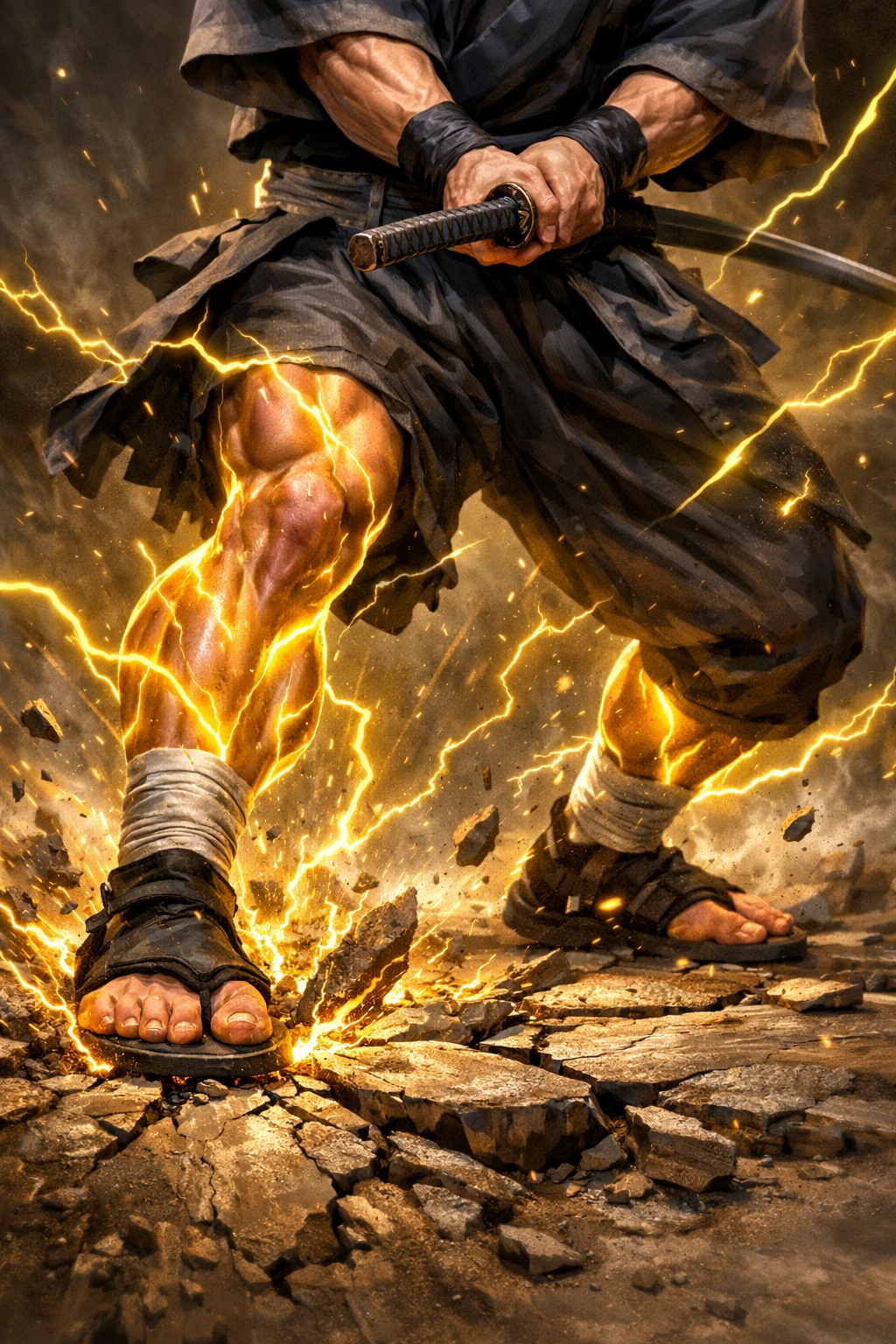
Thunder Breathing requires a physiological anomaly within the user, an intense focus on the lower body’s musculature, particularly the calves, thighs, and the Achilles tendon. The “thunder” associated with this style is not atmospheric weather drawn from the sky; it is the concussive boom of a physical object violently breaking the sound barrier.
When a user like Zenitsu Agatsuma prepares the First Form: Thunderclap and Flash, they are essentially turning their leg muscles into biological coiled springs. The Achilles tendon is stretched to a terrifying tension, acting like an industrial rubber band. By hyper-oxygenating these massive muscle groups, they prepare for an explosive release of kinetic energy.
At the moment of execution, the leg muscles contract with such terrifying force that they displace the air around them instantaneously, creating a localized pressure wave—a sonic boom—the “thunderclap.” The flash of lightning is an optical illusion created by the brain’s inability to track the user’s movement, combined with the static electricity generated by the extreme friction of their sudden acceleration against the ground and air.
This phenomenal speed is achieved through what can be termed “Neurological Lightning.” To move at hypersonic speeds, the muscles alone are not enough; the brain must be able to process the movement. Thunder Breathing users flood their central nervous system with oxygen, essentially firing their synapses at maximum capacity.
This hyper-oxygenation of the brain drastically increases the speed of action potentials traveling down the spinal cord and motor neurons. They achieve pre-cognitive reaction times, completely eliminating the standard OODA loop (Observe, Orient, Decide, Act) that dictates normal human reflexes. This means their body is already executing the movement the millisecond the threat exists.
In Zenitsu’s case, this is achieved in an unconscious state, where the slower, conscious processing of fear and hesitation is bypassed entirely. The pure, uninhibited neurological reflexes take over, driving the body at maximum efficiency while effectively enduring a state of sensory deprivation during the dash.
However, this reliance on instantaneous, explosive speed comes with a crippling biological reality: oxygen debt and severe lactic acidosis. Why can Thunder Breathing only be used in short, blinding bursts? Because forcing the human body to move at hypersonic speeds places an unimaginable strain on the skeletal and muscular systems.
The sheer G-force of accelerating from zero to Mach 1 in a fraction of a second literally threatens to shear the muscle fascia from the bone. The metabolic byproduct of this extreme fast-twitch activation is a massive, immediate buildup of lactic acid, which practically crystallizes in the veins.
If a user were to sustain the speed of Thunderclap and Flash for more than a few seconds, the physical recoil would shatter their femurs, snap their Achilles tendons, and cause complete muscular failure. Therefore, Thunder Breathing is the ultimate assassination art—a style that bets everything on ending the fight in a single, perfectly calculated microsecond before the user’s own body rips itself apart.
5. Wind and Stone: Aerodynamic Slicing and Seismic Resonance
The remaining two core styles, Wind and Stone, diverge significantly from the direct kinetic applications of Water, Flame, and Thunder. They represent the extremes of environmental manipulation through physical force—Wind mastering the aerodynamics of the atmosphere, and Stone mastering the gravity and density of the earth itself.
Wind Breathing, famously utilized by Sanemi Shinazugawa, is the brutal weaponization of barometric pressure and aerodynamics. It is an inherently violent and chaotic style. Instead of the smooth, laminar flow of Water Breathing, Wind Breathing relies on erratic, hyper-aggressive rotational force to create turbulent airflow.
When a Wind user swings their blade, they do so with such immense, shearing velocity and jagged trajectories that they actively manipulate the air pressure around the steel. By swinging fast enough, they create localized vacuums and high-pressure air blades that extend their cutting range far beyond the physical reach of the Nichirin sword.
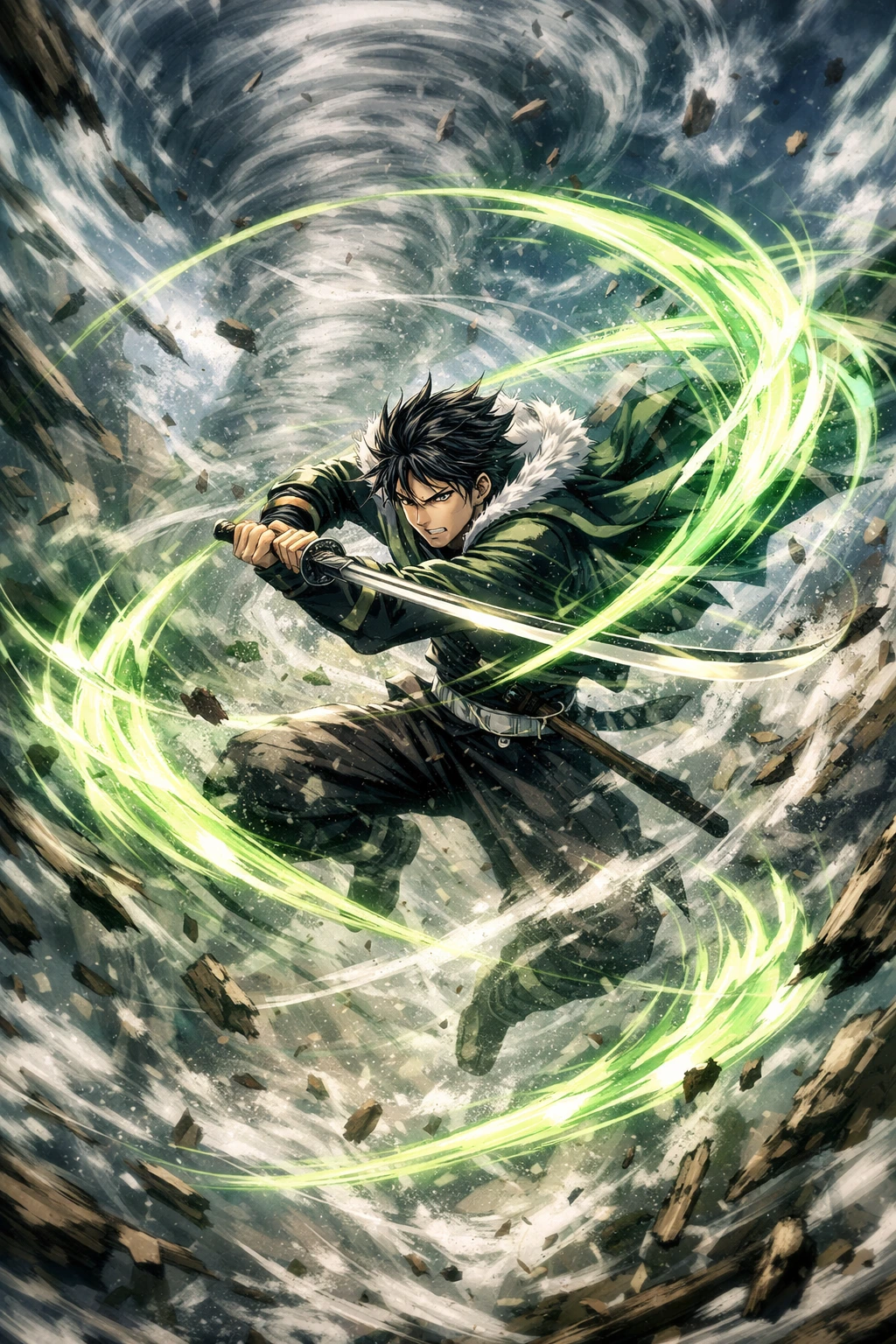
This aerodynamic slicing is achieved through a specific biomechanical rhythm. The user must possess extreme torsional strength in their wrists, rotator cuffs, and forearms to constantly change the angle of the blade mid-swing, violently ripping the air apart rather than slicing cleanly through it.
Forms like the First Form: Dust Whirlwind Cutter generate forward momentum wrapped in a cyclone of displaced air. The visual representation of green wind is the physical manifestation of pressure differentials—high-density air violently clashing with low-density vacuums created by the blade’s erratic path. These vacuums act like invisible riptides, actively sucking an opponent’s limbs or weapons off-course.
This makes Wind Breathing incredibly difficult to block, as the defensive combatant isn’t just trying to parry a piece of steel; they are trying to deflect an invisible, pressurized kinetic shockwave that can shred flesh from a distance, frequently leaving the user’s own skin covered in micro-lacerations from the sheer backdraft of their attacks.
Stone Breathing, on the other hand, ignores the traditional physics of standard swordplay entirely. Utilized by the physically massive Gyomei Himejima, Stone Breathing is the absolute mastery of gravity, mass, and seismic resonance. It does not rely on aerodynamic speed or fluid momentum; it relies on the perfect, mathematical calculation of centrifugal force and sheer, crushing density. Because Stone users typically wield massive, chained weapons like flails and axes, their martial art is centered around turning their own body into a biomechanical fulcrum.

The core of Stone Breathing is the “Grounding Principle.” To swing weapons that weigh hundreds of pounds with enough velocity to obliterate demonic flesh, the user must lock their musculoskeletal structure directly to the earth. If they do not perfectly align their center of gravity, the momentum of their own weapon would rip them off their feet.
Stone users utilize a unique breathing rhythm that hyper-densifies their muscle fibers, acting as biological shock absorbers. Through years of training, their osteoblasts continuously remodel their bones to be exponentially thicker than a normal human’s, making their body biologically immovable. They use the ground itself to absorb the massive recoil of their attacks.
When Gyomei strikes, he is transferring the kinetic energy of the earth up through his locked legs, twisting it through his incredibly dense core, and projecting it out through the chains of his weapon via centrifugal force. The length of the chain and the velocity of the swing multiply the mass of the weapon exponentially right at the point of impact.
The “seismic resonance” occurs when these massive weapons strike a target or the ground, transferring so much kinetic energy that it sends physical shockwaves through the environment, shattering demonic bone not by slicing it, but by utterly crushing its structural integrity through hydrostatic shock and overwhelming gravitational mass.
6. Conclusion: The Human Limit of the Five Pillars
To study the core five Breathing Styles—Water, Flame, Thunder, Wind, and Stone—is to map the absolute biological ceiling of the human anatomy. These styles represent the peak of what the human cardiovascular, musculoskeletal, and nervous systems can endure without facing immediate, catastrophic self-destruction.
The generational degradation and evolution of these styles further prove this point. Anything that exists beyond these five core pillars—such as Love Breathing, Serpent Breathing, or Insect Breathing—are not elevated or superior forms of combat, but rather necessary biomechanical modifications to ensure survival.
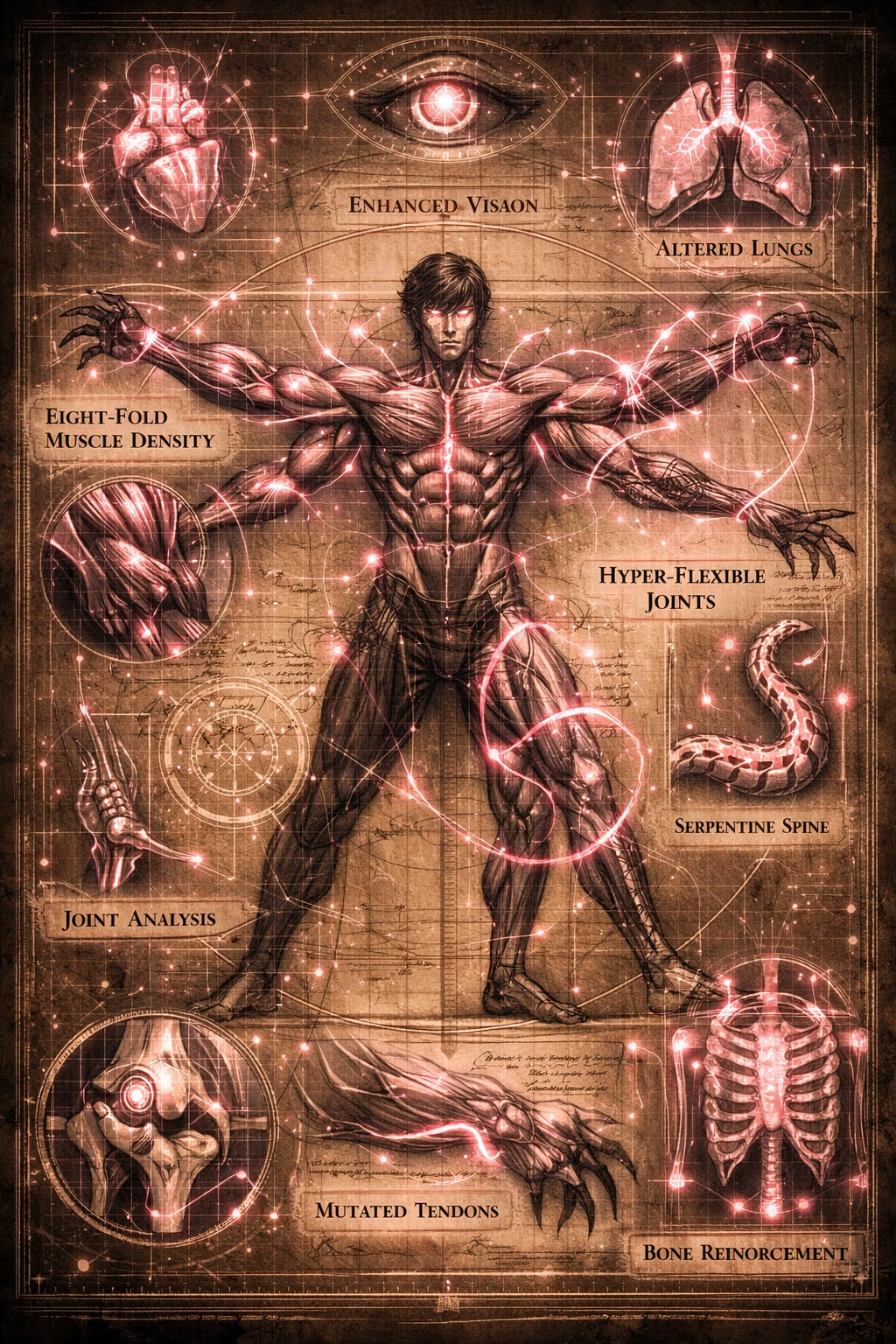
Slayers who could not conform to the rigid physiological demands of the core five had to adapt. Mitsuri Kanroji possessed an abnormal eight-fold muscle density, rendering traditional forms too restrictive, so she developed Love Breathing to utilize whip-like flexibility.
Obanai Iguro possessed extreme skeletal hyper-flexibility and weak arm strength, so he developed Serpent Breathing to rely entirely on joint contortion and unpredictable angles rather than brute force. Shinobu Kocho lacked the physical mass to sever a demon’s head, so she developed Insect Breathing to compensate for a lack of mass with extreme piercing velocity and venom delivery.
The core five styles demand a standard of physical perfection; the derivative styles are brilliant biological workarounds tailored to individual mutations.
Ultimately, we must address the illusion of the elements. The sweeping waves of water, the roaring tigers of flame, the blinding arcs of lightning, the shredding cyclones of wind, and the fracturing earth are not magic. They are magnificent, artistic representations of the invisible biomechanical perfection occurring simultaneously inside the Slayers’ bodies and the extreme physics happening at the edge of their blades.
When we see a water dragon, we are truly seeing a visual metaphor for the perfect conservation of angular momentum and unbroken kinetic chaining. When we see lightning, we are witnessing the terrifying reality of a human central nervous system forced to operate at hypersonic capacity.
The true power of the Demon Slayer Corps, therefore, is far more awe-inspiring than simple elemental magic. Magic implies an external force granted to the user, a shortcut to power that defies consequence. The truth is far grimmer, far more grounded, and far more heroic. The power of the Hashira and the Corps is rooted in the absolute, suicidal discipline of human anatomy.
It is the story of fragile, mortal humans who choose to forcefully evolve their own biology, continuously ripping their muscle fibers, burning their lungs, boiling their blood, and shattering their own limits, all to generate enough kinetic output to stand toe-to-toe with immortal monsters. The elemental displays are just the afterimage; the real, undeniable weapon is the relentless, hyper-oxygenated human heart.
