
1. The Yoshiwara Ecosystem: A Breeding Ground for Mutation
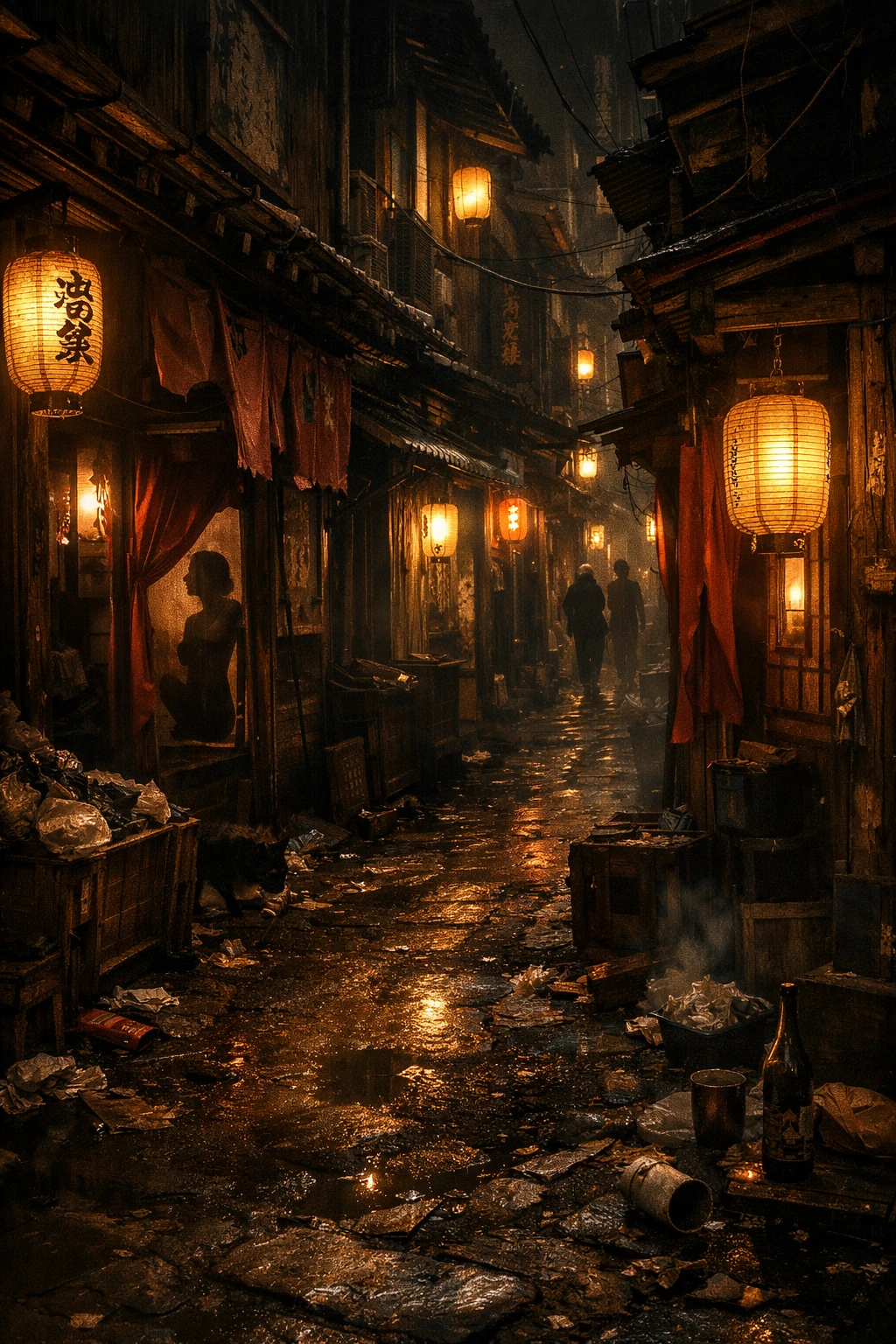
To understand the absolute terror and functional invincibility of Upper Moon 6, one must first understand the terrarium in which they were cultivated. The Yoshiwara Entertainment District is frequently depicted as a dazzling spectacle of nocturnal beauty, a vibrant epicenter of human desire, neon-lit excess, and cultural opulence.
However, beneath the veneer of its golden lanterns, intoxicating perfumes, and the melodic strumming of shamisens, Yoshiwara functioned as a hyper-dense, enclosed ecosystem built entirely on the foundation of disease, extreme poverty, and the systematic disposal of human life. Surrounded by literal walls and a moat, it was designed to keep its inhabitants trapped.
It was a localized meat grinder. This was not merely a setting; it was a societal petri dish meticulously designed to breed the ultimate biological consequences of human neglect.
Gyutaro and Daki are the direct, unadulterated manifestations of this specific environment. They are not simply demons who happened to settle in the red-light district out of convenience; they are the district’s very soul weaponized through Muzan Kibutsuji’s blood.
Their demonic powers, physical forms, and psychological tethers are direct reflections of the starvation, visceral cruelty, and venereal diseases rampant in the shadows of Yoshiwara’s alleyways. In a district where human beings were bought, sold, and discarded like refuse the moment they lost their aesthetic or physical utility, Gyutaro and Daki evolved to become the ultimate apex predators.
They effectively turned the societal rules that once crushed them underfoot into the very mechanics of their immortality.
Muzan Kibutsuji’s decision to position Upper Moon 6 within this specific geographic and cultural locus was a masterclass in strategic camouflage. Muzan fundamentally understood that the absolute best place to hide a monster that feeds on human flesh is deep inside an industry that already systematically consumes human souls. Daki utilized the rigid, impenetrable cultural hierarchy of the Oiran—the highest-ranking courtesans—as an absolute social shield. As an Oiran, Daki was isolated at the pinnacle of a strictly regulated microcosm.
She possessed immense wealth, practically untouchable status, and an endless, unquestioned stream of human capital delivered directly to her private chambers. The brothel owners themselves, driven by greed, inadvertently acted as her accomplices, covering up the disappearances to protect their own lucrative investments.
In Yoshiwara, young girls disappearing, running away to escape crushing debt, or dying of mysterious, untreated illnesses was not an anomaly; it was the expected statistical norm. The district’s inherent transience and its complete lack of fundamental human rights provided the perfect statistical static to mask Daki’s feeding habits.
She could consume hundreds of humans over the course of a century without ever drawing the attention of external law enforcement or the Demon Slayer Corps, because the society she inhabited had already institutionalized the vanishing of the vulnerable. She hid a supernatural slaughterhouse behind the very real, mundane horrors of human trafficking, indentured servitude, and profound societal indifference.
2. Parasitic Symbiosis: The Twin Core Anomaly

The biological structure of Upper Moon 6 presents a physiological impossibility even within the highly mutable, logic-defying parameters of demon anatomy. Demonic cellular structure is typically singular and self-contained, relying on a central nexus—usually the neck and brainstem—to regulate regeneration, process physical trauma, and execute Blood Demon Arts.
However, Gyutaro and Daki achieved something entirely unprecedented: a true, flawlessly integrated parasitic symbiosis. How does one demon live inside the cellular structure of another without triggering a catastrophic autoimmune rejection, a clash of demonic auras, or total cellular breakdown? The answer lies in a masterfully evolved form of biological latency and systemic partitioning.
Gyutaro functions as a dormant, localized biological parasite resting deep within Daki’s physical form. Rather than existing as two constantly active entities consuming vast amounts of shared resources, Gyutaro merges his cellular matrix into Daki’s, entering a state of hyper-efficient metabolic hibernation. In this state, his caloric output drops to absolute zero.
He does not need to eat, breathe, or expend internal energy to maintain his form. Instead, he leeches off the ambient kinetic and demonic energy generated by Daki’s constant consumption of human biomass. He remains entirely submerged within her biology like a coiled spring, conserving an immense reservoir of violent, explosive caloric energy until a Hashira-level threat forces him to physically manifest.
This symbiotic latency ensures that when Gyutaro finally tears himself from her flesh and emerges, he does so at absolute peak biological capacity, completely unburdened by the cumulative fatigue or hunger that a century of waking existence would otherwise impose.
This shared biological architecture introduces the dual-decapitation failsafe, a mechanism that single-handedly neutralized the standard operational procedures of the Demon Slayer Corps. The fundamental doctrine of demonic execution—sever the head with a Nichirin blade to immediately destroy the cellular core—is rendered entirely obsolete. Muzan’s concentrated cellular mass, the true “core” of their demonic existence, is completely split and decentralized between two distinct nervous systems and two highly capable separate bodies.
This presents an absolute mathematical and tactical nightmare for the Slayers, whose breathing techniques are inherently designed for single-target execution. Decapitating one sibling does not trigger the cellular decay cascade because the other sibling acts as a living, fully functional biological backup drive.
The surviving half sustains the life force of the severed half through a localized, invisible, quantum-like connection of their demonic cells, pumping regenerative commands across the battlefield. To kill Upper Moon 6, Slayers must sever both heads simultaneously, or within a microscopic fraction of a second of each other, essentially forcing the combatants to win two completely isolated, highly lethal deathmatches at the exact same moment.
It requires a level of battlefield synchronicity, split-second communication, and sheer physical output that practically guarantees the violent deaths of the Slayers involved.
Furthermore, their symbiosis extends far beyond mere shared mortality; it evolves into advanced, unparalleled sensory hijacking. The most terrifying demonstration of this is the moment Gyutaro physically implants his own demonic eye into Daki’s forehead.
This is not a superficial act of demonic magic; it is a rapid, wireless neurological synchronization. By embedding his highly advanced ocular organ into her relatively simpler neural network, Gyutaro forcefully bridges their central nervous systems without experiencing neurological overload.
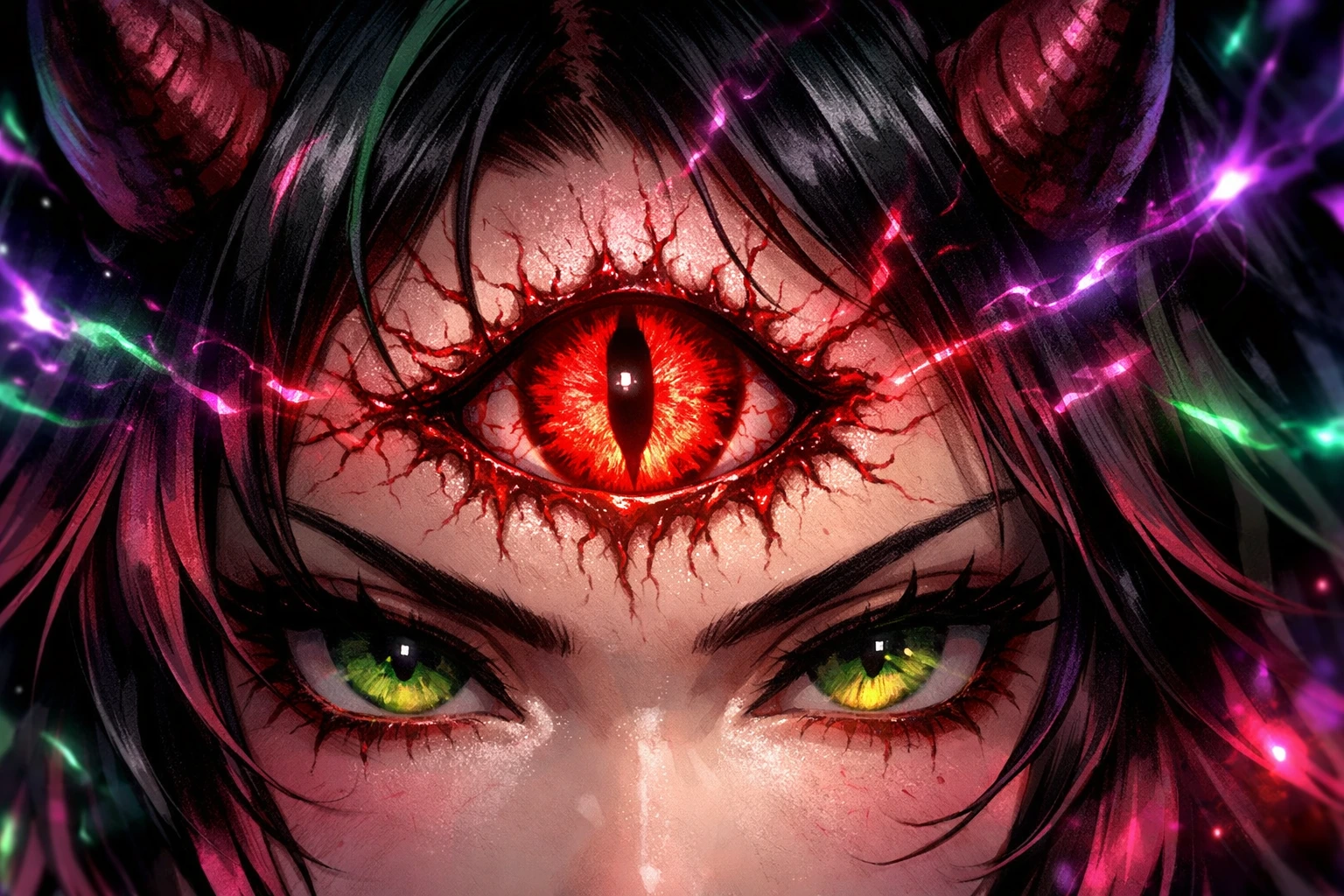
He literally overtakes her visual cortex. In an instant, Gyutaro begins processing Daki’s battlefield data—trajectory, speed, spatial geometry, incoming blade angles, and enemy positioning—directly through a partitioned section of his own brain.
He converts her body into a secondary, hyper-lethal drone, controlling her movements, optimizing the deployment of her Blood Demon Art, and correcting her tactical flaws like a puppet master pulling incredibly complex neurological strings. He does all of this while simultaneously fighting an entirely separate battle independently in his own body.
He is perfectly managing two highly lethal combat zones, processing double the sensory input, and executing flawlessly coordinated dual-vector attacks without a single microsecond of lag. This neurological bridging elevates them from two strong individual demons into a singular, omnidirectional force of biological devastation.
3. Daki’s Obi: Hyper-Compressed Flesh and Spatial Storage
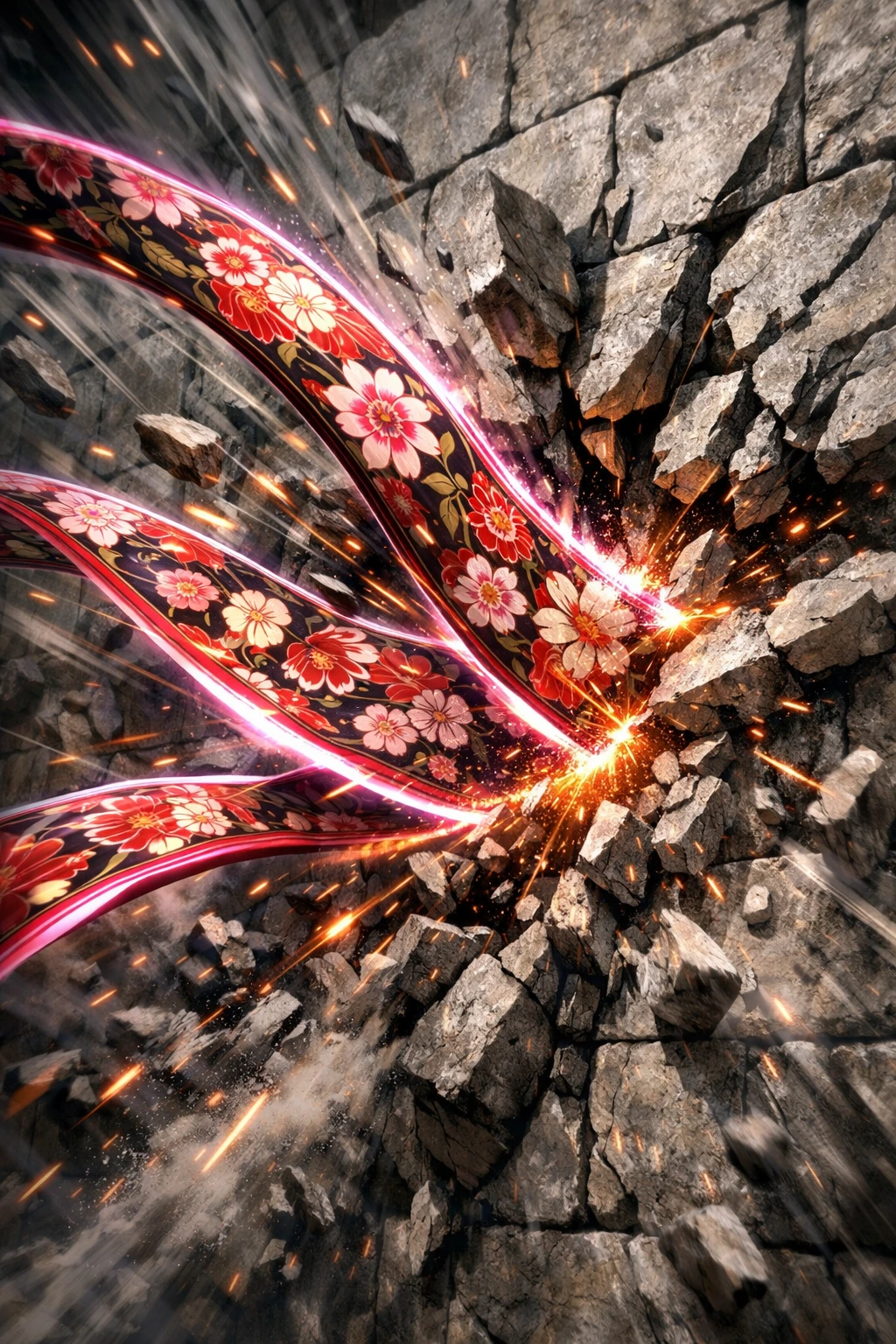
Daki’s primary weapon and the visual centerpiece of her combat style—the sentient, infinitely extending obi sashes—are frequently misunderstood as mere fabric manipulated by a form of demonic telekinesis. In reality, her Blood Demon Art represents a horrifying mastery over localized cellular manipulation and spatial physics.
The obi are not woven silk or dyed cloth; they are highly specialized, ultra-flexible, razor-sharp extensions of her own living biomass. They possess the tactile and structural properties of hyper-durable human muscle fascia, intricately cross-linked with Muzan’s demonic cells to create a material that is simultaneously as fluid as water in motion and as structurally resilient as tempered steel upon impact.
This prehensile biomass acts as both an external nervous system and a multi-tool of unparalleled versatility. The edges of the obi are tapered down to a microscopic, cellular level, creating a monomolecular cutting edge capable of slicing through dense urban architecture, layered armor, and human bone with virtually zero kinetic friction.
Because the obi are literally an extruded part of her flesh, she possesses complete, highly sensitive tactile feedback from them. She can feel the physical texture of her environment, sense minute changes in atmospheric air pressure caused by an approaching blade, and react to incoming attacks from total blind spots by relying entirely on the sensory data transmitted from the sashes directly back to her central nervous system.
However, the lethality of the obi in combat is entirely secondary to its primary, terrifying function: the human vault. Daki’s Blood Demon Art allows her to manipulate the fundamental spatial dimensions of her biological material. She utilizes localized spatial distortion to forcibly compress three-dimensional human bodies into flat, two-dimensional patterns trapped within the microscopic surface area of her obi.
The logistics of this process are a true nightmare of physics and biology. When an obi wraps around a screaming victim, it doesn’t just bind them; it fundamentally breaks down their physical volume. It collapses their atomic structure and preserves their biological state perfectly within the “fabric.”
The sheer horror is that the humans are not killed instantly; they are locked in a torturous state of suspended animation. Their consciousness is silenced, but their biology remains frozen in flat, two-dimensional agony, perfectly aware but entirely immobilized.
Why does she go to such extreme, complex lengths to store her prey instead of consuming them immediately to gain raw power? The answer lies in the harsh realities of predatory biology and the immense caloric demands of Upper Moon 6.
Daki is not just feeding herself for pleasure; she is the localized, dedicated supply chain for her dormant brother. By utilizing spatial storage, Daki essentially acts as a highly mobile, perfectly preserved pantry. She is obsessively hoarding human biomass to ensure their mutual survival.
This spatial storage elegantly solves the biological problem of demonic rot. Normally, dead human flesh would rapidly decay, losing its nutritional and energetic value within days. By trapping them in a dimensional stasis within her obi, Daki preserves the absolute freshness and cellular vitality of her victims indefinitely.
This allows her to maintain a massive, constantly accessible caloric reserve hidden in plain sight beneath the floorboards of Yoshiwara. Over long periods, especially during times when excessive hunting might draw unwanted attention from the Hashira, she can systematically drain this reserve.
She uses it to feed the immense energy requirements needed to maintain her extravagant physical regeneration and, more importantly, to ensure Gyutaro remains fully powered during his hibernation. She is a self-sustaining biological engine, methodically converting human tragedy into long-term, highly efficient fuel.
4. Gyutaro’s Hematophagy: The Physics of Weaponized Blood
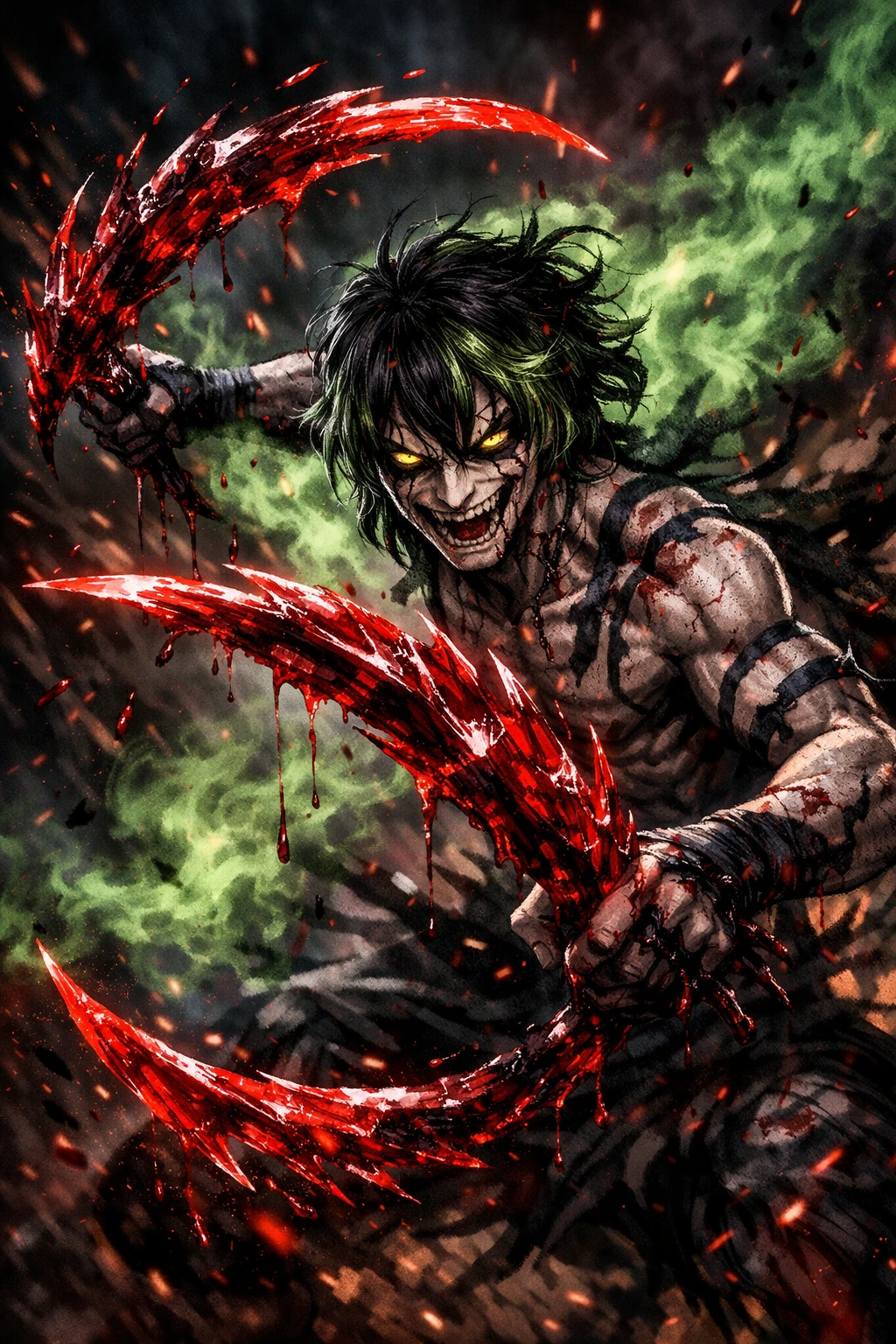
If Daki represents the meticulous preservation and accumulation of energy, Gyutaro represents its absolute, violently explosive release. Gyutaro’s Blood Demon Art, “Flying Blood Sickles,” is a masterclass in aggressive hematophagy and weaponized self-mutilation. He does not manipulate ambient blood from his victims or simply throw liquid at his enemies.
Instead, Gyutaro undergoes a voluntary, highly controlled, and localized cellular hemorrhage. He rapidly expels staggering volumes of his own demonic blood from his body—volumes that would instantly kill a human via hypovolemic shock, but which his hyper-regeneration replaces instantaneously. He then forces this expelled blood to undergo instantaneous, hyper-dense calcification.
He is literally weaponizing his own arterial fluid, crystallizing the plasma and cellular structures into jagged, hyper-aerodynamic sickles. Because these weapons are forged directly from his own living biology rather than inanimate elements, they possess a terrifying physical property: they are essentially sentient, heat-seeking boomerangs.
Through minute micro-manipulations of his Blood Demon Art, Gyutaro can completely alter the trajectory, velocity, and aerodynamic drag of his blood sickles mid-flight. They ricochet off the environment at impossible angles, deliberately curve around physical defenses, and track their targets with the relentless, unyielding precision of an organic missile system.
But the sheer physical trauma and severing power of the sickles are merely the delivery mechanism for the true, inescapable horror of Gyutaro’s biology: his lethal neurotoxin. This is the core medical breakdown of why Gyutaro is undeniably the most lethal close-quarters combatant in the lower half of the Upper Ranks.
The chemical structure of his venom is not a simple poison meant to slowly weaken a target; it is a hyper-aggressive, bi-phasic necrotic agent designed for absolute systemic annihilation.
Upon entering the bloodstream through even the shallowest cut, the venom attacks on two entirely different biological fronts simultaneously. First, it viciously attacks the central nervous system, aggressively binding to neural receptors and causing rapid, agonizing synaptic failure.
This effectively paralyzes the victim’s motor functions, shuts down the respiratory system, and induces terrifying hallucinations. Second, it acts as a localized flesh-eating pathogen. It initiates immediate cellular necrosis at the wound site, rapidly rotting the tissue, boiling the blood in the veins, and dissolving the muscular structure from the inside out.
For a standard human, or even a low-ranking Demon Slayer, a mere microscopic scratch guarantees a violently painful, melting death within minutes, if not seconds. There is no natural biological defense against it; it is an apex toxin designed to completely bypass and overwhelm the human immune system.
This terrifying toxicological reality perfectly contextualizes the sheer, unadulterated absurdity of Tengen Uzui’s survival. Why didn’t the Sound Hashira die instantly upon receiving a deep, venom-laced laceration directly to his face in the opening seconds of the clash?
The answer lies in Tengen’s extreme, borderline superhuman biological conditioning. As a shinobi, Tengen was subjected to unimaginable physical torture, sensory deprivation, and repeated chemical exposure from childhood.
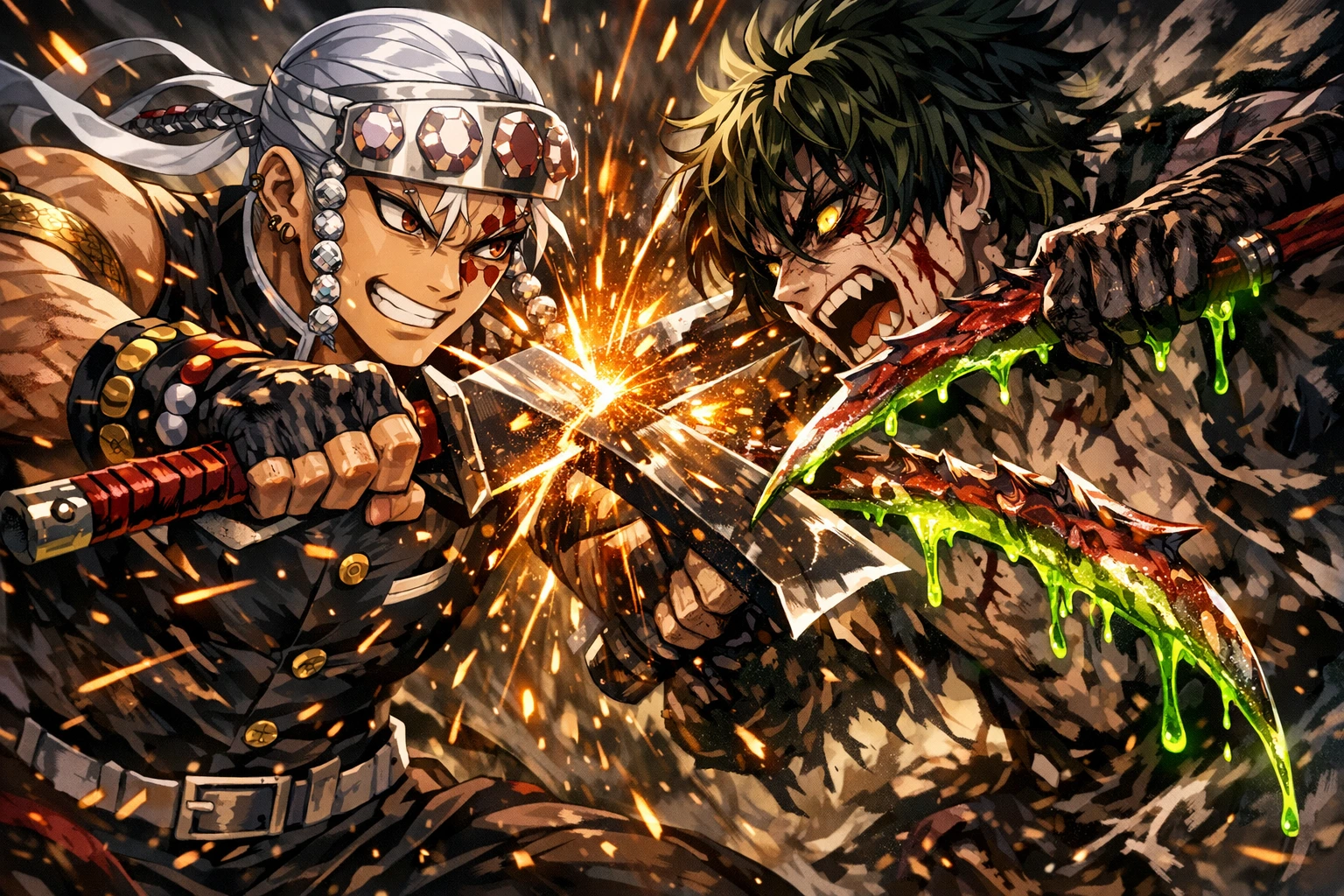
He survived by systematically micro-dosing highly lethal poisons over decades. This extreme regimen fundamentally altered his biology at a cellular level. His liver had mutated to produce highly specialized, hyper-active enzymes capable of rapidly identifying and violently breaking down foreign toxins. His immune system was essentially weaponized.
When Gyutaro’s venom entered Tengen’s bloodstream, it didn’t meet standard, frail human biology; it met a hardened biological fortress. Tengen’s body immediately launched a massive physiological counter-attack, temporarily suppressing the necrotic spread. Furthermore, Tengen utilized advanced breathing techniques to consciously slow his own heart rate, drastically limiting the circulation of the venom through his arteries.
He delayed the paralysis just long enough to continue fighting, forcing his own heart to act as a dam against the poison. He fought a desperate, agonizing internal cellular war while simultaneously clashing dual blades with an Upper Rank moving at supersonic speeds.
5. The Sociological Autopsy: Beauty and the Beast
To view Gyutaro and Daki solely as biological anomalies or challenging boss fights is to entirely miss the profound sociological tragedy of their existence. Their physical demonic forms are not arbitrary design choices made by Muzan; they are literal, anatomical manifestations of their deep human trauma and the extreme, crushing sociological divide of the Yoshiwara district. They are a walking, breathing sociological autopsy of society’s most discarded, forgotten children.
Gyutaro’s horrific physical appearance—the emaciated, hunched frame, the jagged skeletal protrusions, the mottled, decaying skin, and the rotting teeth—is a tragic, permanent preservation of his human malnutrition. In the deepest, darkest slums of Yoshiwara, at the absolute bottom of the societal barrel where even human waste was treated with more care, Gyutaro was starved to the point of near death on a daily basis.
He ate rats and bugs to survive. Furthermore, his physical deformities heavily imply the ravages of congenital syphilis, a disease tragically common and utterly untreated in the impoverished outskirts of red-light districts. When Muzan’s blood mutated him, it did not “fix” his body or grant him a majestic form; rather, it permanently froze his degradation and weaponized it.
His demonic form locked him into an eternal state of severe cachexia, literally turning his immense suffering, his starvation, and his biological rot into the very source of his lethal power. He became the living, breathing embodiment of the grinding poverty that Yoshiwara tried so desperately to hide behind its golden gates.
Contrast this horrific physical preservation with Daki. Her demonic form preserved, amplified, and immortalized the only single thing society had ever valued her for: her superficial, intoxicating physical beauty. Daki was taught from birth by the cruel environment around her that her only worth, her only means of survival in the meat-grinder of the Entertainment District, was her aesthetic appeal and her ability to manipulate the carnal desire of powerful men.
Her demonification locked her into a state of permanent, flawless, untouchable beauty. She became the literal idol of the district, an unaging, perfect porcelain mannequin whose beauty was so absolute and blinding that it served as an impenetrable armor against suspicion. The visual dichotomy between the siblings is intentionally jarring: Gyutaro is the rotting, foundational filth of the society, and Daki is the gilded, blood-stained roof built upon it.
This extreme polarization of their physical forms birthed an impenetrable psychological anchor: the sibling trauma bond. This bond is the crucial psychological analysis required to understand why they remained stagnant as Upper Moon 6 for over a century, despite possessing overwhelming power.
From a pure combat and power-scaling perspective, Gyutaro arguably possessed the raw lethality, unparalleled tactical brilliance, and biological hacks necessary to challenge for higher ranks within Muzan’s hierarchy, potentially unseating Upper Moon 5 or even 4. His venom alone could kill almost anything with a pulse, regardless of rank.
However, they never rose higher because their deep-seated childhood trauma and absolute, suffocating codependence anchored them firmly in place. They did not fight to spread Muzan’s glory, and they certainly did not fight for personal ambition, territory, or higher standing within the cutthroat demonic hierarchy. They fought exclusively, entirely to protect each other.
Gyutaro viewed himself as an irredeemable, ugly monster whose only purpose in the universe was to be the violent, disposable shield for his beautiful, fragile sister. Daki, despite her arrogant, cruel, and boastful exterior, was mentally still a terrified, helpless child who was entirely dependent on her brother’s extreme violence to survive a world that wanted to consume her.
They functioned as a flawless combat unit because they literally could not conceptualize an existence without the other. Their shared trauma was their greatest, most impenetrable strength on the battlefield, but it simultaneously served as the absolute ceiling on their evolutionary potential as individual demons.
6. Conclusion: The Destruction of the Core

The final defeat of Upper Moon 6 stands as one of the most miraculous, strategically improbable, and fiercely contested victories in the entire thousand-year history of the Demon Slayer Corps.
Bringing down this parasitic, symbiotic anomaly required the absolute destruction of their decentralized dual core, a feat demanding a level of tactical perfection that aggressively pushed every single combatant far past the established limits of human biology and endurance.
The Slayers had to execute a simultaneous, perfectly timed strike across a chaotic, rapidly deteriorating battlefield drenched in venom and collapsing architecture. This was not a single, cleanly coordinated maneuver; it was two entirely separate, highly desperate struggles for survival occurring at the exact same microsecond.
On one side of the district, Zenitsu and Inosuke had to mathematically outpace the hyper-dimensional, supersonic spatial strikes of Daki’s obi. They were forced to push their specialized breathing techniques to the literal point of severe muscular tearing and internal hemorrhaging just to sever a neck that was as soft, flexible, and yielding as silk.
Simultaneously, amidst burning rubble, a heavily poisoned, one-armed Tengen Uzui—utilizing his Musical Score technique to perfectly predict the enemy’s rhythm—and a physically exhausted Tanjiro Kamado had to violently breach the impenetrable, toxic storm of Gyutaro’s blood sickles.
The Slayers had to flawlessly counter two entirely different combat styles—one based on sweeping, omnidirectional spatial control, and the other on hyper-aggressive, close-quarters necrotic lethality. The sheer spatial geometry of the final strike, forcing both Nichirin blades through both demonic necks within milliseconds of each other while ignoring their own mortal wounds, was an act of tactical divinity born of pure desperation.
Yet, as the dual heads finally fell and the seemingly invincible demonic flesh began to violently disintegrate into ash, the true, profound tragedy of Upper Moon 6 was laid bare for the Slayers to witness. As the terrifying exterior of their monstrous forms burned away into nothingness, it did not reveal screaming, unrepentant ancient evils; it revealed the “flame in the snow.”
It revealed two deeply traumatized, starving, freezing human children who were violently abused and utterly abandoned by the world long before Muzan Kibutsuji ever found them shivering in the dark. Their final moments, emotionally bickering in the void of darkness before ultimately choosing to forgive each other and walk into the eternal flames of hell together, fundamentally humanized the monsters.
It stripped away the terrifying necrotic neurotoxins and the lethal prehensile biomass, leaving behind only the unbreakable, tragic bond of a crippled brother who failed to protect his sister in life, completely refusing to abandon her in death.
In the final expert verdict, Gyutaro and Daki must be cemented as the absolute most dangerous, transformative roadblock in the entire series’ narrative. They were not merely physically strong; they were a flawless, self-sustaining biological loop of lethal venom, spatial manipulation, and profound psychological trauma.
They represented the absolute peak of what a demon could achieve through symbiotic, co-dependent survival. They did not just violently challenge the Demon Slayer Corps; they irrevocably fractured the established status quo. Upper Moon 6 was the brutal, unforgiving crucible that forced the Slayers to brutally realize that standard, centuries-old tactics were dead.
They forced the heroes to forcefully evolve past their breaking points, to finally awaken their dormant Demon Slayer marks, and to transcend the frail limitations of human flesh—because in the terrifying face of the Yoshiwara siblings, the only alternative was a rotting, agonizing death.