
While our last discussion focused on the broader protagonist tropes, today we’re zooming in on two specific archetypes that often steal the show: the Tsundere vs Kuudere.
1. Introduction: The Art of Emotional Duality
In anime’s rich tapestry of character personalities, few archetypes capture hearts, launch endless debates, and fuel global fan fiction quite like the Tsundere and the Kuudere.
These two tropes stand as the most recognizable members of the entire “dere types explained” family, yet their methods of expressing affection—and hiding it—are diametrically opposed.
They are more than just personality quirks; they are meticulously crafted narrative devices used by writers to generate compelling romantic tension, comedy, and deep character development.
The Tsundere embodies the fiery, volatile conflict between pride and passion.
The Kuudere represents the serene, logical struggle of an individual learning to value human emotion.
Understanding the core difference between these two requires peeling back the layers: analyzing not just what they do, but why they do it, and what psychological principles make their stories so universally appealing.
This detailed guide will dissect the fundamental contrasts, explore the sophisticated psychological underpinnings, and celebrate the most iconic examples of these two titans of the emotional archetypes in anime.
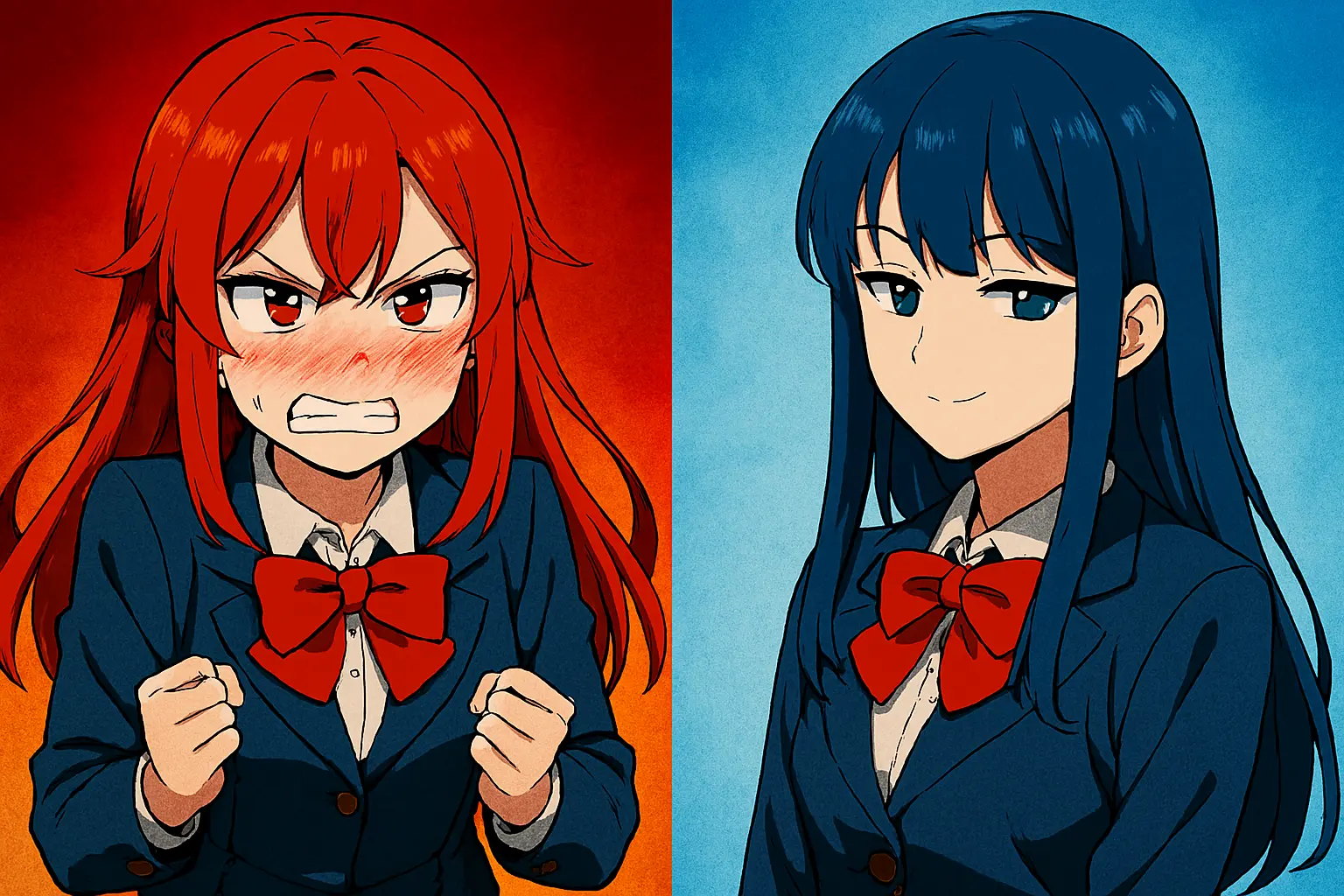
2. Etymology and Core Definition
To truly appreciate these anime character archetypes, you must first break down their linguistic roots in Japanese onomatopoeia.
The common thread uniting the entire “dere” family is the suffix: Dere Dere (デレデレ), which represents the state of being lovestruck or lovey-dovey—the ultimate expression of affection.
The prefixes, however, define the emotional barrier that must be overcome.
2.1. The Tsundere: The Prickly Lover (Tsun Tsun)
The Tsundere is defined by active, high-energy conflict. The prefix Tsun Tsun (ツンツン) signifies turning away in disgust, aloofness, prickliness, or sharpness.
The core dynamic lies in the Conflict of Emotion.
The Tsundere personality traits are built on duality, where their harsh exterior (Tsun) is a reaction to the strong, genuine romantic feelings (Dere) they harbor.
They are loud, visibly flustered, and resort to insults or even comical violence.
This hostility is a desperate, often theatrical, defense mechanism against the perceived weakness of vulnerability.
The core narrative tension is the question: Will their denial ever break?
2.2. The Kuudere: The Cool Heart (Kūru)
The Kuudere is defined by passive, low-energy control.
The prefix Kū (クー) is derived from the English word “Cool” (Kuˉru).
The core dynamic is the Absence of Expression.
The Kuudere personality is characterized by restraint and emotional control.
Their demeanor is stoic, highly composed, logical, and often expressionless.
Their “coolness” is not an active rejection of the love interest, but a passive default state of being reserved, intellectual, or social distance.
The Kuudere arc is a slow, gradual process where they learn to express their inner warmth, making their “dere” moments all the more profound.
3. Kuudere vs Tsundere Differences: A Behavioral and Narrative Breakdown
The fundamental difference between these two archetypes boils down to the Source of their Coldness and the Speed of their Emotional Arc.
3.1. Behavioral Contrast: Fire vs. Ice
| Feature | Tsundere (The Hot-Headed) | Kuudere (The Cool-Headed) |
| Outward Expression | Loud, combative, volatile. They are easily flustered and use aggression or yelling (Baka!) as their primary means of communication. | Quiet, stoic, logical, flat-toned. They maintain a calm, unshakeable facade and use minimal body language. |
| Source of Coldness | Internal Conflict (Pride, embarrassment, denial, or shame). Their hostility is a defense against the target of their affection. | Inherent State (Reserved nature, intellectual focus, past trauma, or genuine lack of emotional literacy). They are impassive to everyone. |
| Emotional Arc Speed | Rapid mood swings within moments. The switch from Tsun to Dere and back is a frequent comedic or dramatic device. | Slow, geological reveal over the entire series. The affection is a steady burn, not a volatile switch. |
| Affection Display | A sudden, powerful blush and a verbal denial (“It’s not like I did this for you!”). Love is expressed through embarrassment. | Subtle, action-based gestures (Acts of service, unwavering loyalty, a rare, faint smile). Love is expressed through reliability. |

3.2. Narrative Implication: Comedy vs. Drama
The choice between a Tsundere and a Kuudere protagonist dictates the genre and pacing of a story.
The Tsundere provides instant conflict and reliable comedic relief.
Their predictable blow-ups are excellent pacing tools that can sustain a romantic comedy for many episodes.
The audience is constantly waiting for the next Tsun eruption, and the comedy is derived from the failure to maintain composure.
Conversely, the Kuudere provides narrative depth and dramatic tension.
Their reserved nature means every single word or gesture of affection is laden with emotional weight.
Their stories are less about volatile comedy and more about the protagonist’s quiet perseverance in earning trust, and the drama is rooted in the success of vulnerability.
3.3. A Comparison to the Dandere (The Quiet Family Member)
It is crucial to distinguish the Kuudere from the Dandere, a frequent point of confusion among anime fans, as both are quiet.
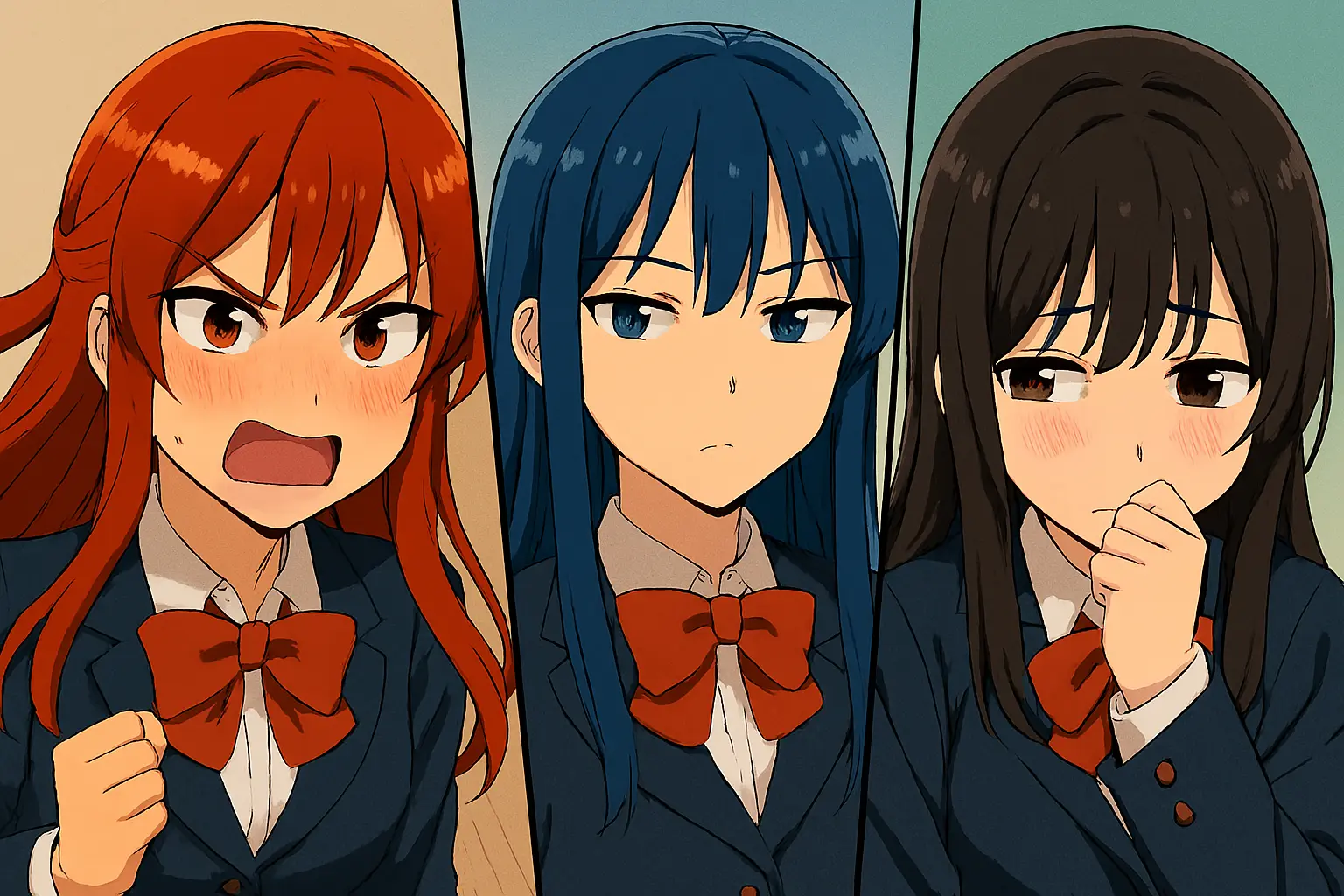
The Dandere (だんまり – Danmari) is silent due to overwhelming shyness or social anxiety.
They desperately want to interact and express themselves but are too fearful. Once they are alone with a person they trust, the “dere” explodes outward in a flood of shy affection.
The Kuudere‘s silence, however, stems from choice, logic, or emotional distance.
They are not shy; they simply see no reason to talk unnecessarily. The Dandere is shy but warm; the Kuudere is aloof but capable.
4. The Psychology and Appeal of Emotional Archetypes: A Deep Dive
The global appeal of these anime character archetypes is more than just surface-level preference; it speaks to fundamental human desires regarding emotional connection and earned affection.
4.1. Decoding the Tsundere’s Explosive Popularity
The Tsundere trope is highly effective due to two primary psychological concepts.
The first is the “Gain-Loss” Principle in Practice.
This principle, originating in the social psychology experiments of Aronson and Linder (1964), posits that a person feels more attracted to someone whose evaluation of them shifts from negative to positive.
The Tsundere starts with an extremely low baseline of affection.
When the character finally allows a moment of genuine kindness (the “dere” phase), this positive reinforcement feels exponentially more powerful because it surpassed all negative expectations.
This mechanism ensures that the viewer feels an intense sense of accomplishment, having earned this rare moment of affection.
The second concept is Reaction Formation and the Fear of Vulnerability.
The Tsundere is a perfect literary manifestation of Reaction Formation.
Their true, loving feelings are the “internal threat,” and admitting them means risking rejection, which threatens their pride and sense of self-worth.
They neutralize this internal threat by vehemently expressing the opposite emotion (anger, hatred, disgust).
The louder they yell “Baka!“, the safer they feel because their true feelings are successfully concealed.
The Tsundere personality effectively weaponizes hostility to preserve their ego.

4.2. Unearthing the Kuudere’s Quiet Charm

The Kuudere’s appeal is more sophisticated, rewarding patience and valuing emotional quality over quantity.
The primary appeal is the Reward of Penetration and Exclusivity.
The Kuudere is the emotional equivalent of a high-security vault.
Their stoicism and lack of expression create an intentional mystery factor.
The person who manages to penetrate this shield and elicit a genuine, heartfelt emotional response (like a real smile or an explicit declaration of care) is granted an exclusive, high-value reward.
This small, rare expression carries infinitely more weight than a thousand easy smiles, symbolizing a deeply earned, unique bond.
This connection is perceived as being truer because it required intense effort and time.
Furthermore, the Kuudere’s composure is often rooted in immense internal strength, known as Coolness as Resilience and Competence.
Characters like Rei Ayanami and Yuki Nagato function as the unflappable anchors of their respective groups.
Their high intellect and logical processing allow them to maintain clear judgment during emotional crises, providing a necessary stability that contrasts with the volatility of other characters.
Their character arc often centers not on hiding love, but on learning to process and express it, signifying true personal growth and an expansion of their emotional literacy.
5. Case Studies: Dissecting the Iconic Character Arcs
To fully grasp the contrast between the Tsundere and Kuudere, you must examine the specific narrative roles and motivations of their most famous examples.
5.1. Tsundere Case Studies (The Arcs of Admission)

Taiga Aisaka (Toradora!) is the Classic Emotional Imposter. Her “Tsun” is her only social survival mechanism, born from her lack of a stable family life and her small stature.
Her relationship with Ryuuji is a masterclass in the Gain-Loss Principle: her extreme dependence on him is masked by her verbal and physical abuse, making the few moments of domestic kindness and vulnerability feel overwhelmingly powerful.
Her climax is not just a confession, but the admission that she is weak and needs him.
Asuka Langley Soryu (Neon Genesis Evangelion) is the Tragic Tsundere.
Asuka’s aggression is deeply psychological, stemming from her mother’s death and her desperate need for external validation (“Tsun” as a constant performance of superiority).
She uses her high performance and constant criticism of Shinji as a shield.
Her “dere” moments—rare and quickly retracted—reveal a profound, agonizing loneliness.
Her arc is a tragic look at a Tsundere who fails to reconcile her pride and need before immense trauma shatters her defenses.
Edward Elric (Fullmetal Alchemist) is the Hot-Headed Protagonist with Tsundere-adjacent Traits.
Edward displays Tsundere-adjacent traits—a mixture of being easily provoked by his short height and his deep responsibility complex regarding his brother Al and Winry.
He expresses his affection through furious efforts to protect them or by shouting insults that mask his fear.
His character proves the archetype’s behavioral dynamics transcend gender, focusing instead on the inability to be gentle when facing deep emotional stakes.
5.2. Kuudere Case Studies (The Arcs of Expression)

Rei Ayanami (Neon Genesis Evangelion) is the Stoic Pioneer.
Rei is the definitive Kuudere. Her initial emotional distance is almost literal; she is an enigmatic entity who lacks a traditional identity or emotional memory.
Her entire development is based on the slow, meticulous accumulation of human experiences, culminating in a few pivotal acts of self-sacrifice and a single, genuine smile that proves she has learned the value of a connection.
Her arc is about existence and emotional enlightenment.
Kanade Tachibana (Angel Beats!) is the Quiet Protector.
Kanade appears emotionless because she has a singular, life-defining purpose: fulfilling the dying wish of her donor. Her actions, though violent and aggressive, are always logical and goal-oriented (Kuudere traits).
Her “dere” is not a blush, but the ultimate act of selflessness and quiet gratitude, cementing the Kuudere’s association with loyalty and earned trust.
Yuki Nagato (The Melancholy of Haruhi Suzumiya) is the Logical Sentinel.
As a “Humanoid Interface,” Yuki’s lack of expression is a programmed necessity.
Her “dere” moments occur only when her programmed logic is overridden by her attachment to her friends, particularly Kyon.
Her shift from a completely logical entity to one capable of independent emotional preference makes her one of the most intellectually compelling Kuudere examples.

6. The Evolution of Tropes: When Archetypes Blur and Intersect

Modern anime, seeking to move beyond simple stereotypes, frequently introduces complex characters who exist between or blend the two archetypes, offering an advanced layer of literary analysis that keeps the audience guessing.
6.1. Tsundere with Kuudere Logic
Kurisu Makise (Steins;Gate) is the Sarcastic Scientist.
Kurisu is quick to insult, deny, and snap (Tsundere), but her insults are always highly intelligent and rooted in scientific logic (Kuudere’s primary tool).
She avoids the clumsy, purely emotional outbursts of a traditional Tsundere, instead using biting sarcasm and wit to create emotional distance.
Her Kuudere intellect is the shield for her Tsundere vulnerability. Her “tsun” is intellectual, not brute force.
6.2. The Confident Kuudere with Unwavering Focus
Hirotaka Nifuji (Wotakoi) is the Adult Male Kuudere. Hirotaka is calm, reserved, and extremely logical, fitting the male Kuudere mold perfectly.
His reserved nature stems from being an intense introvert and an avid gamer, not from social anxiety.
He rarely shows extreme emotion and focuses on his hobbies.
He is a primary example of a pure Kuudere whose unwavering composure and practical acts of service define his deep love for Narumi.
His emotional distance is a matter of introverted preference, not shyness.
This blurring validates the idea that these archetypes are best understood as ranges of behavior—tools that writers use to quickly communicate a character’s internal struggle and their approach to the external world, rather than rigid personality molds.
7. The Practical Application of Tropes in Storytelling
Beyond simple classification, the Tsundere and Kuudere archetypes are instrumental tools for writers to structure and pace their romance narratives effectively.
7.1. Plot Structure and Pacing
The Tsundere functions as a Pacing Mechanic.
A Tsundere character creates natural peaks and valleys in the story.
Every Tsun episode builds comedic tension, while every Dere episode serves as a temporary, rewarding climax.
This cycle keeps the audience invested in the slow burn of the central relationship, often stretching the ultimate confession over several seasons.
Conversely, the Kuudere functions as a Milestone Marker.
A Kuudere character defines plot progression through emotional milestones.
The story beats are tied to significant shifts in the Kuudere’s behavior: the first time they ask for help, the first time they laugh, the first time they initiate contact.
These small actions function as major plot points, emphasizing the value of patience and emotional investment in the story’s world.
7.2. The Male Protagonist’s Role
The choice of archetype also defines the qualities required of the male protagonist.
The Tsundere-Target must possess unshakeable patience, thick skin, and steadfast kindness (e.g., Ryuuji Takasu to Taiga Aisaka).
They must see through the anger to the vulnerable core, a form of wish fulfillment for the audience who wants to “save” the troubled, angry partner.
The Kuudere-Target must demonstrate sincere curiosity, consistent reliability, and non-demanding presence (e.g., Kyon to Yuki Nagato).
They succeed not by fighting the coldness, but by simply providing a warm, stable environment where the Kuudere feels safe enough to lower their guard on their own terms.
The emphasis is on respect for personal space and quiet understanding.
8. Conclusion: The Definitive Legacy of Tsun and Kuu
The comprehensive analysis of Tsundere vs. Kuudere reveals that both are masterful storytelling devices, each fulfilling a unique psychological need in the audience.
The Tsundere offers immediate drama, reliable comedy, and the profound satisfaction of earned affection—the fiery chaos of a heart desperately trying to protect itself.
Their popularity is a testament to the universal human struggle against pride and the eventual triumph of honesty.
The Kuudere provides a deeper, slower narrative burn, rewarding patience, intellect, and perseverance.
Their journey is one of emotional awakening, proving that the quietest hearts often hold the most profound loyalty and the most meaningful transformation.
The rich complexity and lasting appeal of these emotional archetypes in anime ensure that they will continue to dominate romantic narratives for years to come.
By analyzing these character structures, you don’t just categorize characters; you gain a powerful understanding of the psychology behind emotional defense and the different pathways to love.
The Tsundere is defined by conflict and expresses love through anger, leveraging the Gain-Loss Principle, while the Kuudere is defined by control and expresses love through subtle actions, capitalizing on the Reward of Penetration.
Ultimately, both serve as critical tools for pacing, defining the genre, and creating deeply satisfying emotional payoffs in anime storytelling.