
Introduction
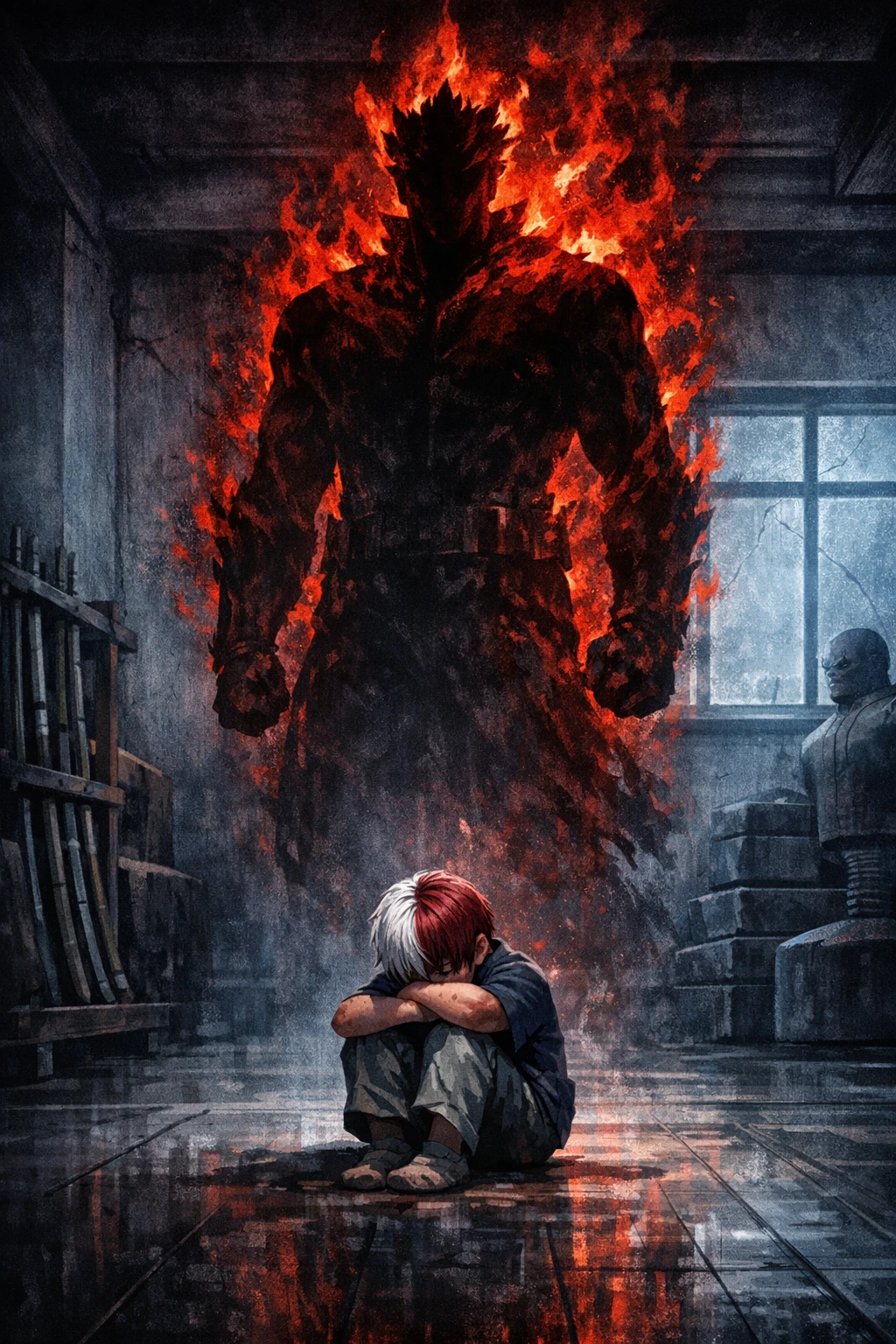
The Sins of the Father: Defining Touya Todoroki
In the grand, colorful tapestry of My Hero Academia, the Pro-Hero society is often presented as a gleaming utopia, a world where the extraordinary is weaponized for the greater good. However, beneath the flashing cameras, the booming merchandise sales, and the towering billboards of smiling saviors lies a dark, festering underbelly of systemic corruption, unchecked ambition, and profound moral compromise.
At the very epicenter of this hypocrisy stands Touya Todoroki, globally infamous under the moniker “Dabi.” To fundamentally understand Dabi is to recognize that he is not simply a mass murderer or a generic, chaotic antagonist born of inherent malice. Rather, he is the physical, burning, undeniable embodiment of the Pro-Hero industry’s darkest obsession with eugenics, legacy, and the commodification of children.
Touya is the horrifying end result of a society that places the value of a human being entirely upon the utility and sheer power of their Quirk. He is a walking, breathing indictment of a system that allows a man like Enji Todoroki—the flame hero Endeavor—to commit unspeakable domestic atrocities in the name of heroic ambition, all while being cheered on by millions.
Dabi’s scorched, stapled flesh is a constant, gruesome reminder of the sins of the father. Every agonizing movement he makes, every blast of searing blue hellfire he unleashes, is a direct retaliation against a world that looked the other way while his father built a throne upon the broken minds and bodies of his own family. Touya Todoroki is the ultimate consequence of conditional love, a tragic figure whose entire existence is defined by the desperate, maddening need to be seen by the very man who created and destroyed him.
A Masterpiece Discarded
To grasp the magnitude of Touya’s fall, one must first comprehend the terrifying height of his original pedestal. Touya was not born an accident; he was engineered. He was brought into the world to be the absolute pinnacle of heroism, a child specifically designed to achieve the singular goal his father could not: surpassing the insurmountable Symbol of Peace, All Might.
For the first few years of his life, Touya was Endeavor’s golden child, the “masterpiece” who inherited a fire Quirk that burned even hotter than his father’s legendary Hellflame. He was showered with attention, validation, and the intoxicating promise of future godhood.
However, this fairy tale of power and legacy violently collapsed the moment biology betrayed him. When it was discovered that Touya possessed a fatal physiological flaw—a body incapable of withstanding his own immense power—he was instantaneously stripped of his title.
He transitioned overnight from the prophesied savior of the Todoroki bloodline to a defective product, a broken tool to be shelved and forgotten. This sudden, brutal discard shattered his psyche. The tragedy of Touya Todoroki is the tragedy of a child born to touch the sun, only to have his wings ripped off by the very man who threw him into the sky.
Article Scope
This article serves as the definitive, expert-level deconstruction of the Touya Todoroki phenomenon. We will systematically break down the complex, multi-layered horror of the Todoroki family dynamic, beginning with the clinical, eugenics-driven foundation of his conception. We will explore the agonizing biological nightmare of a Quirk that literally eats its user alive.
Furthermore, we will chart the complete psychological death of a desperate, validation-starved boy, analyzing how his unrequited love for his father mutated into an apocalyptic hatred. Finally, we will dissect the geopolitical and societal devastation of his revenge, culminating in the masterpiece of psychological warfare known to the world as the “Dabi Dance.” This is the comprehensive autopsy of how a hero’s greatest failure birthed the world’s most devastating villain.
The Genetic Nightmare: Hardware vs. Software
The Eugenics Project
To understand the absolute biological tragedy of Touya Todoroki, one must look at the deeply unsettling foundation of his existence: the concept of “Quirk Marriages.”
In the world of My Hero Academia, as Quirks became more complex and powerful through generations, a taboo, underground practice emerged where individuals were wedded not out of love, but strictly to selectively breed specific, overpowering genetic traits.
Enji Todoroki, utterly consumed by his pathological inability to surpass All Might, resorted to this dystopian practice. He essentially bought his wife, Rei Himura, using his immense wealth and influence to secure a marriage with her declining family.
Rei possessed a powerful Ice Quirk, and Endeavor’s terrifyingly clinical goal was to breed a child who possessed his absolute, overwhelming firepower alongside Rei’s absolute thermal cooling capabilities. It was a eugenics project designed to bypass the physical limitations of the human body.
Enji wanted a weapon that would never overheat, a flawless vessel capable of producing infinite, god-like power. Touya was the firstborn product of this loveless, transactional union, a child whose very DNA was expected to solve a biological equation of power and temperature regulation.
The Biological Mismatch: The Quirk Singularity
The horror of Touya’s existence is beautifully and tragically explained through the lens of the Quirk Singularity theory—the idea that Quirks will eventually mutate and grow too powerful for the human body to physically handle.
Touya represents the ultimate manifestation of this theory in a single, tragic individual. When examining his genetics, we must separate his Quirk into two distinct categories: the “Software” (the supernatural ability itself) and the “Hardware” (the physical body housing the ability).
Touya inherited his father’s Software. In fact, his fire was vastly superior, possessing a terrifyingly high baseline temperature that dwarfed Endeavor’s Hellflame. He was given an engine capable of producing nuclear-level heat. However, in a cruel, cosmic twist of genetic irony, Touya did not inherit his father’s heat-resistant body. Instead, he inherited his mother’s Hardware.
He was born with a physical constitution specifically adapted to resist freezing temperatures. The mismatch is catastrophic: Touya has the firepower of a sun, contained within a body biologically designed to thrive in a blizzard. His genetics are completely at war with each other, making his own superpower a highly lethal poison to his own physical form.
The Boiling Vessel
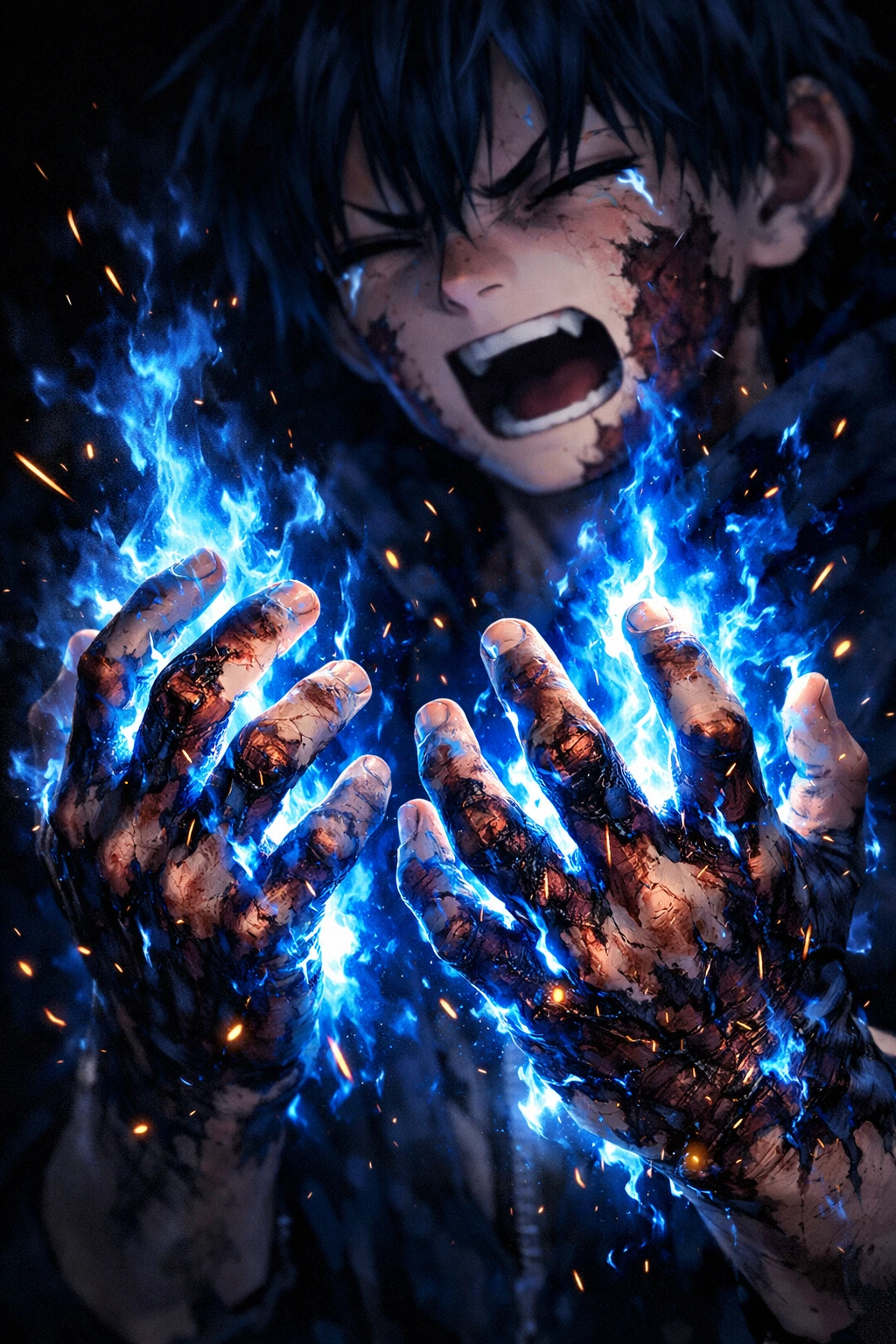
Because of this nightmarish genetic mismatch, the physical horror of Touya’s daily existence cannot be overstated. Every single time he ignites his Quirk, he is essentially locking himself inside a blast furnace. He is a boiling vessel. Using his Quirk literally cooks his flesh from the inside out. Unlike Endeavor, whose body naturally mitigates heat, Touya’s cells have no defense against the inferno he generates.
The prolonged use of his powers results in a cascade of biological destruction. His sweat glands—the body’s natural mechanism for cooling—are scorched and destroyed, trapping the heat entirely inside his body.
His pain receptors and nervous system are constantly being fried, leading to a horrifying duality where he feels excruciating agony until his nerves burn away entirely, leaving numb, necrotic flesh. The staples holding Dabi’s skin together are not merely an aesthetic choice for a villain; they are a desperate, crude medical necessity to keep his decaying, burned skin attached to his muscle tissue. He is a walking corpse, slowly immolating himself every time he summons his power to fight.
The Psychology of the Golden Child
The Taste of the Throne
The biological trauma Touya endures is heavily eclipsed by his profound psychological damage, which was meticulously cultivated during his early childhood by Enji Todoroki. In the beginning, Touya was the undisputed golden child.
Because his flames burned brighter and hotter than his father’s, Enji looked at his eldest son and saw his own salvation. Endeavor poured his absolute attention, his intense validation, and his demanding, conditional “love” entirely into Touya. He placed the heavy, suffocating crown of his own ambitions onto the head of a toddler.
Touya was given a taste of the throne. He was told he was special, that he was the masterpiece, and that he alone would be the one to finally look down upon All Might. For a child, a parent’s undivided attention is akin to oxygen.
Touya breathed in his father’s obsessive validation and internalized it as his core identity. His entire sense of self-worth became inextricably linked to his ability to produce fire. Therefore, when his physical limitations were discovered and Enji abruptly, coldly withdrew all of that attention, the psychological whiplash was devastating.
It wasn’t just a rejection; it was an annihilation of the boy’s entire reality. The throne was ripped away, leaving a gaping, agonizing void.
The Creation of Shoto
The situation escalated from tragic neglect to active psychological torture with the creation of Shoto. Endeavor did not stop his eugenics project when Touya failed; he simply moved on to the next iteration. He forced his wife to bear more children—Fuyumi, then Natsuo—casting them aside as “failures” because they predominantly inherited ice Quirks.
Finally, the “perfect masterpiece” arrived: Shoto. Born with his right side possessing Rei’s ice and his left side possessing Enji’s fire, Shoto was the flawless biological machine Endeavor had been trying to engineer.
For Touya, Shoto’s birth was the ultimate death sentence for his relevance. Shoto’s existence cemented Touya’s permanent status as a failure, a broken prototype relegated to the shadows. Endeavor isolated Shoto from his siblings, enforcing a brutal training regime and physically preventing Touya from interacting with the new golden child.
Touya was forced to watch from the sidelines, physically barred from his father’s presence, as his replacement received the very attention that had been violently stolen from him. Shoto wasn’t just a brother to Touya; he was a living, breathing symbol of Touya’s inadequacy and Endeavor’s ruthless pragmatism.
The Desperate Cry for Approval
Driven to the brink of madness by isolation and the loss of his father’s gaze, Touya developed a lethal obsession with training in secret. He would sneak out to Sekoto Peak, a mountain training ground, and relentlessly push his Quirk, burning his own flesh in a desperate, agonizing bid to prove he was still useful.
The tragic reality of Touya’s motivation is that he never cared about becoming a hero to save people. He had no altruistic desires, no dreams of rescuing civilians with a smile like Izuku Midoriya. His motivation was entirely, painfully insular: he just wanted his father to look at him again.
Every burn he sustained, every patch of skin he charred, was a desperate cry for approval. He was willing to literally burn himself to death if it meant Enji Todoroki would give him one more ounce of validation. He internalized the toxic lesson that his only worth was his power, leading him to believe that if he could just make his flames hot enough, his father would finally love him again.
Ground Zero: The Sekoto Peak Incident
The Breaking Point
The psychological pressure cooker of Touya’s childhood eventually reached a cataclysmic breaking point during what would become known as the Sekoto Peak Incident.
Driven by pubertal emotional volatility and his obsessive training, Touya finally achieved a terrifying breakthrough: his flames transitioned from red to a blinding, ultra-hot blue. This was the ultimate manifestation of his raw power, proof that his firepower was exponentially greater than Endeavor’s Hellflame.
Overjoyed and desperate, a teenage Touya begged his father to come to Sekoto Peak to witness this breakthrough. He genuinely believed that these blue flames were the key to winning back his father’s love, the definitive proof that the “defective” son was actually the masterpiece all along.
However, Endeavor, discovering that Touya was continuing to burn himself, reacted not with the praise Touya craved, but with explosive anger, physically abusing Rei for “failing” to stop him and flatly refusing to go to the mountain. Touya waited on that peak, staring into the woods, waiting for a father who was never going to come.
The realization that even his absolute maximum potential—his brilliant blue flames—was not enough to warrant his father’s presence shattered his mind completely.
The Immolation
What happened next was a terrifying display of the Quirk Singularity fueled by pure emotional despair. Quirks in My Hero Academia are heavily tied to the emotional state of the user. Standing alone on the mountain, consumed by the agonizing realization of his complete and utter rejection, Touya’s emotional limiters completely snapped.
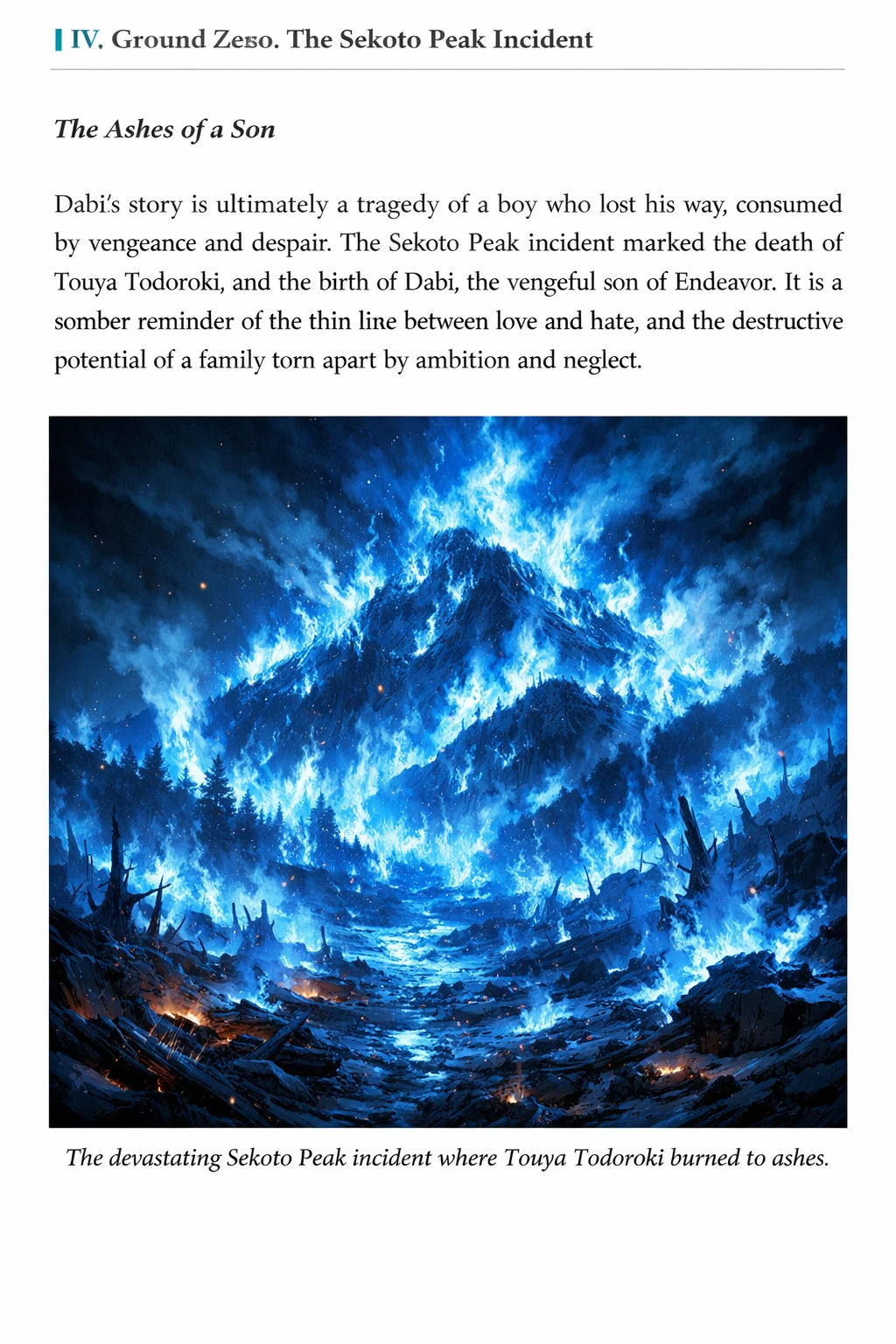
His sorrow, rage, and profound abandonment bypassed all biological safeguards. He unleashed a massive, uncontrollable inferno of blue fire. Blue fire burns at temperatures exceeding 2000°C (3600°F). Because his body was biologically suited for freezing temperatures, he possessed absolutely no capability to withstand, let alone control, a blaze of this magnitude.
The flames consumed the mountain, creating a localized firestorm that obliterated everything in its path. Touya was caught in the dead center of a furnace of his own making, a victim of his own heartbroken immolation.
The Ashes of a Son
The physical destruction of Touya’s body during the Sekoto Peak incident was absolute and horrifying. The 2000-degree flames ravaged his inadequate flesh. His tear ducts were completely burned away—a deeply poetic and tragic injury, meaning that for the rest of his life, he would literally be incapable of shedding tears for the family that broke him. His jaw was severely damaged, and over seventy percent of his skin was completely charred and rendered to ash.
The inferno was so intense, so consuming, that when Pro-Heroes and investigators finally managed to quell the blaze, they found virtually nothing left. Only a small fragment of his jawbone remained in the scorched earth. The world, and Enji Todoroki himself, concluded that Touya had been incinerated completely, burned to ash by his own uncontrollable power. In the eyes of society, Touya Todoroki was dead, closing the book on Endeavor’s greatest failure.
The Resurrection and the Void
The Ujiko Intervention
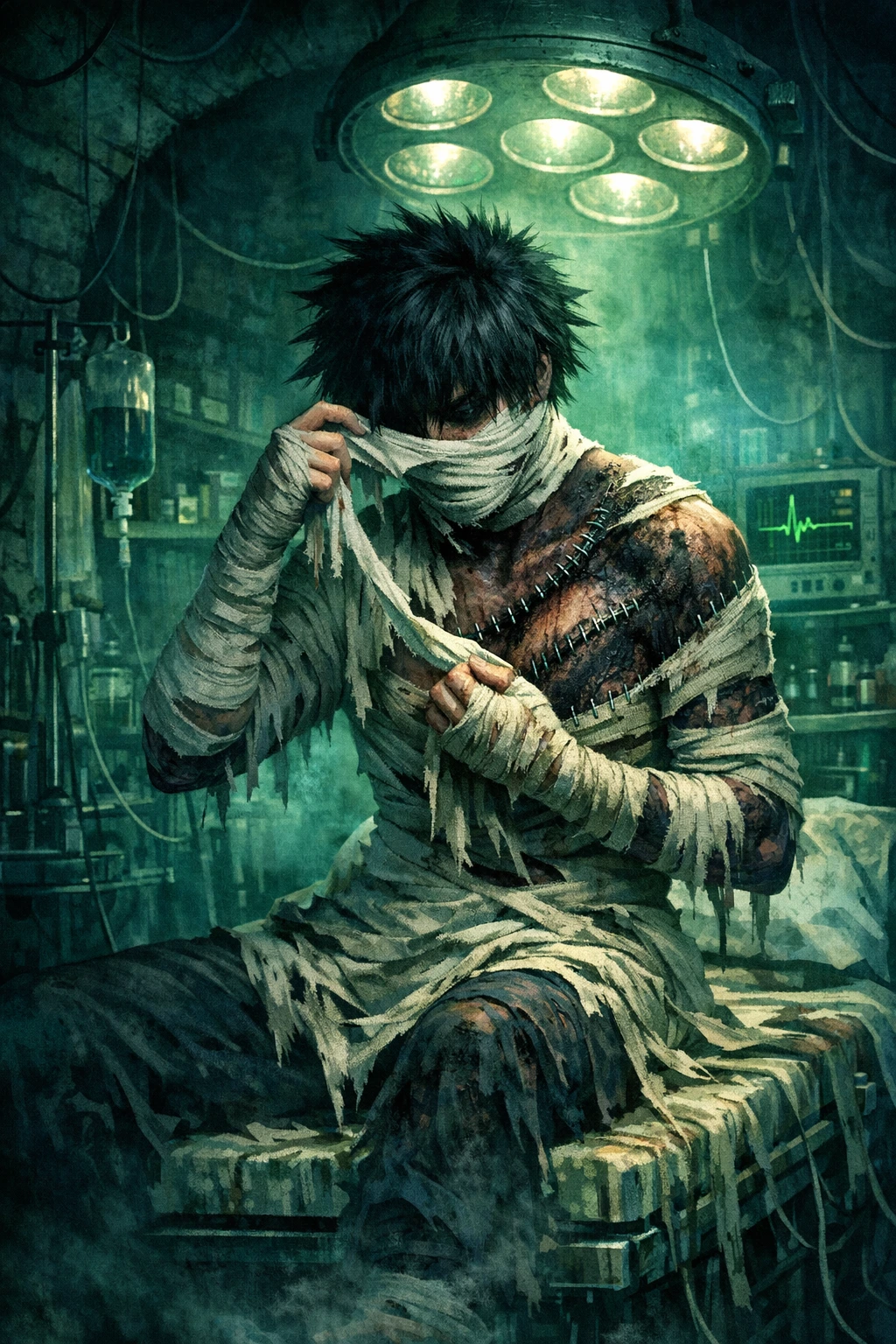
However, Touya did not die on Sekoto Peak. He was pulled from the ashes of his own destruction by the overarching phantom of the criminal underworld: All For One and his trusted scientist, Dr. Kyudai Garaki (Daruma Ujiko). Dr. Garaki, always on the hunt for powerful subjects and potential vessels for All For One, discovered the charred, barely breathing remains of the boy.
Recognizing the immense, raw potential of the blue flames, Garaki brought Touya to his hidden medical facility. For three excruciating years, Touya was kept in a medically induced coma. Garaki painstakingly reconstructed the boy, using experimental skin grafts, crude surgical staples, and regenerative treatments just to keep his organs from failing.
Garaki’s intention was never to save a child; his intention was to groom Touya as a “spare vessel” in case the primary candidate, Tomura Shigaraki, failed. Touya was resurrected not by a miracle, but by the cold, calculating hand of a mad scientist looking for a weapon.
The Return Home
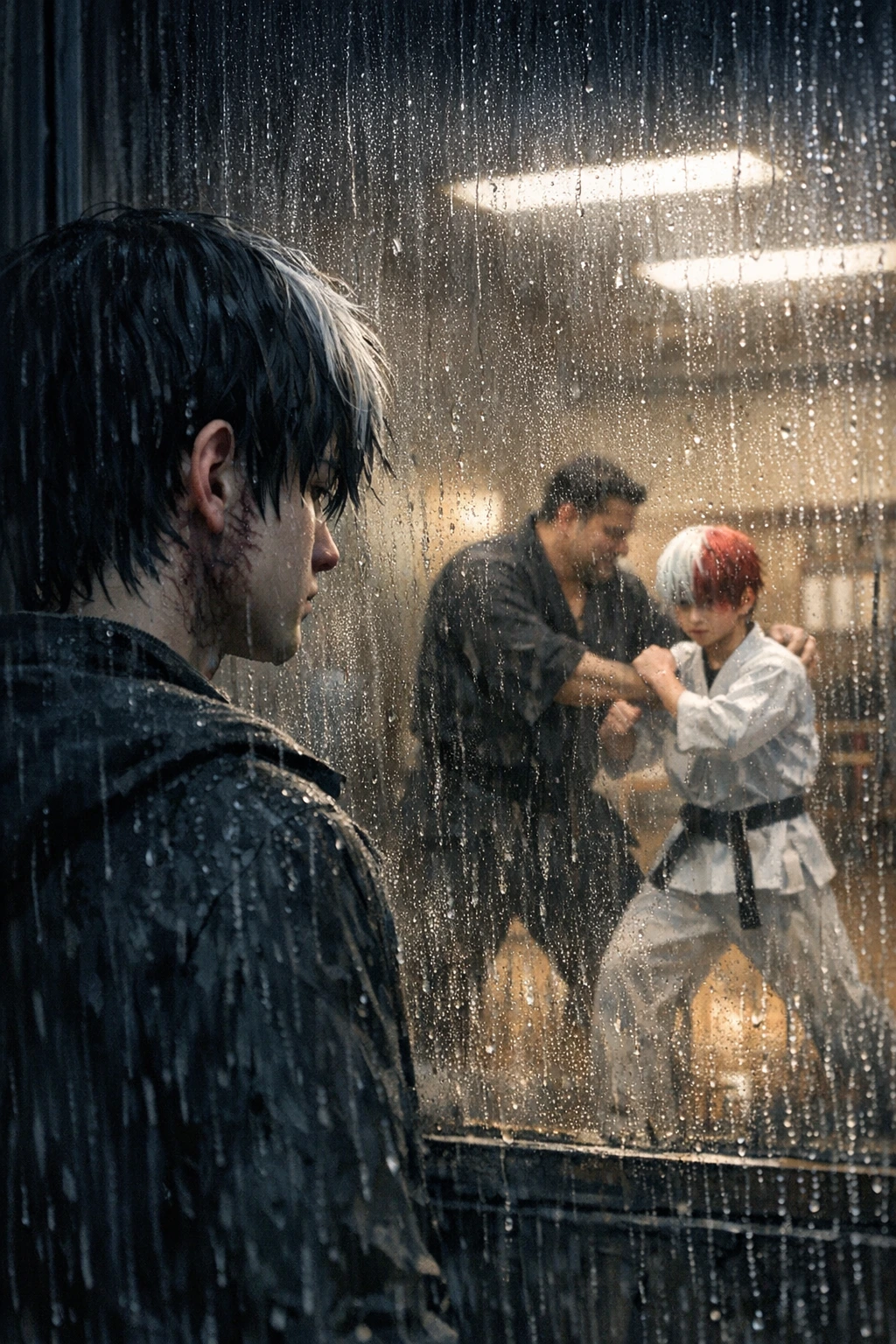
Despite the physical reconstruction, Touya woke up from his three-year coma with only one thought burning in his fractured mind: he had to apologize to his father, show him he survived, and finally prove his worth. Defying Garaki’s expectations, the severely weakened and heavily bandaged Touya escaped the secret orphanage facility. Driven by a lingering, desperate sliver of hope, he made the arduous journey back to the Todoroki household.
This moment is the exact point of no return for his soul. When Touya finally arrived at his home, he did not walk through the front door. He looked through a window into the courtyard. There, he saw Endeavor ruthlessly training a young Shoto. He saw the fire, he saw the ice, and he saw his father’s absolute, unbroken obsession with the masterpiece.
The realization hit him with the force of a physical blow: his “death” meant nothing. His absence had not caused his father to change, reflect, or mourn in any meaningful way that halted the cycle of abuse. Endeavor hadn’t missed a beat; he had simply replaced him entirely. The boy named Touya looked through that window and realized he was a ghost haunting a house that didn’t want him.
The Birth of Dabi
It was in that courtyard, staring through the glass, that Touya Todoroki truly, irreversibly died, and the entity known as Dabi was born. The psychological detachment was absolute. All the lingering love, the desperate need for validation, and the hope for reconciliation were instantaneously incinerated, replaced by a cold, calculating, and apocalyptic hatred.
He shed his identity entirely. He adopted the alias “Dabi,” a word that translates directly to “Cremation.” This was not just an edgy villain moniker; it was a promise. He decided in that moment that if he was not allowed to be Enji Todoroki’s greatest legacy, he would dedicate every remaining second of his rotting, painful life to becoming his ultimate ruin.
He would not just kill his father; he would dismantle everything his father loved, everything he had built, and the entire society that enabled him. Dabi was born from the ashes of Touya’s heart, a living weapon of spite aimed directly at the foundation of the Pro-Hero world.
The Mask of Ideology (The League of Villains)
Hijacking the Hero Killer
When Dabi eventually stepped into the criminal underworld and joined the League of Villains, he arrived masked not just in staples and burned skin, but in stolen ideology. He loudly proclaimed himself a disciple of the Hero Killer: Stain. Stain’s philosophy argued that modern heroes were fake, motivated by money and fame rather than true altruism, and that society needed to be purged to return to true heroism.
However, Dabi’s alignment with Stain was nothing more than a brilliantly convenient smokescreen. Dabi did not give a single damn about societal reform, the purity of heroism, or creating a “just society.” He hijacked Stain’s rhetoric because it was the most effective ideological weapon available to attack Pro-Heroes.
Stain’s ideology provided Dabi with a loyal following, an intimidating aura, and a justification for his murders that resonated with the disillusioned masses. But at his core, Dabi’s motivation remained hyper-personal. He used the grand narrative of societal revolution simply to disguise his singular, intimate goal: maximizing the psychological and public destruction of Endeavor.
The Apathetic Sociopath
Within the League of Villains, Dabi stood out due to his profound emotional detachment. While characters like Tomura Shigaraki, Himiko Toga, and Twice formed a genuinely tight-knit, albeit deeply dysfunctional, found family bound by shared trauma, Dabi remained an island of apathy. He was the ultimate sociopath within the group.
He did not truly care about Shigaraki’s grand dream of destroying everything. He felt no warmth for Toga or Spinner. To Dabi, the League of Villains, the Paranormal Liberation Front, and even the God-like power of All For One were strictly tools. They were means to an end.
He utilized their resources, their manpower, and their chaos to construct the perfect stage for his own personal revenge. His complete lack of empathy for his comrades highlights the depths of his trauma; his heart had been so thoroughly destroyed by his family that he was entirely incapable of forming genuine bonds with anyone else.
The Snatch/Hawks Encounters
This absolute apathy and ruthless pragmatism are violently displayed in his interactions with both enemies and allies. When he brutally incinerated the sand hero Snatch, he mocked the hero’s dying thoughts about the families of his victims. Dabi’s response—that he “cried so hard his tear ducts burned away”—was a chilling, sarcastic weaponization of his own trauma to mock the grief of others.
His manipulation of the number two hero, Hawks, further cements his ruthlessness. Dabi never trusted Hawks when the hero infiltrated the League. He kept him at arm’s length, waiting for the perfect moment to exploit him. When Hawks was forced to kill the villain Twice (a man who genuinely considered Dabi a friend), Dabi didn’t step in to save his comrade.
Instead, he watched, allowing Twice to die so that he could record the murder and use the footage to destroy Hawks’ reputation. He stepped over the bleeding corpse of an ally without hesitation, perfectly willing to sacrifice anyone and everyone if it served his ultimate goal of breaking the public’s trust in heroes.
The Dabi Dance (The Ultimate Broadcast)
The Masterstroke of Vengeance
Dabi’s entire existence culminated in what is arguably the most devastating, perfectly executed psychological attack in the history of My Hero Academia: the event simply known as the “Dabi Dance.” For years, Dabi waited in the shadows, enduring the agonizing pain of his decaying body, biding his time. He did not strike when Endeavor was the number two hero. He waited for the absolute perfect, most devastating moment.
He waited until All Might had retired. He waited until Endeavor had finally achieved his lifelong dream and ascended to the rank of the Number One Pro-Hero. He waited until Endeavor was actively risking his life in a massive war to protect the nation, bleeding for the citizens who had finally accepted him as their new Symbol of Peace.
Only then, at the very apex of Endeavor’s triumph and societal importance, did Dabi strike to tear it all down. It was a masterstroke of vindictive patience; you cannot shatter a man who has nothing, so Dabi waited until his father had everything.
Weaponizing the Truth
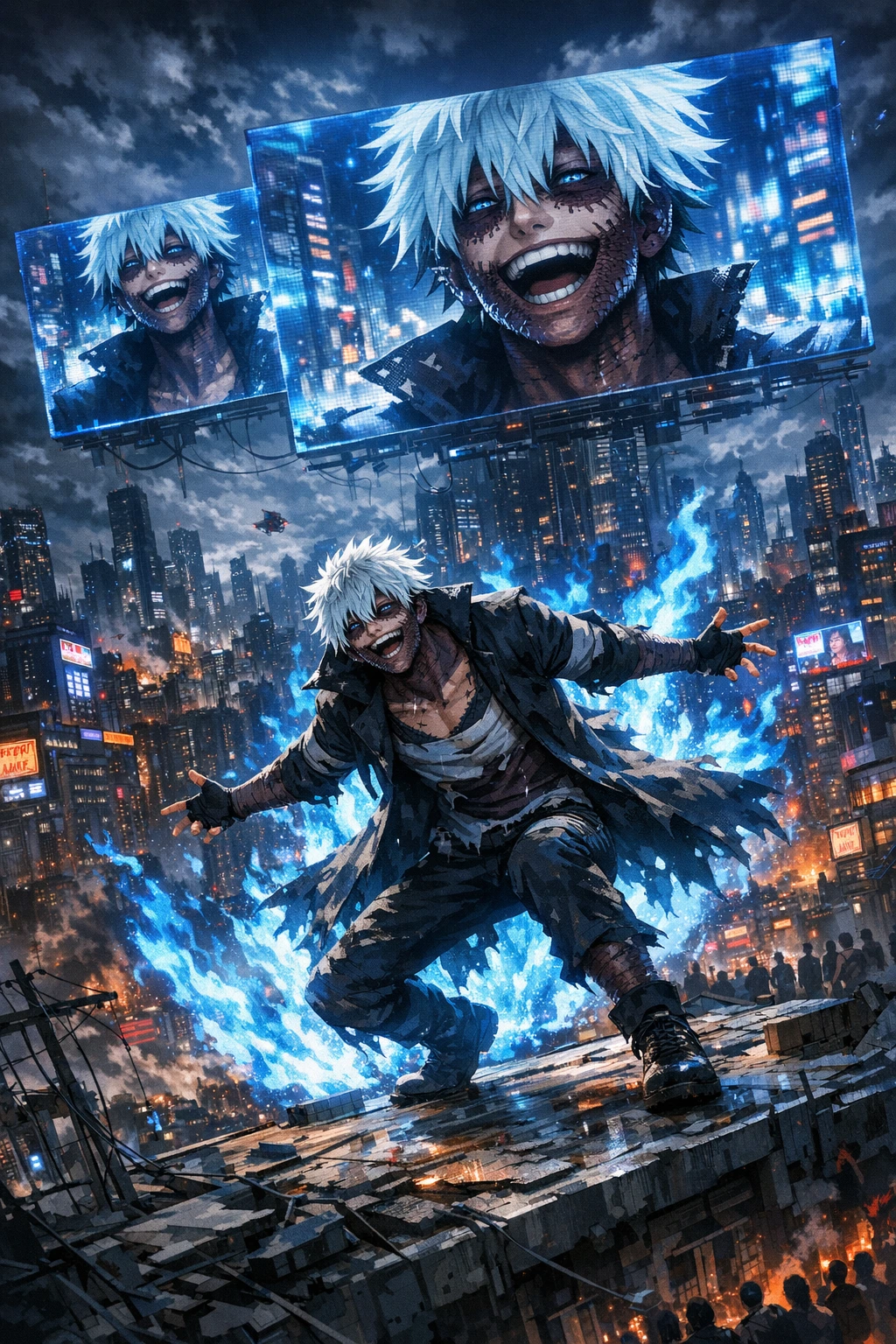
The attack was not physical; it was a broadcast. Mid-battle, standing on the back of the gigantic villain Machia, Dabi washed the black dye from his hair, revealing the stark white locks of the Todoroki bloodline. Simultaneously, a pre-recorded broadcast hacked into every television, smartphone, and public screen across the entire nation of Japan.
In a terrifyingly joyful, theatrical display—literally dancing with manic, psychotic glee as he spoke—Dabi revealed his true identity: Touya Todoroki. He weaponized the truth, dropping a nuclear bomb of information on the public. He released undeniable DNA evidence linking him to the Number One Hero.
But more devastatingly, he broadcasted the entirety of his father’s dark past. He exposed the eugenics of the Quirk marriage, the brutal domestic abuse of Rei Todoroki, the psychological torture of Shoto, and his own horrific origins. He meticulously painted Endeavor not as a savior, but as a power-hungry monster whose ambition birthed a mass murderer.
The Collapse of Society
The immediate fallout of the Dabi Dance was apocalyptic. Dabi accomplished in a five-minute broadcast what villains like All For One and Tomura Shigaraki had struggled to achieve for years: the total, irrecoverable collapse of hero society. The revelation was perfectly engineered to strike at the foundational pillar of the My Hero Academia world—the absolute trust the civilian population placed in Pro-Heroes.
If the Number One Hero, the man entrusted with the safety of millions, was secretly a domestic abuser who drove his own child to become a serial killer, then the entire system was a lie. The public’s faith was completely shattered. Civilians turned against the heroes, refusing their help and taking up arms themselves, leading to massive collateral damage and anarchy.
Heroes, disillusioned and disgusted by the truth of their own leader, began retiring en masse. Dabi’s broadcast plunged the country into chaos, proving that the most destructive weapon in a world of superpowers is the ugly, unvarnished truth about those in power.
The Phosphor Awakening (The Final Burn)
The Suicidal Endgame
Following the catastrophic success of his broadcast, Dabi entered the final war arc with only one objective left: a hyper-violent, suicidal endgame. By this point in the narrative, Dabi’s physical condition defied all medical logic. His skin was completely burned away, revealing charred muscle and bone; his internal organs were failing, and his nervous system was entirely destroyed.
The sheer biological impossibility of his survival was a testament to the horrifying power of his spite. It was not a Quirk keeping him alive, nor was it medical science; it was pure, unadulterated, blinding hatred. His refusal to die before taking his father with him acted as a macabre fuel, keeping his rotting body moving long after he should have collapsed into a pile of ash. He became a living, walking manifestation of a grudge, a zombie propelled entirely by the desire to inflict pain upon his family.
The Ironic Awakening
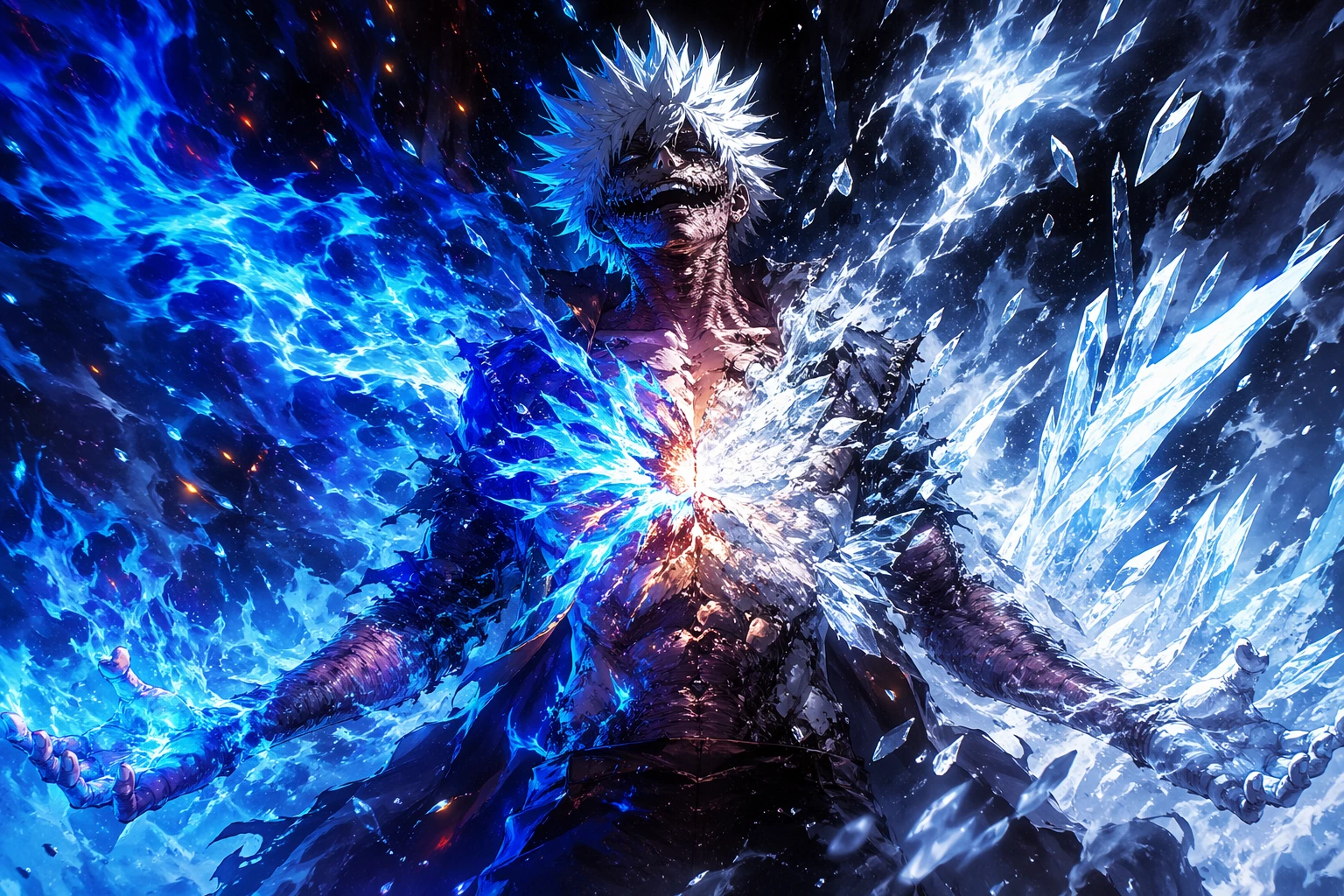
As the final battle reached its climax, with Dabi pushing his core temperature to apocalyptic levels threatening a thermal explosion that would wipe out everything in a massive radius, his body experienced its final, most tragic biological twist. At the absolute brink of total self-immolation, a new Quirk manifested within his chest: his mother’s Ice Quirk.
This awakening—dubbed Phosphor—was the ultimate, bitter irony of Touya’s existence. For his entire life, his body lacked the cooling mechanism required to wield his fire. Now, seconds away from death, his body finally activated the ice hardware he inherited from Rei.
However, this awakening did not occur to save his life or redeem him. Tragically, the ice only served to cool his core just enough to prevent his immediate death, thereby prolonging his suicide attack. The ice merely acted as a stabilizer, allowing him to burn even hotter, for even longer, maximizing the blast radius to ensure he took Shoto, Endeavor, and the entire battlefield to hell with him.
The Family Reunion
The climax of Touya’s arc is a horrific, twisted family reunion. It ends not with a grand villainous monologue, but with a family desperately trying to contain a dying, radioactive star. Shoto utilizes his masterpiece Quirk to combat the flames; Endeavor, missing an arm and completely broken, rushes to his son; and even Rei and the siblings arrive on the battlefield, utilizing their own ice Quirks to try and cool Touya’s melting body.
In these final, agonizing moments, Touya gets exactly what he wanted since he was a child. Shoto is fighting him. His siblings are there. His mother is there. And Endeavor is finally, truly looking at him, crying over the broken body of his firstborn. The tragedy is absolute: Touya Todoroki finally forced his family to look at him, to acknowledge him, and to gather around him, but he had to become an apocalyptic monster on the verge of self-destruction to make it happen.
Conclusion
The Masterpiece of Ruin
Touya Todoroki stands as the ultimate, horrifying warning against the commodification of life and the dangers of using children to fulfill the unachieved dreams of their parents. He is the dark reflection of the hero industry, a grim reminder that when society values absolute power over humanity, monsters are inevitably forged in the margins.
Dabi is not a monster born from the shadows; he is a monster forged in the blinding, suffocating light of a hero’s ambition. He is the masterpiece of ruin, a testament to the fact that when a child is treated as a defective tool, they will eventually return to break the hands of the one who wielded them.
Closing Thoughts
In authoring the saga of the Todoroki family, Kohei Horikoshi crafted one of the most compelling, psychologically complex, and deeply tragic narratives in modern anime history. Dabi’s arc is a masterclass in writing a villain whose anger is completely, undeniably justified, yet whose actions are utterly irredeemable. He is a victim of severe abuse who transformed into an abuser of society.
By tying Dabi’s personal vendetta so intrinsically to the systemic flaws of the overarching world, Horikoshi created a character whose very existence shattered the foundations of My Hero Academia. Touya Todoroki burned his own life away, but in the process, he successfully illuminated the darkest, ugliest truths of a world that desperately wanted to look away.