
I. Introduction: The Footsteps of Doom
The Rumbling’s true cost in Attack on Titan.
It begins not with a shout, but with a tremor. A vibration in the earth that defies geological explanation, originating from the center of a small island but spreading outward like cracks in a frozen lake.
Then comes the heat—a suffocating, blistering rise in temperature that turns moisture into steam and air into a scorching blanket, signaling the arrival of something unnatural.
Finally, the sound arrives: a rhythmic, thunderous cadence of millions of footsteps, synchronized in a march that signals not just an invasion, but the end of history itself.
The Rumbling in Attack on Titan is widely regarded as one of the most terrifying climaxes in modern fiction, not merely for its visual spectacle, but for its absolute, unyielding finality.
When Hajime Isayama penned the final arc of his magnum opus, he moved the goalposts of the genre entirely. We were no longer watching a shonen protagonist fight for freedom against mindless monsters; we were witnessing a Greek tragedy escalate into a global extinction event. The scale shifts from the tactical defense of a city to the strategic obliteration of a planet.
The Rumbling acts as the ultimate philosophical litmus test of the series, and perhaps of the audience itself. For years, fans and critics have debated the “Why.”
Why did Eren do it? Was it determinism? Was it rage? Was it love? Was it the only way? But focusing exclusively on the “Why” distracts us from the far more horrific reality of the “What.” The motivation of the perpetrator is relevant, but the reality of the victim is absolute.
To understand the true weight of Attack on Titan, we must look away from Eren Jaeger’s pained expression and look instead at what lies beneath his feet. We must calculate the butcher’s bill with a cold, forensic eye.
We are not asking if the Rumbling was strategically necessary for Paradis’s survival; we are deconstructing what it cost to buy that survival.
We are measuring the price in gallons of blood, in the erasure of cultural heritage, in the collapse of ecological stability, and in the irreversible fracture of the collective human soul.
This is the autopsy of a world. It is an examination of what happens when the weapon of last resort is actually fired, and the “mutually assured destruction” becomes simply “destruction.”
II. The Mathematics of Massacre: 80% of Humanity
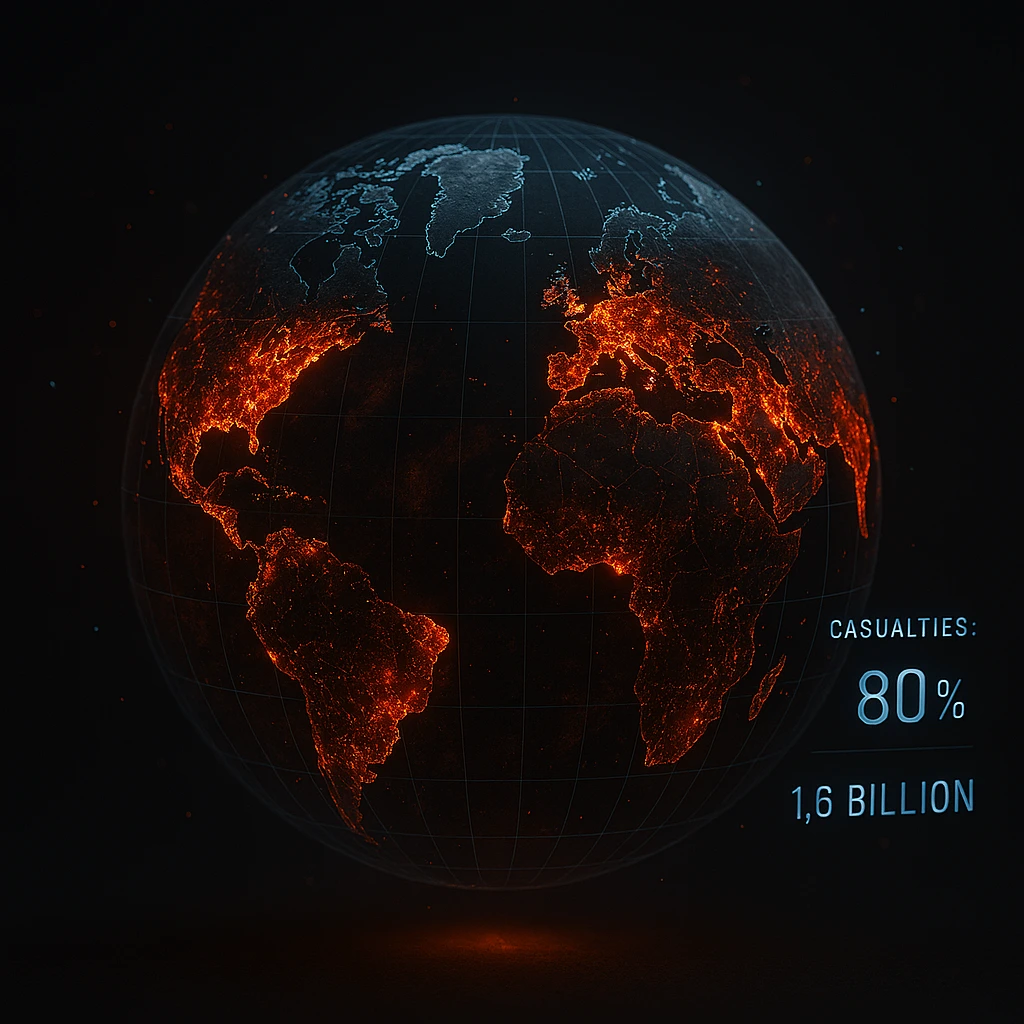
The number is thrown around in the finale with a chilling casualness: 80%.
Eren Jaeger killed 80% of humanity. In the context of a story, it is a statistic, a number on a page. In the context of reality, it is a horror beyond human comprehension.
To truly grasp the weight of this, we must apply demographic and historical analysis to the world of Attack on Titan to understand the sheer scale of the necropolis Eren constructed.
The Demographics of Extinction
Based on the technology and geopolitical scale of the Attack on Titan world, which mirrors our early 20th century—specifically the interwar period of the 1920s—we can estimate the global population.
In our timeline, the world population in the 1920s was approximately 2 billion. If we apply this metric to Isayama’s world, the total population would hover around that same 2 billion mark.
This means the 80% casualty rate translates to approximately 1.6 billion dead. It leaves only 400 million survivors scattered across the ruined earth, largely traumatized and displaced. To put this in perspective, the combined death toll of World War I and World War II in our history is roughly 100 to 120 million.
Eren Jaeger’s Rumbling inflicted a death toll 13 to 15 times higher than the two worst wars in human history combined, and he did it in a matter of days. This is not war. This is omnicide. It is comparable only to geological extinction events, like the Toba catastrophe or the asteroid impact that ended the Cretaceous period.
The Loss of Genetic and Cultural Diversity
Beyond the raw numbers lies the loss of human diversity. When 80% of the population is wiped out, we are discussing a genetic bottleneck event. Entire haplogroups, unique genetic lineages that had evolved over tens of thousands of years, would be snuffed out instantly.
The survivors would represent a fraction of the human genome, potentially leading to long-term health consequences for the species.
Culturally, the loss is even more profound. Consider the layout of the Attack on Titan map, which is an inverted map of our world. The Rumbling swept across the equivalent of Africa, the Middle East, Europe, and parts of Asia and the Americas.
Hundreds, perhaps thousands, of dialects and languages were silenced instantly. The oral histories of tribes who never wrote down their legends, the literature of developed nations, the unique musical traditions of specific regions, and the poetry of entire ethnic groups were vaporized.
Furthermore, the technological regression is absolute. The universities, laboratories, and archives of the outside world were flattened. Medical advancements, architectural blueprints, and engineering breakthroughs that could have propelled humanity forward are gone.
The world has been effectively bombed back into the Dark Ages. Even cultural art was not spared. Museums, cathedrals, temples, and ancient wonders—the equivalent of the Pyramids, the Louvre, or the Hagia Sophia—were crushed into dust. There is no rebuilding these. They are not damaged; they are erased from memory and history.
The Indiscriminate Slaughter
The most damning aspect of the “Mathematics of Massacre” is the indiscriminateness of the Wall Titans. The Rumbling did not target military bases. It did not carry smart bombs. It was a rolling wall of superheated flesh that walked over everything without prejudice.
This slaughter included Eldian sympathizers, such as the Restorationists and human rights groups in other nations who were fighting for Eldian rights. These people, who risked their lives to advocate for Eren’s people, were crushed by the very “god” they prayed for.
It includes oppressed minorities like the Mid-East Alliance and other nations conquered by Marley, who were victims of the same imperialism as Paradis and yet were slaughtered just the same.
Most tragically, it includes the innocents. The scene of the baby being passed through the crowd on the cliffside is the defining image of this slaughter. That baby had no concept of history, no knowledge of King Fritz, no understanding of the Eldian Empire, and no hatred in its heart.
Yet, it was pushed off a cliff to escape the heat. Eren’s logic of “saving his people” necessitated the murder of millions of other “peoples” who had never lifted a finger against Paradis. Mathematically and morally, the Rumbling is the single most inefficient and destructive method of conflict resolution imaginable.
III. The Ultimate Trolley Problem: Utilitarianism vs. Existence
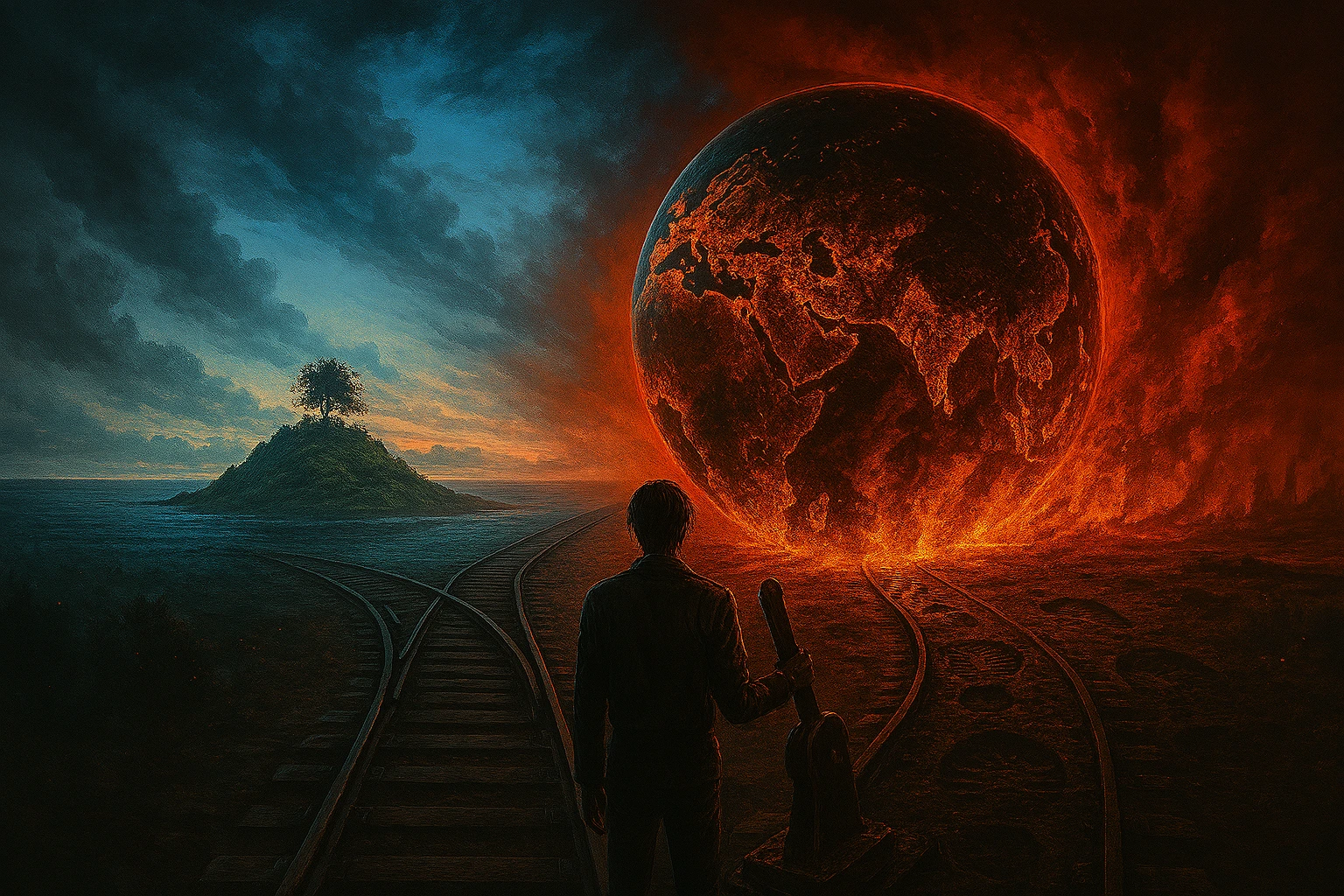
The Rumbling recontextualizes the famous “Trolley Problem” into a global scenario where the tracks are laid over continents.
The lever is in Eren’s hand, but the ethical frameworks guiding the characters represent the two dominant schools of moral philosophy: Utilitarianism and Deontology/Radical Preservation.
The Binary Choice: Us or Them
Eren viewed the world through a binary lens, exacerbated by the failure of diplomacy. The Declaration of War by Willy Tybur confirmed Eren’s worst fear: the world would not stop until Paradis was destroyed.
He saw only two tracks. Track A was to do nothing, or stick to the 50-year plan, meaning Paradis is eventually invaded, the 1-2 million Eldians die, and the 2 billion people of the world live.
Track B was to pull the lever and unleash the Rumbling, ensuring the world dies while the people of Paradis live.
This binary was not entirely natural; it was engineered. Eren, through his access to future memories, felt trapped by a deterministic timeline.
However, the choice to adhere to that timeline was still his. He rejected the “middle ground” options because they required gambling with Paradis’s future, a gamble he was unwilling to take.
Hange and Armin: The Burden of Utilitarianism
Hange Zoë and Armin Arlert represent the Utilitarian perspective: The greatest good for the greatest number.
For Hange, the math was inescapable. “Genocide is wrong,” she declares. It is a simple, absolute statement that brooks no argument.
Even if stopping Eren meant the doom of Paradis, Hange could not ethically justify the slaughter of the global population to save a single island.
This is the noble, yet tragic, stance of the idealist. It accepts self-sacrifice to preserve the majority of the species. It puts the “humanity” in “human rights” above the “nation” in “national security.”
Armin’s horror stems from the realization that they have become monsters to fight monsters. He argues that there must be a middle path—dialogue, partial Rumbling, deterrence.
But Utilitarianism fails in the face of existential hatred. You cannot calculate the “greatest good” when one side refuses to acknowledge the other’s humanity.
Armin is forced to realize that his intellect, his greatest weapon, is useless against the brute force of a god who refuses to listen.
Eren and Floch: Radical Preservation
Eren and Floch represent a dark twist on Deontology and Tribalism: My duty is to my people, regardless of the consequences.
Floch Forster is the embodiment of fear turned into fascism. His logic is unassailable to those terrified of death: “The world wants us dead. We have the gun. Why shouldn’t we fire it?” It is the logic of the cornered animal, the logic that justifies any atrocity in the name of survival.
Floch transforms from a coward who survived a suicide charge into a tyrant who executes dissenters, proving that the victim can easily become the oppressor given enough power.
Eren’s philosophy, however, is more complex. It rejects the Utilitarian calculus entirely. To Eren, numbers don’t matter. The right to exist is absolute. If the world denies his right to exist, he denies the world’s right to exist. It is a rejection of the “Greater Good” in favor of the “Immediate Self.”
This is exemplified by his rejection of Zeke’s plan. Zeke’s Euthanasia Plan was the twisted middle ground—a Utilitarian genocide that would have saved the world by slowly removing the Eldians without violence. To Eren, this was unacceptable because it surrendered the concept of birthright. “Because I was born into this world” is his counter-argument to Zeke’s nihilism.
The Missing Middle Path
The tragedy of Attack on Titan is the systematic destruction of the middle path. Isayama writes the story to methodically close every door except the Rumbling.
Diplomacy failed at the global forum where Eldians were designated the root of all evil. Technology failed because Paradis was 50 years behind and couldn’t catch up in time to fight a conventional war. Alliances failed because nations like Hizuru were only interested in resources, not true defense.
This narrative construction forces the “Trolley Problem” into a scenario where the lever had to be pulled or ignored. There was no third option to derail the train. By removing the viability of peace, Isayama forces the reader to confront the extremity of the situation: when pushed to the absolute edge, does a nation have the right to destroy the world to save itself?
IV. The Ecological Collapse: A World Reduced to Ash
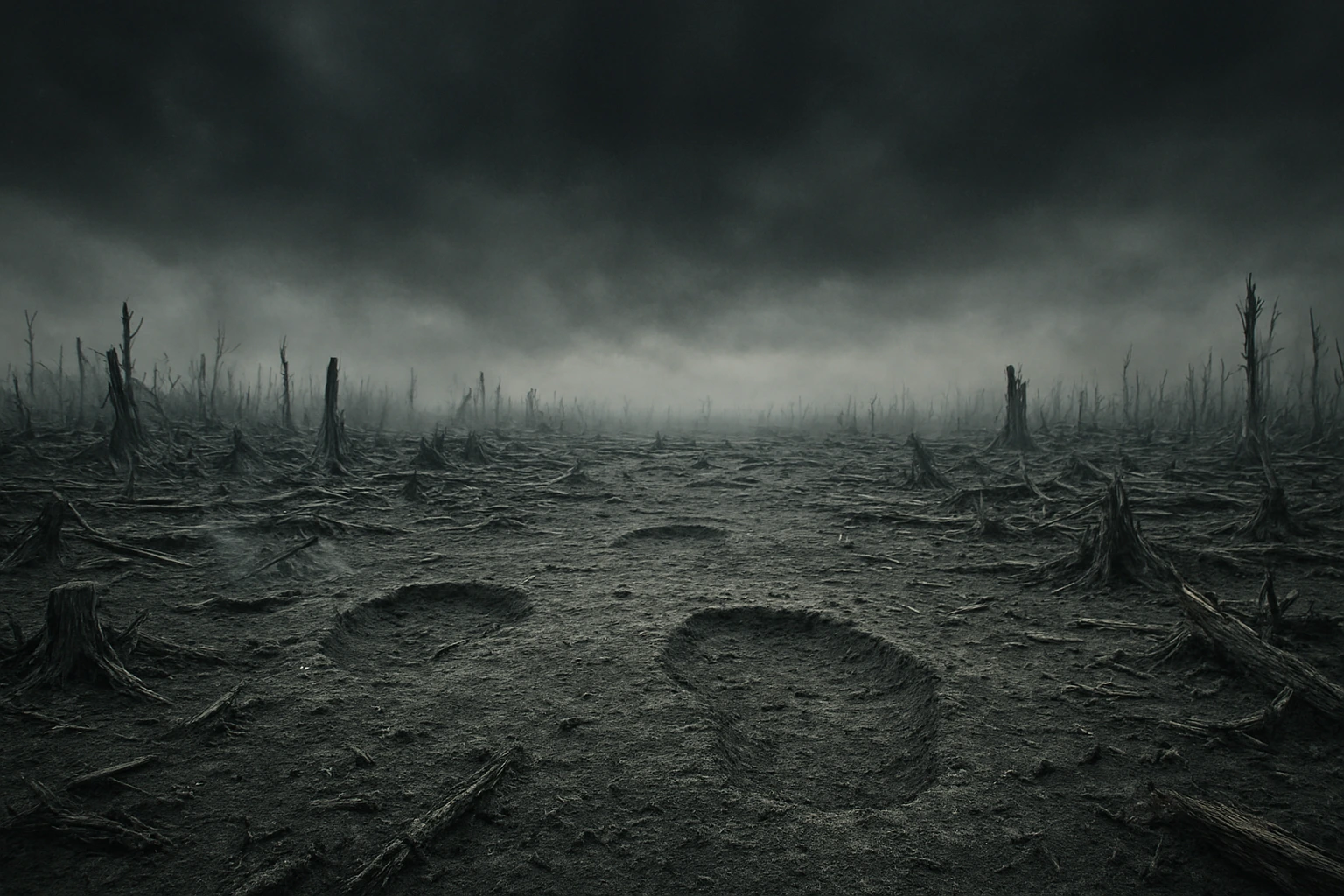
Most analysis of the Rumbling focuses on human death. This is a mistake. The Rumbling is an environmental cataclysm that effectively sterilized the planet.
The Colossal Titans are not just big soldiers; they are walking thermal reactors that fundamentally altered the biosphere.
The Thermodynamics of Hell
The physics of the Wall Titans implies that they emit massive amounts of heat. We see this when they swim; the water boils around them.
When millions of these titans swim across the ocean, the thermodynamic impact is catastrophic. The immediate water around the Titans would boil, killing marine life instantly—whales, fish, and coral reefs would be cooked alive.
However, the damage extends beyond the heat. The decomposition of billions of marine organisms would release massive amounts of methane and sulfur.
Furthermore, the massive release of carbon and debris from the burning land masses into the ocean would alter the pH balance, leading to rapid acidification.
This would cause a global die-off of phytoplankton, the microscopic organisms responsible for producing 50% to 80% of the world’s oxygen. By destroying the ocean, Eren risked suffocating the survivors on land.
The Flattened Earth and “Nuclear Winter”
On land, the situation is even more dire. The Rumbling trampled forests, jungles, and taigas. With vegetation trampled and burned, the photosynthetic capacity of the planet drops by 80%, leading to a massive spike in atmospheric CO2. The destruction of the world’s carbon sinks (forests) means the planet cannot regulate its own temperature.
Additionally, the smoke from burning cities and forests—an amount of particulate matter akin to a supervolcanic eruption—would ascend into the stratosphere, blocking out the sun. This creates a “volcanic winter” or “nuclear winter” effect.
Temperatures would plummet in the months following the Rumbling. Crops in the surviving 20% of the world (and on Paradis) would fail due to lack of sunlight. The survivors of the footprints would likely starve to death in the freezing darkness that followed.The Irony of “That Scenery”
In Chapter 131, Eren looks down at the clouds and calls it “Freedom.” He dreamed of a world of “Fiery Water” and “Lands of Ice.”
The cruel irony is that by triggering the Rumbling, Eren destroyed the very beauty he sought to explore. The Forests of Giant Trees were burned to ash. The Snowfields were covered in black soot. The Oceans were filled with rotting carcasses and debris.
Eren sought an untouched, blank canvas, a world like the book Armin showed him. He achieved it not by finding a new world, but by scraping the life off the old one. He left the remaining 20% of humanity to starve in a broken ecosystem. The “Freedom” he bought is a cage made of ash, a barren rock floating in space.
V. The Psychological Cost: The Soul of the Executioner
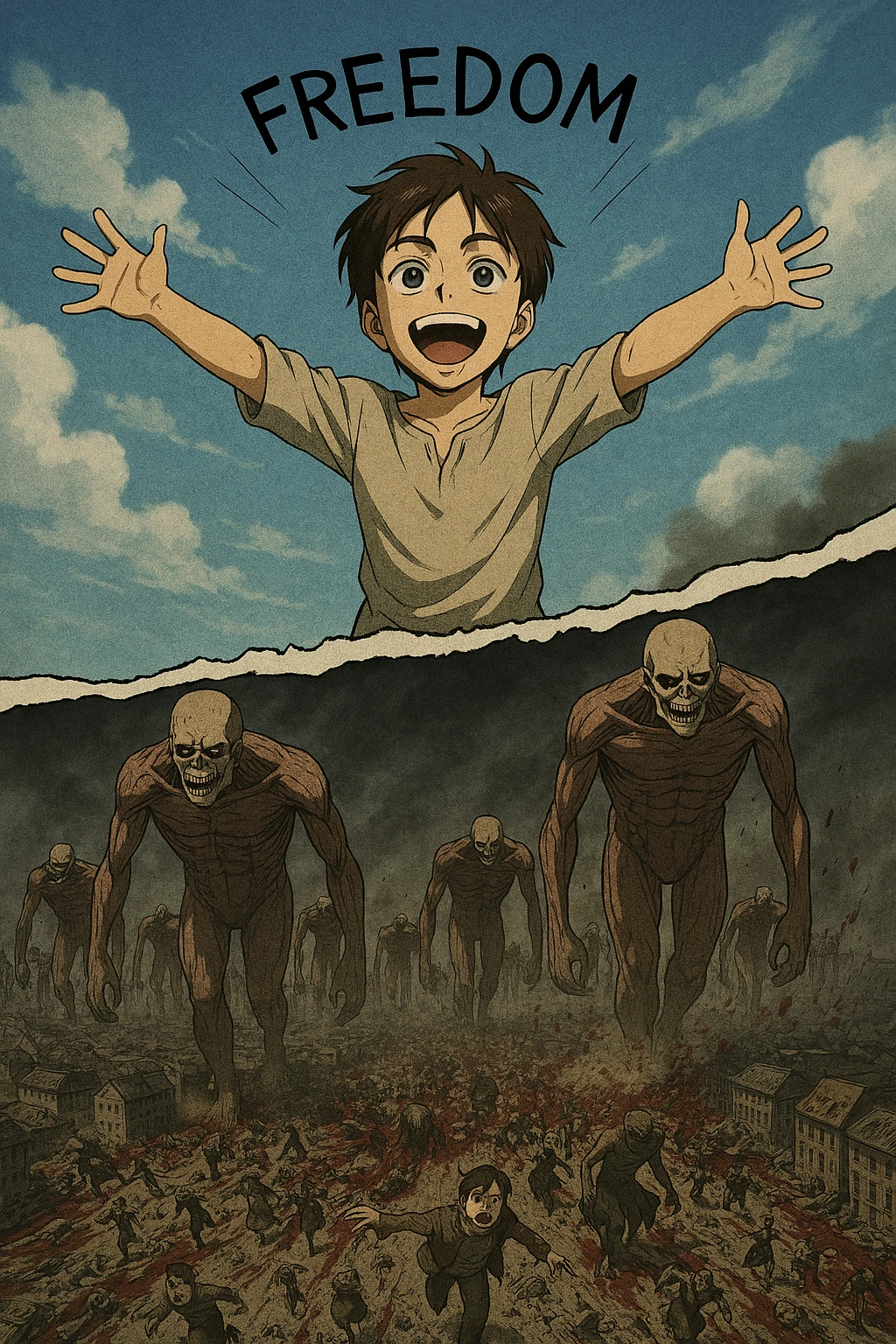
If the physical cost is extinction, the psychological cost is the total erosion of the self. The Rumbling destroys the victims, but it also obliterates the soul of the perpetrator.
The Regression of Eren Jaeger
Chapter 131 reveals the terrifying truth of Eren’s mental state. As the Titans crush men, women, and children, we see Eren soaring above the clouds, arms spread, with a child’s face, shouting “Freedom!”
This is a psychotic break. The reality of what he is doing—feeling the crunch of bodies beneath the Titan’s feet through the link—is too much for the human mind to process. To cope, Eren regresses to a child-like state of dissociation.
He retreats into the abstract concept of “Freedom” because the concrete reality of “Genocide” would break him instantly. He cannot look at the ground; he can only look at the sky. This regression highlights that even the perpetrator cannot withstand the weight of his own actions.
The “I’m Sorry” Moment
The most critical scene in the final arc is Eren’s confession to Ramzi. He collapses in front of the boy, sobbing. “It’s to save Eldia… but it’s more than that. When I learned that humanity lived beyond the walls… I was so disappointed.”
This admission changes everything. It wasn’t just survival. It wasn’t just for his friends. Deep down, a dark, selfish part of Eren wanted the world to be empty. He wanted the world to match the book Armin showed him—a world without people, a world of infinite potential and no enemies.
Here, Eren realizes he is worse than Reiner. Reiner broke the wall to save the world, driven by brainwashing and the desire to be a hero. Eren destroyed the world to satisfy a childish, nihilistic disappointment. He is the ultimate monster because he is fully aware of his selfishness and proceeds anyway.
The Corruption of the Victim
The psychological rot extends to the populace of Paradis. The Yeagerists cheering for the Rumbling represents the corruption of the victim. They have been abused for a century, lived in fear of Titans, and watched their loved ones be eaten. Now, they have the power. Their cheers are not of victory, but of hysterical relief mixed with vengeance.
But in cheering for the slaughter of children outside the walls, they lose the moral high ground they once held. They become the Marleyans they hated. Isayama shows us that trauma does not make you noble; it often just makes you dangerous. The cycle of abuse is completed when the abused becomes the abuser on a grander scale.
VI. The Geopolitical Vacuum: A Broken Future
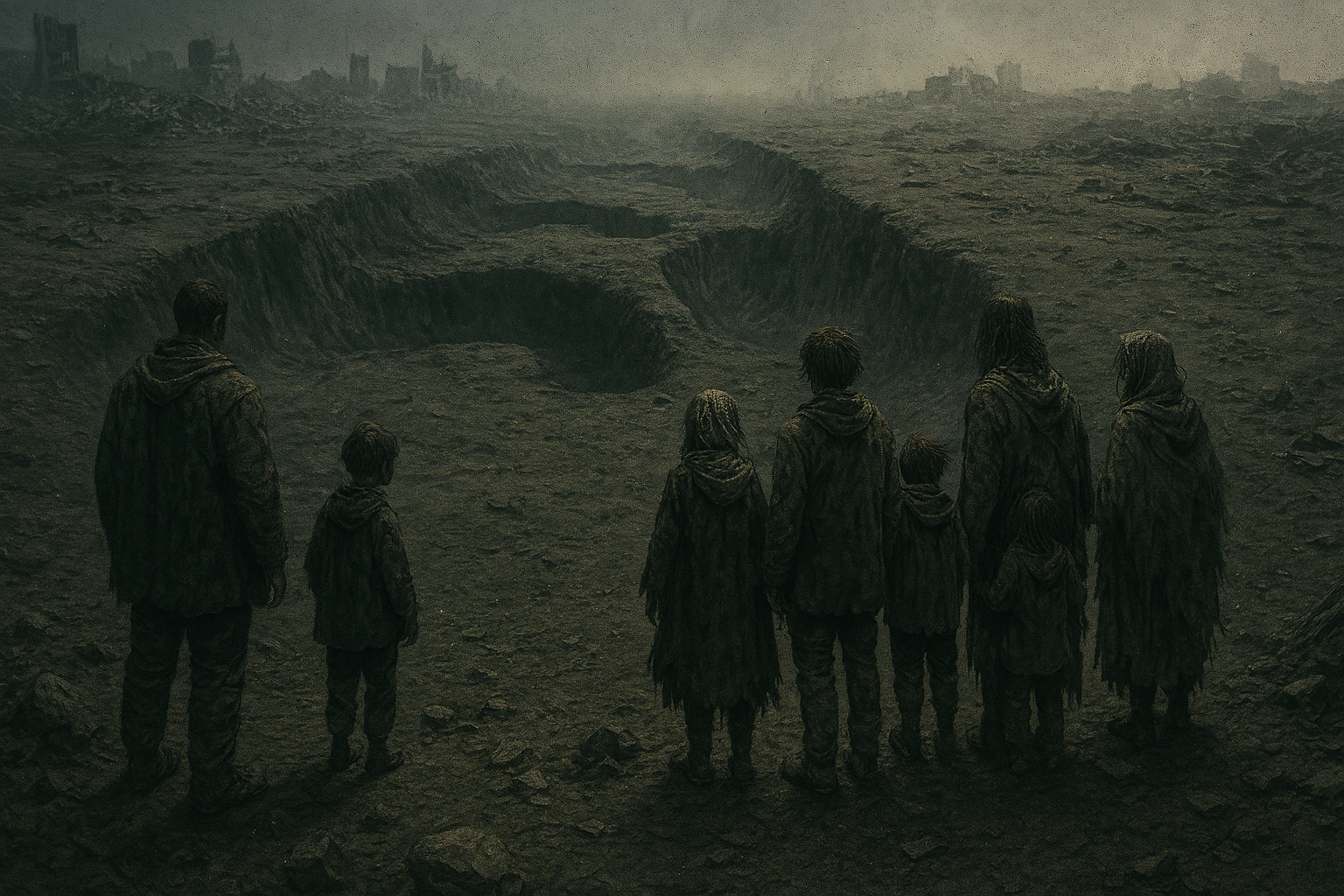
When the dust settles, what is left? The Rumbling was supposed to secure a future for Paradis, but the geopolitical reality it creates is unstable and terrifying.
The Power Balance
The Global Alliance is gone. The navies of the world are sunk. Paradis is, momentarily, the only armed superpower on Earth. However, this is a pyrrhic advantage. The island faces technological isolation; it remains an island of 19th-century tech in a destroyed world, unable to trade for oil, steel, or expertise because they killed their trading partners.
Furthermore, internal civil war looms. With no external enemy, the factions within Paradis (Yeagerists vs. Moderates) will turn on each other. We see this hint in the finale as the Yeagerists form a militaristic fascist government that silences dissent. A nation built on the foundation of omnicide cannot easily transition to a peaceful democracy.
The Helix of Hatred
The cycle of hatred was not broken; it was condensed. The survivors—the 20%—now have a legitimate, undying reason to hate Eldians. Before, the hatred was based on ancient history and propaganda. Now, it is based on the living memory of the apocalypse.
Every person left alive outside the walls saw their family crushed by an Eldian devil. That trauma will breed a hatred far more potent and justified than Marley’s indoctrination ever was. This leads to the inevitable retaliation confirmed in the extra pages of the manga.
Years later, perhaps centuries, Paradis is carpet-bombed into oblivion. The Rumbling did not end the war; it merely bought a ceasefire.
By raising the stakes to extinction, Eren ensured that the retaliation, when it eventually came, would be total annihilation. The world has been set back hundreds of years, but the human capacity for violence remains perfectly intact.
VII. Conclusion: The Pyre of Victory
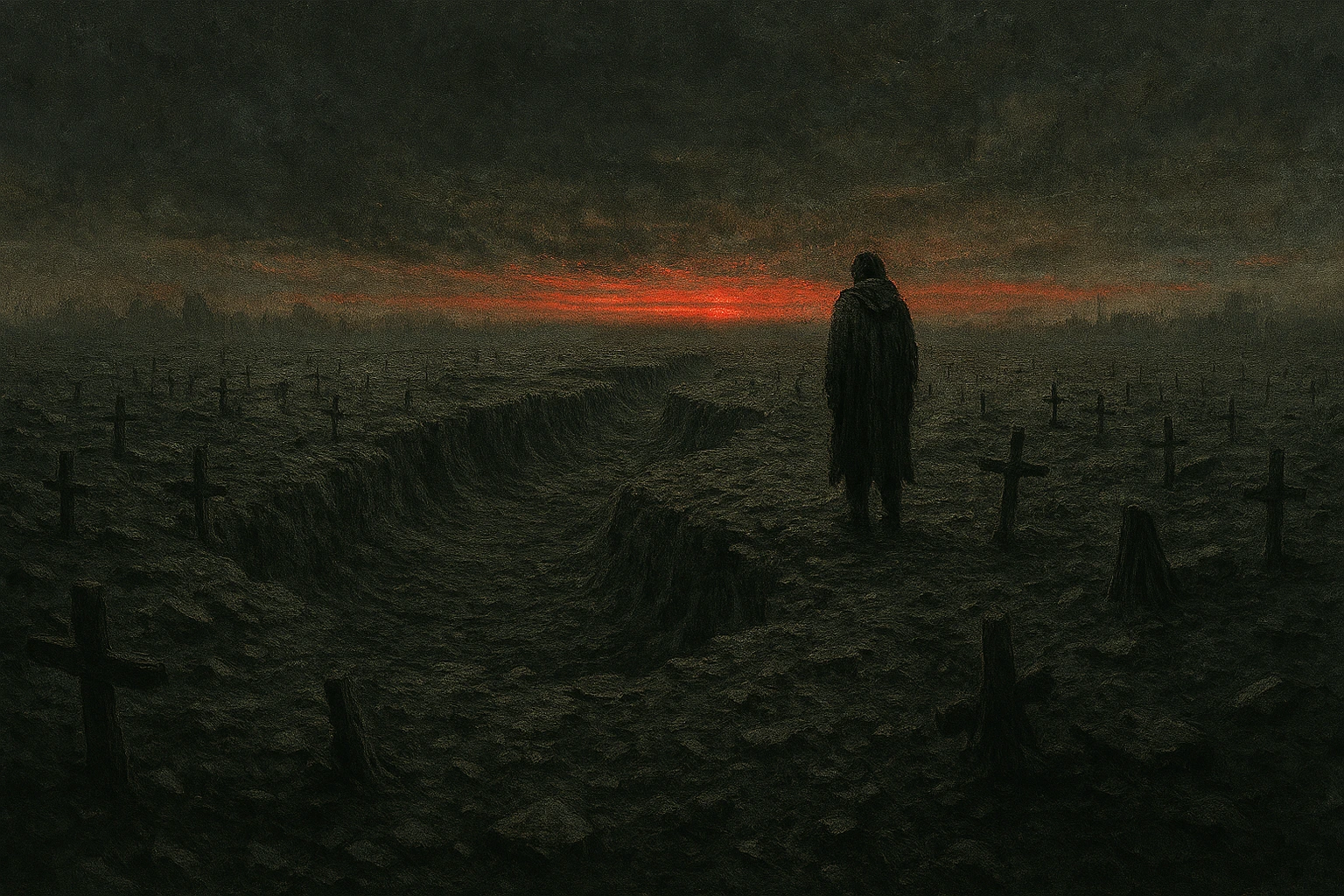
The Rumbling is the most expensive military victory in fiction. It bought Paradis time, but the currency used to pay for it was the soul of the species.
We have analyzed the death toll: 1.6 billion lives extinguished. We have analyzed the environment: A scorched earth incapable of sustaining life, with oceans boiled and skies choked with ash. We have analyzed the morality: A descent into absolute nihilism where the only law is power.
Eren Jaeger’s actions pose a question that echoes long after the final credits roll. Was it worth it? If you strip away the music, the animation, and the hype, you are left with a graveyard. Freedom obtained through genocide is not freedom; it is merely a different form of slavery. Eren lived as a slave to his destiny and died leaving his friends as slaves to their guilt. He sought to wrap a scarf around Mikasa, but to do so, he had to strangle the world.
The “Cost of Freedom” in Attack on Titan was the world itself. And in the end, as the bombs fall on Paradis in the distant future, we realize that the price was too high. The footsteps of doom did not march toward a new dawn; they marched into the night.
The Final Question
If you were standing at that lever—if you held the Founding Titan’s power—and the choice was the death of everyone you love or the death of the world…
Would you have the strength to let the train hit you? Or would you, like Eren, let the world burn?