
If the Survey Corps was a living organism, Erwin Smith was the Brain—cold, calculating, and willing to sever a limb to save the body. Levi Ackerman was the Muscle—lethal, precise, and unbreakable.
But Hange Zoë? Hange was the Heart. And in the brutal, unforgiving world of Attack on Titan, the heart is always the first thing to break.
To truly understand the tragedy of the 14th Commander of the Survey Corps, one must look past the eccentric screaming, the goggles, and the obsession with Titan anatomy. We must look at the silence that befell Hange in the final season.
We must look at the terrifying transition from a scientist who wanted to undress the mysteries of the world to a soldier forced to dress its rotting wounds.
This is the definitive Hange Zoë character analysis—an exploration of the oddball who inherited hell, the idealist who stood alone against the rising tide of fascism, and the “Spirit” of the Survey Corps who carried the heaviest burden of all: the refusal to let go of their humanity, even when the world demanded they become a monster.
I. Introduction: The Oddball Who Inherited Hell
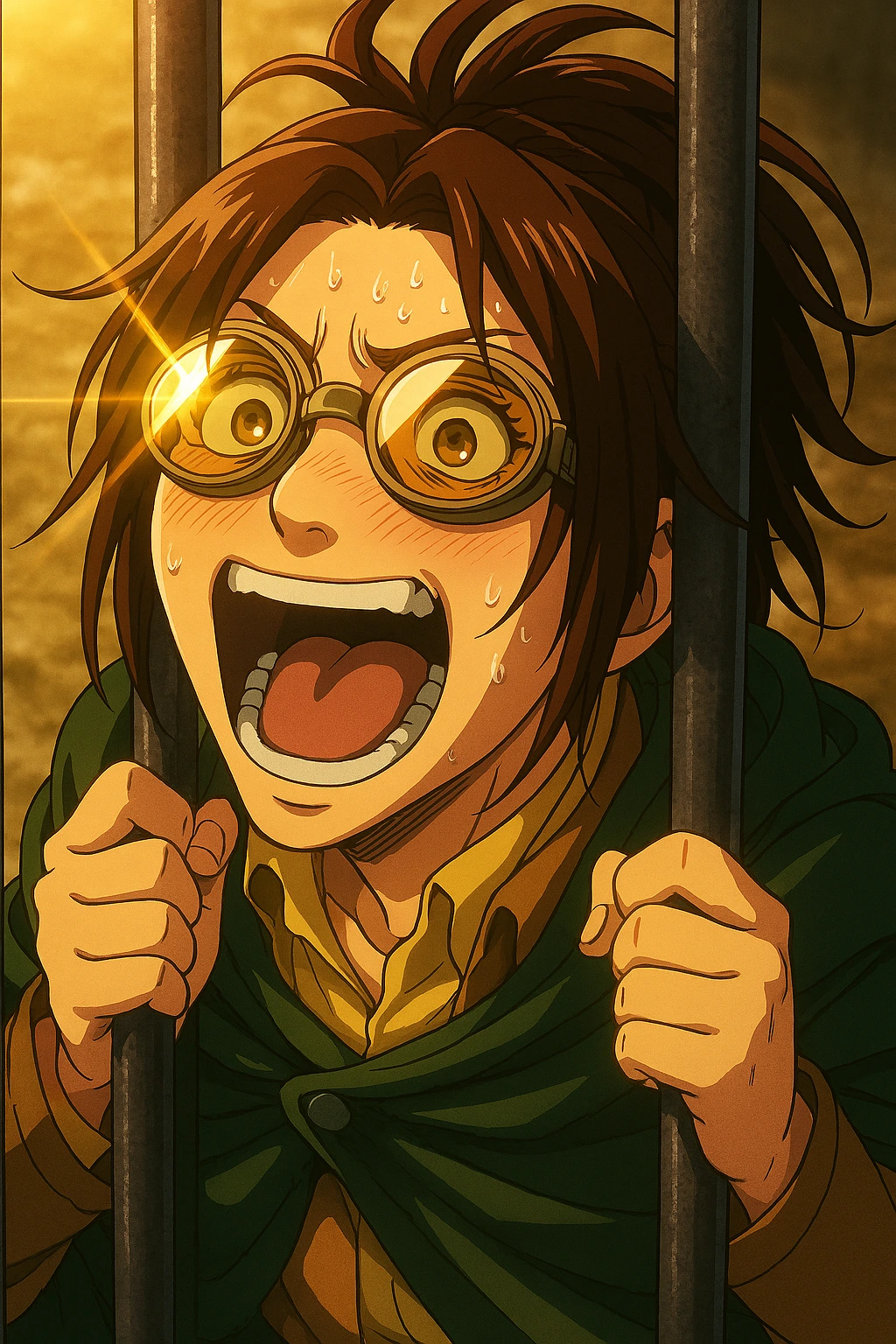
Do you remember the first time you truly saw Hange Zoë?
It likely wasn’t in a war room, a political summit, or a formation chart. It was probably outside a cage, face pressed dangerously close to the iron bars, blushing furiously while screaming about the fascinating skin texture of a captured Titan.
In the early seasons of Attack on Titan, Hange was a splash of chaotic color in a sepia-toned world of despair. While the rest of humanity looked at the Titans and saw only death, destruction, and terror, Hange saw a puzzle. While others saw monsters, Hange saw potential.
That manic, uncontainable energy was the Survey Corps’ last line of defense against total nihilism. It represented curiosity in its purest form.
It represented the human spirit’s refusal to be cowed by fear. In a world where “grim reminder” was the status quo, Hange was the only one laughing—not out of madness, but out of the sheer thrill of discovery.
The Death of Innocence
Now, contrast that vibrant image with the Hange Zoë of Season 4. The eyepatch is no longer just a battle scar from the Shiganshina retaking; it is a symbol of lost vision, a permanent reminder of the cost of the truth they sought.
The chaotic, messy hair is matted with the grime of political deadlock. The screaming excitement has been replaced by a quiet, exhausted desperation. The blush is gone, replaced by the pallor of sleepless nights spent trying to prevent the apocalypse.
Hange represents the death of innocence in Attack on Titan. The character arc is a brutal, methodical deconstruction of the “Absent-Minded Professor” trope. Hange began as the embodiment of Humanity’s desire to know—the pure, unadulterated need to understand the world beyond the walls.
But as the story progressed, the cruel machinations of geopolitical warfare forced Hange to become the Soldier—the embodiment of humanity’s need to kill.
The Impossible Succession
The tragedy of Hange Zoë is not that they died. It is that they were forced to lead in an era where curiosity was a liability.
Succeeding Erwin Smith was not just a promotion; it was a curse. Erwin died with his dream intact, charging toward the truth of the basement. He died a hero, unburdened by the complex horrors of Marley and the outside world.
Hange, however, had to live with the truth Erwin died for: that the world didn’t need to be explored; it needed to be fought. The basement didn’t hold hope; it held history—a history of hatred, blood, and cycles of revenge.
The 14th Commander of the Survey Corps was handed a crown of thorns. And while they bled with every step, seemingly stumbling where Erwin would have strode, they never once bowed to the darkness. Hange’s tenure was not defined by the victories of conquest, but by the victories of the soul.
II. The Mad Scientist: Loving the Monster
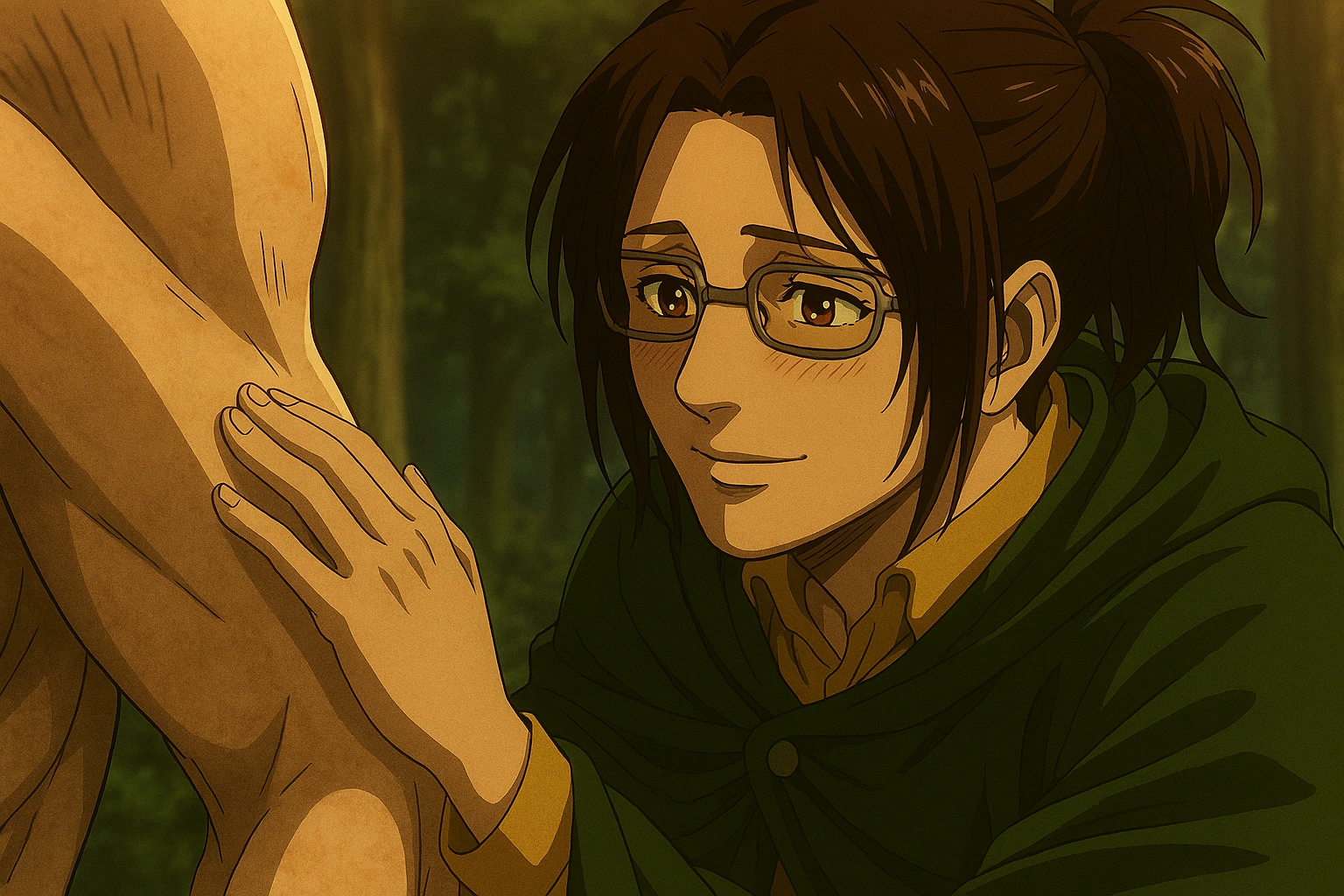
To understand Hange’s leadership—and their ultimate sacrifice—we must first understand Hange’s obsession. Why, in a world where Titans ate people alive, did Hange blush at the sight of them?
The Philosophy of “Titans are Wonderful”
The line “Titans are wonderful” is often played for laughs, but it is the cornerstone of Hange’s philosophy. It is a radical rejection of fear. Hange realized early on that hatred is a blinder. If you hate something, you cannot understand it. And if you cannot understand it, you cannot defeat it.
This was the true meaning of the “Wings of Freedom” for Hange. It wasn’t just the freedom to roam outside the walls; it was the freedom of the mind. It was the refusal to let fear dictate the boundaries of knowledge.
Hange refused to accept the Titans as “acts of God” or “demons.” To Hange, they were biological entities, and biology follows rules.
Hange’s approach was empirical empathy. By naming the Titans (Sawney and Bean), Hange bridged the gap between predator and prey. This wasn’t madness; it was a coping mechanism turned into a weapon.
By humanizing the enemy, Hange stripped them of their mythological terror. Sawney wasn’t a demon; he was a test subject who felt pain, who needed sunlight, who had limits. This demystification is what eventually led to the creation of the Titan Guillotine and the Thunder Spears.
The Invention of Hope: Science as Resistance
It is crucial to recognize that Hange did not just observe; Hange created. In the bleakest years of the war, when Paradis was technologically outmatched by centuries, Hange Zoë was the single accelerating force bridging that gap.
The development of the Thunder Spears (Thunderspears) is perhaps the single greatest turning point in humanity’s war against the Titans. Before Hange, the Armored Titan was invincible. The Colossal Titan was a god. Hange looked at the impossible durability of the Armored Titan and didn’t see despair; they saw a physics problem.
“If the blade breaks, we need an explosion. If we can’t cut, we pierce.”
This mindset—turning existential threats into engineering challenges—is Hange’s legacy. The Executioner from Hell, the automatic Titan-killing guillotine, allowed the Survey Corps to clear the Titans from Wall Maria without risking a single soldier’s life.
It was Hange who gave humanity the breathing room to finally look at the sea. While Erwin led the charge, Hange built the weapons that made the charge possible. Hange transformed science from a passive observation of nature into an active resistance against fate.
The Moblit Factor: The Tether to Sanity
We cannot discuss Hange the Scientist without mentioning Moblit Berner. If Hange was the kite flying recklessly into the storm, Moblit was the string keeping them tethered to the earth.
“Squad Leader, you’re too close!” “Squad Leader, please put on your gear!”
Moblit’s constant panic wasn’t just comic relief; it was the visualization of Hange’s reckless disregard for their own safety in the pursuit of knowledge. Moblit’s death in Shiganshina—shoving Hange into a well to save them from the Colossal Titan’s blast—marked the beginning of Hange’s true isolation.
With Moblit gone, Hange lost their safety net. There was no one left to pull them back from the edge. This loss forced Hange to become more serious, more grounded, and infinitely more lonely. The survivor’s guilt from Moblit’s sacrifice would weigh on Hange until the very end.
The Torturer’s Glove: The Loss of Innocence
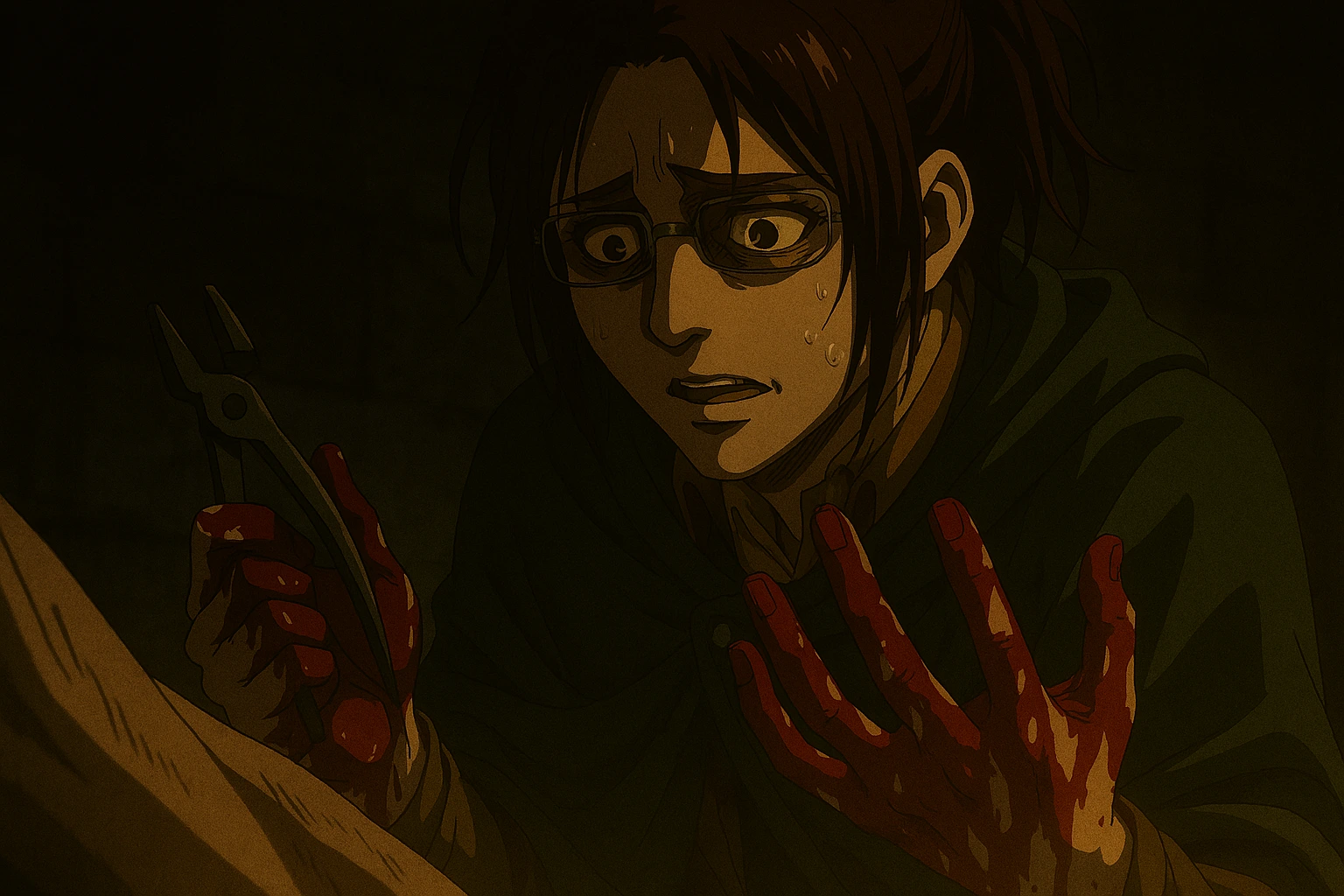
The transformation from “Scientist” to “Commander” began in the uprising arc, specifically in the torture chamber with Djel Sannes. This is a pivotal, often overlooked moment in Hange’s psychology.
Hange, the person who cried when Bean was killed, had to rip fingernails off a human being to learn the truth about the Reiss family. The scene where Hange holds the bloody pliers and looks at their own trembling hands is the death of the “fun” Hange. “I feel like I’ve touched something I shouldn’t have… something broken.”
Hange realized that the pursuit of truth was no longer innocent. It was bloody. It required becoming a monster to defeat monsters. This self-awareness sets Hange apart from Eren or Floch. When Eren commits violence, he justifies it as freedom.
When Hange committed violence, they recognized it as a sin. That moral conscience remained their compass, even when it pointed towards their own destruction.
III. The Crown of Thorns: The Struggles of the 14th Commander
“I want to bring back the Hange who had a gleam in their eye.” — Levi Ackerman
When Erwin Smith appointed Hange as his successor, he didn’t do it because Hange was the best tactician. Armin was a better strategist. He didn’t do it because Hange was the strongest soldier.
Levi held that title. Erwin chose Hange because Hange embodied the “Spirit” of the Survey Corps: the unyielding desire to understand the unknown. Erwin knew that after the basement, the Corps would need more than a general; they would need a visionary.
But Erwin could not have predicted how dark the “unknown” would be.
Destiny vs. Effort
Hange never wanted the job. This is a crucial distinction between Hange and characters like Floch, Erwin, or even Eren. Hange did not seek power. Power was thrust upon them as a duty.
Throughout Season 4, we see Hange crushed under the weight of this duty. The 14th Commander of the Survey Corps spent four years trying to find a peaceful solution for Paradis. They built railroads, forged alliances with the Anti-Marleyan Volunteers, and tried to modernize a medieval island overnight.
The Diplomatic Deadlock: A War of Words
The tragedy of the four-year time skip is often summarized as “Hange failed to find a plan.” But we must analyze why. Hange spent those years meeting with the Anti-Marleyan Volunteers and the Azumabito clan, desperate to find a path to peace that didn’t involve the Rumbling.
Hange was fighting a war on a battlefield they were never trained for: international diplomacy. The world outside the walls didn’t care about truth or understanding; they cared about resources and racial hatred.
The Association to Protect the Subjects of Ymir was a farce that only advocated for Eldians on the mainland, not the “devils” of Paradis.
Hange had to sit in meetings, smiling and shaking hands, while realized that the entire world wanted them dead. The “failure” to find an ally wasn’t a lack of trying; it was a testament to the world’s cruelty.
Hange’s desperation grew with every rejection, every failed negotiation, leading to the agonizing realization that Eren’s radicalism was gaining traction simply because the world offered no other options.
The Sunset on the Railroad: The Last Happy Memory
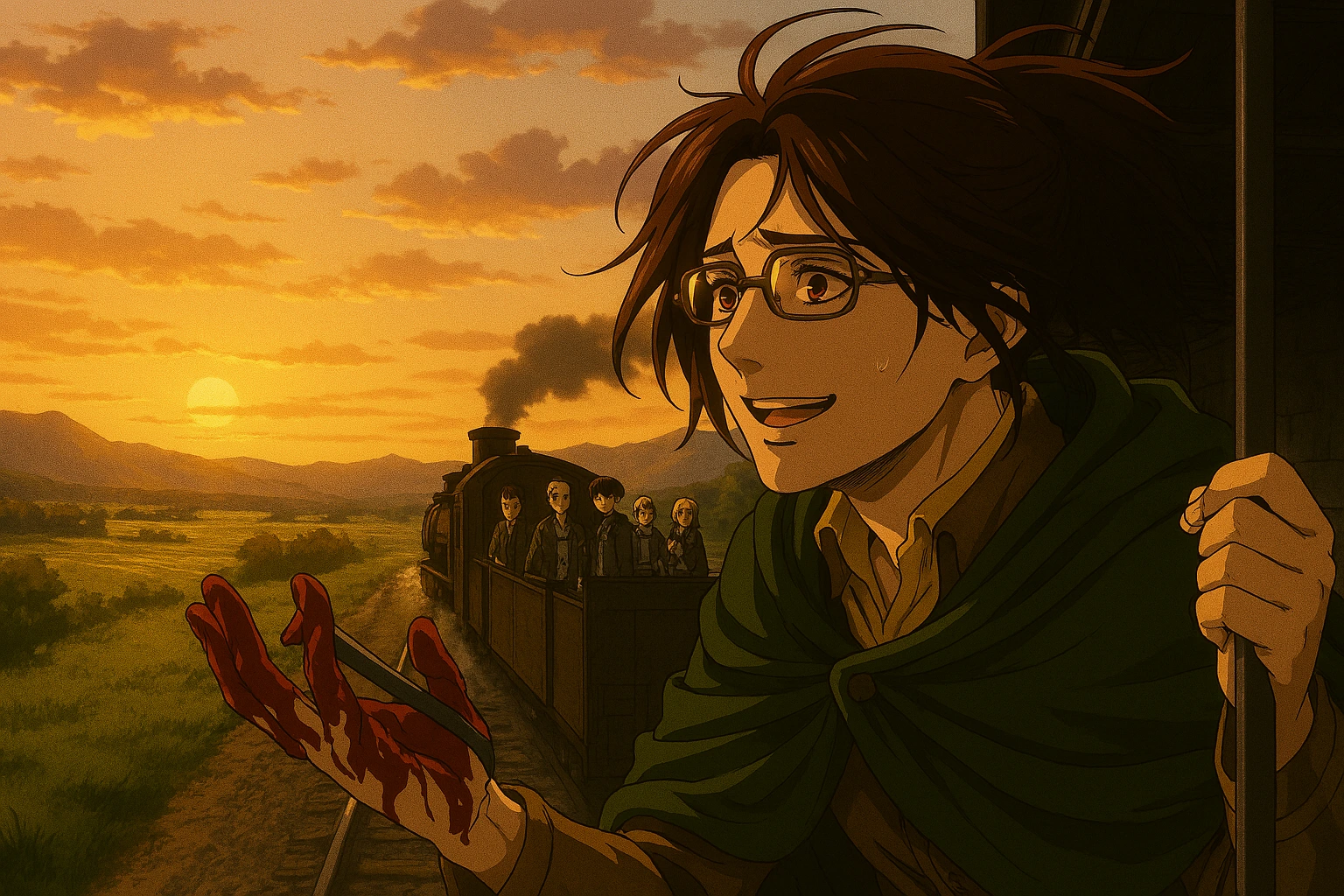
One of the most poignant scenes in the final season is the sunset ride on the newly built railroad. Hange, Levi, and the 104th squad are riding the train, celebrating the technological leap. Hange is beaming, shouting about how this metal beast will connect the districts.
For a fleeting moment, the “old” Hange returns. We see the visionary who believes technology and connection can save the world. It is the last time the Survey Corps is truly united, bathed in the warm, golden light of the setting sun. Hange looks at the tracks stretching into the horizon and sees a future of trade and connection.
But the tragedy is in the subtext. Eren is in the back, silent. While Hange sees a bridge to the future, Eren sees a vulnerability. This scene serves as a tragic anchor point—a glimpse of the “sunny” future Hange was trying to build, a future that was already dissolving into the shadows of the impending Rumbling.
The “Failure” of Hange Zoë
We must be honest about the narrative: Hange couldn’t stop Eren. Hange couldn’t stop the rise of the Yeagerists. Hange couldn’t secure a trade route or a peace treaty that guaranteed Paradis’ safety without the Rumbling.
In the prison cell scene, where Hange tries to talk to Eren and he grabs her through the bars, shouting “Fight, Fight,” we see the shattering of Hange’s authority. Eren had surpassed Hange.
The raw violence of the world had surpassed the pace of Hange’s diplomacy. The “50-Year Plan” Hange advocated for was risky, uncertain, and relied on burdening Historia—something Eren refused to accept.
Hange admits this insecurity frequently, often asking, “What would Erwin do?” This imposter syndrome is heartbreakingly human. Hange felt like a substitute teacher trying to control a class that had already set the school on fire.
The Reality Check: Morality is Not Incompetence
However, this analysis posits a counter-argument: Hange’s “failure” was not incompetence. It was morality.
Erwin Smith succeeded because his enemies were mindless monsters. He could unite humanity against a common, non-negotiable threat. Hange’s enemies were other humans. Hange’s enemy was the intricate, hateful history of the world.
To “win” in Season 4 required a willingness to commit genocide or sacrifice Historia to a cycle of breeding. Hange refused both. Hange’s “failure” was simply a refusal to discard their humanity for the sake of efficiency.
Erwin could sacrifice a hundred soldiers to save humanity. But could Erwin have sanctioned the slaughter of millions of innocent children across the sea?
We don’t know. But we know Hange couldn’t. Hange’s struggle represents the painful reality of idealism in a cynical world. Being “right” doesn’t mean you win. Being “moral” doesn’t stop the tanks.
IV. The Moral Anchor: Hange vs. Floch
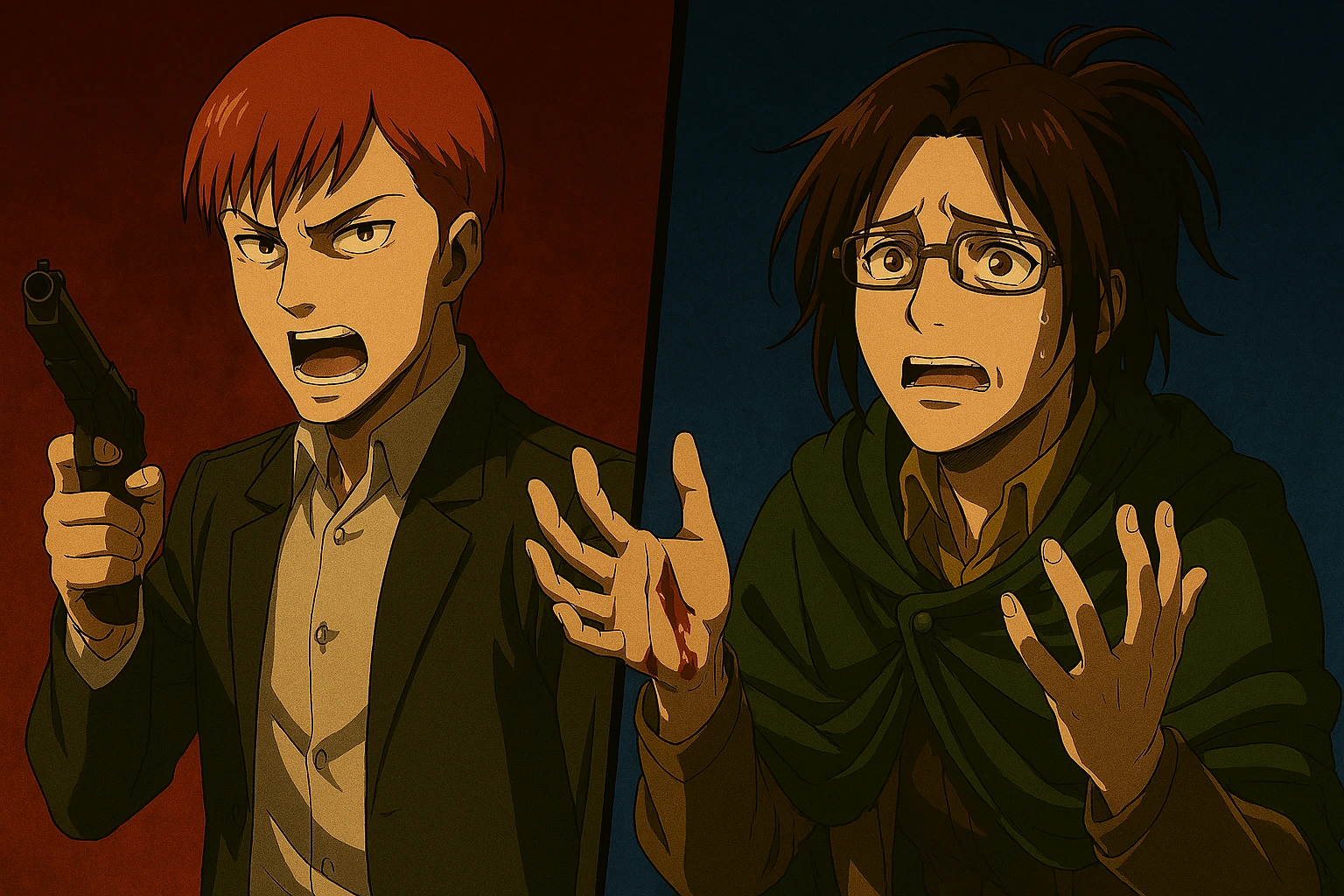
The final arc of Attack on Titan is not just a battle between Eren and the Alliance; it is an ideological war between Hange Zoë and Floch Forster.
The Two Successors of Erwin
Both Hange and Floch claim to carry Erwin’s legacy, but they represent two different interpretations of the Devil.
- Floch represents Erwin’s ruthlessness. He represents the “Devil” who will throw away his humanity to ensure his tribe survives. This is Nationalism. This is Fascism. It is “Survival at all costs.” Floch believes that because the world hates them, they must hate the world back, harder and deadlier.
- Hange represents Erwin’s curiosity and hope. Hange represents the “Spirit” that seeks to understand the world, not trample it. This is Globalism. This is Humanism. It is “Understanding despite the cost.”
This Hange vs Floch ideology clash is the defining conflict of the final chapters. Floch offers easy answers: Kill them before they kill us. Hange offers hard questions: If we kill everyone, do we deserve to live?
The Forest of Gabi and the Children
Hange’s ideology is best reflected in their treatment of Gabi and Falco. While the Yeagerists wanted to throw the Marleyan children out of the airship, and while the rest of the island wanted them dead, Hange (along with Jean and Armin) tried to keep them out of the conflict.
Hange understood Mr. Braus’s metaphor of the “Forest.” To get the children out of the forest of hatred, the adults have to stop the cycle. Floch wanted to burn the forest down with everyone inside it. Hange wanted to plant a path out.
Even when Gabi killed Sasha—someone Hange deeply cared for—Hange refused to seek vengeance against a child. This restraint is the mark of true leadership. It is the refusal to let the sins of the past dictate the actions of the future.
The Mirror of the Past: Shadis and Hange
There is a striking parallel between Hange Zoë and Keith Shadis in the final arc. Both were commanders who felt they had failed. Both were “left behind” by the radicalism of the new generation (Eren and the Yeagerists). And yet, both found their redemption in the same harbor, on the same day.
While Hange fought the Titans in the sky, Keith Shadis blew up the reinforcement train on the ground. Both members of the “old guard” sacrificed themselves not to win a war, but to save the students they raised.
Shadis cleared the path from below, and Hange cleared the path from above. It was the final, coordinated effort of the veteran generation to give the youth a chance to choose a different path than the one laid out by Eren.
The Quote That Defined a Hero
The defining moment of Hange’s command—and perhaps their life—comes in the confrontation with Jean and Mikasa regarding the Rumbling.
“Genocide is wrong! There is no reason that can justify this!”
Critics call this naïve. They ask, “What was Hange’s plan?” But they miss the point. Hange isn’t speaking as a tactician here; Hange is speaking as the moral anchor of the story.
In a world descending into absolute madness, where mass murder is being rationalized as self-defense, someone had to draw a line in the sand. Someone had to say, “No.”
Even when their island was at risk, Hange refused to abandon their humanity. This is the heaviest burden of all. It takes immense strength to fight for your enemy because you believe it is right.
Hange proved that survival isn’t worth it if the price is becoming a monster. If the Survey Corps existed to bring freedom to humanity, then trampling humanity makes a mockery of the Wings of Freedom.
Hange chose to be a traitor to the island to remain loyal to the ideals of the Survey Corps.
V. The Final Flight: Burning Bright
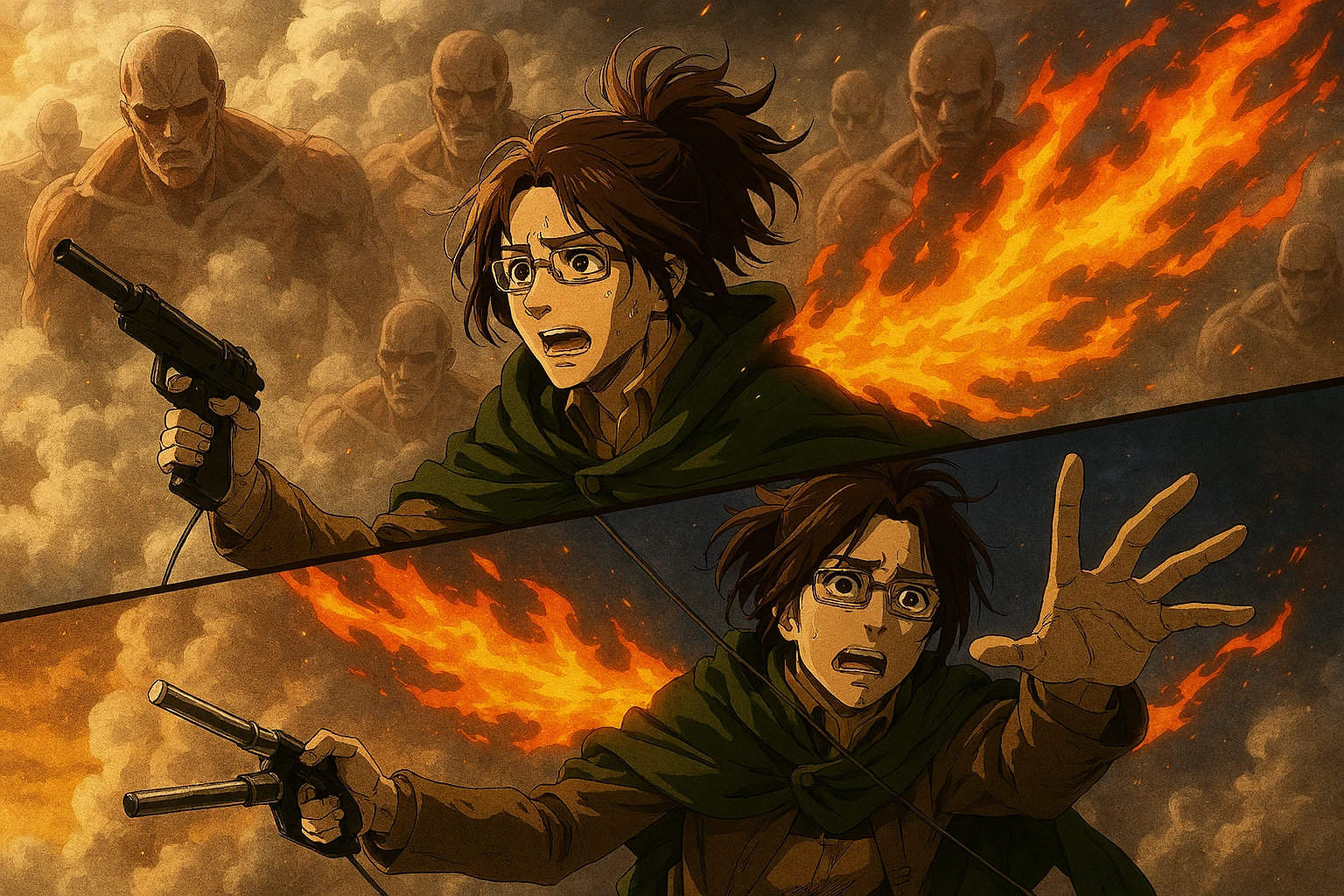
And so we arrive at the harbor. We arrive at the Hange Zoë death scene—arguably the most beautiful, poignant, and visually stunning death in the entire series.
The Context of Sacrifice
The Flying Boat needs time. The Rumbling has arrived. The Colossal Titans are marching, their heat already distorting the air, their footsteps shaking the very foundation of the earth.
Why Hange sacrificed herself is a question of both logistics and closure. Logistically, someone needed to hold back the Wall Titans for a few minutes to allow the mechanics to prep the plane. But thematically, Hange needed to go.
Hange had spent four years carrying the guilt of leadership. They had watched their comrades die, their friends turn into enemies, and their world burn.
Hange was tired. The request to Levi—”I’m counting on you”—was an abdication of the burden. It was the moment Hange finally allowed themselves to stop being the Commander and go back to being a Scout.
The Last Conversation with Levi
The interaction between Hange and Levi before the sacrifice is one of the most intimate moments in the show. Levi, the man who has lost everyone, tells Hange, “Dedicate your heart.”
It is the first time Levi says the phrase. He releases Hange. He understands that his friend is tired. He understands that this is the only way Hange can find peace—by going out on their own terms, fighting for a world they still believe in. It is a heartbreaking permission to die, given by the one person who desperately wanted Hange to live.
The Battle Against the Heat: Wings of Fire
The visuals of Hange’s final battle are breathtaking. It is a dance of fire and steel. Armed with the Thunder Spears—weapons Hange helped create—they dive into the steam of the Colossal Titans.
There is a cruel, poetic irony here. Hange spent a lifetime obsessed with Titans, wanting to get close to them, to touch them, to understand their heat. In the end, that heat is what killed them.
But this wasn’t a quick death. It was a battle of attrition against temperature itself. We see Hange’s cape ignite—the Wings of Freedom literally turning into wings of fire. We see the skin blistering, the gas in the ODM gear boiling. The pain must have been unimaginable, yet Hange kept spinning. Hange kept cutting.
“Hot… these guys are really hot,” Hange mutters. Even in death, the curiosity remained. The scientist remained. Hange didn’t die with a curse on their lips. They died with a sense of wonder. They died doing what they loved: flying, fighting, and studying the Titans.
The Symbolism of the Sacrifice
Hange took down multiple Colossal Titans single-handedly. It was a display of skill that rivaled Levi in his prime. But the true power of the scene wasn’t the violence; it was the dedication.
Hange didn’t die to kill Eren. Hange didn’t die to save the world. Hange died to buy their friends a few seconds. It was a sacrifice of pure “Effort.” It was the ultimate rejection of the “Selfish Gene.”
By sacrificing themselves, Hange passed the torch to Armin, just as Erwin passed it to Hange. But Hange gave Armin something Erwin didn’t give Hange: a chance to save the world, not just manage its destruction. Hange cleared the runway so the next generation could fly.
The Reunion: “You’ve Done Well”
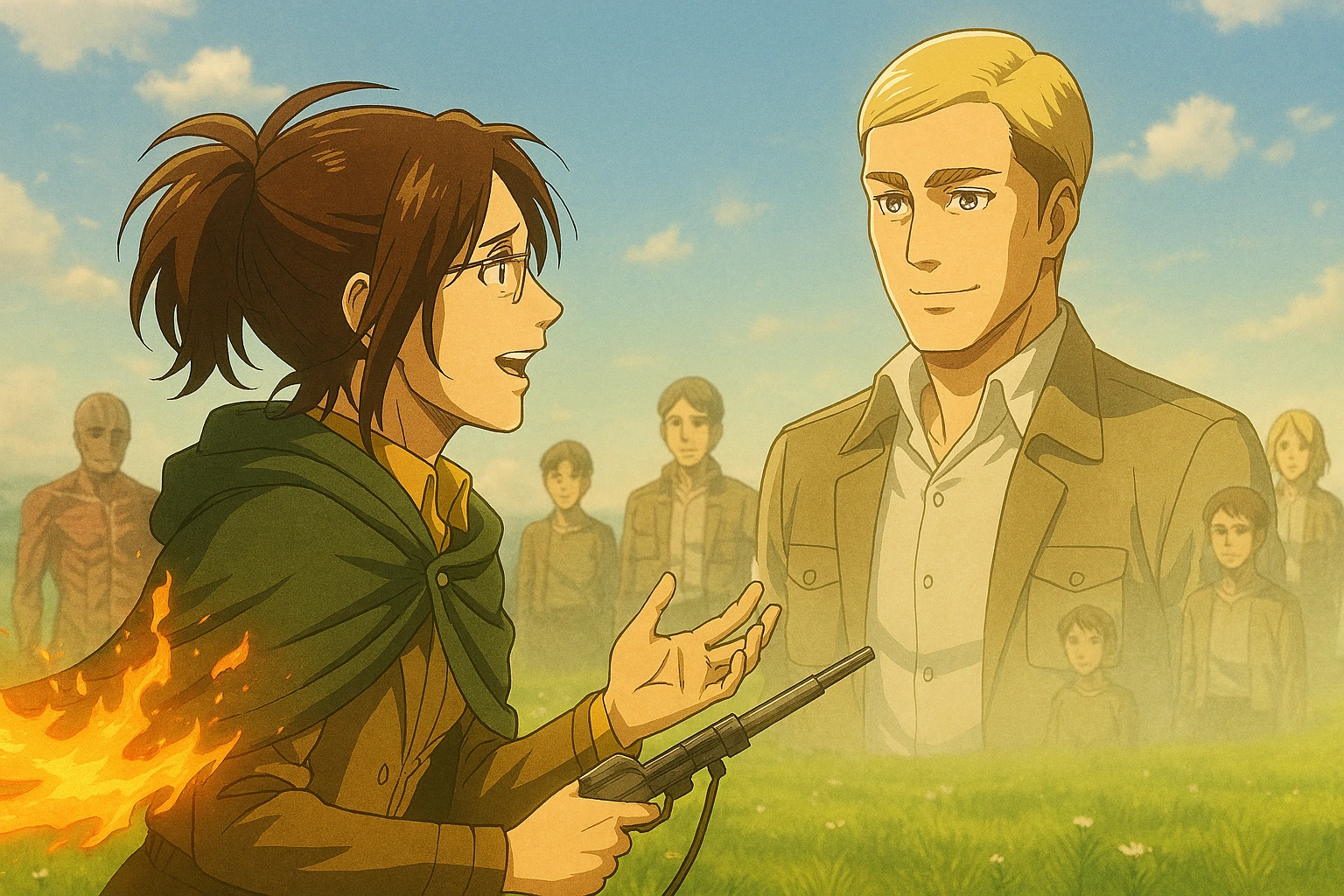
The afterlife sequence is one of the few moments of pure grace in Attack on Titan.
Hange wakes up in a crater, no longer burning. The pain is gone. The sky is blue. And standing there is Erwin Smith.
“Hange. You’ve done well.”
For four years, Hange lived in the shadow of Erwin, terrified of failing him. Hange believed they were an inferior commander, a disappointment. This reunion confirms what the audience knew all along: Hange did not fail.
Hange led the Corps through its darkest hour. Hange kept the moral compass pointing True North when the magnetic field of the world flipped. Erwin’s validation is the closure Hange desperately needed.
The surrounding crowd—Moblit offering a hand, Miche, Sasha—reminds us that Hange is finally home. The burden is set down. The oddball can rest.
VI. Conclusion: The Last Scout
The Hange Zoë gender ambiguity impact is worth a final note. Isayama never confirmed Hange’s gender, and in the end, it didn’t matter. Hange was not defined by gender roles; Hange was defined by intellect, spirit, and action.
By stripping away the gender binary, the character stands purely on merit. Hange was a mind on fire, a spirit that could not be boxed in by walls or social constructs.
The Legacy of the 14th Commander
Hange Zoë was the true embodiment of the Survey Corps.
- Erwin represented the ambition of the Corps—the drive to reach the basement.
- Levi represented the strength of the Corps—the power to survive the journey.
- Hange represented the soul of the Corps—the reason for the journey itself.
The Survey Corps was founded on curiosity. It was founded on the idea that the world is vast and unknown and worth exploring. Eren Yeager distorted that freedom into the freedom to destroy. Floch distorted it into the freedom to dominate.
Only Hange kept the original flame alive. The desire to see the world, not trample it. The desire to understand the enemy, not just exterminate them.
Hange taught us that intelligence without morality is dangerous, but morality without power is tragic. Hange walked that tragic line until the very end, refusing to compromise. Even when the world demanded a devil, Hange remained human.
In the final reckoning of Attack on Titan, when the dust of the Rumbling settles, we must remember the scientist who flew too close to the sun. We must remember the Commander who stood alone against the crushing weight of the world and shouted that genocide was wrong.
In a story of Titans, wars, and the cycle of hatred, Hange Zoë taught us that the most powerful weapon humanity has is not a Thunder Spear or a Coordinate. It is an open mind.
To help you more about it i’m adding a related article hange zoe i hope it will help full to you.
Dedicate your hearts.