
I. Introduction: The Post-Gojo Reality and the Age of Attrition
The world of Jujutsu Kaisen changed irrevocably in the span of a single chapter. The image of Gojo Satoru, the modern era’s “Strongest,” lying bifurcated on the battlefield of Shinjuku wasn’t just a plot twist; it was a paradigm shift. For over two hundred chapters, Gojo was the ceiling, the safety net, and the ultimate deterrent.
His defeat in Chapter 236 didn’t just kill a character; it shattered the hope of the protagonist faction. The psychological weight of seeing the “Honored One” fall cannot be overstated. It signaled to Yuji Itadori, Yuta Okkotsu, and the rest of the sorcerers that the era of relying on a savior was over.
For the students watching via Mei Mei’s crow-stream, the horror was palpable. They witnessed a battle of gods that defied the logic of jujutsu—changing barrier coordinates, refreshing burnout with Reverse Cursed Technique, and bending the laws of physics. When Gojo fell, the silence in the viewing room was louder than any scream. The safety rails were gone. They were no longer students protected by a teacher; they were soldiers standing on the precipice of extinction.
This marked the beginning of what the community has affectionately, and accurately, dubbed “Jump Kaisen.” However, to view the subsequent battle merely as a chaotic gang-up is to misunderstand the tactical brilliance of the High-Grade sorcerers. The Shinjuku Showdown is not a brawl; it is a meticulously calculated raid boss encounter.
It is asymmetrical warfare at its finest. The heroes recognized early on that they could not match Ryomen Sukuna in a contest of pure power. Even with his Cursed Energy output lowered and his Domain burnt out, Sukuna remains a calamity.
Therefore, the strategy shifted from “victory in a duel” to “victory through attrition.” Every sorcerer sent onto the field was not expected to win; they were expected to chip away at the King. One takes his tool; one takes an arm; one takes his heart; one takes his output. This article deconstructs the waves of the Shinjuku Showdown, analyzing the tactical brilliance of the “Suicide Squad,” the logistics of the medical retrieval team, the heartbreaking failures of key gambits, and the ultimate awakening of the Tiger of West Junior High.
II. Wave 1: The God of Lightning (Hajime Kashimo)
The Mythical Beast Amber

The first wave following Gojo’s demise was the God of Lightning, Hajime Kashimo. For the entirety of the Culling Game, Kashimo held his Cursed Technique in reserve, bound by a self-imposed Binding Vow to use it only against Sukuna. This restraint was the foundation of his strength. When unleashed, Mythical Beast Amber proved to be one of the most visually spectacular and biologically devastating techniques in the series.
The technique is a total physiological restructuring. Kashimo does not just manipulate electricity; he becomes a phenomenon. By converting his body into a manifestation of electrical signals, he transcends human limits. The technique forces his brain to process information at the speed of lightning, and his body to move via electrical currents rather than muscular contraction.
This allows him to surpass the reaction speeds of almost any living sorcerer. His offensive capabilities shift from physical punches to varying frequencies of electromagnetic waves: sound waves to shatter eardrums, X-rays to irradiate and degrade cells instantly, and high-voltage electrolysis to vaporize matter upon contact.
However, the tragedy of Mythical Beast Amber lies in its cost. It is a one-way transformation. The human body cannot sustain being turned into pure energy; the cellular structure eventually evaporates. Once the technique ends, the flesh collapses. Kashimo entered the battlefield knowing he would not leave it. It was a suicide run driven not by altruism, but by the selfish desire of a warrior to know if he was truly the strongest.
The Philosophy of Strength
Kashimo’s confrontation with Sukuna was as much a philosophical debate as a physical one. Kashimo, like Gojo, suffered from the “loneliness of the strongest.” He sought validation from Sukuna, asking if strength is a solitude that one must endure. He wanted to know if the weak were worth trampling, or if there was a different meaning to power. He saw Sukuna as the only other being who could possibly understand the isolation of the peak.
Sukuna’s answer was brutal in its simplicity. He rejected Kashimo’s romanticization of strength. To Sukuna, strength is not a burden; it is a license to do whatever one pleases. He eats when he is hungry, he kills when he is annoyed. The love or validation of others is irrelevant to a being who exists solely for his own pleasure. This ideological clash highlighted the difference between a “challenger” like Kashimo, who defines himself by his battles, and a “calamity” like Sukuna, who defines himself by his whims.
The Heian Era Transformation
Tactically, Kashimo achieved one critical objective: he forced Ryomen Sukuna’s hand. Battered by Gojo’s “Unlimited Purple” and pushed by Kashimo’s lightning speed, Sukuna was forced to initiate his reincarnation. This was a pivotal moment in the raid.
By completing his incarnation, Sukuna returned to his original Heian Era form. This functioned as a full heal for his physical body—restoring his eyes, his lungs, and his lost limbs. However, it is crucial to note that this did not refill his Cursed Energy reserves. It was a physical reset, not an energetic one. The four-armed, two-mouthed form is the pinnacle of Jujutsu sorcery. With two mouths, he can chant incantations constantly without pausing his breathing, maximizing output.
With four arms, he can perform hand signs while simultaneously engaging in hand-to-hand combat, or wield multiple Cursed Tools (had he not lost them). Kashimo fell to this perfect form, serving as the benchmark to show the world exactly what kind of monster the remaining sorcerers had to face.
III. Wave 2: The Executioner’s Blade (Hiromi Higuruma)
The One-Hit Kill Strategy

With the “God of Lightning” dead, the sorcerers deployed their most volatile asset: Hiromi Higuruma. The strategy here was arguably the most dangerous to Sukuna. While Gojo relied on brute force, Higuruma relied on the rules of the universe. His Domain Expansion, Deadly Sentencing, offered a theoretical path to victory that didn’t require overpowering the King of Curses.
The plan was a two-step checkmate:
- Obtain a guilty verdict and the death penalty from Judgeman.
- Use the Confiscation penalty to strip Sukuna of his Cursed Technique (Shrine).
- Use the Executioner’s Sword—a sword that kills anyone it cuts instantly—to end the battle in a single strike.
If successful, this would have bypassed Sukuna’s immense durability and Reverse Cursed Technique entirely. Yuji Itadori was deployed alongside Higuruma specifically to secure the “Guilty” verdict by acting as a co-defendant/witness to the massacres in Shibuya, ensuring the trial focused on Sukuna’s crimes rather than a petty misdemeanor.
The Legal Loophole and the Tragedy of Kamutoke
The failure of this plan is one of the most controversial and tragic moments of the Shinjuku Showdown. The trial proceeded, and the Death Penalty was issued. However, Confiscation did not target the “Shrine” technique (Cleave/Dismantle) nor the “Ten Shadows.”
Instead, Judgeman confiscated Kamutoke, the Cursed Tool weapon Sukuna had received from Uraume. This revealed a hidden mechanic of Higuruma’s domain: if the defendant possesses a Cursed Tool, the confiscation penalty prioritizes the tool over the innate technique. This technicality saved Sukuna. It stripped him of his lightning weapon but left him with his slashing attacks fully operational.
While some view this as luck, it reinforces the theme of the Culling Game: rules are absolute, but they are often complex and unfair. The sorcerers gambled on a legal system they didn’t fully understand, and the house won. It was a heartbreaking realization—the legal system, much like the jujutsu world, is full of loopholes that the powerful can exploit, even unintentionally.
Higuruma as a Prodigy
Despite the failure of the plan, Hiromi Higuruma cemented his legacy as a genius rivaling Gojo Satoru. In the heat of battle, facing the strongest sorcerer in history, Higuruma learned Domain Amplification on the fly. This is a technique that essentially wraps the user in a domain to neutralize opposing techniques.
Sukuna himself acknowledged Higuruma’s brilliance. For a man who had been a sorcerer for only two months, Higuruma displayed a manipulation of Cursed Energy that veterans take decades to master. He manipulated his executioner’s sword, turning it giant, tossing it to Yuji, and utilizing the environment with a fluidity that terrified the King of Curses. The fact that he could match Sukuna’s pace, learning advanced barrier techniques in real-time, speaks to the immense potential that was extinguished that day.
The Torch Pass
Higuruma’s death was heavy with symbolism. As he fell, he looked into the eyes of Yuji Itadori. He saw the same spark of responsibility. Higuruma believed his role was to die to atone for the lives he took during the Culling Game. But in his final moments, he didn’t just die; he entrusted the “Executioner’s Sword” (conceptually) to Yuji. Although the physical sword vanished upon his death, the curse—and the blessing—of being the one who must finish the job was firmly planted on Itadori’s shoulders.
IV. Wave 3: The Monster & The Queen (Yuta Okkotsu & Rika)

Domain Expansion: Authentic Mutual Love
Following the failure of the legal route, the heavy hitters arrived. Yuta Okkotsu, the “second strongest,” dragged the battle into his own territory by expanding his Domain: Authentic Mutual Love.
This wave provided one of the most technically dense fights in the series. Yuta’s domain allows him to access an infinite stockpile of copied Cursed Techniques (stored as katanas scattered across the domain) without restriction. We saw Yuta unleash a barrage of techniques:
- Charles’s Future Sight (breaking the ribs of foresight).
- Uro’s Sky Manipulation (Thin Ice Breaker).
- Dhruv’s Shikigami paths.
- Sukuna’s own Cleave.
The moment Yuta used Cleave on Sukuna was poetic. It forced Sukuna to fight a mirror of his own violence. But the true danger wasn’t the damage; it was the setup for the finisher. This fight showcased Yuta’s adaptability—he isn’t just a powerhouse; he is a tactician who utilizes the “trash” techniques of defeated enemies to corner the King.
The Jacob’s Ladder Gambit
The “One-Hit Kill” plan for Wave 3 relied on Angel’s technique: Jacob’s Ladder. This technique extinguishes Cursed Techniques. The specific objective was to apply maximum output Jacob’s Ladder to Sukuna to extinguish the cursed object (Sukuna’s fingers) inhabiting Megumi Fushiguro’s body. If they could sever the link, they could wake Megumi up and suppress Sukuna from the inside.
Yuta executed this perfectly. He baited Sukuna, took massive damage, and allowed Yuji to strike the boundary of the soul with his punches. Yuji’s hits lowered Sukuna’s output and weakened his hold on the body, while Jacob’s Ladder burned the curse away. It was a precise surgical strike amidst a chaotic brawl.
Megumi’s Breaking Point
The plan succeeded mechanically but failed psychologically. Yuji managed to reach Megumi’s soul. However, they found Megumi in a fetal position, deep within the darkness of his own innate domain. Having been forced to kill his sister Tsumiki and his mentor Gojo with his own hands, Megumi had lost the will to live.
The imagery of Megumi curling up in the void is devastating. He wasn’t fighting Sukuna anymore; he had accepted his fate. When Yuji reached out, Megumi rejected the hand. This moment of hesitation—the drop in synchronization—was all Sukuna needed. Since Megumi was no longer fighting back from the inside, Sukuna’s output wasn’t suppressed enough. It highlighted a grim reality: you can save the body, but you cannot save a soul that wants to die.
The World Slash (Chant-Required)
Sukuna, realizing he was cornered, utilized a desperation move that showcased his battle IQ. He had been holding Yuta’s sword with one hand, his other hands restrained or damaged. To fire the World Cutting Slash (the move that killed Gojo), he requires a hand sign (Enmaten) and a chant.
Unable to form the sign properly, Sukuna likely undertook a Binding Vow or utilized his unique physiology to bypass the strict requirements momentarily or tanked the damage to force the chant: “Scale of the Dragon, Recoil, Twin Meteors.” The resulting slash bisected Yuta and shattered the domain. It was a victory for Sukuna, but it cost him heavily. He was now forced to rely on chants to maintain high output, signaling that his reserves were finally draining.
V. Wave 4: The Assassin (Maki Zenin)
The Heart Stab and the Zero-CE Anomaly
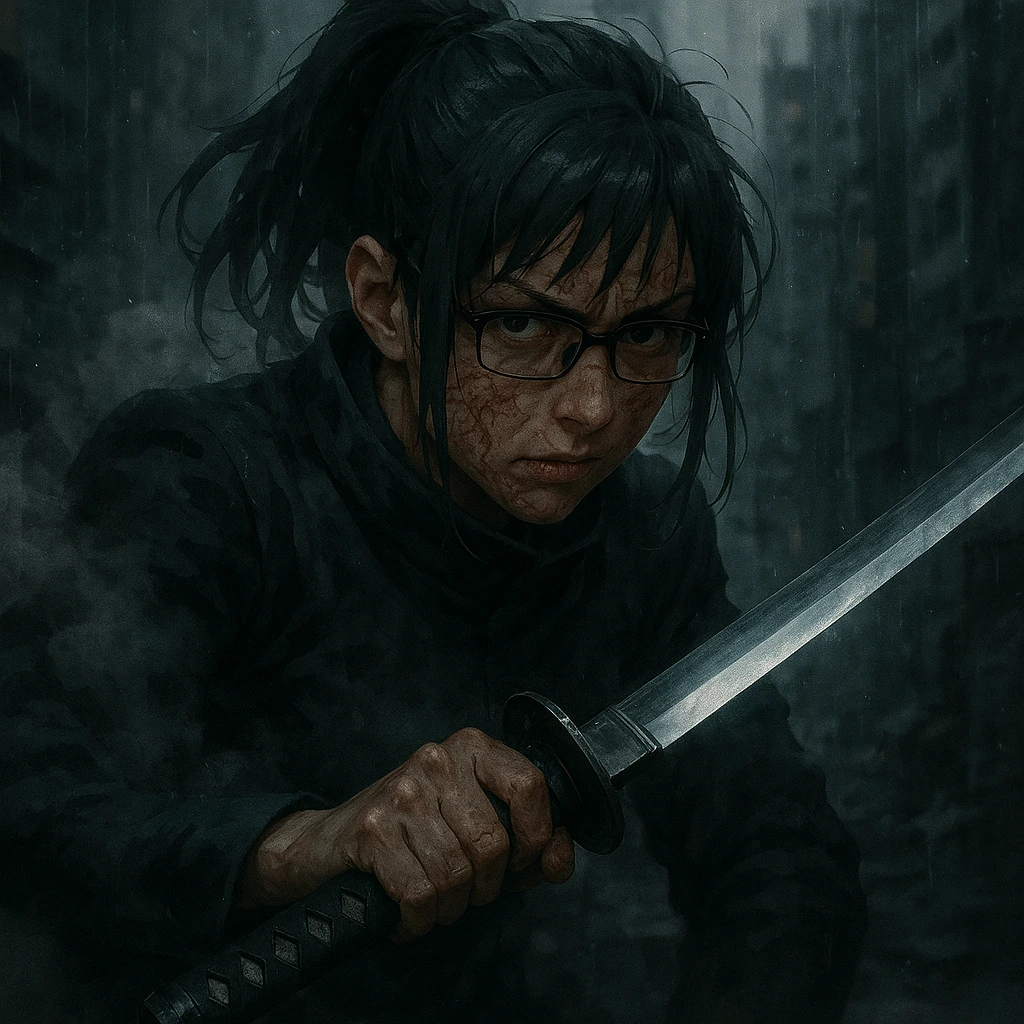
Before the dust of Yuta’s domain had even settled, a blade pierced Ryomen Sukuna’s chest from behind. Maki Zenin had arrived.
The brilliance of this ambush relied on the unique nature of Maki’s Heavenly Restriction. Possessing zero Cursed Energy, Maki is invisible to barriers and sensing techniques. She does not register as a “sorcerer.” To a domain, she is a building; to a sensor, she is air. While Yuta and Yuji were fighting, Maki was likely already inside the barrier, waiting for the moment the noise of the battle masked the sound of her heartbeat. This makes her the ultimate assassin, unseen by the magical radar that all sorcerers rely on.
Soul Damage and the Healing Limit
Maki wields the Split Soul Katana (SSK). This weapon ignores physical durability and cuts the soul directly. The terrifying aspect of soul damage is that it cannot be healed with standard Reverse Cursed Technique (RCT). To heal the soul, one must be able to perceive the contours of the soul.
Sukuna, despite his mastery, cannot easily heal soul damage while maintaining combat output. The stab through the heart forced Sukuna into a frantic state of manual micromanagement. He had to use Cursed Energy to manually pump his blood and keep his heart beating, diverting focus from his offensive output. This was the first time in the fight Sukuna looked genuinely annoyed by the mechanics of his opponent.
Mach 3 Combat and the “Spark”
The duel between Maki and Sukuna showcased the peak of physical combat in Jujutsu Kaisen. Maki, having fully awakened, possesses sensory perception that allows her to “see” the air currents and temperature changes.
When Sukuna launched a World Cutting Slash, Maki did something no one else could: she dodged it mid-air. She didn’t sense the Cursed Energy buildup; she sensed the “spark” preceding the technique and the displacement of the atmosphere. Sukuna acknowledged her as a true anomaly—a being who had discarded Jujutsu to reach the pinnacle of the physical, just as he had discarded humanity to reach the pinnacle of the magical.
VI. The Interlude: Kusakabe’s Glory & The Logistics of War

The Logistics of Survival: Ui Ui and Shoko
While the frontline fighters traded blows with a god, a silent war was being waged in the background—the war of logistics. The unsung heroes of the Shinjuku Showdown are Ui Ui and Shoko Ieiri.
Ui Ui’s teleportation Cursed Technique became the lifeline of the alliance. Every time a heavy hitter fell—Higuruma, Yuta, Kusakabe—Ui Ui instantly teleported onto the battlefield, grabbed the injured, and warped them to Shoko’s medical bay. This prevented Sukuna from confirming his kills. Without this retrieval system, the battle would have ended after Wave 2.
It forced Sukuna to fight wave after wave of fresh opponents because he couldn’t stop to finish off the fallen. This “revolving door” strategy turned the fight from a series of executions into a grinding war of attrition, putting immense mental strain on Sukuna, who began to realize the “insects” were organized.
The Strongest Grade 1
Between the fall of the heavy hitters and the rise of the protagonist, there was a brief, terrified silence. The only one left standing was Atsuya Kusakabe. A man with no innate technique, no massive Cursed Energy reserves, and a self-professed coward.
This interlude was a masterclass in character writing. Kusakabe, the man who consistently tried to avoid Shibuya and the Culling Game battles, found himself as the last line of defense for humanity. He analyzed the situation: Sukuna was weakened, but still lethal.
New Shadow Style Mastery
Kusakabe’s survival relied entirely on New Shadow Style: Simple Domain. He expanded the concept of a Simple Domain from a defensive turtle-shell into an offensive radar. By expanding his range, he created a zone where he could automatically parry any slash that entered his radius.
He managed to deflect Sukuna’s dismantle slashes with pure sword technique. For a few glorious chapters, the “useless” Grade 1 teacher went toe-to-toe with the King of Curses. He kicked Sukuna, slashed him, and bought valuable time. While he was eventually cut down, his contribution proved that even without a “Chosen One” technique, mastery of the basics can allow one to stand with gods.
VII. The Awakening: Yuji Itadori
The Prince of Black Flashes
Every wave prior—Kashimo, Higuruma, Yuta, Maki, Kusakabe—served to chip away at the statue of the King. Now, it was time for the final sculptor. Yuji Itadori returned to the fray, and this time, he was different. The boy who was once just a vessel had become a sorcerer in his own right.
Blood Manipulation and the Death Paintings
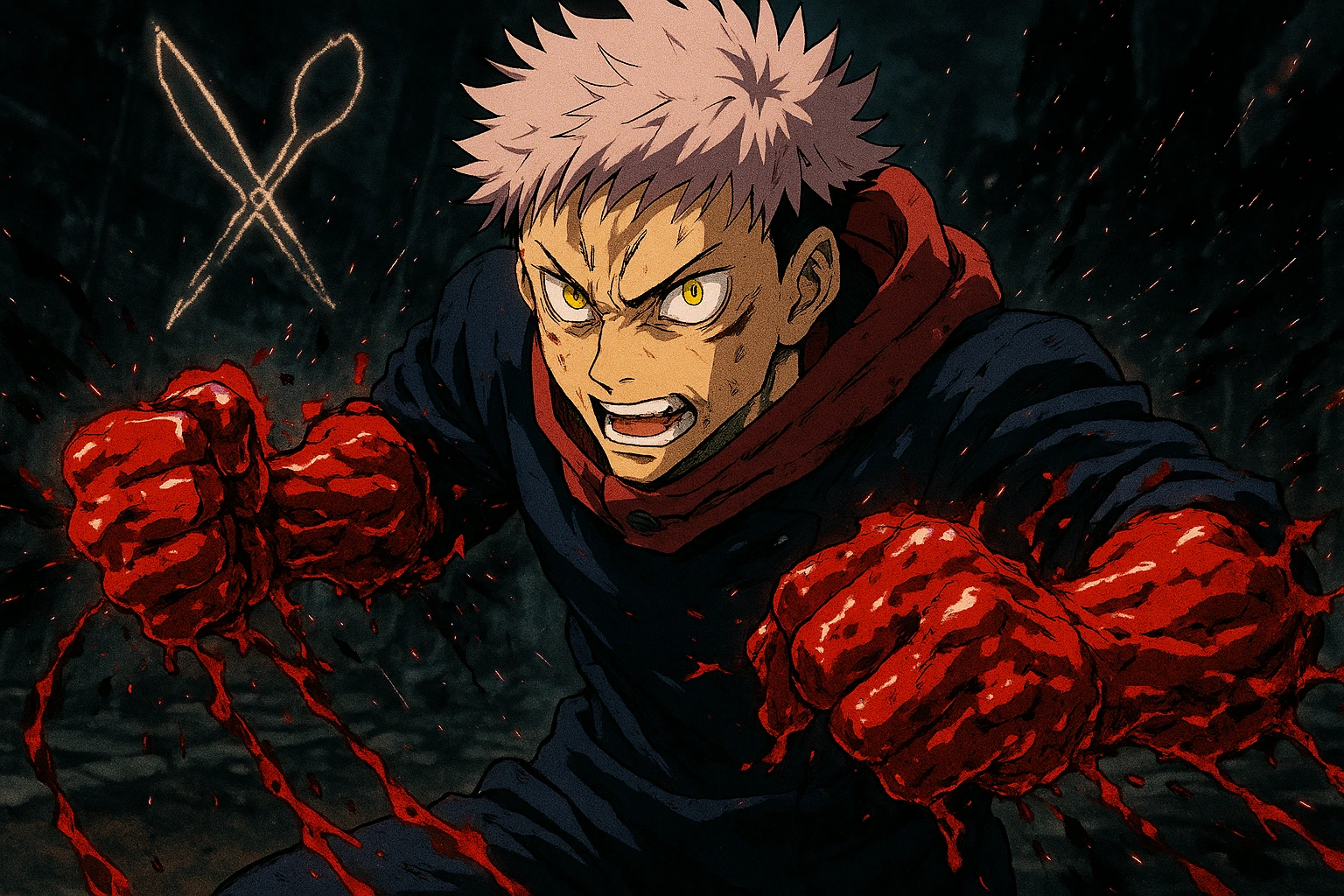
It was confirmed that Yuji had consumed the remaining Death Painting Wombs (Choso’s brothers). This granted him the physiology to convert Cursed Energy into blood, giving him access to Blood Manipulation. While he lacks the refinement of Choso or Kamo, Yuji utilizes it for bursts of attack (Piercing Blood) and, crucially, to reattach his severed limbs. Combined with RCT, this makes him incredibly difficult to kill. He isn’t regenerating limbs from scratch; he is reattaching them with blood threads and healing the seam, which is far more energy-efficient.
“Shrine” Awakened: The Modern Era vs. The Heian Era
The most significant reveal was the awakening of his own Cursed Technique. Gojo’s prophecy from the early chapters finally came true: Sukuna’s technique had engraved itself onto Yuji’s body.
However, Yuji’s Shrine is not a carbon copy of Sukuna’s. In Jujutsu Kaisen, a technique is shaped by the user’s interpretation of the world. Sukuna’s Shrine is a kitchen—he chops, fillets, and cooks. Yuji’s interpretation manifested visually as scissors and modern cutting lines. He attempts to “snip” the connection between souls. It is a technique born of a boy who wants to sever the bad from the good, rather than destroy everything indiscriminately. It represents the clash of eras: Sukuna’s ancient, brutal kitchen versus Yuji’s modern, precise duality.
The Zone and the Soul Chain
The climax of the Shinjuku Showdown (so far) is Yuji entering “The Zone.” Following a pivotal Black Flash, Yuji entered a state of flow that terrified Sukuna. He proceeded to land a chain of 7-8 consecutive Black Flashes.
This isn’t just extra damage. Each Black Flash increases the user’s understanding of Cursed Energy exponentially. It’s akin to an athlete entering a flow state where the hoop looks like an ocean. Yuji hit a state of “Awakened Potential,” forcing Sukuna to scream in frustration. The brat he dismissed as boring was now physically battering him, ignoring his slashes, and walking through his “Divine Flame.”
Unlike Mahito’s Idle Transfiguration which reshapes the soul, Yuji’s punches shake the soul, vibrating the barrier between two souls sharing a body. Each hit drops Sukuna’s output further, making Yuji the perfect counter to an incarnated sorcerer.
VIII. Conclusion: The King’s Limit and the Cog Mentality

As the dust settles on these waves, we must analyze the “Status of the King.” Ryomen Sukuna is undeniably the strongest, but he is currently a shell of his former self:
- Heart: Destroyed by Maki (beating manually via CE).
- Arms: Two disabled/severed.
- Cursed Energy Output: Severely lowered by Yuji’s soul punches.
- Reverse Cursed Technique: Functionality extremely low; barely healing limbs.
- Domain Expansion: Currently burned out (though attempting to restore it via Binding Vows).
The Shinjuku Showdown serves as the ultimate proof of the series’ core combat philosophy. Jujutsu battles are not about honor; they are about results. The heroes have successfully dismantled the raid boss piece by piece. Yuji Itadori has fully embraced his role as a “Cog.” He no longer seeks a grandiose meaning to his life or death; he simply turns to keep the machine of purification running.
The final question remains: Can Yuji Itadori’s soul punches shatter the boundary between Sukuna and Megumi before Sukuna manages to regain his Domain Expansion? If Sukuna casts Malevolent Shrine one more time, the raid is over. It is a race against time—a brawl between a King holding onto his throne and a Cog determined to turn until the machine breaks.
IX. Frequently Asked Questions (FAQs)
Q: Why did Higuruma’s domain take Sukuna’s weapon instead of his technique? A: This was a previously unknown rule of the Deadly Sentencing domain. If a defendant is found guilty and possesses a Cursed Tool, the rule of “Confiscation” prioritizes seizing the tool over the innate technique. It was a worst-case scenario loophole that stripped Sukuna of Kamutoke but left Shrine active.
Q: How is Yuji using Blood Manipulation? A: Yuji consumed the remaining Death Painting Wombs (#4 through #9). As they are half-human, half-curse entities related to the Kamo clan’s bloodline, eating them allowed Yuji to assimilate their genetic capability to convert Cursed Energy into blood, granting him the Blood Manipulation technique.
Q: Why can Maki see the World Cutting Slash? A: Maki’s Heavenly Restriction (0 Cursed Energy) heightens her five senses to a supernatural level. She can perceive changes in air pressure, temperature, and density. The World Cutting Slash requires a “build-up” or “spark” that disturbs the environment before it fires. Maki reacts to this environmental shift, not the Cursed Energy itself.
Q: Did Yuta Okkotsu die in the Shinjuku Showdown? A: Yuta took a massive hit from the World Cutting Slash that severed his torso. However, Rika carried him away immediately to Ui Ui, who teleported him to Shoko Ieiri for healing. While his condition was critical, he was removed from the field alive to undergo emergency treatment. (Note: Subsequent manga chapters involve complex developments regarding Yuta’s status and body swapping, but in the context of the initial “Showdown” waves, he was evacuated).
Q: What is Sukuna’s “Divine Flame” (Fuga/Kamino)? A: “Fuga” (Open) is a fire-based ability that Sukuna accesses as part of his Shrine technique. It is implied to be a “furnace” or heat aspect of the cooking metaphor (Cleave/Dismantle are knives; Fuga is the fire). He uses it to finish opponents with massive area-of-effect heat damage, as seen against Jogo and Mahoraga.
Q: Why does Yuji’s Cleave look like scissors? A: Cursed Techniques are influenced by the user’s era and subconscious interpretation. Sukuna, from the Heian era, views his cuts as kitchen knives or invisible slashes. Yuji, a modern teenager, subconsciously visualizes “cutting” or “severing” through the imagery of scissors or perforated lines, altering the aesthetic manifestation of the technique.