
I. Introduction: The Ordinary Boy
In the grand tapestry of shonen history, protagonists are often marked by destiny. They are the children of prophecy, born with a star above their heads, or gifted with a power that sets them apart from the mundane masses before the story even truly begins.
Naruto Uzumaki had the Nine-Tails sealed within him by a Hokage; Ichigo Kurosaki possessed a lineage encompassing every spiritual race imaginable; Luffy ate the Devil Fruit that defied the gods. These heroes are often “Chosen Ones,” their paths paved by heritage or divine intervention. But then, there is Yuji Itadori Analysis.
When we first meet Yuji Itadori, he is not training to be the strongest or dreaming of becoming a king. He is simply a high school student in Sendai with an unnatural athletic ability that he treats with a bizarre casualness. He is a member of the Occult Research Club, not because he loves the supernatural, but because it allows him the free time to visit his dying grandfather in the hospital by 5:00 PM.
This normalcy is the hook. It is a deception. Gege Akutami presents us with a boy who could have been a star athlete, a boy who just wanted a quiet life, and then violently thrusts him into a world where normalcy is a liability. Unlike his predecessors who seek adventure, adventure invades Yuji’s life like a terminal illness.
Yuji Itadori is the “Anti-Chosen One.” He wasn’t born with a cursed technique. In a world where lineage and innate talent define 80% of a sorcerer’s potential—where the Gojo and Zenin clans reign supreme due to genetics—Yuji started with nothing but a sturdy body. He was not born to lead the Jujutsu world; he was bred to be a cage.
His existence is a manufacture of Kenjaku, a millennia-old sorcerer, yet Yuji operates for most of the series without this knowledge. He is an anomaly—a vessel capable of containing the King of Curses, Ryomen Sukuna, not through a divine gift, but through a terrifying physical resilience that borders on the monstrous. He is a container, an object, a function—not a person in the eyes of the higher-ups.
The catalyst for his descent into the hell of Jujutsu sorcery is not a desire for glory, but a “curse” placed upon him by his grandfather, Wasuke Itadori. In his final moments, Wasuke tells Yuji: “You’re a strong kid, so help people. It doesn’t have to be everyone, just those around you… When your time comes, make sure you’re surrounded by people. Don’t end up like me.”
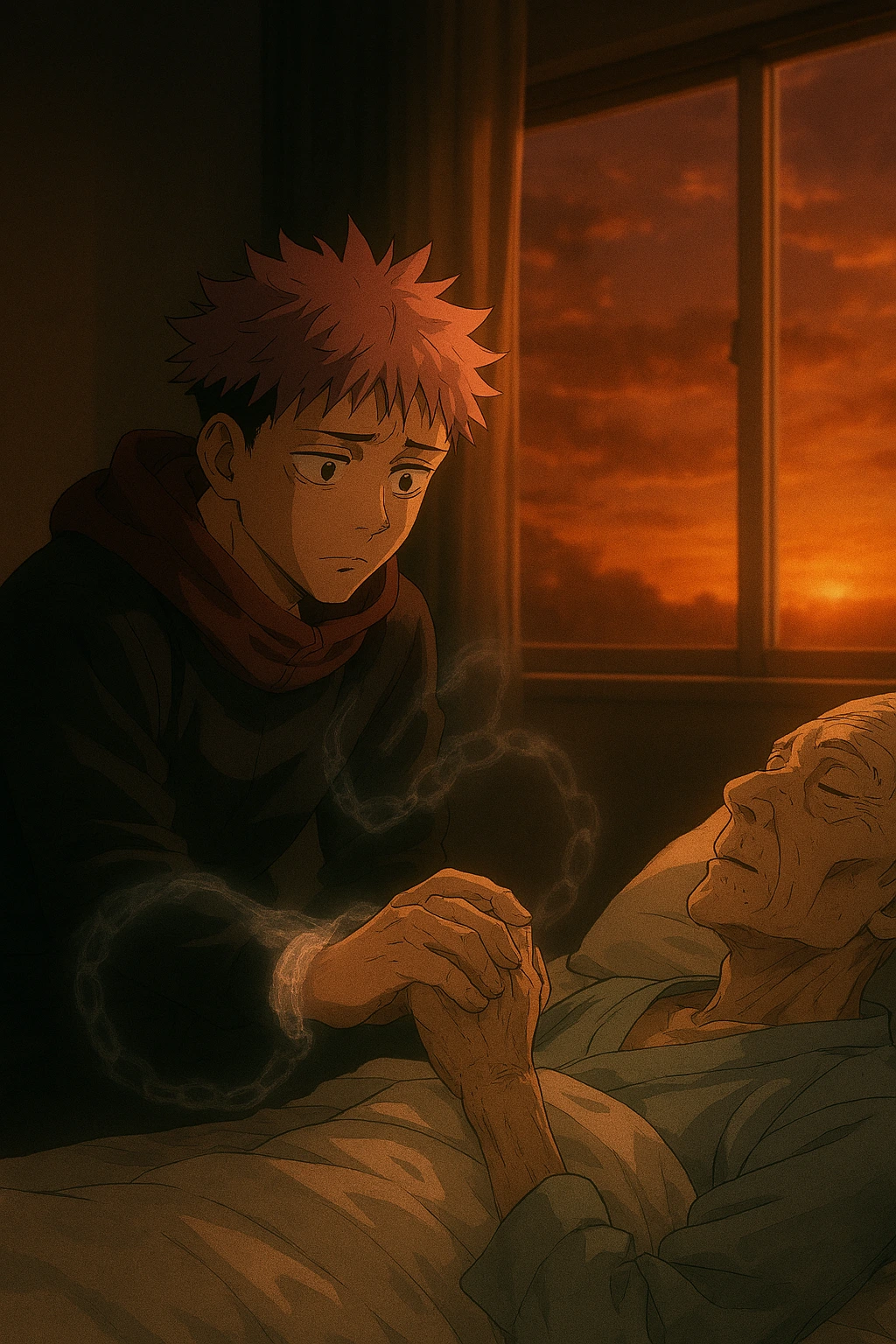
These words are not a blessing; they are shackles. This directive becomes the driving force of Yuji’s life, a compulsion that overrides his survival instincts. It forces him to swallow Sukuna’s finger to save Megumi Fushiguro, an act of madness that seals his fate. It pushes him into the terrifying architecture of Jujutsu High, a school that is essentially a morgue for young dreamers.
It is a burden of altruism in a world that punishes kindness. Throughout Jujutsu Kaisen, we watch Yuji struggle under the weight of this curse, trying to engineer a “proper death” for himself and others, only to realize that in the world of curses, death is rarely proper, and it is almost never peaceful. He chases this ideal of a “good death” so feverishly that he often forgets to live a good life.
This analysis will track Yuji Itadori’s harrowing journey from a naive boy in Sendai to the monster of Shinjuku. We will dissect his psychological descent into the “Cog” mentality, the physics of his impossible strength, and his ultimate awakening where the cage finally breaks the King.
II. The “Cog” Mentality: Philosophy of a Sorcerer
The evolution of Yuji Itadori’s psyche is one of the most brutal deconstructions of the hero archetype in modern media. Initially, Yuji enters the world of sorcery with a classic hero’s mindset: “I want to save everyone.” He believes in the sanctity of life and the possibility of a “proper death.”
He is empathetic, warm, and stubbornly optimistic. He mourns the curses he kills early on, seeing the humanity they once possessed. However, the Shibuya Incident shatters this idealism with the force of a sledgehammer.
The turning point is his confrontation with Mahito. Mahito is the mirror reflection of Yuji—a curse born from human hatred, childish and cruel, who kills without reason just as Yuji saves without reason. Throughout the Shibuya arc, Mahito systematically dismantles Yuji’s spirit. He manipulates Junpei Yoshino, transforming him into a monster before Yuji’s eyes. He kills Nanami Kento, Yuji’s mentor and father figure, blowing his torso apart right as Yuji arrives.
He (seemingly) kills Nobara Kugisaki moments later, touching her face and exploding her eye. He forces Yuji to confront the reality that determination and kindness are not enough to stop pure malice. Mahito asks Yuji to count the curses he’s killed, asking if Yuji has ever stopped to consider their lives, effectively dragging Yuji down to his level.
When Yuji faces Mahito in the final moments of the Shibuya Incident, pursuing him through the snow, something fundamental breaks, and something stronger calcifies in its place. He stops looking for a reason. He stops looking for justification. He delivers the infamous “I am You” speech (or rather, monologue of acceptance).
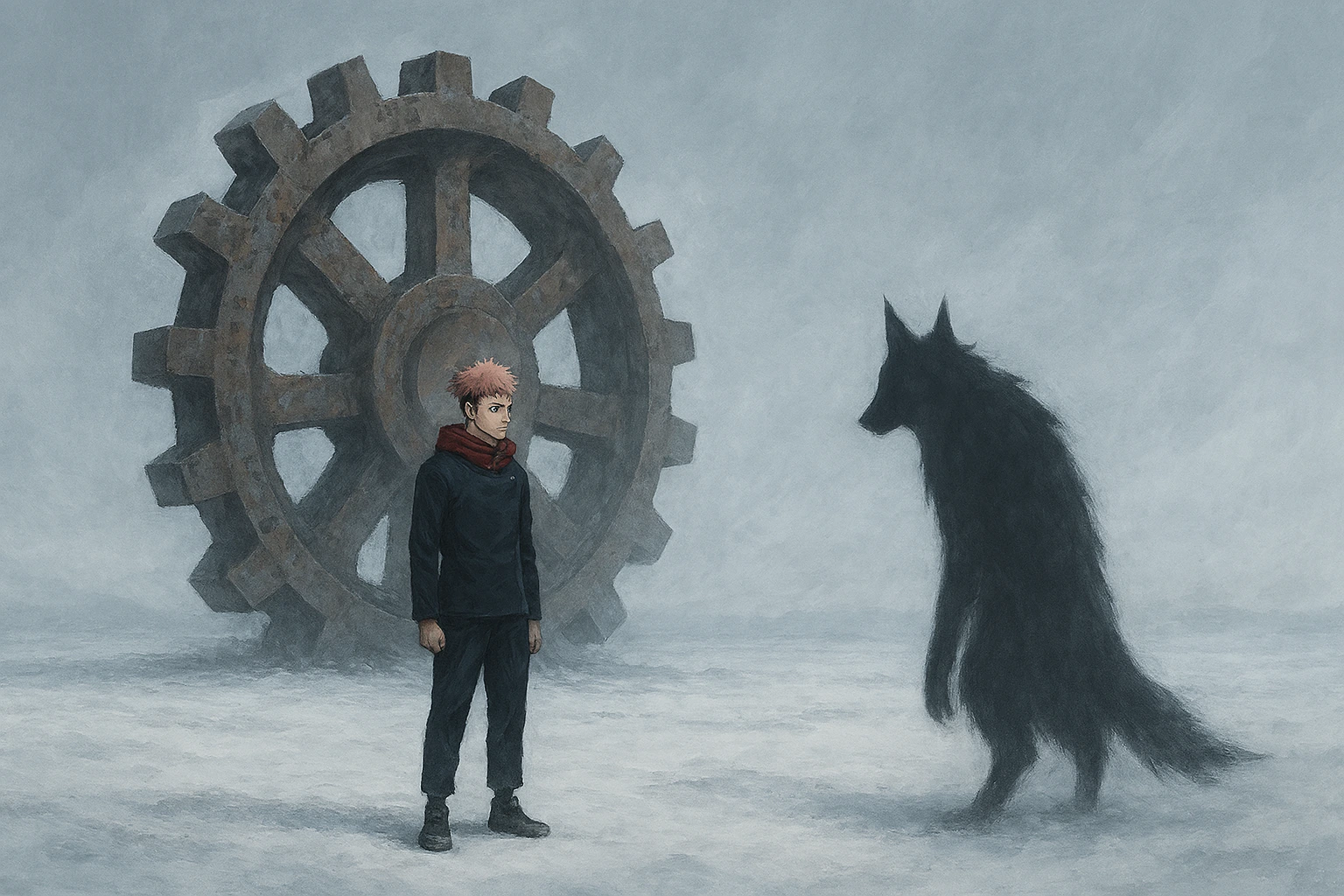
“I’m you. I wanted to reject you, convince myself that you were wrong. But that doesn’t matter now. I’m gonna kill you. Even if you come back as another curse, I’ll kill you. Change your name. Change your form. I’ll kill you again. I don’t need a meaning or a reason.
Maybe a hundred years after my death, the meaning behind my actions will become apparent. In the grand scheme of things… I’m probably nothing more than a cog. But I’ll keep killing curses… for as long as I can. That’s my role in this war.”
This is the birth of the “Cog” mentality. It is a shift from Main Character Syndrome to functional stoicism. Yuji accepts that he is not special in the sense of being a savior; he is a mechanism. Just as Mahito is a machine that generates curses and death, Yuji accepts he is a machine that exorcises them.
It is a bleak, industrial view of one’s own life, stripping away the romance of heroism. He dehumanizes himself to survive the trauma. He stops trying to be a “Hero of Justice” and becomes an “Exorcism Automaton.”
This stoicism becomes his armor. When he processes the loss of Junpei, Nanami, and Nobara, he doesn’t have a breakdown that incapacitates him; he endures. He compartmentalizes the grief, turning it into fuel for the machine. This stands in stark contrast to Gojo Satoru, who stands above the system as a god, or Ryomen Sukuna, who seeks to destroy the system for his own pleasure. Yuji accepts his smallness. He accepts that he is a part of a larger mechanism of Jujutsu society.
However, this “Cog” mentality is also tragic. It represents a loss of self-worth. Yuji begins to view his life as disposable, a currency to be spent to remove Sukuna from the world. He stops caring about his own happiness or his own future. He becomes a weapon that walks.
Yet, paradoxically, this abandonment of ego allows him to reach heights of focus that others cannot. By removing the “I” from the equation, he removes hesitation. He becomes a pure conduit for cursed energy and violence, leading to his mastery of the Black Flash. He enters a state of Mushin (no mind) not through meditation, but through self-abnegation.
III. The Physics of Impact: Black Flash & Divergent Fist
To understand Yuji Itadori as a combatant, we must understand the unique physics of his violence. Unlike other sorcerers who rely on complex innate techniques—manipulating shadows, space, or straw dolls—Yuji’s arsenal is kinetic. It is grounded in the brutal reality of hand-to-hand combat, elevated by Cursed Energy. He is a brawler in a world of mages, forcing wizards to engage in a fistfight.
Divergent Fist: The Weaponized Lag
Initially, Yuji’s lack of experience created a unique phenomenon known as “Divergent Fist.” Because his physical body was so fast—superhumanly so—his fist would make contact with the target before his cursed energy could catch up. The energy flow couldn’t match the velocity of his muscles.
Normally, this is a flaw. In Jujutsu, you want the energy and the impact to be simultaneous for maximum damage. However, Yuji inadvertently turned this lag into a weapon. The first impact is the physical blow, which causes the enemy to brace or flinch. Then, a split second later, the cursed energy crashes into them, creating a double impact. It’s a one-two punch delivered in a single motion.
This “lag” makes his rhythm impossible to read. Enemies defending against the physical hit often drop their guard immediately after, only to be hammered by the delayed energy shockwave. It serves as a metaphor for Yuji himself: he is always slightly out of step with the Jujutsu world, an anomaly that disrupts the established flow.
While he eventually masters the timing to stop using Divergent Fist involuntarily thanks to Aoi Todo’s mentorship, he retains it as a mix-up tool, proving his adaptability. He can consciously choose to delay the energy, creating a tactical nightmare for opponents relying on rhythmic defense.
The Black Flash: The 2.5 Power Exponent

The defining technique of Yuji Itadori is the Black Flash. This is not an innate technique but a phenomenon of distortion in space that occurs when Cursed Energy is applied within 0.000001 seconds of a physical hit. The result is not an addition of power, but an exponentiation.
The force is calculated as Impact to the power of 2.5. To put that in perspective, if a normal punch is a 10, a Black Flash isn’t a 20 or a 30; it is 10 to the power of 2.5, a massive, reality-warping spike in destructive capability.
Yuji is the “Chosen One” of the Black Flash. While no sorcerer can perform it at will, Yuji enters the “Zone” required to trigger it more easily than anyone else in history. Why?
- Concentration: The “Cog” mentality removes extraneous thought. Yuji doesn’t think about glory or fear in the heat of battle; he thinks about the mechanics of the strike.
- The Vessel Physiology: Being Sukuna’s vessel likely attuned his body to the highest levels of cursed energy, giving him an instinctive understanding of the “core” of cursed energy.
- The Spark: There is an innate talent for “feeling” the spark of energy before it impacts.
His record is legendary. During the Kyoto Goodwill Event, he chained four consecutive Black Flashes against Hanami, equaling the record held by Nanami Kento. This wasn’t just luck; it was a flow state induced by his sync with Aoi Todo. Later, against Mahito in Shibuya, he utilized Black Flash as a finisher, shattering the Special Grade’s soul in a moment of pure, unadulterated exorcism.
The “Sparks of Black” are crucial to Yuji’s growth. Every time he lands a Black Flash, his understanding of Cursed Energy deepens. It is a feedback loop: his physical prowess allows him to land the flash, and the flash enlightens him on how to better use his energy. It elevates him from a brawler to a sorcerer. By the final arc, Yuji wields Black Flash with a frequency that suggests he has essentially monopolized the miracle.
The Body: Kenjaku’s Experiment
Underlying all of this is his body. Even without Cursed Energy, Yuji smashed world records for high school athletics effortlessly. He could throw a shot put like a baseball and outrun cars. This is not natural. It is revealed that Yuji is a “Death Painting” of sorts—a designed human. Kenjaku, inhabiting the body of Kaori Itadori, bred Yuji to be a cage capable of holding Sukuna.
This grants Yuji a “Heavenly Restriction-lite” physique. While not as total as Maki Zenin or Toji Fushiguro (who have zero cursed energy), Yuji possesses physical stats that rival them while also possessing cursed energy. This hybrid nature allows him to survive injuries that would instantly kill a normal sorcerer, fight for days without rest, and act as the perfect, durable beatdown machine. He is the ultimate hybrid, possessing the durability of a Heavenly Restriction and the lethality of a Cursed Technique user.
IV. The Prince of Curses: Awakening True Power
For over 200 chapters, critics and fans alike noted that Yuji lacked a “real” Cursed Technique. He was a punch-kick merchant in a world of wizards. However, the Shinjuku Showdown arc completely recontextualized his arsenal, revealing the fruits of his suffering and his lineage. Yuji Itadori finally awakened, not as a copy of Sukuna, but as something entirely his own.
Blood Manipulation

By consuming the remaining Death Painting Wombs (his brothers, technically), Yuji gained the ability to use Blood Manipulation. While he lacks the proficiency of Choso or Kamo Noritoshi, this addition solved his biggest weakness: lack of range and sustainability.
With Blood Manipulation, Yuji gained the ability to reattach severed limbs and heal internal damage by manipulating his blood to stitch his body back together—a pseudo-Reverse Cursed Technique efficiency without the high energy cost.
He can use “Piercing Blood” (often aiming it point-blank or using it as a surprise projectile) to catch enemies off guard. He frequently uses “Supernova” concepts (explosive blood) in close quarters. It symbolizes his acceptance of his family, literally consuming his brothers to carry their will into battle. He isn’t just fighting for them; he is fighting with them in his veins.
Soul Research and Swapping
Perhaps the most technical upgrade came from the research notes of Yuki Tsukumo and his training with Ui Ui. Yuji learned to perceive the contours of the soul. Because he shared a body with two souls (his and Sukuna’s), he has an innate sense of where the soul ends and the body begins.
Training with Ui Ui, who has a soul-swapping technique, allowed Yuji to “cheat” experience. By swapping souls with Kusakabe, Yuji’s body learned the muscle memory of Simple Domain and advanced sword/barrier techniques in a fraction of the time. This training arc turned him from a raw brawler into a technician capable of using barrier techniques—the pinnacle of sorcery.
This soul perception grants his punches a unique debuff property against incarnated sorcerers like Sukuna. Every hit Yuji lands shakes the boundary between the incarnated soul and the vessel’s body, dropping their Cursed Energy output. He literally punches the enemy out of sync with their own vessel.
The Modern Shrine: Scissors
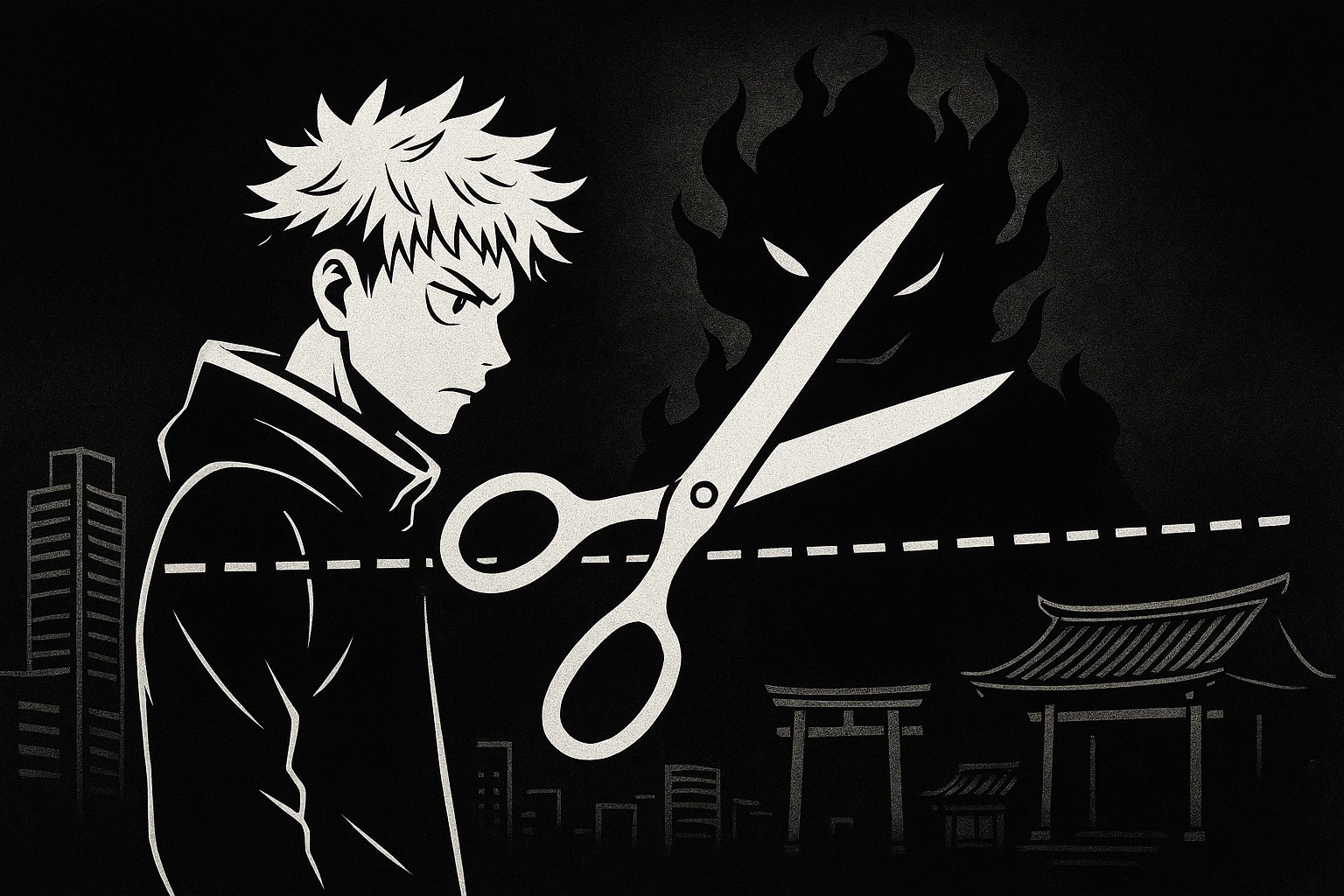
The most climatic reveal was Yuji awakening his own version of Sukuna’s technique, Shrine. However, a technique is shaped by the user’s era and personality. Sukuna’s Shrine is a kitchen—he cooks, fillets, and devours his enemies. His Cleave and Dismantle are chef’s knives.
Yuji’s Shrine is different. The visual representation of his dismantling technique is not knives, but Scissors. He marks a target (often indicated by a dashed line, like on a cut-out coupon or paper craft) and snips.
This variation is profoundly thematic. Scissors are a tool of utility, often used in crafts or schools—fitting for a modern teenager. But more importantly, Yuji uses his version of Cleave and Dismantle selectively. He targets the barrier between souls. His attacks against Sukuna were not just physical slashes; they were metaphysical cuts designed to sever the link between Sukuna’s soul and Megumi Fushiguro’s body.
While Sukuna slashes to destroy, Yuji slashes to separate and save. It is a “kind” violence, perfectly fitting the boy who wants to die surrounded by people. He turned the King’s weapon of mass destruction into a surgical tool for salvation.
V. The Vessel vs. The King: A Toxic Symbiosis
The relationship between Yuji Itadori and Ryomen Sukuna is the antagonistic core of the series. It is not a partnership like Naruto and Kurama; it is a parasite and a cage. It is pure, undiluted hatred on both sides, complicated by a forced intimacy.
Yuji was bred to be a cage. His body is so overwhelmingly dominant that he can suppress the most evil soul in history effortlessly. This is a source of immense frustration for Sukuna. To the King of Curses, Yuji is boring. He is uninteresting. Sukuna values strength, selfishness, and the assertion of will. Yuji represents selflessness, restraint, and the collective. Sukuna hates Yuji not just because he is trapped, but because Yuji’s philosophy is the antithesis of his own. Sukuna views existence as a feast where he is the only diner; Yuji views existence as a shared table.
The Enchain Vow
A critical component of this toxic relationship was the “Enchain” Binding Vow. Early in the series, Sukuna tricked Yuji into a pact: Sukuna could take over the body for one minute, provided he didn’t kill anyone, and Yuji would forget the pact existed.
This was a ticking time bomb. Sukuna used this minute not to kill, but to tear off his own finger and force-feed it to Megumi Fushiguro, effectively abandoning Yuji. This betrayal was two-fold: it robbed Yuji of his agency and stole his best friend.
The Shibuya Trauma
The trauma of Shibuya is the defining scar of this relationship. Sukuna seized control of Yuji’s body (due to Yuji consuming too many fingers at once) and decimated Shibuya, killing thousands with his Domain Expansion, Malevolent Shrine.
When Yuji woke up, he didn’t just see the destruction; he felt the memories of committing it. He felt the sensation of slicing through civilians. This guilt shattered Yuji. It confirmed his worst fear: that his existence kills people. The image of a crater where a city used to be is etched into his soul, fueling his desperate need to die a death that matters.
However, this dynamic shifts in the final arc. Sukuna rejects Yuji, moving to Megumi’s body, calling Yuji a “statue” and a “brat.” He dismisses Yuji entirely. This is Sukuna’s fatal error. By underestimating the “boring” cog, Sukuna allowed Yuji to grow unchecked.
The irony is palpable. Sukuna, the hedonist who lives only for his own pleasure, is eventually cornered by the boy who lives for everyone but himself. Yuji becomes the predator. In their final confrontation, Yuji looks at Sukuna not with fear, but with pity. He recognizes Sukuna’s loneliness, not as a tragic flaw to be romanticized, but as a pathetic state of being.
VI. Domain Expansion: The Station of Memories
The pinnacle of Jujutsu Sorcery is Domain Expansion. For a long time, it was theorized Yuji would never achieve this. Yet, in the climax of the battle against Sukuna, Yuji expands his Domain.
The Imagery
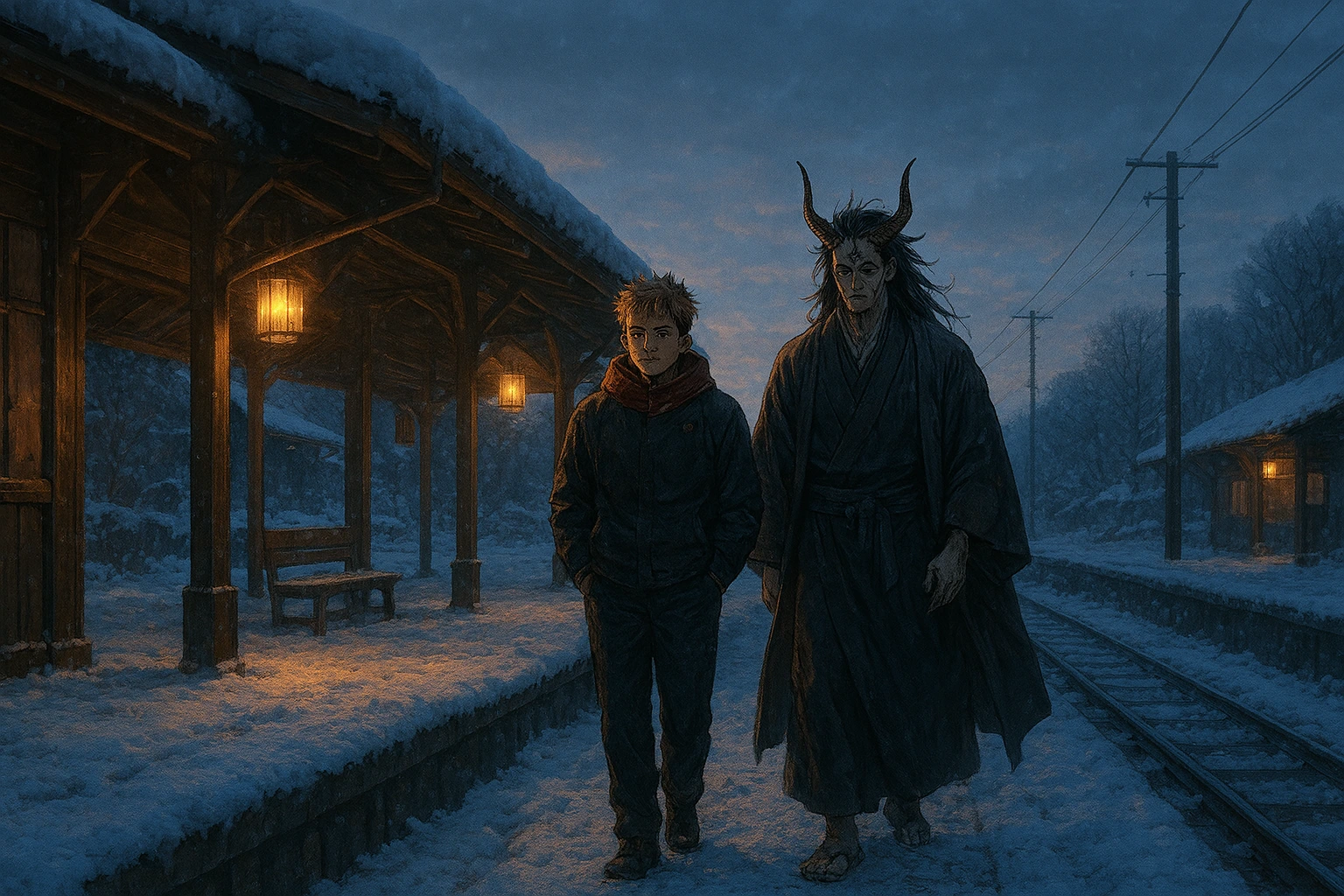
Yuji’s Domain does not look like a temple of bones or a sea of blood. It manifests as a snowy train station. Specifically, it resembles the train station of his hometown in Sendai. It is a liminal space—a place of transit, of arrivals and departures.
This imagery is heartbreakingly human. It represents “Connection” and “Parting,” the two themes that have defined Yuji’s life. He takes Sukuna on a walk through this domain, showing him simple, mundane memories: fishing, archery, walking through the town. It creates a surreal juxtaposition: the ancient, four-armed demon walking calmly beside the boy in a hoodie through a quiet, snowy town. The snow represents the stillness of death and memory, a purity that contrasts with the blood and gore of their previous battles.
The Sure-Hit
Unlike Unlimited Void (infinite information) or Malevolent Shrine (infinite slashing), Yuji’s sure-hit effect is subtle but devastating. It forces empathy and soul dismantling.
The Domain facilitates a direct connection between souls. It forces the opponent to understand Yuji Itadori. For Sukuna, this is torture. Being forced to walk a mile in the shoes of the “brat” he despises is a psychological attack. Furthermore, the Sure-Hit effect applies Yuji’s soul-rending Dismantle attacks directly to the target’s soul, bypassing physical durability. It is the ultimate counter to incarnated sorcerers. It forces the soul to confront the fact that it doesn’t belong in the body it inhabits.
Mercy
In the center of this Domain, Yuji offers Sukuna an ultimatum. He doesn’t scream for revenge. He calmly tells Sukuna, “I can kill you. But if you leave Megumi’s body and go back to being a curse inside me, I’ll spare you.”
Even after everything—after Junpei, Nanami, Nobara, Gojo, and Choso—Yuji offers mercy. He is willing to become the cage again, to sacrifice his life to hold the monster, just to stop the killing. It is the ultimate expression of his grandfather’s curse and his own indomitable kindness. Sukuna, naturally, spits on the offer, but the fact that Yuji made it proves that he never lost his humanity, even after becoming a monster in strength. It validates that Yuji is stronger than Sukuna where it counts: in spirit.
VII. The Familial Twist: The Kamo/Itadori Lineage
The revelation of Yuji’s lineage adds a layer of Greek tragedy to his character. We learn that his mother, Kaori Itadori, was possessed by Kenjaku (the brain-hopping sorcerer) when Yuji was conceived. This makes Kenjaku, the architect of all the suffering in the series, Yuji’s “mother.”
This connects Yuji directly to the Death Painting Wombs. Choso, the eldest Death Painting, realized Yuji was his brother not through a delusion, but through their shared blood connection to Kenjaku. This transforms Choso from an enemy into Yuji’s fiercest protector. The brotherly bond they share is one of the few sources of warmth in Yuji’s later life.
Choso teaches Yuji about their blood, their potential, and ultimately dies protecting his “little brother.” This “brotherhood” phenomenon extends even to Aoi Todo (though that is delusion-based), suggesting Yuji has a charisma that naturally draws lonely outcasts to him, forging families out of broken pieces.
Furthermore, because Kenjaku once inhabited the body of a Kamo clan member and is anciently linked to Sukuna, Yuji is technically Sukuna’s nephew (or at least, shares a convoluted blood relation). The King of Curses and the Brat are family.
This biological irony underscores the theme that Yuji was made for this. He isn’t a random hero; he is the result of a thousand years of eugenics designed to create the perfect vessel. He is the culmination of Kenjaku’s madness, but he ends up being the cure to Kenjaku’s chaos.
VIII. Conclusion: The Human God
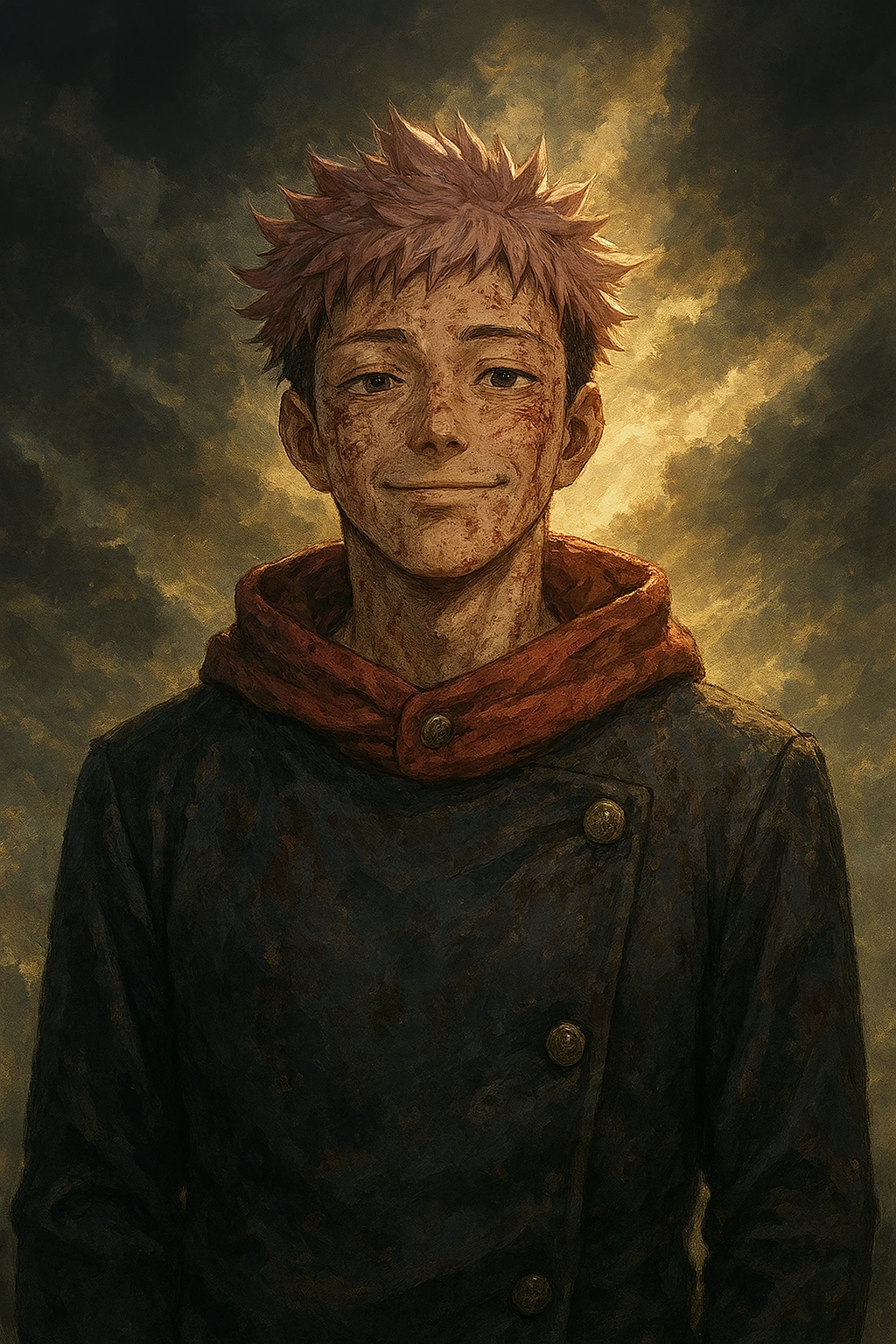
Yuji Itadori’s journey is a subversion of the “Power Fantasy.” He gains power, yes, but the cost is astronomical. He loses his mentors, his friends, his innocence, and essentially his life. He starts as a vessel for a monster and ends as the monster’s executioner.
But strength in Jujutsu Kaisen, as exemplified by Yuji, isn’t just about Cursed Energy output or Domain refinement. Real strength is the ability to maintain one’s soul in the face of absolute despair. Yuji gets beaten down more than any other protagonist. He is physically battered, psychologically tortured, and spiritually dismantled. And every single time, without fail, he stands back up.
He is the Indomitable Soul. He proves that being a “Cog” doesn’t mean you are worthless; it means you are essential. By accepting his role, he was able to stop the wheel of destruction that Sukuna spun for a millennium. He didn’t do it with a divine technique or a special bloodline superiority; he did it with grit, empathy, and the willingness to suffer for the sake of others.
In the end, Yuji Itadori remains true to his grandfather’s words, but he evolves past them. He doesn’t just help people because he was told to; he helps them because that is who he is. He is the human element in a world of demons. As he told Mahito, “I don’t need a meaning. I just have to save you.”
That is the terrifying, beautiful simplicity of Yuji Itadori: a boy who walked through hell and refused to let it burn away his kindness. He stands at the end of the series not as a King of Curses, but as a Human God—a being who conquered the supernatural simply by being undeniably, stubbornly human.