
I. Introduction: The War of the Mind
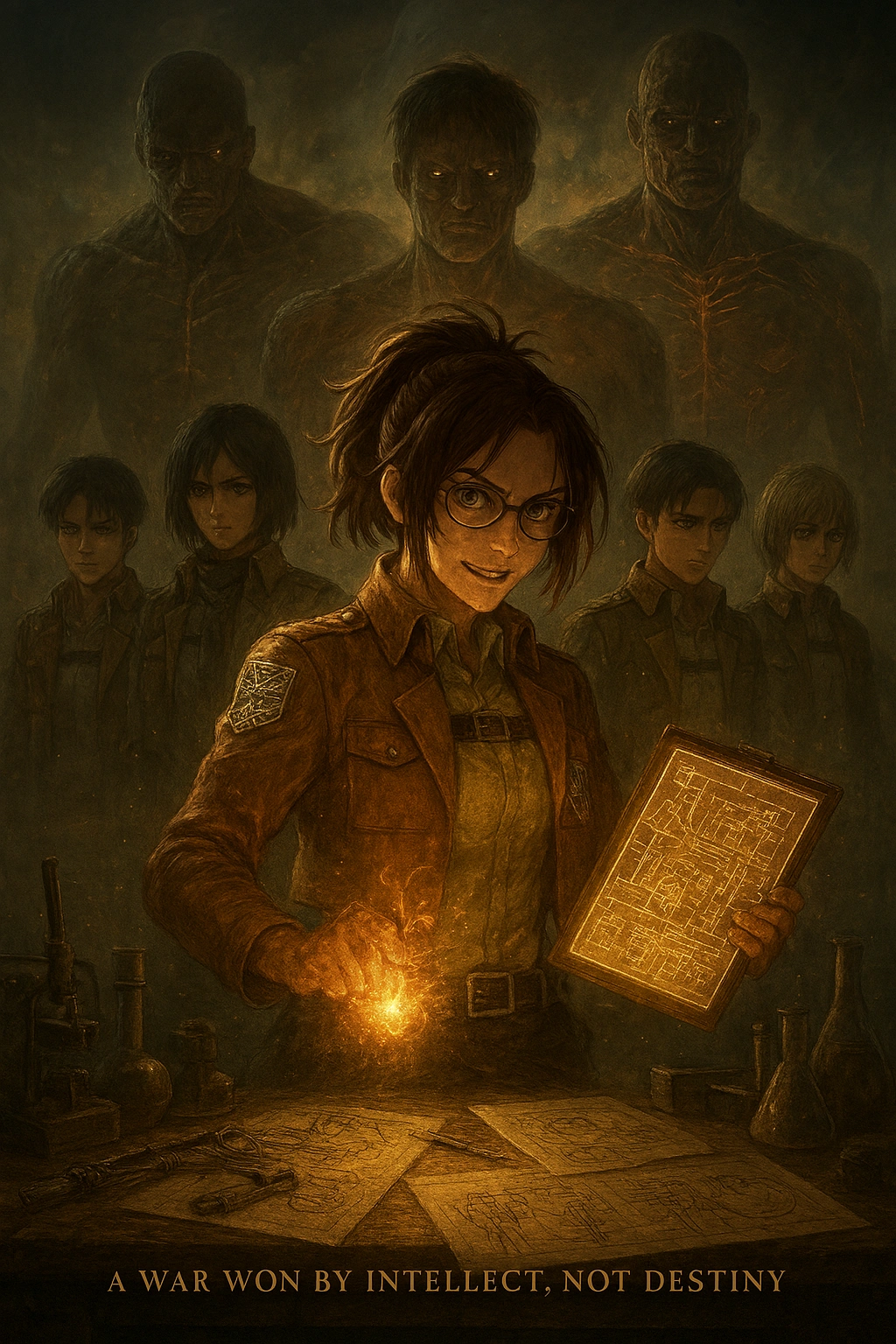
In a war defined by monsters and magic, the greatest victories were not won by muscle, but by math. The story of Paradis Island is overwhelmingly dominated by the supernatural—by boys who become monsters, by bloodlines that rewrite memories, and by a mystical coordinate that connects an entire race.
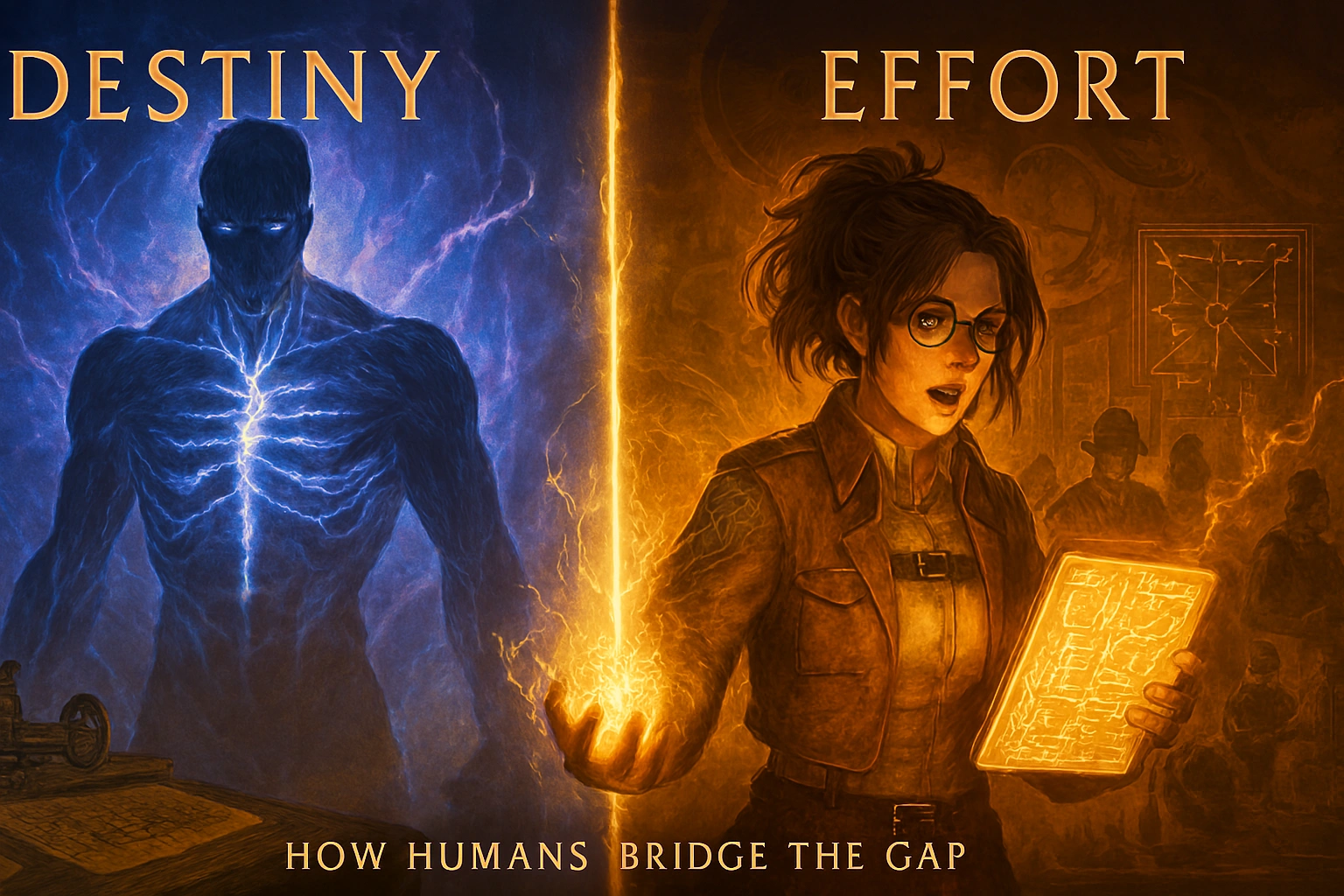
This is the power of “Destiny,” the idea that victory is pre-ordained, locked within the veins of a chosen few like Eren Yeager or the royal Reiss family. The world of the Walls was built on the premise that only a special, “chosen” bloodline or a “fated” Shifter could ever hope to change their reality.
This fatalistic worldview was humanity’s true prison, an invisible wall of superstition and fear that was even more effective than the three stone ones. It fostered a culture of helplessness, where the Common Man was taught to huddle and pray, not to question or analyze.
The “magic” of the Titans was accepted as an absolute, unknowable, and divine punishment, a force of nature beyond the comprehension of mere mortals.
This acceptance of “Destiny” was the enemy’s greatest weapon, as it ensured that for one hundred years, no one truly tried to understand the monster at the gate.
But this narrative of destiny obscures a more profound, more powerful truth. The war against the Titans was truly won by the “Common Man.”
It was not won by fated blood, but by spilled ink. It was won by clipboards, by test tubes, by sleepless nights spent staring at data, and by a terrifying, obsessive curiosity that bordered on madness. While Shifters like Eren represented the “Destiny” of power, Section Commander Secret Science of Hange Zoë represented the relentless, grinding “Effort” of the common people.
Hange was the first person in a century to reject the “Destiny” narrative outright. She looked at the “unknowable” and saw a system. She looked at “magic” and saw a science waiting to be discovered.
This article will deconstruct the “Secret Science” of Hange Zoë, analyzing her rigorous scientific method as the Meso-System’s true rogue element. In a world governed by ancient, god-like rules, Hange’s intellect was the one variable the system never accounted for.
Her breakthroughs are not just tactical advantages; they are the ultimate proof of the Core of Victory: that unwavering effort and pure, unfiltered intellect can systematically deconstruct and dismantle a “magical” threat. Hange’s journey proves, in brutal and bloody detail, that no destiny is unbreakable, no magic is absolute, and even a god can be killed if you simply find the right equation.
This pursuit of knowledge frames the central conflict of Hope versus Reality. Hange embodies the ultimate “hope” of the scientific mind: the belief that what can be understood can be controlled, and what can be controlled can be defeated.
This “hope” is her fuel, driving her past the boundaries of fear and conventional morality. But this hope is a fragile light constantly threatened by the “dark reality” of her discoveries. With every answer she uncovers, a more horrifying truth is revealed—the horrific Price of Power paid by her subjects, the moral cruelty of her own experiments, and the devastating, world-shattering revelation that the monsters she dedicates her life to studying are, in fact, her own people.
Hange’s journey is not one of clean, triumphant discovery; it is a descent into a moral abyss, where every piece of knowledge gained is paid for with a piece of her sanity and humanity.
We will trace this brutal journey through its three critical phases. First, we will analyze the “Sonny & Bean” files, where Hange’s pure research deconstructs the fundamental biology of the enemy, establishing the very rules of the war.
Second, we will examine her shift to applied science, engineering the “god-slaying” tools of victory like the Thunder Spear that allowed the Common Man to defeat Shifters.
Finally, we will confront the crushing psychological price of her discoveries, analyzing the dark reality that knowledge, once gained, can never be unlearned.
II. Section 1: The “Sonny & Bean” Files: Deconstructing Titan Biology
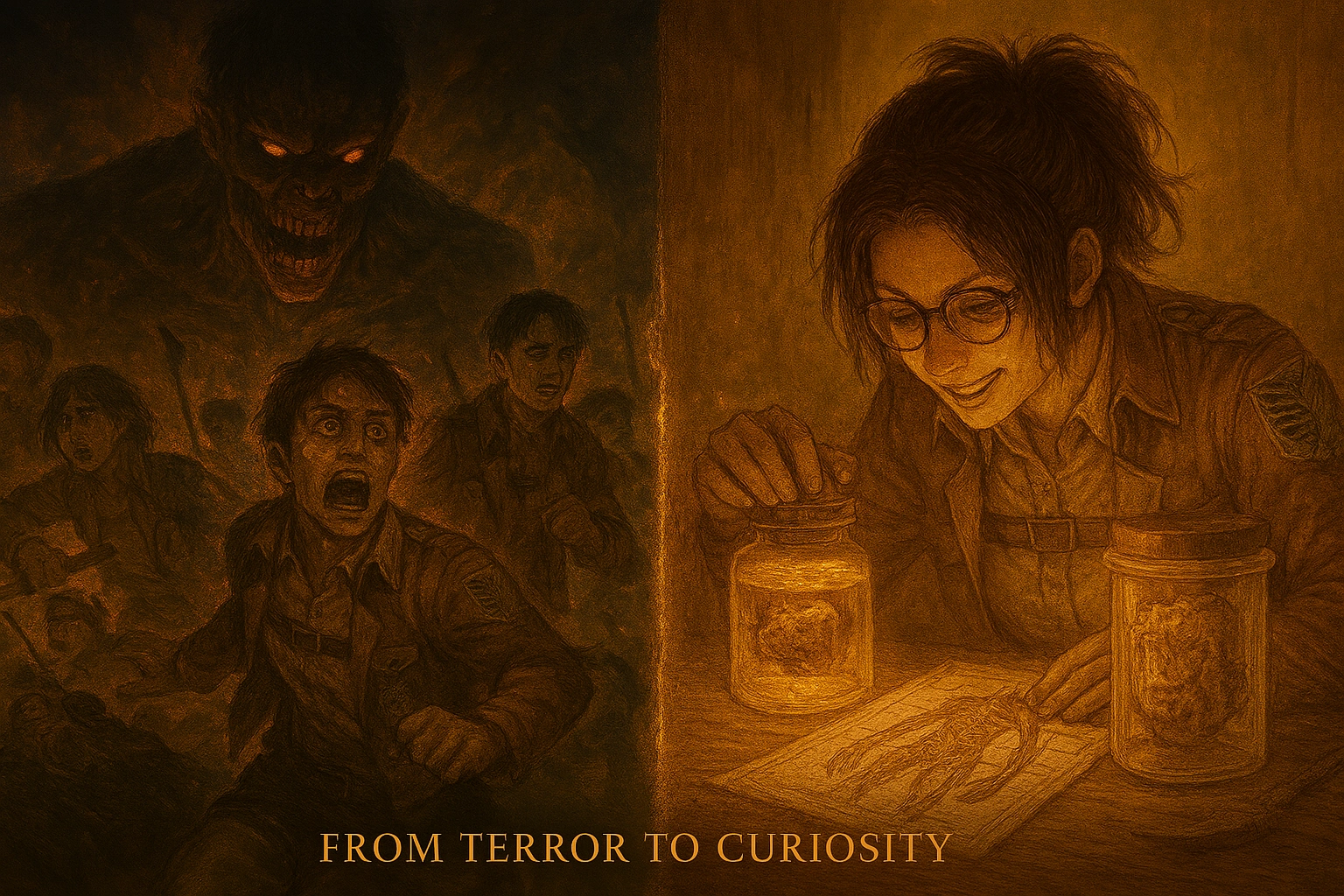
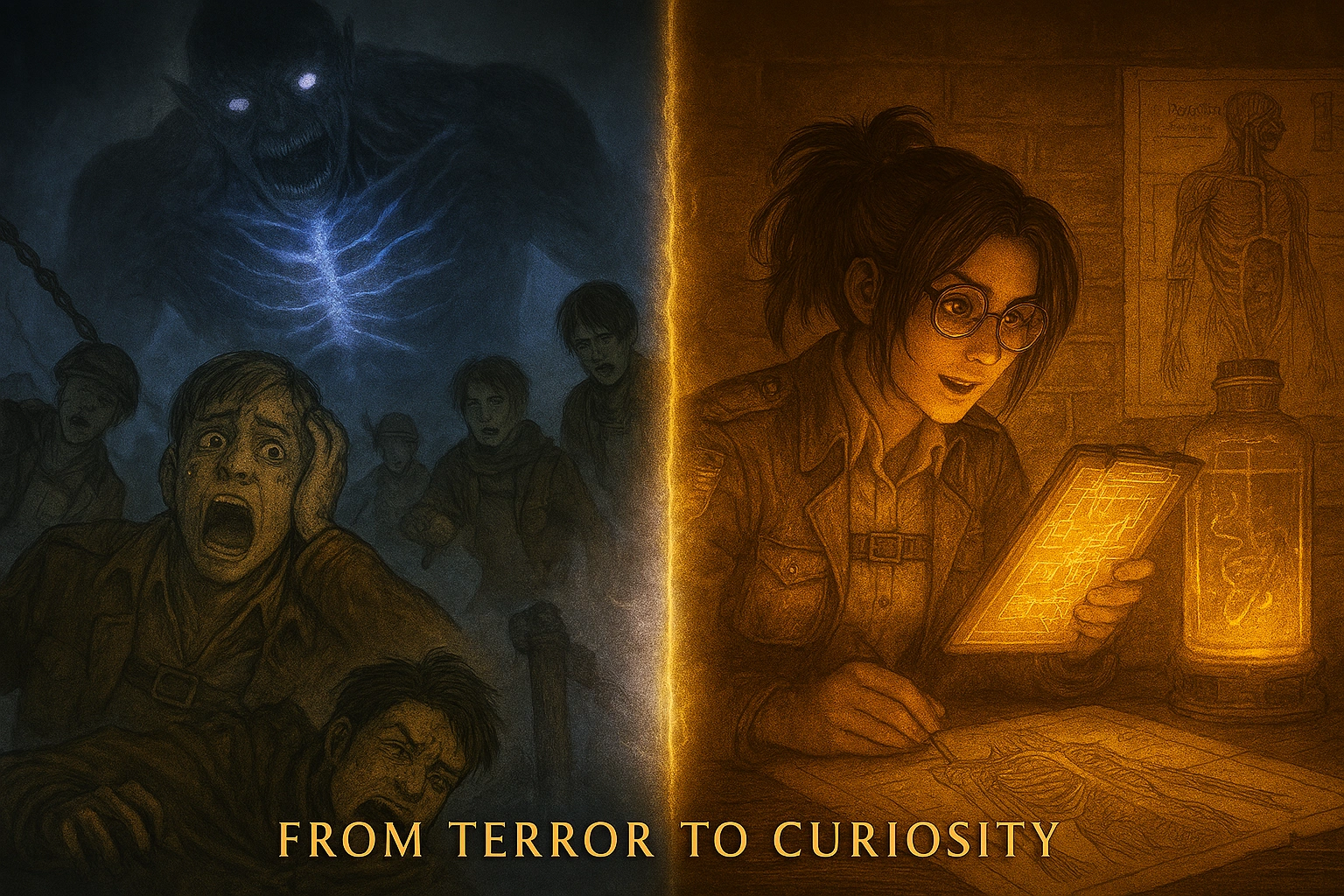
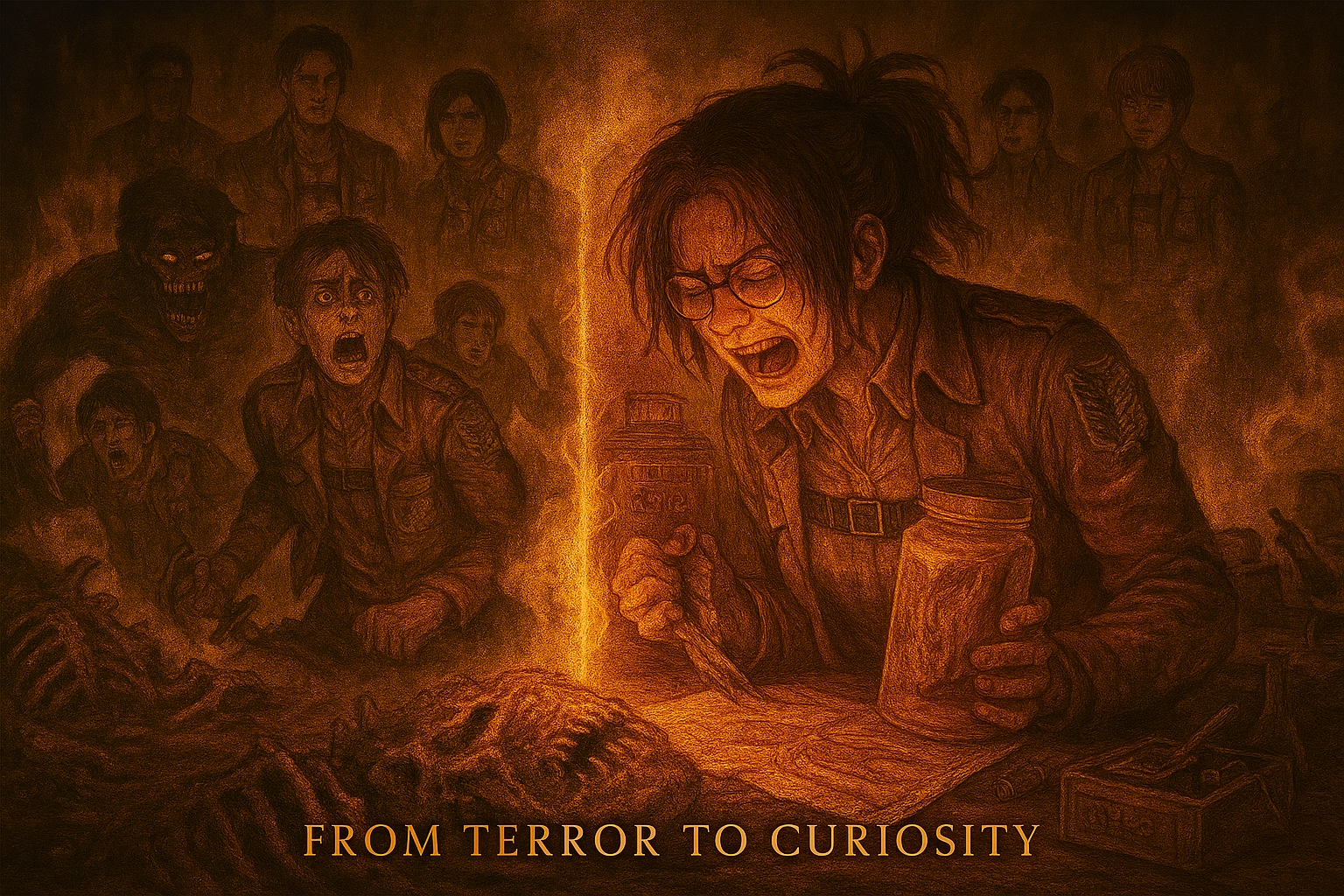
Hange Zoë’s greatest contribution was not a weapon, but a paradigm shift. She was the first person in a century to look at a 15-meter-tall, man-eating monster and, instead of feeling fear, feel an insatiable need to know.
This intellectual pivot from terror to curiosity was the single most revolutionary act in Paradis’s war.
A. The Paradigm Shift: From Fear to Fact
For 100 years, the human response to the Titan threat was medieval, defined by two emotions: fear and fanaticism.
The Common Man, the general populace, saw the Titans as a divine, unknowable plague—a curse from God or a force of nature to be prayed against, not studied.
Their response was superstition. They were cattle, huddling behind the Walls, their only “effort” being prayer and blind obedience to a government that fed them lies. This systemic ignorance was reinforced by all branches of the military.
The Garrison’s response was avoidance, a doctrine of maintenance and repair focused entirely on the Walls. Their job was to “manage” the terror, to cower behind cannons and wait for the monsters to go away, their entire purpose being static defense.
The Military Police’s response was cynical avoidance, using the threat as a political tool to consolidate power and resources far from the front lines, actively suppressing any technology or curiosity that might upset the status quo. Even the Survey Corps, for all their bravery, operated on a doctrine of brute force, evasion, and a desperate, blind hope.
Their goal was to find a “macguffin”—a secret in a basement—not to deconstruct the enemy itself. They were brave, but they were still guessing, fighting in the dark, and their expeditions were less “reconnaissance” and more “human sacrifice” in the vague hope of finding something. Into this world of fear steps Hange Zoë, whose response is a form of intellectual madness.
Where others see monsters, Hange sees a data set. Where soldiers feel righteous fury, Hange feels an ecstatic, obsessive curiosity. This shift is the true revolution. She is the first human to treat the Titans as a scientific problem to be solved, not a “destiny” to be feared or a “curse” to be endured.
This radical act of applying the scientific method (hypothesis, observation, experimentation, conclusion) to a “magical” problem is what ultimately breaks the stalemate. Hange’s effort proves that the “magic” of the Titans is just a system of rules, and any system—no matter how terrifying—can be understood.
Her curiosity was seen as deviant, even grotesque, by her peers. She was the “mad scientist,” the “Titan-freak.” But this very deviancy was her strength. It allowed her to be the “rogue element,” operating outside the norms of fear and military dogma.
Hange’s effort proves that the “magic” of the Titans is just a system of rules, and any system—no matter how terrifying—can be understood. And anything that can be understood can be exploited.
B. The Live-Capture Experiments: Establishing the “Meso-Rules”
Hange’s capture of the two Titans, gleefully nicknamed “Sonny” and “Bean,” is the foundation of all future victories for Paradis.
This “case study” is where Hange, through pure, obsessive effort, establishes the foundational “Meso-Rules” of the enemy.
She is literally writing the textbook on how to kill a god, page by painstaking page. This was not a simple act; the capture itself cost dozens of lives, a Price of Power Hange was willing to pay for the chance at data.
This is where her “hope” for knowledge became a “dark reality” for the soldiers who died to secure her “test subjects.”
Her first and most critical discovery was Solar Dependency. Through simple, methodical observation—depriving Bean of sunlight and meticulously documenting his increasing lethargy, then exposing him to a single ray of light and observing his immediate re-activation—she proved a “M-Rule” that changed the entire strategic landscape.
The Titans are not perpetual motion machines. They are not demons who feed on human flesh out of malice. They are, in essence, biological batteries that require solar charging. This discovery is a cataclysm. It confirms the first usable, strategic weakness in 100 years.
This single piece of data, won through Hange’s effort, gives humanity half the day back. It’s why the Survey Corps begins to travel at night, a tactic that would have been seen as suicide before. It allows for the planning of complex operations like the sealing of Trost or the mission to Shiganshina, as the Scouts can now reliably predict when and where the Titan threat will be at its lowest.
It proves the monsters have a logistical chain, a “fuel,” and any enemy that needs to refuel can be outmaneuvered. This discovery, born from pure observation, was the first chink in the “magic” armor of the Titans.
This led to her second breakthrough: Abnormal Physiology. This is where Hange’s science begins to dismantle the terror of the Titans by replacing it with facts. She deconstructs their physiology and finds that it makes no logical sense in a traditional biological framework, pushing the answer from “biology” to “magic-as-a-system.” She first observed their impossibly light bodies.
A 15-meter Titan, despite its mass, is shockingly, impossibly light. A severed arm that should weigh tons evaporates into steam. This is the first clue that they are not “flesh and blood” in the way humans are, hinting at their true nature as constructs projected from an unseen, “magical” source (the Paths). But the most world-altering revelation was their lack of a digestive tract.
Hange’s internal examinations proved that Titans lack a digestive system. The humans they vomit up are not digested; they are merely stored in an internal cavity. This proves the central horror of the series is a lie: Titans do not eat humans for sustenance. Their motive is not hunger.
This shifts the understanding of the enemy from a simple predator to something far more complex and terrifying: a creature driven by a mindless, specific compulsion to hunt humans, a compulsion they don’t even need to survive.
This psychological blow is immense—they are being killed for no reason at all, which is a “dark reality” far worse than the “hope” of being part of a natural food chain.
Hange’s previous breakthroughs culminate in her third, monolithic tactical rule: The Nape as the Only Rule. Her most brutal experiments—driving a spear into Bean’s eye or heart—elicited no pain response, only aggression. This confirmed that conventional “kill” shots are useless.
Through relentless trial and error, she proved that the Titan body is a disposable puppet. Stabbing the heart does nothing. Destroying the brain does nothing.
The only thing that matters, the only “rule” for a kill, is the 1×1 meter block of flesh in the nape of the neck. This discovery, born from Hange’s obsessive effort, is what created the entire military doctrine of Paradis.
Before Hange, what were soldiers even aiming for? They were just flailing. Her work wasn’t just an improvement; it was the invention of Titan-killing as a science. It is the reason the ODM gear is designed for height and speed. It’s the reason the blades are designed for deep, parallel cuts.
Hange’s scientific data takes the guesswork out of war and turns Titan-killing into an equation. She provides a single, achievable target, transforming a battle against “gods” into a reproducible feat of physics and engineering. The “magic” of Titan regeneration was rendered irrelevant; Hange’s “Effort” had found the “off” switch.
C. The Price of Effort
Hange’s scientific “hope” is for a clean, intellectual breakthrough. She believes that data can be gathered objectively, that she can remain a detached observer.
The “dark reality” is that science is not a clean process, and the cost of her effort is her own humanity. The moment this becomes clear is not during the experiments, but after.
Hange’s hysterical grief over the deaths of Sonny and Bean is one of the most revealing moments in her character arc. It is a terrifying and complex display of emotion.
On one level, it is the cold, calculated rage of a scientist whose precious, irreplaceable data has been destroyed. She screams not just for “Sonny” but for the lost opportunity to test her next hypothesis, for the “hope” of discovery that was stolen from her.
But on another, deeper level, her grief is genuine. She named them. She developed an emotional attachment to her test subjects.
This is the duality that defines her. She is trapped between the “hope” of her scientific mind, which sees them as data points, and the “reality” of her human heart, which sees them as beings, even “pets.” This is the first true glimpse of the Price of Power.
Hange’s “power” is her intellect and curiosity. The “price” is the psychological cost of that obsession. She is forced to sacrifice everything for the sake of data—her soldiers’ lives to capture the Titans, her own moral boundaries to experiment on them, and finally, her emotional stability when they are killed.
This event also isolates her; her comrades feel simple, righteous hatred for Titans and relief that they are dead. Hange’s complex, scientific grief makes no sense to them, setting her further apart as the “rogue element” who walks the line between human and monster.
III. Section 2: The Apex of Effort: Engineering the God-Slayers
If Section 1 was Hange’s work as a pure scientist (theorist, biologist), Section 2 is her evolution into an applied scientist (engineer, weapon-smith).
This is where her “Effort” is literally forged into steel and gunpowder, creating the tools that allow the Common Man to execute the gods.
A. The Titan-Capture Guillotine
Hange’s first true “invention” is the Special Target Restraining Weapon, a massive, complex “guillotine” of spiked barrels.
This tool is the perfect bridge from pure to applied science. The “problem” was clear from her “Sonny & Bean” research: the “hope” of live capture was crushed by the “reality” of the unsustainable cost in human lives. The military’s standard operating procedure was to react.
Hange’s solution was to engineer a proactive tool. This invention is the ultimate expression of the Common Man’s intellect. It is not magic. It is a brilliant, Rube-Goldberg-esque piece of mechanical engineering, using basic principles of levers, triggers, and counterweights. It is built from wood, steel, and rope. Hange meticulously calculated the precise force, angle, and timing needed to entrap a 15-meter Titan without killing it.
This is a tool born from mathematics, not magic. This tool represents a fundamental shift in the power dynamic. For the first time, humanity is not just reacting to Titans; they are controlling them.
Hange’s science allows the Scouts to set a trap, neutralize a 15-meter Titan without casualties, and dictate the terms of the engagement. This is Hange betting her soldiers’ lives on her own calculations being correct, a new Price of Power where her intellectual failure means a squad’s death.
This tool is what enables the capture of the Female Titan and, later, Reiner. Hange’s intellect builds the cage that holds the “magic” of the Shifters.

B. The Ultimate Breakthrough: The Thunder Spear
The Thunder Spear is Hange Zoë’s masterpiece. It is the single most important invention in Paradis’s history and the ultimate, undeniable proof of the Core of Victory. The “problem” it solved was not just tactical, but existential: the “Destiny” of the Armored Titan.
The appearance of the Armored Titan was a rule-breaking moment. Reiner’s armor is a “magic” rule that says, “I cannot be beaten by the Common Man.”
It renders the Scouts’ primary weapon—their blades, the very tools perfected by Hange’s earlier research—completely obsolete. It is a symbol of “Destiny” itself, a seemingly unbreakable wall that negates all of humanity’s effort.
It creates a new hierarchy: The Common Man can kill Pure Titans, but only a “Shifter” (Eren) can fight another “Shifter.” This is a destiny Hange refuses to accept. Her solution is pure, undiluted “Effort.” Hange does not try to find a “magic” sword to counter the “magic” armor.
She deconstructs the problem with cold, brutal logic. She obsessively studies Eren’s new “Hardening” ability (the subject of Article #16), not as “magic,” but as a material with properties. She is the one poking it, measuring it, and testing it while everyone else just sees a new power.
Her analysis determines that the hardened Titan crystal, while incredibly durable, is also brittle. A slice will not work.
But a high-velocity, concussive, piercing force might shatter it. The “hope” of her hypothesis forms. The “dark reality” of this process is that the invention of the Thunder Spear was not a clean flash of inspiration; it was iterative design.
It must have taken countless failures, and given its explosive nature, it is almost certain that soldiers died testing these prototypes.
That is the Price of Power for this invention. The final product is a tool of the Common Man, built from common parts. It combines the industrial knowledge of the Interior (gunpowder) with the specialized technology of the Scouts (ODM gear’s grappling hooks and gas mechanisms). It is, in essence, a rocket-propelled, armor-piercing, explosive javelin.
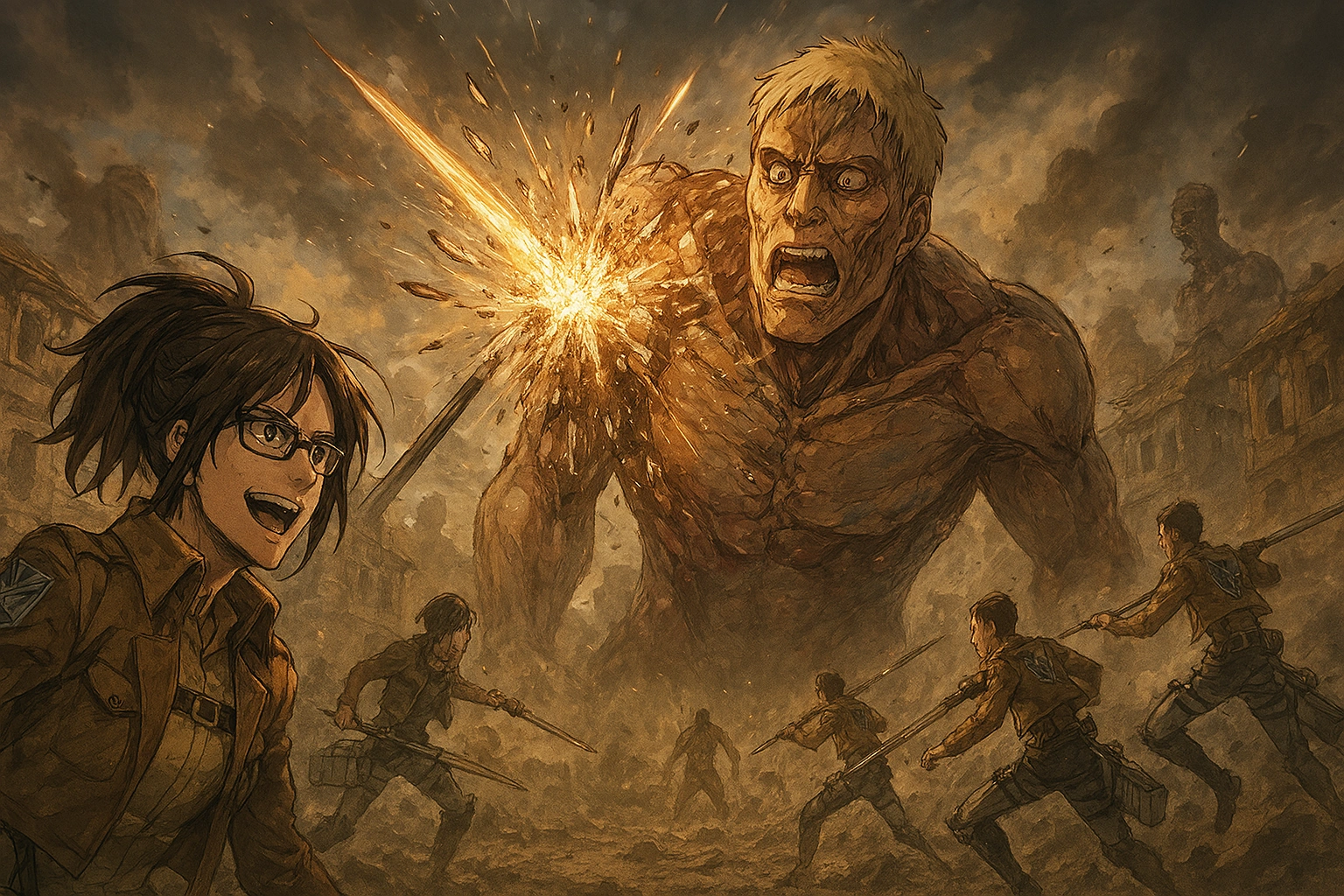
The Battle of Shiganshina is the Thunder Spear’s proving ground. When the Scouts unleash this weapon, it is the single most important “Effort vs. Destiny” moment in the series. The “Destiny” of Reiner’s “unbreakable” armor is shattered by the “Effort” of Hange’s intellect.
The Common Man’s science literally and figuratively breaks the “magic” of a Shifter. More importantly, the Thunder Spear democratizes power.
It takes the “magic” of a Shifter (Eren’s hardening) and, through Hange’s scientific translation, mass-produces it into a weapon that any Common Man can use.
Hange’s effort gives the power to kill a “god” to the average soldier. She proves that for every “magical” rule, there is an “intellectual” exception.
C. Deconstructing the “Magic”
The Thunder Spear is only the most famous example of Hange’s true role: she is the translator of the Flexible Power System. In the Attack on Titan world, “magic” is not a rigid set of laws; it is a flexible system where new rules can be created through willpower and creativity.
This “flexibility” is what allows for new abilities and powers to emerge. Hange is the one who takes this “magic” and translates it into applied science for the Common Man. When Annie encases herself in an unbreakable crystal, the military sees an impasse.
Hange sees a material science problem. She spends years testing its durability, its properties, its very nature, never giving up on the “hope” that it can be broken. When Eren learns to harden, the military sees a new trick. Hange sees the key to everything.
She is the one who analyzes its properties to create the Thunder Spear. She is the one who theorizes it can be used to plug the hole in Wall Maria, turning a Shifter’s “magic” into a large-scale “public works” project. This is the key difference between Hange and other “smart” characters like Armin. Armin is a brilliant strategist.
He is a master of using the existing rules of the system (psychology, wind direction, enemy tactics) to win. Hange is a scientist. Her job is to discover and change the rules of the system itself. Armin wins the game. Hange writes the rulebook.
Without Hange, the “magic” of the Shifters remains just that—magic, a resource exclusive to the “Chosen.” With Hange, that power is deconstructed, analyzed, and weaponized for everyone.
She is the great equalizer, the mind that reverse-engineers the power of the gods and hands it to the people.
IV. Section 3: The Dark Reality of Truth: The Price of Hange’s Victory
Hange’s “power” is her intellect, her relentless drive for the truth.
But the “Price” of this power is the psychological and moral burden of finding it. Every victory of her mind is paid for with a piece of her soul, as the “hope” of knowledge is relentlessly crushed by the “reality” of the truth.
A. The Ilse Langnar Revelation
This is the pivot point for Hange’s entire existence. Her “hope” in the early days, driving the “Sonny & Bean” experiments, was simple: find a weakness, kill the Titans, and free humanity.
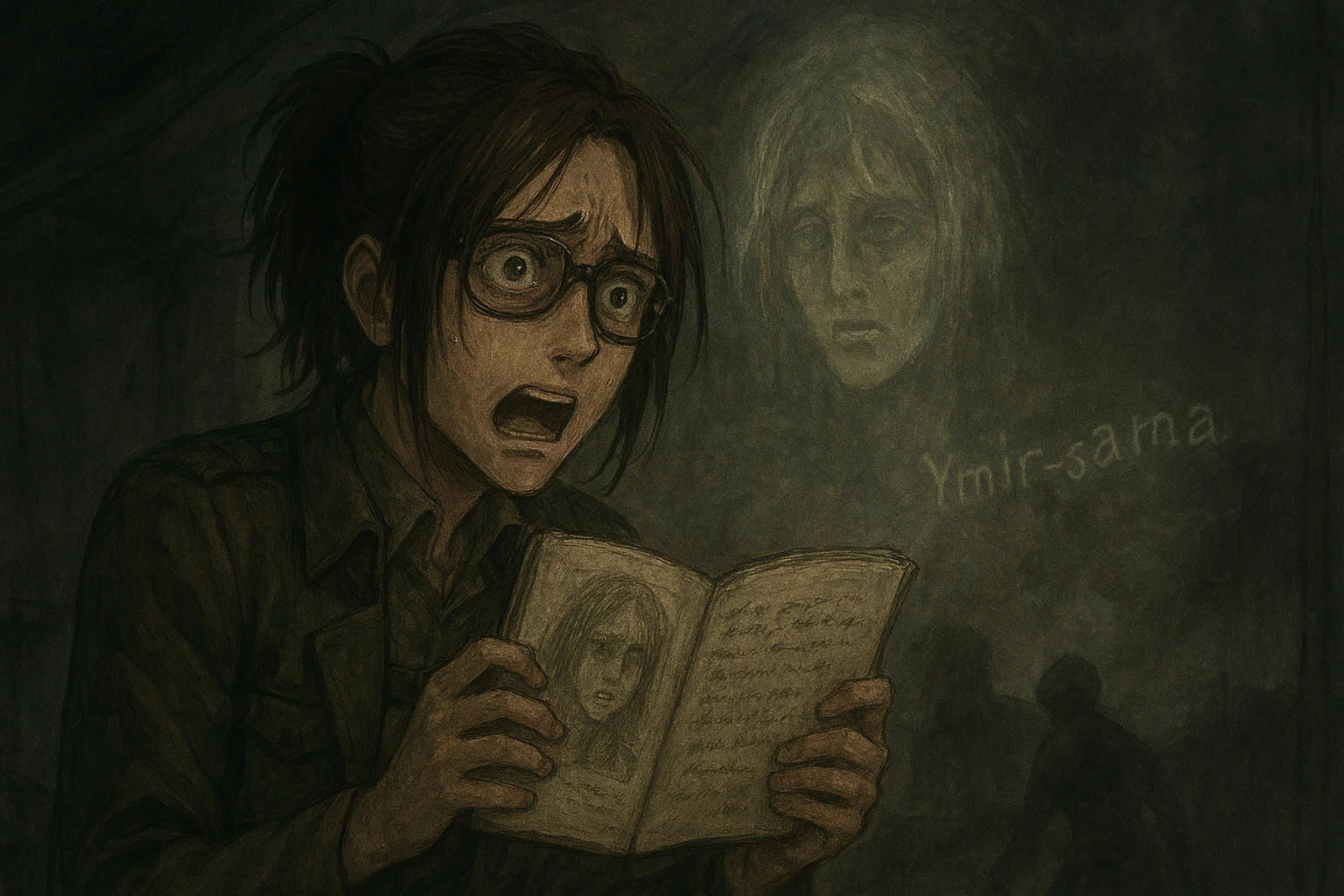
The “dark reality” she uncovers in Ilse Langnar’s notebook is a truth so horrifying it re-contextualizes her entire life’s work. The notebook details Ilse’s encounter with a “Talking Titan,” a Titan that worships “Ymir.” This is the moment Hange’s scientific quest becomes a horrifying ethical nightmare.
The “monsters” she has been capturing, torturing, and vivisecting are not monsters at all. They are human. This revelation is the ultimate “dark reality” check. Her “hope” for a simple, external enemy is shattered. The war is not “humanity vs. monsters”; it is “human vs. human.”
Her scientific efforts to “deconstruct Titan biology” were, in reality, acts of brutal, non-consensual human experimentation. The grief she felt for Sonny and Bean is cast in a new, horrific light.
She wasn’t just a scientist losing data; she was a torturer mourning her victims. This truth is the price of her genius.
It’s a psychological burden that begins to crack her psyche, pushing her from an ecstatic scientist to a grim, haunted veteran.
This revelation is what fuels her later desperate interrogation of Pastor Nick, why she holds him over the edge of the Wall. Her scientific curiosity becomes a moral imperative. She must know the truth, because she can no longer bear the “Price” of acting in ignorance.
B. The Burden of Command
The ultimate Price of Power for a pure scientist is being forced to become a politician and a commander. Hange’s “hope” was for pure, unadulterated research. She wanted to live in the lab, to be free to follow her curiosity.
The “reality” is that her success—her pure “Effort”—makes her indispensable. When Erwin Smith dies, he anoints Hange as his successor. This is not a promotion; it is a damnation. Erwin, the ultimate symbol of practical Effort, forces Hange to sacrifice her “hope” (pure research) for the “reality” of leadership.
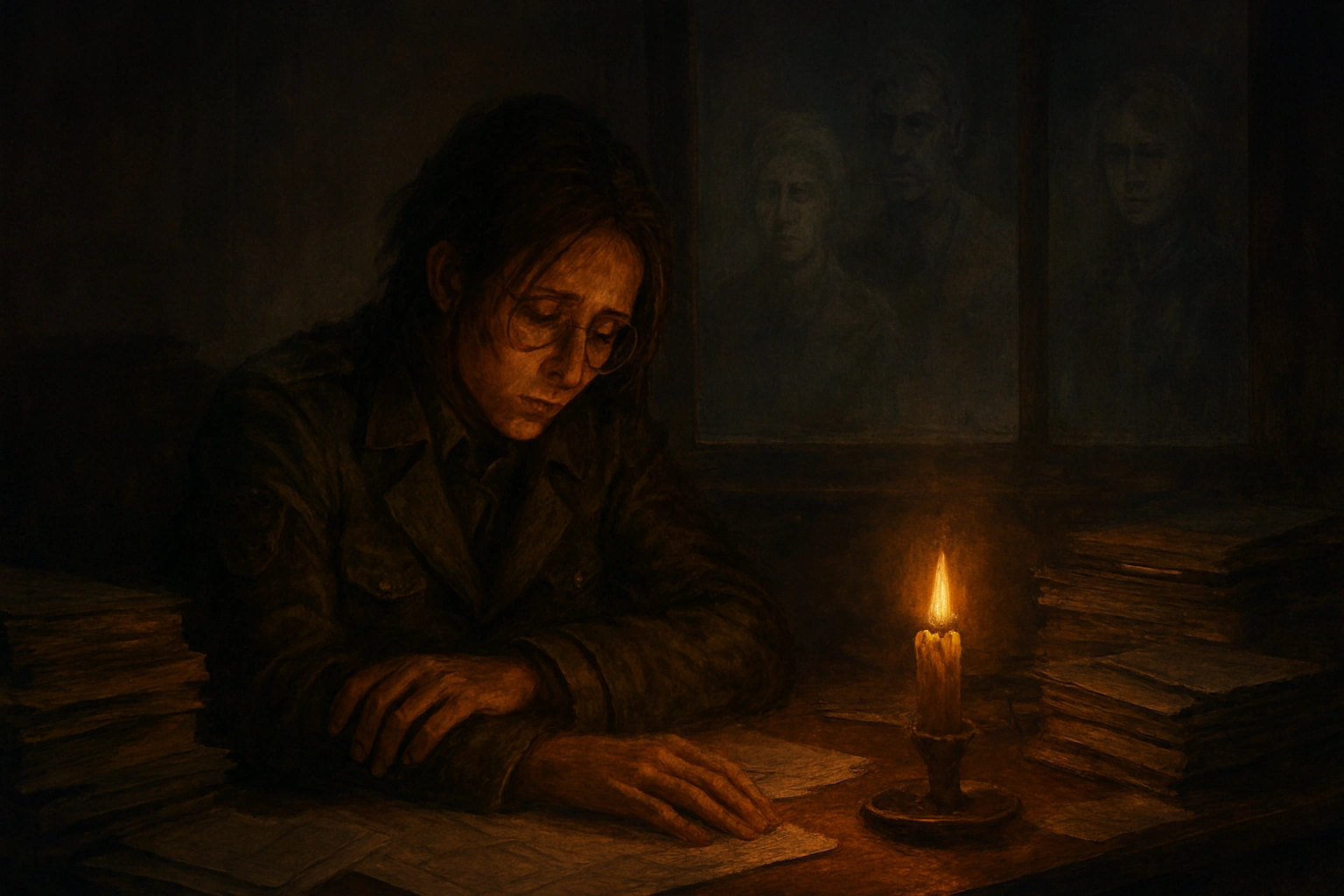
She is ripped from her lab and thrown onto the throne of command. Now, she is no longer just responsible for her own calculations; she is responsible for the lives of every soldier who must execute them. The scientist in Hange wants to wait for more data, to be 100% certain.
The commander in Hange must make guesses and send people to die based on incomplete information. This is a new, personal hell for her. Her greatest “power” (her intellect) becomes her greatest “curse” (the burden of impossible choices).
The weight of every failed plan, every soldier sent to die using her Thunder Spears, and every strategic gamble now rests on her shoulders. She is forced to send the Common Man to his death based on her own data.
This is the ultimate “Price”—the scientist who simply wanted to know is now forced to decide, and every decision is written in the blood of her comrades.
This burden visibly erodes her, stealing her eccentric joy and replacing it with the same haunted, pragmatic exhaustion that defined Erwin.
C. The Final Experiment: Hange’s Last Stand
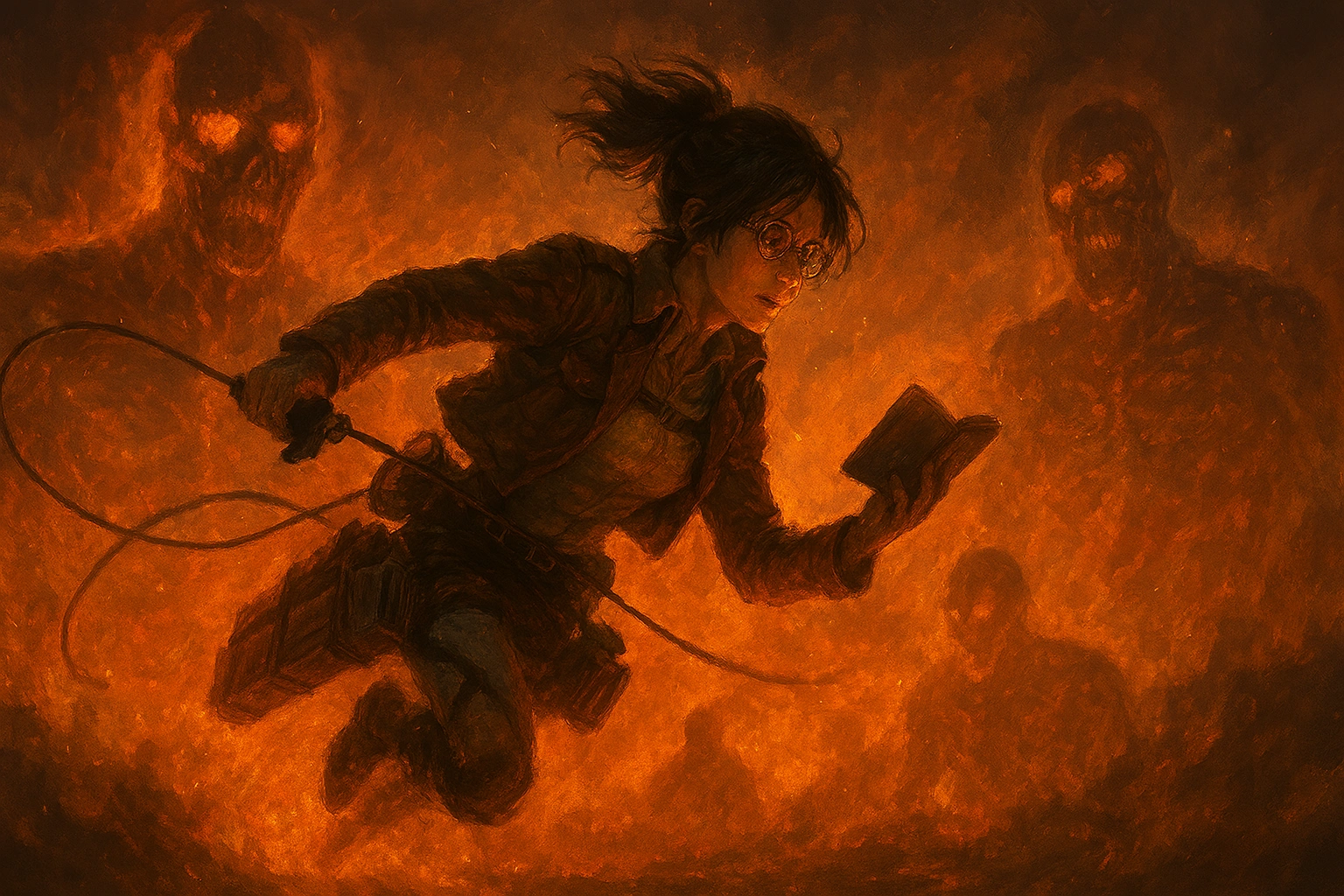
Hange’s death is the ultimate and final expression of her character. It is the last experiment, and the hypothesis is her own life. Faced with the Rumbling, she is not a Shifter. She has no “Destiny” that can save her, no magical power to call upon. She is, to the very end, a Common Man.
She cannot “destine” herself to live. She can only use her “Effort” to buy time for the others. Her final act is a perfect synthesis of her two halves: the Commander and the Scientist.
As the Commander, she sacrifices herself for the mission, a logical choice to protect the “data” (the allied team) that represents humanity’s last hope. She makes the calculation and pays the Price of Power herself, absolving her soldiers of that burden.
But as she burns, the Commander dies, and the Scientist takes over. In her final moments, she is not screaming in terror or praying to a god.
She is analyzing. She is obsessively, ecstatically deconstructing the Colossal Titans, marveling at their power even as it incinerates her. Her final words—”Titans are truly magnificent!”—are not a surrender.
They are a final, defiant act of curiosity. Her Effort, her drive to know, was unbroken to the very end. She died as she lived: as a scientist, collecting one last, perfect piece of data.
V. Conclusion: The Victory of the Mind
Hange Zoë is the ultimate, undeniable proof of the Core of Victory. In a world drowning in gods, magic, and the crushing weight of “Destiny,” the war was decisively won by the unwavering, obsessive effort of a single Common Man’s mind. While Eren Yeager’s power (Destiny) was the “nuke” that ended the old world, it was Hange’s intellect (Effort) that allowed humanity to survive long enough to use it.
She was the one who wrote the rules, built the weapons, and deconstructed the enemy. She dragged the “magical” into the light of the “rational.” Hange‘s science did far more than just kill Titans; it deconstructed the fear of them.
She proved that every god has a weakness, every monster has a motive, and every “unbreakable” rule can be shattered by a mind willing to ask “Why?” Hange’s legacy is the ultimate, brutal testament that no “destiny” is absolute and no “magic” is immune to the relentless, brilliant, and terrifying power of human intellect.