
1. The Sengoku Twin Anomaly: Omen of the Bloodline
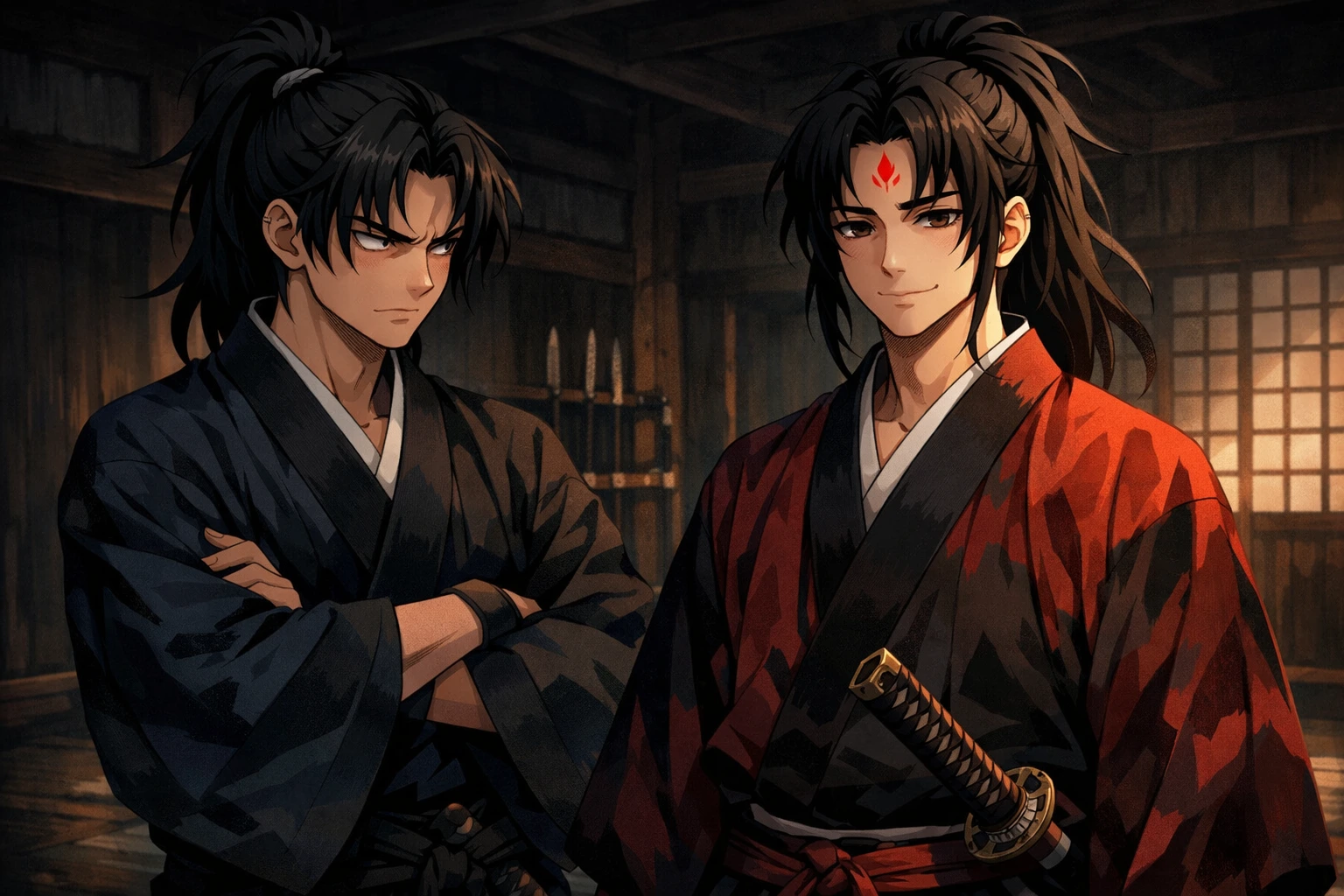
To fundamentally understand the monstrosity that is Michikatsu Tsugikuni—the entity who would eventually mutate into the terrifying Upper Rank One, Kokushibo—one must first strip away the centuries of demonic evolution and return to the blood-soaked soil of the Sengoku period. Michikatsu cannot be introduced simply as a monster born of malice; he must be examined as the ultimate, agonizing victim of a brutal, superstitious era that weaponized familial bonds.
In the warring states of Japan, the birth of twins within a samurai clan was not greeted with celebration; it was viewed with profound, existential dread. Twins were considered a biological and spiritual curse, an omen designed by the heavens to fracture a family’s lineage and plunge a clan into civil war over succession rights. It was a time when a child’s worth was measured entirely by their political utility and biological perfection.
Michikatsu was born as the elder twin, the designated heir to the Tsugikuni clan, stepping into a world that demanded utter perfection and absolute dominance. He was conditioned to view himself as the apex of his bloodline.
His brother, Yoriichi, was the anomaly—a child born with a strange, ominous birthmark, destined to be cast aside, isolated in a tiny room to preserve the singular purity of the succession. From his first breath, Michikatsu’s identity was entirely predicated on this concept of inherent, unassailable superiority. He was the chosen son, the future lord, the one who possessed the right to pity his seemingly fragile, quiet, and clinging younger brother.
His initial feelings toward Yoriichi were genuine, rooted in a patronizing but sincere brotherly love. Michikatsu sneaked his brother a handmade wooden flute, a gesture of profound empathy in a household devoid of warmth or genuine affection. This act of kindness, however, was subconsciously anchored in his belief that Yoriichi was fundamentally inferior, a pitiful creature who required Michikatsu’s noble protection to survive.
The psychological fracture—the exact, microscopic moment Michikatsu’s mind shattered—did not occur through an act of malice, but through a revelation of divine biology. It happened in the training courtyard, a seemingly mundane afternoon that would forever alter the trajectory of the Demon Slayer Corps and the demon realm.
Yoriichi, a child who had never held a sword, picked up a simple wooden bokken and, in the blink of an eye, struck down a master instructor. The sheer speed and force of the blows were incomprehensible for a child, echoing through the courtyard with a terrifying finality. But it was not merely the martial prowess that broke Michikatsu; it was the subsequent revelation of how Yoriichi saw the world.
When Yoriichi innocently explained his innate ability to perceive the inner workings of living creatures—the rushing of oxygenated blood, the precise contraction of muscle fibers, the very structural alignment of bones and joints—Michikatsu realized his brother possessed the Transparent World.
This was not a skill that could be learned through thousands of hours of grueling, bone-breaking practice; it was a god-like biological superiority woven effortlessly into Yoriichi’s DNA. To an average human, standing before someone who can see your literal pulse and predict your every twitch is profoundly terrifying. In that paralyzing instant, the foundation of Michikatsu’s entire reality collapsed.
All his training, his status, his agonizing dedication to the samurai way were rendered utterly meaningless in the face of sheer, genetic divinity. The pity he felt for his brother instantly curdled into a suffocating, venomous envy. He was not the superior heir protecting a weak sibling; he was a profoundly average human, a biological peasant, standing forever in the shadow of a living deity.
This is the central thesis of Kokushibo’s existence: he is the ultimate, tragic manifestation of the inferiority complex. His entire demonic existence, the grotesque anatomical mutations he endures, and the hyper-lethal combat style he develops are all desperate, biological overcompensations for his inherent, unchangeable inability to match his brother.
Every cell in his body, long before it was tainted by Muzan Kibutsuji’s blood, was infected by a cancerous jealousy that consumed his humanity from the inside out. He did not become a demon to conquer the world, nor did he crave mindless slaughter; he became a demon because the biological reality of his own mediocrity was a psychological torture he could no longer survive.
2. Moon Breathing: The Physics of Chaotic Kinetics
To comprehend the sheer, devastating lethality of Kokushibo, one must conduct a meticulous analysis of his martial art: Moon Breathing. This is not merely a fighting style; it is a profound study in the biomechanics of failure, the physics of chaotic kinetics, and the tragedy of forced adaptation. Moon Breathing is, at its core, a derivative breath—a compromised imitation born entirely from biological inadequacy.
When Yoriichi attempted to teach his brother Sun Breathing, the original and perfect breathing style, Michikatsu’s human body fundamentally rejected it at a cellular level. Sun Breathing is an art of absolute kinetic perfection; it requires the user’s internal physiology to achieve a state resembling a continuous, self-sustaining loop of solar energy.
The heart must pump highly oxygenated blood at a specific, relentless rhythm, pushing the body’s internal temperature to near-lethal heights, while the muscles must fire in perfect, unbroken, circular sequences. Michikatsu’s human cells simply could not handle this perfect kinetic loop.
Attempting to channel the Sun burned him from the inside, tearing his muscle fibers, searing his lungs, and exhausting his respiratory system to the point of collapse. Bound by his agonizing physiological limitations, Michikatsu was forced to adapt, twisting the perfect, unyielding circle of the Sun into the erratic, less efficient, but wildly destructive arcs of the Moon.
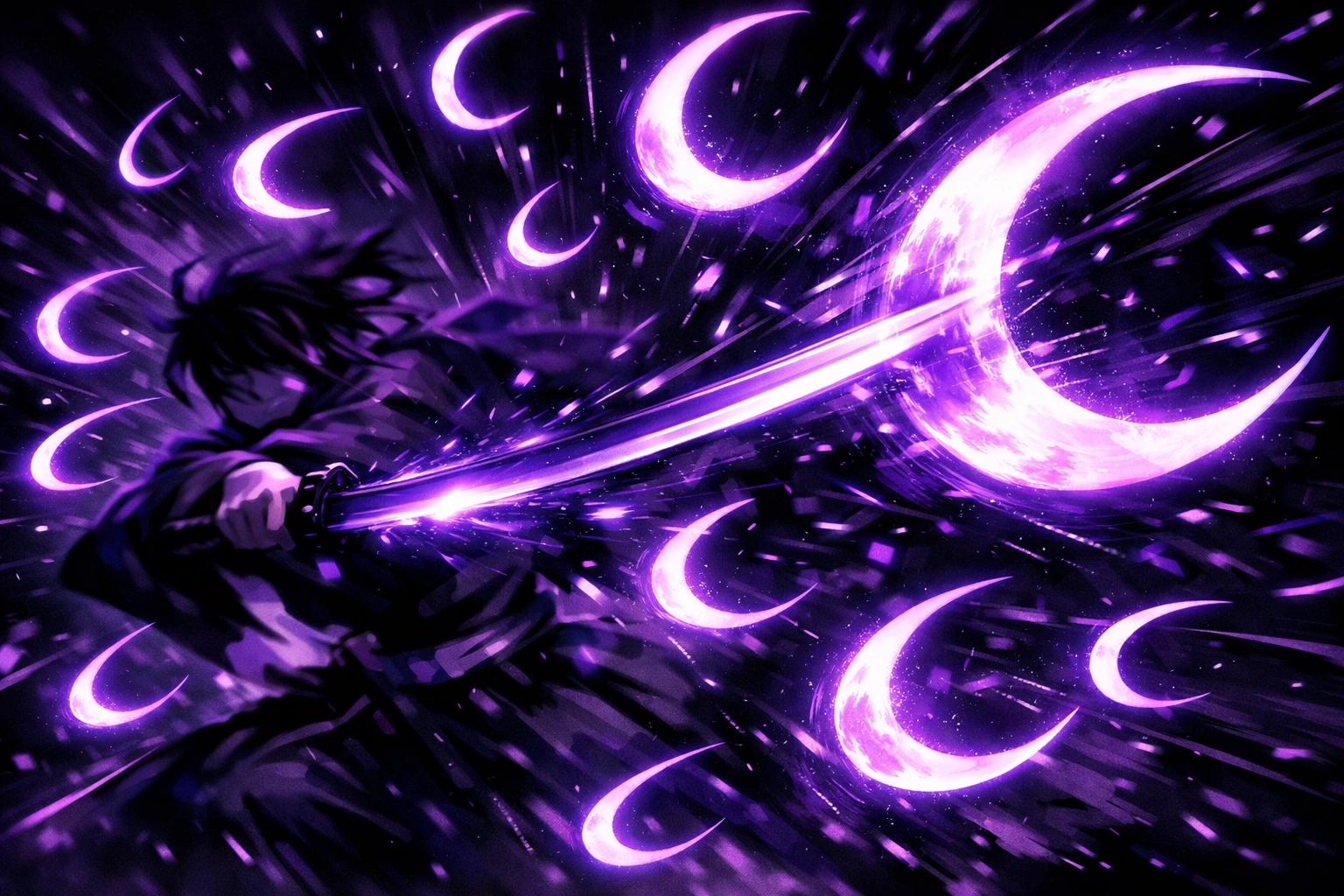
The physics governing Moon Breathing are deeply rooted in the aero-dynamics of his specialized katana. Where Sun Breathing utilizes perfect, uninterrupted arcs of superheated kinetic energy designed to incinerate demonic regeneration, Moon Breathing relies on the violent manipulation of atmospheric pressure to generate chaotic, microscopic crescent blades.
As Kokushibo swings his sword, the hyper-accelerated speed, unique grip, and highly specific angle of the blade create extreme localized pressure differentials in the air. These atmospheric micro-vacuums immediately collapse with high-pitched, screaming shrieks, snapping the surrounding air into solid, razor-sharp crescent projectiles of hardened kinetic force.
Because Moon Breathing is inherently erratic—a style born of physiological compromise and bitter frustration—these crescent moons do not share a uniform size, velocity, or trajectory. They defy the standard laws of momentum.
They are constantly shifting in mid-air, growing, shrinking, and oscillating as they travel, sustained by the dense demonic energy radiating from the sword. This creates a deeply lethal, impossible aerodynamic environment. A single swing of Kokushibo’s blade does not just deliver a primary physical strike; it unleashes a localized storm of chaotic, secondary projectiles that rip through the surrounding space like a tempest of shattered glass.
This is exactly why Moon Breathing is mathematically impossible for standard Demon Slayers to block or parry. In standard sword combat, defense is a matter of pure geometric calculation: a fighter observes the angle of the opponent’s shoulders, the trajectory of the blade, and the speed of the swing, then places their own weapon in the intersecting path to deflect the incoming kinetic force. Moon Breathing completely obliterates this geometric reality.
The crescent blades act as secondary, highly unpredictable independent projectiles that do not follow the primary swing of the sword. A highly skilled opponent might successfully read Kokushibo’s muscular tension and perfectly parry the physical katana, only to be instantly shredded by three invisible, microscopic crescents that spawned from the vacuum of the swing and traveled along entirely different, mathematically irrational vectors.
The crescents change length and width seemingly at random, meaning a gap in a Slayer’s defense that was perfectly safe a millisecond ago is suddenly lethal. This fighting style is designed to systematically dismantle an opponent’s spatial awareness, overwhelming their visual processing and forcing them to defend against an omnipresent, omni-directional threat. It is the physics of a meat grinder translated into a martial art, a bitterly erratic dance of death that perfectly mirrors Michikatsu’s fractured, chaotic psyche.
3. Optical Neurology: The Anatomy of Six Eyes
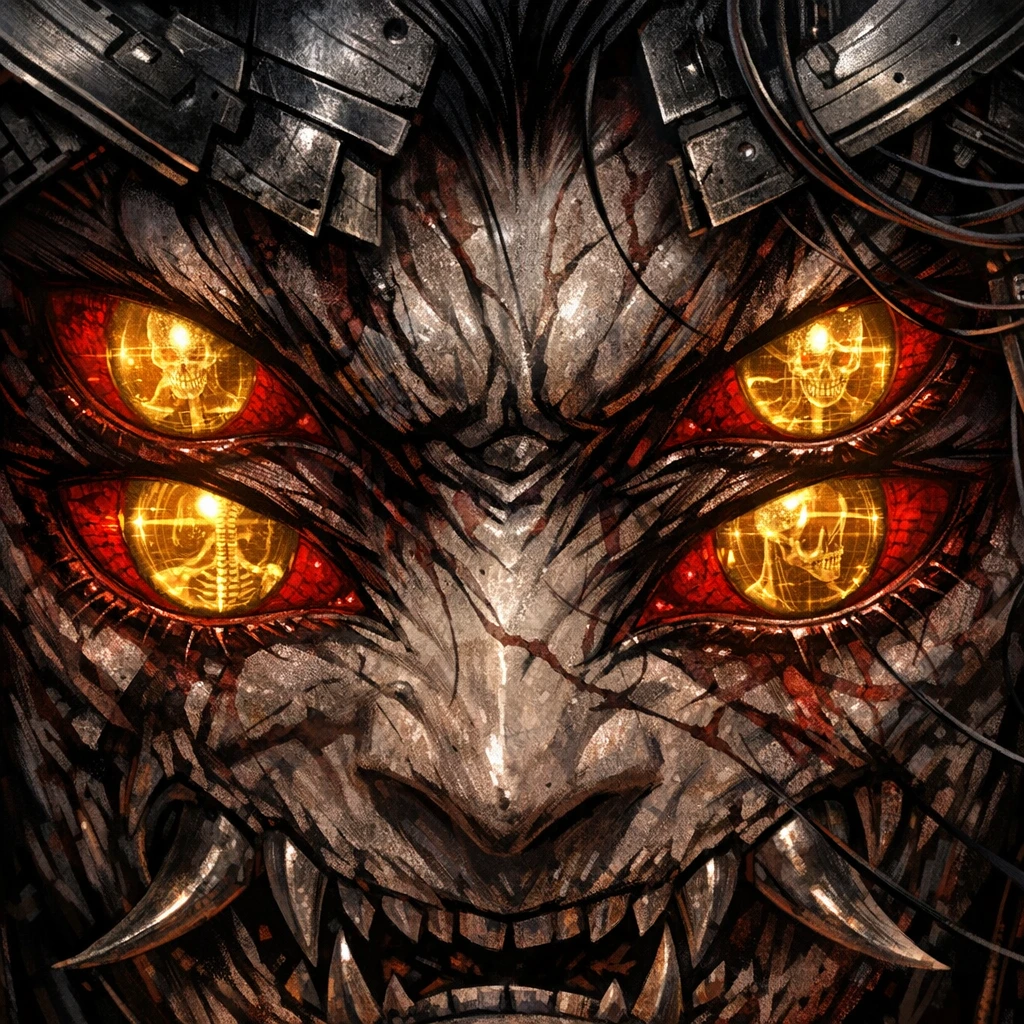
The most immediate, visually disturbing aspect of Kokushibo’s demonic anatomy is his face—a grotesque, terrifying canvas completely dominated by three pairs of golden, bloodshot eyes. To dismiss this simply as a terrifying monster design meant to evoke fear is to ignore the profound, functional, and deeply tragic biology behind it.
We must medically analyze why Michikatsu’s body mutated in this exact, specific manner. This was not a random demonic deformity thrown onto him by Muzan’s blood; it was a highly deliberate, desperate cellular adaptation driven entirely by his obsessive, century-spanning need to track Yoriichi’s god-like speed.
In his human life, Michikatsu learned the hard way that standard human binocular vision—two eyes tracking a single focal point—was fundamentally useless against Yoriichi. A standard human optic nerve simply cannot process environmental information fast enough to register the movements of a being who casually breaks the sound barrier from a resting stance.
To even stand a fraction of a chance at perceiving his brother, Michikatsu required a biological sensory upgrade of unprecedented scale. His demonic transformation facilitated this by aggressively mutating his skull structure and optic neurology, splitting his orbital sockets and forcing the development of six independently functioning eyes.
The neurological load of this vision is staggering to consider. An average human brain dedicates a massive portion of its processing power simply to interpret the stereoscopic image provided by two eyes, filtering out noise to focus on a single point. To process six distinct, high-definition visual feeds simultaneously without experiencing catastrophic sensory overload, agonizing migraines, or severe motion sickness requires an absolute restructuring of the cerebral cortex.
Kokushibo’s demonic brain has developed hyper-advanced neuroplasticity and synaptic hyper-myelination. His occipital lobe has likely expanded enormously and compartmentalized, allowing his brain to instantly stitch together six different, overlapping perspectives into a single, cohesive, omni-dimensional understanding of his immediate environment. He does not just see a room; he processes every geometrical angle of it in real-time.
This optical array grants him absolute Peripheral Dominance. The biology of the six eyes completely eliminates all natural human blind spots, stripping away the vulnerability of the human form. While the central two eyes face forward to lock onto the primary target’s core, the upper and lower pairs are angled slightly outward and vertically, granting him a flawless, 360-degree spherical kinetic radar.
It is mathematically impossible to flank Kokushibo. It is physically impossible to launch a surprise attack from above his eyeline or below his waist. Every strike, no matter how perfectly concealed, is instantly registered by at least two distinct optic nerves.
Furthermore, these six eyes are biologically tuned to process the Transparent World with terrifying, exhausting efficiency. While a human accessing the Transparent World must heavily concentrate, narrowing their focus to look past the surface of an opponent, Kokushibo lives permanently within this state of enhanced, invasive perception. His six eyes act as continuous biological X-ray scanners.
He does not merely see his enemy; he sees the microscopic twitch of their muscle fibers right before a strike is launched. He tracks the sudden rush of oxygenated blood from the heart to the lungs as they prepare a breathing technique.
He watches the shifting of their joints, the compression of cartilage, and the alignment of their skeletal structure, allowing him to mathematically predict the exact vector and velocity of their attacks before the physical motion even begins. By processing these physiological cues from six different angles simultaneously, Kokushibo essentially perceives the world in slow motion, rendering the blinding speed and stealth of nearly any opponent entirely irrelevant.
Yet, this is also a curse; to see the world only as blood, bone, and kinetic data is to completely detach from the beauty of the physical world, isolating him further into a realm of pure, violent calculation.
4. The Flesh Sword: Biological Metallurgy and DNA Assimilation
Perhaps the most horrifying testament to Kokushibo’s obsession with the way of the samurai is his weapon. It is a fundamental, unbending rule of the Demon Slayer universe that Nichirin swords are the ultimate antithesis of demonic flesh.
They are forged from special, Scarlet Crimson Iron Sand and Ore that relentlessly absorb sunlight to eradicate demons at the cellular level, disrupting their regenerative abilities and turning them to ash. Yet, Kokushibo wields a blade that is intimately, biologically tied to his demonic existence. To understand this anomaly, we must delve into the terrifying concept of biological metallurgy and DNA assimilation.
When Michikatsu accepted Muzan’s blood and surrendered his humanity, he did not discard his Nichirin blade as other demons discard human tools. Instead, in an act of supreme physiological defiance, agonizing endurance, and sheer perversion of nature, he assimilated the metallic ore directly into his own DNA. He forced his rapidly mutating, agonizingly painful demonic cells to physically bond with the sun-absorbing steel.
This process neutralized the ore’s lethal, burning properties against him while retaining its unbreakable, sun-forged edge. Kokushibo didn’t just keep his human sword; he consumed it, integrating the metallic compounds into his skeletal structure and nervous system until it became a true biological appendage.
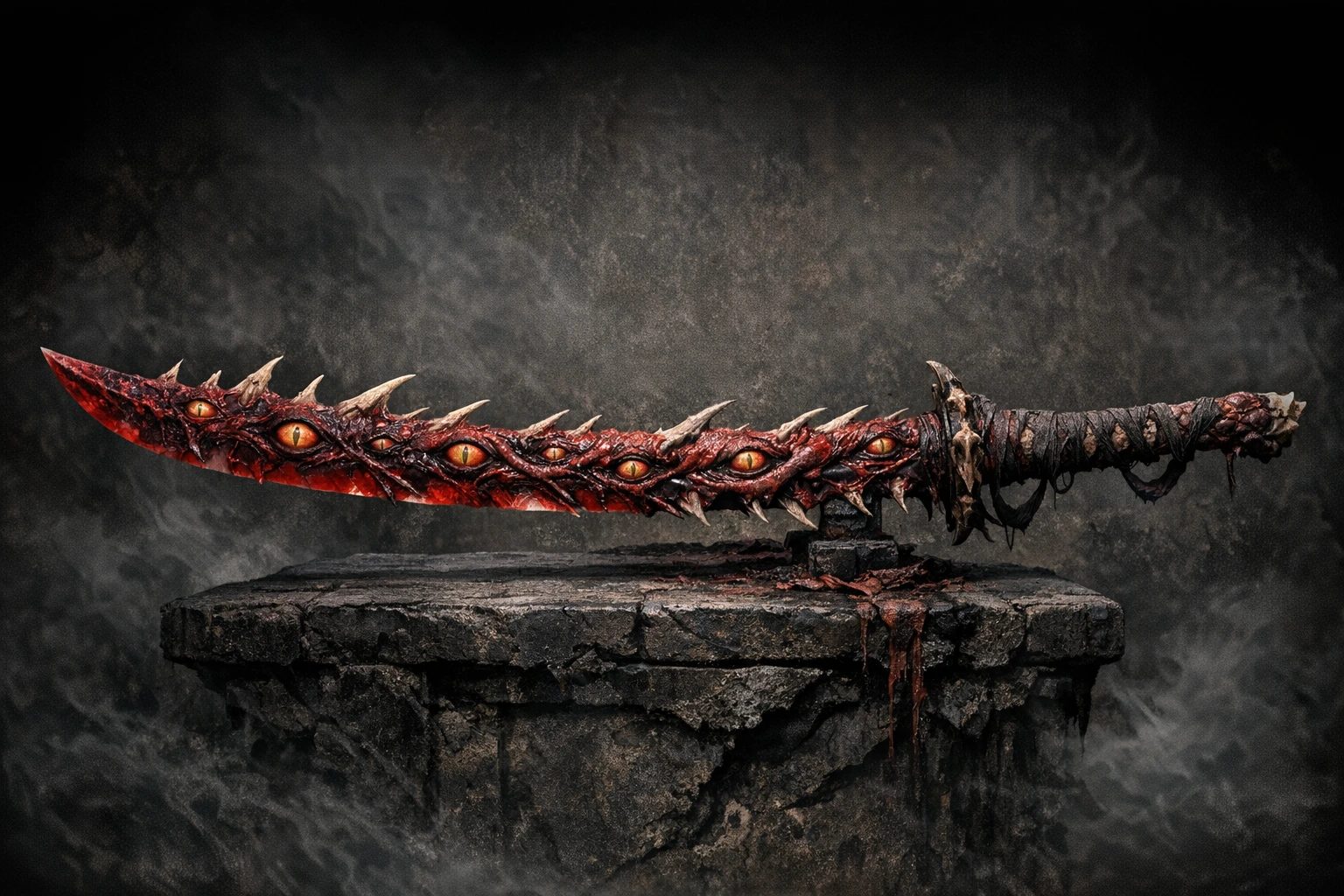
This gruesome process birthed the Living Blade—a weapon of unspeakable horror that exists as a literal extension of Kokushibo’s own anatomy. The sword is quite literally alive, an organ shaped for slaughter. If one looks closely at the flat of the blade, they can see demonic, golden, bloodshot eyes blinking frantically along the fuller, constantly scanning the environment and feeding raw visual data directly back to Kokushibo’s brain.
A faint, sickening heartbeat pulses through the fleshy hilt, syncing perfectly with Kokushibo’s own accelerated demonic cardiovascular rhythm. To hold the sword is to hold his own exposed, beating heart.
Because the sword shares his demonic DNA, it possesses the exact same hyper-accelerated cellular regeneration as his main body. If a Hashira manages to land a heavy blow and chip the edge of the blade, the sword does not remain damaged steel.
It bleeds. Dark, viscous demonic blood seeps from the cracked metal, followed instantly by violent, rapid cellular mitosis. The bone, flesh, and metallic alloys weave back together with a sickening crunch in a matter of milliseconds, restoring the razor edge before the opponent can even retract their own blade to follow up their attack.
To disarm Kokushibo is functionally impossible; you are not trying to knock a static weapon from a man’s hand, you are trying to amputate a highly resilient, rapidly healing, hyper-lethal limb.
The true, devastating physics of this biological metallurgy are revealed in his final, desperate combat phase. When pushed to his absolute physiological limits by the modern Hashira, Kokushibo completely bypasses the traditional, elegant shape of the katana. He commands his sword to undergo violent, unchecked, exponential mitosis.
He forces the cellular structure of the blade to rapidly mutate, multiply, and tear through its own steel sheath. The clean, singular curve of the katana erupts, sprouting massive, jagged, chaotic branches of hyper-dense bone and mutated red steel along the spine and the edge.
In mere seconds, the elegant samurai sword transforms into a towering, asymmetrical, omni-directional meat-grinder. The physics of swinging a weapon with such a bizarre, heavy, constantly shifting center of mass should be impossible, threatening to dislocate the user’s shoulders. Yet, Kokushibo wields it with terrifying, monstrous precision.
These jagged branches exponentially increase the range, weight, and chaotic output of his Moon Breathing. Every swing now generates dozens of massive, intersecting, room-clearing crescent blades, turning the battlefield into a literal blender of localized atmospheric pressure and biological steel.
The Flesh Sword is the ultimate, heartbreaking corruption of the samurai ideal—a weapon that completely abandons technique, discipline, and elegance in favor of overwhelming, monstrous biological superiority and brute-force carnage.
5. The 25-Year Curse: The Cowardice of Immortality
Beneath the terrifying multi-eyed visage, the mastery of atmospheric physics, and the overwhelming martial prowess lies a foundation of profound, deeply human cowardice. The true catalyst for Michikatsu’s fall was not merely his burning jealousy of Yoriichi, but his absolute, paralyzing psychological terror in the face of the Demon Slayer Mark.
To truly understand his transformation, we must explore the harsh biological reality of this mark and the concept of inevitable cellular exhaustion.
The Demon Slayer Mark is often perceived as a divine blessing or a magic power-up; in biological reality, it is a violent physiological overdrive. Activating the mark forces the human body to bypass all natural limiters and operate at 100% capacity continuously.
It drastically elevates body temperature to near-feverish, brain-damaging levels and pushes the heart rate to an agonizing rhythm, forcing the muscular and respiratory systems to fire far beyond their natural, evolutionary limits. This hyper-metabolic state comes at a severe, unavoidable, and highly lethal cost: accelerated telomere degradation and catastrophic cellular exhaustion.
The biological reality of the mark is a guaranteed, inescapable death by the age of 25. The body’s organs simply fail; it literally burns through its own life force to achieve a few fleeting moments of temporary godhood.
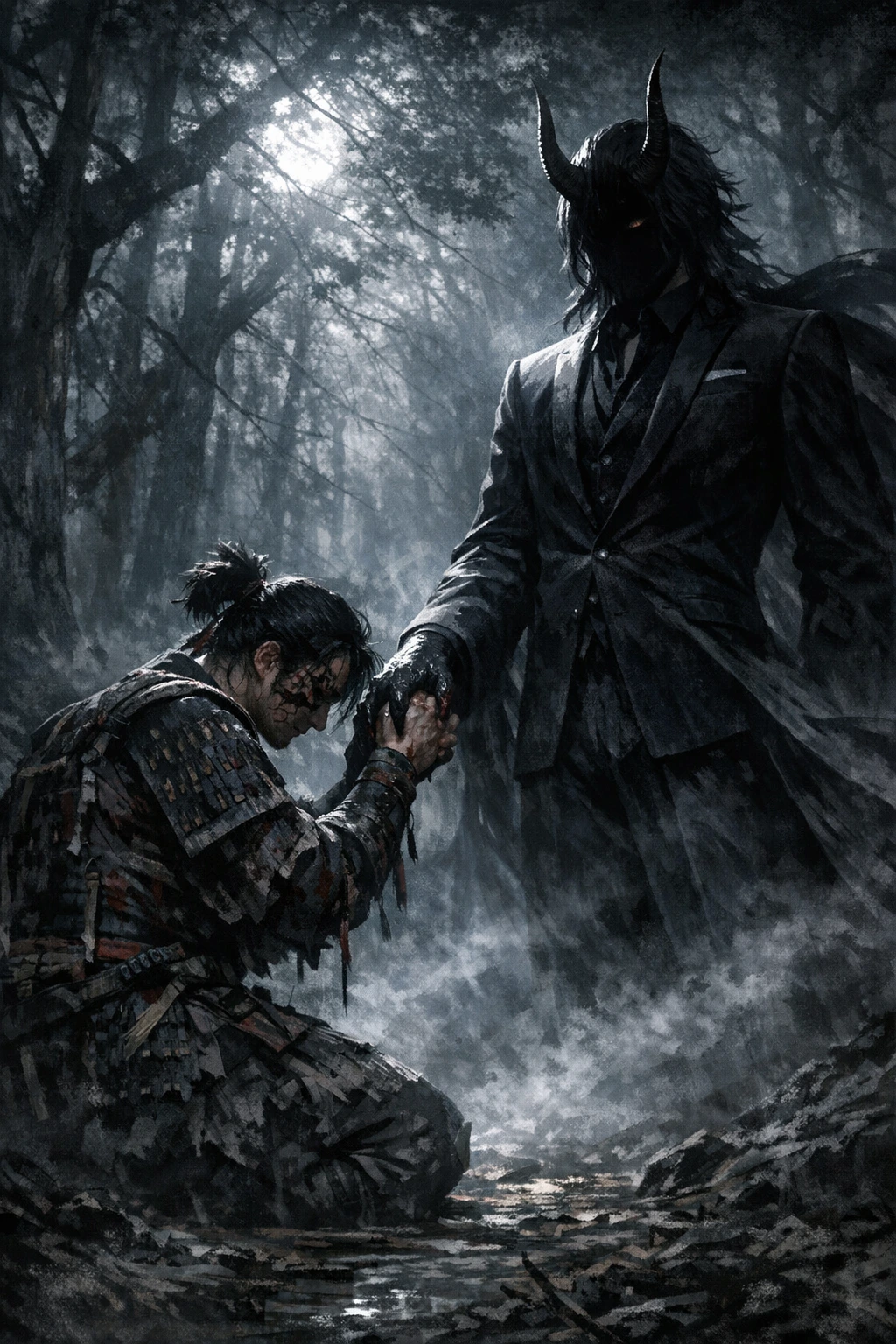
For Michikatsu, who manifested the mark alongside his peers during the Sengoku era, this ticking biological clock completely shattered his resolve. He watched his fellow marked swordsmen cough up blood and die sudden, agonizing deaths as their cells collapsed.
He was consumed by the fear of the void—the sheer terror of non-existence. It was not merely the fear of death itself that broke his samurai spirit, but the agonizing realization that he would die before he ever had the required time to surpass his brother. His life’s singular, burning obsession was going to be cut short by the very biology that had momentarily granted him his immense strength.
It was within this crucible of despair and physiological panic that Muzan Kibutsuji initiated his masterful manipulation. The encounter between the Demon King and the desperate Samurai was not a grand battle of ideals or morality; it was a dark, predatory corporate negotiation.
Muzan did not use brute force or mind control to break Michikatsu; he simply offered him a product he desperately needed: a biological loophole. Muzan recognized Michikatsu’s unparalleled martial potential and offered him demonic cellular immortality—an eternity completely free from the suffocating 25-year curse, an infinite expanse of time to perfect his swordsmanship, refine his breathing, and finally, unequivocally eclipse Yoriichi.
Driven by an all-consuming fear of dying as an average failure, Kokushibo traded his humanity, his honor, and his soul, specifically to buy more time.
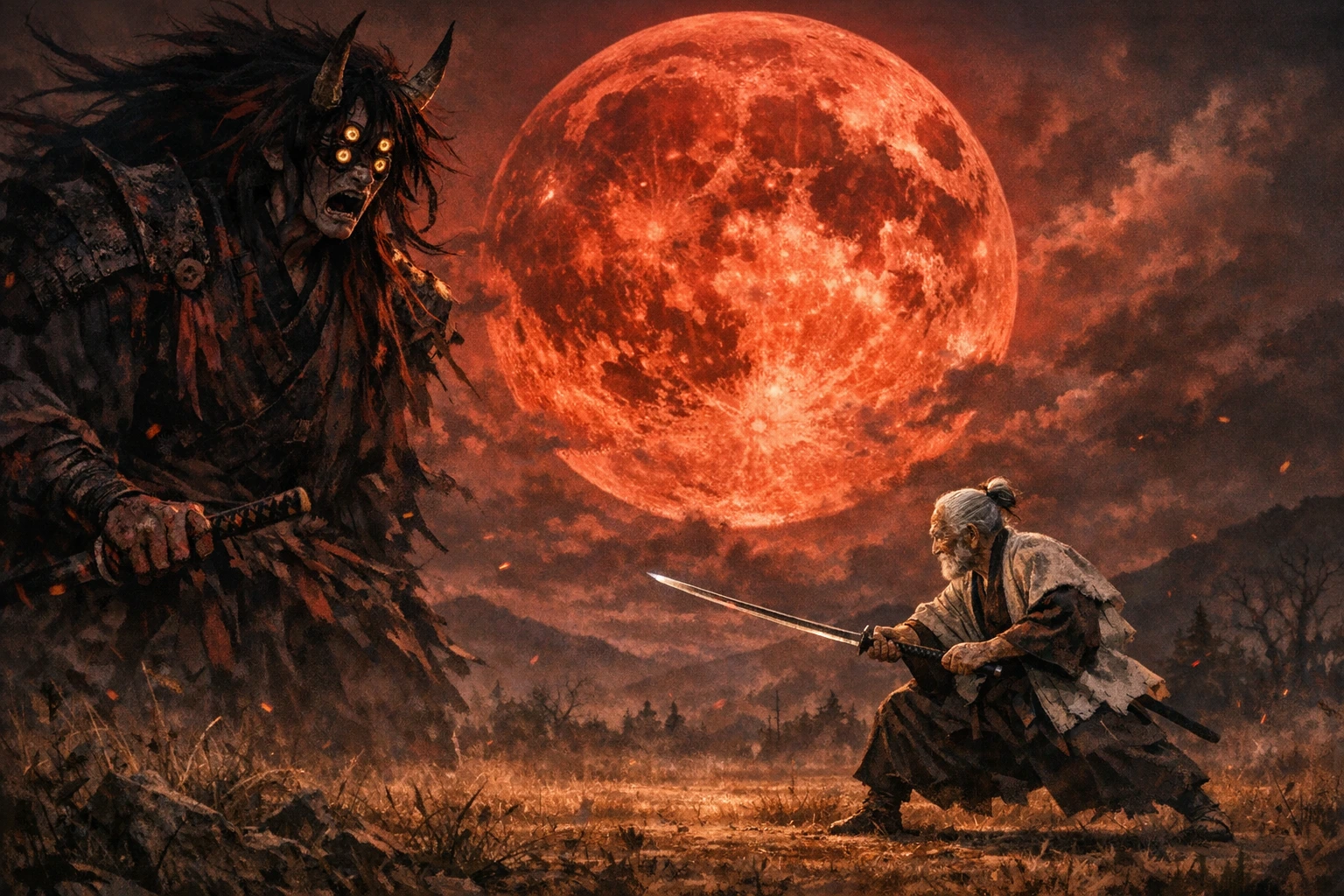
Yet, the universe possesses a cruel, deeply poetic sense of irony, delivering the ultimate physiological and psychological punishment 60 years later. On the night of a blood-red moon, an immortal, heavily mutated, seemingly invincible Kokushibo crossed paths with a human Yoriichi once again.
By all established laws of demonic biology and the unyielding curse of the mark, Yoriichi should have been dead and buried for decades. Instead, Kokushibo stood completely paralyzed, facing an 80-year-old man—fragile, blind in one eye, and ancient. Against all medical and biological logic, Yoriichi had completely, inexplicably defied the curse.
The ensuing encounter was not a duel; it was a psychological slaughter. Kokushibo, who had sacrificed everything—his family, his humanity, his place in the sun—for demonic perfection and infinite time, watched in absolute, cold terror as this fragile old man fell into a stance.
In a fraction of a millisecond, an 80-year-old Yoriichi executed a single, flawless, perfect strike. The blade sliced cleanly through Kokushibo’s hyper-dense demonic neck, stopping mere millimeters from fully severing his spine. Kokushibo was immobilized, trapped in the horrifying realization that he had lost. Even after sixty years of demonic evolution, Yoriichi had fundamentally outclassed him once again.
But the fatal second strike never came. Yoriichi, still standing upright on his feet, his blade perfectly poised, simply died of old age mid-swing. The sheer psychological destruction of this moment defined Kokushibo’s eternity. He realized that even with immortal cells, infinite stamina, and decades of relentless training, he was still, and would always be, nothing more than dirt beneath the feet of his human brother.
6. Conclusion: The Grotesque Reflection
The tragedy of Kokushibo is etched not just in the rivers of blood he spilled over the centuries, but in the microscopic, stubborn fragments of humanity he was biologically incapable of purging from his own heart. When Yoriichi’s lifeless, 80-year-old body remained standing in that field, Kokushibo, driven by a tempest of blinding rage, profound grief, and a sickening sense of inferiority, slashed his brother’s corpse in half.
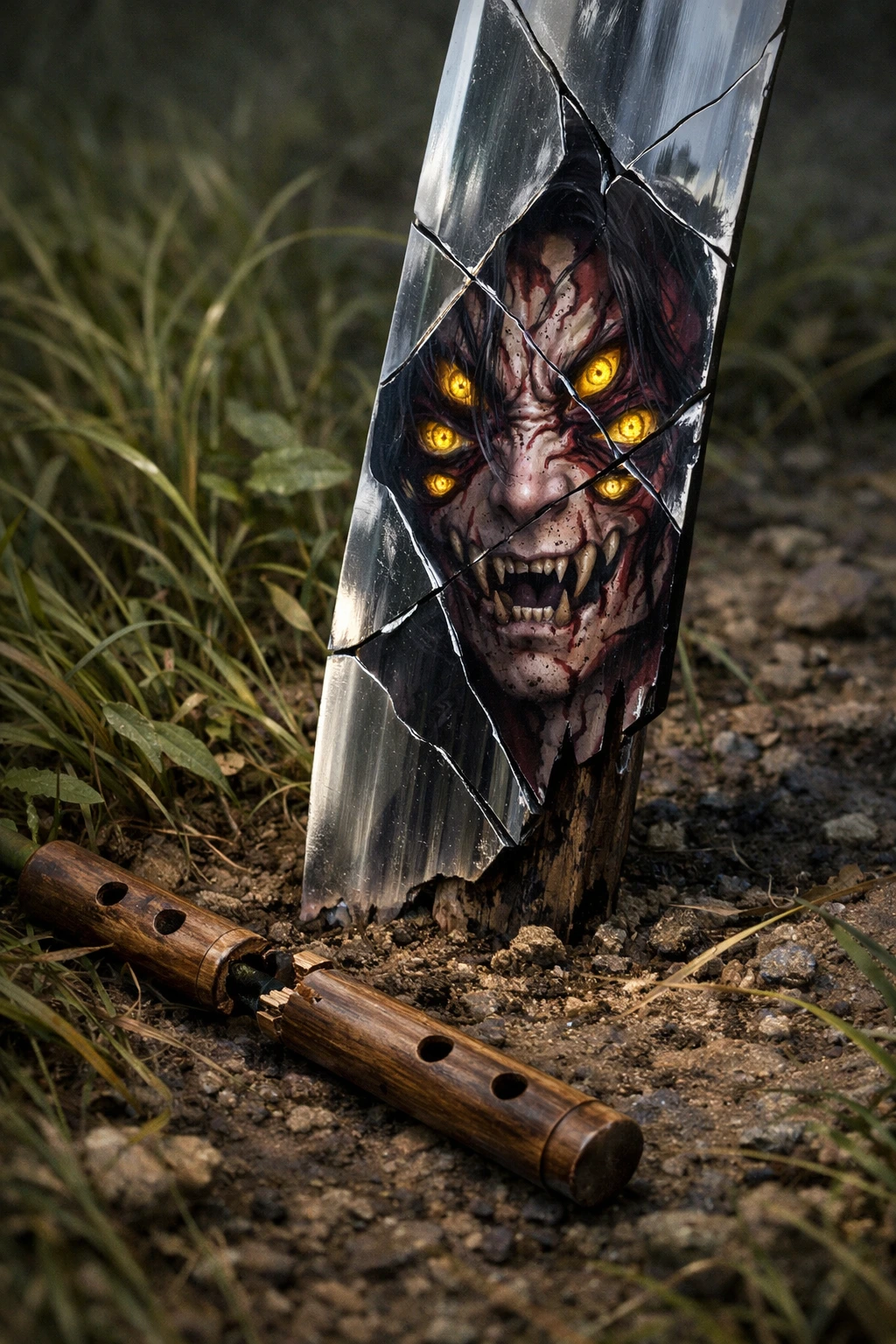
As the frail body fell apart in the grass, a small, unassuming object tumbled from Yoriichi’s robes: the handmade wooden flute Michikatsu had given him over six decades ago. Yoriichi had kept it, cherishing a cheap, practically useless toy as his most prized possession, carrying it close to his heart until his dying breath. The emotional and thematic weight of this broken flute is astronomical.
It represents the microscopic fragment of brotherly love and deep regret that Kokushibo could never fully destroy within himself, no matter how much human flesh he consumed or how deeply the demonic cells violently rewrote his DNA. He kept that shattered flute for the next 400 years, carrying it within his own flesh—a haunting, tangible, parasitic reminder of the warm humanity he threw away for absolutely nothing.
The final, absolute collapse of Kokushibo’s psyche occurred centuries later, deep within the Infinity Castle, during his climactic, apocalyptic battle against the modern Hashira. As he successfully forced his ravaged body to regenerate his decapitated head—a miraculous feat of biological immortality and cellular dominance achieved previously only by the Demon King Muzan himself—Kokushibo believed he had finally transcended.
He believed he had conquered death, conquered the blade, and become a true, immortal god of the sword. But in the midst of this dark triumph, he caught sight of his reflection in the polished, mirrored steel of Sanemi Shinazugawa’s Wind Hashira blade.
What stared back at him was not a dignified, peerless samurai, nor a majestic god of martial arts. The Mirror of Sanemi’s blade revealed the brutal, grotesque reality of his centuries of evolution. He saw a hideous, multi-eyed insect. He saw a monstrous aberration of swelling, purple flesh, jagged, protruding horns, fangs dripping with venom, and a face completely devoid of anything resembling the noble, proud brother of Yoriichi Tsugikuni. He looked exactly like the mindless, repulsive monsters he used to hunt.
The realization was instant and utterly catastrophic. He had spent 400 years enduring endless slaughter, trying to become the most beautiful, perfect, untouchable swordsman in existence, only to mutate into a repulsive, dishonorable beast.
This was the final, fatal psychological collapse. Kokushibo’s immensely powerful demonic cells—cells capable of regrowing a head and defying Nichirin steel—began to rapidly crumble and turn to ash, not because the Hashira’s blades had mathematically destroyed him, but because his own will to live had shattered into a million pieces. His cellular regeneration failed precisely at the exact moment his self-delusion broke. He simply could not bear to exist as the creature he saw in the blade.
This is the final expert verdict on the existence of Upper Moon 1: Michikatsu Tsugikuni was given every conceivable advantage a warrior could dream of. He possessed immortal, hyper-regenerative cells, infinite stamina, an unyielding biological sword, and 400 years of uninterrupted, focused martial experience. He was a being of unfathomable power and kinetic destruction.
Yet, he died because he was utterly and completely defeated by the crushing, inescapable gravity of his own jealousy. He built an impenetrable fortress of demonic invincibility over four centuries, only to realize, in his agonizing final moments, that he had merely locked himself inside a lonely, disgusting prison of his own profound mediocrity.