
I. Introduction: The Fever of Battle
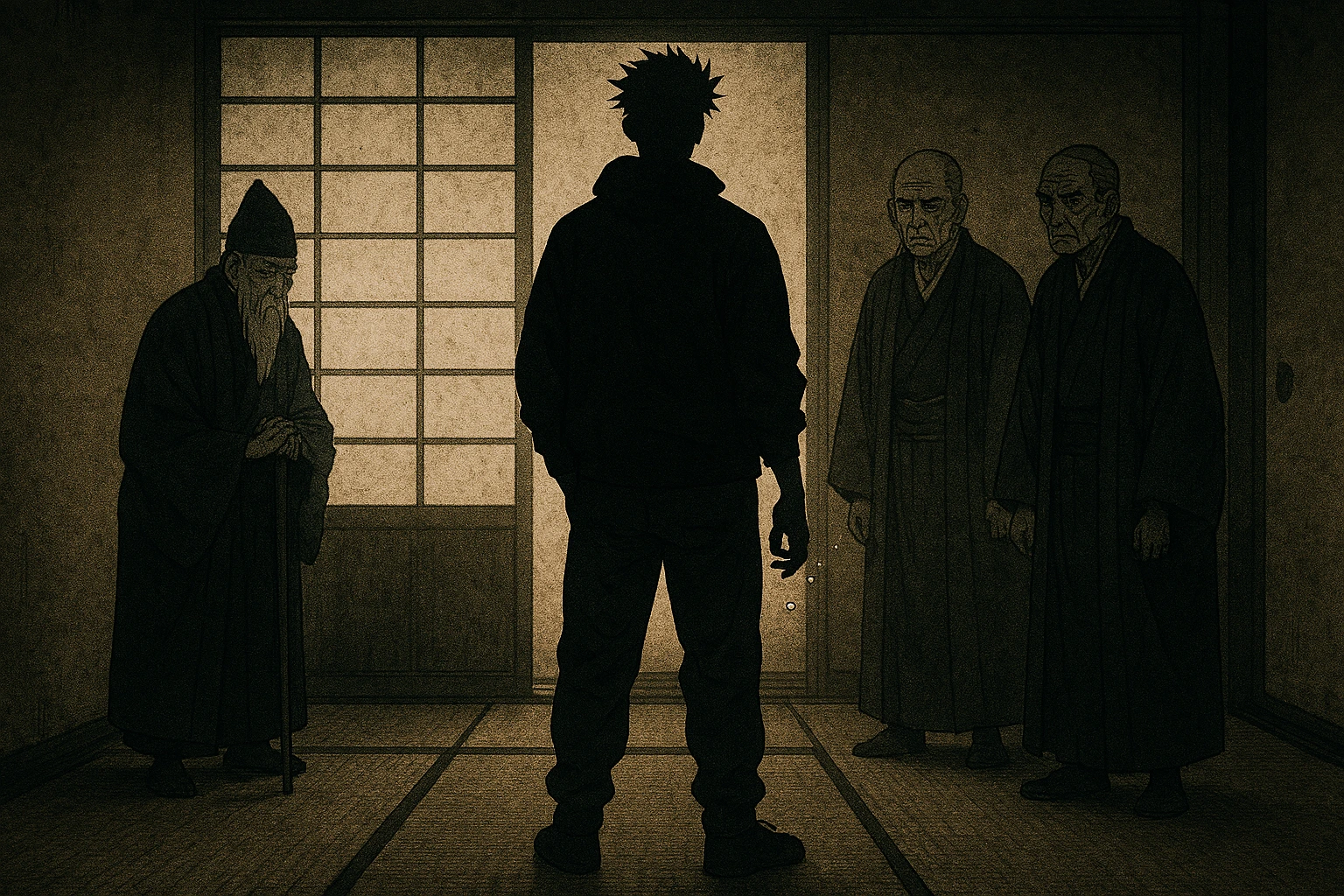
In the grim, blood-soaked world of Jujutsu Kaisen, where sorcerers often fight out of duty, revenge, or a desperate need to protect the weak, Kinji Hakari stands apart as a terrifying anomaly. He does not fight for justice. He does not fight to save the world. He fights because he is addicted to the “fever”—that razor-thin edge between life and death where luck dictates destiny.
“I don’t help people who don’t have the ‘fever’.”
This declaration defines his existence. Hakari is not a hero; he is an adrenaline junkie weaponizing the concept of probability itself. While Satoru Gojo seeks to foster a generation that can look beyond the rigid traditions of the Jujutsu world, Hakari embodies the chaotic potential of that new generation. He represents the “New Wave” of Jujutsu—modern, rough, industrialized, and utterly incomprehensible to the conservative higher-ups.
It is precisely this incomprehensibility that led to his suspension from Jujutsu High. The elders, obsessed with tradition and predictable techniques, looked at Hakari’s power—a Domain Expansion based on a romance manga pachinko machine—and saw only blasphemy. They couldn’t grade it, they couldn’t control it, and they certainly couldn’t understand it.
The conflict between Hakari and the higher-ups wasn’t just ideological; it was physical. The reason for his suspension was an assault on a conservative official who insulted his technique. This act of violence cemented his reputation as a delinquent, but it also highlighted the fundamental flaw in the Jujutsu establishment: they were trying to measure a modern monster with a ruler from the Heian era. They feared what they couldn’t categorize, and Hakari is uncategorizable by design.
Yet, despite his suspension and his rough demeanor, his potential is undeniable. Satoru Gojo, the strongest sorcerer of the modern age, explicitly named Kinji Hakari alongside Yuta Okkotsu as the students who would one day reach his level. This is not a compliment given lightly. To be compared to Gojo is to be compared to a god. While Yuta represents the boundless capacity of Cursed Energy and copying—a reflection of traditional sorcery taken to its extreme—Hakari represents the absolute mastery of variance. He is the wild card in a deck of stacked odds.
In this deep dive, we will dismantle the enigma of the Restless Gambler. We will decode the labyrinthine mechanics of his Domain Expansion, “Idle Death Gamble,” analyze the terrifying nature of his immortality, and relive his legendary duel against Hajime Kashimo—a fight that stands as a testament to why, when it comes to Hakari, you should always bet on the house.
II. The Philosophy of Gambling: Controlled Chaos
Life is a Gamble
To understand Kinji Hakari’s strength, one must first understand his worldview. The conservative elders of the Jujutsu world prioritize “safety,” “control,” and “stability.” They maintain the status quo through secrecy and rigid hierarchy. Hakari finds this repulsive. For him, a life without risk is a life not worth living. He operates on the principle that high stakes yield high rewards.
This philosophy puts him at direct odds with the traditionalist mindset. The elders want sorcery to be a predictable science; Hakari treats it like a night at the casino. He thrives in instability. When chaos ensues, others panic, but Hakari begins to vibrate with excitement. He understands that in the world of curses, where death is always one misstep away, the ability to embrace uncertainty is a weapon. He doesn’t just tolerate risk; he invites it, courts it, and eventually forces his opponents to play by its rules.
The “Fever” as a Sixth Sense
For Hakari, the “fever” isn’t just an emotion; it’s almost a sensory perception. It is the ability to sense the flow of luck and momentum in a battle. He perceives combat not as a series of physical exchanges, but as a fluctuating graph of probability. He knows when the tide is turning, when to push his luck, and when to fold (though he rarely folds).
This “fever” allows him to make decisions that seem irrational to a logical fighter but are perfectly calculated within the logic of a gambler. He acts on intuition honed by thousands of high-stakes moments, making him unpredictable to enemies who rely on standard combat theory.
The Texture of Rough Energy

Before he even expands his domain, Hakari is a formidable brawler due to the unique nature of his Cursed Energy. In Jujutsu Kaisen, most sorcerers have energy that feels like fluid power—heavy, forceful, or sharp. Hakari’s energy, however, has a distinct “texture.”
Yuji Itadori, upon taking a hit from Hakari, described it vividly: it feels like being struck with a serrated bat. Others have compared it to sandpaper. This roughness gives his physical attacks a devastating edge that transcends simple reinforcement. Even without a specific Cursed Technique active, a punch from Hakari rips and tears at the opponent’s defenses. It is abrasive and painful, inflicting a distinct type of “stinging” damage that lingers.
This texture mirrors his personality—abrasive, unrefined, and incredibly difficult to handle directly. It is a physical manifestation of his “spiky” demeanor, a warning that engaging him in close quarters will leave you shredded.
This energy property is significant because it grants Hakari high stopping power. Even if an opponent blocks, the “serrated” nature of his energy causes chip damage, wearing down their endurance and pain tolerance. It turns every exchange into a grueling ordeal, softening them up for the inevitable Domain Expansion.
The Underground Fight Club
This hunger for the “fever” led Hakari to establish his underground fight club, the “Gachinko” battles. Before the Culling Games forced him back into the main narrative, Hakari had essentially monetized sorcery. He gathered sorcerers and non-sorcerers alike, pitting them against each other in brutal matches while spectators placed bets.
This venture highlights his entrepreneurial spirit and his disdain for the “sacred” nature of Jujutsu. To the higher-ups, Cursed Energy is a secret to be guarded; to Hakari, it’s a resource to be exploited for entertainment and profit. The fight club was his way of finding people with the “fever”—those willing to risk it all for glory or money.
It was also a rejection of the Jujutsu High model. He didn’t need missions or grades to validate his strength; he built his own kingdom, operated by his own rules, fueled by the raw excitement of combat. It was here that he honed his ability to read people, to manipulate the flow of a fight, and to control the chaos of battle—skills that would prove crucial in the life-or-death struggles to come.
The atmosphere of the Gachinko club reflects Hakari’s aesthetic: gritty, urban, and loud. It is a place where the elitism of the Zenin or Kamo clans holds no sway. In the ring, lineage doesn’t matter; only your ability to withstand pain and seize victory counts. This environment served as the perfect incubator for Hakari’s philosophy, proving that modern strength is forged in the mud, not in the classroom.
III. Domain Expansion: Idle Death Gamble

The crowning jewel of Hakari’s arsenal, and arguably the most complex ability in the entire series, is his Domain Expansion: Idle Death Gamble (Zaza Hakari). To the uninitiated, it looks like a confused mess of noise and lights. To the expert, it is a masterpiece of binding vows and probability manipulation.
The Theme: Private Pure Love Train
The domain takes the form of a giant Pachinko machine themed around a fictional romance manga series titled CR Private Pure Love Train. This seemingly ridiculous theme is a deliberate subversion. In a world of terrifying domains filled with skulls, blood, and darkness (like Sukuna’s Malevolent Shrine or Mahito’s Self-Embodiment of Perfection), Hakari’s domain is filled with anime characters, upbeat pop music, and subway train aesthetics.
The narrative of the “game” revolves around the protagonist, Riichi, trying to make it to the station to meet his love interest. If he makes the train, creates a romantic moment, or succeeds in a specific scenario, the machine triggers a “Jackpot.” If he fails—misses the train, gets rejected, gets beaten up—the spin fails. This juxtaposition of a life-or-death battle with a cheesy shoujo romance plot creates a cognitive dissonance that disorients opponents. They are fighting for their lives while watching a melodrama unfold on giant holographic screens.
The Rules of the Game
When Hakari expands his domain, the opponent is not attacked physically by the domain itself. Instead, they are forced to participate in a game of chance. The complexity of the rules is staggering, but essential to understand:
- The Visuals: The domain manifests giant pachinko balls, sliding doors, and holographic screens. The color of the visual effects indicates the “chance” or probability of hitting a jackpot.
- Green: Low probability.
- Red: High probability.
- Gold: Near-guaranteed Jackpot.
- Rainbow: Guaranteed Jackpot (Automatic Win).
- Reach Actions (Riichi): These are the “cutscenes” that play out during the fight. The domain forces the combatants to watch a scenario from the manga. For example, a character rushing to catch a train. The outcome of this cutscene determines if Hakari wins the jackpot. During these cutscenes, combat continues, but the narrative on the screens dictates the flow of luck. If Riichi is running faster, Hakari’s attacks might land heavier.
- Pseudo-Spins: Every attack Hakari lands, and every moment that passes, cycles the “spins” of the pachinko machine. He doesn’t just stand there; he fights to force the machine to spin. The physical combat feeds the digital algorithm.
Probability Shifts and Indicators
Hakari is not a passive player in his own domain. He can use specific visual indicators to manipulate the odds.
- Chance Balls: If he hits the opponent with a specific colored ball (Cursed Energy construct), he can trigger a “Reach Action.”
- Consecutive Effects: If a specific pattern appears, the probability of the next spin yielding a jackpot increases.
- Probability Change Mode: If Hakari fails a spin but enters a specific mode (like “Time Reduction Mode”), the probability of a Jackpot in the next cycle skyrockets. He essentially “loads” the dice. Even a failure builds towards a future success.
The genius of this system is that it turns the battle into a grind. The opponent thinks they are fighting a sorcerer, but they are actually fighting a mathematical algorithm designed to eventually payout. The house always wins, and in this domain, Hakari is the house. Even if the probability is low (1/239), Hakari can spin the wheel hundreds of times in a minute due to his speed and aggression.
The Binding Vow: The Weaponized Info-Dump
One of the most brilliant applications of Jujutsu theory in Hakari’s domain is how he handles the “Sure-Hit” effect. Most domains use their sure-hit function to land a lethal attack (like Gojo’s Unlimited Void flooding the mind or Sukuna’s Dismantle cutting the body).
Hakari’s sure-hit effect is information.
Upon entering Idle Death Gamble, the rules of the domain and the pachinko machine are forcibly beamed directly into the opponent’s brain. They instantly understand how the game works. This seems like a disadvantage—why tell the enemy your weakness?
However, by revealing his “hand” (a Binding Vow), the activation speed of his domain becomes unparalleled. Because the sure-hit effect is harmless (just information transfer), it encounters almost no resistance and activates faster than almost any other domain in history. In his clash with Kashimo, it is noted that Hakari’s activation speed is faster than Mahito’s 0.2-second domain expansion in Shibuya.
This speed allows him to overwhelm opponents in tug-of-war battles before they can even realize what is happening. The info-dump is the bait; the game that follows is the trap. By the time the opponent processes the rules, the game has already started.
IV. The Jackpot: 4 Minutes and 11 Seconds of Godhood
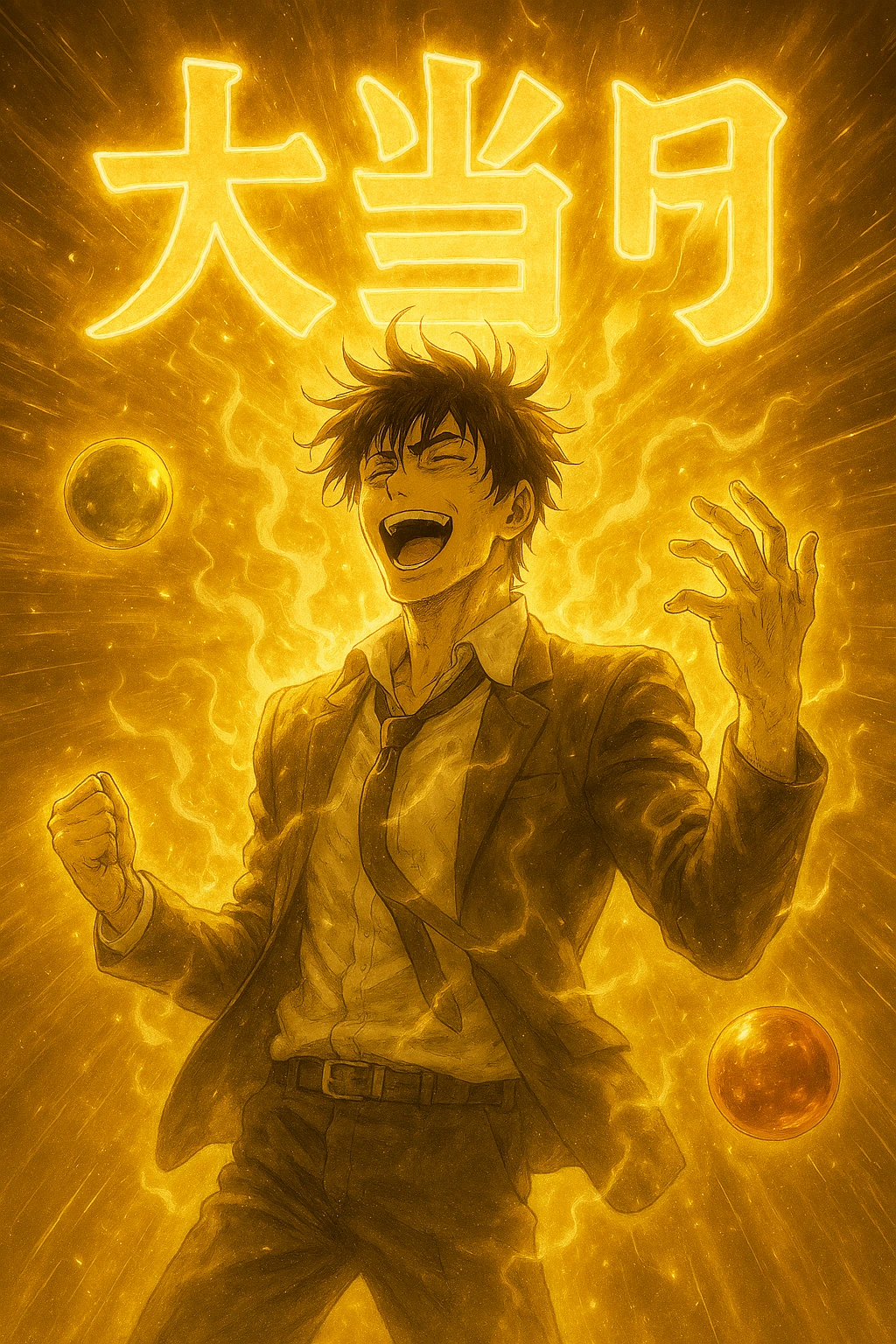
When the Private Pure Love Train scenarios align—when the characters kiss, or the train arrives on time—three bold kanji appear in the air: JACKPOT.
At this moment, the game changes. The domain dissolves (usually), and Hakari enters a state of supreme existence.
Infinite Cursed Energy
The primary reward of the Jackpot is Infinite Cursed Energy. Normally, a sorcerer has a limited pool of energy. Using high-level techniques or Reverse Cursed Technique drains this pool. For Hakari, during a Jackpot, his reserves are boundless. He can expend massive amounts of energy on every single punch, kick, or movement without ever running dry. His output becomes terrifyingly high, allowing him to brawl with special-grade entities purely on physical stats reinforced by endless energy.
This state is described as an “overflow.” The energy is so potent that it leaks out of him visibly, creating an aura that feels like a physical weight to anyone nearby. He becomes a perpetual motion machine of destruction.
The Theme Song: “Admiring You”
The duration of this god mode is exactly the length of the anime’s theme song, “Admiring You”: 4 minutes and 11 seconds. For this specific duration, Hakari is a deity. The music plays audibly from nowhere, a diegetic soundtrack to the opponent’s beating. The rhythm of the fight is dictated by this song. Hakari knows exactly how much time he has left based on the verse and chorus. It adds a psychological layer of pressure to the opponent—they have to survive the song. The upbeat, happy pop tune contrasts sharply with the violence Hakari inflicts, creating a surreal and terrifying experience for the victim.
Automatic Reverse Cursed Technique (Reflexive Immortality)
The most broken aspect of the Jackpot is not the power, but the survivability. Because Hakari’s Cursed Energy is infinite and overflowing, his body instinctively performs Reverse Cursed Technique (RCT) to prevent his body from bursting.
- He does not cast it manually. Most sorcerers (like Yuta or Gojo) have to consciously focus to heal themselves. It takes mental processing power and can be interrupted.
- It is automatic. Hakari’s body heals reflexively. If his arm is blown off, it grows back before the blood hits the ground. If his head is damaged, the brain is repaired instantly.
- True Immortality: As long as the music is playing, Hakari cannot die. He is unkillable. Poisons are purged, limbs are regenerated, and fatigue is nonexistent. He becomes a zombie with the hitting power of a truck.
This automatic healing removes the concept of “defense” from Hakari’s mind. He stops blocking. He stops dodging. He simply walks through attacks, trading damage because he knows he will heal and his opponent won’t. It allows for a reckless, suicidal fighting style that terrifies calculating fighters.
The Loop
The nightmare for the opponent is that the 4:11 time limit isn’t the end. Once the song ends and the immortality fades, Hakari’s Cursed Energy returns to normal—but his Domain Expansion is replenished. Because he had infinite energy, he feels no exhaustion from casting the Domain. Furthermore, usually after a Jackpot, the probability of the next Jackpot is increased (Probability Change Mode). So, the loop goes:
- Expand Domain.
- Survive until Jackpot (usually with increased odds).
- IMMORTALITY (4:11).
- Song ends.
- Expand Domain immediately.
This loop makes Hakari a stamina monster. He can theoretically fight forever, wearing down opponents who have limited energy reserves while he constantly refreshes his own stats. To beat Hakari, you must kill him inside his domain before he hits a Jackpot, or survive the 4 minutes and 11 seconds and kill him in the split second before he casts his domain again. Both options are nearly impossible.
V. Hakari vs. Kashimo: The Best Fight in the Culling Games
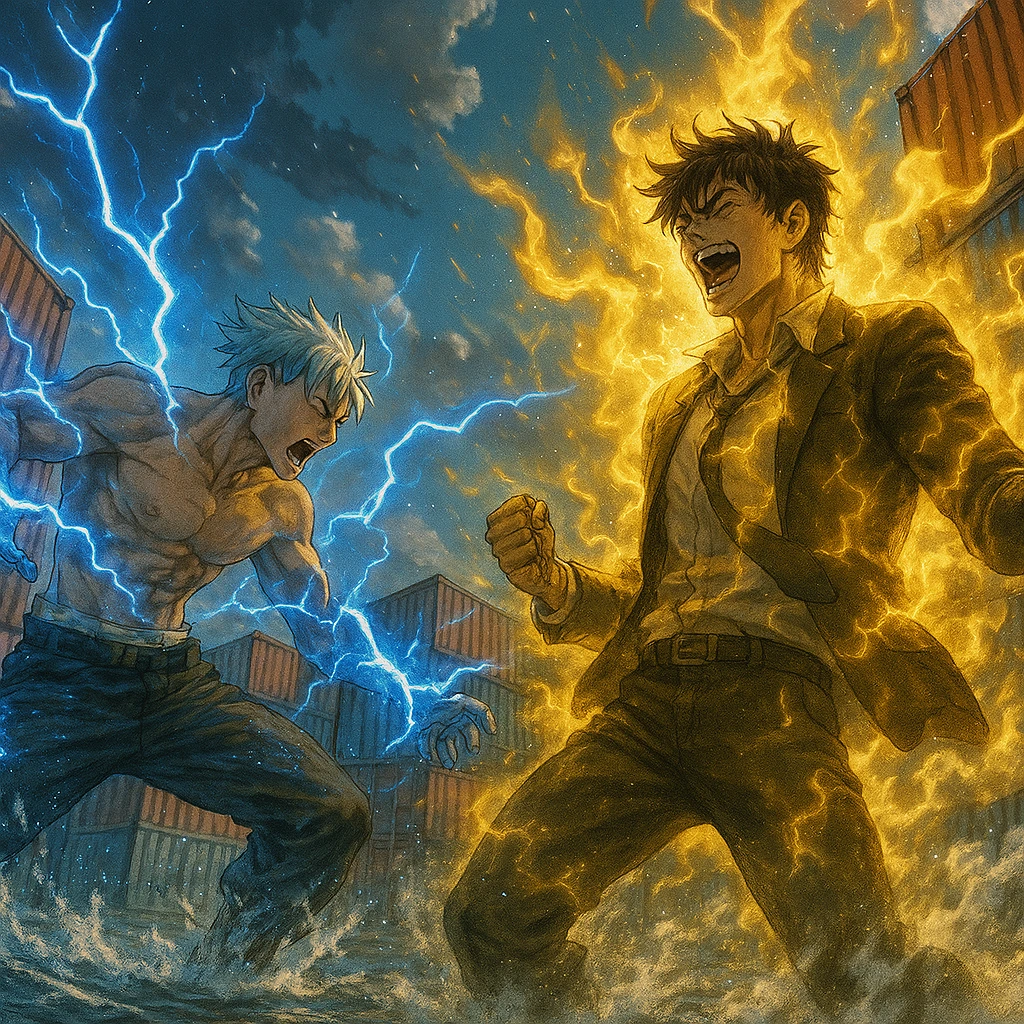
If the theory of Hakari’s power is impressive, the application of it against Hajime Kashimo is legendary. This battle is widely regarded by fans as the highlight of the Culling Games arc, a pure, unadulterated contest of strength and madness.
The Matchup: God of Lightning vs. The Undying Gambler
Hajime Kashimo, an ancient sorcerer reincarnated from 400 years ago, seeks the strongest. His Cursed Energy has the property of electricity, making his hits unblockable shocks. He is a lethal, tactical fighter who can accumulate charges on an opponent and then discharge a lightning bolt (sure-hit without a domain) to blow them apart.
On paper, Kashimo counters Hakari. Lightning to the head should kill him instantly. But Hakari counters Kashimo’s logic with sheer absurdity. This fight represents the clash of eras: the old-school, “one-shot kill” philosophy of the Edo period against the modern, attrition-based complexity of Hakari’s domain.
The Dance of Death
The fight is a masterclass in pacing. We see Hakari hit a Jackpot, enter immortality, and just tank everything Kashimo throws at him. Kashimo blows a hole in Hakari’s stomach? Healed in a second. Kashimo tears off his arm? It grows back mid-punch. The visual of Hakari dancing to the pop music while being electrocuted is the peak of his character. He isn’t just surviving; he is enjoying the “fever.” He laughs as his nose is ripped off, purely because the rush of the gamble is hitting its peak.
This section emphasizes Hakari’s durability. He doesn’t just regenerate; he ignores pain. He treats catastrophic injuries like minor inconveniences. When Kashimo realizes that physical trauma won’t stop him, the fight shifts from a brawl to a tactical puzzle.
Tactical Genius and Environmental Warfare
However, Hakari isn’t just a brute. He displays immense tactical intelligence during the fight.
- Coordinate Shifting: Realizing that Kashimo’s electricity is dangerous even with immortality (due to the stun effect and headshot potential), Hakari stealthily moves the coordinates of his Domain’s barrier. He rolls the barrier across the battlefield like a hamster ball. When the domain shatters, he drops them both directly above the ocean.
- Water Physics (The Electrolysis Strategy): He uses the water to force Kashimo to discharge his Cursed Energy. Since electricity leaks in water, Kashimo is forced to constantly expend energy just to maintain his charge, or risk discharging it all into the sea. This drains the opponent’s reserves while Hakari (in Jackpot mode) has infinite energy.
- Binding Vow Sacrifice: In the climax, Kashimo triggers a steam explosion intended to vaporize Hakari right as his immortality ends. Hakari, in a split-second decision, makes a Binding Vow. He sacrifices his left arm to protect the rest of his body. He shifts the cursed energy that would have healed his arm to reinforce his core. “A true gambler knows when to cut their losses.” He loses the arm, but he wins the fight (or at least, secures the alliance). This moment proves that Hakari isn’t just lucky; he is smart. He knows exactly what chips to cash in to stay alive. It distinguishes him from a mindless berserker; he is a calculating gambler who knows the exact value of his own body parts.
VI. The Heavy Hitter: Role in the Story
Following the Shibuya Incident, the sorcerer world was left in ruins. Satoru Gojo was sealed in the Prison Realm. Yaga was executed. Nanami was dead. Nobara was MIA. The protagonist group was decimated. In this vacuum, Kinji Hakari stepped up as the Heavy Hitter.
The Pillar of the Team
With Yuta Okkotsu operating independently in Sendai, Hakari became the muscle for Yuji and Megumi’s group in the Tokyo colonies. His presence provided a much-needed sense of security. Knowing that they had an “immortal” tank on their side allowed the younger students to operate with more confidence. He filled the “Gojo-sized hole” in terms of raw confidence, if not absolute power.
Leadership and Negotiation
We also see Hakari’s skills as a leader. His recruitment involves a fight with Charles Bernard, a failed manga artist. Hakari doesn’t just beat him; he critiques his work, breaks his spirit, and then rebuilds his motivation to fight. He has a strange charisma that rallies weirdos and outcasts. He understands the darkness in people’s hearts because he lives in the underworld himself.
His relationship with Kirara Hoshi is also vital. Kirara acts as his anchor, the only person who truly understands his eccentricities and helps manage the Fight Club. Their dynamic shows a softer, more loyal side to the gambler, proving he values his “family” above the traditional Jujutsu hierarchy.
Stalling the Ice Star: The Shinjuku Showdown

Later in the Shinjuku Showdown arc, Hakari takes on the role of stalling Uraume, the ancient sorcerer and Sukuna’s loyal servant. Uraume utilizes devastating ice techniques (Frost Calm) that can freeze opponents to the bone instantly.
Hakari’s role here is crucial and strategic. By engaging Uraume alone, he prevents Sukuna from having backup. This matchup is a perfect elemental clash: Uraume’s ice represents absolute stasis and death, while Hakari’s regeneration represents infinite life and motion.
- The Counter: Hakari’s automatic RCT hard-counters Uraume’s ice. Every time his limbs are frozen and shattered, they instantly regrow. The ice cannot hold him because his body is in a constant state of renewal.
- The Stalemate: He turns the fight into a stalemate, keeping a Special Grade threat occupied indefinitely purely through his regenerative endurance. He doesn’t need to win quickly; he just needs to keep the “fever” going and keep the music playing, preventing Uraume from interfering with the main battle against Sukuna. This role of “tank” is thankless but essential for the heroes’ victory.
VII. Conclusion: Bet on Hakari

Kinji Hakari is a subversion of the traditional shonen mentor or powerhouse. He isn’t the stoic samurai or the wise teacher. He is a roughed-up, suspended high schooler with a gambling addiction and a serrated edge to his soul. He represents the messy, complicated reality of the modern sorcerer—someone who rejects tradition not out of malice, but because tradition is too small to contain his ambition.
Yet, he represents the ultimate evolution of Jujutsu sorcery. He proves that power isn’t just about big blasts or intricate techniques; it’s about mindset. It’s about the willingness to step onto the precipice of death, look into the abyss, and spin the wheel. While others calculate the odds of survival, Hakari calculates the payout.
His Domain Expansion, Idle Death Gamble, is a metaphor for the life of a sorcerer. You fight, you struggle, you pray for a lucky break, and if you have the grit to survive the bad spins, you eventually hit the Jackpot. In a world defined by tragedy and loss, Hakari forces his own luck. He imposes his own rules on reality, bending fate to the rhythm of a pop song.
When the music starts, and the “Administering You” track begins to pump through the air, the logic of the battle fades away. Damage becomes irrelevant. Death becomes a temporary inconvenience. There is only the fever. As Hakari himself would say, in a fight between sorcerers, if you aren’t willing to go all in, you’ve already lost. Always bet on Hakari.