
I. Introduction: The Reluctant Hero
“Sorcerers are shit. Work is shit. I chose the one I was more suited for.”
In the pantheon of shonen anime, heroes are typically defined by their boundless ambition. They want to be the Pirate King, the Hokage, or the strongest hero in the world. They scream their dreams into the void, fueled by passion and an unyielding desire to change the status quo. Their journeys are additive; they seek to gain power, gain friends, and gain status. And then, there is Kento Nanami.
Nanami stands as a stark anomaly in the world of Jujutsu Kaisen. He does not fight for glory, nor does he fight for the abstract concept of justice. He fights because it is his job. He is the ultimate grounding force in a narrative populated by maniacal curses, god-complex sorcerers like Satoru Gojo, and naive dreamers like Yuji Itadori. Nanami represents the “Adult” in the room—a figure of stoic reliability in a world gone mad. He is a character defined not by what he seeks to gain, but by what he is willing to endure.
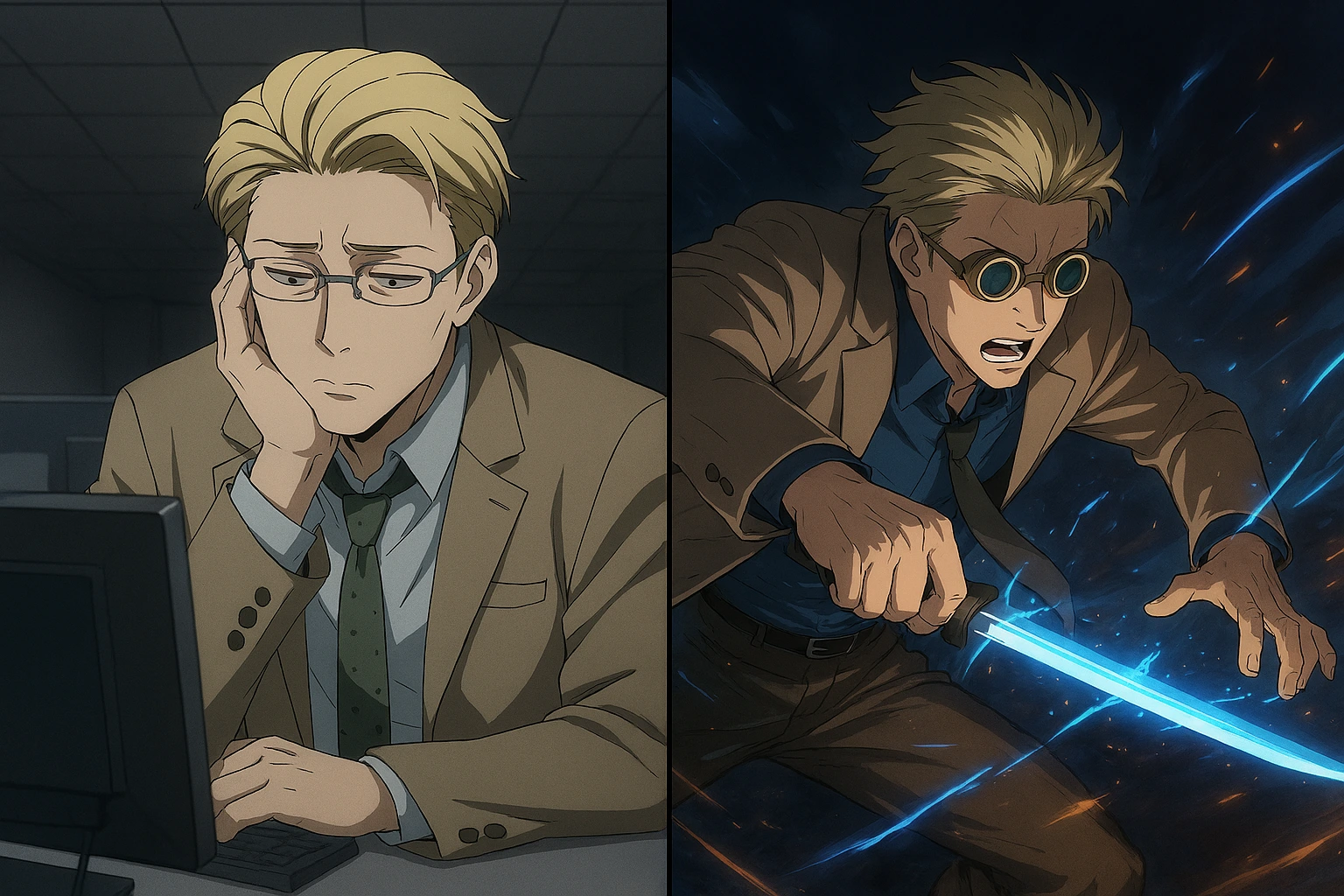
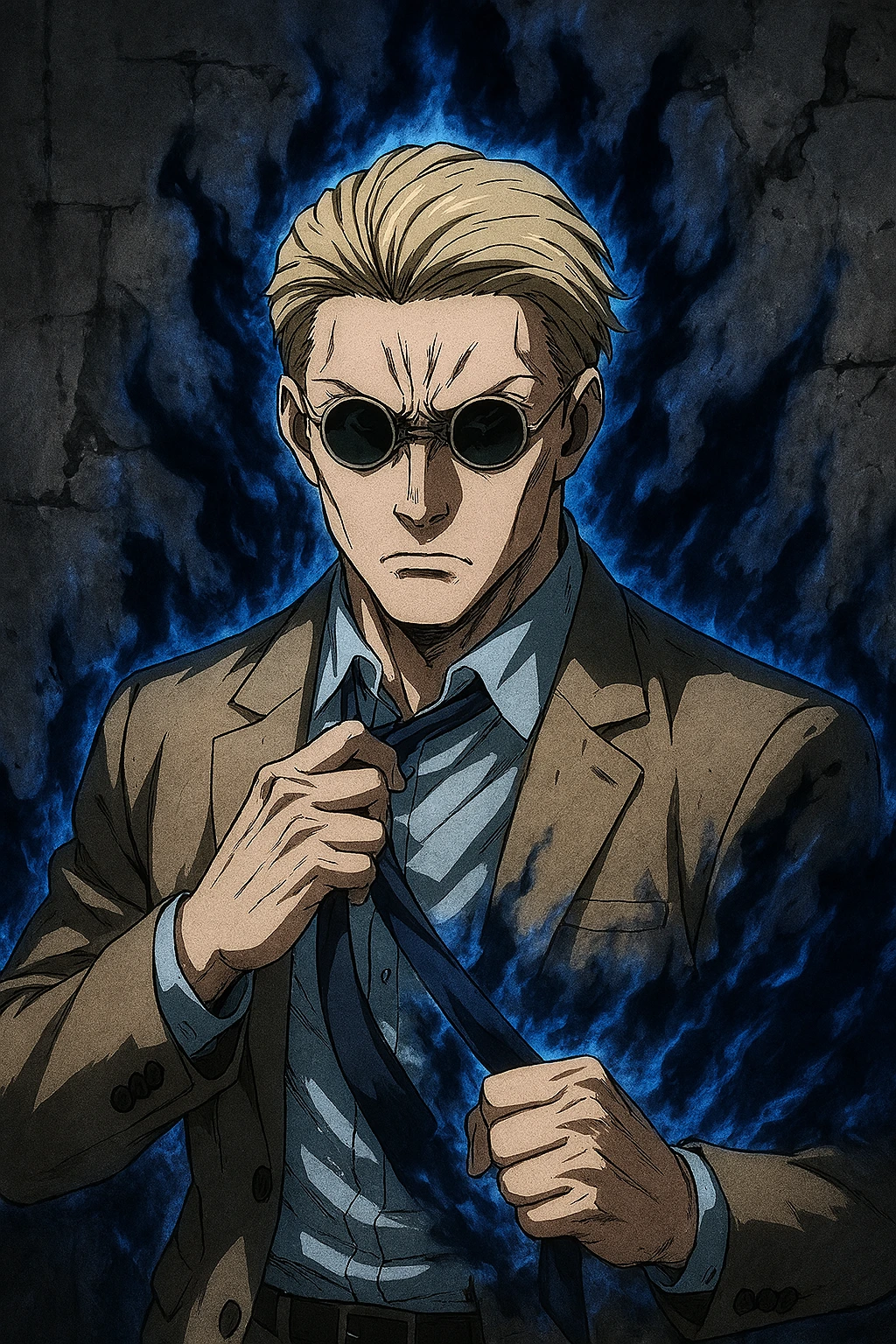
His aesthetic speaks volumes before he even activates a cursed technique. While other characters don elaborate robes, stylized combat gear, or traditional hakama, Nanami wears a beige suit, a blue dress shirt, and a spotted tie. His eyes are shielded not by a mask, but by pragmatic, retro-style goggles that conceal his gaze, separating him from the horrors he witnesses. His weapon of choice is not a legendary katana steeped in myth or a magical staff, but a blunt executioner’s sword wrapped in cloth, resembling a wrapped machete or a measuring tool. He fights with dignity, precision, and an air of exhausted competence. He is not a warrior poet; he is a contractor clearing out a pest infestation.
This article serves as a comprehensive dossier on Kento Nanami, the Salaryman Sorcerer. We will dissect the trajectory of his life, from his disillusionment with the corporate world to his return to jujutsu society. We will analyze the mathematical lethality of his Ratio Technique (7:3), the legend of his Black Flash record, the risk-reward mechanics of his Binding Vows, and his crucial role as the only true mentor Yuji Itadori ever had. Finally, we will walk with him through the fires of Shibuya, examining his heartbreaking end and the legacy he left behind. Nanami proves that one does not need to be a “hero” to be a good man; sometimes, you just need to finish your shift.
II. The Philosophy of “The Adult”
To understand Kento Nanami, one must first understand his definition of maturity. In a conversation that serves as the thesis statement for his character, he tells Yuji Itadori, “Adulthood is just the accumulation of small despairs.”
This is a profoundly cynical yet deeply realistic worldview. Most shonen mentors teach their students that adulthood is about freedom, power, or the ability to protect others. Nanami teaches that adulthood is a process of erosion. It is the slow grinding down of idealism against the hard rock of reality. It is compromising your dreams, accepting the mundane, and realizing that you cannot save everyone.
The Ghost of Haibara
This philosophy stems directly from his traumatic past at Jujutsu High. As a student, Nanami was partnered with Yu Haibara, a character who embodied the typical shonen optimism. Haibara was energetic, eager, and believed in the inherent goodness of their mission. Nanami, even then, was reserved, but he drew comfort from Haibara’s light.
The turning point came during a mission that was misclassified. Sent to handle what they thought was a Grade 2 curse, they encountered a deity-level threat. Haibara was killed. Nanami survived. That loss shattered his belief in the purpose of a sorcerer. He saw the meat grinder of the jujutsu world for what it was: a cycle of consuming young people for a vague, ungrateful greater good. He looked at Satoru Gojo—who had become a god in human skin—and realized that if Gojo could handle everything, individual effort from “normal” sorcerers like himself was meaningless. He quit.
The Corporate Fugue
Rejection of this cycle led him to the corporate world, the supposed antithesis of the chaotic life of a sorcerer. He sought normalcy. He sought a life where the stakes were merely profit and loss, not life and death. For four years, Nanami worked as a stockbroker/salaryman. He moved money. He made wealthy people wealthier. He lived by the clock, ate efficient sandwiches, and slept in a pristine apartment. He was successful by societal standards, yet he was spiritually hollow.
Nanami became a symbol of the Japanese concept of “Karoshi” (death by overwork) in spirit, if not in body. He worked relentless hours, dealing with clients who viewed money as a game. He was disconnected, drifting through a monochromatic existence where the only metric of success was a rising portfolio value.
The Bakery Girl: A Return to Meaning

The moment the “Salaryman” died and the “Sorcerer” was reborn occurred in a bakery. Nanami had developed a routine of buying bread from a local shop, where a young woman with a heavy curse (a fly-head) on her shoulder worked. For a long time, he ignored it. To acknowledge the curse would be to acknowledge his nature as a sorcerer, blurring the line he had drawn between his new life and his old one.
But eventually, the “accumulation of small despairs” became too much. He realized that his corporate work had no tangible impact; he was a cog in a machine that didn’t care about human connection. When he finally exorcised the curse from the bakery girl’s shoulder, her simple, genuine gratitude—“Thank you”—shattered his resolve.
He realized a fundamental truth: money on a screen is abstract, but fixing a stiff shoulder is real. Helping one person is real. He didn’t return to being a sorcerer because he wanted to be a hero; he returned because he realized that if he was going to suffer through “work” regardless of the path, he might as well choose the work where his suffering had meaning.
This places him in direct contrast to Satoru Gojo. Gojo operates on a macro scale; he wants to overturn the entire jujutsu establishment and change the world. He is the “Honored One,” existing above humanity. Nanami, conversely, operates on a micro scale. He just wants to finish the mission, minimize casualties, and go home to read a book. Gojo is the sky; Nanami is the earth.
This grounding makes Nanami fiercely protective of youth. He repeatedly tells Yuji, “It’s not a sin to be a child.” In a world that demands children like Yuji and Megumi fight wars, Nanami acts as a shield. He tries to preserve their innocence for as long as possible, taking on the burdens of the “adults” so the “children” don’t have to. It is a noble, tragic responsibility that defines every action he takes.
III. The Ratio Technique: Critical Hit Physics

Kento Nanami’s Cursed Technique, the Ratio Technique (Tokusa no Justuhiki), is a masterclass in conceptual combat design. It perfectly mirrors his personality: precise, rule-oriented, and exacting. It is not flashy like Jogo’s fire or Hanami’s plants; it is clinical.
The Concept: The 7:3 Rule
The technique allows Nanami to forcibly create a “weak point” on any target he strikes. He mentally divides the target’s length into ten equal sections. The weak point is located exactly at the 7:3 ratio point along that line.
Crucially, this technique allows him to designate the “line” arbitrarily. It could be the length of the opponent’s entire body, the length of their arm, or even the span of their head. As long as he strikes that specific coordinate, the hit is guaranteed to be a critical hit. This requires immense spatial awareness and split-second calculation, traits that Nanami possesses in abundance.
The Mechanics of Durability Negation
What makes the Ratio Technique terrifying is that it largely ignores the opponent’s inherent durability. In video game terms, Nanami forces a “Critical Hit” regardless of the enemy’s defense stats. If a curse has skin as hard as steel, it doesn’t matter. If Nanami strikes the 7:3 point, the technique enforces a structural weakness in reality itself. The steel must break because the technique dictates it is weak at that spot.
This allows Nanami to punch far above his weight class. He can dismember special grade curses that should logically be able to tank his attacks. It turns combat into a game of precision rather than a contest of brute strength. He doesn’t need to hit harder; he just needs to hit correctly.
Cursed Technique Extension: Collapse
Nanami’s mastery of the Ratio Technique extends to the inanimate environment. This application is known as “Collapse” (Garagara). By striking the 7:3 point on a wall, floor, or structural pillar, Nanami can imbue the generated rubble with his cursed energy.
He shatters the environment with a single strike, causing the debris to fall with devastating force. This acts as an Area of Effect (AoE) attack, perfect for clearing out swarms of weaker curses or burying a stronger opponent to create an opening. It demonstrates his tactical brilliance; he turns the battlefield itself into a weapon, deconstructing the architecture around him with the same efficiency he applies to his enemies.
The Blunt Blade
Nanami’s weapon choice is deeply symbolic and mechanically relevant. He wields a blunt executioner’s sword, wrapped in cloth with a black splatter pattern. A sharp blade relies on the edge to cut; Nanami relies on the technique to cut.
Using a blunt weapon emphasizes that the lethality comes from his cursed technique, not the physical object. It’s a flex of skill. He is essentially bludgeoning his enemies with a dull bar of metal, but because of the Ratio Technique, it severs limbs as cleanly as a laser. The cloth wrapping suggests a tool that is kept ready but perhaps protected—or maybe it implies that the blade underneath is irrelevant. It is an instrument of work, not a fetishized object of war.
The Legend of the Black Flash
Before the events of the series, Kento Nanami held a legendary record: Four Consecutive Black Flashes.
The Black Flash is a distortion in space that occurs when Cursed Energy is applied within 0.000001 seconds of a physical hit. It raises the attack’s power to the power of 2.5, creating an impact of catastrophic proportions. It is a phenomenon that even Special Grade sorcerers cannot perform at will. It requires a state of “flow” akin to an athlete being in the zone.
For years, Nanami held the record for the most consecutive uses, a testament to his incredible focus and combat rhythm. While he modestly claims, “I just got lucky,” the feat speaks to his elite status. It separates him from the average Grade 1 sorcerer. He isn’t just reliable; when pushed, he is capable of touching the core of Cursed Energy itself. Although Yuji Itadori eventually matches and breaks this record, Nanami remains the standard-bearer for precision striking.
IV. Binding Vows: The Power of Overtime
In the Jujutsu Kaisen power system, a “Binding Vow” is a pact made with oneself or another to gain power in exchange for a restriction. It is the economic principle of “equivalent exchange” applied to magic. Nanami is the undisputed master of using Binding Vows to maximize his efficiency, specifically through his signature restriction: Overtime.
The Restriction: The 9-to-5 Shift
Nanami operates strictly within the confines of standard working hours. While on the clock (typically 8:30 AM to 5:30 PM, though it varies by mission), Nanami voluntarily limits his Cursed Energy output. He suppresses his power to roughly 80-90% of his maximum potential.
To an outsider, this seems foolish. Why would a sorcerer fight at less than full strength in life-or-death situations? The answer lies in the multiplier effect. By restricting himself during the “easy” hours, he creates a debt of power that can be cashed in later. This speaks to his philosophy: do the bare minimum required to get the job done, and save the big guns for when things go wrong.
The Release: Overtime
Once the shift ends—once the metaphorical clock strikes 5:00 PM—Nanami loosens his tie and activates “Overtime” (Jikan-gai Rōdō).
The Binding Vow rewards his earlier restriction with a massive surge in cursed energy. His output spikes to approximately 110-120% of his base maximum. This isn’t just a return to normal; it is a buff. By handicapping himself for the majority of the day, he gains a state of “super-mode” when the situation drags on too long.
The Strategy of Risk/Reward
This mechanic serves two purposes:
- Narrative/Thematic: It solidifies his “Salaryman” persona. He hates working late. The power boost represents his anger and desire to finish the job quickly so he can go home. The stronger he gets, the more annoyed he is.
- Tactical: It catches enemies off guard. An opponent who thinks they have gauged Nanami’s speed and strength during the day will be fatally surprised when his parameters suddenly jump by 20-30% in the evening.
Furthermore, Nanami utilizes a “Vow of Revealing One’s Hand.” By explaining his technique to his opponent, he increases its effectiveness. This is a common trope in the series, but Nanami uses it with professional courtesy. He explains how he is going to kill you, not out of arrogance, but to ensure the job is done efficiently.
Nanami’s approach to cursed energy is fundamentally economic. He manages his stamina and output like a budget. He doesn’t spend energy frivolously. Every move is calculated for maximum return on investment. If Gojo is a limitless spender with infinite resources, Nanami is the prudent investor who knows exactly how to leverage his assets for a massive payout when the market crashes.
V. The Mentor: Teaching Yuji How to Live

While Satoru Gojo taught Yuji Itadori how to fight—how to control cursed energy, how to use Divergent Fist, and how to understand domains—Nanami taught Yuji how to be a sorcerer. The distinction is vital. Fighting is a physical act; being a sorcerer is a mental and ethical burden.
The Mahito Arc
The relationship between Nanami and Yuji crystallizes during the Vs. Mahito arc. This was Yuji’s first exposure to the true cruelty of curses. Mahito, a curse born from human hatred, didn’t just kill humans; he transfigured them, twisting their souls and bodies into grotesque monsters.
When Yuji encounters these transfigured humans, he hesitates. He sees them as victims to be saved. Nanami, however, steps in with the cold bucket of reality. He teaches Yuji that there are people who cannot be saved. He shows Yuji that sometimes, the only mercy you can offer is a swift death.
“You are a child. You have to watch.”
Nanami doesn’t coddle Yuji, but he doesn’t traumatize him unnecessarily either. He stands in front of Yuji, taking the brunt of the physical danger, while forcing Yuji to confront the moral danger. He validates Yuji’s pain. When Yuji fails to save Junpei, it is Nanami who offers the grounding perspective that prevents Yuji from breaking completely.
The Other Disciple: Takuma Ino
Nanami’s mentorship style is further illuminated by his relationship with Takuma Ino, a Grade 2 sorcerer who wears a ski mask. Ino idolizes Nanami, constantly seeking his approval and basing his moral compass on “What would Nanami do?”.
Nanami treats Ino differently than Yuji. With Ino, he is more of a stern boss, expecting competence and professionalism. Yet, he entrusted Ino with significant responsibility during the Shibuya Incident, showing that he trusts the next generation. Ino’s reliance on Nanami underscores just how large of a void Nanami fills in the community. He is the standard of professionalism that younger sorcerers aspire to.
Respect for Gojo
Nanami’s relationship with Gojo highlights his character’s depth. He frequently claims to dislike Gojo, calling him frivolous and annoying. Yet, he is one of the few people Gojo trusts implicitly. Gojo entrusted Yuji’s growth to Nanami because Gojo knows that he cannot teach Yuji how to be a normal human. Gojo is a god; he cannot relate to the fear of death or the struggle of weakness. Nanami can.
Nanami respects Gojo’s strength (“I’ve entrusted everything to him”), but he pities Gojo’s isolation. Nanami is the only peer who treats Gojo like a coworker rather than a deity, which is perhaps the highest form of respect he can offer.
VI. The Shibuya Incident: The Limit of the Body
The Shibuya Incident arc is where Kento Nanami ascends from a supporting character to a tragic legend. It is the crucible that tests his philosophy of “small despairs” to its absolute limit.
The Anger of a Quiet Man: Vs. Haruta Shigemo
Before his tragic end, Nanami gets one final moment of absolute dominance. He encounters Haruta Shigemo, the “miracle” user who had been torturing the assistant manager, Akari Nitta, and Nobara Kugisaki.
Seeing his colleague (Ijichi) stabbed and his juniors threatened, Nanami’s composure cracks—not into screaming rage, but into a terrifyingly cold fury. He approaches Haruta with the energy of an unstoppable force. When Haruta tries to attack, Nanami doesn’t even dodge; he simply tanks the hits, unfazed.
He grabs Haruta by the ponytail and slams him through a wall. He asks, “Where are the others? And how many?” When Haruta feigns ignorance, Nanami delivers a beatdown that is cathartic for the audience. He utilizes the Ratio Technique to demolish Haruta, stripping away his “miracles” with brute force. It is a reminder that while Nanami is a gentleman, he is also a monster in close quarters combat. He fights not for the thrill, but to eliminate threats to his people.
The Tank
Throughout the chaos of Shibuya, Nanami acts as a relentless anchor. He leads the younger sorcerers (Megumi and Ino), coordinating attacks and prioritizing civilian safety. His durability in this arc is the stuff of nightmares.
- The Fish Swarm: He survives the onslaught of Dagon’s Shikigami inside a Domain Expansion for a prolonged period. Even as chunks of his flesh are bitten away, he continues to calculate the 7:3 ratio, protecting Megumi and Maki.
- The Fire: Immediately after escaping Dagon, he is blasted by Jogo, a special grade curse with firepower capable of incinerating almost anyone instantly. Nanami is engulfed in flames.
The Grim March

What follows is one of the most haunting sequences in the series. Half of his face burned away, his signature suit tattered and scorched, Nanami wanders the subway levels of Shibuya. He is, for all intents and purposes, a dead man walking. His body has failed, but his sense of duty overrides his biology.
He encounters a horde of transfigured humans. In this state, he could have—and should have—retreated or collapsed. Instead, he draws his blunt blade. He fights. The animation and manga panels depict him moving with the jerky, automatic motions of a machine running on fumes. He isn’t fighting for survival anymore; he is fighting because there is “work” left to do. He is clearing the path for those coming behind him. He worries about Megumi, about Maki, about Yuji. Even in death, he is managing the team.
The Dream: Malaysia

As he slaughters the transfigured humans, Nanami’s mind begins to fracture. He hallucinates. He doesn’t see the blood-soaked subway station; he sees a beach in Kuantan, Malaysia.
He imagines the life he never got to live. He sees himself building a house on the shore. He sees the books he wanted to read. “I’ll buy all the unread books I’ve piled up… and read them slowly, page by page.” This juxtaposition of extreme violence and a peaceful daydream is heartbreaking. It emphasizes that Nanami was never a warrior at heart. He was a man who just wanted peace. He wanted to retire. The tragedy is not just that he dies, but that his modest dream—a simple life of reading on a beach—was the one thing the world denied him.
VII. The Death: A Curse or A Blessing?
Nanami’s final moments are a masterclass in writing. He is confronted by Mahito, his arch-nemesis. Nanami knows this is the end. He looks up and sees Yuji Itadori arriving just a second too late.
The Choice
In the world of Jujutsu, words are power. A dying sorcerer’s final words can become a “curse” that binds the living. Nanami considers telling Yuji to run, or to avenge him, or to fight on. He thinks, “If I say that to him, it will become a curse.”
If he tells Yuji to keep fighting, he burdens Yuji with his own unfinished will. He forces Yuji to carry the weight of Nanami’s death, adding another scar to the boy’s psyche.
The Correction
So, Nanami stops himself. He looks at the boy he tried so hard to keep out of this world, smiles—perhaps the only genuine, unburdened smile we ever see him give—and says:
“You’ve got it from here.”
Analysis
With these words, Nanami refuses to curse Yuji. He validates Yuji’s capability. He isn’t giving Yuji an order; he is giving him permission to take over. He is saying, “I have done my shift. The rest is up to you.”
Mahito blows Nanami’s upper body apart. It is sudden, brutal, and devoid of fanfare. But Nanami dies having won his internal battle. He didn’t die in despair; he died trusting the future. He released himself from the burden of the “Adult” and passed the torch to the generation he protected.
VIII. Conclusion: The Good Man
Kento Nanami was not the strongest sorcerer. He didn’t have a Domain Expansion. He didn’t have infinite cursed energy. In the grand power scaling of Jujutsu Kaisen, he was merely a Grade 1 sorcerer. Yet, his impact on the story and the audience is colossal.
Nanami is the most relatable character in the series because he reflects the modern human condition. We are not Gojo; we are not chosen ones. We are Nanami. We are tired. We deal with incompetent bosses, long hours, and back pain. We search for meaning in the grind. Nanami showed us that there is heroism in simply showing up. There is dignity in doing your job well. There is profound value in protecting those younger than you, even if you are cynical about the world they are inheriting.
He leaves behind more than just a memory. His blunt blade is eventually inherited by Ino, carrying on his will. His words become the bedrock of Yuji’s resolve in the final battles against Sukuna. He was a man who hated work, yet worked harder than anyone else because he knew it helped people. He was the Salaryman Sorcerer who clocked out for the final time in Shibuya, leaving behind a legacy of professionalism, kindness, and small despairs.
Rest well, Nanami. You’ve earned your overtime.