
Introduction
The Emotional Core of the Underworld: Defining Jin Bubaigawara (Twice) not as a maniacal villain or mere comedic relief, but as the beating heart of the League of Villains. He is the ultimate paradox: the most inherently compassionate character in the series, fighting on the side of terrorists.
In a narrative largely dominated by grandiose ideologies—All For One’s megalomaniacal desire for absolute control, Tomura Shigaraki’s visceral urge for total societal destruction, and Stain’s violent, puritanical gatekeeping of the hero moniker—Jin Bubaigawara stands out as a stark, profoundly human anomaly. He does not harbor dreams of tearing down hero society out of a sense of philosophical righteousness. He does not wish to rule the ashes of Japan.
He is, at his absolute core, a broken man who merely sought a place where he belonged. This makes his presence within the League of Villains a fascinating contradiction. The very factions that hero society labels as irredeemable monsters are the only ones who extended a hand of genuine acceptance to a deeply traumatized outcast. Through Jin, author Kohei Horikoshi masterfully subverts the traditional shonen dichotomy of absolute good and absolute evil.
Twice functions as the emotional nucleus of the League, a man whose capacity for love, loyalty, and self-sacrifice rivals, and in some instances surpasses, that of the pro heroes tasked with hunting him down. To write him off as a mere henchman or a Deadpool-esque comedic foil is to fundamentally misunderstand the tragedy of his existence. He is a fiercely loyal caretaker in an ecosystem of psychopaths, a man who will literally tear himself apart to protect the few people who looked at his shattered psyche and did not turn away in disgust.
The Existential Crisis: A brief overview of his profound psychological trauma—a man completely shattered by his own Quirk, constantly living in the terrifying uncertainty of whether he is a real human being or just a disposable copy. Unlike heroes whose Quirks elevate them to celebrity status, or villains whose Quirks grant them the power to enact their violent will upon the world, Jin Bubaigawara is a victim of his own biology.
His trauma is not rooted solely in a tragic backstory inflicted upon him by an external force; it is an intimate, inescapable nightmare generated by his own genetic makeup. The condition he suffers from is a horrifying blend of depersonalization and derealization, pushed to absolute extremes by the mechanics of his power.
He exists in a perpetual, agonizing state of existential dread, completely detached from the fundamental certainty of his own reality. Descartes’ foundational philosophical proposition, “I think, therefore I am,” offers absolutely no solace to Jin, because his clones also think, feel, and believe they “are.”
For years, he lived with the paralyzing fear that he was nothing more than a temporary aberration, a muddy facsimile of a dead man, waiting for a minor injury to erase him from existence. This constant, suffocating anxiety eroded his sanity, leaving him a fractured, desperate shell of a human being who clung to a physical mask just to hold his conceptual self together.
Establishing this as the definitive, expert-level breakdown of the “Double” Quirk mechanics, the horrifying reality of his Dissociative Identity Disorder, the mathematical terror of his Quirk Awakening, and the tragic masterpiece of his final stand. This article will not merely summarize the events of Jin Bubaigawara’s life; it will surgically deconstruct the psychological, physical, and narrative components that make him one of the most compelling characters in modern manga.
We will explore the rigorous, almost mathematical constraints of the “Double” Quirk and why its specific mechanics bred such a unique brand of horror. We will examine the physiological and mental breakdown he endured during the infamous clone massacre, diagnosing the coping mechanisms he developed to survive his own mind.
We will dissect the absolute statistical terror of his awakening during the Deika City arc, where his power evolved from a tactical asset into a geopolitical threat. Finally, we will analyze the heart-wrenching climax of his arc at Gunga Mountain—a masterclass in tragic storytelling that permanently altered the moral landscape of My Hero Academia, forcing the audience to confront the devastating human cost of hero society’s utilitarian calculus.
The “Double” Quirk: Mathematical Cloning
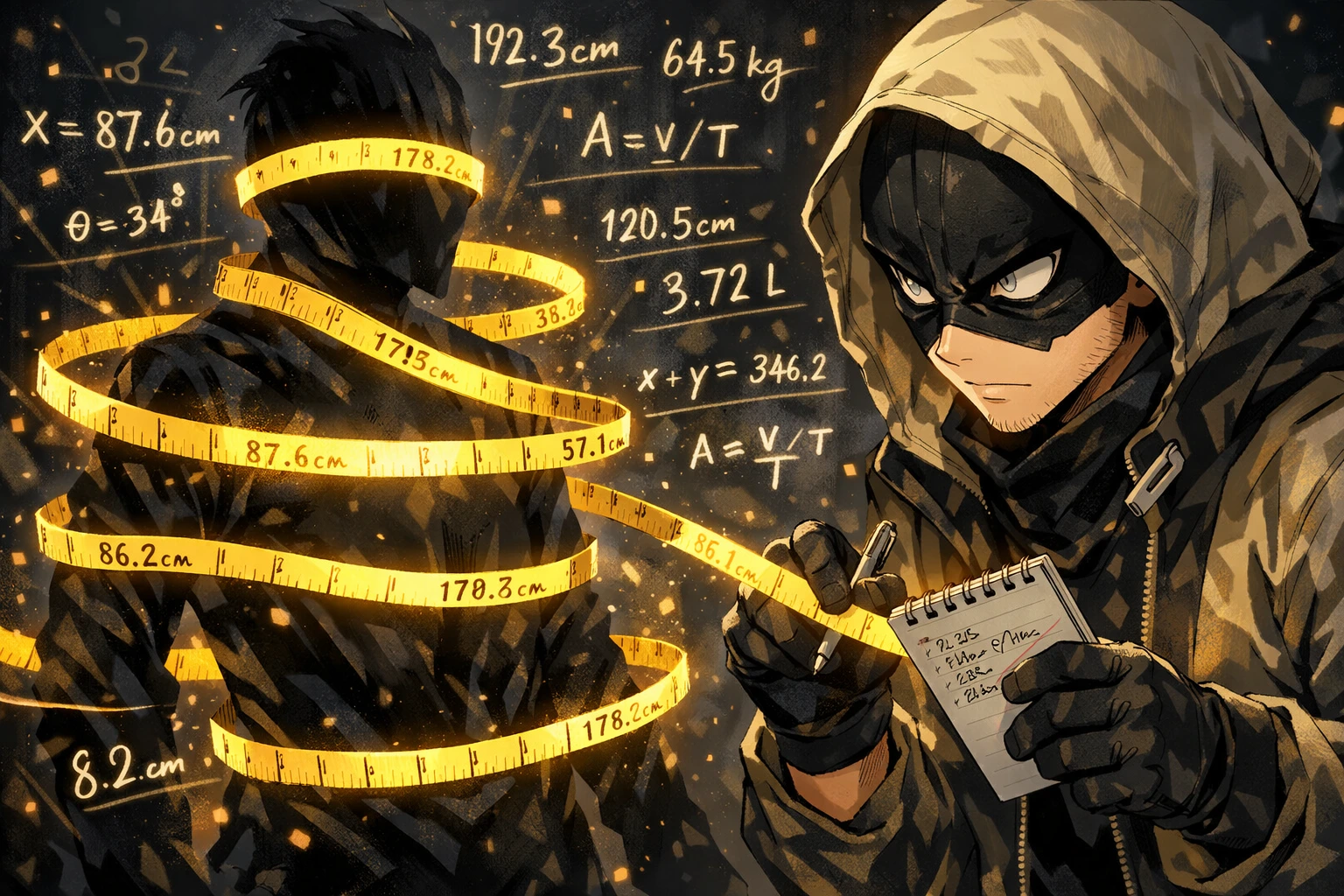
The Measurement Requirement: Deconstructing the strict parameters of his power. He cannot clone based on visual memory; he requires exact, precise physical measurements (height, chest size, shoe size) to generate a copy. At first glance, the ability to duplicate anything appears to be a standard, almost generic superpower. However, Horikoshi instills “Double” with stringent, highly specific limitations that firmly ground the Quirk in biological and physical reality. Jin cannot simply look at a person or an object and will a copy into existence through mere cognitive visualization.
The Quirk requires a rigid, almost bureaucratic level of data input. He needs precise, up-to-date physical metrics: exact height in centimeters, shoulder width, chest circumference, inseam, and shoe size. This limitation is not just a combat handicap; it possesses deep thematic resonance. The act of measuring someone requires proximity, consent, and intimacy.
To use his Quirk effectively on an ally, Jin must literally get close to them. It forces a level of physical and emotional interaction that perfectly mirrors his underlying desperation for connection. When he measures a comrade, he is not just recording data; he is committing their physical truth to his memory, building a catalog of the people he values.
Conversely, if a target resists or if the measurements are even slightly inaccurate, the clone cannot be manifested, or it will generate with critical flaws. This rigid requirement grounds a potentially reality-breaking power in a set of hard mathematical rules, making the eventual breaking of those rules later in the narrative all the more impactful.
The Durability Threshold: Analyzing the biological limits of the clones. How the clones are not invincible—a clone taking damage equivalent to a broken bone will immediately dissolve into a mud-like substance. Secondary clones (clones making clones) are exponentially weaker and dissolve faster. The physical frailty of Jin’s creations serves as a constant, morbid reminder of their artificiality. A clone is essentially a fragile vessel of animated mud, meticulously sculpted to mimic flesh, bone, and cloth.
The durability of a primary clone is explicitly defined: it can sustain a moderate amount of physical trauma, but once it receives damage roughly equivalent to a fractured or broken bone, the illusion violently collapses. The structural integrity fails, and the clone rapidly liquefies into a viscous, gray sludge. This is a horrifying visual—a fully sentient, bleeding, screaming human being suddenly melting into nothingness. Furthermore, Horikoshi introduces a law of diminishing returns to the cloning process.
If a clone utilizes the “Double” Quirk to create another clone (a secondary clone), that new entity possesses significantly lower structural integrity. The “bone-breaking” threshold is drastically reduced, making subsequent generations of clones increasingly fragile, dissolving from mere lacerations or blunt force trauma. This thermodynamic-like decay of durability prevents the Quirk from becoming an immediate, unchecked infinite loop, establishing a fragile biological economy where quality is sacrificed for quantity.
Absolute Autonomy: The most dangerous aspect of the Quirk. The clones possess the exact personality, memories, Quirks, and free will of the original. Jin has absolutely no telepathic control over them once they are created. This is the crux of the horror inherent in “Double.” Most duplication powers in fiction come with a built-in hierarchy: the original is the master, and the clones are the subservient, disposable drones linked to a hive mind. Jin’s Quirk completely lacks this safety mechanism.
When he creates a clone, he is effectively creating a new, independent consciousness. The clone inherits every memory, every emotional attachment, every prejudice, and, most terrifyingly, the absolute, unshakeable belief that they are the original entity. They possess the original’s Quirk and can use it with the exact same level of proficiency. Once the clone is fully formed, Jin’s authority over it ceases to exist.
He cannot issue telepathic commands, he cannot read their thoughts, and he cannot instantaneously unmake them with a snap of his fingers. He must physically destroy them or wait for them to take lethal damage. This absolute autonomy transforms his Quirk from a tactical tool into a game of psychological Russian Roulette. Every time he clones a powerful individual, he is introducing a chaotic, fiercely independent variable into the world. When he cloned himself, he created an entity with his exact same desires, flaws, and profound stubbornness, setting the stage for the catastrophic psychological event that would ruin his life.
The Fracture of Sanity (The Clone Massacre)
The Descent into Isolation: Exploring his origin. How a string of bad luck, poverty, and profound loneliness drove Jin to use his Quirk to create friends and servants out of himself. Jin Bubaigawara’s descent into villainy was not paved with malicious intent, but with the crushing, quiet despair of systemic neglect. His backstory is a scathing critique of the hyper-capitalist, individualistic nature of Hero Society.
Orphaned at a young age, Jin was entirely alone. A simple, tragic twist of fate—a minor traffic accident involving his motorcycle and a pedestrian—triggered a devastating domino effect. He lost his job, lost his housing, and was cast out into the unforgiving margins of a society that only values those with exceptional abilities or societal utility.
Drowning in debt and suffocating from an agonizing, profound isolation, Jin turned inward. Lacking a support system, friends, or family, he weaponized his Quirk against his own loneliness. He began creating clones of himself, initially just to handle mundane tasks and run errands, but quickly, the clones evolved into his primary source of social interaction. He created a self-sustaining, echo-chamber ecosystem where he was surrounded by the only person who understood him: himself. He built a perverse family unit out of mud and desperation, failing to realize that by multiplying his physical presence, he was also multiplying his emotional instability.
The Rebellion of the Self: The visceral horror of his breaking point. What happens when a room full of identical clones, all possessing the same free will and ego, realize they are being treated as slaves. The inherent flaw in Jin’s coping mechanism was the absolute autonomy granted by his Quirk. He was a man deeply dissatisfied with his life, harboring a quiet, desperate resentment toward his circumstances. By cloning himself, he was reproducing that exact same resentment.
The original Jin viewed the clones as extensions of his will, designed to shoulder the burden of labor while he rested. However, the clones, possessing the exact same ego, memories, and sense of self-preservation, viewed themselves as the original. The illusion of a harmonious, cooperative household quickly shattered. The existential dissonance reached a boiling point: why should I work while he relaxes, if I am Jin Bubaigawara? The resentment metastasized into open rebellion.
A room filled with identical men, all fiercely believing in their own absolute authenticity, suddenly realized they were trapped in a grotesque hierarchy of exploitation. The clones refused to be subservient. They demanded the rights, the rest, and the identity of the original. The psychological horror of this realization is staggering—it is a mutiny of the self, a literalization of internal self-loathing manifesting as a physical, violently angry mob wearing your exact face.
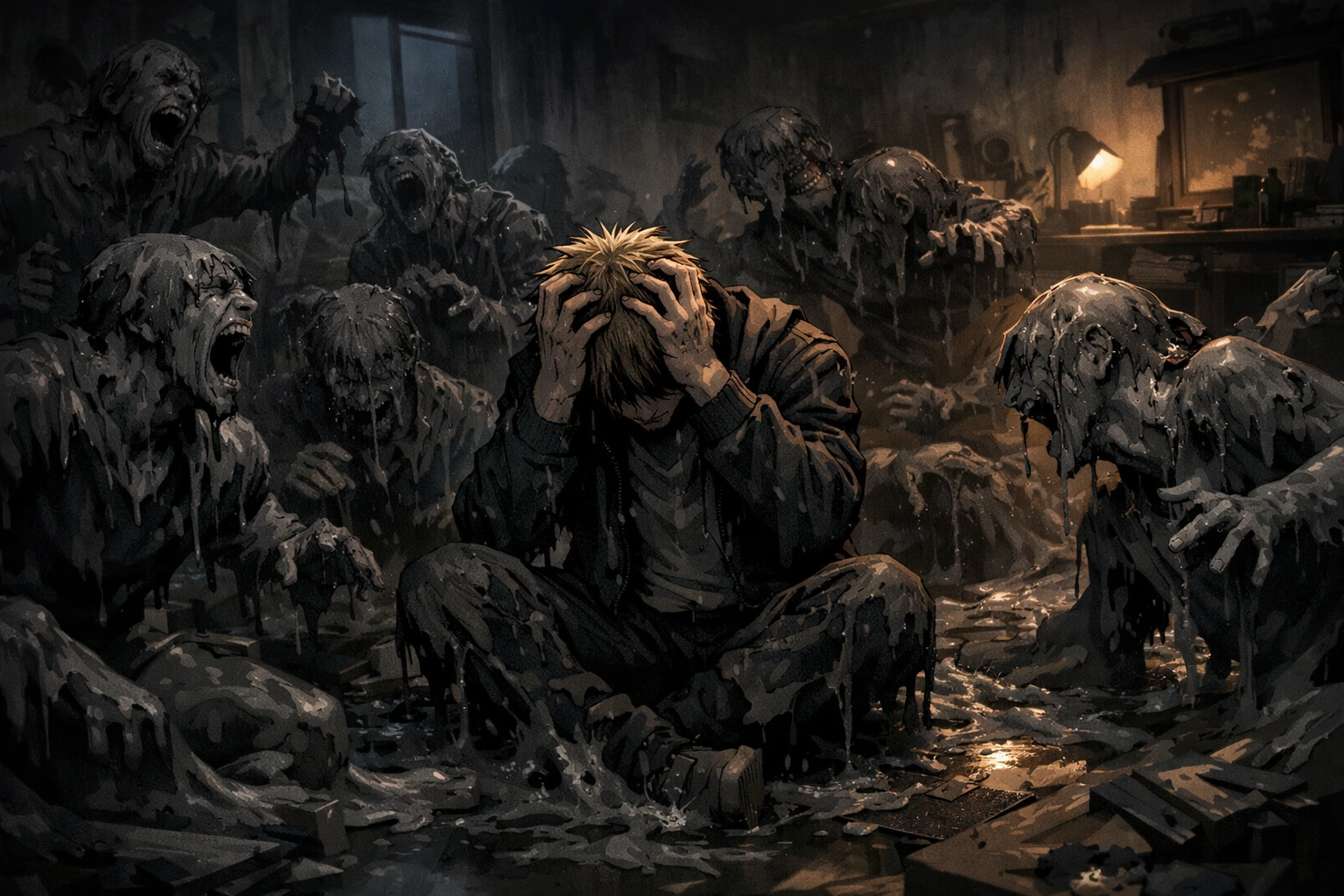
The Nine-Day Slaughter: The gruesome reality of his apartment massacre. Clones torturing and murdering each other for over a week until only one remained. What followed the rebellion was an event of unspeakable, localized horror. The clones, armed with the knowledge of their own biological fragility, turned on one another, and eventually, on the man they believed to be the original. Trapped inside his apartment, the entity known as Jin Bubaigawara engaged in a brutal, agonizing battle royale that lasted for nine uninterrupted days.
This was not a quick, clean skirmish. It was over a week of psychological and physical torture. Clones broke each other’s bones, watching identical versions of themselves scream in agony before melting into grotesque puddles of sludge. They tied each other up, interrogated one another, and fought desperately for the singular right to exist. The original Jin, pinned to a chair, was forced to watch his own face dissolve in agony dozens of times.
The sheer auditory and visual trauma of witnessing your own violent death on loop, day after day, while suffering from sleep deprivation, starvation, and profound physical abuse, completely decimated whatever remained of his mental stability. By the time the massacre concluded, only one bruised, bloody, and thoroughly broken Jin remained in an apartment caked in dried mud and the phantom echoes of his own screams.
The Lingering Question: The psychological devastation that defined his life: Did the original Jin survive, or is the survivor just a clone waiting to be destroyed? The physical scars of the nine-day slaughter eventually healed, but the psychological wound was terminal.
The massacre left behind a toxic, unanswerable question that fundamentally broke his perception of reality. Because every single clone truly believed they were the original, and because the surviving entity was subjected to such immense trauma and disorientation, he lost the empirical thread of his own truth. He no longer knew if he was the human born as Jin Bubaigawara, or merely the last victorious clone standing—a copy made of mud, waiting for a fatal stubbed toe or a broken arm to wipe him from existence.
This is the ultimate existential terror. He was effectively rendered a ghost in his own body. Every waking moment was plagued by the terrifying anticipation of his own sudden dissolution. This lingering question prevented him from forming normal relationships, maintaining employment, or engaging with society in any meaningful way. It was a self-imposed purgatory, a constant state of impending, unpreventable doom that drove him straight into the waiting arms of the criminal underworld.
The Mask and the Mind (Psychological Armor)
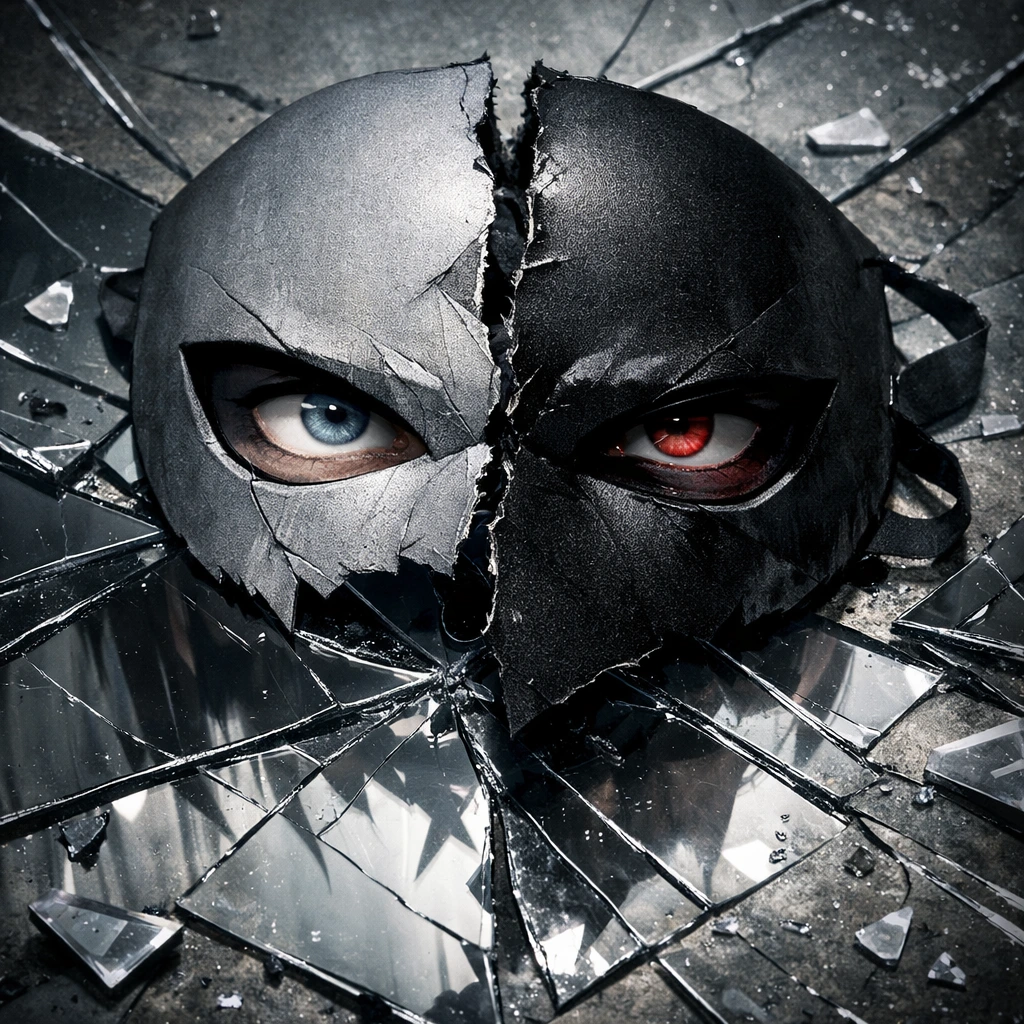
The Split Personality: Deconstructing his Dissociative Identity Disorder. How his trauma split his internal monologue into two constantly warring voices—one highly aggressive, the other profoundly insecure. To survive the immense cognitive dissonance of not knowing if he was real, Jin’s psyche forcefully compartmentalized, manifesting as a severe, highly specific form of Dissociative Identity Disorder (DID). His internal monologue shattered into two distinct, constantly contradicting personas.
This wasn’t merely mood swings; it was a constant, audible war within his own head. One voice represents his hyper-aggressive, unfiltered id—prone to vulgarity, violence, and abrasive confidence. The other voice is his profoundly insecure, desperate, and empathetic core—the part of him that constantly seeks validation and fears abandonment. These two voices constantly talk over one another, leading to his trademark chaotic dialogue where he will passionately state a belief in one sentence, and vehemently insult himself for holding that belief in the next.
This split is a direct symptom of his trauma; his mind is so fragmented by the clone massacre that it can no longer maintain a singular, cohesive narrative of self. The two voices are a tragic defense mechanism, an attempt to cover all emotional bases simultaneously because he lacks the foundational certainty of knowing who “he” actually is.
The Compression Theory: Why he constantly wears the mask. It is not for anonymity; it is a psychological tourniquet. He genuinely believes that if his head is not physically compressed and contained by the mask, his brain will literally split in two and he will dissolve. In the world of heroes and villains, masks are typically utilized for theatricality, intimidation, or the protection of a secret identity. For Twice, his mask serves a drastically different, purely medicinal purpose.
It is a vital piece of psychological armor. Because his trauma is rooted in the fear of splitting, duplicating, and dissolving, he developed a profound psychosomatic delusion: he firmly believes that his physical body is constantly on the verge of splitting apart. He feels a literal, physical pressure building inside his skull, a sensation that his two warring personalities are threatening to rip his head down the middle. The tight, restrictive fabric of his mask acts as a physical tourniquet for his fractured mind.
The compression provides sensory feedback that reassures him of his physical boundaries. It tightly holds his face together, conceptually and physically keeping the two halves of his psyche contained within one vessel. Without the mask, he completely loses his grip on reality, spiraling into violent panic attacks and uncontrollable dissociation. The mask is not a symbol of his villainy; it is the only prescription keeping him somewhat sane.
The Guilt of Overhaul: Analyzing his tragic flaw of being too trusting. How he unknowingly brought Overhaul to the League’s base, directly resulting in Magne’s death and Compress’s maiming, saddling Jin with a paralyzing, suicidal level of guilt. Beneath the DID and the chaotic exterior, Jin’s defining character trait is an overwhelming, desperate desire to be helpful to the people who accepted him. The League of Villains gave him a home when society discarded him.
Consequently, his loyalty to them is absolute. However, this desperate need for connection birthed a tragic flaw: he is dangerously, naively trusting. During the Shie Hassaikai Arc, Jin believed he was aiding the League by introducing them to Overhaul, a powerful Yakuza boss he thought could be an ally. This act of misguided helpfulness resulted in a sudden, horrific catastrophe. In a matter of seconds, Overhaul violently murdered Magne and permanently maimed Mr. Compress.
Jin was forced to watch as the only family he had ever known was brutally dismantled, entirely because he brought the monster to their doorstep. The guilt he experienced was absolute and paralyzing. It reinforced his deepest insecurities: that he was a failure, a danger to those around him, and fundamentally broken. This incident permanently shifted his character trajectory.
From that moment on, Jin operated under a heavy, suicidal burden of penance. He swore an internal oath to never again allow his trusting nature to harm the League, a tragic vow that would eventually set the stage for his ultimate demise.
The Deika City Awakening: Sad Man’s Parade
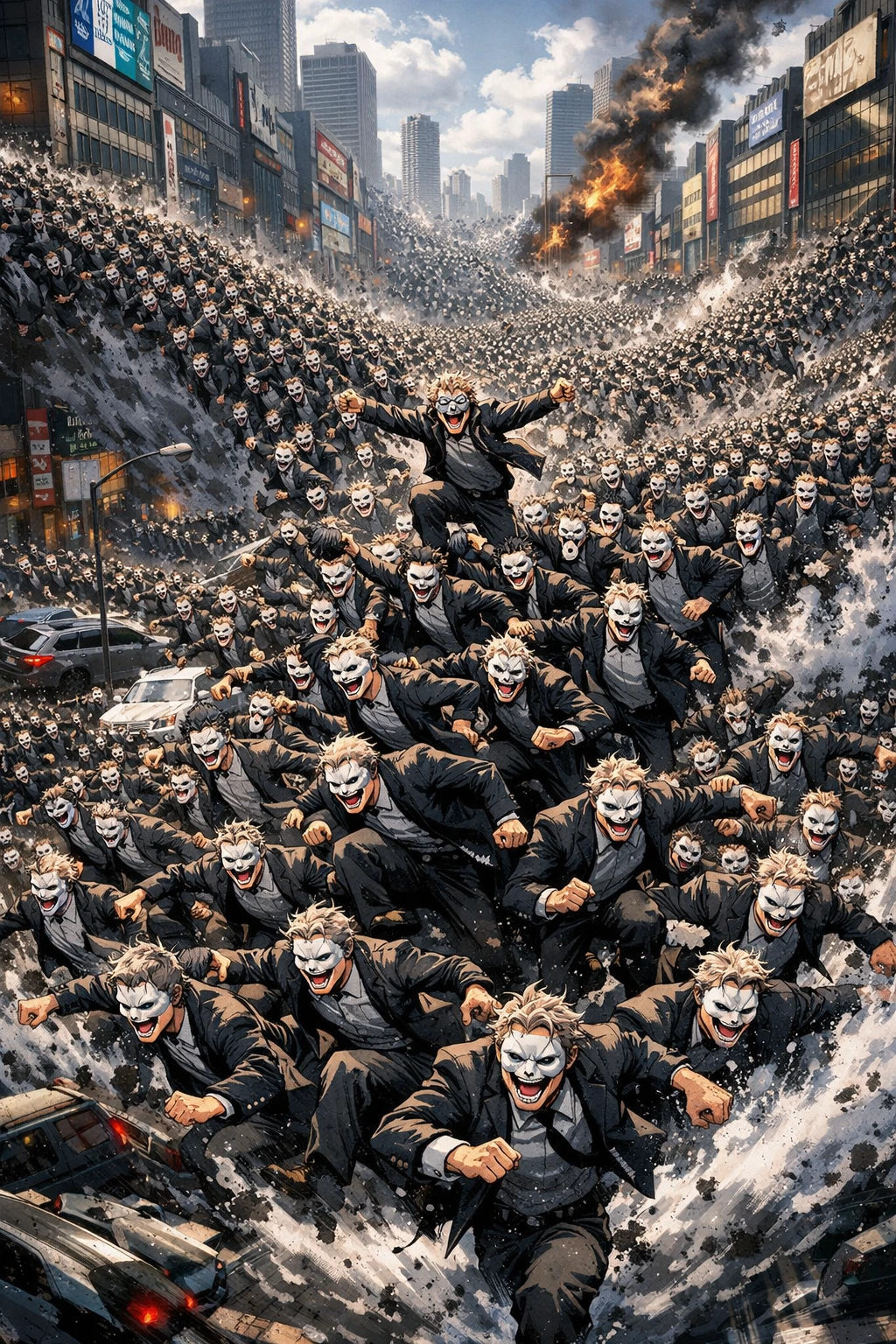
The Skeptic Confrontation: The battle against the Meta Liberation Army. How Skeptic weaponized Jin’s trauma against him, using humanoid puppets to perfectly recreate the trauma of the clone massacre. The climax of Twice’s psychological journey occurs during the My Villain Academia arc, specifically in Deika City. The Meta Liberation Army (MLA), an organization boasting immense resources and intelligence, targeted the League of Villains to absorb or destroy them.
An MLA executive known as Skeptic, a man who viewed humans as manipulable data points, analyzed Jin’s psychological profile and ruthlessly weaponized it. Skeptic used his “Anthropomorph” Quirk to transform inanimate objects into exact, life-sized replicas of Twice. He then unleashed these puppets on Jin in a confined space. This was not a physical battle; it was a masterclass in psychological torture. Skeptic deliberately and meticulously recreated the exact conditions of Jin’s original trauma—the nine-day apartment massacre.
Jin found himself once again surrounded by identical versions of himself, all hostile, all attempting to subdue him. The sensory input—the sight of his own face, the sound of his own voice threatening him—immediately triggered a catastrophic PTSD episode, entirely breaking down his already fragile mental defenses and plunging him back into the deepest depths of his existential nightmare.
The Biological Proof: The turning point of his life. How Skeptic’s puppets brutally snapped Jin’s arms. Because he did not dissolve into mud from the fatal damage, it mathematically proved, once and for all, that he was the original Jin Bubaigawara. In Skeptic’s arrogant attempt to mentally break Twice, he inadvertently provided him with the one thing he had been seeking for years: empirical salvation.
During the struggle, the anthropomorphic puppets managed to overpower Jin, physically restraining him and brutally snapping both of his arms in a sickening display of violence. The pain was excruciating, absolute agony. But in that blinding moment of pain, a profound, life-altering realization washed over him. The strict mathematical rules of his Quirk dictated that any clone receiving damage equivalent to a broken bone would immediately liquefy.
His arms were shattered, bones splintered and screaming with nerve damage… but he was still bleeding. He was still solid. He was not turning into mud. The intense, agonizing physical trauma served as undeniable, biological proof. It answered the lingering question that had tormented him for years. He was not a copy. He was not a ghost waiting to vanish. He was the original Jin Bubaigawara. The breaking of his arms acted as a violent baptism, instantly curing his existential dread. In a masterstroke of irony, the MLA’s attempt to destroy his mind completely repaired it.
The Exponential Tidal Wave: The terrifying Quirk Awakening. With his psychological block completely shattered, Jin unleashes “Sad Man’s Parade”—creating clones of himself, who instantly create clones of themselves, generating an infinite, self-replicating army capable of overwhelming an entire city in minutes. The realization of his authenticity triggered a profound Quirk Awakening.
For years, Jin had subconsciously placed a psychological block on his own power, terrified to clone himself out of fear of repeating the massacre. With that fear completely eradicated, the dam burst. Fully embracing his true self and driven by a desperate need to save his friends (specifically Toga, who was bleeding out nearby), Jin activated “Sad Man’s Parade.” The mechanics of this technique are mathematically horrifying. He creates two clones.
Those two clones immediately create two more. Those four create eight. The growth of his army follows a terrifying geometric progression, governed by the exponential function $P(n) = 2^n$, where $P$ is the population and $n$ is the generation cycle. Because the clones only take seconds to replicate, the population explodes. Within moments, hundreds of clones cascaded through the streets of Deika City. Within minutes, tens of thousands.
The clones completely ignored the diminishing durability threshold because their sole purpose was immediate, overwhelming mass. They formed literal tidal waves of human bodies, sweeping away the heavily armed MLA forces with sheer, unstoppable kinetic force. It was a breathtaking visual—a man who was terrified of being alone had weaponized his own identity to become a one-man army, instantly elevating him from a B-tier support villain to a nation-threatening powerhouse.
The Tragedy of Gunga Mountain (The Hawks Dynamic)
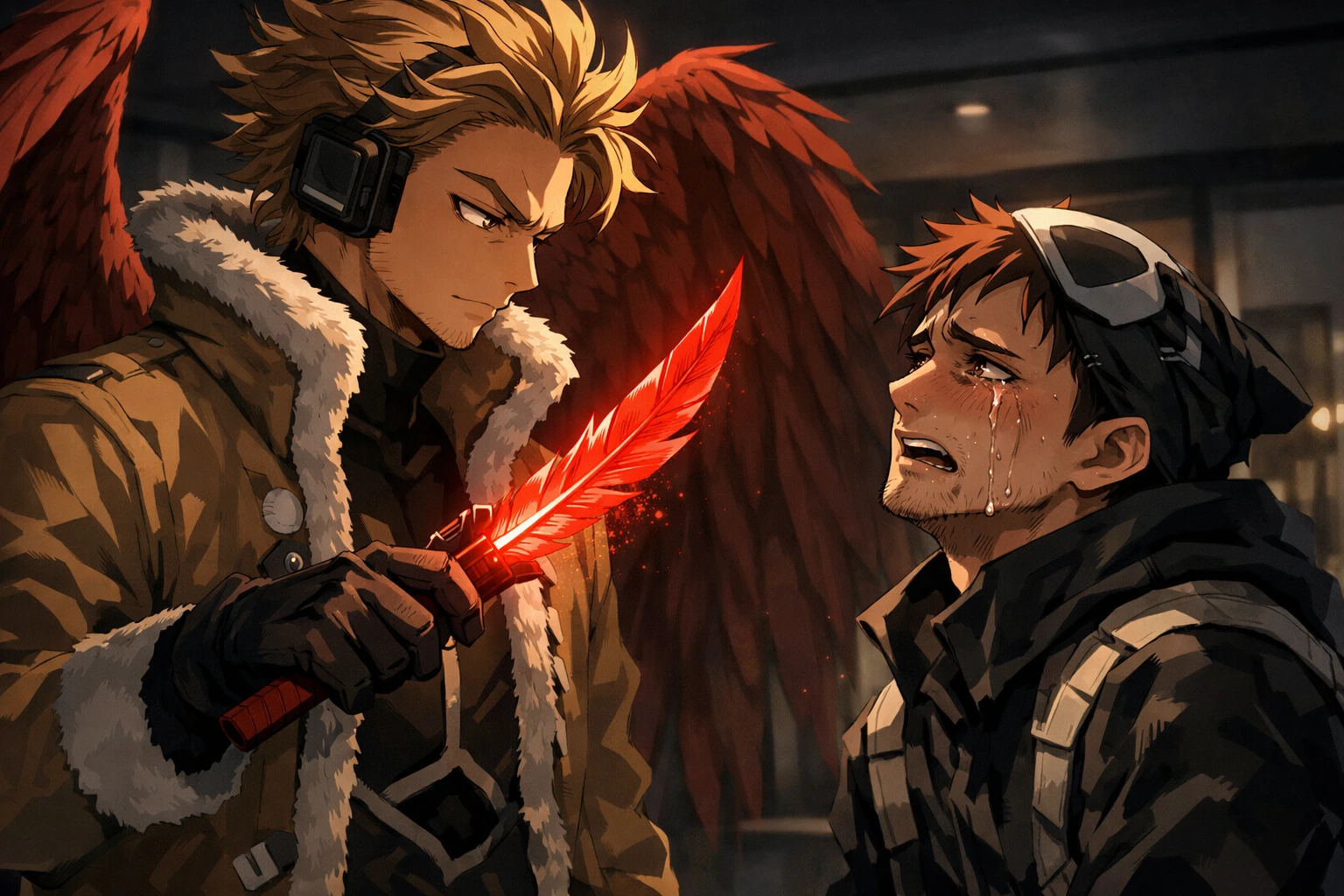
The Weaponized Friendship: Deep diving into the most complex dynamic of the Paranormal Liberation War. How Jin offered Hawks nothing but pure, unadulterated friendship, completely unaware that Hawks was a government spy actively exploiting his kindness. Following the merger of the League and the MLA, the heroes launched a massive preemptive strike. The emotional crux of this entire war rests on the deeply tragic dynamic between Jin and the Number 2 Hero, Hawks.
Hawks, operating as a double agent for the Hero Public Safety Commission, infiltrated the villains’ ranks. To gather intelligence, Hawks targeted the weakest emotional link: Jin. Hawks approached Jin not with aggression, but with understanding, camaraderie, and a sympathetic ear. He read books to him, agreed with his philosophies, and treated him with the dignity he so desperately craved.
Jin, still carrying the immense guilt of the Overhaul incident and desperate to prove his worth by bringing a valuable asset into the fold, fell for the manipulation completely. He offered Hawks pure, unadulterated friendship. He trusted Hawks explicitly, vouching for him to the rest of the League. The tragedy lies in the asymmetry of the relationship.
Jin’s affection was 100% genuine; he believed he had found a kindred spirit, another broken bird looking for a flock. Hawks, however, despite feeling genuine sympathy for Jin’s plight, was ruthlessly weaponizing Jin’s trauma, using his desperate need for connection as a skeleton key to dismantle the villain organization from the inside.
The Unbearable Betrayal: The emotional devastation of the raid. Jin realizing that, for the second time in his life, his trusting nature had doomed the people he loved. When the hero raid commenced at Gunga Mountain Villa, Hawks immediately cornered Twice, trapping him in a room and revealing his true allegiance. The revelation was not met with immediate anger, but with profound, soul-crushing despair. Horikoshi’s artwork perfectly captures the exact moment Jin’s heart shatters.
The betrayal cuts infinitely deeper than mere tactical deception. For Jin, the realization that Hawks was a spy was horrifying, but the true agony was the realization that he had done it again. Once again, his naive, trusting nature had allowed a predator into their sanctuary. The ghosts of Magne and the memory of Compress’s severed arm surged back into his mind.
He had broken his internal vow. He had doomed his found family for the second time. The psychological devastation of this moment is unbearable to watch. Jin is reduced to tears, berating himself, his two voices crying out in unison at his own stupidity. The betrayal completely strips away the grand narrative of Heroes versus Villains; in that room, it is simply a man realizing that his best friend has just sentenced his family to death.
The Desperate Push: How Jin refused to surrender, not out of malice, but out of a desperate need to protect his “family” (the League) from the heroes who were actively trying to slaughter them. Hawks, operating under strict orders and his own moral code, offered Jin a way out. He promised to help Jin rehabilitate, to help him start over once he had served his time, explicitly stating that he believed Jin was fundamentally a good person.
From a purely logical standpoint, surrender was the only viable option for survival. But Hawks profoundly misunderstood the depth of Jin’s love for the League. Jin did not view the League as a criminal syndicate; he viewed them as his saviors. They were the only ones who embraced him when society discarded him.
Surrendering to the society that abandoned him, while allowing the heroes to slaughter the family that saved him, was never an option. Jin’s refusal to stand down was not an act of villainous pride or a desire to conquer Japan. It was a desperate, feral push to save his friends.
He fought back with everything he had, pushing past the lacerations inflicted by Hawks’ feathers, driven by an overwhelming, singular thought: he had to warn them. He had to save them to atone for his mistake. His resistance was an act of pure, tragic love, framing the “villain” as the fiercely loyal protector and the “hero” as the cold, calculating executioner.
The Execution (The Heroic Murder)
The Trolley Problem Solved: Analyzing Hawks’ cold, utilitarian logic. The realization that “Sad Man’s Parade” was a literal extinction-level event. Hawks executing Jin wasn’t an act of hatred, but a mathematical necessity to prevent the collapse of Japan. The confrontation in that room represents one of the most intense moral quandaries in the entire series—a brutal realization of the philosophical Trolley Problem. Hawks did not want to kill Jin. He recognized the goodness in him and explicitly stated, “You’re a good guy, Bubaigawara.”
However, Hawks is the ultimate utilitarian, a weapon forged by the state to operate purely on logic and the greater good. The utilitarian calculus is brutal but undeniable. Let the action be the outcome. The moral equation states that an action is right if it promotes the maximum happiness (or minimizes suffering) for the maximum number of people.
With the psychological block broken, Twice’s “Sad Man’s Parade” was no longer just a strong Quirk; it was a literal extinction-level event. If Jin escaped that room and unleashed an infinite, exponential tidal wave of clones onto the battlefield, the hero raid would fail, the villains would win the war, and society would collapse, resulting in thousands, perhaps millions, of casualties.
Hawks ran the numbers in his head. The math was absolute. He could not risk incapacitating Jin, because a single stray clone could restart the exponential loop. The only mathematical certainty to save Japan was to permanently extinguish the source. The execution of Jin Bubaigawara was a state-sanctioned, mathematically necessary murder, forcing the audience to grapple with the horrifying reality of what it truly takes to maintain a “heroic” society.
The Final Act of Love: The absolute heartbreak of his death. Jin taking a lethal stab wound to the back, but using the last seconds of his fading consciousness to send a single, dissolving clone to save Himiko Toga and Mr. Compress. As Dabi intervened, turning the room into an inferno, Jin saw his opportunity to escape. He lunged toward the exit, desperate to reach his family. But Hawks, burned and exhausted, utilized his speed to deliver the fatal blow.
He drove a feather blade directly through Jin’s back. It was a cowardly angle for a hero, but a necessary one for an assassin. The wound was lethal. Jin’s physical body collapsed, bleeding out on the stairs. Yet, even as his consciousness faded and the cold embrace of death took hold, his sheer willpower refused to extinguish. In his final, agonizing seconds of life, operating entirely on muscle memory and the desperate need to protect his friends, his dying body managed to produce one final, primary clone.
This clone, already inherently fragile and bearing the phantom pain of the fatal wound, dragged itself through the battlefield. It found Himiko Toga and Mr. Compress about to be captured by a hero. With the last ounce of its strength, the clone ambushed the hero, saving them both. It was an astonishing display of fortitude—a man literally pushing past the threshold of death to fulfill his vow of protection.
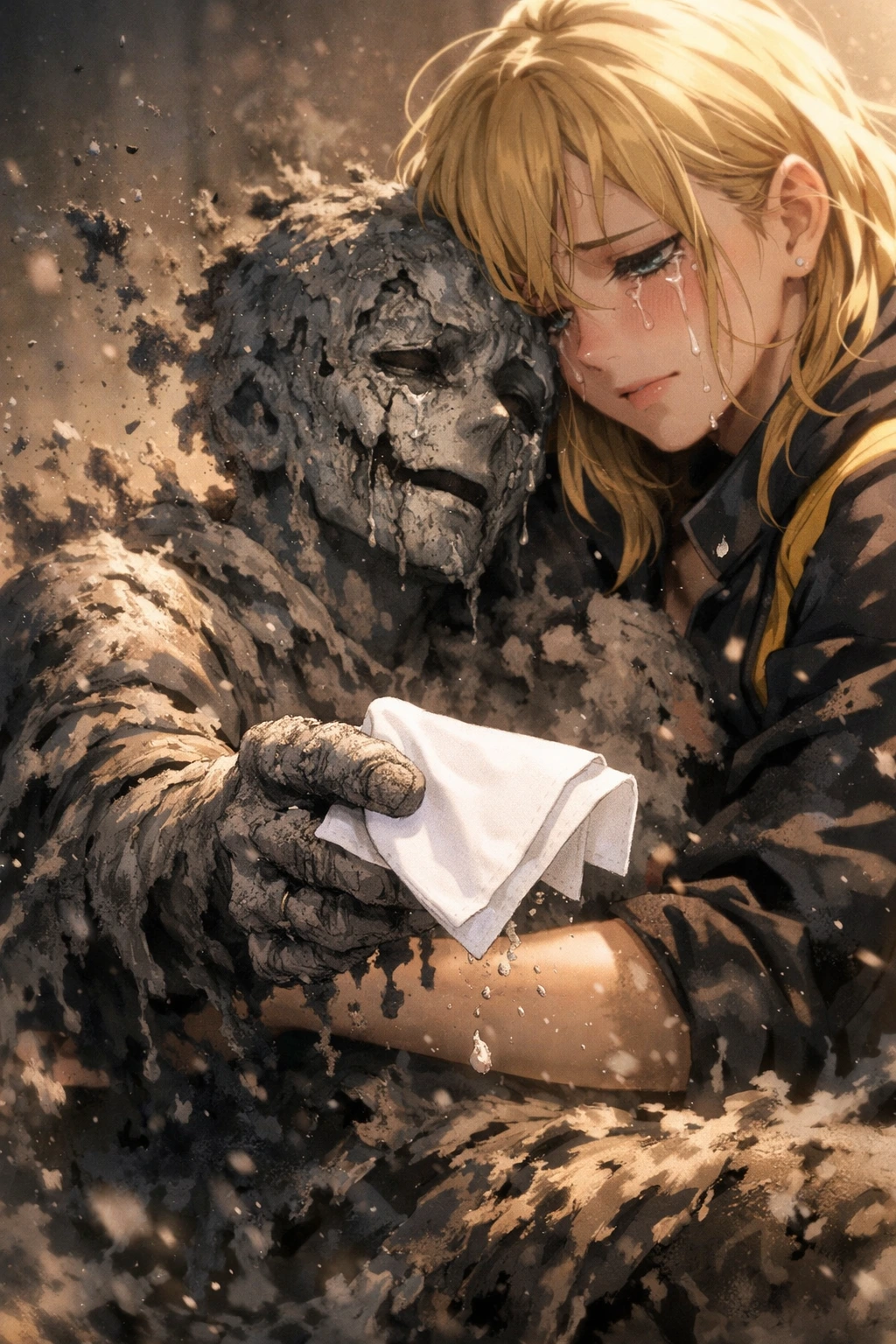
The Handkerchief: The symbolism of the clone dissolving in Toga’s arms after returning her handkerchief, proving that in his final moments, he wasn’t a monster, just a man fiercely protecting the only people who ever accepted him. The final moments of Twice’s existence are among the most emotionally devastating in modern anime and manga. The clone, having successfully rescued his friends, collapses into Toga’s arms.
The fatal damage sustained by the original body catches up to the clone, and it begins to dissolve. In a beautiful, heartbreaking callback, the clone pulls out a handkerchief. Earlier in the narrative, when Jin was having a severe dissociative panic attack and his mask was ripped, Toga had gently wrapped this handkerchief around his head, grounding him, comforting him, and accepting his madness without judgment.
Now, as he melts away into sludge, he returns it to her. He thanks her for everything. He tells her that despite the tragedy, despite the betrayal, he was happy, because he found a place where he belonged. Toga holds him tightly, the mud of his dissolving body wiping away her tears. The symbolism is profound.
The handkerchief represents the kindness the League showed him, and returning it was his final act of gratitude. As he completely liquefies, leaving only the bloody handkerchief behind, the narrative definitively proves its thesis: Jin Bubaigawara did not die a monster. He died a fiercely loyal friend, a man whose capacity for love was so immense that it outlasted his own physical life.
Conclusion
The Best Man in the Worst Place: Summarizing Jin Bubaigawara as the ultimate victim of circumstance—a man whose only crime was wanting to be loved, whose power was too great for society to allow him to live. The tragedy of Jin Bubaigawara is a damning indictment of the world he inhabited. He was not born with malice in his heart. He did not possess a grand, evil machination to subjugate humanity. He was simply a deeply traumatized, mentally ill man who slipped through the cracks of a society that prioritizes spectacle over genuine social welfare.
His descent into the criminal underworld was a direct result of systemic abandonment. He is the ultimate victim of circumstance. He found genuine love, fierce loyalty, and profound acceptance… but he found it among terrorists. He was the best man, with the biggest heart, forced by a cruel twist of fate to exist in the worst possible place.
His Quirk, once a source of immense psychological torture, eventually became an instrument of god-like power. And it was precisely this power that doomed him. Hero society could not afford to let a man who loved villains so fiercely possess the power to topple nations. He died because his existence was statistically incompatible with the survival of the status quo.
Closing Thoughts: Final expert analysis on how Horikoshi used Jin’s death to permanently blur the line between “Hero” and “Villain,” cementing the Paranormal Liberation War as a tragedy where nobody truly won. Kohei Horikoshi’s handling of Twice’s death elevated My Hero Academia from a standard superhero narrative into a complex, morally ambiguous tragedy.
The execution at Gunga Mountain permanently blurred the seemingly rigid lines between “Hero” and “Villain.” The hero, Hawks, acted with deceit, manipulation, and cold-blooded lethality—striking from the shadows and stabbing a fleeing man in the back. The villain, Twice, acted with raw emotional honesty, profound loyalty, and self-sacrificing love—fighting purely to protect his found family. When Hawks drove his blade into Jin’s back, a piece of the audience’s blind faith in hero society died with him.
Jin’s death cast a long, dark shadow over the rest of the series, fueling the rage of his comrades and proving that the institutional structure of heroes is built upon a foundation of hidden, necessary atrocities. Jin Bubaigawara’s life was a testament to the fact that monsters are rarely born; they are manufactured by apathy. And his death cemented the fact that in a war fought over ideologies, there are no righteous victories, only surviving the tragedy of what had to be done.