
I. Introduction: The Ouroboros of Misery
At the heart of Jujutsu Kaisen lies a truth so simple yet so devastating that it transforms the series from a standard battle shonen into a modern tragedy: Curses are not invading aliens, nor are they demons from a hell dimension disconnected from our reality. They are us. They are the shadow cast by humanity’s collective consciousness. As long as humans possess the capacity to feel shame, regret, hatred, and fear, the world of Jujutsu is condemned to an eternal war.
This is the core premise of Gege Akutami’s magnum opus—a narrative that is less about the triumph of good over evil and more about the management of an incurable societal disease. The series presents a grim equation that governs every interaction, every death, and every tragedy within its universe:
Most fictional worlds offer a path to “peace.” In Naruto, peace is achieved by breaking the cycle of hatred between nations through understanding. In One Piece, it is found in the absolute freedom of the Pirate King. But Jujutsu Kaisen posits a terrifying, existential question: How do you defeat an enemy that is generated by your own survival instinct? You cannot kill fear without becoming something less than human. You cannot eliminate regret without eliminating the past.
The “Cycle” is a mechanism of entropy. Non-sorcerers, the vast majority of the population, act as unconscious reactors, leaking negative energy into the atmosphere. This energy coalesces, taking shape and form as Cursed Spirits. Jujutsu Sorcerers are then conscripted—often from childhood—to act as the janitors of this mess, exorcising spirits in a never-ending battle. The sorcerers suffer, they die, and their own trauma contributes to the very energy they fight against. It is a closed loop. A serpent eating its own tail. The system is designed to fail, yet it is the only system that keeps humanity from immediate extinction.
This article serves as a comprehensive analysis of this systemic trap. We will dissect the metaphysics of how misery manifests as monsters, scrutinize the archaic and failing political structures of Jujutsu High that perpetuate the suffering, and rigorously evaluate the three competing philosophies—represented by Yuki Tsukumo, Suguru Geto, and Kenjaku—that attempted to shatter the wheel. We ask the ultimate question: In a world built on negative energy, is “salvation” even a possibility, or are we merely choosing the manner of our destruction?
II. The Metaphysics of Misery: How Curses Are Born
To understand the solution—or the lack thereof—one must first understand the problem at a molecular level. The metaphysics of Jujutsu Kaisen are grounded in the concept of “Leakage” versus “Control,” a dynamic that defines the biological hierarchy of the series.
The Mechanics of Leakage

Every human being possesses Cursed Energy (CE). It is the byproduct of volatile emotions. When a salaryman hates his boss, when a student fears an exam, or when a patient fears death, they produce CE. For a non-sorcerer, this energy is like steam escaping a pot; it dissipates into the environment. However, it does not disappear. It pools. Like sediment in a river, this leaked energy gathers in areas of high population or high stress—hospitals, schools, graveyards—and eventually gains sentience.
Sorcerers differ not because they produce more emotion, but because their bodies naturally close this loop. A sorcerer recirculates their energy within their own body, using it to fuel Cursed Techniques (CT) or reinforce their physical prowess. They do not leak. Therefore, ironically, the only people not responsible for the creation of Cursed Spirits are the sorcerers themselves. This creates the fundamental unfairness of the setting: the minority (Sorcerers) must clean up the mess of the majority (Non-Sorcerers/Monkeys), a dynamic that eventually broke the mind of Suguru Geto.
The Geography of Curses and Tengen’s Barriers
Why is Japan the epicenter? Why don’t we see Special Grade curses ravaging New York or London with the same frequency? The answer lies in the barriers erected by Master Tengen.
Tengen’s barriers act as a massive containment field for Cursed Energy within Japan. While intended to optimize the accumulation of energy to nurture sorcerers and protect the Jujutsu stronghold, this concentration has a catastrophic side effect: it turns Japan into a pressure cooker. By preventing the energy from diffusing globally, the barriers ensure that the curses born in Japan are of a significantly higher grade and density than anywhere else in the world. The monopoly on Cursed Energy is both Japan’s strength (in producing powerful sorcerers) and its curse (in producing world-ending threats). This geographical isolationism forces Japan to be the eternal battleground, trapping its sorcerers in a localized hell.
The Hierarchy of Fear
The grading system of curses is a direct reflection of human psychology. The more primal and collective the fear, the stronger the curse.
- Grade 4 to Grade 2: These are born from specific, localized anxieties. The fear of a specific urban legend (like the slit-mouthed woman), or the collective stress of a workplace. They are dangerous but manageable.
- Grade 1 and Special Grade: These represent fundamental concepts.
- The Disaster Curses: Jogo (Earth/Volcanoes), Hanami (Forests/Nature), and Dagon (Oceans) represent humanity’s primal fear of the natural world. These fears are ancient, embedded in our DNA. Thus, the curses born from them are intelligent, philosophical, and immensely powerful. They view themselves as the “true humans” because they are born of pure, unadulterated emotion, unlike humans who lie and deceive.
- Mahito (The Human Curse): Mahito is the terrifying realization that humans fear each other more than they fear nature. Born from human hatred, deception, and violence toward one another, Mahito is the most dangerous because he understands the human soul better than any human.
Vengeful Spirits: The Glitch in Death
There is an exception to the natural formation of curses: the Vengeful Spirit. This occurs when a sorcerer is killed without the use of Cursed Energy. If a sorcerer dies via conventional means (a knife, a bullet, or old age) while harboring intense regret or resentment, their soul does not pass on. Instead, their own Cursed Energy collapses inward, rebirthing them as a Vengeful Cursed Spirit.
We see this with Naoya Zenin, whose ego and hatred allowed him to return as a grotesque, speed-obsessed curse. We see it in the lore of the Three Great Vengeful Spirits of Japan (Sugawara no Michizane). This mechanic adds a layer of tactical cruelty to the world: sorcerers must kill their enemies with Jujutsu, or risk facing them again in a form far more terrible. It is a system where even death is not a release unless it is executed with the proper bureaucratic procedures of energy management.
III. The Law of Equivalent Exchange: Binding Vows
One cannot discuss the cycle of curses without discussing the economic system that governs it: Binding Vows (Shibari). This is the immutable law of the Jujutsu universe, acting as the invisible chains that hold the cycle together.
The Economy of Power
A Binding Vow is a pact made with oneself or another. By accepting a handicap or a condition, a sorcerer gains power. This system prevents the world from becoming a lawless chaos of infinite power scaling. It enforces a cruel rationality: to gain something, you must lose something.
- Nanami Kento’s “Overtime”: By restricting his Cursed Energy output during working hours, Nanami gains a massive boost in power once his shift ends.
- Sukuna’s “Open”: By keeping the true nature of his technique a secret (or perhaps revealing it, in the case of the “Revealing One’s Hand” vow), sorcerers manipulate the efficacy of their techniques.
The Narrative Function of Vows
Binding Vows represent the rigidity of the Jujutsu world. You cannot simply “try harder” to win; you must sacrifice something. This reinforces the theme of the cycle: it is a transactional existence. Sorcerers are constantly bargaining parts of their humanity, their time, or their bodies in exchange for the power to survive the day. It is a system of desperation.
The most dangerous Binding Vows are those made with others. Kenjaku’s millennia-spanning plan relied entirely on Vows made with ancient sorcerers to participate in the Culling Game. These Vows are absolute; breaking them results in a punishment from “fate” itself, a consequence so vague and terrifying that even Sukuna respects it. This proves that there is a force greater than Cursed Energy governing the world—a cosmic law of contracts that ensures the suffering continues.
IV. The Failed System: The Corruption of Jujutsu Society
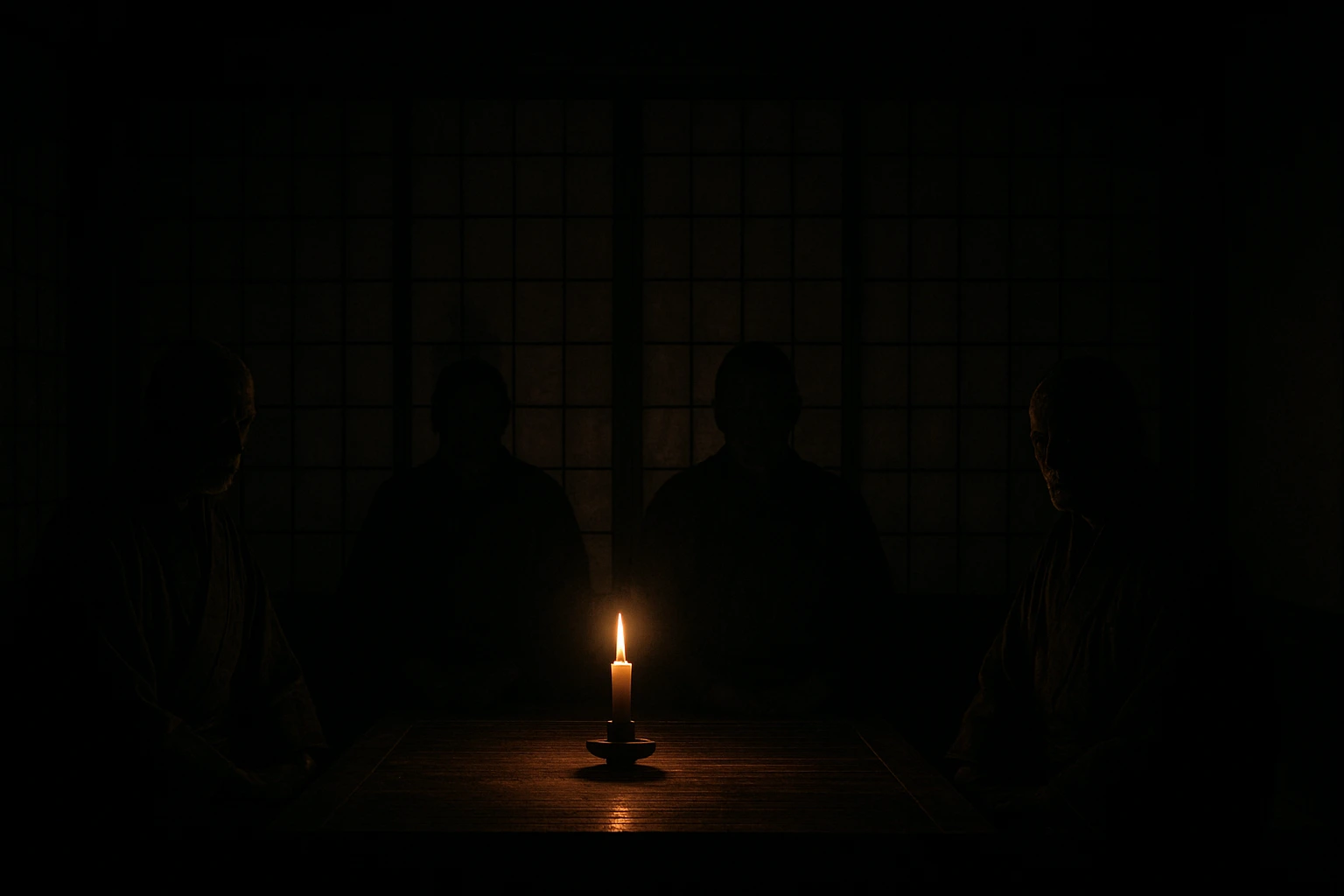
If Cursed Energy is the disease, Jujutsu Society is a hospital run by malpractice. The tragedy of the series is exacerbated by the fact that the institutions designed to protect humanity are rotting from the inside out.
The Higher-Ups: Conservation of Stagnation
The “Higher-Ups”—that faceless council of elders behind folding screens—represent the absolute worst of conservative bureaucracy. Their primary directive is not “eradication of curses” or “protection of the innocent,” but “maintenance of the status quo.”
They operate on a policy of fear. They fear anything they cannot control, leading to the execution orders for Yuji Itadori (a vessel), the attempted assassination of Megumi Fushiguro, and the alienation of Hakari and Yuta. They treat the world as a delicate equation that must not be unbalanced. However, by suppressing growth and clinging to tradition, they failed to prepare for the inevitable evolution of curses. They are the managers of a sinking ship, forbidding the crew from building lifeboats because it violates protocol.
The Exploitation of Youth
The most heartbreaking aspect of the Jujutsu system is its reliance on child soldiers. The mortality rate for sorcerers is astronomical, yet the schools (Tokyo and Kyoto Tech) consistently send first-year students—teenagers aged 15 and 16—into active combat zones.
- Haibara Yu: His death broke Nanami. He was a bright, optimistic boy sent on a mission graded incorrectly by the Higher-Ups. His death was a clerical error written in blood.
- Nanami Kento: Nanami represents the “adult” response to this trauma. He fled the system to become a salaryman, only to return because he realized that while normal work creates money, Jujutsu work saves people. Yet, he died exhausted, dreaming of a beach, crushed by the weight of a war he didn’t start.
- Geto Suguru: The pressure of protecting humanity while seeing his friends die turned him into a monster.
The system devours its young to buy a few more days of peace for the old. It treats youth not as the future, but as ammunition.
The Clans: The Poison of Lineage
The “Big Three Families” (Zenin, Kamo, Gojo) act as feudal lords within this modern setting. The Zenin clan, in particular, serves as a microcosm of everything wrong with the sorcerer mindset. They value “Inherited Techniques” over human life.
The Zenin ideology is one of pure eugenics. If you do not possess a powerful technique, you are trash. This mindset led to the abuse of Maki and Mai, and the ostracization of Toji. It creates a toxic internal environment where sorcerers are fighting their own families just as hard as they fight curses. The Zenin clan’s downfall at the hands of Maki was not a tragedy; it was a corrective measure—a violent excision of a tumor that had been growing for centuries. It proved that the “prestige” of the clans was a hollow shell, rotting from the inside.
Gojo’s Rebellion: Education as a Weapon
Satoru Gojo, the strongest sorcerer in history, could have killed the Higher-Ups at any moment. He could have slaughtered the Zenin and Kamo elders before breakfast. But he chose not to. Why?
Gojo realized that a coup d’état would only replace one tyrant with another. If he killed the elders, the system would just replace them with fearful sycophants. To truly change the cycle, he had to change the people.
His “Educational Rebellion” was a long-term gamble. By raising a generation of strong, independent, and morally complex sorcerers (Yuji, Megumi, Yuta, Hakari, Maki), he hoped to create a wave that would naturally wash away the old guard. Gojo’s dream was not to rule, but to create a world where he didn’t have to be the strongest alone. His failure, arguably, was that he was too strong to understand the weakness that drove others to evil, but his solution was the only one that retained humanity.
V. Toji Fushiguro: The Anomaly in the Machine

To understand how fragile the cycle actually is, one must look at the man who broke it: Toji Fushiguro. He is the most significant character in the lore regarding the disruption of fate.
Toji was born with a Heavenly Restriction that removed all Cursed Energy from his body in exchange for physical perfection. In the eyes of the Zenin clan, he was a failure. In the eyes of the universe, he was an invisible man. Because he had zero Cursed Energy, he existed outside the laws of Jujutsu. Barriers could not detect him; logic could not track him.
Toji is the “monkey” who killed the gods. His actions in the Hidden Inventory Arc—killing the Star Plasma Vessel—shattered the destiny that bound Master Tengen, the Six Eyes, and the Star Plasma Vessel together. This singular act of violence destabilized the barriers and set the stage for Kenjaku’s plan. Toji proves that the system is not infallible; it is brittle, and it cracks under the weight of those it rejects. He is the ultimate argument for Yuki Tsukumo’s philosophy: the only way to win the game is to stop playing it.
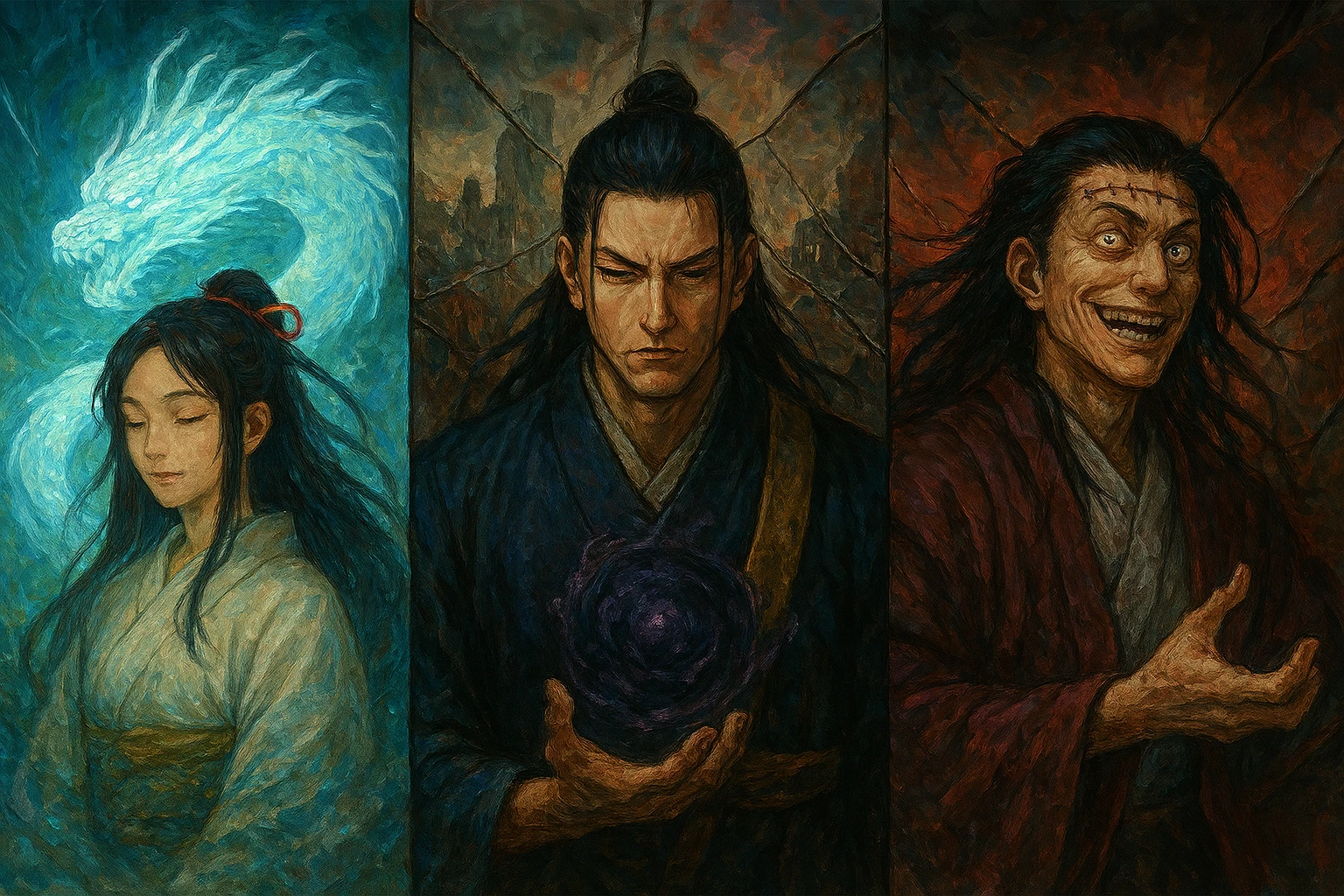
VI. The Three Solutions: Philosophies on Breaking the Cycle
The central conflict of Jujutsu Kaisen is not really about punching ghosts; it is an ideological war between three distinct methods of ending the “Age of Curses.” Yuki, Geto, and Kenjaku all identified the same problem: The current model of exorcism is a band-aid on a bullet wound. However, their proposed cures were radically different.
Solution A: The Yuki Tsukumo Plan (Eradication)
The Theory: Yuki Tsukumo, a Special Grade sorcerer, was the only one looking at the root cause. She posited that if all humans possessed zero Cursed Energy, curses would cease to be born.
The Method: Her ideal world is one where humanity evolves into beings like Toji Fushiguro. Toji was the first case of a “Heavenly Restriction” that completely eliminated Cursed Energy in exchange for superhuman physical prowess. A human with zero Cursed Energy breaks away from fate. They are invisible to domains, invisible to barrier techniques, and they do not leak energy.
The Flaw: Yuki’s plan relies on a biological miracle. Toji was a glitch in the matrix. Maki was a recreation of that glitch through extreme trauma. Replicating this across the entire human population is scientifically impossible with current Jujutsu. Furthermore, Yuki spent so much time researching this theoretical future that she neglected the present, failing to stop the immediate threats that led to the Culling Game. Her solution was a utopia that she had no roadmap to achieve.
Solution B: The Suguru Geto Plan (Selection)
The Theory: Geto’s logic was the inverse of Yuki’s. Sorcerers do not leak energy; they control it. Therefore, if the entire human population consisted only of sorcerers, no Cursed Spirits would be born. The cycle would end.
The Method: Genocide. Geto proposed the extermination of all non-sorcerers (“monkeys”). By culling the weak, he would force an evolutionary bottleneck where only those capable of controlling Cursed Energy would survive.
The Flaw: Aside from the obvious moral bankruptcy of wiping out 99.9% of the human race, Geto’s plan was logistically doomed. As he admitted to Gojo, “If you were me, you could do it.” Geto lacked the power to fight the entire world. His ideology was born of trauma, not logic—a desperate attempt to assign meaning to the senseless deaths of his comrades. He wanted to create a paradise for sorcerers, but he became a demon to do it.
Solution C: The Kenjaku Plan (Optimization/Chaos)
The Theory: Kenjaku, the ancient sorcerer possessing Geto’s body, viewed humanity not as something to be saved or culled, but as a petri dish. He believed that the current limitations of both humans and sorcerers were boring. He sought to force human evolution to the “next stage” by merging humanity with Master Tengen.
The Method: The Culling Game. This ritual was a massive refinement process, accumulating vast amounts of Cursed Energy to prepare humanity for the merger. Kenjaku wanted to turn every human in Japan into a singular, storm-like entity of pure Cursed Energy—something that transcends the definition of a curse or a sorcerer.
The Flaw: Kenjaku is the mad scientist who burns down the laboratory to see what color the flames are. His plan offers no guarantee of survival or happiness. The “creature” born from the merger might be a god, or it might be a mindless abomination that destroys the planet. Kenjaku doesn’t care; he just wants to see something “new.” His solution is the ultimate gamble, risking total extinction for the sake of curiosity.
VII. The Turning Point: The Shibuya Incident
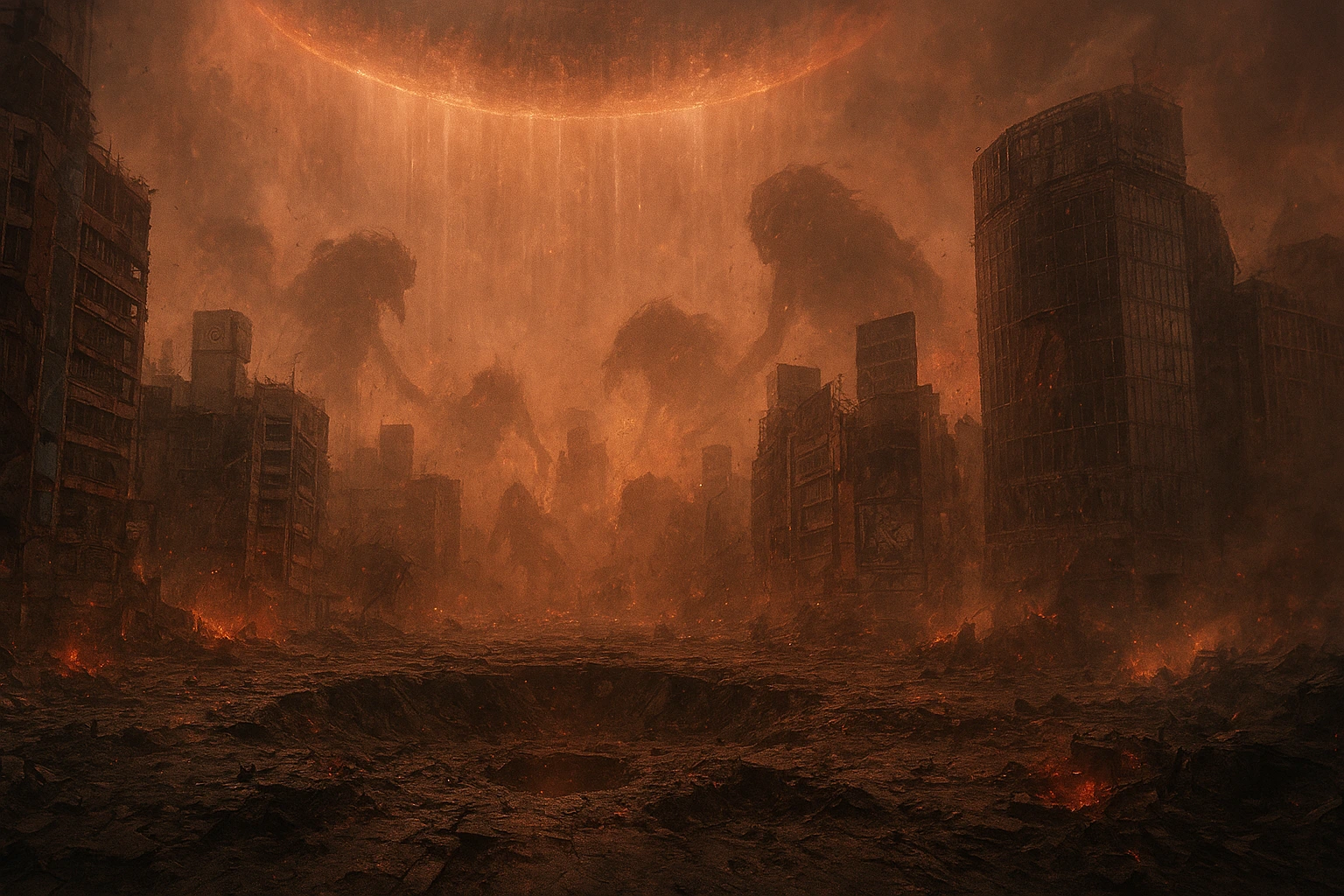
If the Hidden Inventory Arc was the crack in the foundation, the Shibuya Incident was the collapse of the building. This arc represents the point of no return for the cycle of curses in the modern era.
In Shibuya, the “balance” maintained by Satoru Gojo was forcibly removed. For years, curses and curse users lived in the shadows, terrified of Gojo. His sealing didn’t just remove a combatant; it removed the deterrent that held the chaos at bay.
Shibuya demonstrated what a world ruled by curses looks like. It was a massacre of civilians, a subversion of the “protect the weak” trope. The incident proved that the system of Jujutsu High was entirely dependent on one man. Without Gojo, the bureaucracy crumbled, the clans turned on each other, and Japan fell into ruin. Shibuya was the death knell of the “Peaceful Era” and the beginning of the “Heian Era” redux—a return to survival of the fittest. It stripped away the illusion of control that the Higher-Ups had desperately tried to maintain.
VIII. Mahito: The Mirror of Humanity
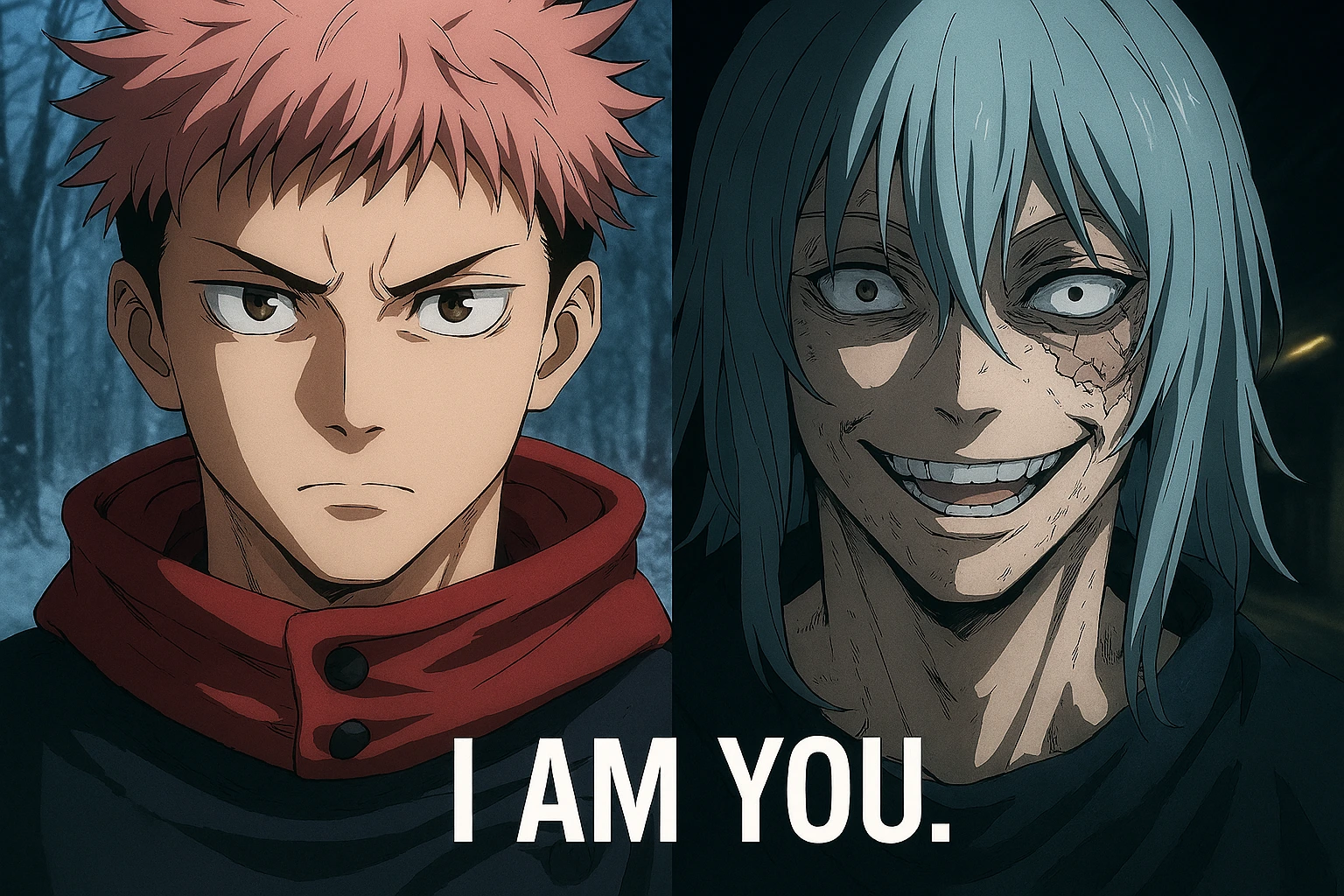
To fully grasp the cycle, one must look into the eyes of Mahito. He is arguably the best-written villain in the series because he is the most “honest.”
“I Am You”
The climax of the Shibuya Incident features a dialogue that deconstructs the hero-villain trope. Mahito tells Yuji: “I am you. I wanted to kill you. You wanted to kill me. Does it matter who is right?”
Mahito forces Yuji to confront the hypocrisy of his heroism. Yuji kills curses to save people. Mahito kills people to save curses (or rather, to fulfill his nature). Mahito argues that they are simply two different species fighting a war for survival. There is no justice, only the food chain. This revelation shatters Yuji’s naive belief in being a “hero of justice.”
The Human Curse
Mahito is terrifying because he is playful. He treats humans the way humans treat insects—with a mix of casual cruelty and scientific curiosity. He transforms people (Idle Transfiguration) not just to kill them, but to see what happens. This mirrors how humans treat the environment and animals. Mahito is the reflection of humanity’s lack of empathy for anything “other” than itself. He is not an aberration; he is the natural result of human history.
The Soul vs. The Body
Mahito also serves as the vehicle for the series’ theological debate: Does the soul precede the body, or does the body precede the soul? Mahito believes the soul comes first, and by reshaping the soul, he reshapes the body. Kenjaku, however, believes they are one and the same (citing Geto’s body reacting even after death). This debate is central to the cycle. If the soul is mutable, then humanity can be changed (Mahito’s method). If the body is the anchor, then physical evolution is the key (Kenjaku’s method).
Yuji’s Acceptance as a “Cog”
Yuji defeats Mahito not by proving him wrong, but by accepting the horror of the truth. When Yuji says, “I am you. I wanted to deny it, but now I get it. I’m just a cog,” he is surrendering his main character syndrome.
Yuji realizes he is not a “hero” destined to save everyone. He is a function of the Jujutsu system. He is an exorcist. His role in the cycle is to remove curses, just as a white blood cell removes bacteria. He strips away the romanticism of his goal and accepts the cold, mechanical reality of his duty. This acceptance of being a “cog” in the infinite cycle paradoxically gives him the resolve to keep fighting, not for a grand finale, but simply because it is what must be done.
IX. The Curse of Love
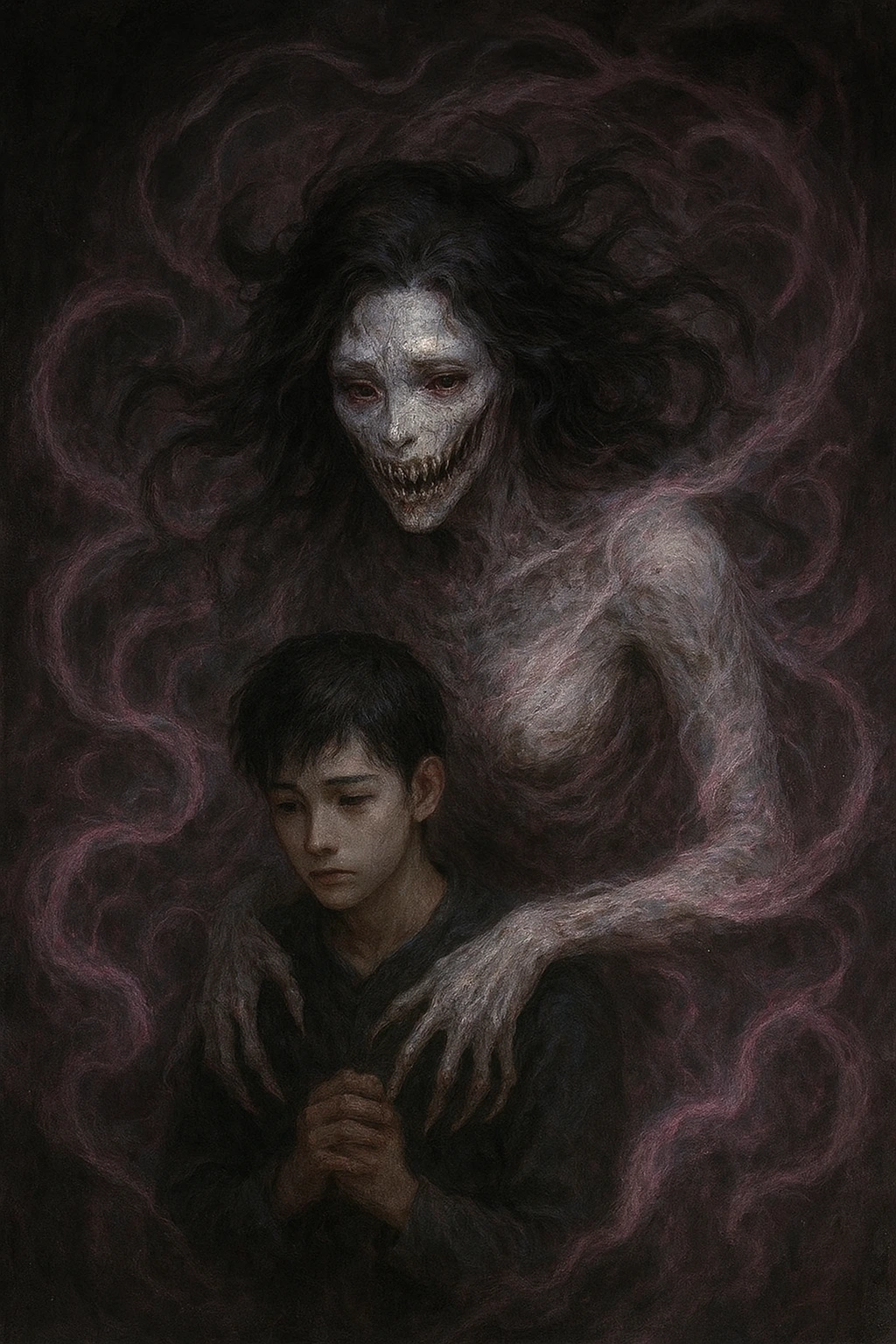
While fear fuels the cycle, Jujutsu Kaisen posits a controversial counter-thesis: Love is the most twisted curse of all.
JJK Volume 0: The Origin
The series begins with Yuta Okkotsu and Rika Orimoto. Rika did not become a Vengeful Spirit because she was evil; she became one because Yuta loved her too much to let her die. His refusal to accept her death bound her soul to the mortal plane, transforming an innocent girl into the “Queen of Curses.”
This establishes a terrifying precedent: Positive emotion (love), when possessive or unable to let go, creates negative outcomes (curses). Love in JJK is binding. It restricts freedom. It creates a “knot” in the flow of energy that can fester into something monstrous.
Sukuna’s Rejection of Love
Ryomen Sukuna stands as the antithesis to Yuta. Sukuna is the “King of Curses” not because he loves evil, but because he loves only himself. His philosophy is one of absolute solitude. He mocks Jogo and Yorozu for their reliance on others. To Sukuna, love is a weakness that dulls the blade. He compares humans to tastes—he eats when he is hungry, kills when he is annoyed.
Sukuna represents the ultimate liberation from the cycle. He doesn’t care about the balance, the Higher-Ups, or the future. He lives entirely in the moment, for his own pleasure. The series presents a dichotomy: The “Good” characters are burdened by love and connection, which makes them weak but human. The “Evil” characters (Sukuna) reject connection, making them strong but calamitous.
Megumi’s Burden
Megumi Fushiguro is perhaps the greatest victim of the Curse of Love. His entire motivation is the protection of his sister, Tsumiki. It is a noble goal, but it is this very attachment that Kenjaku exploits. By participating in the Culling Game to save her, Megumi plays right into Kenjaku’s hands, eventually leading to his possession by Sukuna.
The series suggests that while love gives sorcerers a reason to fight, it also gives them a vulnerability that the cycle will inevitably exploit. To love in the world of Jujutsu is to hand your enemy a knife and point it at your heart.
X. Conclusion: Is There an End?
As we analyze the overarching narrative of Jujutsu Kaisen, we move from a story about fighting monsters to a story about fighting the systemic inevitability of suffering.
The narrative arc has systematically dismantled every easy answer. You cannot punch your way out of the cycle (Gojo). You cannot commit genocide to end it (Geto). You cannot scientifically engineer a way out (Yuki). And you certainly shouldn’t merge humanity into a blob (Kenjaku). The “Golden Age” of the Heian era was not a time of peace, but a time of unbridled chaos, and the modern era was merely a stifling suppression of that chaos.
So, is there an end?
The “Infinite Cycle” implies that there isn’t. However, the story seems to suggest that the response to the cycle is what matters. The ending of the cycle might not be the elimination of curses, but the acceptance of death as a natural part of life, rather than something to be feared or fought with Cursed Energy.
If humanity can learn to process negative emotion without “leaking” it—through culture, connection, or acceptance—perhaps the curses will weaken. But as long as humans are human, there will be monsters in the dark. The job of the Sorcerer is not to build a utopia, but to stand in that darkness and hold the line, knowing full well that the sun might not rise for them. It is a bleak, Sisyphean task, but there is a profound beauty in the struggle. The “Cog” keeps turning, not because it expects to finish the job, but because turning is what keeps the machine from collapsing entirely.
XI. Frequently Asked Questions (FAQs)
Q1: What creates a Special Grade Curse? A Special Grade Curse is created by the accumulation of vast amounts of negative energy directed toward a singular, powerful concept. While a Grade 4 curse might come from the fear of a dog, a Special Grade comes from the fear of “The Forest” or “Plagues.” They require a collective, societal level of fear to manifest.
Q2: Why did Yuki Tsukumo want to remove Cursed Energy? Yuki believed that “treating the symptoms” (exorcising curses) was a waste of time. She wanted to cure the disease. She observed that Toji Fushiguro, who had zero Cursed Energy due to a Heavenly Restriction, did not leak energy and therefore did not contribute to the creation of curses. She believed evolving humanity into beings like Toji was the only path to true peace.
Q3: Was Geto right about non-sorcerers? Technically, yes, but morally, no. Geto was factually correct that non-sorcerers are the source of Cursed Spirits because they cannot control their energy leakage. However, his solution (genocide) is morally abhorrent. He identified the correct mechanical problem but applied the most evil solution possible.
Q4: How does Master Tengen affect the creation of curses? Tengen’s barrier techniques cover the entirety of Japan. These barriers improve the efficiency of Jujutsu techniques and protect the schools, but they also trap Cursed Energy within the country. This concentration creates a “greenhouse effect,” causing curses in Japan to be more frequent and more powerful than in the rest of the world.
Q5: What does Yuji mean by “I’m a Cog”? When Yuji calls himself a “Cog,” he is abandoning his desire for a “proper death” or a hero’s narrative. He accepts that he is part of a machine designed to destroy curses. It is a surrender of his individuality for the sake of his duty. He stops looking for meaning in the fight and accepts that the fight is the meaning.
Q6: What is the difference between a Curse and a Shikigami? A Cursed Spirit is formed from leaked negative energy and possesses its own will and malice. A Shikigami is a construct summoned and controlled by a sorcerer using their own Cursed Energy. While they may look similar, Shikigami are tools of the sorcerer, whereas Curses are independent entities born of human emotion.
Q7: Can a non-sorcerer become a sorcerer? Generally, no. Being a sorcerer is genetic; you are born with the capacity to manipulate Cursed Energy. However, Kenjaku bypassed this in the Culling Game by using Idle Transfiguration to alter the brains of non-sorcerers who had potential, awakening their latent abilities. This proved that the line between sorcerer and human is thinner than previously thought.