
I. Introduction: The Failure of the Zenin
In the brutal, stratified world of Jujutsu Kaisen, the Zenin Clan stands as a towering monument to tradition, power, and an archaic definition of worth. Alongside the Gojo and Kamo clans, they form the “Three Great Families,” dynasties descending from the Three Great Vengeful Spirits of Japanese legend. Their philosophy is etched into the very architecture of their estate and the minds of their children:
“If you are not a sorcerer, you are not a person.” To be born into the Zenin family is to be entered into a cruel lottery where Cursed Energy is the only currency. Those who possess high levels of energy and inherited techniques—like the Ten Shadows or Projection Sorcery—are treated as royalty; those who do not are treated as less than livestock.
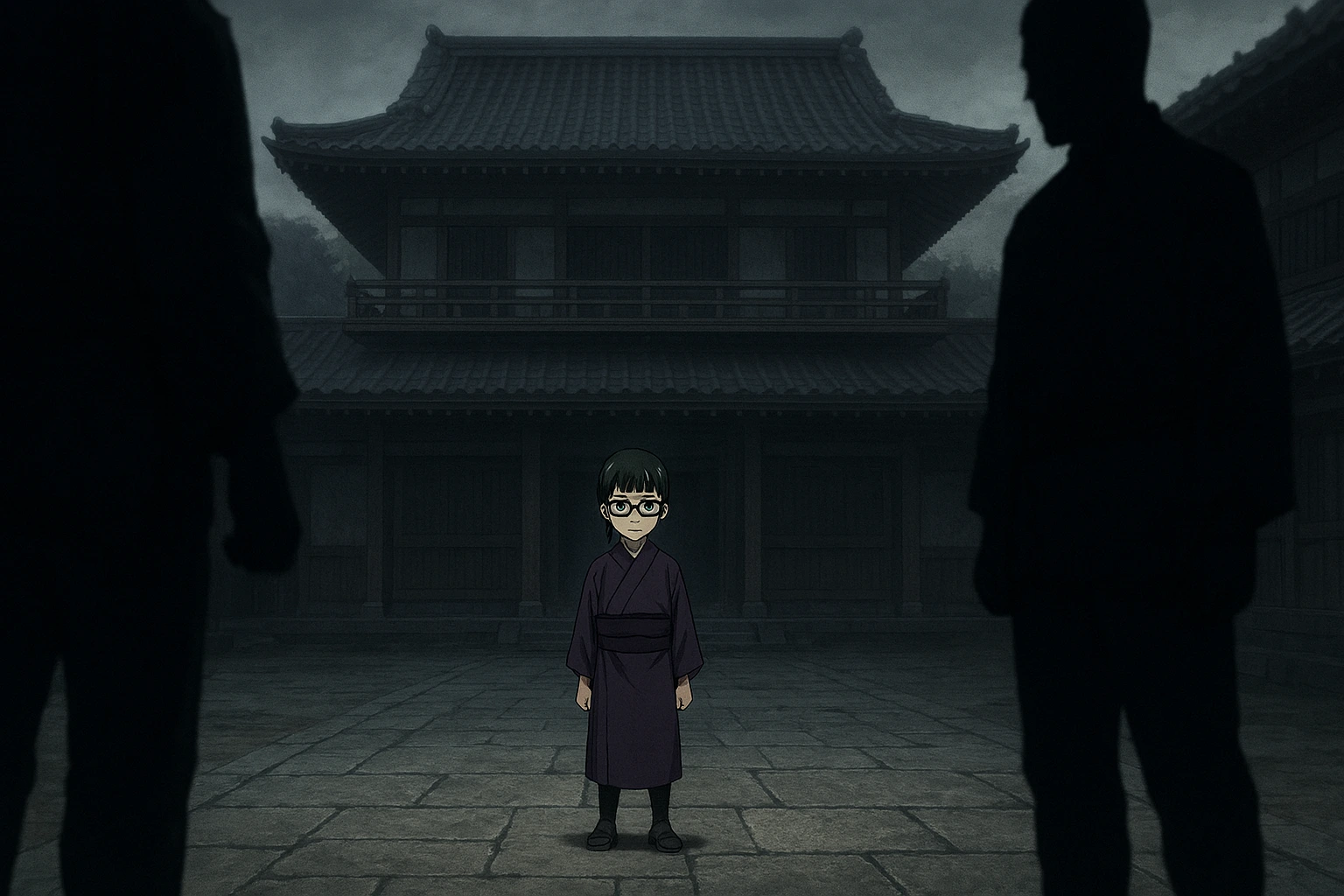
Maki Zenin was born at the absolute bottom of this hierarchy. Born without an innate technique and possessing barely enough Cursed Energy to see curses only through the aid of glasses, she was the living embodiment of the Zenin Clan’s “failure.” She was a stain on their pristine reputation, a walking reminder that their bloodline was not infallible.
Her father, Ogi Zenin, looked at her not with paternal love, but with political disdain. She was not a daughter; she was a hindrance to his ambition of becoming the Clan Head. He explicitly stated that his inability to rise to the rank of Clan Head was not due to his own lack of skill, but because of the “burden” of having failed children.
However, the Zenin Clan made a fatal miscalculation. They assumed that because Maki lacked the power to fit into their system, she lacked power entirely. They mistook non-conformity for weakness. They believed that by suppressing her, ostracizing her, and assigning her to the lowest of grunt work, they could break her spirit. Instead, they forged her in the fires of resentment.
Maki is the ultimate “system breaker” of the series. While other characters, like Megumi Fushiguro, represent the potential to change the Zenin Clan from within—perhaps by becoming a benevolent head and reforming their ways—Maki represents a far more radical and violent solution.
She did not seek to reform the rot; she sought to excise it. She didn’t want the throne; she wanted to burn the castle down. Her path was never about validation from the elders; it was about the utter dismantling of the structure that dared to judge her worth.
Her journey is one of the most compelling arcs in modern shonen manga because it subverts the typical underdog trope. Usually, the powerless character works hard to gain the same power as everyone else (like Naruto learning ninjutsu or Deku gaining One For All). Maki never gained “Jujutsu” in the traditional sense.
She didn’t unlock a secret technique or find a massive reservoir of magic. Instead, she leaned into what made her an outcast, stripping away every vestige of sorcery until she became something entirely different—something predatorily evolved to hunt sorcerers.
In this analysis, we will dissect the anatomy of a monster. We will explore the mechanics of her Heavenly Restriction, the tragic necessity of Mai’s sacrifice, the absolute catharsis of the Zenin Massacre, and her ascension to a realm of power previously occupied only by the Sorcerer Killer, Toji Fushiguro. This is the story of how a failure became a calamity.
II. Heavenly Restriction: Trading Magic for Might
To understand Maki’s power, one must first understand the rigid laws of the Jujutsu Kaisen universe, specifically the concept of Heavenly Restriction (Ten’yo Jubaku). In a world governed by “Binding Vows”—contracts made with Cursed Energy to gain power in exchange for sacrifice—Heavenly Restrictions are the ultimate, involuntary vows imposed at birth. The individual has no say in the matter. The universe simply takes something away and gives something else in return, creating a forced balance in the karmic scales of a sorcerer’s biology.
For Kokichi Muta (Mechamaru), the restriction was physical agony: a body missing limbs, skin so sensitive that moonlight burned it, and constant chronic pain. In exchange, he received immense Cursed Energy and range capable of covering the entire country of Japan. For Maki, the exchange was meant to be the exact opposite: the loss of Cursed Energy in exchange for physical prowess.
The Concept and the Glitch
The ideal Heavenly Restriction of this type creates a superhuman physical specimen. By reducing Cursed Energy to absolute zero, the body breaks the chains of fate that bind sorcerers. It grants immunity to barrier techniques (as barriers target Cursed Energy), heightened senses that border on precognition (the five senses perceiving the environment so acutely it mimics a sixth sense), and physical strength capable of shattering concrete and steel with bare hands.
However, for most of her life, Maki was “incomplete.” She was strong—far stronger than an average human—and durable enough to survive a point-blank blast from Jogo, a Special Grade curse, during the Shibuya Incident. But she wasn’t a phenomenon. She was just a very strong weapon user. She relied on Cursed Tools like the Playful Cloud and Dragon Bone to deal damage. The reason for this mediocrity lay in a cruel quirk of Jujutsu biology: she was a twin.
The Twins Paradox

In the metaphysics of Jujutsu, twins are considered a single soul split into two bodies. This spiritual connection acts as a lifeline, or rather, a shackle. The universe viewed Maki and her twin sister, Mai, as one entity. Even though they had separate bodies and minds, their “existence” in the eyes of Cursed Energy was shared.
Maki was born with a Heavenly Restriction that wanted to strip her of all Cursed Energy to gift her with immense physical power. However, Mai possessed Cursed Energy and an innate technique (Construction). Because they were spiritually one, as long as Mai held onto her Cursed Energy, Maki could never truly hit “zero.” The link between them acted as a reservoir; Mai’s energy leaked into Maki’s existence, rendering her Heavenly Restriction half-baked.
This tragedy is the core conflict of Maki’s early existence. She was trying to become a superhuman warrior while dragging the spiritual weight of her sister. Conversely, Mai, who never wanted to be a sorcerer and only wished to live a quiet life, was forced into the brutal world of Jujutsu because Maki left the clan. They were dragging each other down—Maki preventing Mai from being free of duty, and Mai preventing Maki from being free of weakness. It was a symbiotic curse: Maki’s ambition was killing Mai’s peace, and Mai’s existence was killing Maki’s potential.
Comparison: The Toji Threshold
The benchmark for Maki’s potential was always Toji Fushiguro (formerly Zenin). Toji was the only known case of a fully realized Heavenly Restriction. He had absolutely zero Cursed Energy. As a result, he was invisible to sensors, could bypass barriers effortlessly, and possessed physical stats that allowed him to brutalize Special Grade sorcerers like Gojo Satoru and Suguru Geto. Toji was the man who defeated the strongest sorcerers of his era not with magic, but with strategy, speed, and a gun.
For years, Maki was chasing Toji’s shadow. Characters like Yuki Tsukumo noted that Maki was “like him,” but definitively lesser. Where Toji was a force of nature—a chaotic anomaly that the world couldn’t track—Maki was merely a strong fighter. She was still “in the system.” She had just enough Cursed Energy to be detected by barriers and seen by sorcerers, but not enough to use techniques. It was the worst of both worlds. She had the disadvantages of a non-sorcerer (discrimination) and the disadvantages of a sorcerer (traceable energy) without the supreme benefits of either.
This distinction is vital. A “low Cursed Energy” user is still a sorcerer subject to the laws of Jujutsu. A “zero Cursed Energy” user is an error in the code of reality. Toji proved that a human could ascend to the level of a natural disaster purely through flesh and bone. Maki was stuck at the threshold, banging on the door, unable to enter that realm of absolute freedom until the Zenin Clan, in their arrogance, forced the door open.
III. The Awakening: “Destroy Everything”

The turning point of Maki’s life—and the death knell of the Zenin Clan—occurred in the grim, blood-stained wine cellar of the Zenin estate. This sequence is not just a training montage or a power-up; it is a horror story that transitions into a revenge tragedy. It is the moment the genre of her story shifted from “Sports Anime Underdog” to “Slasher Horror.”
The Scene
Following the Shibuya Incident, the Jujutsu world was in chaos. Maki returned to the Zenin household to retrieve cursed tools to aid in the Culling Game. She expected resistance, perhaps a fight, but she did not expect execution. Instead of cooperation, she found betrayal. Her father, Ogi Zenin, driven by a complex inferiority complex toward his brother (the former clan head) and hatred for his children, decided to execute both Maki and Mai.
The brutality of Ogi’s actions cannot be overstated. He struck down his own children with cold efficiency. He beat them, cast them into a pit filled with Grade 2 curses—spirits kept hungry specifically for executions—and left them to be devoured. It is the ultimate expression of the Zenin philosophy: use the weak as fodder. Ogi literally attempts to erase his “failures” to clear his path to power, believing that their death would prove his loyalty and competence to the rest of the clan.
The Sacrifice
In that pit, barely clinging to life, Mai makes the decision that defines the rest of the series. She realizes the truth of their connection. She understands that as long as she lives, Maki will always be half-formed. Mai, who always resented Maki for leaving her behind and trying to be strong, performs the ultimate act of love and spite.
She chooses to die.
By using her Construction technique one last time, she creates a weapon from nothing—sacrificing her life force to do so. Construction is a technique that uses Cursed Energy to create matter, but it is incredibly inefficient and taxing on the body. To create a permanent, Special Grade weapon requires everything she has. But the true gift isn’t the sword; it’s her death. By dying, she takes all the Cursed Energy they shared with her. She severs the link. She removes the “impurity” from Maki’s soul.
The Gift and The Command
The weapon Mai constructs is a replica of the Split Soul Katana, a cursed tool once wielded by Toji Fushiguro. But the physical object pales in comparison to the metaphysical change. As Mai fades away, leaving Maki holding her corpse, she imparts a final, chilling curse.
It isn’t a curse of malice toward Maki, but a directive. A Binding Vow of intent.
“Destroy everything.”
Mai didn’t say, “Kill Dad” or “Escape.” She said, “Destroy everything.” This included the clan, the system, the house, the ideology—everything that made them suffer. It was a scorching earth policy delivered with her dying breath.
In that moment, Maki the Student died. The girl who wanted to return as a high-ranking sorcerer to prove her family wrong ceased to exist. In her place stood a demon. When Maki opens her eyes, the Cursed Energy is gone. The curses in the room, which moments ago were terrifying threats, suddenly feel sluggish. Weak. The sensory overload of the world hits her—the sound of breathing, the shift of dust, the heartbeat of the insects.
Ogi Zenin, sensing the change from outside the pit, looks at his daughter as she emerges. For the first time in his life, he feels a primal fear he hasn’t felt in over a decade. He looks at Maki, but the face he sees superimposed over hers is Toji’s. The “monster” has returned.
IV. The Zenin Massacre: Absolute Catharsis
The sequence that follows, known as the “Perfect Preparation” arc or simply the Zenin Massacre, is one of the most violent and cathartic sequences in manga history. It is a dismantling of the patriarchy in the most literal, visceral sense possible. It represents the total collapse of an institution that stood for centuries, undone in a single afternoon by the one person they deemed worthless.
The Pacing of Extermination
The pacing of the massacre is deliberate. It is not a desperate struggle for survival. It is a slaughter. Gege Akutami illustrates this with a cold, detached precision. Maki moves with a fluidity and speed that the Zenin sorcerers cannot comprehend.
First is Ogi. The man who blamed his daughters for his own lack of success draws his sword, igniting it with his technique, “Blazing Courage.” He prepares his strongest stance, convinced that his “failure” of a daughter cannot withstand him. He screams about his superiority, about how the heavens denied him. Maki decapitates him in a single, horizontal slash. There is no speech, no hesitation, no clash of blades. She bisects her trauma at the source. She kills her father not as an act of passion, but as one would swat a fly—he was simply in the way.
The Hei Squad: Elite Fodder
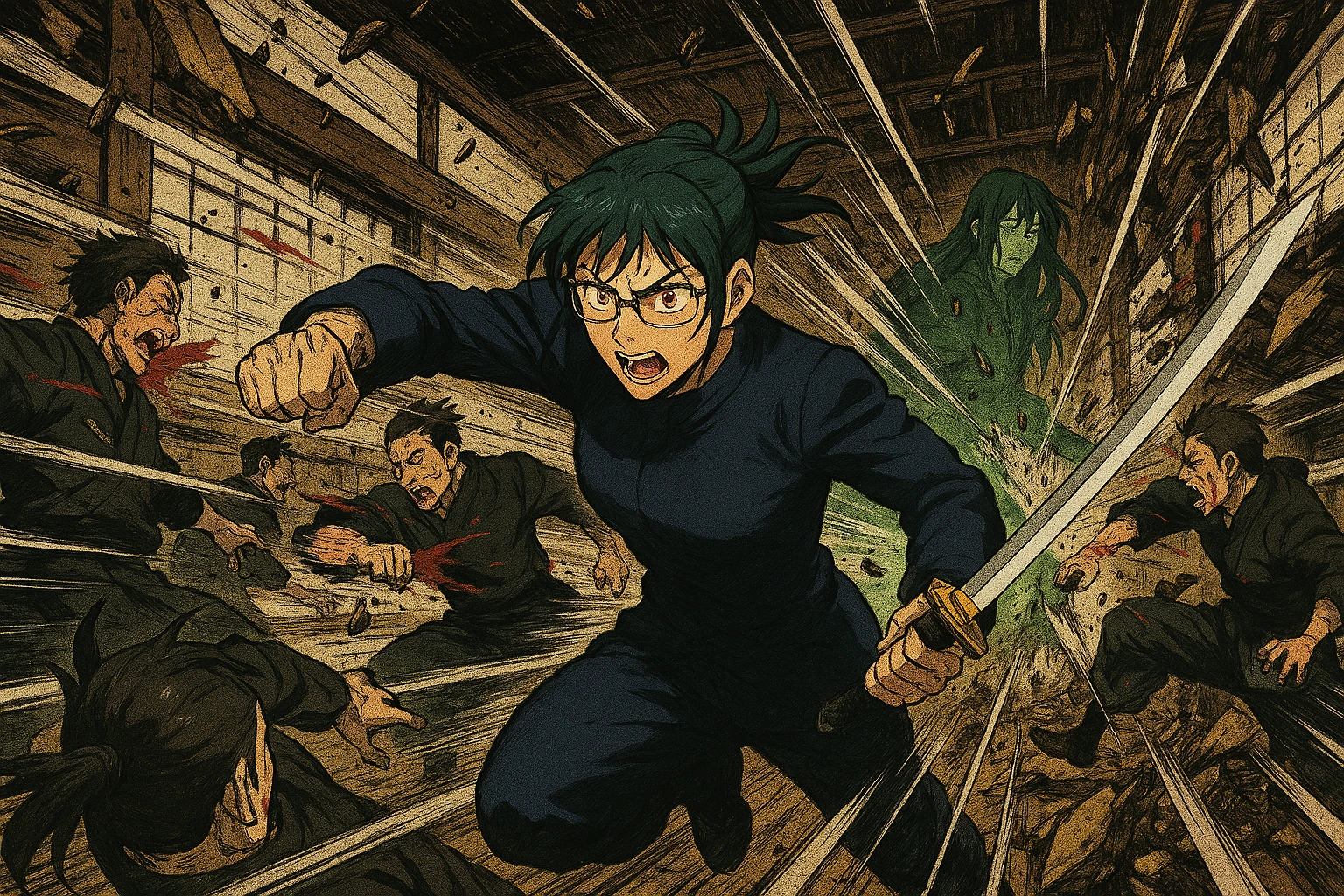
As she emerges from the pit, the Zenin Clan sends everything they have at her. They unleash the “Hei,” the elite squad of the clan, comprising Semi-Grade 1 and Grade 1 sorcerers. These are veterans, the pinnacle of what the Zenin system produces.
Maki tears through them like wet paper.
This section highlights the sheer difference in dimension between a Sorcerer and a Heavenly Restricted superhuman. The Hei try to use tactics, traps, and complex cursed techniques. Maki simply outruns their perception. She rips out throats with her bare hands. She breaks weapons. She moves through their ranks like a wolf in a sheep pen.
Notable interactions include her dismantling of the specific elite members:
- Chojuro Zenin: A master of earth manipulation who creates giant stone hands to crush opponents. Maki doesn’t dodge; she physically overpowers the construct, shattering the stone with raw strength that defies the logic of his technique.
- Ranta Zenin: Ranta possesses a powerful technique that uses his gaze to paralyze opponents. When he locks eyes with Maki, he attempts to freeze her in place to allow the others to strike. While it briefly works, Maki’s physical strength is so overwhelming that she forces her body to move through the paralysis. Ranta’s eyes literally burst from the strain of trying to hold her, screaming that she is “not human” before he dies.
- Jinichi Zenin: A high-ranking elder who unleashes a torrent of giant, missile-like fists. This is a callback to the type of overwhelming force that would crush a normal sorcerer. Maki responds not with a technique, but by decapitating him and tossing his head into the pond, a gruesome echo of how Toji handled his opponents.
Naoya Zenin: The Symbol of Misogyny
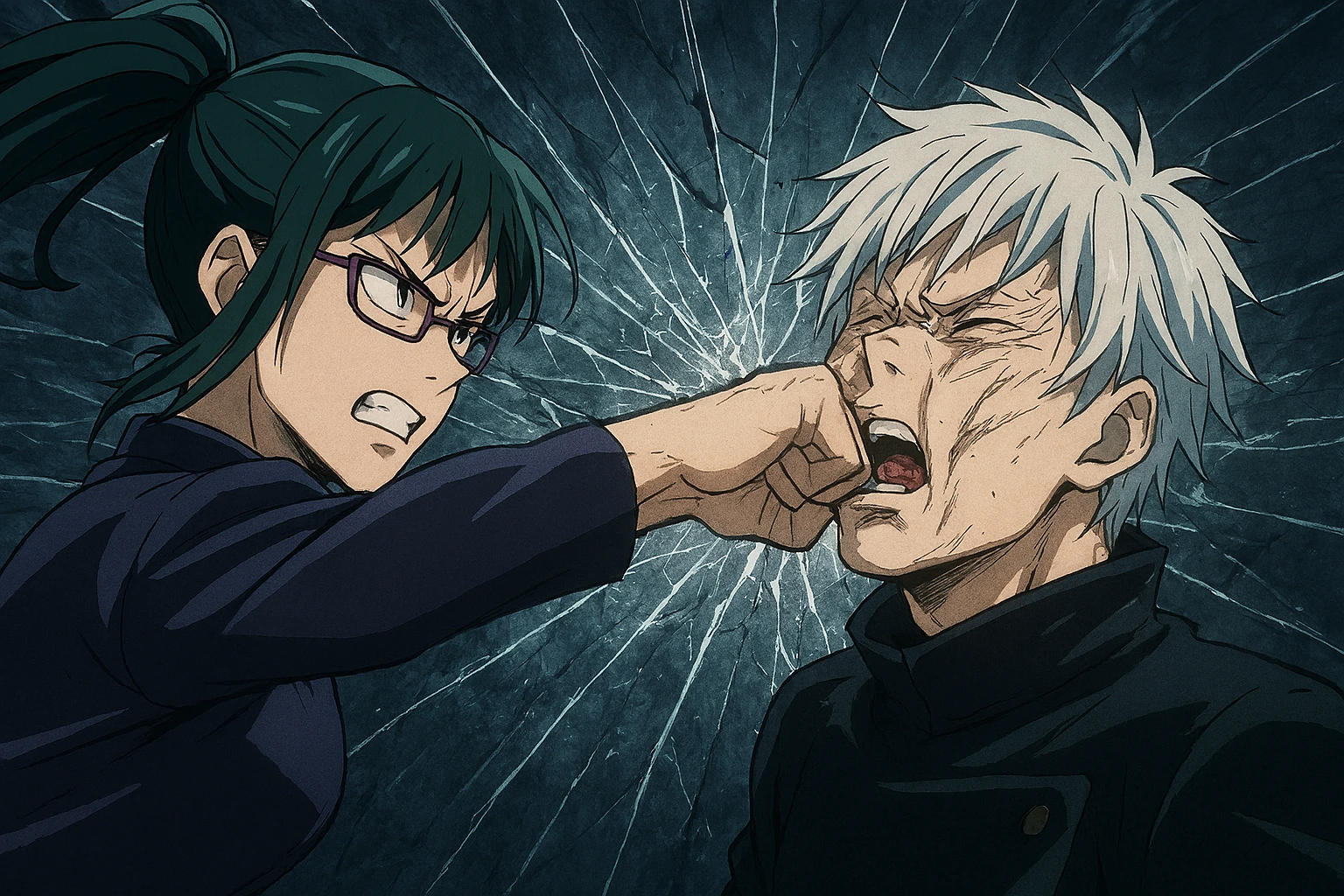
The climax of the massacre is the confrontation with Naoya Zenin. Naoya is the crystallization of everything wrong with the clan. He is arrogant, misogynistic, and obsessed with power. He idolized Toji for his strength but despised Maki for being a woman, unable to reconcile that a woman could hold the same power as his idol.
Naoya’s technique, Projection Sorcery, is one of the fastest in the series. It allows him to move at subsonic speeds by pre-determining his movements in 24 frames per second. If the opponent fails to follow the “24 FPS” rule, they are frozen in a frame for one second. He mocks Maki, calling her a fraud, convinced that speed determines the victor.
But Maki sees him. With her newly awakened senses, she can track his movements frame by frame. She understands the physics of his technique not through study, but through raw instinct. The fight ends not with a slash of a sword, but with a punch. Maki catches Naoya mid-movement—an impossible feat for a sorcerer—and delivers a devastating punch to his face, shattering his ego along with his facial structure.
Her line to him encapsulates her transformation: “I’m not an adult. I’m a monster.” She accepts the label the clan gave her and uses it to crush them. She realizes that playing by the rules of “adulthood” and “society” is what kept her weak. Embracing her monstrosity was the key to liberation.
Impact
By the time the sun sets, the Zenin Clan is effectively extinct. The grand estate is in ruins. The “Three Great Families” are reduced to two. Maki fulfills Mai’s curse completely. She doesn’t just kill the leaders; she kills the soldiers, the guards, and the elders. She destabilizes the entire political landscape of the Jujutsu world. She proves that a “monkey” (as Toji and Geto might say) can topple the gods of sorcery. The Zenin clan, which prided itself on 1000 years of Jujutsu history, was ended in one afternoon by a girl with no magic.
V. Sakurajima Colony: Becoming the Unequaled
Despite the massacre, Maki’s evolution was not finished. Gege Akutami masterfully shows that physical power is not the same as mastery. During the Culling Game, in the Sakurajima Colony, she faces a vengeful spirit version of Naoya Zenin. This cursed Naoya is faster, stronger, and more durable than his human form, having evolved into a literal jet turbine of cursed energy. And Maki begins to struggle.
The Wall
This arc is crucial because it addresses the nuance of Heavenly Restriction. Maki had the body of Toji, but she didn’t have the mind of Toji. She was physically gifted, but she was still fighting like a sorcerer—relying on sight, reacting to movements, and carrying the mental burden of her trauma. She was tense. She was overthinking. She was trying to satisfy the expectations of her dead sister and her comrades.
She realizes that even though she killed the clan, she is still comparing herself to them. She hasn’t achieved true freedom. She takes damage, she bleeds, and for a moment, it looks like Naoya might actually win.
The Sumo and The Katana
In one of the most bizarre yet philosophically profound sequences in Jujutsu Kaisen, Maki is mentored by two incarnated players who appear out of nowhere: Rokujushi Miyo (a sumo enthusiast) and Hagane Daido (a master swordsman without Cursed Energy).
These characters function as plot devices to highlight what Maki is missing.
- Miyo (The Sumo Wrestler): He casts a simple Domain: a sumo ring where time moves faster. He challenges Maki to sumo. This removes the distraction of “life or death” combat and strips it down to pure physical interaction. Through wrestling, he teaches her to get “out of her head.” He asks her, “Why are you so obsessed with the opponent?” He teaches her that she is too focused on the technique coming at her, ignoring the vastness of the world around her.
- Daido (The Swordsman): Daido picks up the Soul Split Katana—a weapon Maki couldn’t fully utilize—and wields it perfectly despite not being able to see the curse (Naoya). He teaches her that “seeing” isn’t just about eyes. He asks, “Is there a difference between the air and the sword?” He teaches her to sense the soul of everything, animate and inanimate.
The Realization
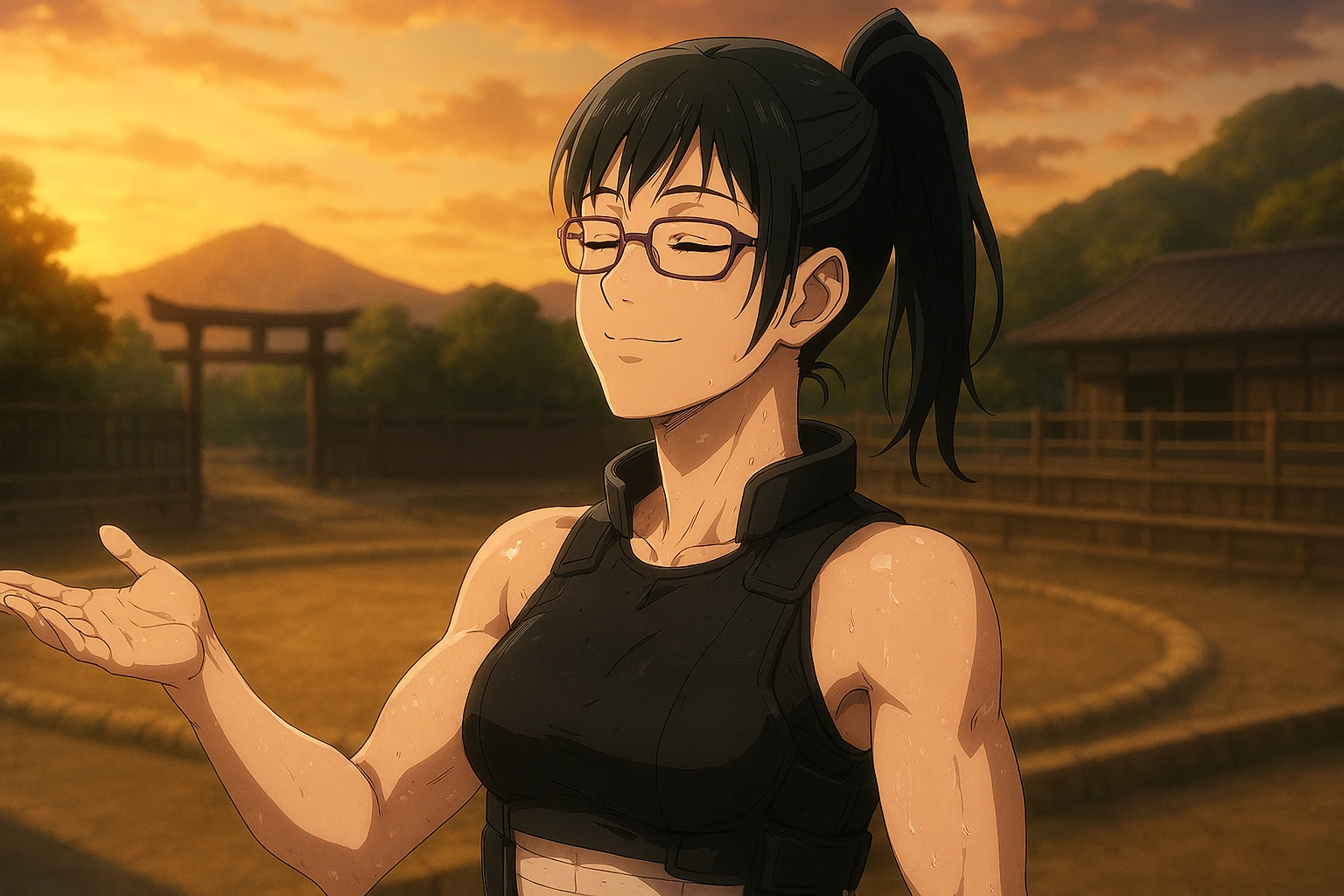
Maki has an epiphany inside the Sumo domain. Her Heavenly Restriction doesn’t just make her strong; it connects her to the physical world in a way sorcerers can never understand. Sorcerers are blinded by Cursed Energy. They focus on the “noise” of magic. They look for sparks of energy to predict attacks.
Maki realizes she can feel the density of the air. She can feel the temperature shifts. She can sense the “soul” of the inorganic matter—the ground, the wind, the light. By perceiving the inorganic world, the organic/cursed world becomes distinct by contrast.
She gains the ability to step on air by interacting with the density of the atmosphere. She gains a form of precognition by sensing changes in air pressure before an attack lands. She realizes that to be “free” like Toji, she must accept that she is part of the world, not fighting against it.
When she emerges from the Sumo domain, she is smiling. She is relaxed. She is no longer a warrior straining to win; she is a force of nature flowing through the battlefield. She exorcises Cursed Naoya effortlessly, dodging his mach-speed attacks without even looking, achieving the status of “The Unequaled.”
VI. The Soul Split Katana: Technical Analysis
Maki’s primary weapon, the Soul Split Katana (SSK), is integral to her threat level. Understanding this weapon helps explain why she is a threat even to the most durable characters in the series, including Ryomen Sukuna.
The Mechanic
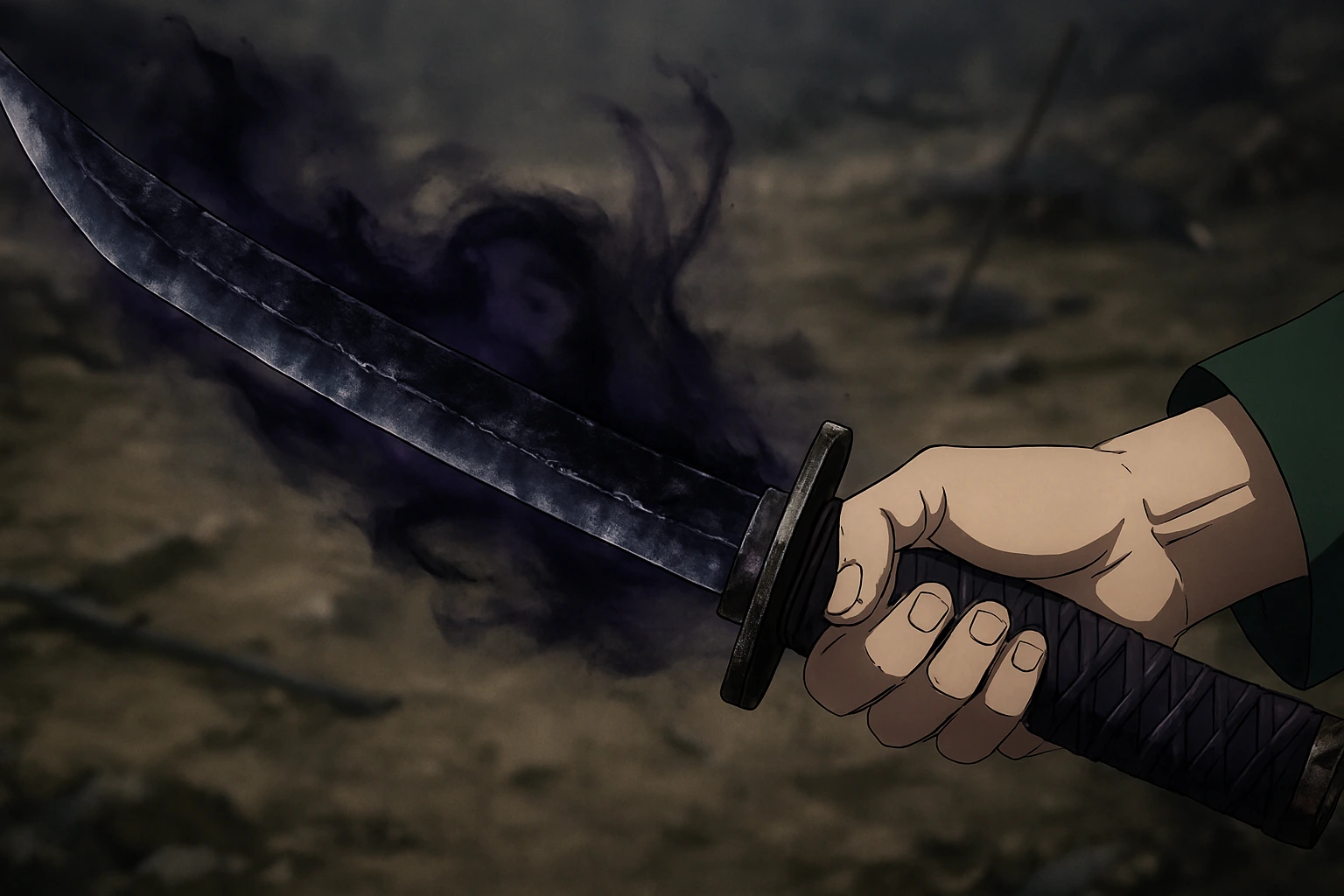
The Soul Split Katana ignores physical durability. In the world of Jujutsu Kaisen, sorcerers reinforce their bodies with Cursed Energy to tank attacks. Someone like Sukuna, Hanami, or Yuji Itadori has skin harder than diamonds because of this reinforcement. Conventional weapons, even high-grade cursed tools, would bounce off them.
The SSK bypasses this entirely. It does not cut the flesh; it targets the soul residing within the flesh. If the soul is severed, the body separates, regardless of how tough the physical exterior is. Physical regeneration (Reverse Cursed Technique) is also difficult against these wounds because the soul itself has been altered. Healing the body doesn’t fix the soul. To heal a wound from the SSK, one must be able to perceive the outline of their own soul—a feat extremely few sorcerers (like Sukuna) can achieve.
The Requirement
However, the sword has a high entry barrier. To use its durability-negation property, the wielder must be able to perceive the outlines of the soul. This is why Maki couldn’t use it effectively at first. She was swinging it like a sharp stick.
Only after her enlightenment in Sakurajima—where she learned to sense the “souls” of inanimate objects—did she unlock the sword’s true potential. By perceiving the soul of the air, the ground, and the opponent, she can guide the blade through the path of the soul. This allows her to cut through anything, from the hardest diamond to the most reinforced sorcerer, as if they were butter.
Toji’s Legacy
Wielding this sword completes the visual and thematic parallel to Toji. Toji used this weapon to bypass Gojo’s limitless durability (in theory) and Geto’s tough curses. By mastering it, Maki steps out of the role of “imitation” and becomes a peer. She is not just “like Toji”; she is the current era’s manifestation of the physical apex. She has inherited the ghost of the man who haunted the Zenin clan, and she wields his fang.
VII. The Role in Shinjuku: The Heavy Assassin
In the final arc, the Shinjuku Showdown against Ryomen Sukuna, Maki plays a role that no other sorcerer can fill. She is the “Heavy Assassin.” While Yuji Itadori and Yuta Okkotsu fight Sukuna head-on, engaging in a battle of Jujutsu, Maki operates on a different axis.
The Ambush
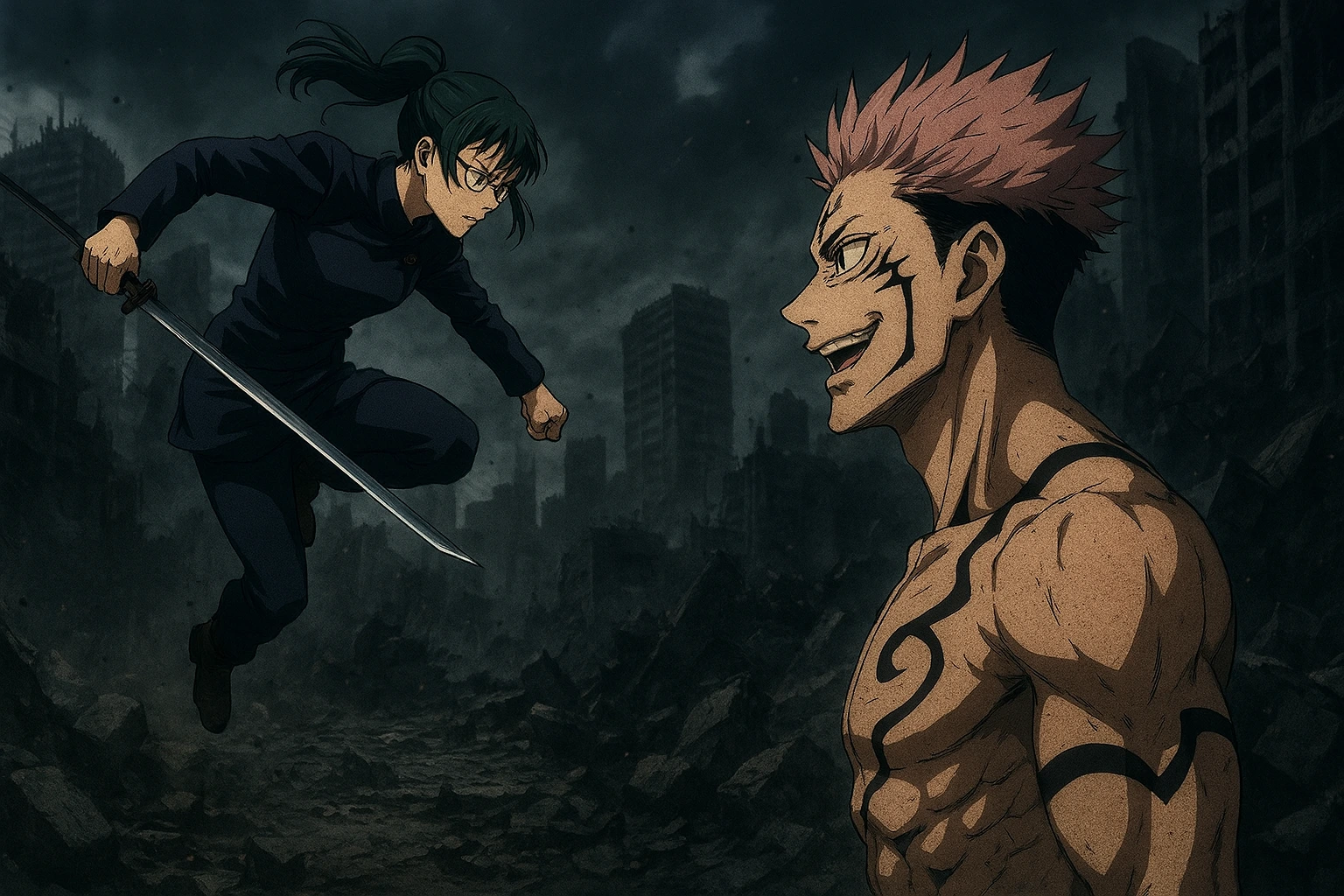
The sorcerers’ plan against Sukuna relies on heavy hitters to draw attention, but Maki is the ace in the hole. Because she has zero Cursed Energy, she is invisible to Sukuna’s sensing. He cannot feel her presence, her killing intent, or her energy buildup. To a sorcerer, she is indistinguishable from a building or a tree.
She is the only one who can truly ambush the King of Curses. Her entry into the battle—stabbing Sukuna through the chest from behind while he was distracted fighting Yuta—is proof of her unique utility. Anyone else would have been detected the moment they stepped into the barrier. Maki, however, is a hole in the barrier.
Sukuna’s Excitement
Interestingly, Sukuna finds a twisted joy in fighting Maki. Throughout the series, Sukuna is bored by sorcerers who rely on techniques he has seen for a thousand years. He dissects their magic, mocks their vows, and crushes them. But Maki represents a rejection of Jujutsu.
He views her as a test case: “Flesh and Bone vs. Sorcery.” He wants to see which is truly superior. During their duel, Sukuna enters a state of ecstasy, shouting that she is the one who will teach him about true strength. He even lands a Black Flash on her—a technique that multiplies impact power exponentially. A normal human would vaporize. A normal sorcerer would die. Maki, however, takes the hit, is sent flying through buildings, and simply comes back.
This durability feat is absurd. It confirms that her body is tough enough to withstand the strongest impacts in the verse. She forces Sukuna to try, to pump his heart manually (since she stabbed it), and to acknowledge her as a genuine threat. She strips him of his arrogance, forcing him to lock in. It is a battle of ideologies: Sukuna, the peak of Cursed Energy and selfishness, vs. Maki, the peak of Humanity and freedom.
VIII. Conclusion: The Phoenix
Maki Zenin’s story is a violent deconstruction of the “magical family” trope. She is not the chosen one; she is the rejected one who refused to disappear. She is the anomaly that proves the system was flawed from the start.
She burned down her past to build her future. The fire that consumed the Zenin estate was a funeral pyre for the old ways and a birthing fire for her new self. She sacrificed her humanity (in the eyes of sorcerers) to gain a power that transcends them. She lost her sister, her home, and her status, but she gained a self-defined identity.
Maki represents true freedom. She is unbound by Cursed Energy, unbound by fate, and unbound by family expectations. In a world where characters are crushed by the weight of their cursed techniques and lineages—where Gojo is burdened by being the Strongest, and Megumi is burdened by the Ten Shadows—Maki threw it all away. She stands on the battlefield not as a Zenin, but as Maki—a monster of her own making, walking on air, sword in hand, free.
As the narrator aptly put it: “She has truly become a monster.” And in the dark world of Jujutsu Kaisen, being a monster is the only way to be free.