
Introduction
The Walking Calamity: Defining Gigantomachia In the sprawling, superhuman-dominated society of Kohei Horikoshi’s My Hero Academia, villains are traditionally defined by their ideologies, their tragic backstories, or their specific, conceptual Quirks. However, Gigantomachia exists on an entirely different plane of narrative and physical existence.
To call Gigantomachia a “villain” is a fundamental misunderstanding of his nature; he is a biological weapon of mass destruction, a walking natural disaster, and an extinction-level event tethered only by his fanatical devotion to a single man. When Gigantomachia moves, the narrative genre of the series actively shifts from a superhero action story to a terrifying kaiju survival thriller.
He does not plot, he does not scheme, and he does not hold grand philosophical monologues about the state of hero society. He is the physical manifestation of All For One’s indomitable, oppressive will—a catastrophic force that treats cities as mere stepping stones and Pro Heroes as insignificant insects to be crushed beneath his gargantuan heel.
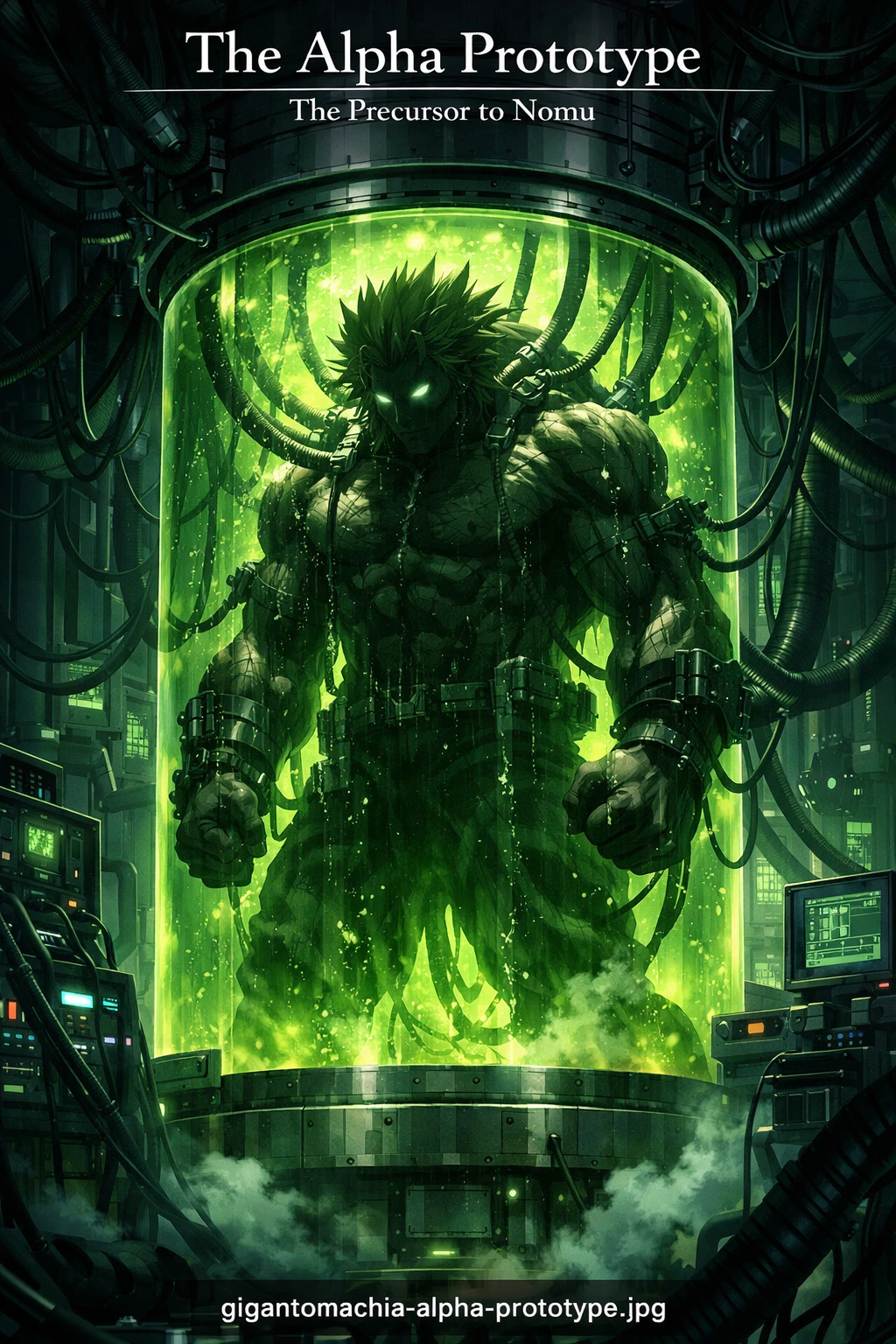
The Precursor to Nomu To truly understand the biological terror of Gigantomachia, one must look at the dark scientific underbelly of the series, specifically the work of Dr. Kyudai Garaki. Long before the creation of the brainless, shock-absorbing Nomu that assaulted the USJ, and years prior to the development of the sophisticated, regenerating High-End Nomu, there was the alpha prototype.
Gigantomachia stands as Dr. Garaki’s earliest and arguably most successful experiment in pushing the boundaries of human biology. The primary obstacle in the My Hero Academia universe regarding multiple Quirks is the physiological toll they take on the human brain and nervous system—a phenomenon tied closely to the Quirk Singularity Doomsday Theory.
Holding multiple Quirks usually results in the user becoming a mindless, comatose husk. Gigantomachia is the horrifying exception. He is the prime specimen, a living human successfully modified to harbor an arsenal of Quirks without his brain melting or his body decaying, serving as the grim proof-of-concept for everything the League of Villains would later unleash.
Article Scope This article serves as the definitive, expert-level breakdown of Gigantomachia. We will move far beyond surface-level observations to perform an anatomical, psychological, and tactical autopsy of this walking behemoth.
This scope will encompass a rigorous analysis of his unprecedented baseline biology, a mechanical breakdown of how his seven distinct Quirks synergize to render him virtually immortal, and a deep psychological profiling of his master-servant conditioning.
Furthermore, we will dissect his most defining battles—from his month-long subjugation of the League of Villains to his apocalyptic march through Jaku City—culminating in the brilliant, desperate strategies required to finally bring the giant to his knees.
The Prime Specimen (The Alpha Hardware)
The Biological Anomaly Why did Gigantomachia succeed where countless early Nomu experiments failed? The answer lies not in the genius of Dr. Garaki’s science, but in the sheer, unprecedented genetic anomaly of Gigantomachia’s original human body.
In the realm of computer science, one cannot install an incredibly demanding, next-generation software program onto a decaying, obsolete computer without crashing the system. Quirks are the “Software,” and the human body is the “Hardware.” Most humans possess hardware designed to run exactly one Quirk.
When All For One forcibly inserted multiple Quirks into ordinary people, their hardware shattered. Gigantomachia, however, was born with a baseline physiology of unparalleled stamina, vitality, and durability. His natural biology was a supercomputer.
This inherent, freakish constitution made him the absolute perfect vessel. Before a single artificial Quirk was ever given to him by All For One, his body was already capable of withstanding catastrophic levels of physical stress, making him a one-in-a-billion biological lottery winner that the villainous underworld capitalized on.
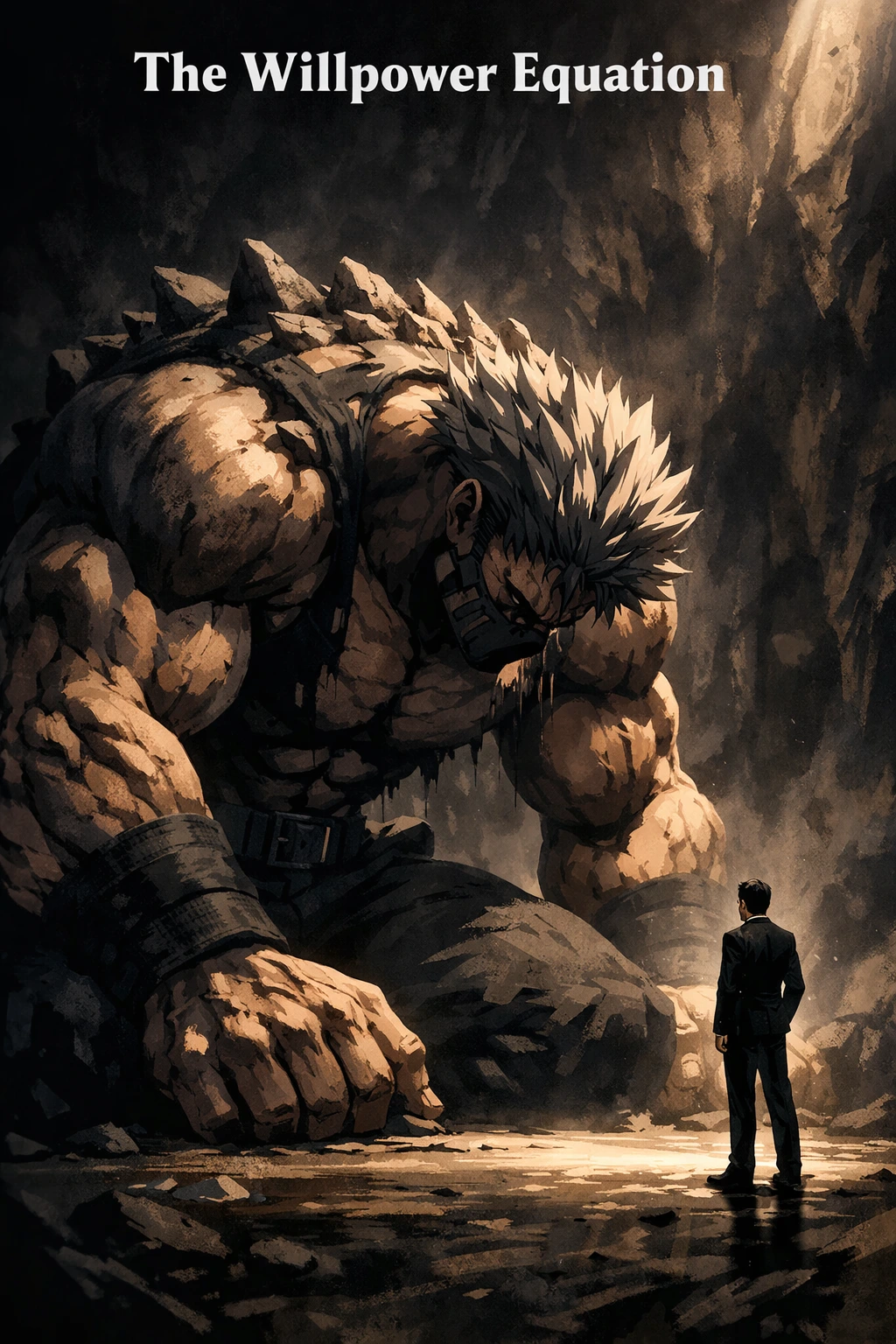
The Willpower Equation The most critical and fascinating difference between Gigantomachia and a top-tier High-End Nomu like Hood or Woman is the mechanism of their survival and operation. High-End Nomu require extreme bio-engineering, extensive brain surgery, and essentially a complete wipe of their original consciousness to function.
They are reanimated corpses programmed with combat instincts. Gigantomachia is alive. His brain was not wiped, nor was it replaced with artificial programming. The staggering, almost incomprehensible reality of his existence is that his ability to handle the extreme neurological load of multiple Quirks is sustained almost entirely by his sheer, fanatic willpower.
His absolute devotion to All For One acts as a mental anchor. Where a normal person’s mind would fracture under the strain of housing seven distinct genetic abilities, Machia’s mind remains whole because it is singularly, obsessively focused on a single directive: serve the Lord. His willpower is so potent that it transcends psychological motivation and acts as a physiological stabilizer.
The Preservation of Personality Perhaps the most disturbing aspect of Dr. Garaki’s alpha masterpiece is the deliberate preservation of Machia’s personality. He is not a silent, unfeeling golem. He cries, he screams, he mourns, and he speaks.
He experiences extreme emotional highs and agonizing emotional lows. From a clinical perspective, retaining such strong emotional capacity might seem like a liability in a weapon. However, in Machia’s case, it is a masterstroke of design. His emotional core acts as the primary engine for his physical power. Rather than hindering his combat effectiveness, his ability to feel extreme devotion, crippling sorrow, or furious rage actually bolsters his strength.
His biology is intrinsically linked to his emotional state; the more he feels, the more unstoppable he becomes. This creates a terrifying dynamic where attacking him physically is useless, and attacking him emotionally only serves to trigger his secondary Quirk mutations, feeding the very beast the heroes are trying to slay.
The Arsenal of the Behemoth (Seven Quirks)
Endurance & Energy Saver To understand the tactical nightmare of engaging Gigantomachia, one must systematically break down his arsenal of Quirks, beginning with the foundational pillars: Endurance and Energy Saver.
These are not flashy, destructive abilities, but they are the core reason he is unbeatable in a war of attrition. “Endurance” allows him to process physical and mental trauma at a fraction of the normal cost, while “Energy Saver” dramatically reduces his body’s need for vital resources like oxygen, hydration, and caloric intake. Together, these Quirks form a bio-feedback loop that is powered directly by his morale.
As long as he believes he is serving his master, he converts loyalty into physical stamina. This allows him to operate at maximum physical output for over 720 hours—a full, uninterrupted month—with almost zero sleep, food, or water. In a superhero society where most Pro Heroes suffer from stamina depletion after a few hours of high-intensity combat, Machia’s ability to simply outlast any opponent renders traditional combat strategies entirely obsolete.
Fierce Gains & Gigantification While his foundational Quirks keep him moving, “Fierce Gains” and “Gigantification” make him a physical god on the battlefield. “Gigantification” allows his base form to expand to the size of a skyscraper, granting him immense kinetic weight and leverage. However, it is the synergy with “Fierce Gains” that makes this combination lethal.
Fierce Gains causes his muscles and skin to naturally harden and expand in direct proportion to the level of physical stress, damage, or emotional excitement he is experiencing. This means that as heroes strike him, their attacks act as a catalyst to make him larger, denser, and more durable. It is a terrifying escalation mechanic.
Conventional blunt force trauma, piercing attacks, and even extreme heat or cold simply trigger his body to build a thicker, impenetrable callous. Striking Gigantomachia is akin to feeding oxygen to a fire; the harder the heroes fight him, the more invulnerable he becomes.
Pain Blocker Adding to this impenetrable defense is “Pain Blocker,” a Quirk that serves a deeply specific, terrifying purpose: the removal of biological limiters. In a standard human, pain is a necessary evolutionary mechanism; it tells the brain that the body is taking damage, forcing the organism to retreat before lethal trauma occurs.
Pain Blocker severs this communication between the nervous system and the brain. Attacks that successfully bypass his hardened skin and should mathematically cripple his organs, shatter his bones, or sever his tendons do not even register in his consciousness.
He does not flinch. He does not slow down. This Quirk allows him to push his already titanic body far beyond the tearing point of normal muscle tissue, utilizing 100% of his physical output even while actively sustaining structural damage, turning him into an unfeeling juggernaut.
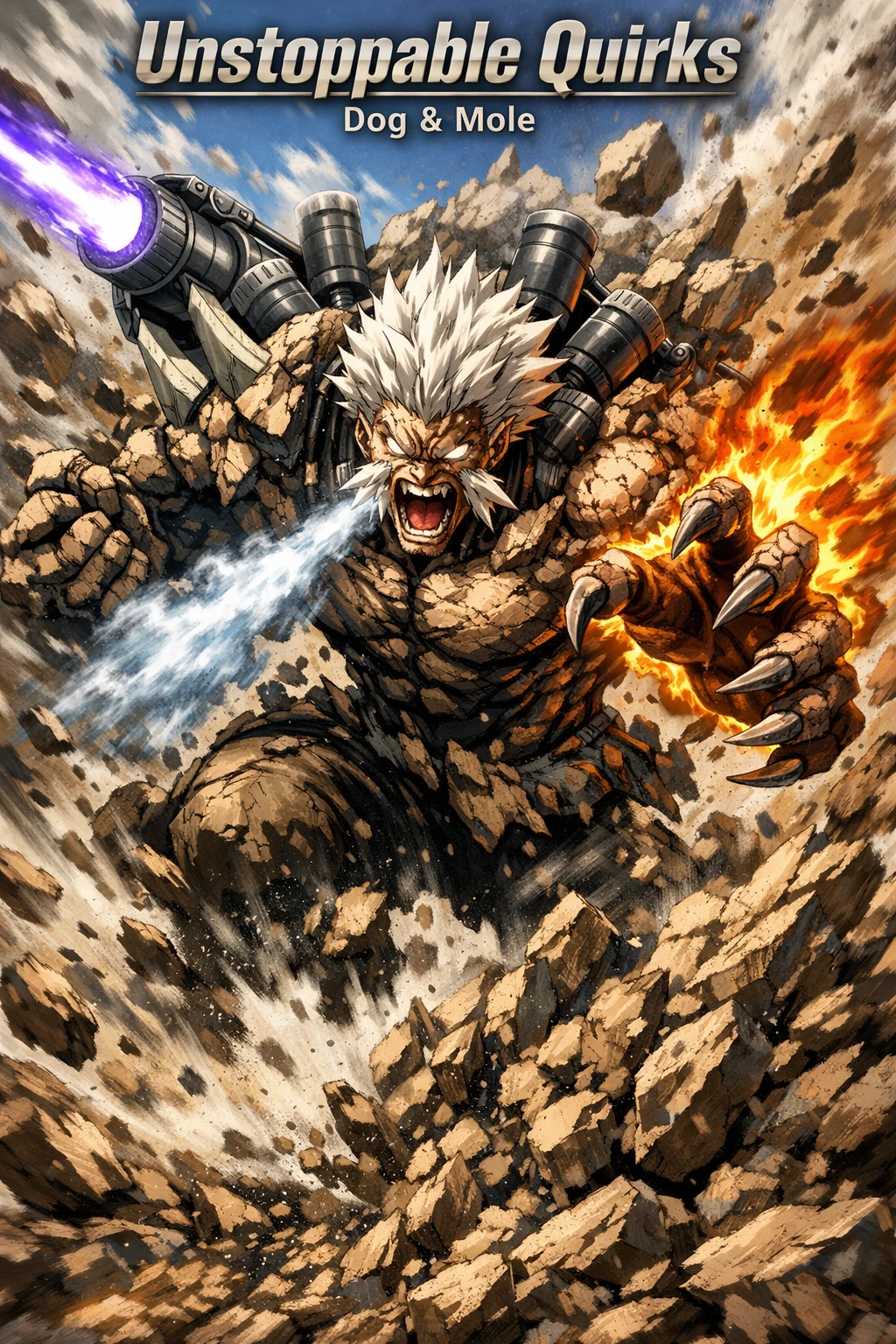
Dog & Mole Finally, the Quirks “Dog” and “Mole” transition Gigantomachia from a stationary fortress into an inescapable, continent-spanning apex predator. “Dog” grants him a hyper-enhanced, multifaceted sense of smell and hearing. This is not merely the ability to track a scent; it is the ability to lock onto the specific genetic and pheromonal signature of his master, or his targets, from hundreds of miles away, through shifting weather patterns and urban pollution.
Once he has the scent, “Mole” provides the terrifying mobility required to close the distance. Mole allows him to instantly project physical force to burrow through solid bedrock, concrete, and soil as easily as a human swims through water. This turns the very terrain of the earth into his personal weapon. He can ambush from beneath the ground, destabilize the foundations of entire cities to trap his enemies, and travel vast distances without ever being spotted by aerial surveillance.
The Psychology of Absolute Subjugation
The Master-Servant Complex To analyze Gigantomachia strictly through the lens of his physical Quirks is to ignore the true horror of his existence: his mental architecture. His psychology is a profound study in absolute, unbreakable subjugation.
Gigantomachia views the world through a terrifyingly simple, binary lens. In his reality, there are only two classifications of matter. First, there is the “Lord”—All For One, the master, the creator, the singular entity worthy of love, obedience, and reverence. Second, there is “dust”—literally everything and everyone else in existence.
Pro Heroes, civilians, buildings, mountains, and even other members of the League of Villains are categorized as irrelevant obstacles. He does not kill out of malice or sadism; he kills because wiping away dust is a necessary chore to reach his master. This complete lack of empathy or moral compass, combined with his immense power, makes reasoning with him an absolute impossibility.
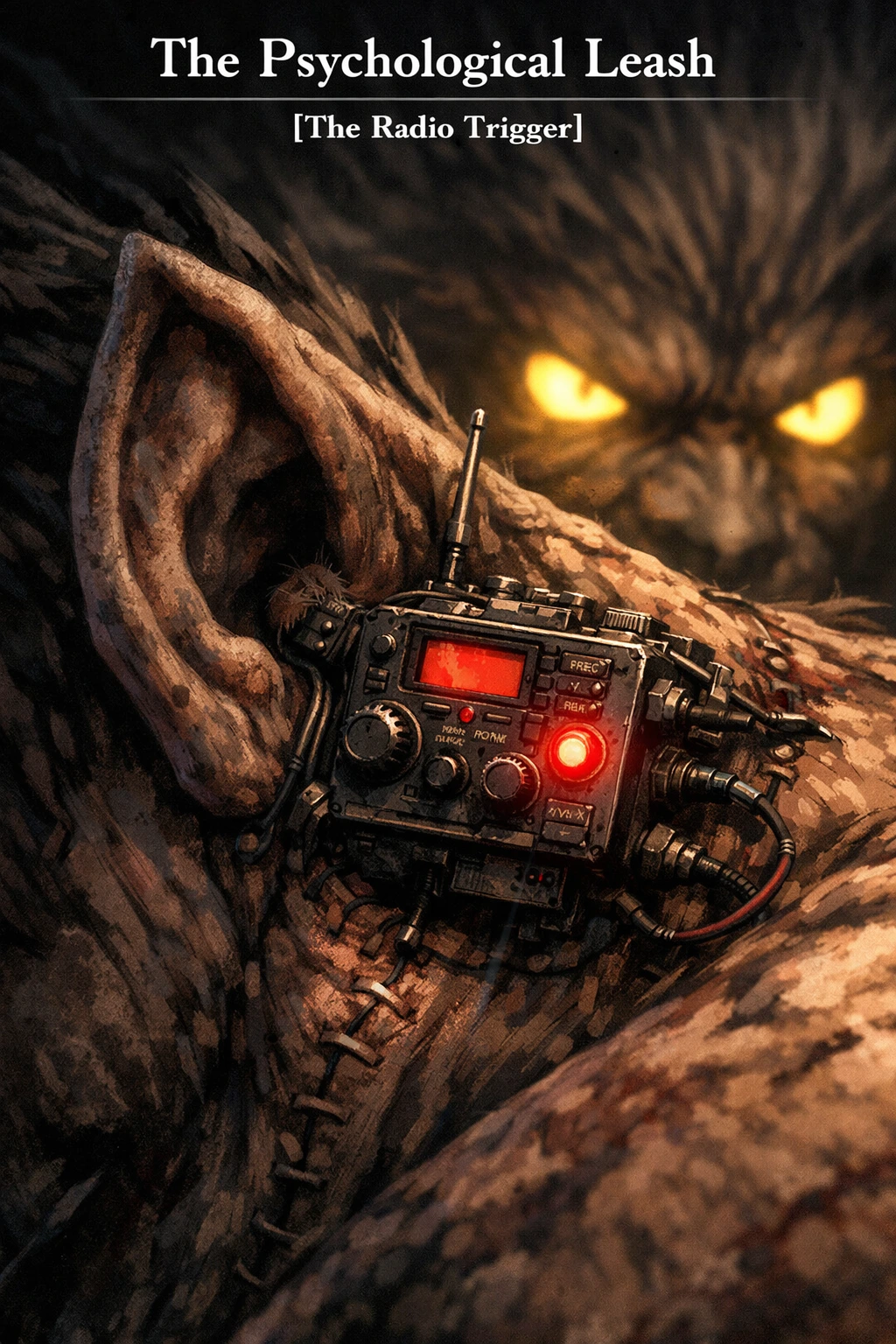
The Radio Trigger The psychological conditioning instilled by All For One is so deeply rooted in Machia’s cerebral cortex that it borders on Pavlovian conditioning taken to a superhuman extreme. The primary mechanism of this control is the “Radio Trigger”—the auditory conditioning linked directly to All For One’s voice. Machia carries a specialized radio receiver embedded into his form.
The mere frequency, cadence, and tone of his master’s voice act as an instantaneous override command. This trigger bypasses all logical thought processes. Hearing that voice can wake Machia from a deep, drug-induced coma, snap him out of a blind, destructive rage, or instantly halt his movements mid-strike. It is a master switch built directly into a biological weapon, proving that All For One designed him not just to be strong, but to be the ultimate, obedient attack dog, tethered entirely to an acoustic leash.
The Despair of Abandonment Beneath the impenetrable skin and the terrifying Quirks lies a deeply tragic psychological flaw: the crushing despair of abandonment. Following the fall of All For One at Kamino Ward, Gigantomachia was left without orders.
The result was not a rampage, but a profound, pathetic sorrow. He spent years hiding deep within the mountainous regions of Japan, literally weeping over the loss of his master. This reveals the psychological toll of his conditioning; without the “Lord,” he has no purpose, no identity, and no reason to exist. This profound grief directly fueled his initial, violently hostile rejection of Tomura Shigaraki.
When Dr. Garaki introduced Shigaraki as the successor, Machia saw only a fragile, weak, unworthy child trying to sit on a throne that belonged to a god. His hatred for Shigaraki was born purely from the heartbreak of being left behind, setting the stage for one of the most grueling trials in the series.
The Trial of the King (My Villain Academia)
The Unwinnable Fight The My Villain Academia arc presents a narrative masterclass in scaling, showcasing Gigantomachia not as a hero’s obstacle, but as a seemingly insurmountable wall for the villains themselves. To earn Machia’s submission and inherit All For One’s empire, Tomura Shigaraki and the League of Villains were forced into an unwinnable fight.
For a full month, they engaged in a brutal, cyclical war of attrition against the behemoth. The conditions were nightmarish: Machia would attack relentlessly for exactly 48 hours, sleep for precisely 3 hours, and then resume the slaughter.
He required no food, no rest, and showed absolutely no signs of fatigue. The League, comprised of standard human beings with human limitations, were pushed to the absolute brink of starvation, exhaustion, and psychological collapse. It was a visceral demonstration of Machia’s “Endurance” Quirk in action, proving that he could outlast an entire team of elite Quirk users without ever breaking a sweat.
The Tactical Nightmare Fighting Gigantomachia forced a fundamental, painful evolution within the League of Villains. Prior to this trial, the League operated as a chaotic group of individualistic murderers and outcasts who occasionally happened to attack the same target. Machia’s sheer scale and power rendered individual combat entirely useless.
Dabi’s flames could not burn through his hardened skin; Compress could not get close enough to touch him; Toga’s knives were like mosquito bites. To survive the 48-hour intervals, the League was forced to abandon their selfish tactics and learn to fight as a synchronized, highly coordinated unit.
They had to learn to cover each other’s blind spots, chain their Quirks together for defensive maneuvering, and rely on each other for survival. Ironically, in his attempt to crush them for their weakness, Gigantomachia served as the ultimate drill sergeant, forging the disparate members of the League into a hardened, unified military vanguard.
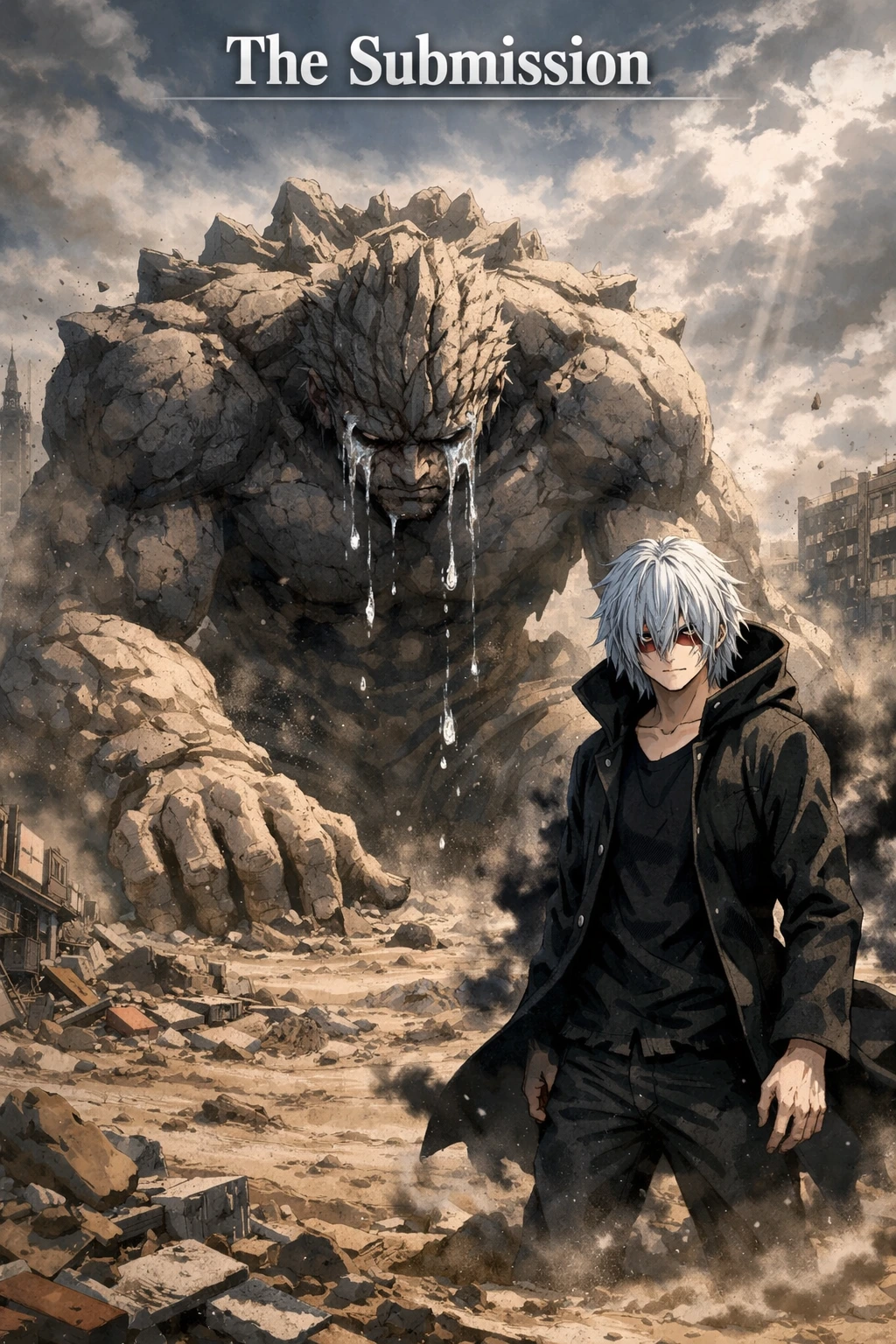
The Submission The climax of this grueling trial, and the exact moment Gigantomachia’s will was finally broken, occurred during the chaotic climax of the Deika City war against the Meta Liberation Army. Exhausted, bleeding, and pushed beyond his absolute limits, Tomura Shigaraki experienced a Quirk Awakening.
His ‘Decay’ ability evolved, shedding its limitations and allowing him to disintegrate entire city blocks with a mere touch of the ground. When Gigantomachia arrived on the scene, he witnessed a breathtaking display of pure, unadulterated destruction that mirrored the apocalyptic presence of All For One. Shigaraki no longer looked like a fragile successor; he radiated the sheer, oppressive aura of a tyrant.
Watching Shigaraki stand amidst the turning dust of a fallen city, Machia wept tears of profound joy. In that fraction of a second, the beast recognized the sheer weight of Shigaraki’s power. He dropped to his knees in the rubble, bowing his colossal head. The “King” had finally returned, and the ultimate weapon was now in Shigaraki’s hands.
The Jaku City March (The Unstoppable Force)
The Directive The horrifying potential of Gigantomachia was fully unleashed during the Paranormal Liberation War arc, specifically the Jaku City March. The moment Shigaraki awoke from his own agonizing biological enhancement, his first act was to issue a single, telepathic/radio directive to his loyal servant. The activation of this command birthed one of the most terrifying sequences in modern shonen manga.
Waking from his slumber, Machia expanded to his maximum size, loaded the remaining members of the League onto his broad back, and began a dead sprint across the Japanese countryside. The sheer terror of a 100-foot-tall, multi-Quirk monster running at top speed toward a highly populated urban center shifted the tone of the war entirely. It was no longer a battle of ideals; it was a desperate race to stop an unstoppable, kinetic asteroid before it hit the mainland.
The Failure of the Pros The true horror of the Jaku City March was the systematic, effortless failure of the top-ranked Pro Heroes to halt his momentum. This was a tactical breakdown on a spectacular scale. The heroes attempted to treat him as a conventional threat. Mt. Lady, utilizing her own gigantification Quirk to match his size, attempted to physically grapple him.
She was brutally overpowered, dragged through the dirt, and ultimately thrown aside, proving that size without Machia’s dense, Quirk-enhanced musculature was useless. Kamui Woods attempted to bind him in impenetrable timber, only to have his wood instantly snapped by Machia’s sheer kinetic velocity.
Even the R-Rated Hero: Midnight, attempting a desperate aerial drop to expose him to her atmospheric sleep gas, was swatted out of the sky by a casual flick of debris, leading to her tragic death. The heroes failed because they could not comprehend that they were fighting a creature whose very biology negated blunt force, binding, and standard combat tactics.
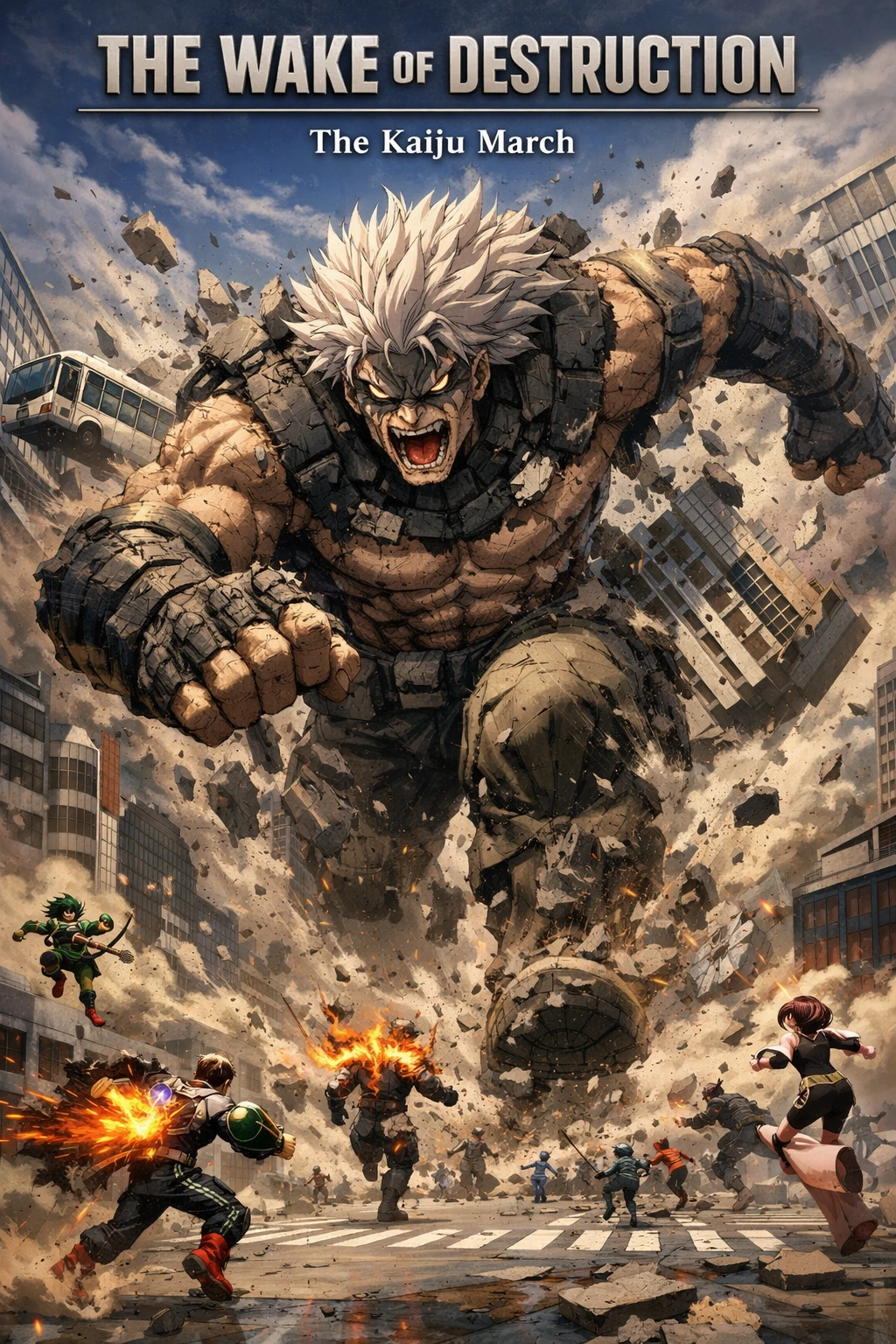
The Wake of Destruction The geographical, geopolitical, and civilian cost of Gigantomachia’s march cannot be overstated. As he carved his path toward Shigaraki, he did not politely step around infrastructure; he moved in a perfectly straight line. He essentially erased multiple cities from the map in a matter of minutes.
Forests were uprooted, mountainsides were pulverized, and massive urban centers were flattened into plains of debris. The wake of his destruction left thousands of civilians dead or homeless and completely shattered the public’s faith in hero society.
The heroes were meant to be an impenetrable shield, but Machia walked through them as if they were wet tissue paper. This specific event fundamentally altered the narrative of My Hero Academia; it demonstrated that the villains possessed a nuclear option, and that the age of brightly colored heroes saving the day with a smile was officially dead and buried beneath the rubble of Machia’s footprints.
The Sedation Strategy (The U.A. Students’ Triumph)
Brain vs. Brawn With the top Pro Heroes either incapacitated, dead, or desperately trying to evacuate civilians, the task of stopping the apocalypse fell to the students of U.A. High School’s Class 1-A and 1-B. Their eventual triumph is a testament to tactical adaptability.
Where the seasoned Pro Heroes failed by trying to match Machia’s brawn with their own, the students realized instantly that a physical victory was mathematically impossible. They stopped treating Gigantomachia as a combatant to be defeated and started treating him as a biological puzzle to be solved.
They recognized that his exterior—fortified by ‘Fierce Gains’ and ‘Gigantification’—was an impenetrable fortress. To bring down the fortress, they had to bypass the walls entirely and attack the vulnerable systems inside.
The Inside-Out Method The tactical brilliance of the sedation strategy was spearheaded by the intellect of Momo Yaoyorozu. Using her Creation Quirk, she rapidly synthesized vast quantities of an incredibly potent, un-diluted liquid sedative.
The plan was terrifyingly simple but required flawless execution: if his skin cannot be pierced by needles or blades, the sedative must be introduced directly into his mucosal lining and digestive tract. The students essentially created a gauntlet of traps, explosions, and visual distractions, not to damage him, but to force him to open his massive mouth.
It was an “inside-out” method of attack. By sacrificing themselves, taking massive hits, and utilizing extreme coordination, Mina Ashido and Eijiro Kirishima managed to throw the concentrated vials of sedative directly down the beast’s throat, bypassing all of All For One’s external defense modifications.
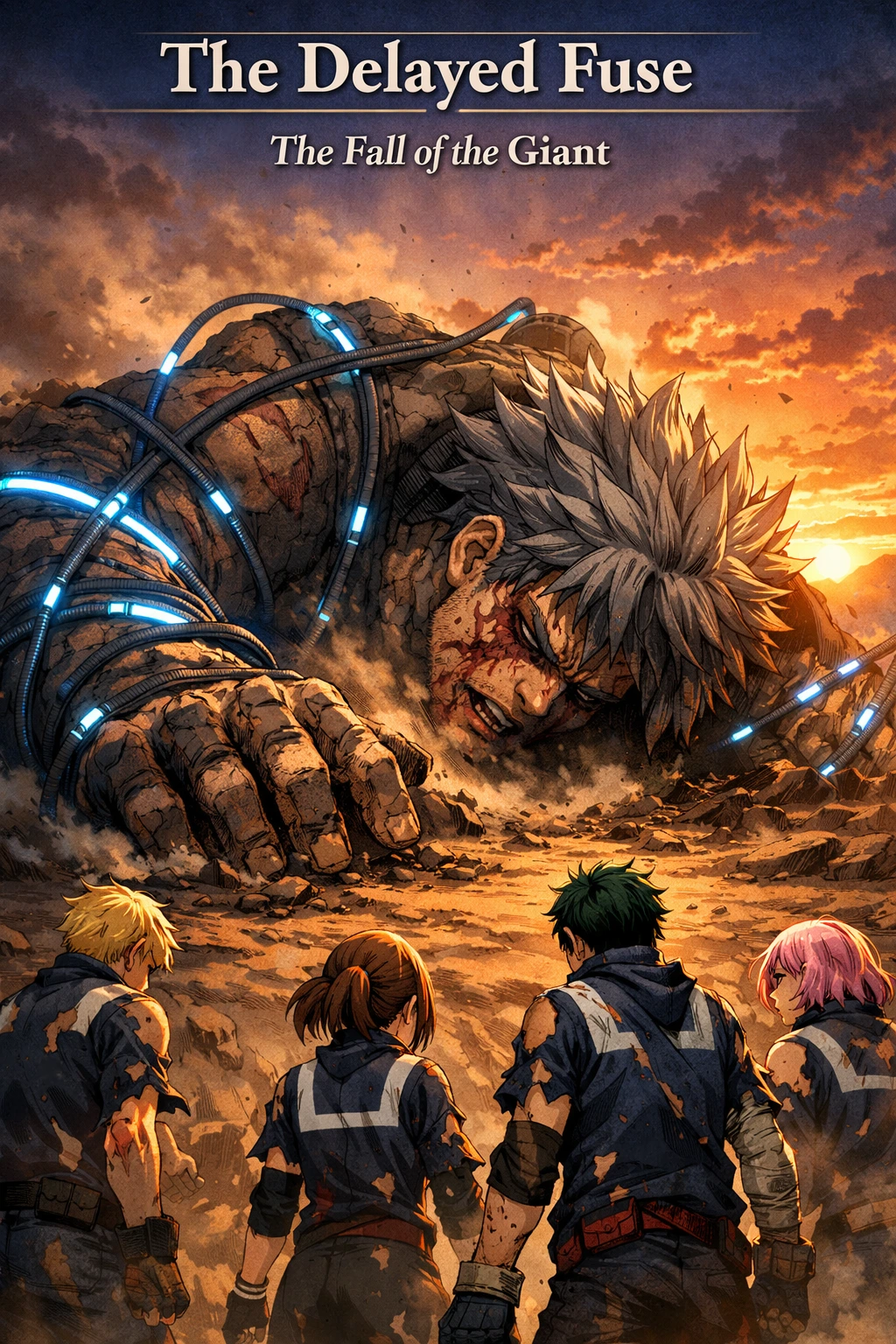
The Delayed Fuse However, the brilliance of Kohei Horikoshi’s writing ensured that this victory was not instantaneous. In reality, pharmacology takes time. Even a massive dose of sedative needs time to be absorbed by the stomach lining, enter the bloodstream, and circulate to the brain. This created the “Delayed Fuse” scenario, one of the most agonizing, high-tension sequences in the war.
The students had succeeded in delivering the payload, but Machia continued to rampage. It required the arrival of the Number 3 Hero, Best Jeanist, using carbon-fiber cables to physically restrict Machia’s muscles, to stall for time. The heroes had to hold the line against a thrashing, furious titan, taking immense damage and praying that the drug would take effect.
Finally, the very hyper-metabolism that made Machia so powerful became his undoing; his rapidly pumping heart circulated the drug faster, and the unstoppable giant finally closed his eyes and crashed to the earth.
The Final Betrayal
The Shinso Hijack The tragedy and terror of Gigantomachia did not end with his capture. During the Final War arc, the heroes weaponized the very psychological conditioning that created him. Recognizing that Machia’s loyalty was tied entirely to auditory commands, the heroes utilized Hitoshi Shinso and his ‘Brainwashing’ Quirk.
Using a specialized vocal chord modulator, Shinso mimicked the exact frequency and tone of All For One’s voice. When Machia was unleashed on the battlefield, he was not fighting for the villains; he was a hijacked weapon. Shinso issued the command to attack All For One himself.
This strategy turned the villains’ greatest asset into their most devastating nightmare, forcing the Demon Lord to face the sheer, unadulterated physical might of his own greatest creation.
The Broken Faith The narrative climax of Gigantomachia’s character occurs when Shinso’s brainwashing is inevitably broken. As the mental fog lifted, Machia regained his true consciousness mid-battle. The expectation was that he would immediately turn on the heroes and resume serving his master. Instead, he experienced a profound, tragic realization.
He looked at All For One—a master who had repeatedly left him behind, who had allowed him to be captured, and who was currently prioritizing his own survival over his loyal servant. The unbreakable faith shattered. For the first time in his long, unnatural life, the master-servant binary dissolved. The tears he shed were no longer of joy, but of profound betrayal and heartbreak. He realized that to the Lord, he was truly just another speck of dust.
The Fall of the Giant This realization sparked the final, furious rebellion. Fuelled not by blind loyalty, but by the raw, agonizing rage of a discarded dog, Gigantomachia turned his full, terrifying arsenal against All For One. He fought not to protect Shigaraki or the League, but to exact vengeance on the man who had manipulated his existence, warped his biology, and ultimately abandoned him.
In his final stand, he absorbed catastrophic damage from All For One’s ultimate attacks, holding the villain down and buying crucial seconds for the heroes. It was a heartbreaking end for the behemoth. He fell not as an evil mastermind, but as a victim of ultimate manipulation, proving that even the most absolute, biologically ingrained loyalty has a breaking point when faced with the cruelty of absolute apathy.
Conclusion
The Pinnacle of Biological Loyalty In the final analysis, Gigantomachia stands as the pinnacle of biological loyalty and the ultimate physical hurdle within the My Hero Academia universe. He was not a character motivated by greed, societal reform, or malice. He was a force of nature, a hurricane shaped by the hands of a mad scientist and directed by the voice of a tyrant.
His existence serves as a terrifying exploration of what happens when human willpower is weaponized and stripped of its humanity, leaving only blind, destructive devotion in its wake. He is the physical embodiment of the tragedy of manipulation, a creature too powerful to be allowed to live, but too fiercely loyal not to pity in his final moments.
Closing Thoughts From a literary and structural perspective, Kohei Horikoshi utilized Gigantomachia with absolute genius. The character served as the vital narrative bridge that shifted the scale of the story. Before Machia, the conflicts in My Hero Academia were largely localized street battles, gang skirmishes, or contained classroom exercises.
By introducing a character whose very footsteps registered on the Richter scale, Horikoshi seamlessly transitioned the manga into an era of catastrophic, kaiju-level warfare. Gigantomachia forced the heroes to stop acting like police officers and start acting like an army, elevating the stakes, the destruction, and the sheer epic scale of the story to unprecedented heights. He remains one of the most mechanically fascinating, terrifying, and ultimately tragic figures in modern anime history.