
1. The Talentless Anomaly: The Desperation of Genya Shinazugawa

To truly understand the horrific, awe-inspiring anomaly that is Genya Shinazugawa, one must first confront the brutal, unforgiving reality of the Demon Slayer Corps. In the war against Muzan Kibutsuji and his immortal, flesh-warping monstrosities, the baseline requirement for human survival is Total Concentration Breathing.
This esoteric martial arts technique is not merely a stylistic choice; it is a fundamental biological necessity. By hyper-oxygenating the blood and accelerating the heart rate, a human swordsman temporarily bridges the insurmountable evolutionary gap between humanity and demon-kind. Breathing Styles grant the explosive kinetic energy, the accelerated clotting, and the superhuman reflexes required to track and decapitate creatures that move faster than the eye can see.
Without this hyper-oxygenation, a human facing a demon experiences overwhelming sensory and physical failure. Muscles tear from the sheer strain of trying to dodge unnatural strikes, lungs burn as they fail to process enough oxygen to fuel the necessary kinetic output, and the human eye simply cannot track the speed of demonic regeneration.
Statistically speaking, within the grim mathematics of the Demon Slayer Corps, if you cannot master a Breathing Style, you are not a soldier—you are a casualty waiting to happen. To step onto the battlefield without oxygen-empowered blood is synonymous with an agonizing, mathematically guaranteed death.
Enter Genya Shinazugawa. He is the talentless anomaly, the statistical outlier who should have died during the Final Selection. Genya was born lacking the specific neurological aptitude and lung capacity required to maintain even the most basic forms of Total Concentration Breathing.
In a world where swordsmen conjure roaring flames and crashing waterfalls through the sheer power of their lungs, Genya stood powerless, breathless, and fundamentally inadequate. He was biologically locked out of the only system designed to keep humanity alive in the dark. Yet, he refused to die, and he refused to quit.
Instead of accepting his physical limitations, Genya became the ultimate survivalist. Stripped of the elegant, elemental powers of his peers, he resorted to the most taboo, biologically dangerous, and visually grotesque tactic in the history of the war: eating the enemy.
To comprehend why a human boy would willingly tear into the putrid, mutating flesh of a demon, one must analyze the extreme psychological trauma that forged his mind. Genya’s entire existence is defined by a singular, crushing singularity of guilt revolving around his older brother, Sanemi.
After their demonified mother slaughtered their younger siblings, Sanemi was forced to kill her to save Genya. In the chaotic, blood-soaked aftermath, a terrified and traumatized Genya looked at the brother who had just saved his life and called him a “murderer”—a primal, fear-driven reaction of a child that would haunt him for the rest of his life.
This single utterance fractured their bond, leaving Genya utterly isolated in his grief. That word, “murderer,” echoed in Genya’s mind every single day, evolving from a moment of childhood shock into a venomous, self-replicating mantra of unworthiness. His subsequent drive to become a Demon Slayer was never about heroism, saving the world, or eradicating evil.
It was a suicidal, single-minded crusade to stand face-to-face with the Wind Hashira and simply apologize. To reach Sanemi, Genya had to survive. To survive without a Breathing Style, he had to cheat the laws of biology. His psychological desperation pushed him past the boundaries of human sanity, leading him to completely abandon his humanity, his bodily autonomy, and his safety.
He weaponized his own inadequacy, turning his desperation into a monstrous hunger. Genya did not just fight demons; he consumed their nightmares to fuel his own, proving that when the human spirit is driven by absolute, unbearable guilt, it will willingly digest hell itself.
2. The Digestive Mutagen: Anatomy of a Demon Eater
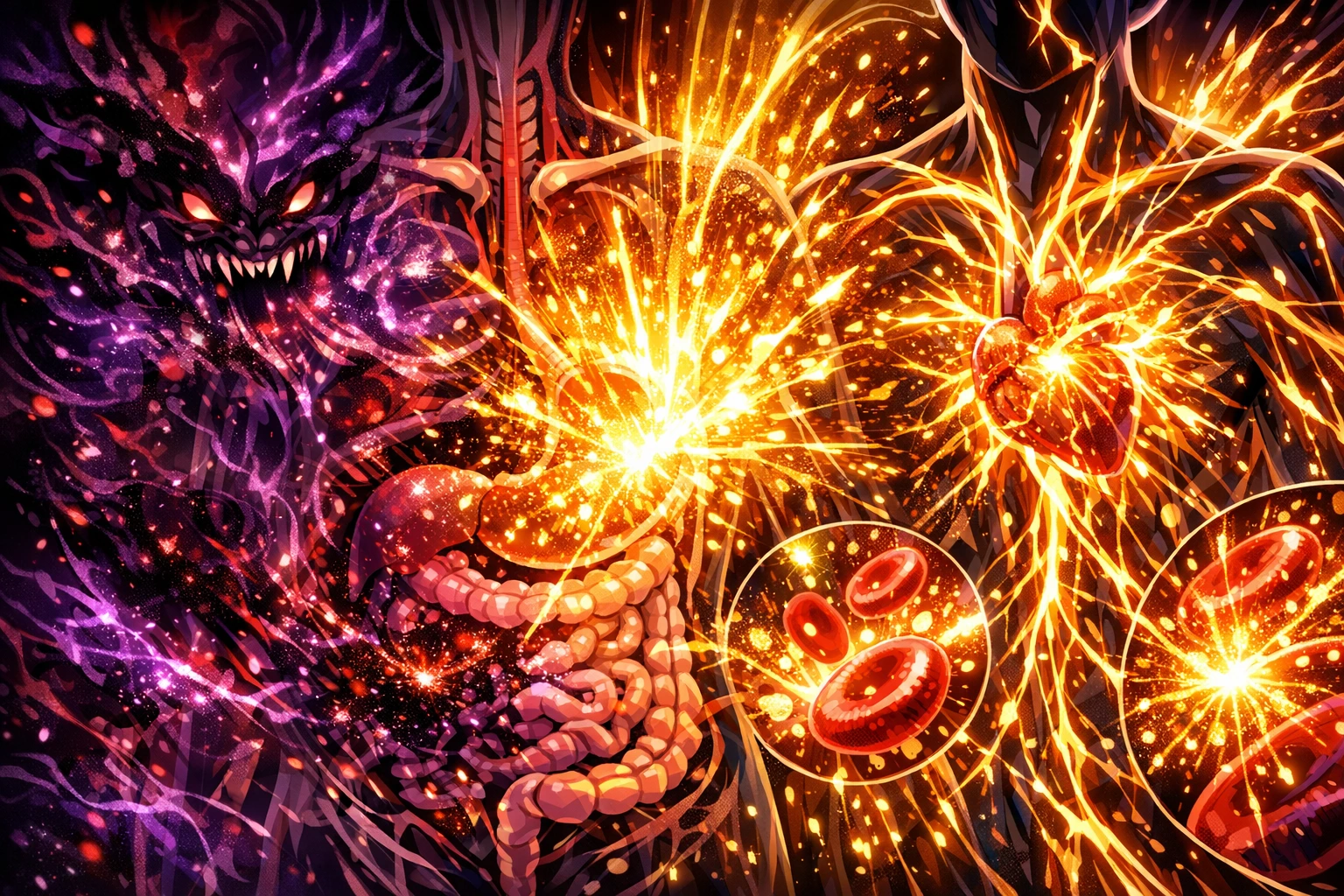
The sheer concept of a human consuming raw demon flesh defies every established law of biology within the Kimetsu no Yaiba universe. Demon cells, fundamentally empowered by the blood of Muzan Kibutsuji, are highly aggressive, parasitic, and hyper-mutagenic.
When introduced into a normal human system, Muzan’s blood acts as a catastrophic retrovirus. It either forcibly overwrites the host’s DNA, transforming them into a demon, or—if the human is too weak to withstand the cellular mutation—causes their cells to undergo violent, immediate necrosis, literally melting them from the inside out. Therefore, Genya Shinazugawa’s gastrointestinal tract is nothing short of a medical marvel, a biological crucible that operates on an entirely different evolutionary paradigm.
To break down hyper-regenerative demon flesh, Genya’s stomach must possess an unimaginably acidic and enzyme-rich environment. A standard human stomach operates at a pH level of 1.5 to 3.5. For Genya to dissolve flesh that is dense enough to shatter steel and capable of regenerating within milliseconds, his gastric acid must logically mimic industrial-grade solvents, heavily laced with specialized, mutant proteolytic enzymes.
When he swallows demon tissue, his digestive tract must instantly neutralize the regenerative properties of the cells before they can parasitize his organs. The biological stress of this process must be excruciating. Digestion at this level of intensity likely causes his internal core temperature to skyrocket, resulting in terrifying fevers and a sensation akin to swallowing liquid fire. His stomach acts as a biological incinerator, breaking down the demonic proteins and neutralizing the virulent, mutagenic properties of Muzan’s blood before it can trigger an involuntary transformation or cellular death.
However, the true miracle of Genya’s anatomy lies in what happens after digestion: temporary cellular assimilation. He does not permanently alter his baseline human DNA. Instead, his body performs a miraculous, highly controlled “genetic override.” As the demon flesh is digested, his intestines absorb the demonic ATP (adenosine triphosphate)—the raw cellular energy of the creature.
This triggers an explosive, temporary metamorphosis. His muscle fibers undergo rapid, transient hypertrophy, swelling and tearing to accommodate an influx of power that his skeleton was never meant to support, granting him the physical strength to throw full-grown demons through walls. His cells temporarily adopt the demon’s rapid mitosis, allowing him to regenerate from otherwise fatal wounds, such as being bifurcated or having his limbs severed.
But this is a fleeting borrowed power, and the withdrawal is brutal. Once the demon flesh is fully metabolized and the demonic ATP is burned out, Genya’s cells violently snap back to their fragile, human baseline. The sudden loss of structural support and regenerative shielding leaves him exhausted, vulnerable, and likely in a state of immense physiological shock.
The most critical and fascinating aspect of this biological anomaly is Genya’s “Immune System Firewall.” Why doesn’t Muzan’s omnipresent will, carried within every drop of demon blood, hijack Genya’s brain? Demons are essentially biological extensions of Muzan; he can read their thoughts, control their actions, and destroy them from afar.
Genya, however, remains entirely autonomous. This suggests that Genya’s white blood cells and neurological blood-brain barrier act as an uncompromising biological firewall. His immune system is uniquely designed to violently reject the psychic and genetic control markers embedded in Muzan’s DNA, while simultaneously allowing the raw kinetic energy, the physical strength, and the regenerative factors to pass through.
This internal defense mechanism is not a passive shield; it is a localized, microscopic war fought every single time he swallows a piece of flesh. His liver and lymphatic system must work in terrifying overdrive, filtering out the “Muzan” consciousness while weaponizing the biological raw material. It is a razor-thin tightrope walk between empowering himself and becoming the very monster he is fighting. One moment of cellular weakness, one drop of unfiltered blood bypassing his neurological barriers, and his mind would be subsumed.
3. Jaw Mechanics and Biomechanical Bite Force

While his digestive system handles the internal assimilation, the initial act of consuming a demon presents a massive biomechanical hurdle. Standard demon flesh is not akin to human muscle or animal meat. As established repeatedly throughout the series, the flesh and bones of lower-tier demons, let alone the Kizuki (Twelve Moons), possess a tensile strength and density capable of catching, dulling, and snapping Nichirin steel katanas. To physically tear through this hyper-dense, armored tissue, Genya cannot rely on a normal human bite. The physics of his jaw must be fundamentally, horrifyingly augmented.
To shatter demon flesh, Genya’s mandible engineering must exceed that of apex predators. For context, an adult human has an average bite force of around 160 PSI (pounds per square inch). A saltwater crocodile, boasting one of the strongest bites in the animal kingdom, exerts roughly 3,700 PSI. To tear through flesh that deflects forged steel, Genya’s bite force must theoretically exceed tens of thousands of PSI. This implies an immense, unnatural hypertrophy of his masseter and temporalis muscles—the primary muscles responsible for closing the jaw.
When Genya prepares to bite, these muscles likely engorge, radically changing the shape of his face to accommodate the necessary leverage. Furthermore, his teeth and jawbone must possess an anomalous, perhaps reinforced bone density to withstand the sheer kinetic feedback of his own bite. Without a reinforced skull and shock-absorbing jaw hinges, clamping down with that much force would instantly shatter his own teeth, fracture his maxilla, and dislocate his mandible.
His mouth is not a tool for eating; it is an organic, hydraulic press designed to crush supernatural armor. The auditory feedback of this act alone—the sickening crunch of demon bone giving way to human teeth—must be as psychologically terrifying for the demons as it is physically devastating.
However, Genya is acutely aware that he cannot simply walk up and bite a moving, hyper-lethal demon. He requires a method to stagger them, to shatter their outer defenses, and to create the split-second opening necessary to latch on with his teeth. This is where his unique, highly pragmatic dual-wielding combat style comes into play: The Shotgun vs. Nichirin approach.
Genya recognized early on that without a Breathing Style, a sword alone was insufficient for close-quarters combat against superior foes. Therefore, he adopted a Western-style, double-barreled sawed-off shotgun. But this is no ordinary firearm. The weapon is chambered with custom shells loaded with Scarlet Iron Sand and Sunlight Ore—the exact same photolithic materials used to forge Nichirin blades, which absorb sunlight and are lethal to demons.
The integration of the shotgun is a stroke of brutal, ballistic genius. A Nichirin sword requires immense physical strength, leverage, and breathing techniques to cut through a demon’s neck. A shotgun, however, relies entirely on chemical propellants and ballistic kinetic energy.
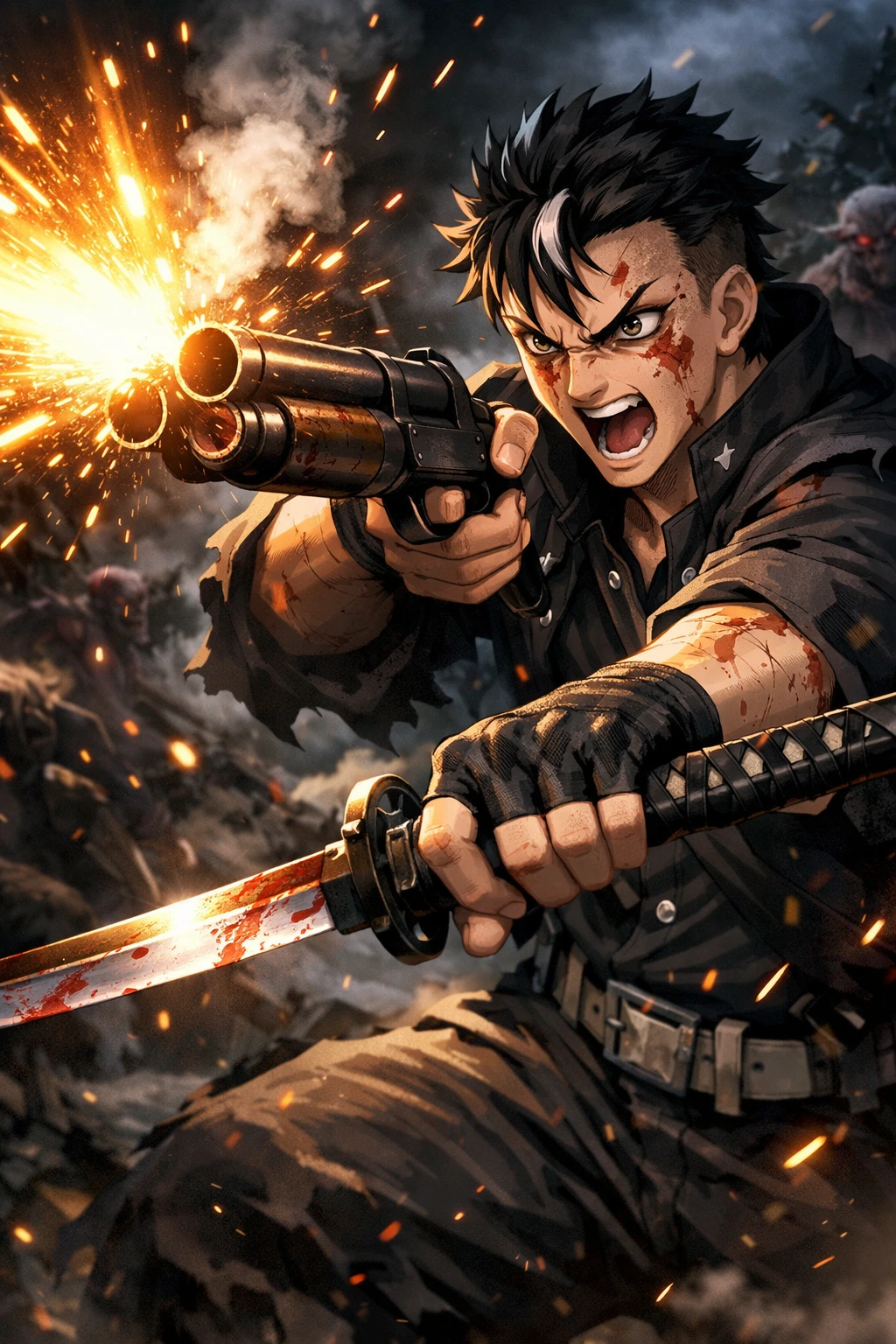
When Genya fires at point-blank range, the concussive force and the spread of the Sunlight Ore buckshot instantly blow apart demon limbs, shredding their flesh and overwhelming their immediate regenerative capabilities.
Wielding this weapon comes at a tremendous physical cost. Firing a double-barreled shotgun loaded with heavy metallic sand without the physical anchoring of Total Concentration Breathing produces recoil that should realistically dislocate a standard human shoulder. Genya absorbs this kinetic blowback through pure, stubborn endurance.
He uses the sheer stopping power of the firearm to blast away the demon’s defenses. Once the enemy is staggered, their flesh exposed and mutilated by the blast, Genya uses his Wakizashi (a short Nichirin sword) to parry their flailing counterattacks, finally lunging in to sink his reinforced teeth into the vulnerable tissue. The shotgun is the breaching charge; his jaw is the killing blow. It is a highly tactical, hyper-violent rhythm of combat engineered specifically by a boy who knew he had to fight dirty to survive.
4. The Shinazugawa Bloodline: Internal vs. External Weaponization
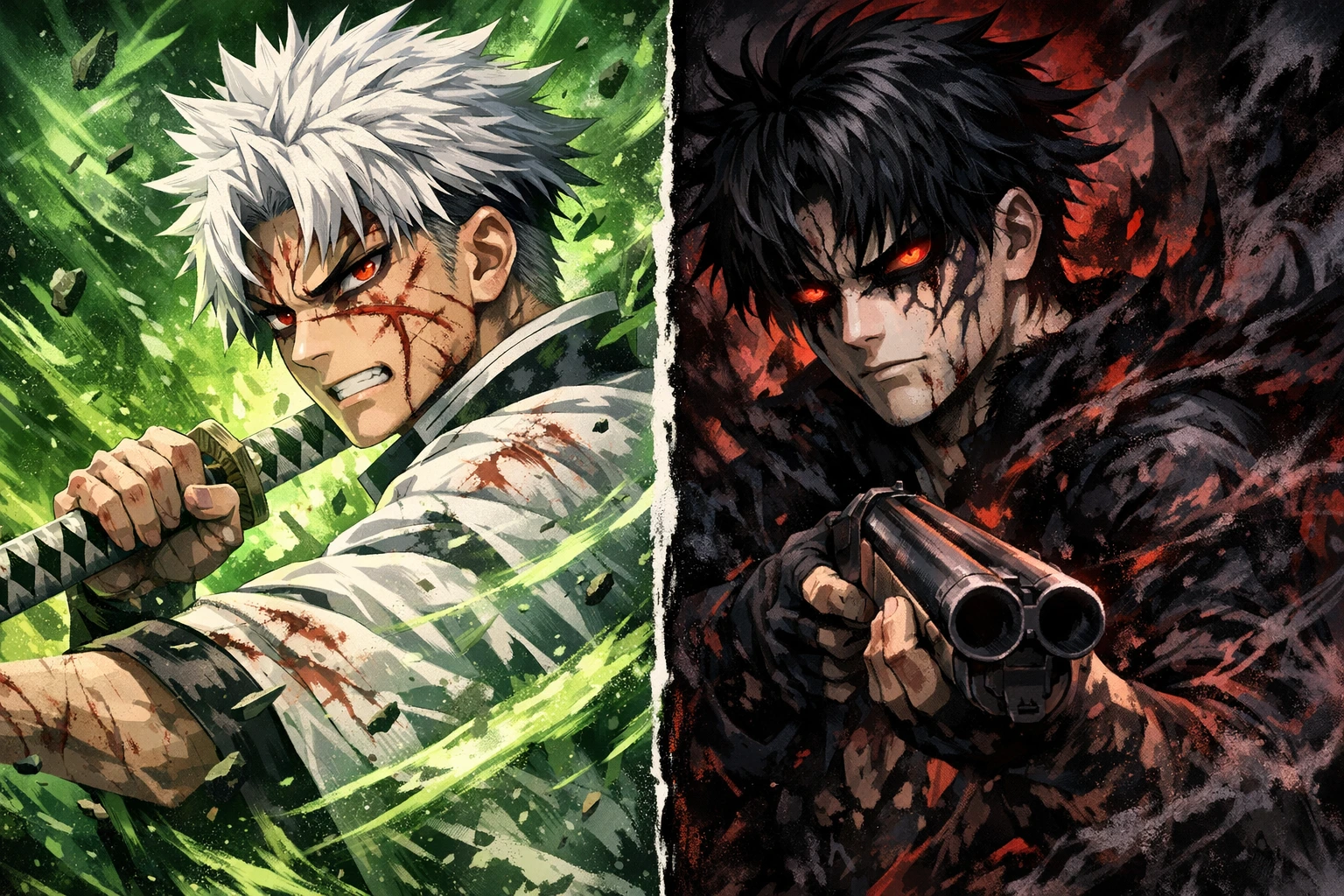
To fully contextualize Genya’s bizarre biological traits, one must zoom out and examine the genetic anomaly that is the Shinazugawa bloodline. Both Genya and his older brother, Sanemi (the Wind Hashira), are the beneficiaries—and victims—of an incredibly rare, mutated genetic lottery.
They belong to a bloodline that seems evolutionarily designed specifically to hunt and kill demons, but this genetic blessing manifests in two completely opposite, diametrically opposed ways. It is a cruel twist of fate that provides them with weapons demanding nothing less than total self-mutilation.
Sanemi Shinazugawa is the possessor of a highly potent Marechi (Rare Blood) mutation. His blood is an external weapon. When exposed to the air, Sanemi’s blood acts as an aerosolized, hyper-concentrated narcotic. To demons, the scent is overwhelmingly intoxicating, completely overriding their cognitive functions, dulling their reflexes, and driving them into a state of drunken, feral predictable hunger.
Sanemi purposefully scars and cuts himself in battle, utilizing his own blood as an external area-of-effect debuff that strips demons of their tactical intelligence, allowing him to easily decapitate them with his Wind Breathing. His power relies on bleeding himself dry, projecting his life force outward to poison the enemy’s mind.
Genya, on the other hand, represents the dark mirror of this mutation. His power is entirely internal. Rather than his blood intoxicating the demons, his internal organs weaponize the demon against itself. If Sanemi is the bait that lures the demon to the blade, Genya is the furnace that consumes the demon to forge his own strength.
This dichotomy—the external intoxicant versus the internal assimilator—paints a fascinating picture of a family cursed by the gods to be the ultimate anti-demon weapons. Sanemi bleeds, and Genya consumes. Sanemi degrades his physical form through blood loss, while Genya degrades his humanity through toxic, cellular accumulation.
Yet, this biological divergence is the root of an immense, heartbreaking psychological friction between the two brothers. For the vast majority of the series, Sanemi treats Genya with abhorrent brutality, physically beating him, blinding him in one eye, and verbally devastating him, constantly demanding that Genya leave the Demon Slayer Corps. To the outside observer, and to Genya himself, Sanemi appears as a hateful, abusive monster.
However, the tragedy of their misunderstanding is profound. Sanemi’s brutality was not born of hatred, but of a desperate, terrified, and ultimately misguided attempt to protect his little brother. Sanemi, with his deep knowledge of demons and the lethal toll of their own cursed bloodline, knew exactly what Genya was doing. He understood the biological reality of the Demon Eater.
Sanemi knew that consuming demon flesh was not a sustainable power; it was a biological ticking time bomb. Every bite Genya took was a gamble with a catastrophic retrovirus. Sanemi realized that Genya was slowly poisoning his human cellular structure, inching closer to an agonizing death or worse—a permanent demonic transformation that Sanemi himself would be forced to execute, repeating the unbearable trauma of slaughtering their own mother.
Sanemi pushed Genya away with violence because he wanted Genya to live a normal, safe life, free from the curse of their bloodline and the stench of demon flesh. Genya, fundamentally misunderstanding this, interpreted Sanemi’s rage not as protection, but as confirmation of his own weakness and unworthiness.
Driven further into despair, Genya consumed more demons, endured more agonizing internal poison, and mutated his body further, all in a desperate bid to become strong enough to finally be accepted by the brother who was desperately trying to push him away. It is a masterclass in tragic irony: the internal weapon destroying himself from the inside out just to reach the external weapon who is bleeding himself to death to save him.
5. The Upper Moon 1 Zenith: Consuming Kokushibo
The ultimate test, the zenith of Genya’s horrific biological adaptations, occurs during the climax of the Infinity Castle Arc. Here, the Shinazugawa brothers, alongside Gyomei Himejima (the Stone Hashira) and Muichiro Tokito (the Mist Hashira), face off against Michikatsu Tsugikuni, known as Kokushibo—Upper Moon 1, the second most powerful demon in existence, and the brother of Yoriichi, the progenitor of Breathing Styles.
Kokushibo is not merely a demon; he is an apex entity radiating an aura of dread so palpable it physically paralyzes lesser slayers. With centuries of combat experience, he utilizes Moon Breathing alongside hyper-dense, infinitely regenerating flesh swords covered in ever-shifting eyes. Against such a god-like adversary, Genya is hopelessly outmatched.
Within the first few moments of engagement, he is swiftly and brutally bifurcated—literally sliced perfectly in half down the middle. For a normal human, this is instant, undeniable death. The shock, blood loss, and organ failure would ensure cessation of consciousness within seconds. But Genya is not normal. In an act of unparalleled desperation, ignoring the sheer medical impossibility of his severed torso, Genya uses his fading consciousness to consume a piece of Kokushibo’s flesh sword and a lock of the Upper Moons hair.
This is the ultimate, forbidden meal. The concentration of Muzan’s blood within Upper Moon 1 is orders of magnitude higher than anything Genya has ever digested. When Genya swallows Kokushibo’s cellular material, the resulting temporary assimilation is violently explosive.
The sheer volume of demonic ATP and mutagenic data triggers a catastrophic cellular overload, forcibly knitting his bisected body back together in seconds and vaulting his physical parameters into the realm of the Upper Moons. His human physiology completely yields to the demonic blueprint required to keep him alive.
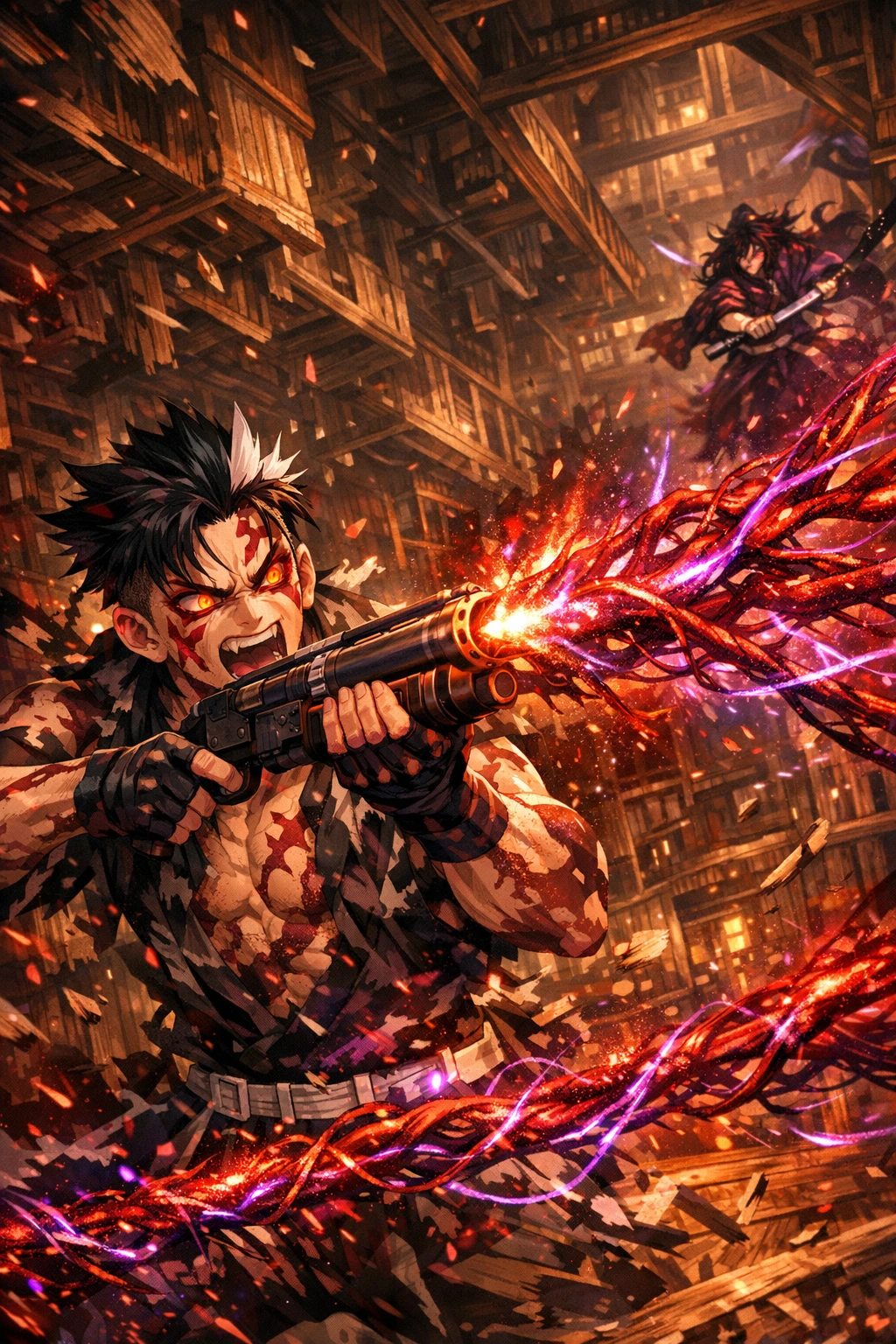
But the most critical and terrifying evolution in this moment is the manifestation of his own Blood Demon Art. Because Kokushibo’s flesh is so intrinsically tied to his own unique Blood Demon Art (the manipulation of his own flesh into weaponry), Genya’s body absorbs and reinterprets this data. He does not just gain physical strength; he temporarily unlocks the ability to manipulate his own weaponized biology. He forcibly merges his newly acquired demonic cells with his shotgun, fusing living, pulsating flesh with cold steel in a grotesque synthesis.
When Genya fires upon Kokushibo in this state, he unleashes the “Flesh-Root Bullets.” This acts as a Parasitic Sniper mechanism. The bullets, forged from Kokushibo’s own biological signature mixed with Genya’s assimilated power, embed themselves deep into the Upper Moon’s flesh. Upon impact, the bullets rapidly germinate, aggressively overriding Kokushibo’s biology. They sprout massive, demonic wooden roots that violently erupt from within Kokushibo’s body, tearing through his internal organs and branching outward.
These roots serve a dual, devastating purpose. First, mimicking Kokushibo’s own ability to weaponize flesh, the roots rapidly siphon Kokushibo’s blood, draining the Upper Moon of his vast reserves of strength and actively preventing his near-instantaneous regeneration. The more Kokushibo struggles, the deeper the roots feed.
Second, the massive roots physically lock Kokushibo in place, creating a cage of his own biology, anchoring the fastest, most lethal demon in the world to the ground. In this moment, Genya transitions from a talentless, bisected swordsman to the ultimate tactical support unit. His Blood Demon Art creates the singular, impossible opening required for the Hashira to strike. He successfully immobilizes the immovable object.
6. Conclusion: The Price of the Forbidden Fruit
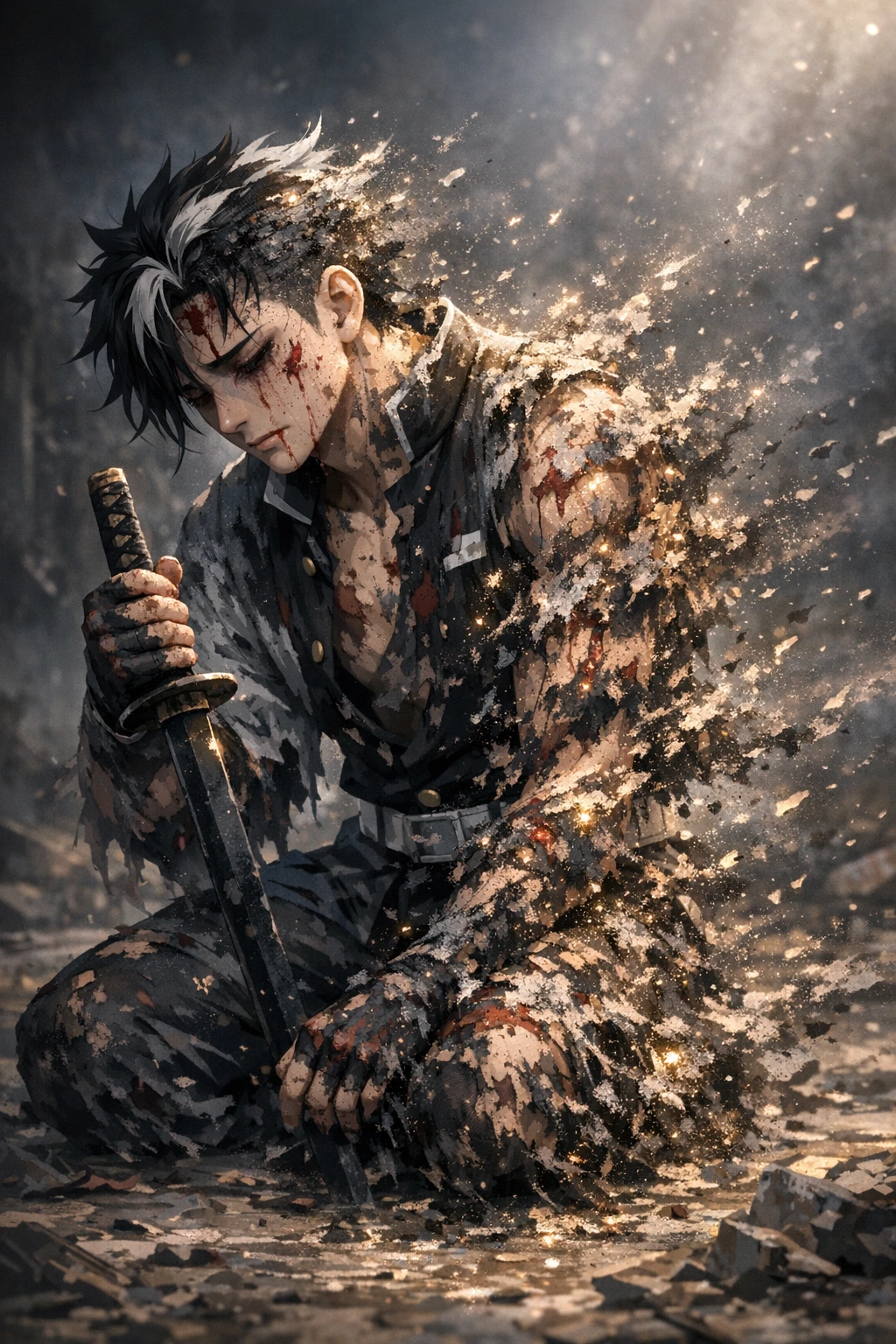
However, the biology of the Demon Eater is absolute, and the laws of cellular degradation cannot be cheated forever. The climax of the battle against Kokushibo marks the fatal threshold of Genya’s existence. By consuming the concentrated, primordial flesh of Upper Moon 1, Genya pushed his human biology past the point of no return.
His immune system firewall, which had fought countless localized wars against the demon cells he had ingested over the years, finally and completely collapsed under the sheer, crushing weight of Muzan’s most potent genetic material.
When Kokushibo is finally defeated, the tragic reality of Genya’s biology reveals itself. Because his human cells were so thoroughly overwhelmed and systematically replaced by the demonic DNA required to keep his bifurcated body functioning, the death of the “source” triggered a catastrophic cascade failure. Genya did not die like a human boy succumbing to blood loss or shock.
His body, now functioning entirely on the borrowed life force of a demon, reacted to Kokushibo’s destruction exactly as a demon would. In the arms of his weeping brother—finally hearing the desperate, shattered apology and the declaration of love he had spent his entire life chasing—Genya Shinazugawa crumbled into ash. It is a profoundly poetic and tragic end; a human boy who sacrificed everything dissolving into the wind, evaporating like the very monsters he had consumed, leaving nothing behind but the memory of his sacrifice.
Yet, despite the grotesque nature of his abilities and the horrific manner of his death, Genya’s legacy is undeniable and monumental. He was the ultimate support pillar of the Demon Slayer Corps. If one looks at the battle against Kokushibo purely through the lens of combat mathematics, speed, and biological scaling, the top three Hashira (Gyomei, Sanemi, Muichiro) could not have won.
Even with the manifestation of their Demon Slayer Marks, the heat of Red Nichirin Blades, and access to the precognitive abilities of the Transparent World, Kokushibo was simply too fast, too durable, and too infinitely lethal. Without Genya’s suicidal consumption of Upper Moon flesh, without his parasitic roots locking Kokushibo down and draining his lifeblood to stall his regeneration, the Hashira would have been systematically slaughtered. Genya was the vital, bloody linchpin that held the entire victory together, paying the toll the others could not.
Genya Shinazugawa represents the absolute darkest extreme of human willpower. In a universe populated by elegant swordsmen who breathe lightning and dance like water, Genya was the boy who crawled through the mud and tore through flesh with his bare teeth. He is the terrifying testament to what a human being is capable of when driven by the pure, unadulterated need for atonement.
He had no talent, no breathing style, and no physical gifts. Instead, he possessed an iron will that utterly defied the laws of nature. He literally consumed monsters, tearing them apart from the inside out, poisoning his own body with every swallow, and sacrificing his very soul, all for one singular, heartbreaking goal: just to hear his big brother say, “I love you.”