
Eldian Restorationists vs Marleyan Warriors
I. Introduction: Two Sides of the Same Coin
The basement in Libero stands as one of the most pivotal settings in the entire history of Attack on Titan. It is a dark, claustrophobic room, illuminated only by the flicker of a lamp and the terrifying realization of truth.
When Eren Yeager sits across from Reiner Braun, four years after the betrayal that shattered the Walls, the audience expects vengeance. We expect the rage of the boy who watched his mother die. Instead, we receive a confession that fundamentally recontextualizes the entire series.
Eren looks his enemy in the eye and delivers a line that serves as the thesis for the tragedy of their world: “I’m the same as you.”
This moment dissolves the binary of good versus evil that characterized the early arcs of the story. For years, the conflict appeared simple: humanity fighting against mindless monsters.
However, as the curtain was pulled back, the true nature of the war was revealed to be far more insidious. It was not a battle between species, but a civil war of ideology fought between two factions of the same race: the Eldian Restorationists and the Marleyan Warriors.
Both groups were comprised of the Subjects of Ymir. Both groups were oppressed by the global superpower of Marley.
Both groups fought desperately for the survival of their people. Yet, they were positioned at each other’s throats, manipulated by historical revisionism and state-sponsored propaganda.
The tragedy of the Eldian people is that their greatest enemies were never truly the Marleyans, but the lies they were told about themselves. On one side stood the Restorationists, radicalized by oppression and fueled by a romanticized version of the past where Eldia could do no wrong.
On the other stood the Warriors, crushed by self-hatred and indoctrinated to believe that the only way to atone for their existence was to die for their oppressors. To understand the Rumbling and the apocalyptic conclusion of Attack on Titan, one must first dissect the ideological machinery that created Grisha Yeager and Reiner Braun.
This is not merely a story of war; it is a historical study of how propaganda shapes soldiers, turning innocent children into instruments of genocide.
The complexity of this conflict lies in the fact that neither side was fighting for “freedom” in the purest sense; they were fighting for validation.
The Restorationists sought validation from history, desperate to prove that their ancestors were gods rather than devils. The Warriors sought validation from the world, desperate to prove that they were “one of the good ones.”
Both ideologies were cages, built by Marley but locked from the inside by the Eldians themselves.

II. The Eldian Restorationists: Radicalism Born of Oppression
The birth of the Eldian Restorationists cannot be separated from the brutality of the environment that spawned it. Radicalism rarely appears in a vacuum; it is almost always a reaction to extreme suppression.
For Grisha Yeager, the journey from an obedient citizen of the Internment Zone to a revolutionary leader began with a single walk outside the walls. The murder of his sister, Faye Yeager, was a moment of such visceral cruelty that it shattered his worldview.
It was not just that she was killed; it was that she was fed to dogs for the amusement of a Marleyan officer, simply because she had transgressed a boundary. When Grisha’s father chose to bow and apologize to the murderers rather than demand justice, Grisha realized that submission offered no safety.
In his eyes, the passive acceptance of their status as “devils” was a fate worse than death.
The Myth of Purity
The ideology of the Restorationists was built on a desperate need for dignity. Marley taught that Eldians were the spawn of the devil, responsible for centuries of ethnic cleansing and tyranny. To counter this overwhelming narrative of shame, the Restorationists did not seek a middle ground; they swung the pendulum to the opposite extreme.
They unearthed ancient texts and decoded—or perhaps projected—a history where Ymir Fritz was a benevolent goddess who built bridges and cultivated wastelands. They believed in the “Glorious Past” of the Eldian Empire. This was a classic reactionary movement.
Because Marley lied about everything, the Restorationists assumed that the opposite of Marley’s history must be the absolute truth.
They refused to acknowledge the atrocities of the old Eldian Empire, choosing instead to rewrite history into a myth of purity.
This selective blindness is critical to understanding their downfall. By refusing to engage with the possibility that the Eldian Empire had committed sins, they blinded themselves to the fears of the rest of the world.
They became a mirror image of Marleyan nationalism, just with a different flag. They didn’t want to dismantle the system of oppression; they wanted to seize the controls.
The Tragedy of Dina Fritz
A central figure in this movement was Dina Fritz, the last remaining descendant of the royal family on the continent. For the Restorationists, she was not just a leader; she was a messianic figure.
Her royal blood was the key to unlocking the Founding Titan, but her existence highlights the dehumanizing nature of the movement. To the Restorationists, Dina was a symbol first and a woman second.
Her marriage to Grisha was strategic, a union designed to produce a child of royal blood who could lead the revolution.
This utilitarian view of family would bleed into Grisha’s parenting of Zeke, creating the very cracks that would destroy them.
Dina’s fate is perhaps the most horrific irony in the series. The woman who sought to restore Eldia was turned into a mindless Titan—the Smiling Titan—who would go on to eat Carla Yeager, the second wife of her husband.
This narrative loop underscores the cruelty of the Attack on Titan universe: the ideology of restoration didn’t save Dina; it turned her into the catalyst for Eren’s apocalyptic rage.
The Owl’s Gamble
At the center of this movement was the Owl, Eren Kruger. As a spy embedded deep within the Marleyan Public Security authorities, Kruger was the architect of the Restorationist movement, yet he possessed a pragmatism that Grisha initially lacked.
Kruger understood that ideology alone does not win wars; power does. His philosophy was brutal and utilitarian. He tortured and maimed thousands of his own people to maintain his cover, all to save the few who might retake the Founding Titan.
His mantra, “You must move forward to pay for the sins,” became the spiritual backbone of the Attack Titan.
Kruger represented the cold reality that the Restorationists ignored. While Grisha and his comrades debated history books in secret meetings, Kruger was cutting off fingers to keep his cover.
He knew that the only way to defeat a monster was to become a greater one. When he finally entrusted the Attack Titan to Grisha, it wasn’t because Grisha was the strongest or the smartest, but because he had the most hate. Kruger knew that hate was the only fuel potent enough to burn down the world Marley had built.
III. The Marleyan Warriors: The Tragedy of Child Soldiers
If the Restorationists were born from a desire to reclaim the past, the Marleyan Warriors were born from a desperate need to secure a future. The Warrior Unit represents one of the most harrowing depictions of child soldiers in modern fiction.
Unlike the Restorationists, who were adults making conscious (albeit radicalized) choices, the Warriors were children manipulated before they could even understand the concept of war.
Their motivation did not stem from glory or historical revisionism; it stemmed from the primal need for acceptance and the safety of their families. They were fighting to be “Good Eldians.”
The Weaponization of Love
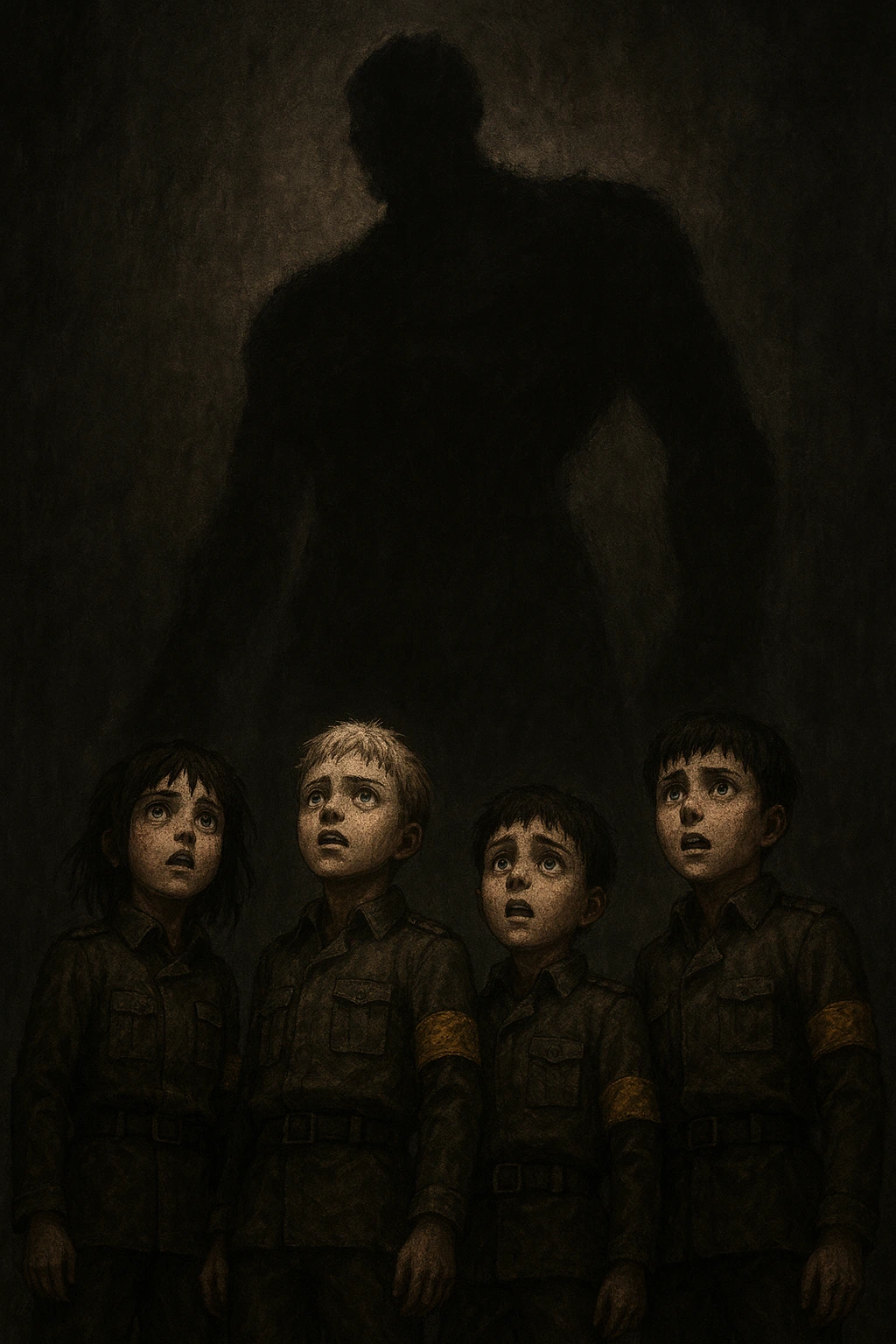
Marley’s brilliance lay in weaponizing the love children have for their parents. By promising the title of “Honorary Marleyan,” the state offered a lifeline out of the ghetto. For a child like Reiner Braun, whose existence was complicated by a forbidden Marleyan father, the Warrior program was the only path to uniting his family.
This was not a political ambition; it was a heartbreakingly human one. Reiner didn’t care about the history of Helos or Ymir; he just wanted his father to look at him without disgust.
The selection process was brutal, pitting children against one another in tests of loyalty, strength, and intelligence. But the true tragedy is revealed in the backstory of Marcel Galliard. Reiner was never meant to be the Armored Titan; he was the bottom of the class.
He was only chosen because Marcel, desperate to save his own brother Porco from the curse of the Titans, sabotaged Porco’s reputation and boosted Reiner’s. This act of brotherly love doomed Reiner to a life of hell.
It adds a layer of devastating guilt to Reiner’s character—he is living a stolen life, wielding a power meant for someone else, fighting a war he wasn’t strong enough to qualify for.
The Campfire of Lies
The brainwashing of the Warrior candidates was total. They were taught to hate their own blood, referring to the Eldians on Paradis as “Island Devils.” This self-hatred is a powerful psychological tool. By convincing the Warriors that the people of Paradis were the source of all their suffering, Marley deflected the blame for their own cruelty.
The moment the Warriors’ worldview began to crack was not when they met Eren, but the night before the breach of Wall Maria. After Marcel was eaten by Ymir (the Titan), Annie and Bertolt wanted to turn back. They were terrified children who had just lost their leader.
It was Reiner—desperate to maintain his persona of the “chosen warrior”—who coerced them into continuing the mission. He physically wrestled Annie into submission, adopting the persona of Marcel to cover his own cowardice.
This moment is critical: Reiner didn’t breach the wall because he hated the Island Devils; he breached the wall because he was terrified of returning to Marley as a failure. He slaughtered thousands of innocents not for ideology, but to cover up his own inadequacy.
Reiner Braun stands as the ultimate victim of this duality. His psyche shattered under the weight of his conflicting identities. To survive the guilt of breaching Wall Maria and killing thousands of innocent civilians, Reiner created a secondary personality: the dependable “Big Brother” soldier who genuinely cared for his comrades in the 104th Cadet Corps. This was not simple deception; it was a dissociative survival mechanism.
He could not reconcile the fact that he was a mass murderer with the fact that he was a hero in his own mind. The Warrior program destroyed Reiner not by killing him, but by forcing him to kill the part of himself that was human.
IV. The Tybur Family: The Architects of Silence

To fully understand the war between the Restorationists and the Warriors, one must acknowledge the third player on the board: the Tybur family. While Grisha and Reiner fought in the mud, the Tyburs watched from high castles.
They were the Shadow Rulers of Marley, a family of Eldians who held the War Hammer Titan and lived in luxury, exempt from the persecution faced by their brethren in the internment zones.
The Tyburs represent the ultimate hypocrisy of the Attack on Titan world. They knew the truth of the Great Titan War—that King Fritz had chosen peace and retreated behind the walls voluntarily. They knew that the “Island Devils” were not planning an invasion.
Yet, for a century, they allowed Marley to propagate the lie that Paradis was an existential threat. They allowed their fellow Eldians to be oppressed, turned into Titans, and used as cannon fodder, all to maintain their own comfortable status quo.
The Restorationists were radicalized because they believed they were fighting a monster. The Warriors were indoctrinated because they believed they were saving the world from a monster. But the Tyburs knew there was no monster, and they let the slaughter continue anyway.
Willy Tybur’s eventual confession and declaration of war is a masterclass in political theater, but it comes too late. By the time the Tyburs decided to step into the light, they had already allowed the cycle of hatred to spin out of control.
They are the complicit bystanders of history, proving that silence in the face of oppression is just as deadly as the oppression itself. Their role highlights that this was never truly an ideological war—it was a managed conflict, a stage play written by kings and nobles where the poor were forced to kill each other.
V. Comparison Table: Grisha vs. The Warriors

To truly understand the ideological chasm—and the terrifying similarities—between these two groups, we must look at the data side by side. While their methods differed, their roles as pawns in a larger game remained constant.
| Feature | Grisha Yeager (Restorationist) | Reiner Braun (Warrior) | Zeke Yaeger (The Synthesis) | Annie Leonhart (The Apathetic) |
| Primary Goal | Restore the Eldian Empire to glory. | Become a hero and save his family/world. | “Save” Eldians through Euthanasia. | Return home to her father. |
| Origin of Drive | Trauma (Faye’s death) and hatred of Marley. | Desire for parental acceptance and indoctrination. | Rejection of both ideologies; nihilism. | Self-preservation and promise to father. |
| View on Eldians | The Chosen People; victims of history. | “Island Devils” vs. “Good Eldians.” | A cursed race that suffers by existing. | Irrelevant; everyone is equally terrible. |
| Methodology | Espionage, secrecy, insurrection. | Brute force, infiltration, betrayal. | Machiavellian manipulation, double-crossing. | Cold efficiency, isolation. |
| Relationship to History | Rewrote it to favor Eldia. | Accepted Marley’s version completely. | Saw history as a cycle of mistakes. | Ignored it; focused on the present. |
| Ultimate Fate | Sacrificed himself to pass on the Titan. | Lived in perpetual torment and regret. | Beheaded by the relentless march of his brother. | Survived, but lost years in crystal stasis. |
| Biggest Failure | Treated Zeke as a tool, not a son. | Treated himself as a tool, not a human. | Underestimated the will to live (Eren). | Believed she could remain detached. |
Analysis of the Divide The table reveals a stark parallel in how both Grisha and Reiner were consumed by their roles. Grisha failed as a father because he viewed Zeke solely as an extension of the Restorationist will.
He projected his desire for revenge onto a child, effectively doing to Zeke what Marley did to the Warriors—robbing him of his childhood for a political cause.
Conversely, Reiner failed because he internalized Marley’s view of him as a weapon. He sought validation from a system designed to exploit him.
The critical difference lies in the direction of their hatred. The Restorationists directed their hatred outward at Marley. The Warriors directed their hatred inward at themselves and their “devil” heritage. Yet, both paths led to the same destination: the slaughter of innocents and the perpetuation of the conflict.
Whether fighting for the “Glorious Empire” or the “Honorary Marleyan,” the human cost remained identical.
VI. Zeke Yeager: The Synthesis of Both Worlds

Zeke Yeger is the fascinating, terrifying bridge between these two worlds. As the biological son of Grisha Yeager (the Restorationist leader) and Dina Fritz (royal blood), and the adoptive “son” of Tom Ksaver (a Warrior researcher), Zeke represents the synthesis of both ideologies—and the rejection of both.
Zeke’s betrayal of his parents is often cited as one of the coldest moments in the series, but a deep dive reveals it as an act of ideological desperation. Zeke did not turn in his parents simply because he wanted to be a good Warrior.
He turned them in because he realized their plan was doomed. He saw the futility of the Restorationists’ radicalism; he knew that a violent uprising would only lead to the carpet-bombing of the Internment Zone. In his eyes, his parents were leading the entire Eldian population to a slaughter.
However, Zeke did not buy into Marley’s propaganda either. He didn’t hate Eldians because they were devils; he pitied them because they were born into a world that hated them.
The Baseball Metaphor
Zeke’s relationship with Tom Ksaver is pivotal. Ksaver was a failed Warrior, a man who researched Titans rather than fighting with them. He became the father figure Grisha never was.
Through their games of catch, Zeke learned to view the world with a sense of detachment. The baseball became a metaphor for his entire worldview: life is just a game, and sometimes the kindest thing you can do is stop the game from being played.
Zeke’s philosophy is pure nihilism wrapped in a cloak of mercy. Influenced by Ksaver, who lamented his own existence, Zeke concluded that the only way to end the cycle of hatred was not War (the Marleyan way) or Victory (the Restorationist way), but Non-Existence.
His Euthanasia Plan was a solution that accepted the Marleyan premise—that Titans are a problem—but rejected the violence of war. If Eldians simply ceased to reproduce, the Titan curse would vanish within a century.
There would be no more suffering, no more children fed to dogs, no more child soldiers.
This ideology makes Zeke the ultimate tragic antagonist. He is a man who loves his people so much he wants to genocide them gently.
He believes he is saving the unborn from the cruelty of the world. Zeke is the direct result of being torn between two extreme ideologies. When a child is pulled between a father who demands he become a god and a world that demands he die as a devil, the child eventually wishes he had never been born at all.
VII. The Cycle of Hatred: How Ideology Creates Monsters

The conflict between the Restorationists and the Warriors teaches us that ideology is a circle, not a line. The hatred does not end when one generation dies; it is passed down like a family heirloom.
This is most evident in the character of Gabi Braun. Gabi is the thematic mirror of Eren Yeager. She is loud, brash, talented, and filled with a burning desire to kill her enemies. However, unlike Eren, who fought for freedom, Gabi fights for validation from her oppressors.
Gabi is the perfect example of a “New Era” Warrior. She has swallowed the Marleyan software whole. When she kills Sasha, she doesn’t see herself as a murderer; she sees herself as a righteous avenger striking down a devil.
It takes a journey into the heart of the “enemy” territory for her to realize the truth that Reiner learned years prior: “There were no devils on this island. Just people.”
The Children of the Forest
Mr. Braus, a minor character with major thematic weight, summarizes the entire series with his metaphor of the “Forest.” He explains that the world is a dark forest of kill-or-be-killed, and the adults have failed because they keep dragging the children into it. This metaphor is the lens through which we must view the ideological war.
- Grisha dragged Zeke into the forest by burdening him with the Restorationist mission at age five.
- Marley dragged Reiner, Annie, and Bertolt into the forest by forcing them to become mass murderers at age twelve.
- Eren eventually dragged Falco into the forest by using his kindness to facilitate a terrorist attack.
Falco Grice stands as the antithesis to Gabi and the only hope for breaking the cycle. While Gabi is motivated by ideology and hatred, Falco is motivated by empathy and love. He doesn’t want to kill devils; he just wants to save Gabi.
He listens to Eren not with hatred, but with curiosity. Falco represents the possibility of a future where children are not consumed by the sins of their fathers. But even he is eventually turned into a Titan, proving that as long as the ideology of war exists, no one is safe from the forest.
The real enemy in Attack on Titan was never the Restorationists, and it was never the Warriors. It was the history that refused to die. It was the narrative that required one side to be subhuman so the other could feel righteous. Both sides were fighting for a future that required the genocide of the other.
The Restorationists wanted to crush Marley; Marley wanted to exterminate Paradis. This zero-sum game created a pressure cooker that inevitably exploded.
VIII. Conclusion: Victims of the Narrative
In the end, neither the Eldian Restorationists nor the Marleyan Warriors won the war. The Restorationists were turned into mindless Titans, wandering the horrors of Paradis for decades, an ironic hell where they became the very monsters Marley claimed they were.
The Warriors were chewed up by the machinery of war, dying young or living with fractured minds, realized too late that their “honor” was a lie invented to make them disposable. They were all merely fuel for the fire that Eren Yeager eventually ignited.
The tragedy of this conflict is rooted in the lack of communication. If Grisha had looked at the Marleyans not as monsters, but as fearful humans; if Reiner had been able to tell his mother the truth about the island; if the world had stopped screaming long enough to listen, the Rumbling might have been avoided.
But they were trapped in their narratives. They were soldiers fighting a war that started 2,000 years before they were born.
Eldian Restorationists and Marleyan Warriors were two sides of the same tragic coin. They were victims of a world that taught them they had to kill to justify their own existence.
In analyzing their struggle, we see a reflection of our own history—a warning that when we dehumanize our enemies, we inevitably destroy ourselves. The Rumbling was not just the footsteps of Wall Titans; it was the accumulated weight of centuries of lies, finally crushing the world that created them.
Who had the more tragic path? Grisha, who lost his humanity to revenge, or Reiner, who broke his mind for acceptance? Share your thoughts in the comments below.