
1. The Brigade of the Broken: The Psychology of the Kakushi

The world of Demon Slayer is defined by its breathtaking breathing techniques, legendary swordsmen, and the terrifying power of the Twelve Kizuki. Yet, beneath the flashy surface of Nichirin blades and Blood Demon Arts lies a harsh, unspoken reality: the Demon Slayer Corps is a military organization, and not everyone is cut out to be a frontline hero.
To understand the Kakushi is to confront the psychological weight of inadequacy and the profound courage it takes to channel failure into unwavering duty. The vast majority of the Kakushi are individuals who survived the brutal Final Selection—or failed the grueling breathing training altogether—yet absolutely refused to abandon the thousand-year war against Muzan Kibutsuji. They are the broken blades that were reforged into the shield of the Corps.
To frame the Kakushi merely as servants or cleanup crews is a fundamental misunderstanding of warfare. In any military structure, combat divisions are merely the tip of the spear; the shaft that drives it forward is logistics, supply, and medical support. The Kakushi are the critical circulatory system of the Demon Slayer Corps.
Without their meticulous coordination, the Hashira would bleed out in the streets, the rank-and-file slayers would starve, and the secretive nature of the organization would be exposed to a modernizing Taisho-era government within weeks. They are the arteries that keep the heart of the Corps beating, ensuring that the combatants can focus entirely on the singular task of decapitating demons.
The psychological profile of a Kakushi is fascinatingly complex. They operate in the exact same apocalyptic warzones as the Hashira, facing the exact same bloodthirsty monsters, but they do so without the benefit of superhuman strength, enhanced reflexes, or magical breathing styles. They are ordinary humans stepping into the domain of gods and monsters. This immense disparity in power necessitates the Kakushi’s most defining visual trait: their absolute anonymity.
The anonymity mandate—enforced through their uniform dark clothing and face-concealing veils—serves multiple crucial purposes. Psychologically, stripping away individual identities creates a unified, fearless support network.
When a Kakushi dons the veil, they cease to be a failed swordsman with a name and a past; they become an omnipresent, invisible force of preservation. This uniform fosters a profound sense of brotherhood and collective duty, allowing them to overcome their natural, human terror when stepping into a blood-soaked battlefield.
Tactically, this anonymity is the ultimate countermeasure against Muzan’s vast information network. Muzan Kibutsuji is a master of espionage, utilizing lower-level demons and human familiars to track the Corps. If the Kakushi operated with exposed faces, they would be easily identifiable.
By hiding their identities, they protect not only themselves but, more importantly, their families and loved ones from Muzan’s horrific retribution. A Kakushi might be carrying a poisoned Hashira through a crowded city street, appearing as nothing more than a nondescript shadow. If a demon spy were to spot them, there is no face to remember, no family name to hunt down.
The veil is both a shroud of humility and an impenetrable armor of secrecy, allowing the Brigade of the Broken to operate with absolute impunity in the darkest corners of the hidden war.
2. The “Golden Hour” Protocol: Battlefield Triage and Medevac

In modern military and emergency medicine, there is a concept known as the “Golden Hour”—the critical window of time immediately following a traumatic injury during which there is the highest likelihood that prompt medical and surgical treatment will prevent death.
For the Demon Slayer Corps, the Golden Hour is practically non-existent; they operate in a “Golden Minute.” Demons do not merely inflict lacerations; they sever limbs, crush internal organs, and inject virulent, supernatural toxins. The Kakushi are the unsung combat paramedics of this hidden war, operating under conditions that would break modern medical professionals.
A deep dive into their medical reality reveals a masterclass in historical battlefield triage. When extracting critically wounded Slayers—such as Tanjiro Kamado or the Sound Hashira, Tengen Uzui—from active warzones, the Kakushi cannot rely on advanced medical machinery. They rely on their mastery of raw, life-saving fundamentals.
They are experts in applying high-pressure tourniquets to severed limbs to halt catastrophic arterial bleeding. They execute rapid splinting of shattered femurs and ribs to prevent bone fragments from puncturing lungs or vital organs during transport. Furthermore, they must possess an encyclopedic knowledge of Blood Demon Art symptomatology, identifying whether a Slayer is dying from physical trauma, neurotoxins, or hemotoxins, and applying rudimentary field antidotes or stabilizing agents before beginning the grueling extraction.
The logistics of covert extraction in Taisho-era Japan add an agonizing layer of complexity to their medical duties. Japan during this period was rapidly modernizing. Police forces were established, telegraph lines connected cities, and medical authorities were highly regulated. How does a team of Kakushi transport a dying, poisoned Hashira, missing an eye and an arm, across the country without attracting the police, the press, or civilian hysteria?
The answer lies in their mastery of underground transport routes and superhuman physical endurance. The Kakushi utilize a hidden network of safe houses, unmapped mountain trails, and sympathetic civilian contacts (often families saved by the Corps in generations past) to move their wounded. Because horse-drawn carriages or trains would attract too much attention or require government documentation, the Kakushi rely primarily on their own bodies.
They must possess the sheer physical stamina to carry fully grown, heavily muscled combatants on their backs for miles, navigating treacherous terrain in the dead of night, all while ensuring the wounded Slayer’s airway remains open and their tourniquets do not slip.
There is no greater example of the psychological terror and logistical nightmare of a Kakushi’s duty than the case study of Goto during the aftermath of the Entertainment District Arc. Goto, a prominent Kakushi member, serves as the audience’s window into the true horror of the cleanup operation.
When Goto and his team arrived at the Yoshiwara district post-battle, they were not stepping into a standard crime scene; they were stepping into an apocalyptic crater. Entire city blocks had been leveled by Gyutaro’s blood scythes and Daki’s obi sashes. The air was thick with the suffocating smell of smoke, pulverized wood, and the putrid stench of dissolving Upper Moon flesh.
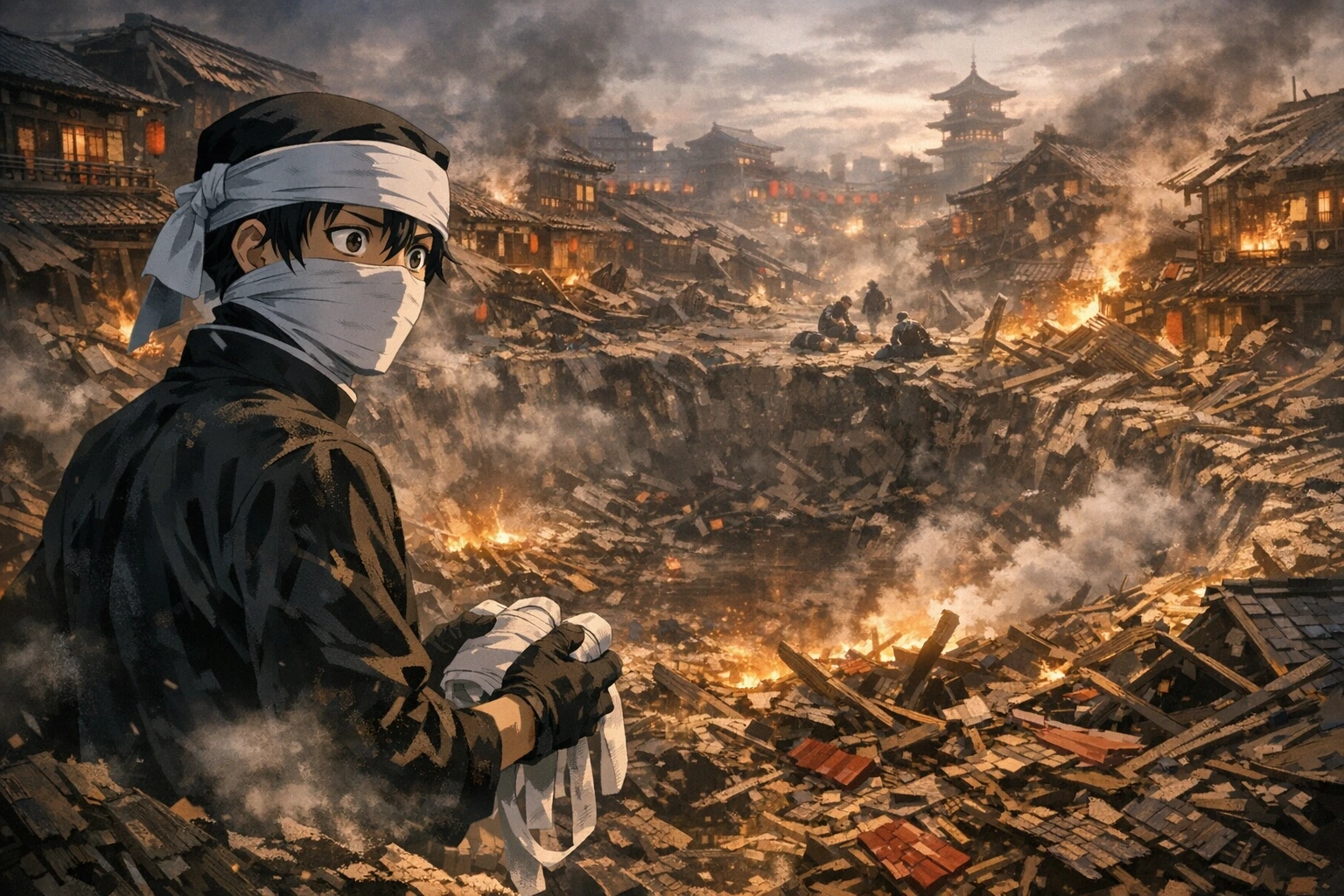
Analyze Goto’s perspective: he is a normal human being walking into a zone where gods clashed. He must navigate burning debris and unstable ruins, actively suppressing his own panic to search for survivors. Finding the battered bodies of Tanjiro, Inosuke, Zenitsu, and the mutilated form of Tengen Uzui required Goto to push past paralyzing trauma.
He had to instantly assess who was closest to death, scream orders to his subordinates, coordinate the immediate application of pressure dressings to Tengen’s severed arm, and map out a quiet extraction route out of a burning, densely populated red-light district before the Tokyo police arrived. The sheer mental fortitude required to witness the severed limbs of demons and the dying gasps of the world’s strongest swordsmen, and still have the presence of mind to execute a flawless medevac, elevates the Kakushi from mere medics to tactical saviors.
3. Information Warfare and Forensic Scrubbing
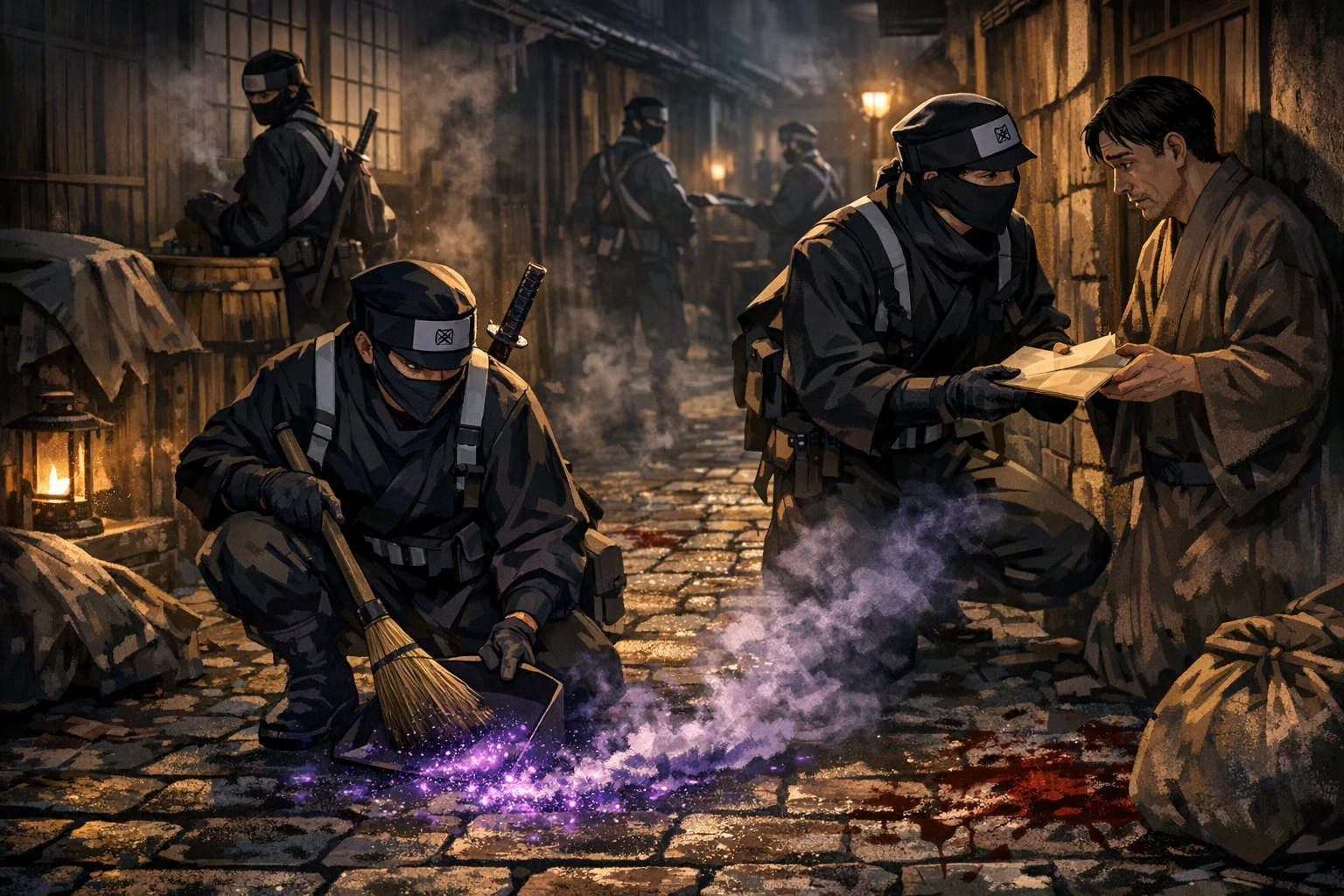
The physical war against Muzan is fought with swords, but the survival of the Demon Slayer Corps is secured through information warfare. The Corps is not a government-sanctioned military; they are an unsanctioned, vigilante organization wielding illegal weaponry in an era where samurai have long been outlawed.
If the Japanese government fully discovered the existence of demons and the Corps, the resulting panic, military intervention, and public scrutiny would destroy the organization’s ability to operate and hand Muzan an easy victory. Therefore, the Kakushi function as the ultimate “Clean-Up Crew,” executing forensic scrubbing with a level of precision that rivals modern intelligence agencies.
Breaking down the forensic science of covering up a demon attack reveals a staggering logistical undertaking. When a battle concludes, the Kakushi do not merely carry away the wounded; they must erase the supernatural from reality. This begins with the systematic disposal of demon ashes. While demons disintegrate in sunlight or by Nichirin blades, traces of their clothing, collateral bio-matter, or residual demonic aura must be scrubbed from the environment.
Structural damage poses an even greater challenge. A battle between a Hashira and a Lower Moon can demolish a forest; a clash with an Upper Moon can level a town. The Kakushi bring in covert construction crews to rapidly repair massive structural damage under the cover of darkness.
More importantly, they manipulate the flow of information. The Kakushi act as intelligence officers, altering local police reports, bribing morticians, and feeding plausible cover stories to the local press. A horrific slaughter by a demon is meticulously restaged and classified in official records as a “bear mauling” or a “pack of rabid wolves.”
The catastrophic destruction of a building is quickly documented as a “gas leak explosion” or an “accidental fire.” They weave a veil of mundane tragedy over supernatural horror, ensuring the general public remains blissfully ignorant.
This massive scale of cover-up and forensic scrubbing requires capital, which brings us to the Ubuyashiki Black Budget. Kagaya Ubuyashiki, the Master of the Mansion, possesses immense, virtually infinite wealth—a byproduct of his family’s curse and centuries of strategic asset management. However, wealth is useless without a distribution network.
The Kakushi act as the financial distributors of the Corps’ black budget. They are the ones who arrive at the scene of a tragedy with briefcases of cash. They instantly buy the silence of traumatized witnesses, compensate victims’ families to prevent them from seeking police investigations, and purchase entirely destroyed properties to control the narrative.
A prime example is the aftermath of the Mugen Train incident. A massive steam locomotive was derailed, and its flesh-infused carriages were destroyed, leaving hundreds of passengers stranded. The Kakushi used the Master’s wealth to instantly bribe railway officials, pay for the immediate medical care of all 200 passengers in private, secure facilities, and purchase the wreckage outright under the guise of an eccentric scrap company. They turned a supernatural train hijacking into a standard mechanical failure in the eyes of the government within hours.
Beyond cleanup, the Kakushi are masters of counter-espionage, best exemplified by the tactical necessity of their transportation protocols to the Swordsmith Village. The Swordsmith Village is the beating heart of the Corps; if Muzan finds it, the war is lost.
To protect this location, the Kakushi employ a cryptographic routing system made of human beings. When transporting Slayers like Tanjiro to the village, they mandate a total sensory blackout. Slayers are heavily blindfolded, given earplugs to disrupt spatial and auditory tracking, and sometimes scent-masked.
The transportation itself is a marvel of operational security. The Kakushi form a human chain of scrambled GPS coordinates. One Kakushi will carry the Slayer on their back, guided by a designated Kasugai Crow, to a specific, unmapped rendezvous point. There, they hand the Slayer over to a completely different Kakushi, guided by a different crow, who takes a convoluted path to the next point.
Neither the starting Kakushi nor the ending Kakushi knows the full route. The path changes every single time. This human chain ensures that even if Muzan’s most advanced spies, or an Upper Moon with tracking abilities, were to capture a Kakushi or follow a Slayer, they would only uncover a fragmented, useless piece of a continually shifting puzzle. It is a flawless, analog encryption system that has kept the Corps’ most vital asset hidden for centuries.
4. The Butterfly Mansion Synergy: Pharmacology and Supply

The Demon Slayer Corps cannot survive on martial prowess alone; it requires a massive, continuous influx of medical supplies, specialized weaponry, and supernatural deterrents. At the center of this logistical web is the Butterfly Mansion, and the Kakushi serve as the vital arteries connecting this medical hub to the bleeding front lines. Their synergy with the Butterfly Mansion encompasses pharmacology, agriculture, and psychological rehabilitation, forming a supply chain that rivals any modern military medical corps.
One of their most critical, yet overlooked, responsibilities is acting as the Wisteria Harvesters. Wisteria is not merely a beautiful flower in this universe; it is a strategic, weaponized resource. It acts as a natural demon repellent, a key ingredient in poisons, and a foundational element for the Final Selection warding. The agricultural logistics of this war are staggering.
The Kakushi are responsible for cultivating, harvesting, processing, and refining massive amounts of Wisteria year-round. They must ensure the soil is maintained at specific altitudes where the flower blooms out of season, carefully extract the essential oils without degrading its supernatural potency, and distribute the processed Wisteria to Slayers across the country in the form of incense, concentrated extracts, and protective charms.
This agricultural division of the Kakushi ensures the Corps has a constant supply of their only natural defense against the demon threat.
This pharmacological duty reaches its absolute peak when the Kakushi act as Shinobu Kocho’s left hand. The Insect Hashira relies entirely on lethal, highly volatile Wisteria-based poisons to compensate for her lack of physical decapitation strength. However, manufacturing the poison is only half the battle; transporting it is a logistical nightmare.
Transporting Shinobu’s concentrated demon toxins to the front lines is akin to moving weaponized, radioactive material. The Kakushi are tasked with safely packaging, temperature-controlling, and physically carrying these highly volatile glass vials across rough terrain. A single misstep, a shattered vial, or an accidental skin exposure could result in severe illness or death for the carrier.
The Kakushi undergo specialized hazard training to handle, deploy, and restock these poisons during active combat scenarios, ensuring Shinobu never runs dry when facing the Upper Ranks. They are the brave couriers of liquid death, taking on immense personal risk so the Insect Hashira can strike true.
Perhaps the most fascinating dynamic of the Kakushi at the Butterfly Mansion is their role as the Rehabilitation Enforcers. When Slayers survive a battle, they are often brought back with shattered bones, torn muscles, and severe psychological trauma. The nurses (like Aoi Kanzaki) and the resident Kakushi must oversee their recovery.
Here lies a profound psychological dynamic: these non-combatants, who possess no superhuman strength or breathing techniques, are the only individuals permitted to physically discipline, scold, and restrict the movement of heavily armed, traumatized, and super-powered teenagers.
Slayers like Inosuke Hashibira or Sanemi Shinazugawa are wild, adrenaline-fueled warriors who constantly attempt to break out of bed rest to return to training or the battlefield before their bodies are healed. The Kakushi and the Butterfly Mansion staff must act as an immovable wall of tough love.
They confiscate Nichirin blades, force foul-tasting medicines down the throats of uncooperative patients, and physically restrain combatants who could easily overpower them. This requires immense emotional intelligence and sheer audacity.
The Kakushi understand that a Slayer returning to the field at 70% capacity is a dead Slayer. Therefore, they willingly absorb the verbal abuse, the tantrums, and the terrifying auras of frustrated warriors, standing their ground to ensure the combatants heal properly. They enforce the discipline of recovery, proving that sometimes, the hardest battle is forcing a hero to sit still.
5. The Hashira Dynamic: Fear, Reverence, and Disconnect
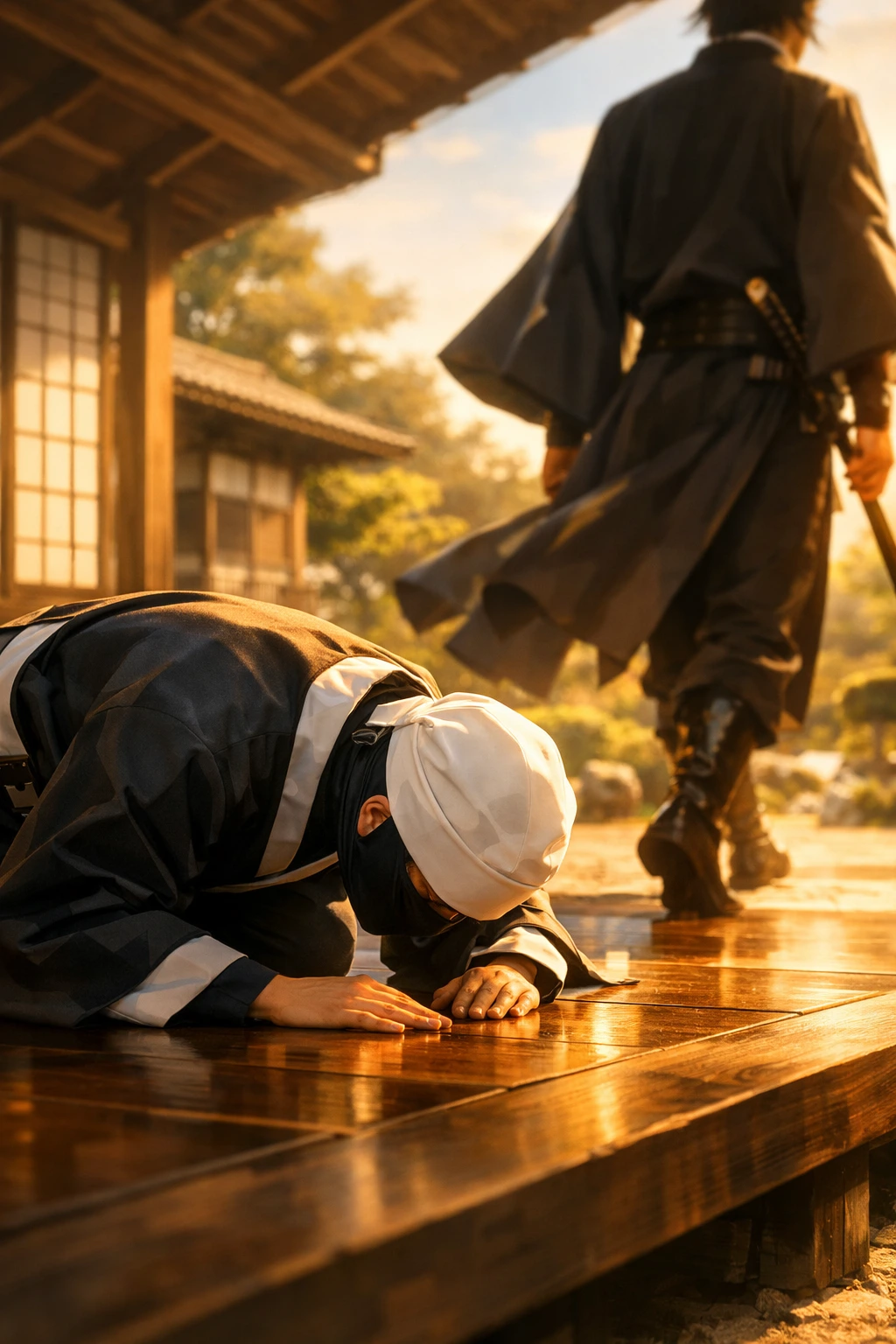
To fully grasp the socio-political structure of the Demon Slayer Corps, one must analyze the complex dynamic between the Kakushi and the Hashira. The nine Pillars sit at the absolute apex of the organization’s hierarchy, possessing power that borders on the mythical.
To a normal human—especially a Kakushi who likely washed out of basic swordsmanship training—a Hashira is not just a superior officer; they are a terrifying, almost alien entity. They are forces of nature, dripping with killing intent, adorned in eccentric uniforms, and bearing the scars of battles that would drive a normal person insane.
The Kakushi view the Hashira with a potent mixture of awe, existential fear, and desperate reverence. Watching Sanemi Shinazugawa train or observing Obanai Iguro’s serpentine movements is a constant reminder of the insurmountable power gap between the sweepers and the elite.
This disconnect often breeds a profound sense of intimidation. The Kakushi walk on eggshells around the Pillars, terrified of drawing their ire, knowing that the people they serve routinely slaughter monsters that normal humans cannot even comprehend.
This immense gap in power and responsibility became a logistical crucible during the Pillar Training Arc. As Muzan’s final attack loomed, the Corps initiated a massive, nationwide training camp where every lower-ranked Slayer was subjected to the grueling tutelage of all available Hashira. From a combat perspective, it was necessary. From a logistical perspective, it was a waking nightmare for the Kakushi.
The Kakushi facilitated the entire infrastructure of this monumental endeavor. They had to coordinate the movement of hundreds of Slayers between various Hashira estates spread across vast territories. Imagine the sheer nightmare of supplying this operation: the Kakushi were tasked with cooking thousands of high-calorie meals a day to sustain the hyper-metabolism of training Slayers.
They worked around the clock repairing thousands of wooden bokken (practice swords) shattered against Hashira defenses. Most brutally, they operated as full-time trauma medics. When a Slayer was beaten unconscious by Sanemi’s brutal wind drills, or suffered severe blunt-force trauma, concussions, and dehydration from Gyomei’s boulder-pushing exercises, it was the Kakushi who dragged their broken bodies to the infirmary, bandaged them, hydrated them, and prepared them for the next day’s torture.
The Hashira provided the crucible; the Kakushi provided the fuel, the repairs, and the medical safety net that prevented the training from becoming a mass casualty event.
Yet, despite this terrifying power dynamic and the endless, grueling labor, the emotional core of the series shines through in the unspoken respect the greatest Hashira hold for the Kakushi. While figures like Sanemi might be abrasive, the true leaders of the Corps understand the value of their support network. Kyojuro Rengoku, the Flame Hashira, treated every Kakushi with booming, absolute respect, acknowledging their hard work with a bright smile, never once looking down on them for lacking sword skills.
Gyomei Himejima, the Stone Hashira and the strongest of them all, wept for their sacrifices and spoke to them with gentle reverence.
These elite warriors, possessing god-like reflexes and strength, understand a fundamental truth: a Hashira can only be a Hashira because the Kakushi exist. A Pillar can sleep soundly because a Kakushi stands watch. A Pillar can swing their sword without hesitation because they know a Kakushi will clean up the blood, protect the civilians, and carry them home if they fall.
This mutual, unspoken respect bridges the massive disconnect in power. The Hashira are the sword that strikes the demon, but the Kakushi are the hand that grips the hilt, providing the stability required to win the war.
6. Conclusion: The Backbone of the Victory
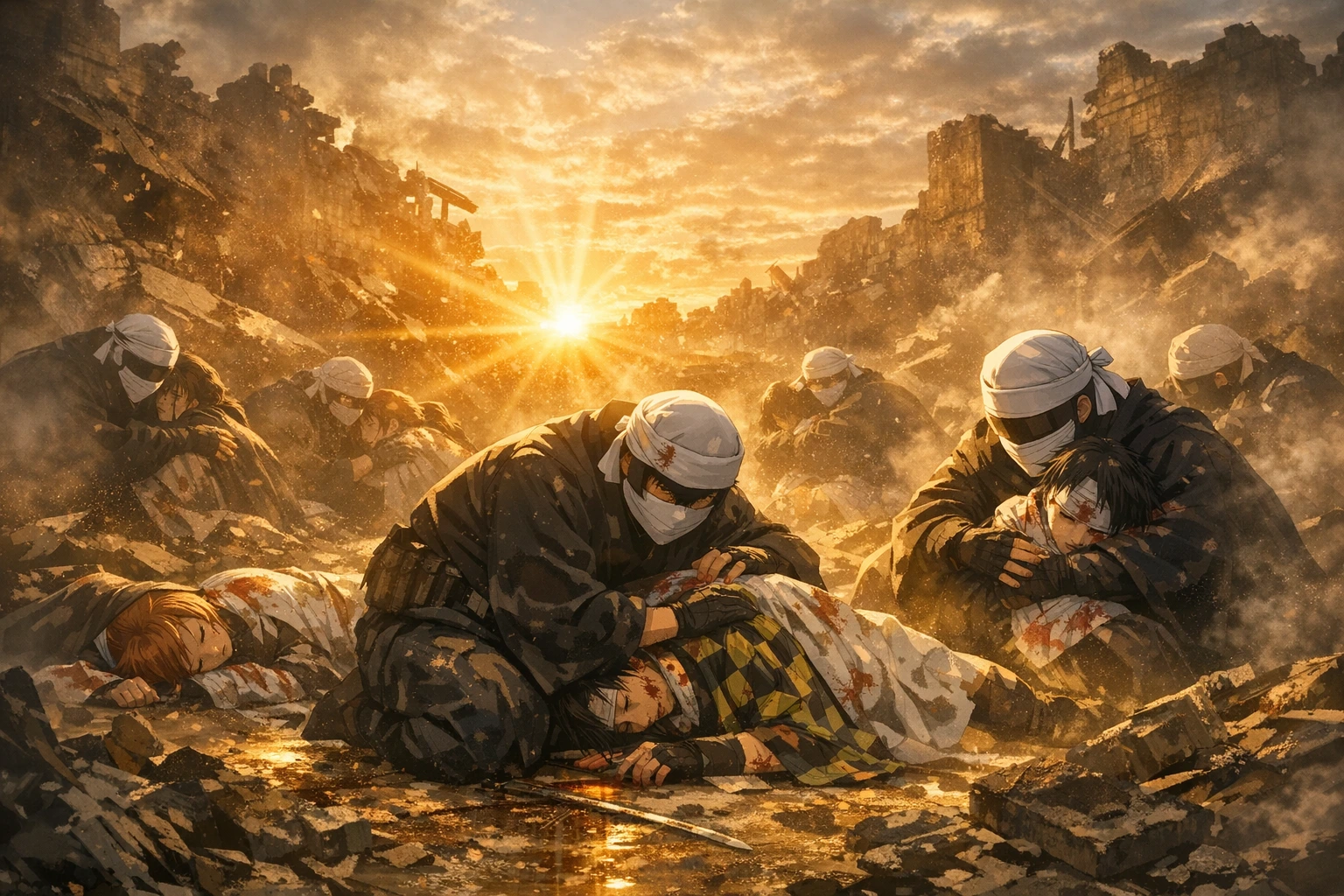
The climax of Demon Slayer is a symphony of blood, sacrifice, and unbreakable human will. During the final, apocalyptic battle against Muzan Kibutsuji, the true essence of the Kakushi was laid bare for all to see. The Sunrise Triage was not conducted in the shadows after the battle had ended; it occurred in the chaotic, crumbling epicenter of the warzone.
As the Hashira and the Kamaboko squad pushed their shattered bodies past the limits of human endurance to keep the Demon King pinned under the rising sun, the Kakushi abandoned their traditional role of covert sweepers. They flooded the battlefield.
Frame this final battle from the perspective of a Kakushi: the sky is raining debris, the ground is quaking from Muzan’s shockwaves, and monstrous, flesh-tearing whips are moving faster than the eye can track. Yet, the Kakushi did not flee. They rushed directly into the kill zone. They dragged severed limbs and bleeding Hashira out of the line of fire.
In the most heart-wrenching displays of valor, when Muzan unleashed his desperate, final omnidirectional attacks, ordinary Kakushi formed a literal human shield. They threw their own fragile, unarmored bodies over the wounded Slayers—over figures like Kanroji, Iguro, and Sanemi—willing to be vaporized by Muzan’s whips to buy the combatants one more second of life.
It is here that the Kakushi are cemented as the unsung heroes and the absolute pinnacle of human bravery in the series. Bravery is not the absence of fear; it is action in the face of overwhelming terror. The Hashira are brave, but they are armed with Nichirin steel, enhanced by Demon Slayer Marks, and empowered by Total Concentration Breathing.
The Kakushi face the exact same monstrous horrors, the exact same threat of violent dismemberment, but they do so as normal, powerless human beings. They do not have magic to protect them; they only have their sheer, indomitable will to see a world without demons. Their sacrifice during the dawn of that final day was the ultimate equalizer, proving that the human spirit, regardless of combat aptitude, is stronger than Muzan’s blood.
The final expert verdict on the lore of Demon Slayer is one deeply rooted in the realities of warfare: battles are won by firepower, but wars are won by logistics. For one thousand years, the Demon Slayer Corps waged a secret, attritional war against an immortal, biologically superior enemy. They did not survive a millennium because they always had the strongest swordsmen—there were generations where the Hashira were weak and demons ran rampant. The Corps survived for 1,000 years solely because the Kakushi never stopped working.
They never stopped forging the cover stories. They never stopped harvesting the Wisteria. They never stopped carrying the broken bodies of teenagers out of burning forests. They never stopped cleaning up the blood. The decapitation of Muzan Kibutsuji was the final, glorious strike of the blade, but it was the Brigade of the Broken, the invisible, tireless Kakushi, who carried that blade through the darkness for a thousand years to finally reach the dawn.