
I. Introduction: The Monster That Ate the World
In the spring of 2013, the landscape of global animation changed forever. It didn’t happen with a whimper, but with a crack of lightning, a colossal hand gripping a fifty-meter wall, and a grim reminder that humanity was merely cattle.
When Attack on Titan legacy (Shingeki no Kyojin) first aired, it was immediately classified as a horror-action spectacle—a show about giant, skinless zombies eating people while soldiers zipped around like Spider-Man with swords. But looking back from the vantage point of its conclusion, calling Attack on Titan a “zombie show” feels as reductive as calling Breaking Bad a show about high school chemistry.
Hajime Isayama did not just write a manga; he crafted the defining narrative of a generation. Before Attack on Titan, there was a distinct, tangible barrier between “anime” and “prestige television.”
Anime was often viewed through the lens of specific tropes: the power of friendship, colorful transformations, and high school antics. Western audiences consumed Breaking Bad, Game of Thrones, and The Sopranos for their moral complexity, while anime was often relegated to a separate category of entertainment.
Attack on Titan shattered that barrier. It demanded to be taken as seriously as the heaviest live-action dramas, forcing the medium of animation to grow up, bulk up, and face the cruelty of the real world.
This article is not a mere review. It is an autopsy of a cultural titan. We will dissect how Isayama systematically deconstructed the Hero’s Journey, weaponized political realism to terrify his audience, and presented a philosophical treatise on freedom and birth that will be studied in media literacy courses for decades.
This is the story of how a shonen manga became a cautionary tale about the cyclical nature of human violence, and why it stands as the most important animated work of the 21st century.
II. The Death of the “Power of Friendship” (Deconstructing Shonen)
To understand the magnitude of Attack on Titan’s legacy, one must first look at the environment into which it was born. The “Shonen” demographic (young boys) has been dominated for decades by the “Big Three” philosophy (Naruto, One Piece, Bleach).
The core tenets of this philosophy are simple: if you scream loud enough, train hard enough, and rely on your friends, you will win. Willpower is a tangible force that can override physics.
Isayama looked at this formula and dismantled it with surgical precision.
The Fallacy of the Scream
In a traditional shonen, when the protagonist is backed into a corner and watches a loved one die, they unlock a hidden power. They scream, their hair changes color, and they defeat the villain.
In Attack on Titan, when Eren Yeager screams in the early seasons, nothing happens. He gets eaten. When he charges blindly at the Colossal Titan in Trost, he loses his leg. The series establishes a brutal rule early on: Competence creates survival, but luck dictates it.

Consider the fate of the original Levi Squad in the Forest of Giant Trees. These were the elite of the elite—the absolute apex of human combat ability. In a standard narrative, their combined power and bond of friendship would be enough to overwhelm the Female Titan. Instead, they are swatted like flies.
Petra Ral, a fan favorite, is crushed against a tree instantly. There are no “last words.” There is no slow-motion flashback to her childhood to give her death “meaning.” She dies terrified, in pain, and alone.
This was a shock to the system for anime viewers. It introduced real stakes. In Attack on Titan, characters do not die to further the plot; they die because they made a tactical error, or simply because they were in the wrong place at the wrong time.
This unpredictability stripped the audience of their “plot armor” comfort blanket. We stopped watching with the assumption that “everything will be okay” and started watching with the dread that “anyone could die right now.”
The Turning Point of Trust
The deconstruction goes deeper than just death; it attacks the very concept of trust. In standard team-based anime, trusting your comrades is the ultimate virtue.
During the Female Titan arc, Eren is faced with a choice: trust his squad to handle the threat, or trust in his own power and transform. He chooses the “moral” option—he trusts his friends.
And because of that choice, they all die.
If Eren had transformed immediately, Levi Squad might have survived. Isayama subverts the moral lesson. In this world, trusting others isn’t always the right answer; sometimes, individual ruthlessness is required to preserve life.
This moment fundamentally breaks Eren, planting the seeds for his future solitary path. It teaches him that relying on others can lead to disaster, a lesson that festers until it blooms into the genocide of the final season.
The Grey Protagonist: From Hero to Monster
The most significant deconstruction, however, lies in the character of Eren Yeager. Initially, Eren is presented as the archetypal shonen protagonist: loud, determined, and fueled by a simple desire for revenge. He wants to “kill them all.” In Season 1, this is framed as a righteous crusade. We, the audience, cheer for him. We want him to kill the Titans.
Isayama played a long con on his audience. He didn’t change Eren; he changed the context around him. Eren’s personality remains largely static—he is always an angry boy seeking freedom at any cost. But by shifting the genre from a “Humanity vs. Monsters” story to a “Humanity vs. Humanity” story, Eren’s traits stop being heroic and start being terrifying.
The same drive that makes a shonen hero inspiring is what makes a genocidal dictator dangerous. An unwillingness to compromise, a singular focus on “enemies,” and a belief that the end justifies the means—these are the traits of a villain.
Isayama forced the audience to look in the mirror and ask: “You cheered for his violence when it was directed at monsters. Why are you uncomfortable now that it is directed at people?”
III. The Mirror of Our World: Politics and War
The “Basement Reveal” in Attack on Titan is perhaps the greatest plot twist in modern fiction, not just because it changed the story, but because it changed the genre.
For three seasons, we watched a post-apocalyptic survival horror. We believed humanity was extinct, huddled inside walls to survive a natural predator.
Then, the photograph was found. Humanity wasn’t extinct; the people inside the walls were just an isolated ethnic minority, and the “Titans” were biological weapons sent by a modernized world that hated them.
From Survival to Geopolitics
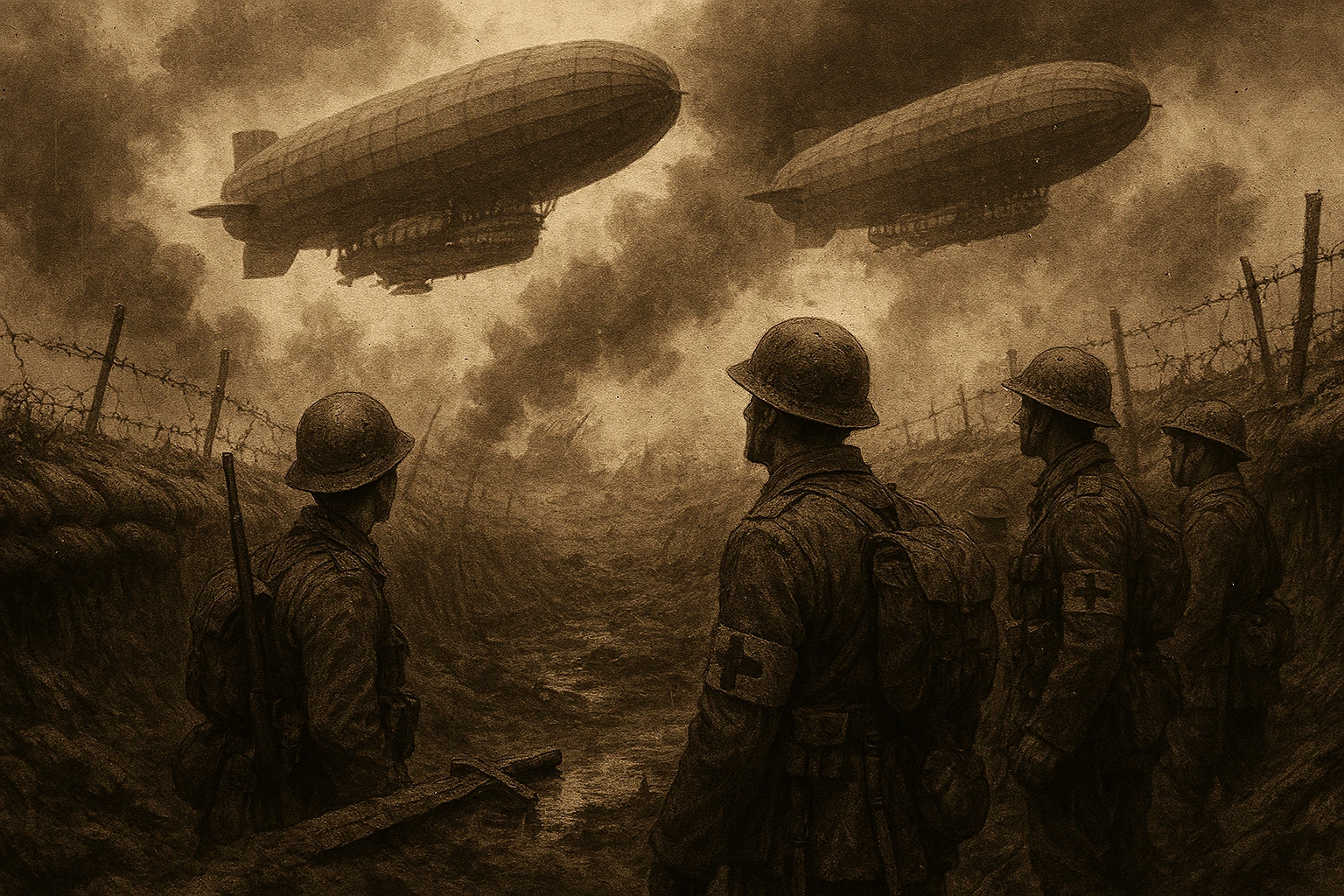
Suddenly, the story wasn’t about survival; it was about racism, historical revisionism, and the military-industrial complex. The transition from Season 3 to Season 4 is jarring by design. We trade the lush forests and medieval towns of Paradis for the trenches, airships, and internment zones of Marley.
Isayama utilizes imagery that evokes the darkest chapters of the 20th century. The Eldians in Marley are forced to live in ghettos, wearing armbands to identify their heritage. They are subjected to systemic indoctrination, taught to hate their own ancestors to survive. This is where the series transcends entertainment and becomes a political horror.
The brilliance of the “Marley Arc” is how effectively it brainwashes the audience. We spend the first part of the final season with the “enemy.” We meet Gabi, Falco, and Reiner. We see that they aren’t evil; they are just children fed a steady diet of propaganda.
When Eren attacks Liberio, slaughtering civilians and children, the audience is placed in an impossible position. We know Eren’s pain, but we also see the horror he is inflicting. We can no longer blindly support the protagonist.
The Radicalization of the Common Man: Floch Forster
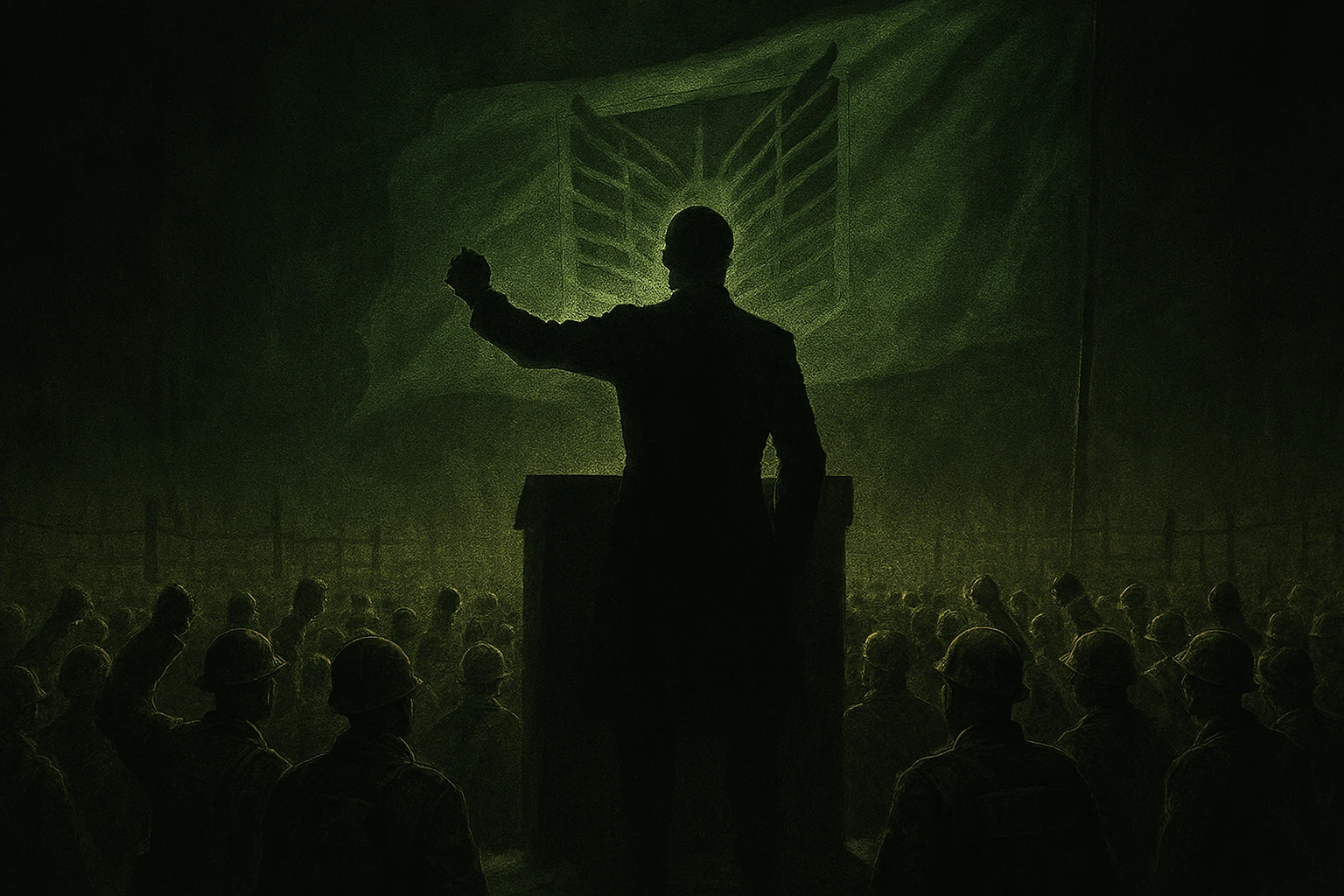
To understand the political genius of Attack on Titan, one must look at Floch Forster. He is arguably the most realistic character in the series. Floch begins as a coward—a cannon fodder recruit who survives the suicidal charge against the Beast Titan purely by luck. He is traumatized, broken, and terrified.
In a standard story, Floch would either overcome his fear to become a hero or retire in peace. Isayama chooses a third, darker path: Radicalization. Floch’s trauma convinces him that the only way to survive in a cruel world is to be crueler than the enemy. He looks for a “Devil” to lead him, first in Erwin Smith, and then in Eren Yeager.
Floch represents how fascism rises not from “evil” people, but from fearful ones. He becomes the face of the Jaegerists, executing dissenters and burning homes, all while believing he is saving his country. He is the mirror of the modern extremist—radicalized by trauma, seeking safety in authoritarian strength, and justifying atrocities in the name of national defense.
His evolution from a weeping coward to a nationalist leader who dies for his cause is a chilling study on how easily the “common man” can be corrupted by hate.
The Cycle of Hatred
The core political thesis of Attack on Titan is that violence is a self-perpetuating machine. It doesn’t offer the childish solution of “World Peace” achieved through a common enemy (the Code Geass or Watchmen route).
When characters in Attack on Titan try to break the cycle, they fail.
- The King of the Walls tried to break it by erasing memories and accepting isolation. It failed because the world wouldn’t leave them alone.
- Zeke Yeager tried to break it through sterilization (peaceful genocide). It failed because it denied the basic right to life.
- Eren Yeager tried to break it through omnicide (killing everyone outside the island). It failed because violence leaves scars that never heal.
The story posits a grim reality check: As long as there are two people left on Earth, there will be conflict. The series serves as a critique of the “us vs. them” mentality, showing that “them” is just “us” born on the other side of the ocean.
The Jaegerists (Eren’s radical faction) are a perfect depiction of how nationalism can morph into fascism. They start as freedom fighters and end as tyrants executing dissenters in the streets, proving that the oppressed often become the oppressors the moment they gain power.
IV. The Philosophy of Birth: “Because I Was Born Into This World”
While the politics of Attack on Titan are grand and sweeping, its philosophy is deeply intimate. The central ideological battle of the series is not between Eldia and Marley, but between Natalism (the belief that life is worth living) and Anti-Natalism (the belief that it is better never to have been born).
The Nihilism of Zeke Yeager
Zeke Yeager represents the ultimate pessimist. His philosophy is rooted in the trauma of his childhood and the suffering of the Eldian people. He looks at the world—full of pain, racism, and war—and concludes that existence itself is the problem.
His “Euthanasia Plan” is, in his eyes, an act of mercy. If Eldians stop having children, the Titans disappear, and no one has to suffer anymore. It is a utilitarian approach: minimize suffering by eliminating the sufferer. This is a powerful, dangerous philosophy because it appeals to logic. If life is pain, why continue?
The Existentialism of the Mothers

Opposing Zeke is the philosophy of Eren, inherited from his mother, Carla. When a bystander asks if Eren is special, Carla says, “He doesn’t have to be special. He doesn’t have to be great. Look at him… he’s so cute. He’s already special, because he was born into this world.”
This is the show’s rebuttal to nihilism. It is a radical affirmation of life. Value is not derived from what you achieve, your bloodline, or your utility to the state. Value is intrinsic to existence. This clash comes to a head in the Paths, where the ideology of the older brother (who wishes he was never born) clashes with the younger brother (who fights because he was born).
The Architecture of Slavery: Ymir Fritz

The philosophical pinnacle of the series is the revelation of Ymir Fritz, the Founder. For centuries, she was viewed as a goddess or a devil. In reality, she was neither. She was a slave.
Ymir’s story is the ultimate tragedy of the series. She gained godlike power, yet she remained mentally shackled to the King who abused her, enslaved her, and forced her to bear his children. Even in death, she spent 2,000 years building Titans out of sand in the Paths, obeying the royal bloodline.
Isayama uses Ymir to explore the darkest corners of the human psyche: the inability to break free from an abusive love. Ymir represents the part of humanity that seeks connection so desperately that it will endure any torture to maintain it. She didn’t yearn for power; she yearned for love.
Her “freedom” could not be granted by Eren (who only offered her the freedom to destroy); it had to be granted by Mikasa. Ymir needed to see someone who loved their oppressor (Mikasa loved Eren) but had the strength to kill him for the greater good. This act severed the psychological chains of 2,000 years, proving that love and obedience are not the same thing.
Erwin vs. Armin: Meaning in Death vs. Meaning in Life
The series also explores how we cope with the cruelty of the world through the contrasting worldviews of Erwin Smith and Armin Arlert.
Erwin Smith represents the search for meaning through a “Great Goal.” He leads hundreds to their deaths by convincing them that their sacrifice contributes to a larger truth. His philosophy is one of grandiose burden. “The living must give meaning to the dead.” It is noble, but it is also a heavy curse.
Armin Arlert, conversely, finds meaning in the mundane. In his conversation with Zeke in the Paths, he doesn’t talk about saving the world or grand strategies. He talks about a leaf. He talks about running up a hill with Eren and Mikasa. He talks about throwing a baseball. Armin argues that the meaning of life isn’t found in the grand conclusion, but in the “trivial moments.” This existentialist perspective—that small joys justify the struggle of existence—is ultimately what convinces Zeke to change his mind. It is the “leaf” that beats the “spear.”
What is Freedom?
Finally, the series tackles the paradox of freedom. Eren Yeager is the character most obsessed with freedom in fiction history. He moves forward, crushing everything in his path, to achieve it. Yet, the irony is that Eren is the least free character in the show.
He is a slave to his own future memories. He sees the future and feels compelled to enact it. Is a man free if he knows his destiny and cannot change it? Isayama suggests that absolute freedom is a cage. By seeking to be free of all constraints, Eren becomes a slave to his own nature. The “Attack Titan” moves forward not because it chooses to, but because it must.
V. The Evolution of Animation: WIT vs. MAPPA
The legacy of Attack on Titan is not just narrative; it is technical. The production of the anime is a tale of two studios, each defining a different era of the story.
The WIT Era: The Golden Age of Action
Seasons 1 through 3 were handled by WIT Studio. Their approach was defined by “Araki Style” (named after director Tetsuro Araki). It was characterized by thick, bold lines, vibrant colors, and—most importantly—the revolutionizing of 3D maneuver gear sequences.
Before Attack on Titan, portraying three-dimensional movement in 2D animation was notoriously difficult. WIT utilized a groundbreaking blend of 3D backgrounds and 2D character animation. The camera would swoop and dive through the Trost District, tracking Levi or Mikasa as they spun through the air. These sequences were visceral, high-octane, and visually stunning. This style perfectly matched the “Heroic” phase of the story. It was romanticized violence—terrible, but beautiful.
The MAPPA Era: The Gritty Reality
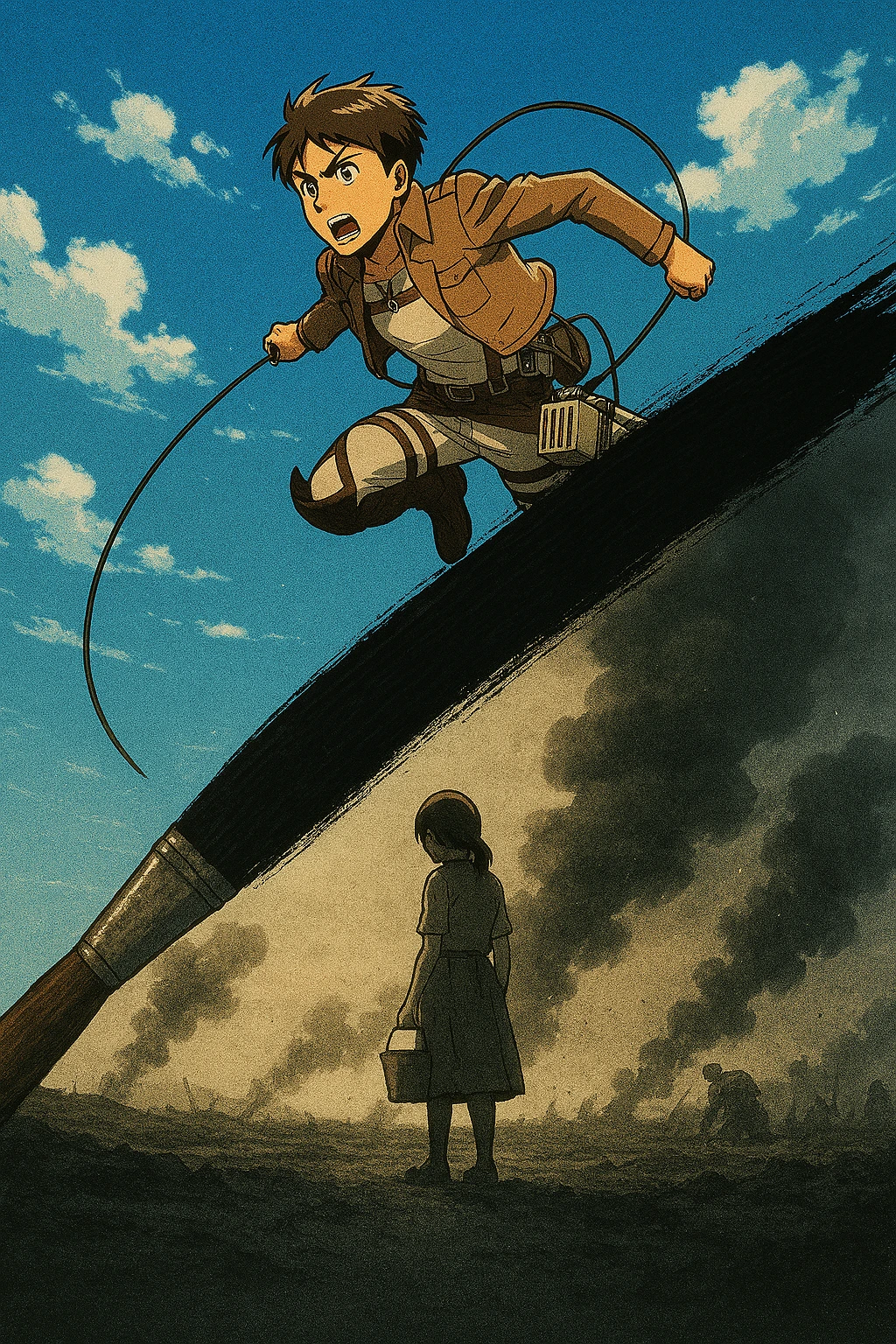
When MAPPA took over for the Final Season, the visual identity shifted drastically. The thick lines were gone, replaced by a more detailed, sketchy, and realistic art style that closer resembled the manga’s later chapters. The colors became desaturated. The “beauty” was stripped away.
This shift was controversial, especially regarding the use of CGI for the Titan shifters. However, thematically, it was perfect. The story was no longer a romantic struggle against monsters; it was a gritty war drama. The CGI Titans, while initially jarring to fans used to 2D, possessed a weight and uncanniness that fit the industrial warfare of the Marley arc.
The “CGI Titan” controversy also highlighted the industry’s darker side. Attack on Titan pushed the limits of what was technically possible on a TV schedule, leading to widespread reports of animators working in grueling conditions.
The “production hell” stories surrounding the series became a meta-commentary on the state of the anime industry itself. It highlighted a systemic issue where creating a masterpiece often requires immense human sacrifice, a burden not unique to Attack on Titan but exemplified by its schedule.
VI. The Cultural Phenomenon: “Break the Internet”
It is difficult to overstate how much Attack on Titan permeated mainstream culture. Before 2013, you might see a Dragon Ball shirt in public. After 2013, the Scout Regiment “Wings of Freedom” logo was everywhere—on backpacks, jackets, and cars.
The Sunday Ritual
For a decade, Attack on Titan created a global synchronized viewing event. When a new episode dropped, streaming servers (Crunchyroll, Funimation, Hulu) reportedly struggled under the load, with frequent outages cited by fans during premiere hours. This wasn’t just viewership; it was an event. The hashtags would trend worldwide on Twitter (X) for hours.
It bridged the gap between the “Sub vs. Dub” divide and brought in the “HBO Crowd.” People who would never touch a “cartoon” were watching Attack on Titan because the plotting was as intricate as Westworld or Breaking Bad. It became the watercooler show.
The Sound of the Apocalypse
The legacy is also sonic. Hiroyuki Sawano’s soundtrack for the first three seasons is legendary. It used German lyrics, massive orchestral drops, and electronic synthesizers to create a soundscape that felt “Epic” in the truest sense of the word. Tracks like “Vogel im Käfig” (Bird in a Cage) are instantly recognizable.
Then, Kohta Yamamoto took the reins for the final season, shifting the sound to something more tragic and eerie, perfectly complementing the darker tone. The opening themes reflect this journey: from the patriotic, bombastic “Guren no Yumiya” by Linked Horizon (representing the fervor of war) to the chaotic, screaming metal of “The Rumbling” by SiM (representing the horror of genocide).
However, the most culturally significant track might be “My War” (Boku no Sensou) by Shinsei Kamattechan. Opening Season 4, this track abandoned the “hype” rock of previous seasons for a creepy, disjointed, choral melody that sounded like children chanting in a cult.
It was disturbing, artistic, and signaled to the world that the “heroic” story was over. It wasn’t an opening song designed to make you buy toys; it was a piece of avant-garde art designed to make you uncomfortable. This willingness to alienate the audience for the sake of tone is what set Attack on Titan apart.
VII. The Ending Controversy: A Feature, Not a Bug
No discussion of Attack on Titan is complete without addressing the elephant in the room: Chapter 139 (and the final episode). The ending was arguably the most divisive conclusion in anime history, rivaling the controversy of Mass Effect 3 or Game of Thrones.
The fanbase fractured. Some wanted a “Chad Eren” ending where he completes the Rumbling, kills everyone, and returns to his wife and child—a complete victory for nationalism. Others wanted a “Code Geass” ending where Eren unites the world through his death.
Isayama gave them neither. He gave them a messy, pathetic, and painful reality.
The Destruction of the Idol
In the finale, Eren breaks down. He confesses he doesn’t want to die, that he’s an “idiot” who got hold of too much power. This enraged fans who had projected a “stoic god” image onto him. But this was Isayama’s final deconstruction. He stripped the mask off the monster to reveal a confused, angry child. It was a rejection of the “Cool Genocider” trope.
The 80% Solution
Eren kills 80% of humanity. It is an incomprehensible number. The alliance stops him, but the damage is done. The world is broken. The most controversial aspect, however, is the epilogue (specifically the extra pages in the manga and the post-credits scene in the anime).
We see peace for a while. Mikasa lives a long life. But eventually, decades or centuries later, Shiganshina is bombed. The city is destroyed. War returns.
Many fans screamed, “It was all for nothing!” But that is the point. That is the message. Isayama refused to write a fairy tale where killing a “Demon Lord” brings eternal peace. The ending validates the thesis: Conflict is human nature. Eren bought his friends long lives, but he could not cure humanity of its violent impulses. The Rumbling was not a solution; it was just another rotation of history.
The fact that the fandom is still fighting about the ending—arguing over who was right, the Jaegerists or the Alliance—is the ultimate meta-proof that Isayama’s themes worked. We, the real humans, are trapped in the same conflict loop over a drawing. The ending wasn’t a mistake; it was a mirror reflecting our own inability to find common ground.
VIII. Conclusion: A Modern Masterpiece
Attack on Titan is a flaw in the system. It is a story that was too dark for children, yet too animated for traditional adults, and somehow, it captured everyone. It began as a story about walls—physical walls keeping monsters out—and ended as a story about the invisible walls of history, race, and ideology that keep us apart.
Its legacy is cemented alongside the titans of the industry: Neon Genesis Evangelion (for its psychological depth) and Akira (for its visual revolution). But Attack on Titan stands alone in its political audacity. It dared to ask its audience to sympathize with monsters, to question their own definitions of freedom, and to accept that there are no happy endings in war, only survivors.
It challenged the medium to be more than just escapism. It proved that animation can handle the weight of genocide, fascism, and existential dread without losing its mass appeal. It raised the bar for storytelling, sound design, and thematic consistency so high that future anime will spend the next decade trying to reach it.
In the final shot of the series, a boy and a dog approach the tree where Eren is buried—a tree that now looks suspiciously like the one where the original Titan power was found. The cycle is ready to begin again.
Isayama leaves us with a haunting sentiment, a message sent “To You, 2,000 Years From Now”: The world is cruel, but it is also beautiful. And while we may be doomed to repeat our mistakes, the struggle to understand one another is the only thing that makes the nightmare worth enduring.
This is not just an anime. It is a warning. And it is a masterpiece.

What Do You Think?
Did Attack on Titan truly kill the “Power of Friendship” trope, or did it just complicate it? Is Eren Yeager a victim of fate or a monster of his own making? Leave a comment below with your thoughts—we want to hear your perspective on the legacy of the Titans.