
By the time the smoke cleared from the office of Premier Darius Zackly, the old world of Attack on Titan was dead. It didn’t die with a Titan’s roar or a blast of steam; it died with the cheers of a radicalized crowd.
The explosion that shattered the military headquarters was more than an assassination; it was a declaration of a new era. For years, the story of Paradis Island was defined by a unified humanity fighting against mindless monsters.
The lines were clear: Humanity stood on one side, and the Titans stood on the other. But the moment Zackly’s body hit the pavement, followed by the roar of the crowd chanting “Dedicate your hearts” to a new savior, the narrative shifted irrevocably. The monsters were no longer Titans; the monsters were us, them, and the terrifying ambiguity in between.
This marked the birth of the “New Eldian Empire” and the rise of the Yeagerists (Yeager-ha).
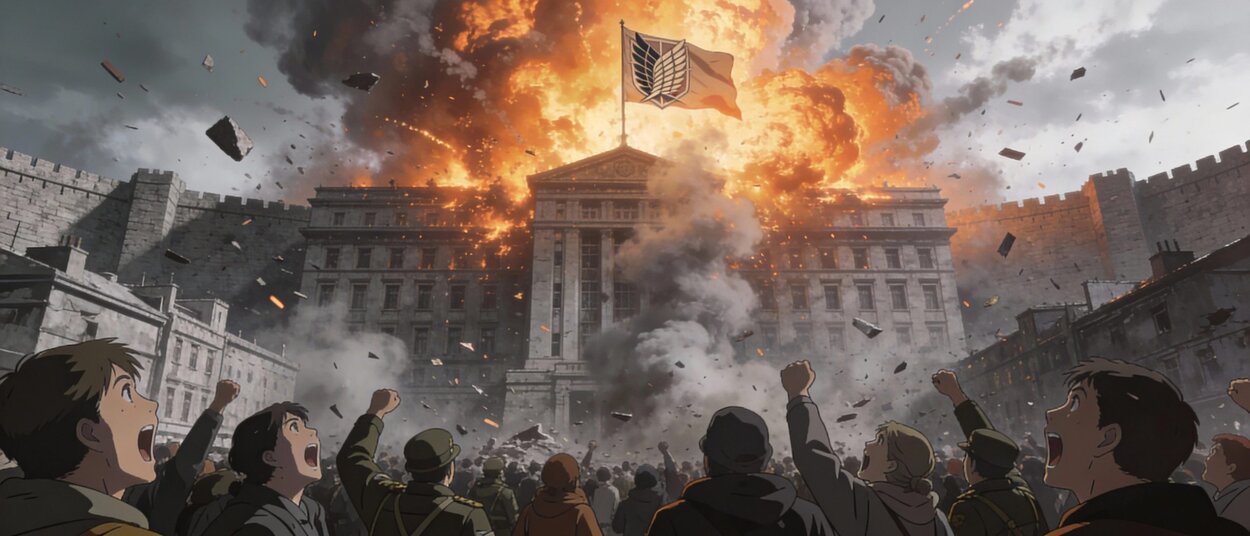
To the casual viewer, the Yeagerists attack on titan often appear as cartoonish villains—gun-toting, xenophobic extremists who overthrew a rightful government. They are easy to hate. They beat up Keith Shadis, the man who trained them; they executed dissenters in the streets; they cheered for global genocide with a fervor that chills the spine.
However, to dismiss them simply as “evil” is to ignore the masterclass in sociological storytelling that Hajime Isayama constructed. The Yeagerists are not an anomaly; they are a consequence. They are the inevitable biological reaction of a society that has been caged, eaten, lied to, and then told that the entire world wishes for their extermination.
The Survey Corps, led by Hange Zoë and Armin Arlert, represented the idealism of the past—the belief that understanding and dialogue could bridge the gap between enemies, no matter how wide. But idealism requires time, and time was the one resource Paradis Island did not have. The Global Alliance was gathering.
The Declaration of War had been signed in Liberio to thunderous applause. The fleets were approaching. In this vacuum of existential dread, the Yeagerists emerged not as villains, but as the manifestation of the “Cornered Rat” theory: when an organism is trapped with no escape, it does not negotiate; it bites.
This article will not just recount the events of the uprising; it will surgically dissect the soul of the Yeagerist movement. We will analyze the trajectory of Floch Forster, a man who transformed from a coward into a kingmaker, examine the terrifying psychology of the mob, and answer the uncomfortable question that lingers over the series finale: Was the average citizen of Paradis wrong to view the Alliance as traitors?
Floch Forster: The Devil’s Right Hand
To understand the Yeagerists, you must understand their architect. Floch Forster is, without a doubt, one of the most polarizing figures in modern anime history. He is a character designed to be detested, yet written with such terrifying logical consistency that you cannot help but respect his competence. His evolution is not just character development; it is a warning.
The Survivor: From Coward to Zealot
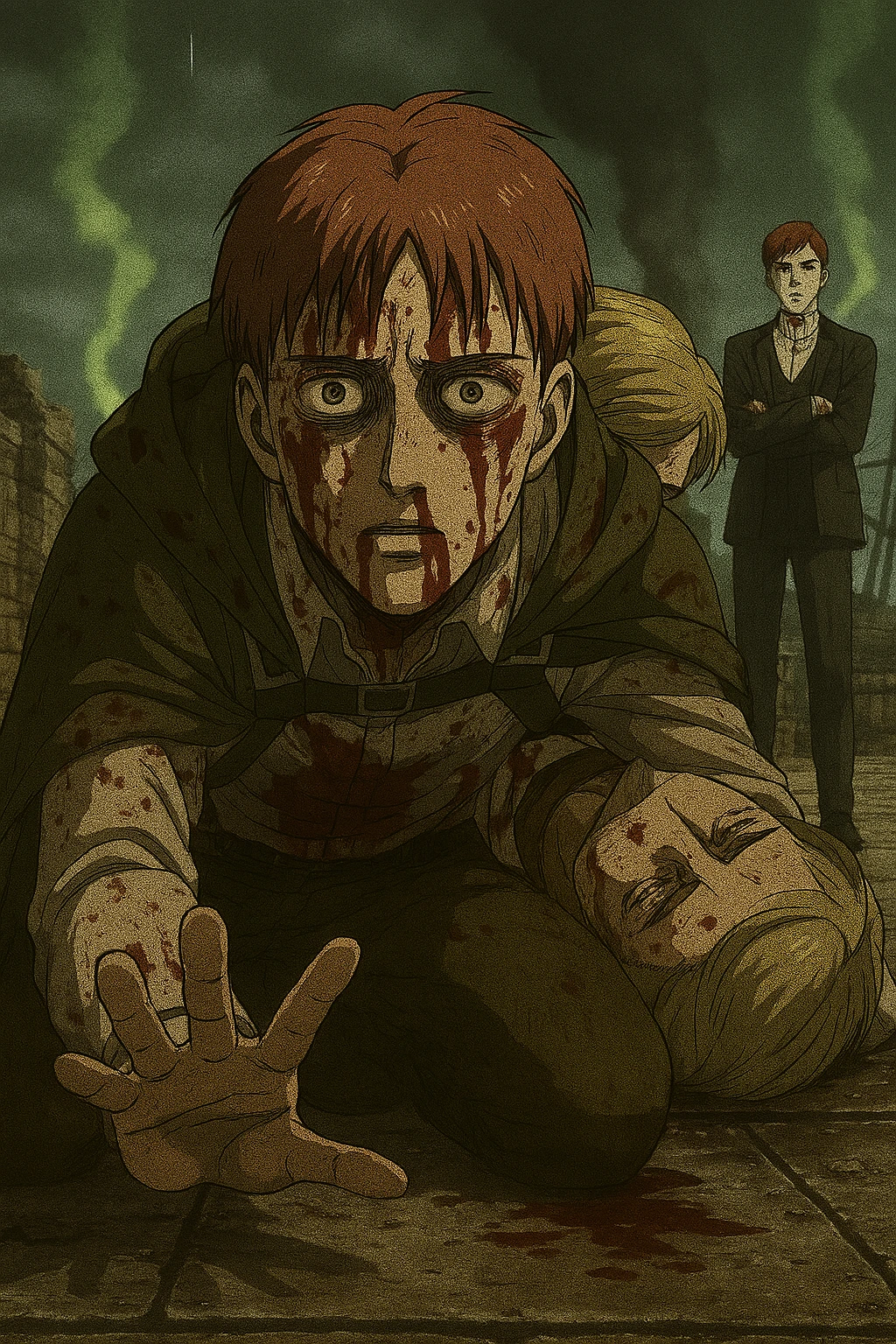
Floch’s journey begins in the shadow of giants, and it begins in humiliation. In Season 3, during the Return to Shiganshina arc, Floch was nothing more than fodder—a terrified recruit in the Garrison who joined the Scouts looking for glory, only to find himself facing the Beast Titan’s deadly barrage of crushed rocks.
He was the voice of fear, the one who openly wept and asked the question everyone else was too proud to voice: “What is the point of dying if it’s meaningless?”
He was not brave. He was not skilled. He survived the suicide charge not by talent, but by sheer, cruel chance. He was the sole survivor of Erwin Smith’s final gamble, wandering through a mist of blood and viscera to find his commander still breathing.
This trauma broke Floch, but it also remade him. Carrying the dying Commander Erwin back to Levi, Floch came to a dark realization that would define the rest of his life: Humanity cannot be saved by morality. It can only be saved by a Devil.
When Levi chose to save Armin instead of Erwin, Floch felt a profound sense of betrayal. He believed that the logic of the world dictated that the ruthless survive and the kind perish. In his eyes, Armin was a symbol of hope, dreams, and the ocean—luxuries they could not afford in a war for survival.
Erwin was the symbol of necessary sacrifice, the man who would discard his humanity to defeat monsters. When the “Devil” (Erwin) died, Floch spent the four-year time skip searching for a new one. He found that devil in Eren Yeager.
Floch’s loyalty to Eren is not born out of friendship; it is born out of religious necessity. He views Eren not as a comrade, but as a weapon—the only entity capable of doing what needs to be done.
Floch sacrificed his humanity on that battlefield in Shiganshina, and in return, he demanded a leader who would do the same. He projected Erwin’s ghost onto Eren, believing that only a monster could fight the world.
The Competence of Tyranny
Why is Floch hated? The SEO query is simple, but the answer is complex. He is hated because he is brutal, smug, and seemingly devoid of empathy. He shoots volunteers without blinking, burns homes of those who disagree, and mocks the dying with a disturbing smile.
However, if we strip away the emotional visceral reaction to his cruelty, we are left with a startling fact that many fans are reluctant to admit: Floch was the most competent leader in the final arc.
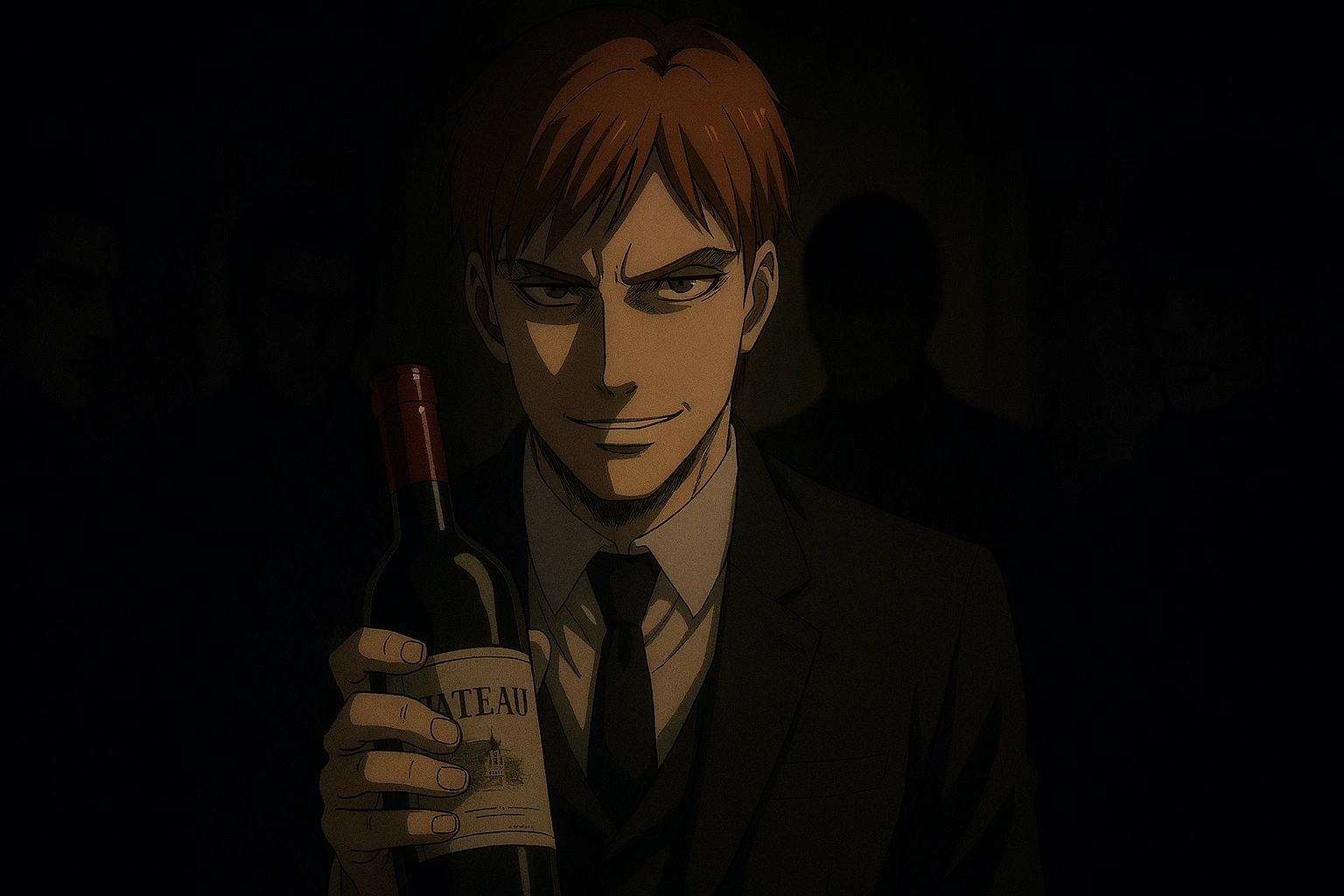
While the old military police were drinking wine (laced with spinal fluid) and debating eager politics in comfortable rooms, and while Hange and Armin were paralyzed by the moral weight of their options, Floch was working.
- The Shadow Coup: He organized a comprehensive rebellion right under the military’s nose. He identified the dissatisfaction among the new recruits and weaponized it.
- The Wine Conspiracy: He was instrumental in the distribution of the tainted wine, effectively holding the entire military command structure hostage without firing a single shot until necessary.
- The Jailbreak: He facilitated the transport of Zeke Yeager and the escape of Eren, coordinating a multi-front operation that the established government never saw coming.
- Mobilization: He secured the Founding Titan and mobilized an effective army in a matter of weeks, creating a unified fighting force out of a fractured military.
Floch achieved more in a month than the Paradis government achieved in four years of peace. He recognized that the bureaucracy was stagnant and that stagnation meant death. His methods were fascist, undeniably. He utilized fear, suppression of the press, and public executions to maintain order.
But in the context of a total war for survival, effectiveness is the only metric that matters to the desperate. Floch was the only character operating on “war time” while everyone else was operating on “peace time.” He understood that the rules of engagement had changed, and he played by the new rules while the old guard was still reading the rulebook.
The Only One Who Knew
Perhaps the most telling aspect of Floch’s character is that he was the only one Eren told the truth to. Eren did not tell Mikasa, his lifelong protector. He did not tell Armin, his best friend and strategic confidant. He told Floch.
Why? Because Eren knew that Floch would not hesitate. Floch would not try to talk him out of it; Floch would not appeal to his better nature. Floch would ask, “How can I help you bury them?”
This validates Floch’s role as the “Devil’s Right Hand.” He was the gatekeeper of the Rumbling. He bore the weight of the conspiracy alone, acting as the grim reaper who cleared the path for Eren’s march. His dedication was absolute.
Even in his final moments, which we will discuss later, he never wavered. He didn’t die for glory; he died for his people. He accepted his role as the villain in the history books, as long as there were history books left for Eldians to write.
The Voice of the Common Man: Fear vs. Morality
It is easy to judge the Yeagerists from the comfort of our screens. We, the audience, have the benefit of omnipotence. We see the sympathetic backstories of Gabi and Falco; we know that Reiner is suffering from immense guilt; we know that there are “good people” across the sea who want peace. We see the nuance.
The average citizen of Paradis knows none of this. To understand the Yeagerist movement, we must strip away our omniscient perspective and look at the world from the ground level.
The Shopkeeper’s Dilemma
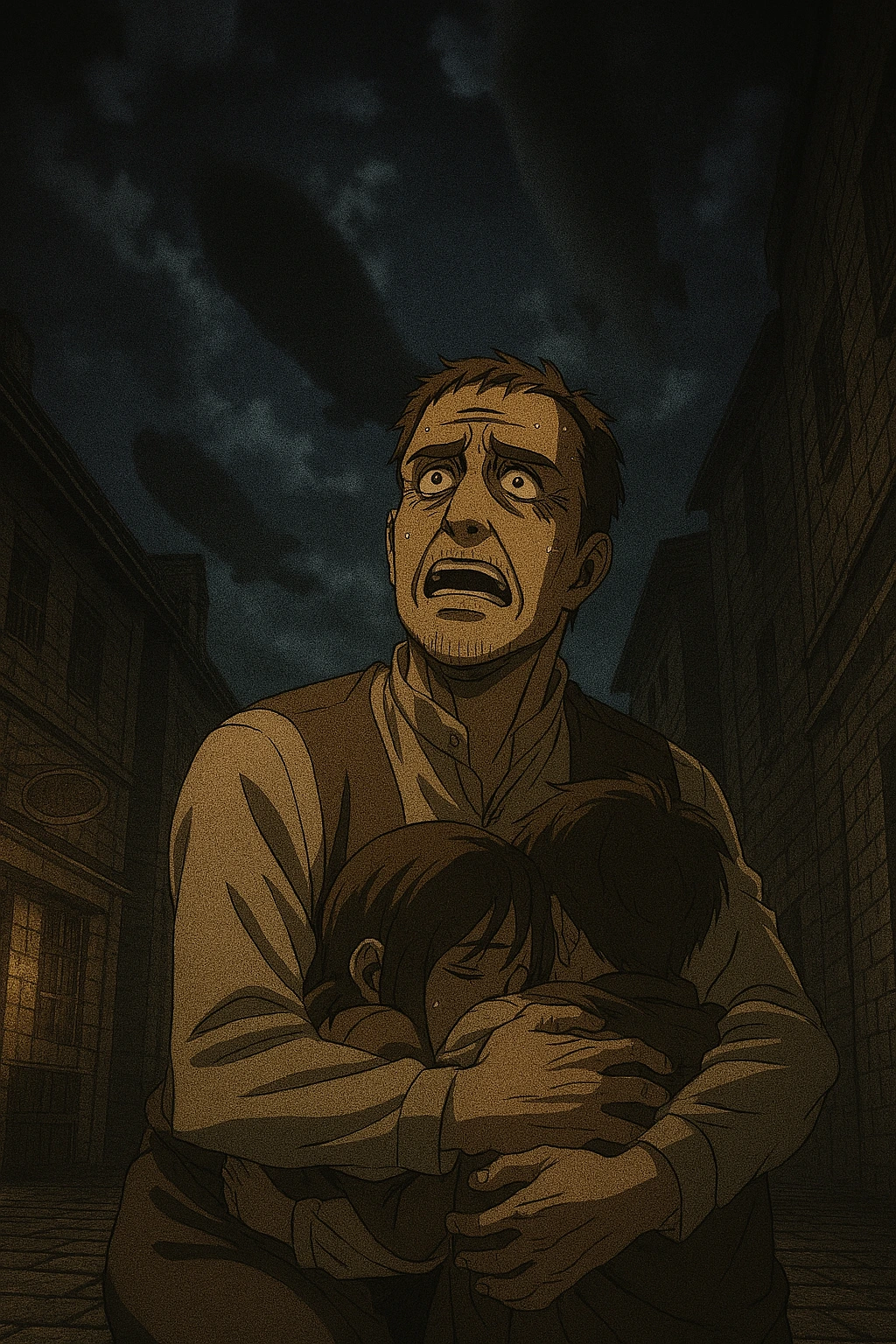
To understand the rise of the Yeagerists, you have to put yourself in the shoes of a random shopkeeper in Wall Rose.
- Context: For 100 years, you lived in abject fear of Titans eating your family. You watched your neighbors get devoured. You lived in a cage.
- Revelation: You find out humanity exists outside the walls. But instead of rescue, you learn that they hate you. They call you a “Devil.” They want you dead not for what you did, but for what you are.
- Escalation: The entire world declares war on you in Liberio. They are coming with blimps, battleships, and anti-Titan artillery. They are not coming to conquer; they are coming to exterminate. You are going to die. Your wife is going to die. Your children are going to die.
- The Options: The government (Hange, Pyxis, Zackly) tells you to be patient. They want to negotiate. They are looking for allies. But years have passed, and nothing has changed. Meanwhile, a young man named Eren Yeager—the hero who sealed Wall Maria—says, “I will kill them all so you can live.”
Who do you support? Do you support the moral high ground of Hange Zoë, which offers spiritual cleanliness but guarantees physical danger? Or do you support the absolute violence of Eren Yeager, which offers spiritual damnation but guarantees physical safety?
For 99% of the population, this is not a choice. It is a reflex. Maslow’s Hierarchy of Needs dictates that safety comes before morality. You cannot philosophize when you are dead. The Yeagerists tapped into this primal fear. They didn’t need to force the population to support them; the population was begging for a Yeagerist movement before it even had a name. They offered a solution to the terror that had gripped the island for a century.
The Failure of the Scouts
This leads us to the tragedy of Hange and Armin. The Yeagerist uprising is, effectively, the result of the Survey Corps’ failure to provide a viable alternative. The time skip (the four years between Season 3 and 4) was a period of political stagnation. Hange’s policy was one of caution and diplomacy. They sought allies, but found only the Azumabito (who wanted resources and money) and the Volunteers (who wanted Zeke’s secret plan).
To the public, Hange and Armin looked like they were asleep at the wheel. They were holding meetings while the enemy was building fleets. When Eren attacked Liberio, striking a decisive blow against the enemy leadership, the Scouts arrested him. To the public, this was insanity. Why arrest the only weapon you have? Why punish the man who struck back at the enemy who just declared war?
The public turned on the Scouts because the Scouts stopped representing survival. The “Wings of Freedom” crest, once a symbol of hope and exploration, became a symbol of hesitation and bureaucracy. The Yeagerists co-opted the symbol, bloodying it, but also energizing it. They promised action. In a world of “kill or be killed,” the man offering to kill for you is not a villain—he is a savior. The Scouts offered “talk” which had yielded nothing; Eren offered “fight” which yielded results.
The Psychology of the Mob
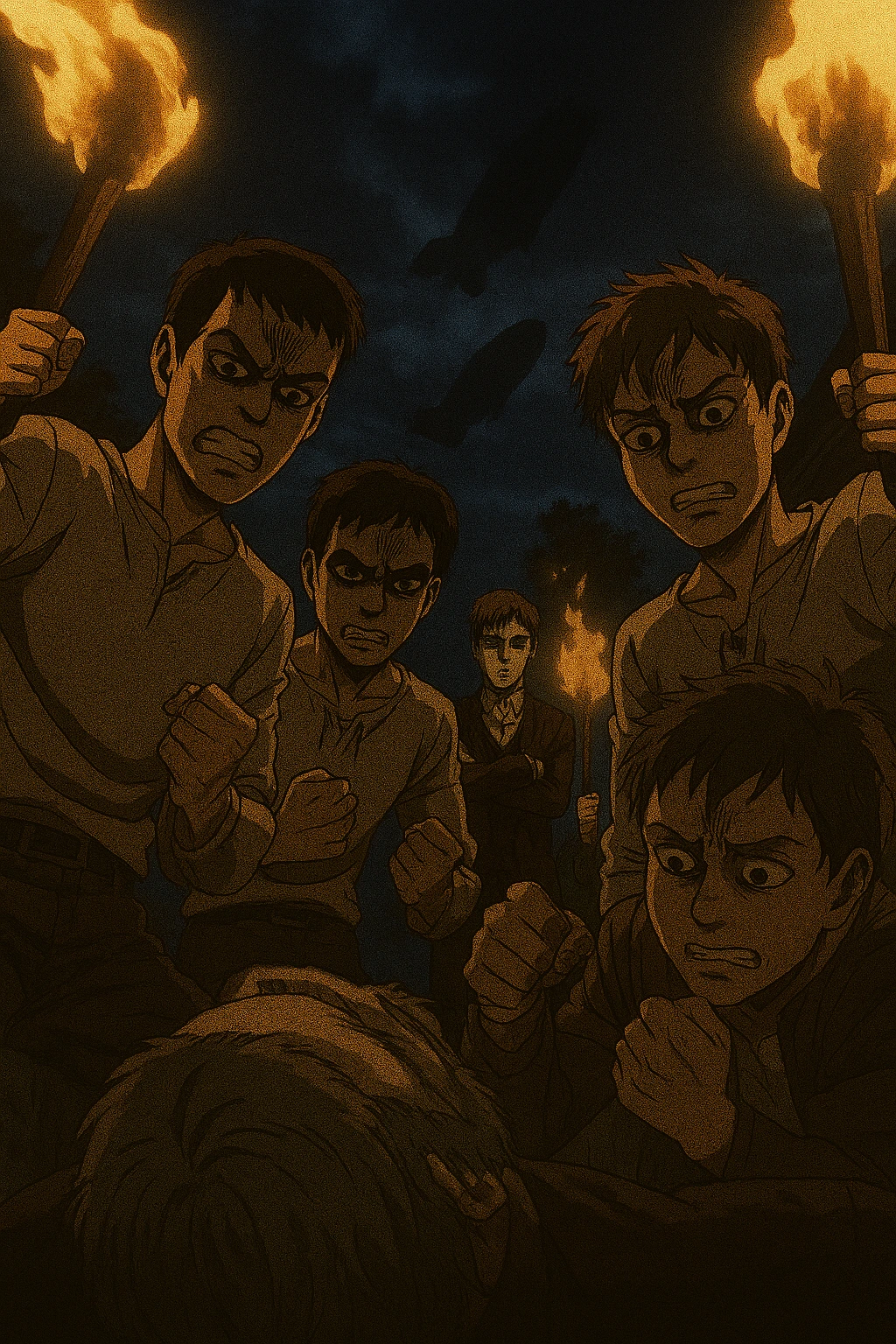
Isayama portrays the populace not as innocent victims, but as an active, terrifying force. The scene where the recruits beat Keith Shadis is difficult to watch, but it is essential to understanding the movement. It represents the “Ritual of Blood.” To join the new tribe, one must strike down the old father figure.
Floch orchestrates this, but the mob participates willingly. This demonstrates the scary reality of populism. The Yeagerists empowered the powerless. People who felt helpless against the impending global invasion suddenly felt powerful by aligning with the “New Eldian Empire.” They channeled their fear into anger and directed it at the easiest targets: the old military, the volunteers, and anyone who questioned Eren.
The mob does not think; it feels. And what Paradis felt was a century of trauma screaming for release. The Yeagerists were simply the funnel for that scream. The violence against Shadis wasn’t just about him; it was a rejection of the old ways that had kept them ignorant and confined. It was a violent assertion of their new identity: predators, not prey.
The “Us or Them” Binary: Validating the Extremism
The core philosophy of the Yeagerists can be summed up in three words: Us or Them.
This binary worldview is dangerous, reductive, and often leads to atrocities in the real world. However, the tragedy of Attack on Titan is that Isayama constructed a world where this binary was actually, terrifyingly true.
The Reality of the External Threat
Usually, in stories about fascism or extremism, the “threat” is manufactured or exaggerated by the dictator to control the populace. The government invents a boogeyman to keep the people in line. In Attack on Titan, the threat is 100% real.
The Global Alliance was not a propaganda tool invented by Floch; it was a massive military armada gathering at the port of Karifa with the explicit goal of a scorched-earth campaign against Paradis.
The Yeagerists did not invent the war; they reacted to it. The world gathered and declared, “We do not want to live with Eldians.” The Yeagerists replied, “Fine. Then you won’t live.”
This creates a moral vacuum where extremism feels validated. When your enemy’s stated goal is genocide against you, “defensive genocide” becomes a logical (albeit horrific) counter-move. The Yeagerists argue that they cannot be judged by the morality of a peaceful world because they do not live in one.
They live in a cage match where the loser is wiped from history. The technological gap—Paradis with swords vs. the World with anti-Titan cannons and airships—further necessitated extreme measures. They couldn’t fight a conventional war; they needed the apocalypse.
The Darker Side: Execution of Volunteers
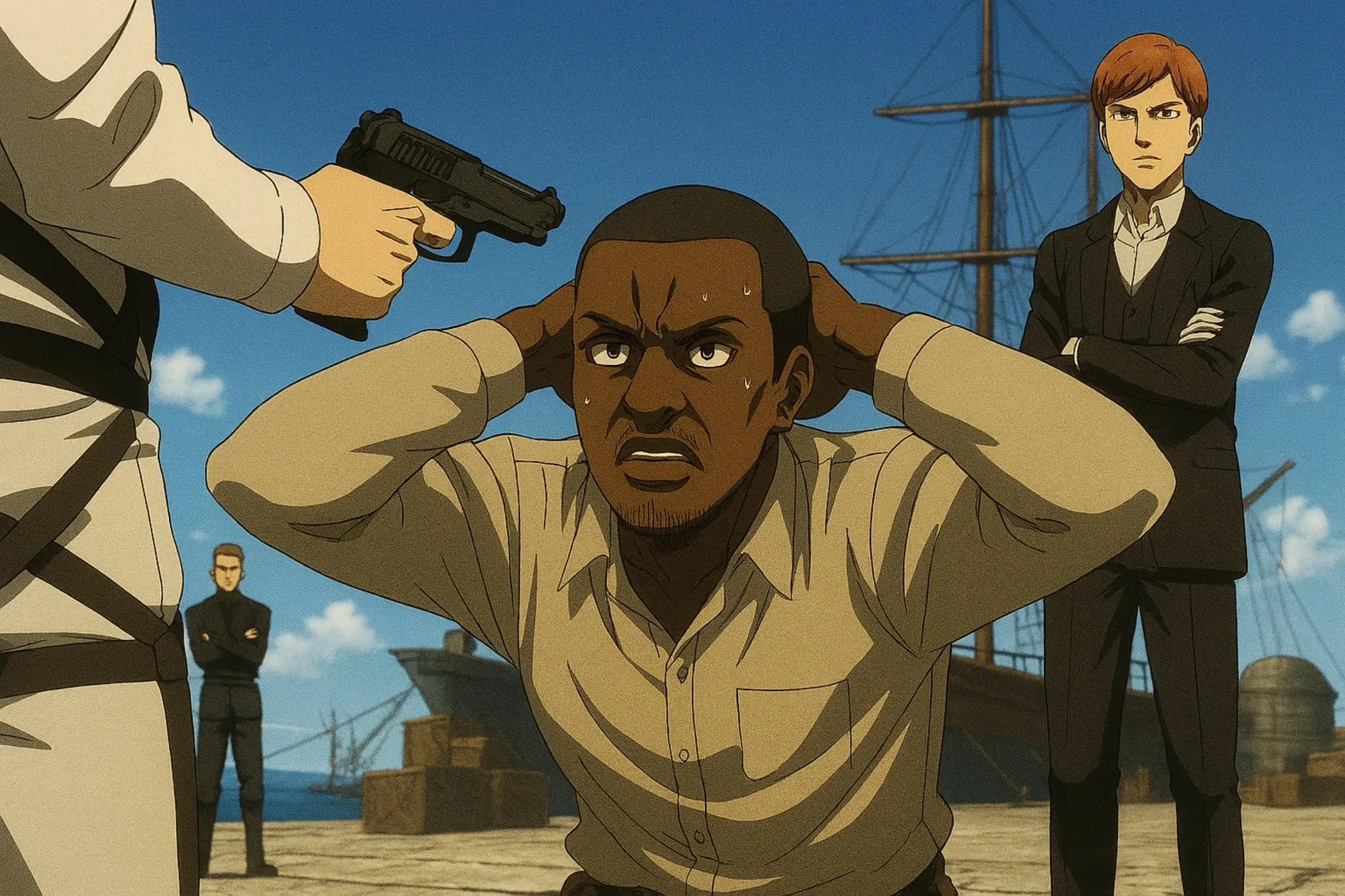
However, Isayama does not let the Yeagerists off the hook. While their defense of the island is understandable, their behavior rapidly descends into cruelty that exceeds necessity. This is where the “defense” argument begins to crumble into pure hate.
The treatment of the Anti-Marleyan Volunteers is the prime example. Onyankopon and his comrades helped modernize Paradis. They built the railroads, the port, and the technology that gave Eldia a fighting chance. They were allies. Yet, the moment the Yeagerists took power, they put a gun to the Volunteers’ heads: “Submit or die.”
This is where the Yeagerists transition from “Defenders of Paradis” to “Eldian Supremacists.” Executing Onyankopon (or attempting to) served no strategic purpose. He was a pilot; he was useful. Killing him was purely ideological. It was xenophobia.
It proved that the Yeagerists were not just fighting for survival; they were fighting for dominance. They were becoming the very thing they hated—Marley. They were adopting the oppressor’s mindset: “We are the chosen people, and you are disposable.”
Nationalism vs. Imperialism
The Yeagerists mirror the Marleyan mindset perfectly. Marley believed they were the chosen superpower, justified in subjugating others for the “greater good” of the world. The Yeagerists believe they are the “New Eldian Empire,” justified in crushing others for their own safety.
Isayama uses the Yeagerists to show the cyclical nature of hatred. If you abuse a child long enough, they don’t grow up to be a pacifist; they grow up to be an abuser. Paradis absorbed the hatred of the world and reflected it back tenfold.
The Yeagerists are the ugly reflection of the world that created them. They are what happens when you strip a people of their dignity for a hundred years and then hand them a gun. They don’t put the gun down; they aim it at everyone.
The Port Battle: The Final Stand of the Yeagerists
The climax of the Yeagerist arc—and arguably the peak of Floch’s character—occurs at the Port Battle. This is the moment the narrative flips entirely, and the viewer is forced to confront the horror of civil war.
The Narrative Inversion
For three seasons, we watched the Scouts fly through the air, using ODM gear to take down giant, mindless Titans. It was a classic “David vs. Goliath” setup. We cheered for the little guys with the swords.
At the port, Isayama inverts the imagery. The Scouts (Mikasa, Connie, Jean) are now the invaders. They are the ones with the Titan powers (Armin, Reiner, Annie) and the Ackermans. They are slaughtering the Yeagerists.
The Yeagerists, conversely, are normal humans. They are using Thunder Spears—weapons designed to fight monsters—to fight the “Traitors of the Alliance.” They are terrified. They are outmatched. They are dying in droves. We see Yeagerists hesitating to shoot their former friends, only to be cut down by Mikasa or blown apart by Connie.
Visually, the Yeagerists become the “humanity” fighting against the “Titans” (the Alliance). This uncomfortable realization forces the audience to question who they are rooting for. Are we rooting for Connie and Jean to kill their former classmates, people they ate dinner with just weeks ago?
Are we cheering as Mikasa bathes in the blood of soldiers whose only crime is wanting to stop the Rumbling from being halted? The Yeagerists at the port aren’t fighting for conquest; they are fighting to stop the Alliance from dooming their families.
Floch’s Last Stand
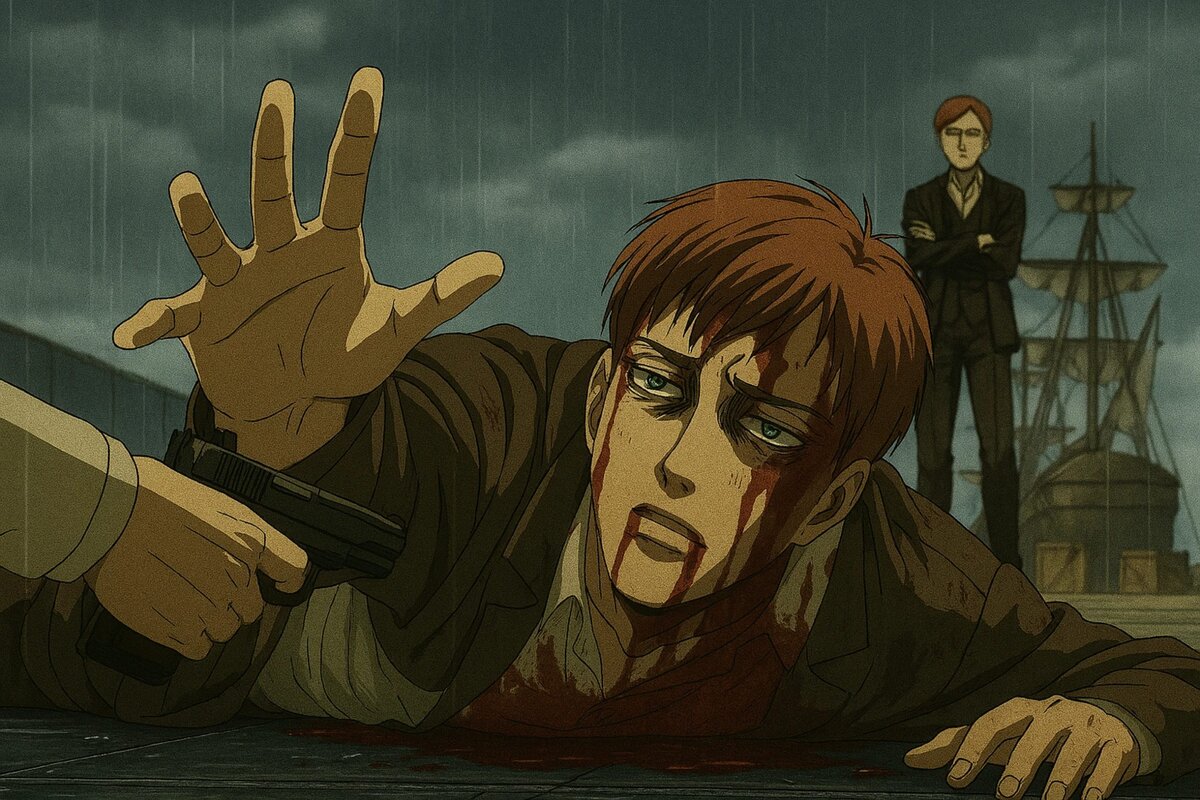
Floch’s behavior at the port is the ultimate testament to his sincerity. If Floch were merely a power-hungry opportunist, as many claimed early on, he would have fled the moment the Armored and Female Titans appeared. He would have realized the battle was lost, hid in the countryside, waited for the dust to settle, and tried to snake his way into whatever regime emerged.
He didn’t. He led the charge. He organized the defense. He flew directly into the face of two Titan shifters and an Ackerman, knowing it was likely suicide.
His final act—clinging to the ship, bleeding out from a gunshot wound, dragged across the ocean for hundreds of miles, suffering unimaginable pain—is an act of sheer, indomitable will. When he crawls onto the deck and shoots the fuel tank of the flying boat, it is a desperate, final attempt to buy time for Eren. He isn’t trying to save himself. He is spending his last breath to ensure the Rumbling continues.
The Prophetic Dying Words
Floch’s death scene is one of the most poignant and disturbing in the series. He does not beg for his life. He does not curse them. He begs for the island.
“Please… don’t go. If you stop Eren… everyone inside the island will die. Our devil… is our only hope.”
This line haunts the remainder of the series. Floch is not speaking out of malice here; he is speaking out of prophetic fear. He genuinely believes that stopping the Rumbling means the genocide of his people.
And the tragedy is, from his perspective, he is logically correct. The Alliance has no plan to ensure Paradis’s safety after stopping Eren. They are running on hope and idealism. Floch was running on certainty and historical precedent.
His death marks the end of the Yeagerist resistance, but his words plant a seed of doubt in the heroes: Are we dooming our people to save the world? Hange hears these words and knows, deep down, that Floch might be right.
But they have to try anyway. That is the tragedy of the Alliance: they are fighting for a moral victory that might result in their physical extinction.
The Legacy of the Gun: Paradis After the Rumbling
The story does not end with the Battle of Heaven and Earth. The epilogue gives us a glimpse into the Paradis that Floch helped create, and the vindication of his ideology in the eyes of history.
The Militarization of Eldia
Three years after the Rumbling, we see Paradis. It is not a peaceful utopia. It is a fortress. The Yeagerists did not disappear with Eren’s death; they became the government. The chant “If you don’t fight, you can’t win” became the national motto, etched into the psyche of the nation.
The island transformed into a fascist military state, constantly preparing for a retaliation that they knew would come eventually. We see new recruits marching, chanting slogans, holding guns. The atmosphere is tense.
Queen Historia, despite her gentle nature and royal status, was forced to align with the Yeagerists to maintain order and present a unified front to the remaining world.
This confirms that Floch’s ideology won the cultural war. Even though he died, his ideas lived on. The people of Paradis accepted that they were alone in a hostile world, and they embraced the gun as their only god.
The Yeagerists succeeded in transforming the Eldian identity from one of passive victimhood to aggressive militarism.
The Vindication: Was Floch Right?
The most controversial aspect of Attack on Titan comes in the extra pages released with the final volume. We see a panel, far in the future, of Shiganshina. It has grown into a modern city with skyscrapers, resembling our modern world. And then, we see the missiles.
The city is carpet-bombed by stealth bombers. It is reduced to rubble. Paradis is destroyed. The Eldian civilization is wiped out.
This single image retroactively changes the entire context of the Yeagerist movement.
The Alliance (Armin, Mikasa, Jean) believed that if they stopped the Rumbling, they could negotiate peace. They believed that by saving the remaining 20% of humanity, they could prove to the world that Eldians were good people who deserved to live. For a few decades (perhaps a century), they succeeded. Peace was maintained. But eventually, the world came back.
This leads to the harrowing conclusion: Floch was right.
Floch predicted that if the outside world was left standing, they would eventually regroup, rearm, and exterminate Paradis. He argued that you cannot leave an enemy alive if they are sworn to destroy you. The extra pages confirm this exact scenario. The 80% Rumbling was not enough. The survival of the outside world guaranteed the destruction of the island.
This vindication makes the Yeagerists a tragic warning. They were the ones who saw the end coming. They were the Cassandra of Paradis—cursed to speak the truth and be reviled for it. The bombing of Paradis proves that in the cruel world of Attack on Titan, idealism was indeed a fatal flaw, and absolute violence was the only permanent shield. The Yeagerists’ brutal methods were an attempt to prevent exactly what happened in those final pages.
Conclusion: The Necessary Evil?
The Yeagerists are not heroes in the traditional sense. They executed innocents, beat their own instructors, and championed a global massacre. To call them “good” is to lose one’s moral compass. They lost their humanity in the pursuit of survival.
But to call them “villains” is to lose one’s grasp on reality.
The Yeagerists are a mirror. They reflect the hatred of Marley, the fear of Eldia, and the failure of the Scouts. They are what happens when a group of people is pushed to the absolute brink of extinction.
They represent the terrifying length humans will go to when the choice is “Us or Them.” They are the embodiment of the survival instinct stripped of all social pleasantries.
Floch Forster stands as the avatar of this uncomfortable truth. He is the character who looked at the hell of the Attack on Titan world and decided that he would rather be a devil than a victim. He saw that the world had no place for “good” Eldians, so he decided to be a “bad” one who survived.
You don’t have to like Floch. You don’t have to agree with his methods. You can despise everything he stood for. But as the bombs fall on Paradis in the distant future, reducing Eren’s home to dust and silence, you have to admit one terrifying thing:
He told us so.
The Yeagerists were the monsters Paradis created to fight the monsters across the sea. And in the end, the tragedy isn’t that they existed; the tragedy is that, in the brutal calculus of Isayama’s world, they were arguably necessary. The world of Attack on Titan asked a question: “Can we escape the cycle of hatred