
I. Introduction: The Fallen Hero

If you listen closely to the memories of Tokyo Jujutsu High, specifically around the year 2006, you can almost hear the sound of fizzing soda and the hum of cicadas in the summer heat. It is a sound that evokes a specific kind of nostalgia—the “blue days” of youth, where the world seems manageable because you are standing next to your best friend, and together, you are invincible.
In the vast, blood-soaked tapestry of Jujutsu Kaisen, there are villains born of pure malice, like Ryomen Sukuna, and villains born of chaotic instinct, like Mahito. But Suguru Geto stands apart. He is not a monster who crawled out of the abyss; he is a hero who fell into it.
To understand Geto is to understand the most tragic archetype in storytelling: the man who breaks not because he is weak, but because he carried too much. He is the narrative embodiment of the road to hell being paved with good intentions.
At the start of the Hidden Inventory arc, Geto is the moral compass. He is the one lecturing Satoru Gojo on responsibility. He is the one insisting that power requires justification. Yet, by the time the story reaches Jujutsu Kaisen 0 and the Shibuya Incident, he has become a genocidal leader, termed the “worst curse user,” intent on slaughtering non-sorcerers to create a paradise for his kind.
How does a man go from shielding the weak to massacring them?
The answer lies in a question that haunts the narrative: “Are you the strongest because you’re Gojo Satoru? Or are you Gojo Satoru because you’re the strongest?” When Gojo ascended to godhood, becoming a solitary entity of infinite power, Geto was left behind in the realm of mortals, shackled by a conscience that Gojo had transcended. Geto’s descent is a slow, agonizing erosion of the soul, chipped away by the sensory horror of his technique and the ungrateful ugliness of humanity.
In this analysis, we will walk the path of the “Summer Oil” (Geto’s name translation). We will trace his journey from the righteous guardian of the weak to the architect of the Night Parade of a Hundred Demons. We will dissect the sensory nightmare of Cursed Spirit Manipulation, the psychological break caused by Riko Amanai’s death, and the heartbreaking philosophical divergence that tore the “Strongest Duo” apart. This is not just a study of a villain; it is an autopsy of a hero’s heart.
II. The Philosophy of Duty: Strong Protect the Weak
To understand the darkness Geto embraces, we must first understand the light he extinguished. In his youth, Suguru Geto was a man defined by a rigid, almost dogmatic moral framework. He was the classic archetype of the “Honorable Student.” While Satoru Gojo was brash, arrogant, and questioned the necessity of protecting those weaker than him, Geto was the anchor.
“Sorcery exists to protect non-sorcerers.”
This was his mantra. It was a noble, textbook ideology. In the early days of 2006, Geto genuinely believed that the gift of strength came with a tax: the duty to serve the weak. He viewed society as a hierarchy where the strong were obligated to be the shield.
This wasn’t just a rule for him; it was a mechanism to give his suffering meaning. If he was swallowing curses and enduring the filth of the jujutsu world, it had to be for something. It had to be for the greater good. By framing his existence as a service to humanity, he could rationalize the horrors he faced.
However, this philosophy was fragile because it was theoretical. It was an ideal held by a boy who hadn’t yet seen the true face of the “weak” he swore to protect.
The reality check arrived with shattering force during the Star Plasma Vessel mission. The mission was simple: escort Riko Amanai, a young girl destined to merge with Master Tengen, to her fate. Over the course of the mission, Geto and Gojo bonded with Riko, seeing her not as a vessel, but as a vibrant, living teenager who wanted to live a little longer, to see more of the world, to go to school with her friends.
When Toji Fushiguro assassinated Riko right before their eyes, the tragedy wasn’t just in her death; it was in the reaction of the “weak.”
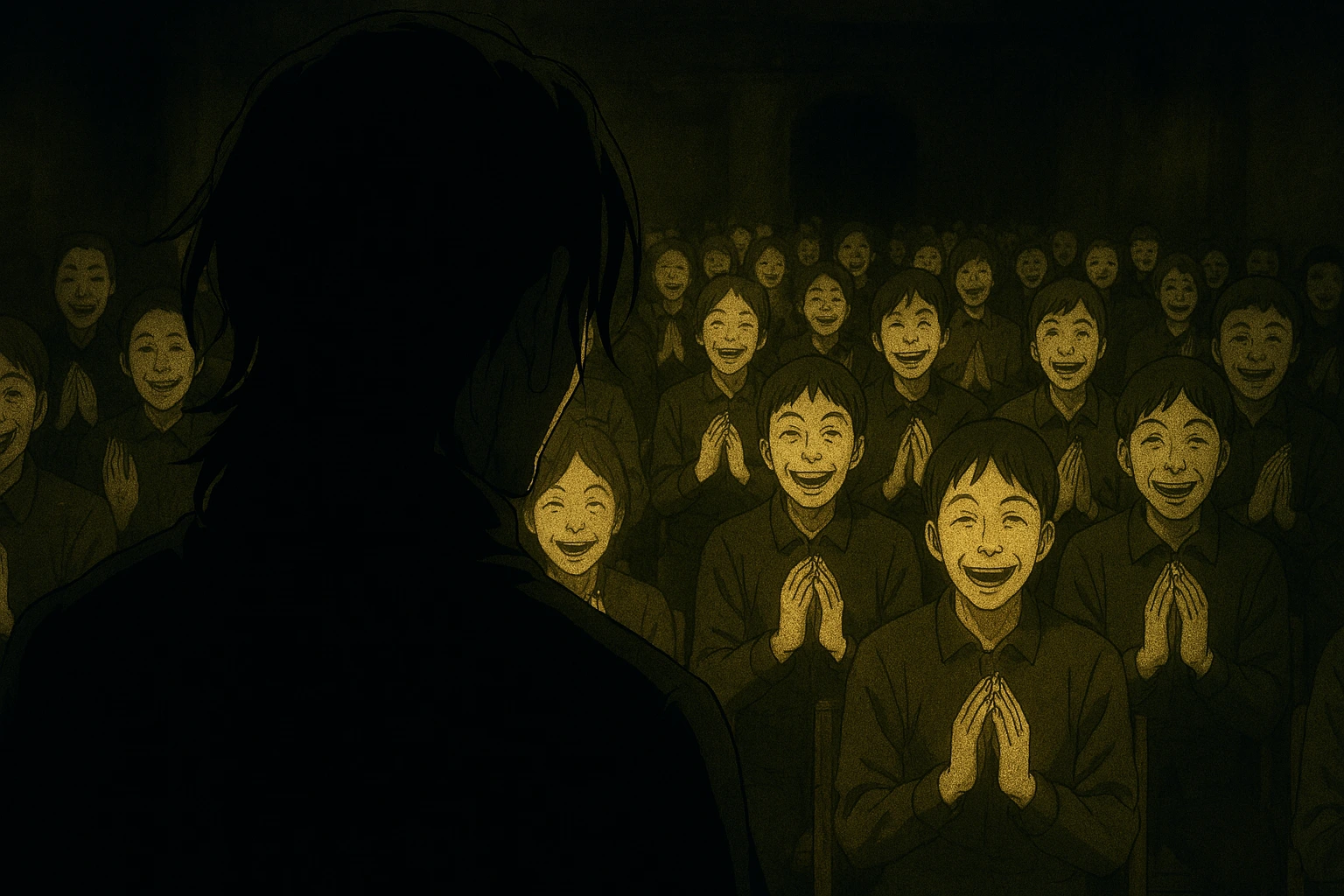
The pivotal moment—the crack in the glass of Geto’s soul—occurred in the headquarters of the Time Vessel Association. As Geto arrived, broken and battered, he found the cult members gathered in the main hall. They were not powerful sorcerers. They were ordinary humans, the very “weak” Geto had sworn to protect. And they were applauding.
They were smiling. They were clapping. They were cheering for the murder of a fourteen-year-old girl.
The sound of that applause was the death knell of Geto’s righteousness. In that moment, the abstract concept of “The Weak” dissolved. They were no longer innocent sheep needing a shepherd; they were ugly, selfish, grotesque creatures who rejoiced in the death of a child because it suited their religious dogma.
This is where the shift began. The “protection” he offered turned into “disgust.” Geto realized that the strong were not being lifted up by their duty; they were being dragged down into the mud by the ingratitude and malice of the monkeys they shielded. Why should a sorcerer, a higher form of life, bleed and die for creatures that would clap at a child’s corpse?
The “Strong Protect the Weak” ideology is predicated on the assumption that the weak are worth protecting. Once that assumption was shattered, Geto was left with a terrifying void where his moral compass used to be. He began to see the non-sorcerers not as people, but as a disease—a plague that produced the curses he was forced to consume, while offering nothing but ignorance and malice in return. The duty became a shackle, and the protector began to resent the protected.
III. Cursed Spirit Manipulation: The Taste of Hell

While the philosophical disillusionment provided the reason for Geto’s fall, his Cursed Technique provided the environment for it. To fully grasp Geto’s suffering, we must look at the visceral, sensory reality of Cursed Spirit Manipulation (Jurei Sōjutsu).
On paper, it is one of the most versatile and powerful techniques in the series. Unlike Shikigami users who rely on a set bond or mediums, Geto can enslave free-roaming curses. If a curse is two grades below him, he can absorb it instantly. If it is stronger, he must weaken it first. This gives him an army of infinite utility, allowing him to be a one-man army.
But the cost of this power is grotesque.
In Jujutsu Kaisen, the extraction and absorption of a curse is not a clean transfer of energy. It is a physical act of consumption. Geto must turn the curse into a dense sphere of energy and swallow it whole.
Geto describes the taste vividly: “Like swallowing a rag used to wipe up vomit.”
Let us dwell on that image for a moment. It is not just “bad.” It is repulsively textural. A rag implies something fibrous, choking, and dry. Vomit implies bile, acid, and the deepest biological rejection. To ingest a curse is to ingest concentrated negativity, filth, and human suffering.
And Geto has to do this every single time he wants to get stronger or replenish his arsenal.
Imagine the daily routine of Suguru Geto. He goes on a mission, exorcises a curse, and then, in the silence of an alleyway or a forest, he has to force this sphere down his throat. He has to gag, choke, and suppress the urge to vomit, purely to gain a tool to protect the “monkeys” he is beginning to hate.
This creates a cycle of profound isolation. Sorcery is usually a lonely profession, but Geto’s technique is uniquely isolating. When Gojo uses Limitless, he feels the ecstasy of power. When a Shikigami user summons a divine dog, they feel a connection.
When Geto uses his technique, he feels nausea. He is physically internalizing the horrors of the world. He is a walking graveyard of curses. No one else—not even Gojo—can understand the physical sensation of that burden.
Over time, this routine erodes his sanity. Every curse he swallows is a reminder of human ugliness, because curses are born from human negative emotions. Every time he tastes that “vomit rag,” he is tasting the fear, hatred, and jealousy of non-sorcerers. He is literally eating the sins of humanity.
This context recontextualizes his power. It is not a gift; it is a penance.
The pinnacle of this technique, Maximum: Uzumaki, further illustrates his approach to power. Technically, Uzumaki condenses a massive number of curses into super-high-density cursed energy, releasing it in a single, devastating blast. However, as Kenjaku later reveals, the true value of Uzumaki isn’t just the blast—it’s the extraction of the Cursed Techniques from semi-grade 1 and higher curses.
It is telling that Geto, during his life, seemed to focus on the raw destructive power of Uzumaki rather than the technical nuance of extracting techniques (though he may have simply not realized its full potential). For Geto, the curses were a mob, a faceless mass to be used and discarded. He didn’t view them as individual tools with unique value to be harvested, but as a collective weight to be thrown.
The “Taste of Hell” is the sensory backdrop of his tragedy. It is hard to maintain love for humanity when the byproduct of their existence tastes like bile in your throat every single day. The physical act of his sorcery reinforced his growing hatred: humans produce the filth, and Geto is forced to eat it.
IV. Hidden Inventory: The Breaking Point
The “Hidden Inventory” arc is often cited as the best arc in Jujutsu Kaisen because it is essentially a tragedy in the classical sense. It details the precise mechanism of Geto’s breaking point.
The catalyst, as mentioned, was the death of Riko Amanai. But the breaking point was the divergence that happened afterward.
Following the Toji Fushiguro incident, Satoru Gojo underwent a near-death awakening. He unlocked the Reverse Cursed Technique, mastered Red and Purple, and essentially ascended to a plane of existence where he was “The Honored One.” Gojo became a god. He could run his technique automatically, 24/7. He ceased to tire. He became untouchable.
This created a gap. Before this summer, Gojo and Geto were “The Strongest.” They were a duo. They were equals. If one struggled, the other was there. But suddenly, Gojo was miles ahead, existing in a stratosphere Geto could not reach.
Geto was left behind.
The panels detailing Geto’s summer following the incident are hauntingly quiet. We see Gojo taking on solo missions because he is efficient enough to handle them alone. This leaves Geto to take on solo missions as well. The duo is broken not by malice, but by utility.
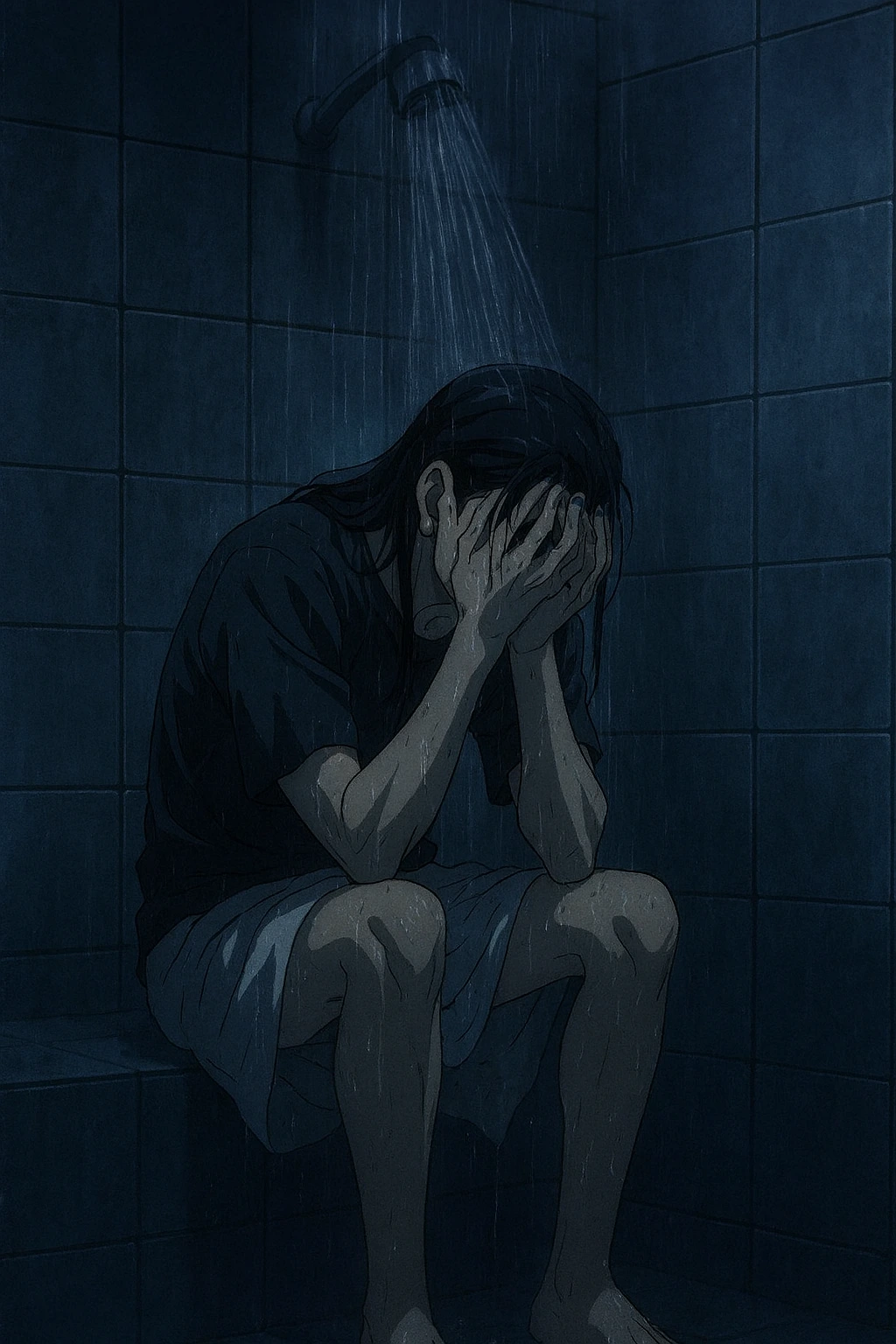
We see Geto losing weight. We see the dark circles under his eyes deepening. We see him sitting in the shower, the water running over his head, trying to drown out the noise in his mind. The isolation becomes absolute. Without Gojo beside him to act as a buffer or a distraction, Geto is left alone with the “taste of the rag” and the clapping of the cultists.
He begins to question the loop. Exorcise. Consume. Protect. Repeat. For who? For what? The repetition becomes a form of torture. He is running a marathon on a treadmill of suffering, going nowhere.
The final straw that snapped the camel’s back was the death of Yu Haibara.
Haibara was a bright, optimistic junior sorcerer. He was everything Geto used to be—eager, helpful, and looking up to his seniors. When Haibara dies on a mission that was mishandled due to bad intel (a mission meant for Grade 2s that turned out to be a Grade 1 deity worship case), Geto stands in the morgue, looking at the half-destroyed body of his friend.
This was the validation of his worst fears. Sorcerers—the few, the special, the talented—were dying to protect a mass of ignorant monkeys. Haibara didn’t die for a noble cause; he died because the system was broken and humans leaked curses.
The equation finally balanced in Geto’s mind: The cost of protecting monkeys was the lives of sorcerers. And the price was too high. The pile of sorcerer corpses was getting higher than the pile of saved humans he actually cared about. The grief for Haibara transmuted instantly into a cold, hard resolve. If the world creates this kind of suffering for sorcerers, then the world is wrong, and it must be fixed.
V. The Conversation: Yuki Tsukumo & The Choice
In the depths of his existential crisis, Geto has a conversation with Yuki Tsukumo, a Special Grade sorcerer. This conversation is often misunderstood as Yuki “corrupting” Geto, but in reality, she merely provided the intellectual framework for feelings he already had.
Yuki presents a solution to the “curse problem.” She posits two paths to stop the creation of curses:
- Strip all humans of cursed energy (The Toji Fushiguro model).
- Make all humans control their cursed energy (turn everyone into sorcerers).
Geto, seizing on the logic, asks the obvious follow-up: “Then if we kill all non-sorcerers, wouldn’t that solve the problem?”
Yuki admits that, logically, yes, that is the easiest path. It’s extreme, but technically sound. This was the validation Geto needed. He wasn’t crazy. His dark thoughts had a logical basis. Yuki didn’t tell him to do it—she explicitly said she wasn’t crazy enough to try it—but she planted the seed that his genocide was a valid solution, not just an emotional outburst.
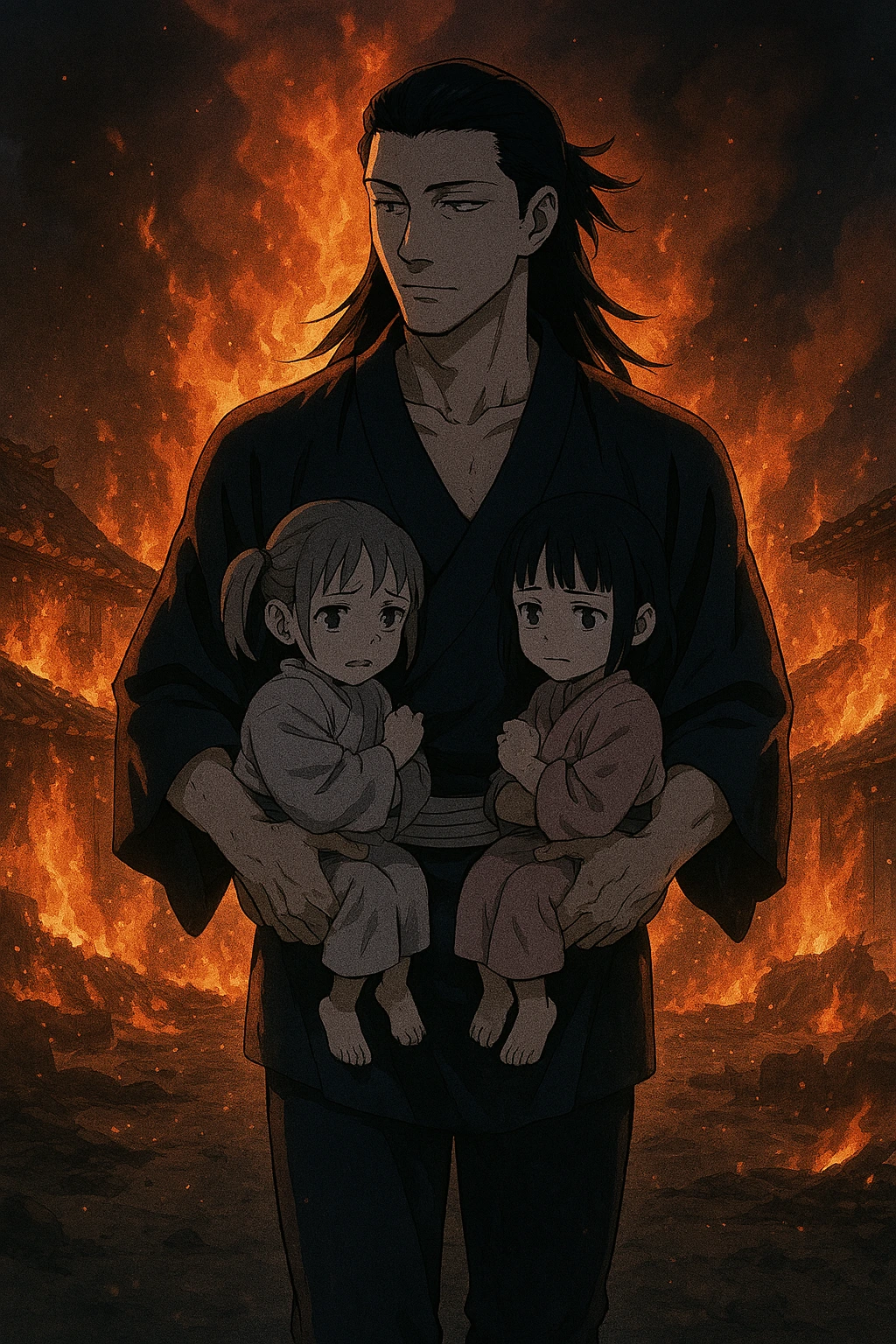
The tipping point comes shortly after, when Geto is sent to a village on a mission. He finds two young girls, Mimiko and Nanako, locked in a cage, beaten and abused by the villagers who blame them for the curse attacks. The villagers are ignorant, cruel, and fearful of the girls’ power.
Here, the choice is presented in its rawest form. On one side: A village of ignorant “monkeys” who abuse children. On the other side: Two young sorcerers, suffering just like he is.
Geto chooses.
He slaughters the entire village. 112 people. Men, women, elderly. He kills them all to save the two girls.
This is the moment of no return. It is the moment he embraces the title of “Villain.” But crucially, look at his face in the aftermath. He doesn’t look manic. He doesn’t look chaotic. He looks relieved. For the first time in years, the noise in his head stops. He has chosen a side. He is no longer torn between duty and disgust. He has chosen his family (sorcerers) over the rest of the world.
He confronts Gojo in Shinjuku shortly after, delivering the devastating line: “I have decided to live a life where I can laugh from the bottom of my heart.”
He accepts the role of the monster because it is the only way he can save the people he actually loves. He realizes he cannot save everyone, so he decides to save “his own kind” by eliminating the threat posed by the other kind.
VI. Jujutsu Kaisen 0: The Night Parade
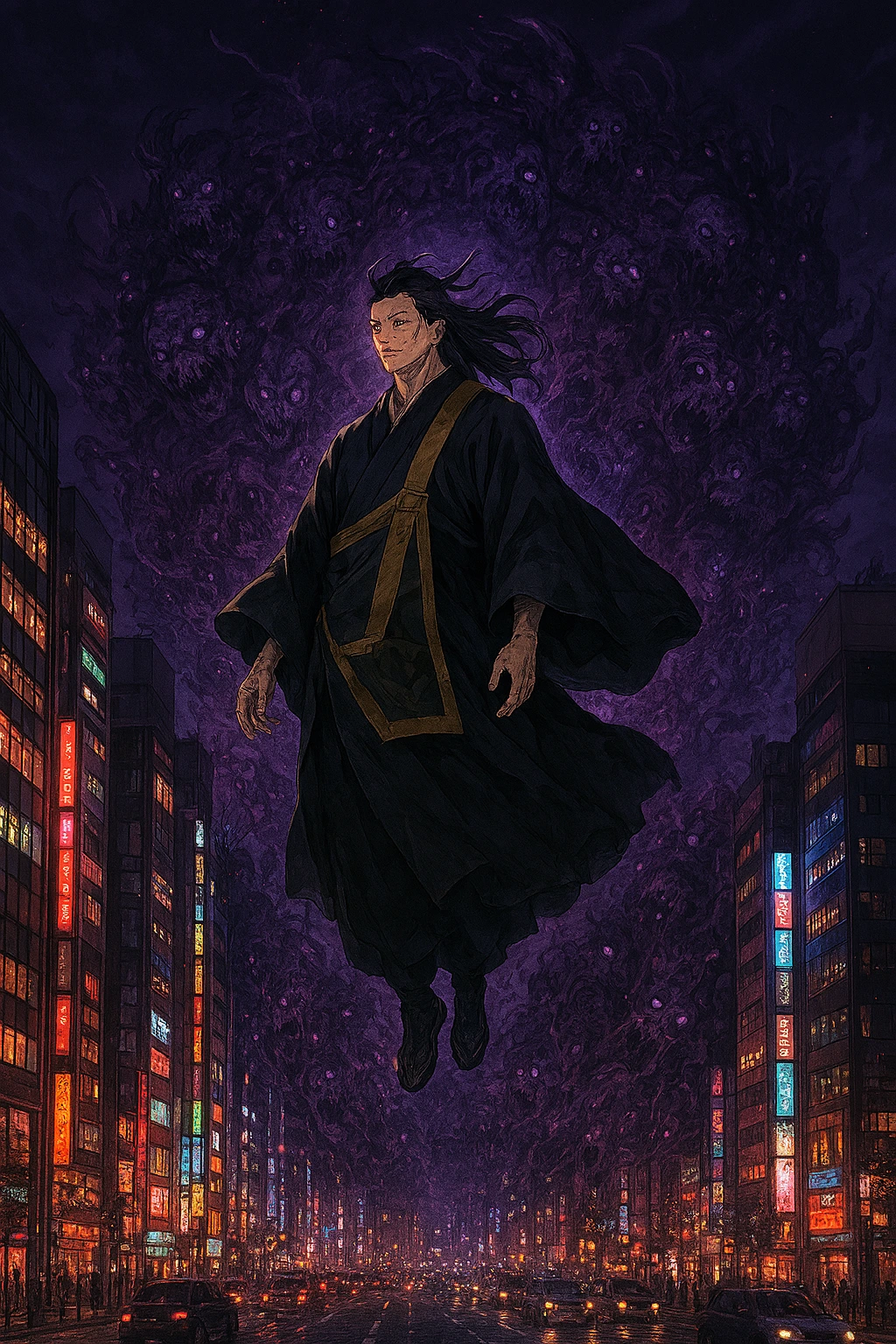
By the time of the prequel, Jujutsu Kaisen 0, Geto has fully settled into his role as a cult leader and revolutionary. He wears the robes of a priest, mocking the very institutions he hates, and gathers money from monkeys to fund their own destruction.
His declaration of war, the Night Parade of a Hundred Demons, set for December 24th, is a masterstroke of tactical audacity. He releases thousands of curses in Shinjuku and Kyoto to draw the bulk of Jujutsu High’s forces away, leaving the school vulnerable so he can isolate Yuta Okkotsu.
His goal? To capture Rika Orimoto, the Queen of Curses. With Rika, he believes he can overturn the world order and finally enact his genocide of non-sorcerers.
What is fascinating about this era of Geto is his hypocrisy, which he is partly aware of. He calls humans “monkeys” and claims to hate them, yet he runs a religious group that manages their grievances. But more importantly, we see his genuine love for his “family.”
Geto is not a solitary tyrant. He is a father figure to Mimiko and Nanako. He has the loyalty of powerful sorcerers like Miguel and Larue. They don’t follow him out of fear; they follow him out of love and respect. Even in his villainy, Geto is charismatic and caring toward sorcerers. He never attacks young sorcerers if he can help it. His ideology is consistent: Sorcerers are precious.
His defeat at the hands of Yuta Okkotsu is ironic. Geto mocks Yuta for playing “make-believe” with friendship, yet Geto’s entire motivation is driven by his love for his friends (sorcerers) and his inability to let go of the past. When he faces Yuta and Rika’s pure love beam, he realizes he has been outmatched not just in power, but in conviction. He tried to bear the burden of the world alone, while Yuta drew strength from connection.
In the end, he sits against a wall, bleeding out, missing an arm. And who finds him? Gojo Satoru.
This final interaction is the emotional anchor of the series. There is no hatred. Gojo doesn’t lecture him. Geto doesn’t beg for forgiveness. “I hate the monkeys. But that doesn’t mean I hate everyone at Jujutsu High.” Even at the end, he couldn’t completely cast aside his old connections. He remained a man torn between two worlds, dying in the twilight of his own making.
VII. The Afterlife of the Body: Kenjaku
The tragedy of Suguru Geto extends beyond his death. In a cruel twist of fate, he does not even find peace in the grave. Because Gojo, in a moment of sentimentality, did not have Geto’s body disposed of properly by Shoko Ieiri, the ancient sorcerer Kenjaku was able to seize the corpse.
For modern viewers of the anime, the “Geto” we see in the Shibuya Incident is Kenjaku. But the body—the vessel—remains Geto’s. This violation is deeply unsettling. The man who cared so deeply about the dignity of sorcerers is turned into a puppet for the most heinous plan in history.
However, there is a glimmer of the soul left. In Shibuya, when Gojo is trapped by the Prison Realm and calls out, “How long are you going to let him control you, Suguru?” the body reacts. Geto’s hand shoots up and grabs his own throat, choking Kenjaku.
It is a fleeting moment, but a powerful one. It suggests that Geto’s will was so strong, his connection to Gojo so profound, that it transcended biological death. The body remembered the soul. It remembered who its best friend was.
The contrast between Kenjaku and Geto is also stark in how they use Cursed Spirit Manipulation. Kenjaku uses it coldly, logically, extracting techniques and burning through curses like ammunition. Geto used it with a sense of weight. Even though he hated the taste, he respected the hierarchy of power. Seeing Kenjaku pilot Geto’s body is like watching a stranger drive a beloved classic car; the movements are right, but the spirit is wrong. It serves as a constant, painful reminder of the hero we lost.

VIII. Conclusion: The Blue Days
Suguru Geto is a warning. He is a warning that empathy, without boundaries, leads to madness. He is a warning that taking the weight of the world onto a single pair of shoulders will crush the spine.
He tried to fix a broken world. He looked at the injustice of sorcerers dying for ungrateful humans and decided it was unacceptable. His solution was monstrous, yes. Genocide is indefensible. But his motivation was rooted in a deep, agonizing love for his people. He wanted a world where his friends didn’t have to die young. He wanted a world where Haibara could have lived.
The tragedy of Geto is that he is the one person Gojo Satoru could never replace. Gojo has students, he has allies, but he never again had a “best friend.” He never had an equal. Geto took a piece of Gojo’s humanity with him when he defected, and another piece when he died.
In their final moments in Jujutsu Kaisen 0, Gojo leans down and whispers something inaudible to Geto. Geto smiles, a sad, genuine smile, and says: “At least curse me a little at the very end.”
He didn’t want forgiveness. He didn’t want pity. He just wanted to be acknowledged by the one person who truly knew him. In the end, Suguru Geto wasn’t a villain who wanted to destroy the world for the sake of destruction. He was a boy who loved summer, who loved his friends, and who simply lost his way in the dark, trying to find a future where they could all be happy. The blue days are gone, but the shadow of Suguru Geto stretches long over the world of Jujutsu Kaisen, a permanent reminder of the cost of being “The Strongest.”