
1. Introduction: The “Before & After” Era
The Provocation: The Death of Nuance
Before Solo Leveling, the landscape of Korean webtoons (Manhwa) was a wild, untamed garden. It was a medium defined by the eccentricity of Tower of God, the high-school brutality of The God of High School, and the vampiric elegance of Noblesse. These stories had texture. They had ensemble casts, messy plotlines, and protagonists who bled, cried, and frequently failed. Readers were accustomed to slow burns, intricate world-building that didn’t rely on exposition dumps, and art styles that varied wildly from rough sketches to watercolor paintings.
Then, the Shadow Monarch arrived.
If you look at the history of the medium, you can draw a distinct red line through the year 2018. Before this line, stories had plots; after this line, stories had Levels. Solo Leveling did not just become a hit; it became a viral infection that rewrote the genetic code of the entire industry. It fundamentally altered reader expectations, convincing a generation of fans that if the main character isn’t a ruthless, glowing god of death by Chapter 20, the story is “mid.” The patience for character growth evaporated overnight, replaced by a hunger for immediate, quantified gratification.
The Viral Infection
To say Solo Leveling was popular is an understatement. It was a cultural phenomenon that transcended the niche boundaries of webtoon apps. It was the “Gateway Drug” for millions of Western readers who had never touched a Korean comic before. But with that massive influx of new blood came a catastrophic side effect: the Homogenization of Fantasy.
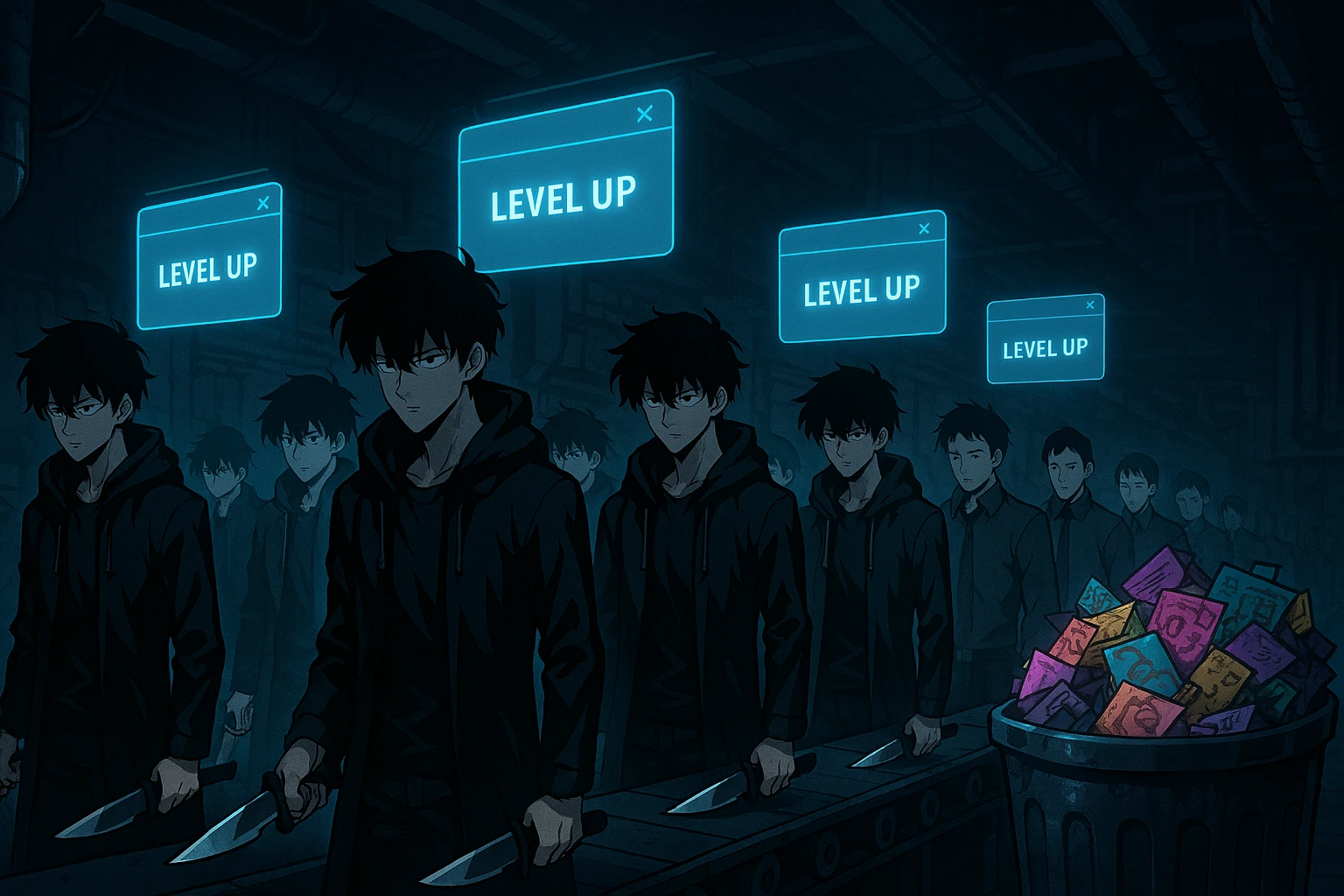
Walk through any webtoon aggregator site today, and what do you see? A sea of black coats, blue status windows, and daggers. The industry looked at the astronomical success of Sung Jin-woo and learned the wrong lesson. They didn’t think, “We need high-octane art and compelling pacing.” They thought, “We need an F-Rank hunter who finds a secret system.” This created a feedback loop where publishers refused to greenlight unique concepts, favoring “safe” system-based scripts that mimicked the Solo Leveling beat sheet.
This sparked the “Factory Era” of Manhwa. Studios began churning out clones with the efficiency of a Ford assembly line. The titles became sentences—I Am The Only One With A System, The Max Level Newbie, The Player Who Returned 10,000 Years Later. The creativity was suffocated by the algorithm, and the unique artistic voices that once defined the medium were drowned out by a chorus of identical content.
The Ultimate Question
This article poses a difficult question for the true connoisseurs of the medium: Did Solo Leveling save the Manhwa industry by injecting it with billions of won and global relevance, or did it kill the soul of creativity by setting an impossible, superficial standard?
We are living in the “Post-Leveling” world, where 90% of new readers drop nuanced series like Kubera or Magician because the art “isn’t glowing enough” or the protagonist takes too long to become overpowered. We have traded narrative depth for dopamine hits. We have traded the journey for the destination. And the Shadow Monarch sits on his throne, casting a shadow so long that no other story can grow beneath it. The industry is richer than ever, but it is also creatively bankrupt, trapped in a dungeon of its own making.
2. The Visual Drug: The Legacy of DUBU (RIP)
The Glow Effect: Defining a Generation
We cannot discuss the impact of Solo Leveling without paying respects to the late Jang Sung-rak, known professionally as DUBU. He was not just an artist; he was a cinematographer working in a vertical format.
Before DUBU, webtoons often looked flat. They resembled digital comics—clean, colorful, but static. DUBU introduced a level of visual fidelity that was previously reserved for high-budget anime key visuals. His mastery of lighting was the “secret sauce.” He didn’t just color within the lines; he painted with luminescence.
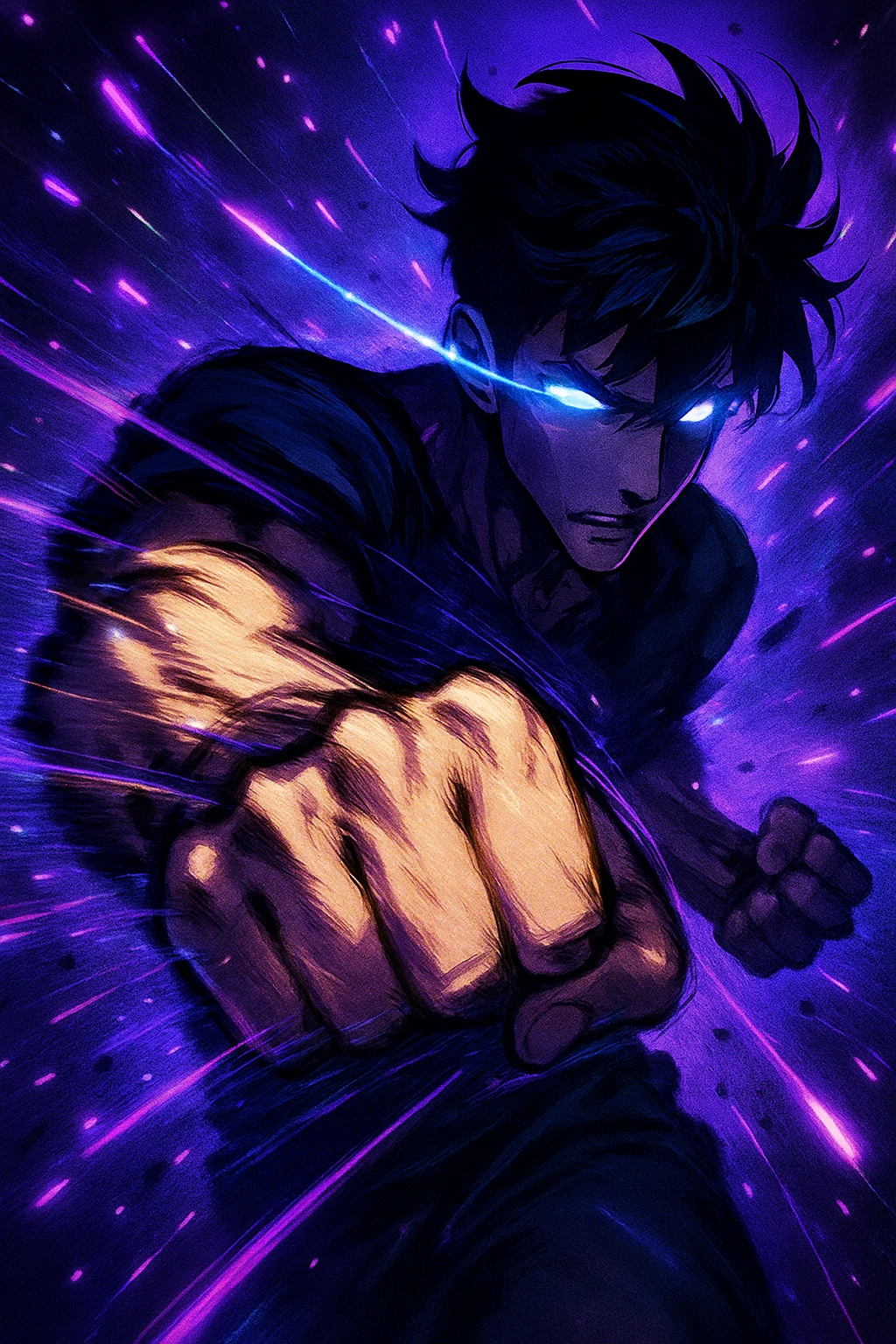
Analyze any major panel of Sung Jin-woo. He is rarely just “standing there.” He is backlit by a purple aura; his eyes leave trails of blue light; the shadows around him embrace him like a physical substance. DUBU utilized particle effects, lens flares, and aggressive contrast (chiaroscuro) to make every panel pop off the screen. This “Glow Effect” became the visual signature of the series. It was addictive. It triggered a primal “cool factor” in the brain that dialogue simply could not compete with. The specific shade of “necromancer purple” combined with the electric blue of the system interface created a color palette that is now instantly recognizable—and endlessly copied.
Action Choreography: The Static Animation
Most comic artists struggle to convey speed. DUBU mastered it. He understood the vertical scroll of the webtoon format better than anyone else. He used the “gutter” (the white space between panels) to control the passage of time, pulling the reader’s eye down the screen at breakneck speed.
In the fight against Igris the Blood Red, the action flows like liquid. DUBU used heavy motion blur, impact frames, and distorted perspectives to simulate the feeling of a camera lens struggling to keep up with a superhuman subject. When Jin-woo punches, you don’t just see the fist; you see the warped air pressure around it. This wasn’t reading; it was watching a blockbuster movie on a phone screen. The kinetic energy was so palpable that readers would scroll faster and faster, their heart rates syncing with the frantic pace of the battle.
The Unfair Standard
This visual mastery created an “Unfair Standard” for the rest of the industry. Suddenly, excellent storytelling with “good” art wasn’t enough. Readers began to demand “God-Tier” art for every generic hunter story.
This destroyed the careers of traditional artists who couldn’t keep up. If a new series launched and the art didn’t have that “Redice Studio Polish” (the studio DUBU founded), the comment sections were ruthless. “Art is trash,” “Where is the glow?”, “Looks like a sketch.” The industry shifted away from unique, stylized art (like the rough lines of The Breaker or the watercolor style of Her Summon) and moved toward a uniform, hyper-polished, VFX-heavy style. Art became a commodity, not an expression. We saw the rise of the “Studio Model,” where backgrounds, coloring, and line art were split among different teams to churn out high-fidelity chapters weekly, stripping away the individual artist’s touch.
The Human Cost
We must also acknowledge the dark side of this visual revolution. The level of detail DUBU maintained—weekly, for years—is humanly impossible without a devastating toll. The “Manhwa Industrial Complex” demands 60+ panels of full-color, high-resolution art every seven days.
DUBU’s untimely death sent a shockwave through the community, highlighting the grueling “crunch culture” of the Korean webtoon industry. We demand the “Glow,” but we rarely think about the health of the hands that create it. The curse of the Shadow Monarch isn’t just on the stories; it’s on the artists forcing themselves to burn out to meet the standard he set. The industry essentially demands that every artist sprint a marathon, leading to chronic health issues, hiatuses, and tragedies that the flashy visuals conveniently obscure.
3. The “System” Epidemic: The Clone Wars
The Blueprint of Laziness
If Solo Leveling provided the visual standard, it also provided the narrative crutch: “The System.”
Before this era, if a character wanted to get strong, they had to train. We saw the montages. We saw the failure. In The Breaker, the protagonist gets beaten to a pulp for volumes before he throws a decent punch. In Solo Leveling, strength is quantified. It is a UI (User Interface).
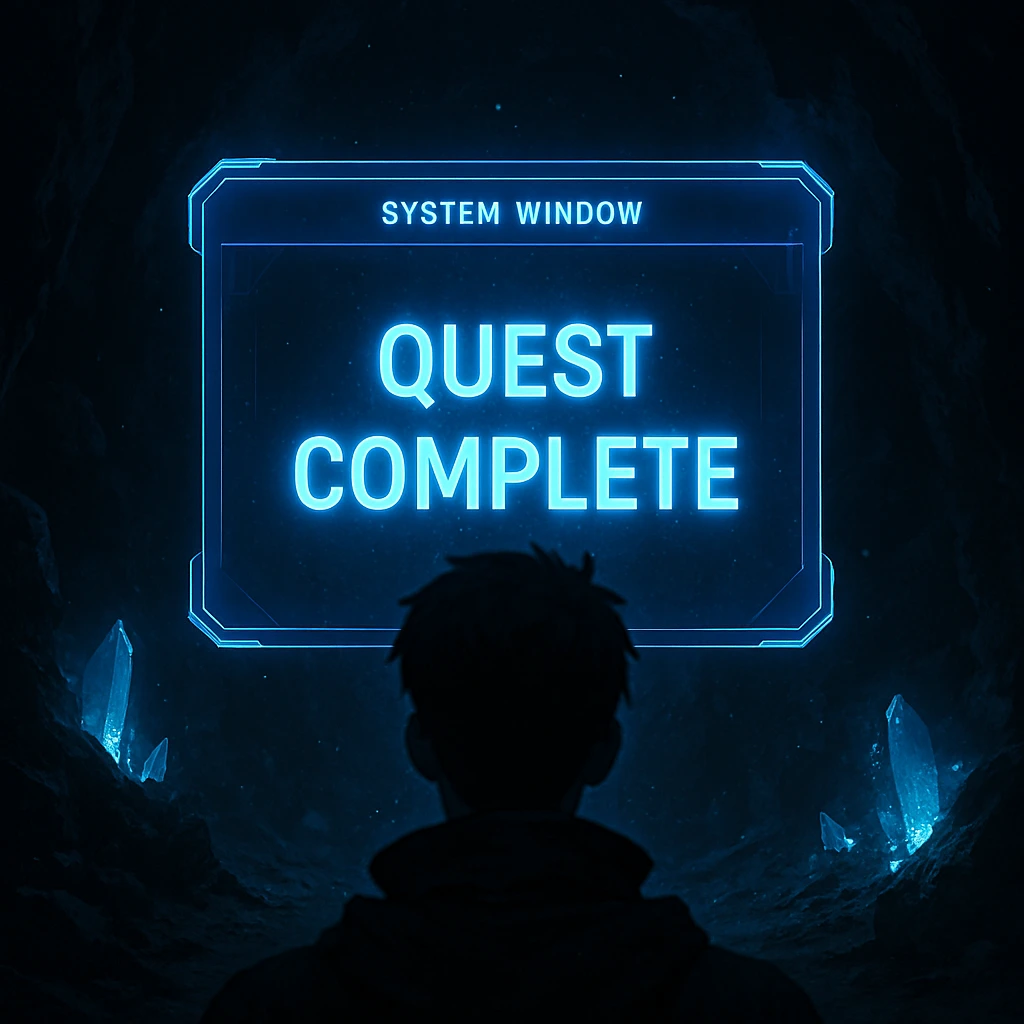
This gamification of storytelling is the most damaging legacy of the series. It allows writers to bypass actual character development. Instead of showing us how a character has grown emotionally or mentally, they just show us a blue screen:
$$Strength has increased by +10$$
. It killed the mystery of magic systems. There is no need for lore, ancient texts, or wise masters when a floating window explains every ability in bullet points. The “Show, Don’t Tell” rule of writing was replaced by “Don’t Show, Just Read the Stat Sheet.”
The Formulaic Checklist
The industry realized that Solo Leveling wasn’t just a story; it was a formula that could be replicated for easy profit. The formula goes like this:
- The Loser Start: The MC must be the weakest in the world (F-Rank, No Talent, Trash).
- The Tragedy: The MC must have a sick mother in the hospital (requiring money) or a massive debt.
- The Betrayal/Incident: The MC is left for dead by his party or falls into a hidden dungeon.
- The Awakening: “You have qualified to be a Player.”
- The Glow Up: The MC sheds his personality along with his weakness, becomes tall, handsome, and cold.
We have seen this exact sequence in dozens of top-ranking manhwa. Solo Max-Level Newbie, Kill The Hero, Seoul Station’s Necromancer—they are all distinct stories, yet they feel like DLC packs for the same game. Writers stopped trying to build unique worlds and started using the “Modern World with Dungeons” template because it requires zero setup. You don’t need to explain geography or politics; you just put a “Dungeon Gate” in the middle of Seoul and start the action.
Dungeon Fatigue
Readers are currently suffering from “Dungeon Fatigue.” The vocabulary of the genre has become stale. Guilds, Association Chairmen, S-Rank Gates, Mana Stones, Daily Quests. It has become a feedback loop.
The tragedy is that Solo Leveling didn’t invent this. The Gamer introduced the concept of a real-life RPG interface years prior. But The Gamer used it to explore the mechanics and comedy of the situation. Solo Leveling stripped away the comedy and the math, turning the “System” into a pure power fantasy vehicle. It took a niche concept and made it the only concept that sells. We are now trapped in a cycle where every protagonist is a Necromancer, a Regressor, or a Constellation’s favorite, and the joy of discovery is gone.
The Death of the Party
The “Solo” in Solo Leveling is literal. And it killed the concept of the “Adventure Party.” In One Piece or Naruto, the protagonist relies on friends. Their strength comes from bonds. In the post-SL era, the protagonist is a lone wolf. Other characters exist solely to react. They are not teammates; they are the audience. They stand on the sidelines, mouths agape, saying, “How is he so fast?” or “Is he really an E-rank?”
This isolationism makes for a cool power trip, but it creates a lonely, hollow narrative world. The side characters become cardboard cutouts whose only purpose is to be saved by the MC or to explain how strong the MC is to the reader.
4. The Death of Struggle: The “Edgelord” Protagonist Problem
Character vs. Caricature
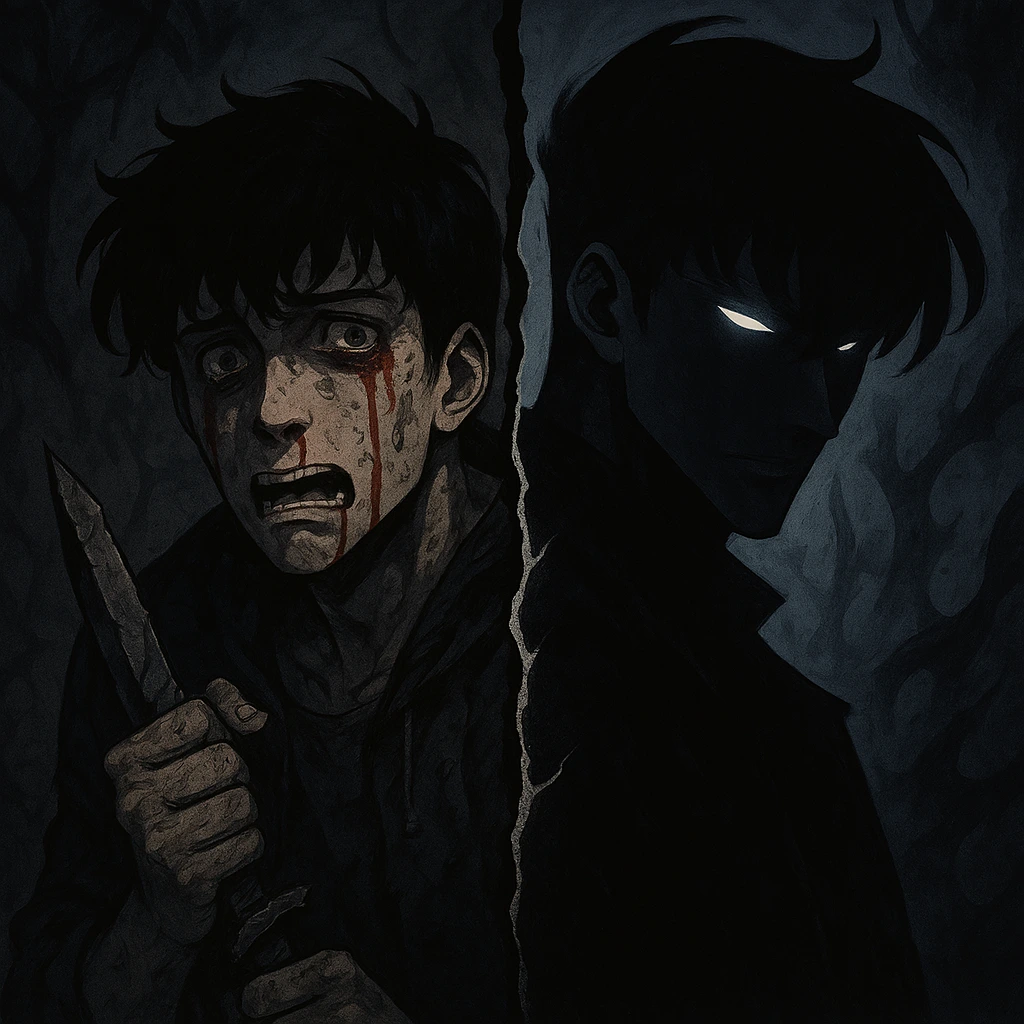
Let us be honest about Sung Jin-woo. In the first 10 chapters, he is a fantastic character. He is terrified, he is weak, he is desperate to survive for his family. The “Double Dungeon” arc is a masterpiece of horror and tension because Jin-woo is human. We root for him because he is the underdog fighting a hopeless war against gods.
But after the “Job Change” arc, Sung Jin-woo effectively dies. The character who replaces him is not a person; he is a force of nature. He loses his fear, his hesitation, and arguably, his personality. He becomes the “Shadow Monarch”—a cool design, a stoic face, and a vessel for violence. Even his physical appearance changes so drastically that he becomes unrecognizable. This “glow up” wipes away the relatable flaws that made him interesting, replacing them with perfect abs and a monotone voice.
The “Mary Sue” Issue
Modern manhwa protagonists are terrified of losing. Solo Leveling taught writers that “fans hate seeing the hero lose.” If the hero loses, the comments section screams “Frustrating!” or “Drop!”.
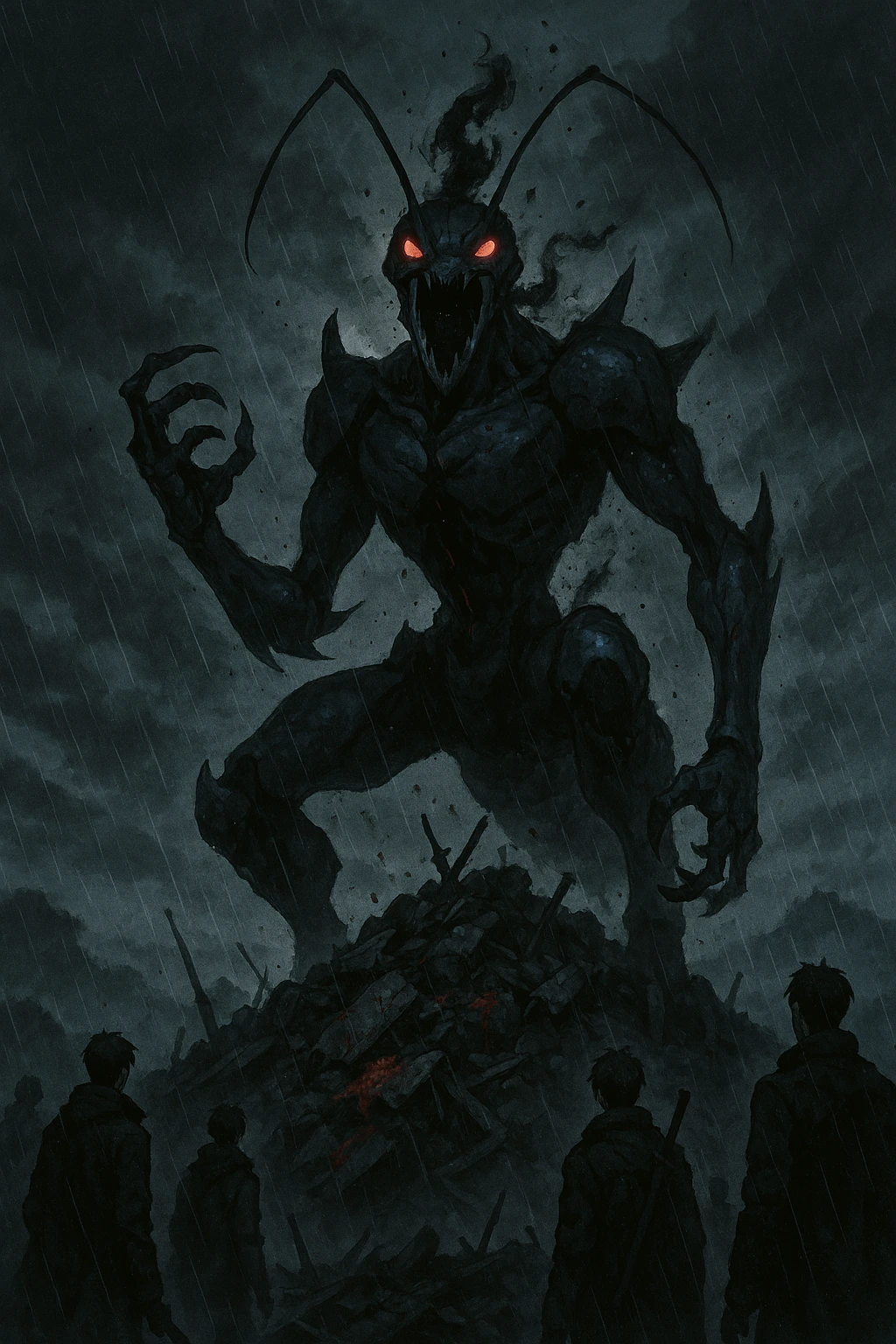
As a result, we have entered the era of the “Cider” protagonist (a Korean slang term for a plot that is refreshing and frustration-free, like a carbonated drink). Jin-woo never really struggles after he gets his powers. He dominates. When he fights the ant king Beru—a creature that slaughtered the strongest hunters in Japan—he treats it like a minor inconvenience. This reflects a shift in reader psychology; in a hyper-competitive society, readers don’t want to see their hero struggle like they do in real life. They want absolute, crushing dominance.
This kills narrative tension. If we know the MC will win, and we know he won’t even be permanently injured, where is the thrill? The thrill shifts from “Will he survive?” to “How cool will he look while winning?” It is a shift from drama to spectacle.
The Emotional Void
Compare Jin-woo to Bam from Tower of God. Bam gains power, but he loses his innocence. He is betrayed, he creates enemies, he hurts his friends. There is a cost to his ascent.
Jin-woo’s ability, “Arise,” removes the ultimate consequence of death. When a character dies, Jin-woo can simply bring them back as a loyal shadow soldier. While this is undeniably “cool,” it creates an emotional void. Death is not a goodbye; it’s a recruitment process. The stakes evaporate. The shadows, while charming in their own way, are sycophants who exist only to praise their liege. We are left with an “Edgelord” protagonist who is infinitely strong, infinitely rich, and infinitely right. It is satisfying in the way eating a bag of sugar is satisfying—rush, then crash, then emptiness.
5. The Nationalism Controversy: Korea vs. Japan
The Politics of Power Fantasy
To understand Solo Leveling deeply, you must understand the geopolitics of East Asia. The “Jeju Island Arc” is the most controversial segment of the story, and for good reason. It serves as a blatant nationalist power fantasy.
In the story, the Japanese Hunter Association is portrayed not just as rivals, but as conniving, arrogant villains. They plot to let the ants destroy the Korean hunters so that Japan can swoop in, save the day, and annex Korean territory economically. It frames the Japanese characters as deeply incompetent and malicious, driven by a desire to subjugate Korea again.
Then, the story humiliates them. The strongest Japanese hunters are slaughtered like cattle. Goto Ryuji, the pride of Japan, is decapitated instantly. The Japanese system fails completely, and only the “lone Korean god,” Sung Jin-woo, can save the day.
The “Anti-Japan” Trope
This is not accidental. It taps into deep-seated historical resentment regarding the Japanese occupation of Korea. For a domestic Korean audience, seeing a Korean hero casually effortlessly dismantle the strongest fighters of Japan provides a powerful cathartic release. It validates national strength in a fictional arena.
However, for an international audience, it felt heavy-handed and uncomfortable. It wasn’t just “good guys vs. bad guys”; it was “Virtuous Korea vs. Deceitful Japan.” This trope is common in lesser-known manhwa, but Solo Leveling‘s massive platform magnified it, making the political subtext impossible to ignore. It transforms the story from a universal fantasy into a specific regional revenge fantasy.
The Anime Changes
This controversy was so radioactive that the anime adaptation had to fundamentally alter reality for the Japanese broadcast. In the Japanese release of the anime, the setting is changed to Tokyo, and Sung Jin-woo is renamed “Shun Mizushino.” They essentially had to localize the story to hide the fact that the source material actively antagonizes their country.
This nationalism is a double-edged sword. It helped fuel the hype domestically in Korea, turning the webtoon into a national pride, but it alienates the very global audience the genre is trying to court. It highlights a maturity issue in the writing—the need to elevate the protagonist by tearing down entire nations rather than building compelling villains.
6. The Anime Gamble: Can It Ever Live Up to the Hype?
The “Ufotable” Standard
When the anime was announced, the internet exploded. But the second reaction was hesitation: “A-1 Pictures? Why not Ufotable? Why not Mappa?”
The fans didn’t just want an adaptation; they wanted a religious experience. They wanted the Demon Slayer treatment. The fear was that A-1 Pictures (known for Sword Art Online) would give it a “standard” polish, which would be a death sentence for a series that relies entirely on visual spectacle. While A-1 is a top-tier studio, the specific aesthetic of Solo Leveling—the heavy use of blacks, sharp angles, and aura effects—requires a very specific direction that traditional animation struggles to replicate.
The Pacing Issue: Rushing the High
The first season of the anime exposed the narrative cracks. Without DUBU’s art to linger on, the story moves frighteningly fast. The anime highlighted how thin the character interactions actually are. In the webtoon, you can scroll past the dialogue to get to the fights. In the anime, you have to sit through the dialogue, and viewers began to realize: “Wait, does Jin-woo actually talk to anyone about anything other than leveling up?”
The pacing felt rushed because the studio knew they had to get to the “Arise” scene (the Igris fight) before the season ended to hook the audience. They sacrificed context for “cool moments,” cutting out minor world-building details and side character moments that gave the original novel a bit more flavor.
The CGI Problem: The Shadow Army
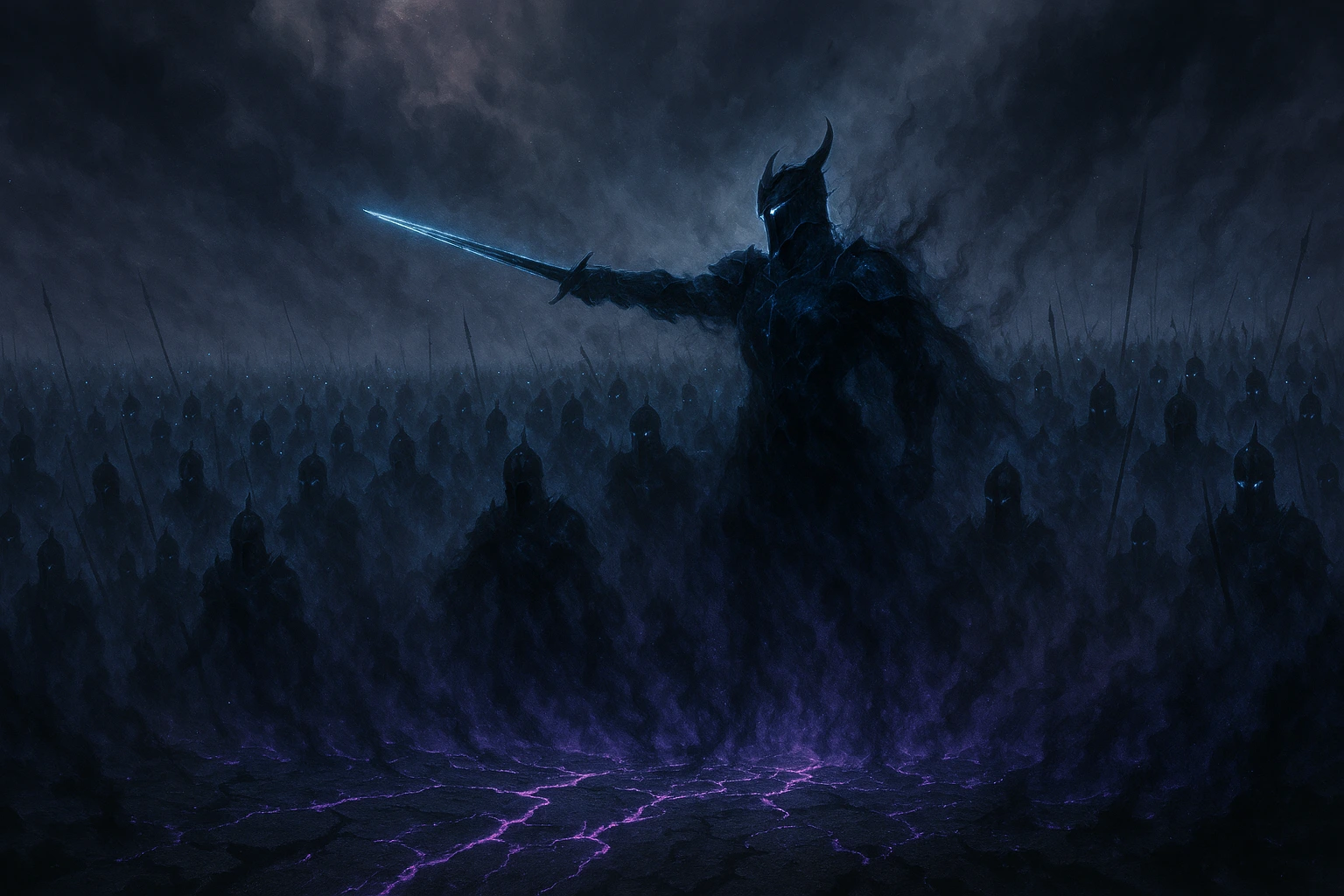
The biggest threat to the anime’s legacy is the Shadow Army. In the webtoon, the shadows are ink-black, smoky, and fluid. In animation, drawing hundreds of individual soldiers by hand is a budgetary nightmare.
We have already seen the reliance on CGI (Computer Generated Imagery). While modern CGI is good, the fear is that in later seasons—where Jin-woo commands thousands of soldiers—the show will devolve into a clash of low-poly CGI models. If the Shadow Monarch’s army looks like a PS2 cutscene, the “Cool Factor” collapses. And without the cool factor, Solo Leveling has nothing left to stand on. The ethereal, smoky quality of the shadows is their defining trait, and rendering that frame-by-frame in 3D without it looking jarring is a technical hurdle that could break the immersion.
The Verdict on Adaptation
The anime is popular, yes. But it has not transcended the medium in the way Arcane or Cyberpunk: Edgerunners did. It is a faithful adaptation of a flawed masterpiece. It entertains, but it does not elevate. It proves that while you can animate the fights, you cannot animate the feeling of scrolling through DUBU’s masterpiece for the first time.
7. The Economic Monster
The Billion Won Webtoon
Regardless of artistic criticism, Solo Leveling is an economic monster. It proved that a webtoon could generate revenue on par with major manga titles. It was the “Proof of Concept” that investors needed.
Because of Solo Leveling, billions of Won were poured into the industry. Platforms like KakaoPage and Naver Webtoon expanded aggressively into the West (Tapas, Tappytoon, Webtoon). It created the infrastructure that allows other artists to get paid. It shifted the power dynamic, proving that a digital-first comic could compete with the printed giants of Japan’s Shonen Jump.
The Merchandise Machine
We are now seeing the “Marvelization” of the IP. The game, Solo Leveling: Arise, is a gacha money-printer. There are hoodies, figures, and potential live-action talks. Solo Leveling showed the world that Manhwa is not just a niche hobby; it is a transmedia juggernaut.
It opened the door. Without Solo Leveling kicking down the gate, masterpieces like Omniscient Reader’s Viewpoint or The Beginning After The End might never have received the global marketing push they deserved. It acted as the battering ram for Korean culture to enter the Western comic market. It established a pipeline: Web Novel -> Webtoon Adaptation -> Global Licensing -> Anime -> Game. This is now the gold standard business model for Korean entertainment companies.
8. Conclusion: The King on the Empty Throne
The “Dragon Ball Z” of a Generation
In the end, Solo Leveling is the Dragon Ball Z of the webtoon generation.
Is Dragon Ball Z the best-written story? No. It has plot holes, power creep, and repetitive fights. But it is legendary. It is visceral. It hits a primal chord that sophisticated storytelling cannot reach. Solo Leveling is the same. It is simple, it is flawed, but it is undeniably, aggressively entertaining. It distilled the essence of the “power fantasy” into its purest, most potent form.
The King’s Legacy
The “Curse” of the Shadow Monarch is real. It has saturated the market with trashy clones, ruined the patience of readers, and imposed an inhuman workload on artists. It has turned Manhwa into a fast-food industry of power fantasies where quantity and “hype” are valued over quality and substance.
However, it also built the theater. It brought millions of eyes to the medium. It forced Japanese Manga to acknowledge its Korean neighbor as a serious competitor. It proved that a story doesn’t need to be deep to be loved; it just needs to be cool.
The Challenger
Will any series dethrone it? The only contender is Omniscient Reader’s Viewpoint. If Solo Leveling is the physical peak of the medium (pure strength), Omniscient Reader is the intellectual peak (meta-commentary on stories themselves). Omniscient Reader deconstructs the very tropes that Solo Leveling popularized, asking why we enjoy watching characters suffer for our entertainment.
Solo Leveling did not ruin Manhwa; it just evolved it into a global blockbuster. It sacrificed its soul to gain the world. And as Sung Jin-woo sits on his throne in the eternal darkness, he is the undisputed King—but the kingdom he rules is filled with shadows that look exactly like him.