
1. Introduction: The Beauty That Buzzed
In the pantheon of Solo Leveling villains, there is a distinct hierarchy of fear. There is the overwhelming, brute force of the Dragon Monarch, Antares, who represents destruction in its purest form. There is the primal, jagged violence of the Beast Monarch, who represents the hunt. But then, standing apart from them in a sphere of nausea and dread, is Querehsha, the Plague Monarch. She does not represent war; she represents rot. She is the Queen of Insects, and her brief but horrifying reign over Seoul stands as one of the most disturbing chapters in the entire manhwa.
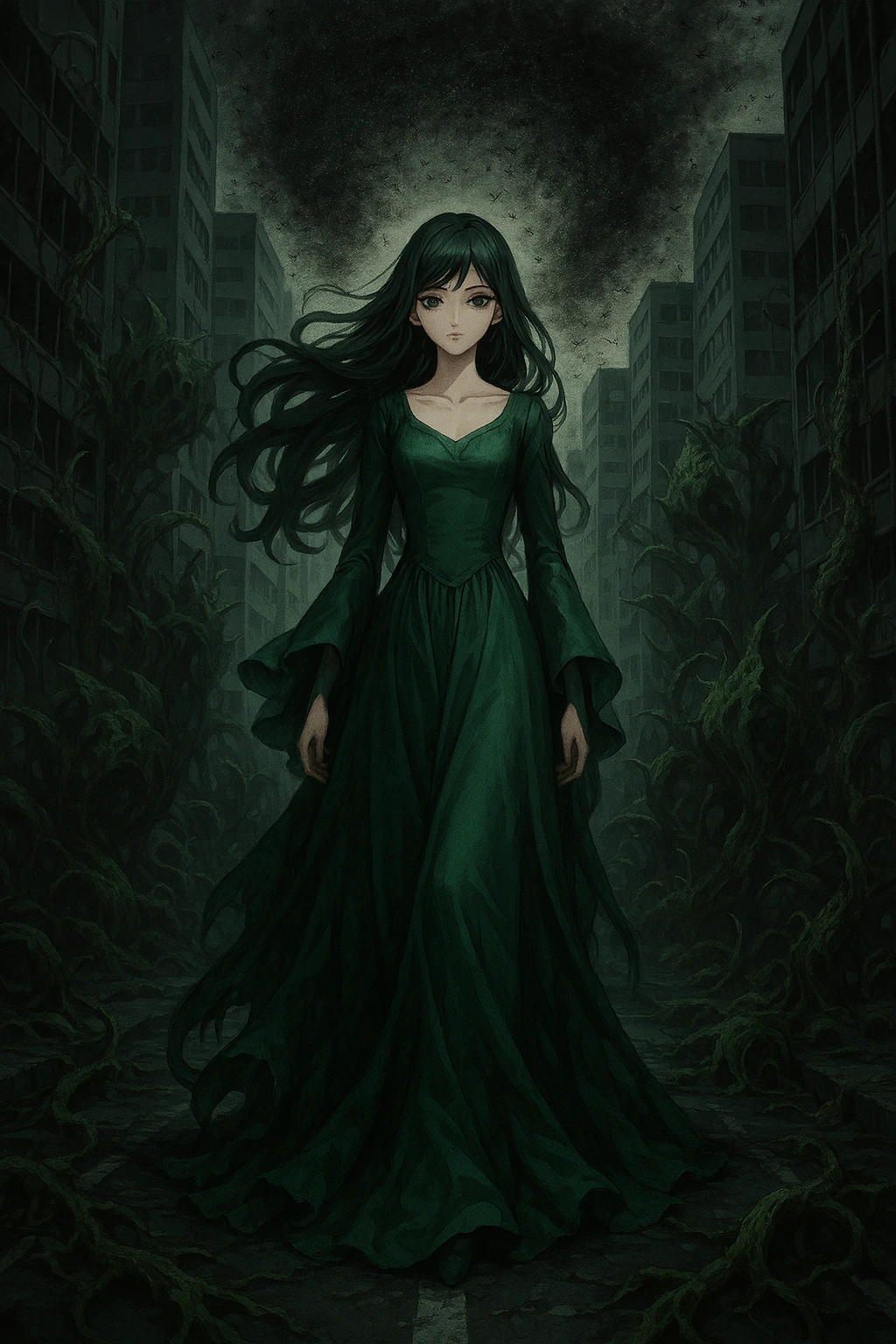
The introduction of Querehsha is a masterclass in cognitive dissonance—a psychological phenomenon where what our eyes see conflicts violently with what our instincts tell us. When she first descends, she does not look like a monster. She appears as a woman of striking, almost ethereal beauty. She is draped in a flowing green dress, her movements elegant, her posture regal. To the untrained eye of a lower-ranked hunter, she might have looked like a goddess or a high-ranking elf.
But the horror lies in the details. It lies in the sound.
Before she is fully seen, she is heard. A constant, low-frequency thrumming permeates the air around her. It isn’t the clean whoosh of wind or the crackle of energy; it is the chaotic, organic sound of a billion wings beating in unison. It is a buzzing sound that triggers a primal “fight or flight” response in the human brain. Evolution has taught humanity that a loud buzzing sound means a swarm is coming—locusts to eat the crops, mosquitoes to bring disease, or hornets to bring pain. Querehsha weaponizes this evolutionary fear before she even lifts a finger.
This deception—the beautiful woman who sounds like a swarm of flies—creates an immediate sense of unease (“The Uncanny Valley”). She smiles, but the smile doesn’t reach her eyes, which are cold and compound in their focus. She speaks, but her voice carries the harmonic distortion of a thousand insects rubbing their legs together.
Her domain expansion was instant and absolute. When the Monarchs invaded, the Frost Monarch brought winter, freezing the skyscrapers of Seoul into distinct, icy tomb markers. But Querehsha brought the jungle. In seconds, the concrete jungle of a modern metropolis was overgrown with thick, pulsating vines and humid, sticky air. This wasn’t a healthy, vibrant forest; it was a parasitic ecosystem. The plants were not growing from the earth; they were feeding on the infrastructure.
She turned Seoul into a hive. The air became thick with spores and pheromones. The sleek glass of corporate buildings became nesting grounds for giant centipedes. The streets, once filled with cars, became rivers of scurrying legs. This transformation established her title immediately: “The Monarch of Plagues.” She doesn’t just kill her enemies; she infects the environment. She violates the sanctity of the human world not by breaking it, but by making it filthy.
This introduction sets the stage for a villain who operates on a level of visceral disgust that no other Monarch touches. Antares might burn you to ash, which is clean and final. The Plague Monarch wants to lay eggs in your corpse. That distinction is why, despite her relatively short screen time, she remains the most disturbing villain Sung Jin-Woo ever faced.
2. The Mother of Insects: A Hive Mind
To understand the threat of Querehsha, one must understand that she is not a singular entity in the traditional sense. While she possesses a main body, her consciousness is a hive mind that extends to every single insect under her command. She is the Queen, and the millions of creeping things in her domain are her fingers and toes.
The Authority of the Hive
Her authority is absolute. In the animal kingdom, a queen bee or an ant queen releases pheromones to guide the colony. Querehsha uses mana to enslave the very concept of “insect.” This control ranges from the microscopic to the kaiju-sized.
- The Micro: Clouds of gnats and mosquitoes that can drain a human of blood in seconds, acting like a sentient grey goo.
- The Macro: Giant, armored beetles and centipedes capable of crushing tanks and tearing through S-Rank barriers.
This range makes her impossible to defend against using conventional warfare. You can shoot a giant beetle, but you cannot shoot a cloud of spores. You can block a physical attack, but you cannot block the tiny parasites that crawl into the ventilation shafts of a bunker. She represents the “inevitability” of nature. Just as ants will eventually find the sugar in your pantry no matter how tightly you seal the jar, Querehsha’s minions will eventually find a way into your defenses.
The Zombie Parasites
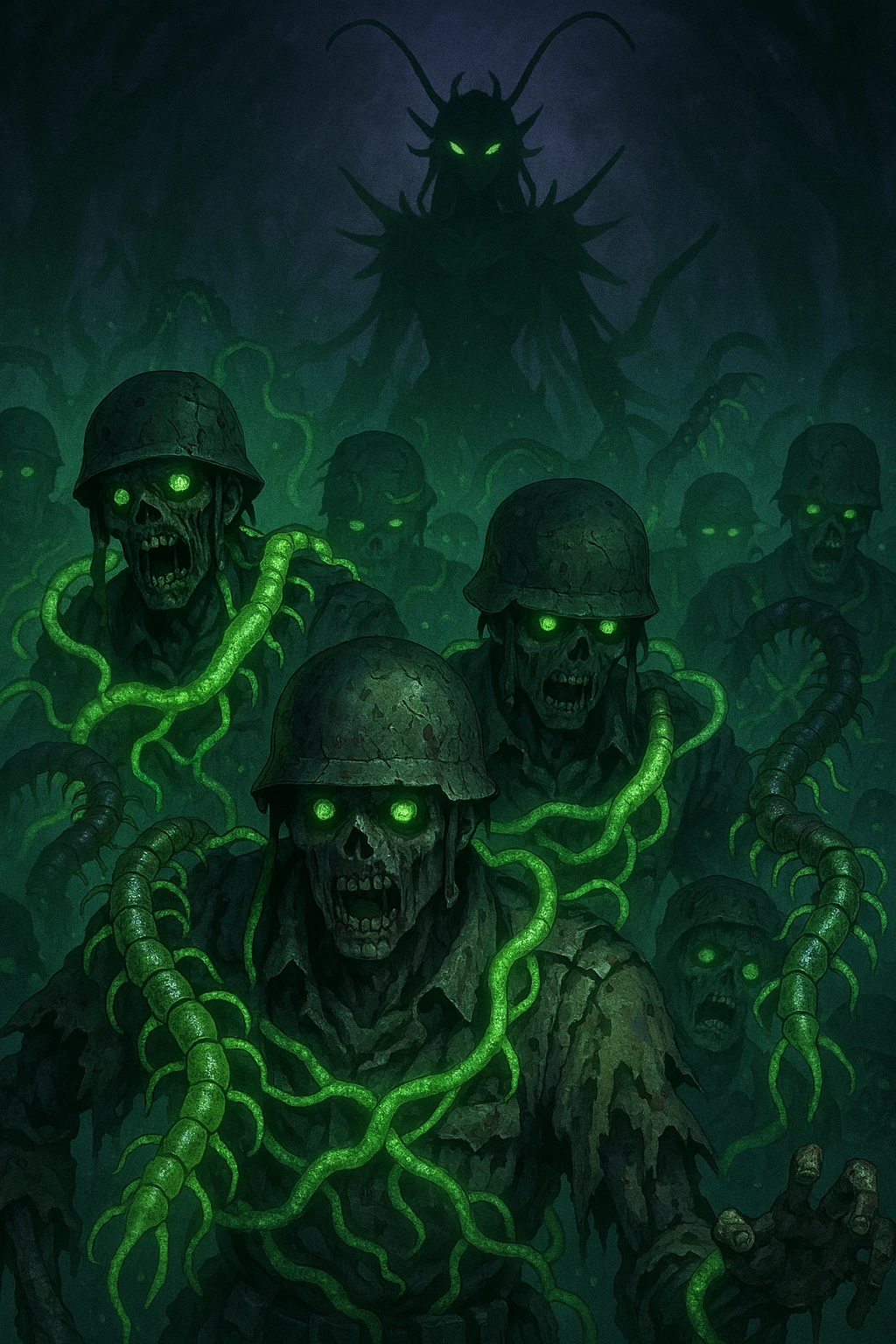
The most horrifying aspect of her power, however, is not her control over bugs, but her control over people via bugs. This is where Solo Leveling briefly dipped its toes into the genre of pure body horror. Querehsha does not let the dead rest.
Unlike Sung Jin-Woo’s Shadow Extraction, which is a clean, spiritual summoning that retains the personality and loyalty of the soldier, Querehsha’s necromancy is biological and non-consensual. She utilizes parasitic worms and larvae to burrow into the bodies of deceased civilians and hunters. These parasites hijack the nervous system, turning the host into a meat puppet.
We saw this in the tragic scenes across Seoul. Civilians who had been killed in the initial invasion were seen rising again, their movements jerky and unnatural. Their eyes were glazed over, or worse, missing entirely, replaced by the writhing heads of parasites. This is a perversion of life. The “Insect Soldiers” are not fighting for loyalty; they are fighting because their muscles are being pulled by strings of living organic matter.
This ability creates a psychological warfare advantage that dwarfs the other Monarchs.
- The Frost Monarch: Freezes you. You die.
- The Beast Monarch: Eats you. You die.
- The Plague Monarch: Kills you, fills you with worms, and forces your body to kill your friends.
It is a darker, twisted mirror of Jin-Woo’s power. Where Jin-Woo offers “Eternal Rest” and a chance to fight for a noble cause, Querehsha offers “Eternal Slavery” and the degradation of the body. She consumes not just the life of her victims, but their dignity.
The Disgust Factor
The “Disgust Factor” is a critical component of her character design. The author and artist utilized trypophobia (fear of clusters of small holes) and entomophobia (fear of insects) masterfully.
There are moments in the battle where she is struck, and instead of blood, insects pour out of the wound. When she speaks, sometimes a centipede curls out from behind her ear. Her ability to vomit bugs—literally regurgitating a stream of acid-covered insects—is a visual representation of her inner rot. It suggests that she is hollow, a skin suit filled with a writhing colony.
This biological horror serves a narrative purpose: it makes the reader want her dead. Not just defeated, but eradicated. When a villain is “cool” or “stoic,” we respect them. When a villain is “gross,” we want them cleansed with fire. Querehsha was designed to be hated on a visceral level, making her eventual execution by Jin-Woo one of the most satisfying moments of catharsis in the series.
3. The King vs. The Goddess: Beru’s Last Stand
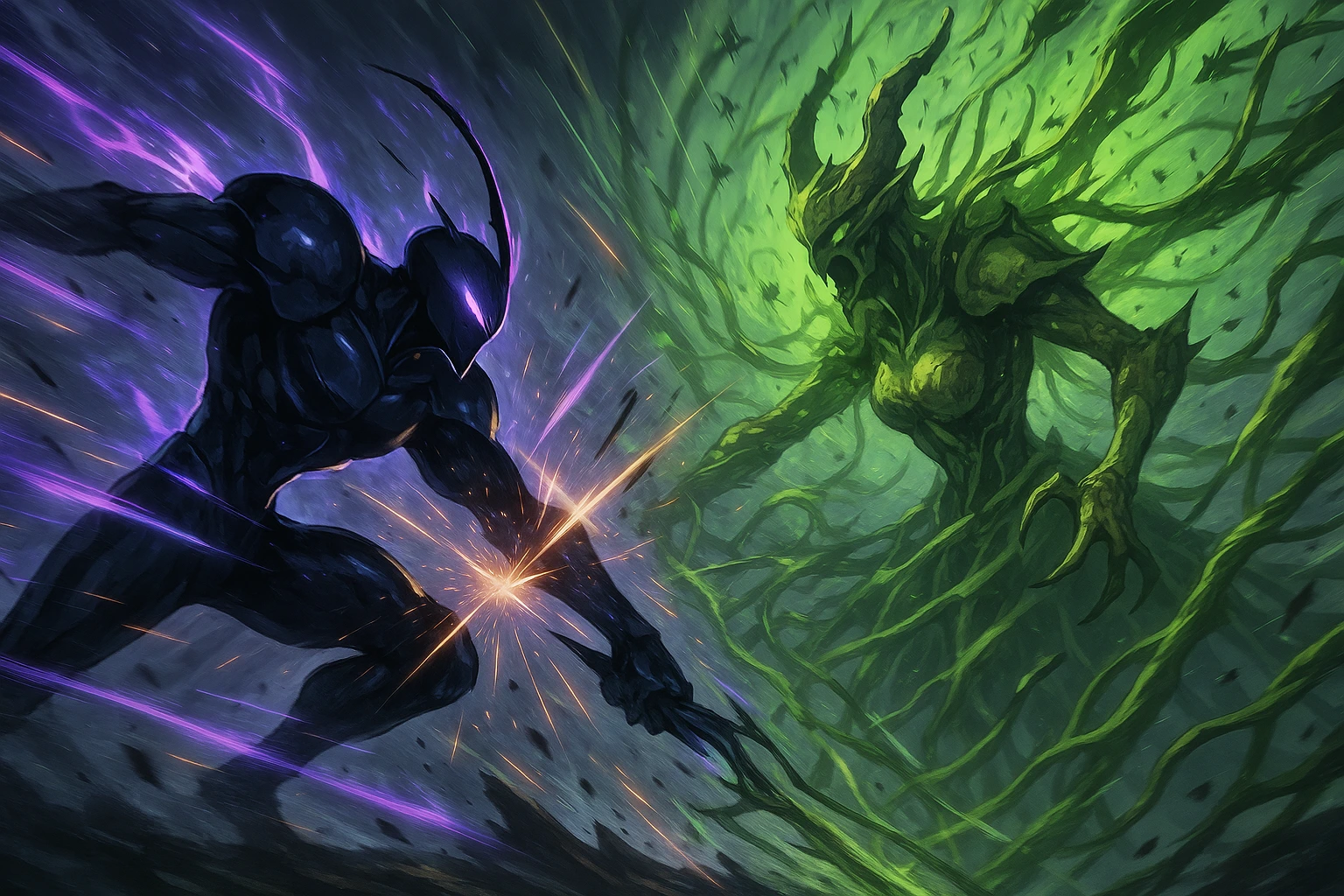
The confrontation between Beru (The Ant King) and Querehsha (The Plague Monarch) is arguably the most thematically rich sub-battle in the entire Solo Leveling saga. It is a battle of hierarchy, loyalty, and nature versus divinity.
The Hierarchy of Bugs
On paper, this fight should not have happened. Beru is the King of Ants, the apex predator of the Jeju Island raid. He was born to rule the insect world. However, Querehsha is the Monarch of Plagues. In the cosmic hierarchy of the Solo Leveling universe, a King is below a Monarch. A King rules a species; a Monarch rules a concept.
To Querehsha, Beru is not a rival; he is a rebellious subject. She looks at him with genuine confusion and disdain. In her eyes, an ant attacking the God of Insects is a glitch in the matrix. It is a violation of natural law. She calls him a “mere bug,” a “mutant,” and a “failure.” This dialogue is crucial because it highlights Querehsha’s arrogance. She believes that biology dictates destiny. Because she created the concept of insects, she believes she owns them.
The Glitch in the Programming
Beru’s defiance is what makes this fight legendary. Beru acknowledges her status. He feels the overwhelming pressure of her aura, a pressure that tells every cell in his body to kneel. His instincts are screaming at him to submit to the Queen.
But Beru has evolved beyond his biology. Through his service to Sung Jin-Woo, he has gained something insects do not possess: Loyalty born of love.
When Querehsha laughs at his devotion, calling it a “glitch,” she inadvertently highlights Beru’s greatest strength. He is no longer just an ant; he is a Shadow Soldier. He is not fighting for the hive; he is fighting for his Liege. This shift from “Hive Mind” to “Individual Devotion” is the core conflict of the fight.
The Battle Dynamics
Visually, the fight is a spectacle of speed versus volume.
- Beru relies on his immense speed and piercing power. He is a scalpel—precise, deadly, and fast. He zips through the air, tearing through her minions, aiming for the Queen herself.
- Querehsha relies on volume and environment. She doesn’t need to be faster than Beru; she just needs to be everywhere. She surrounds him with walls of insects, clouds of poison, and grasping vines.
Beru is fighting a losing battle, and he knows it. He is outclassed in mana, outclassed in authority, and outclassed in durability. He takes massive damage. His exoskeleton is cracked, his wings are torn, and he is slammed into the ground repeatedly. Yet, he keeps getting up.
This “Last Stand” buys crucial time. If Beru had submitted to his natural instincts, Jin-Woo might have arrived too late to save the other hunters. Beru’s refusal to bow to the “Goddess of Insects” is the ultimate proof of Jin-Woo’s influence. Jin-Woo didn’t just resurrect Beru; he gave him a soul.
The tragedy of the fight is palpable. Beru, usually the arrogant monster who screams “KIEEEEK!” and slaughters S-Rank hunters for fun, is reduced to a desperate guardian. Seeing the Ant King—the nightmare of Jeju Island—being batted around like a toy establishes just how high the power ceiling has risen. It proves that the Monarchs are not just “stronger hunters”; they are gods. And to kill a god, you don’t need a King; you need a Shadow Monarch.
4. The True Form: Nightmare Fuel
Every Monarch has a transformation, a state where they abandon their human vessel (or disguise) and reveal their spiritual body. For the Beast Monarch, it was a giant werewolf-lion hybrid—fearsome, but recognizable. For the Plague Monarch, the transformation was pure, unadulterated nightmare fuel.
The Shedding of the Skin
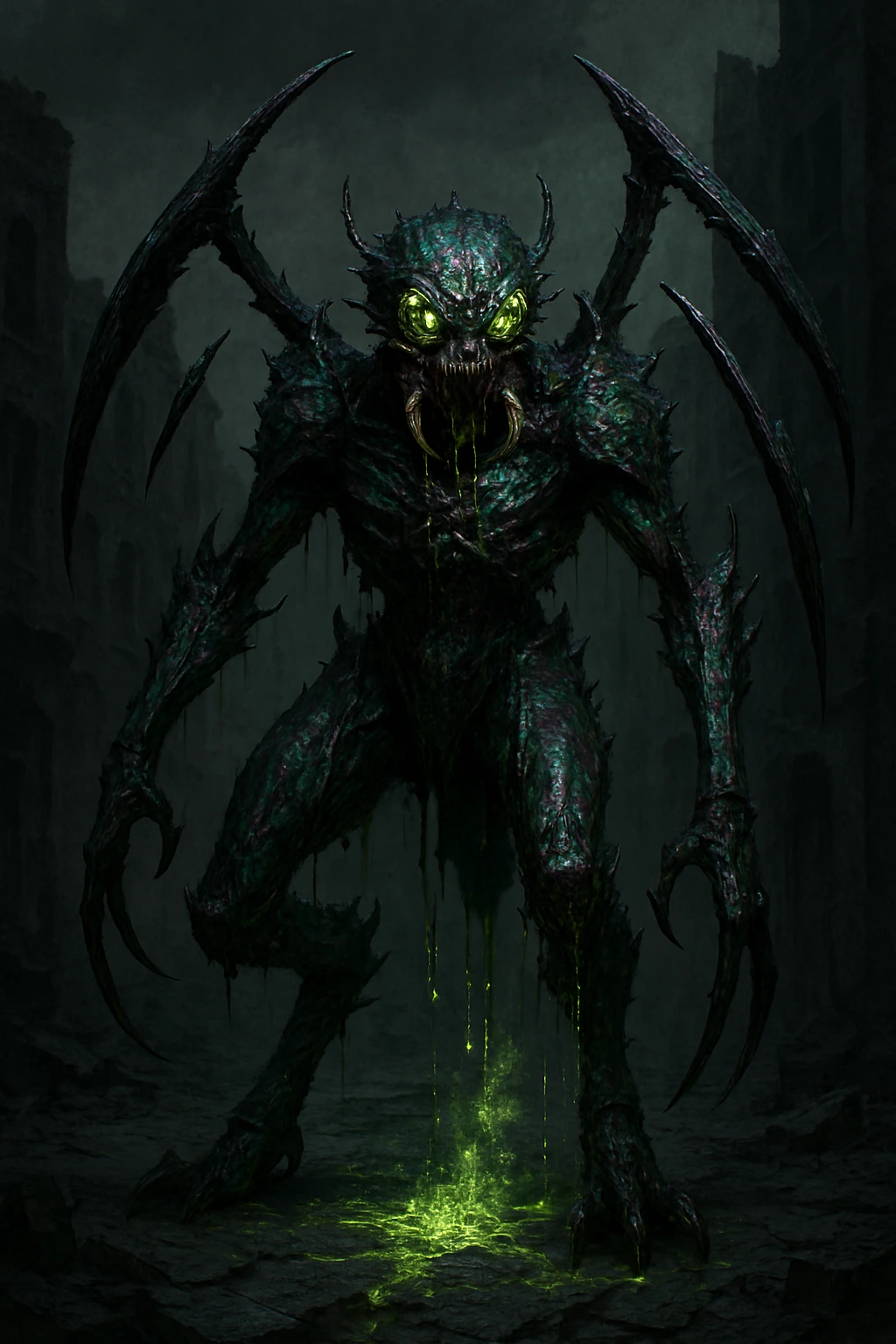
The moment Querehsha decides to stop playing with her food is depicted with grotesque detail. She does not “morph” smoothly. She sheds. Her human skin splits open, tearing down the middle as if the woman we saw earlier was merely a tight suit she was wearing.
What emerges is a monstrosity that defies easy classification. She becomes a humanoid insect, but not in a clean, superhero way.
- The Color: A sickly, iridescent green mixed with necrotic purple.
- The Limbs: Multiple extra appendages sprout from her torso, tipped with razor-sharp hooks meant for grappling and impaling.
- The Face: Her human beauty is obliterated. In its place is a visage of mandibles, compound eyes that reflect a thousand images of her prey, and antennae that twitch with sensory overload.
This true form is the embodiment of “Rot.” She looks wet, slimy, and covered in a sheen of biological mucus. It plays into the primal human fear of contamination. Touching her doesn’t just mean getting cut; it means getting slimed.
The Acid and the Ecology
In this form, her offensive capabilities skyrocket. Her primary weapon becomes a corrosive acid that she can spit or spray from her body. This is not normal acid; it is mana-infused bile. We see it melt through the environment instantly. Steel girders dissolve into gray sludge. Concrete hisses and evaporates.
More terrifying is its effect on living things and magical constructs. Even the shadows—beings made of mana—are not immune to the corrosion. Her acid eats away at the mana that binds the Shadow Soldiers together. This poses a unique threat to Jin-Woo. Usually, his soldiers are immortal as long as he has mana. But Querehsha’s acid burns the mana faster than it can regenerate, threatening to permanently erase his army.
The Regeneration of the Hive
The difficulty in killing Querehsha lies in her regenerative properties. As the Queen of Insects, she shares the vitality of the hive. Insects are notoriously hard to kill; you can cut a cockroach in half, and it will still crawl. Querehsha takes this to the extreme.
Wounds inflicted on her true form bubble and knit together rapidly. It is implied that as long as her mana persists, and as long as she has biomass to consume, she is immortal. She is a cancer cell made manifest. To kill a cancer, you cannot just cut it; you have to excise it completely, ensuring no microscopic trace remains. This durability makes her harder to put down than the Beast Monarch, who, despite his strength, was still flesh and blood. Querehsha is more fluid, more adaptable, and infinitely more persistent.
5. The Poison That Failed
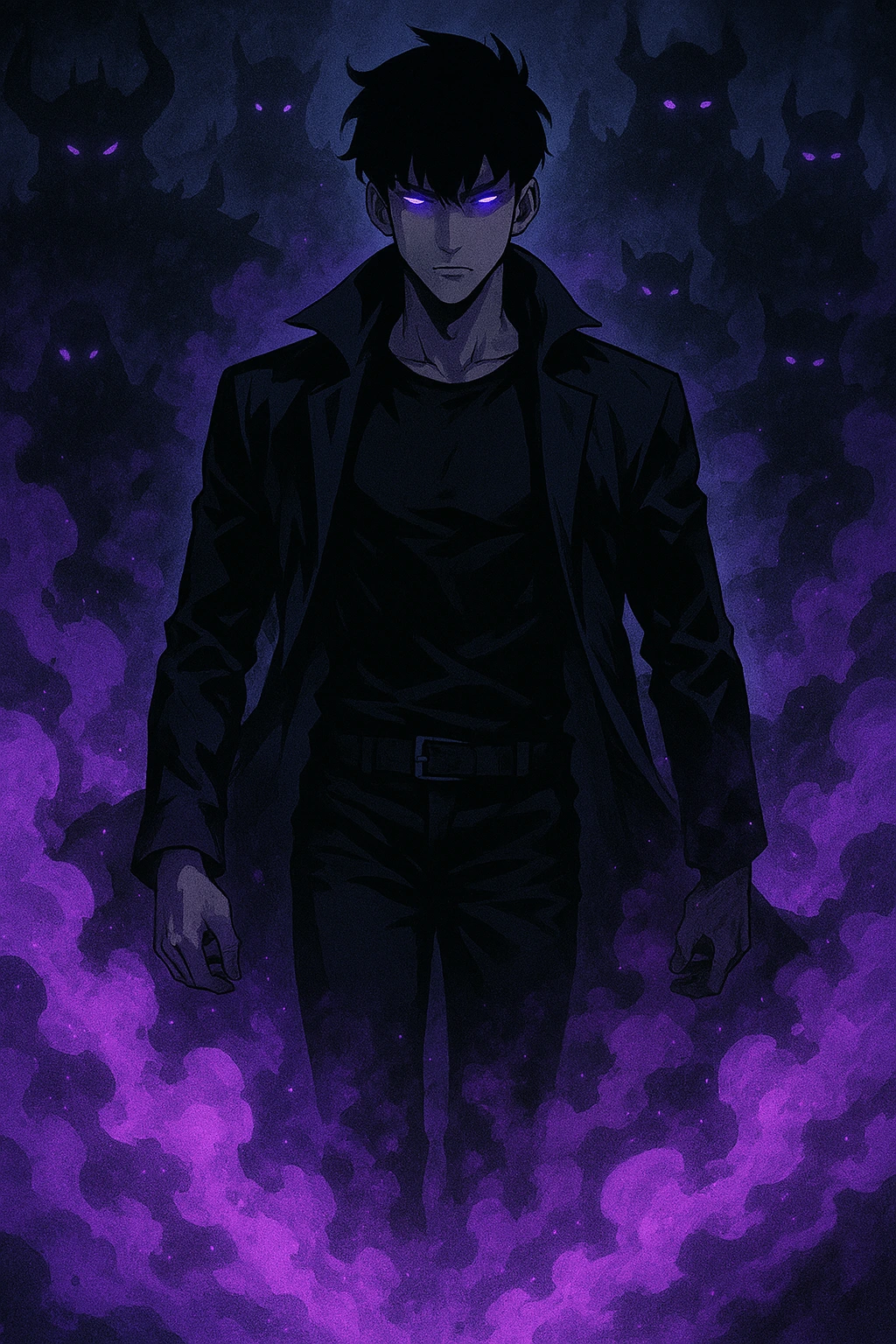
Every villain in anime or manhwa has an “Ultimate Move”—a technique they believe is invincible. For Querehsha, this was her Neurotoxin Mist.
The Strategy of Rot
Her ultimate weapon was a purple, heavy mist that she exhaled, covering the battlefield. This mist was a neurotoxin designed to rot mana itself. The logic was sound: The Shadow Monarch relies on mana to maintain his army and his physical enhancements. If you poison the mana, you cut off the source of his power.
This poison creates a “Domain of Death.” Inside the mist, ordinary humans would melt. Hunters would suffocate as their lungs filled with fluid. Even high-ranking S-Rank hunters would find their movements sluggish and their skills failing to activate. It is an anti-magic field made of gas.
The Unstoppable Counter
However, Querehsha made a fatal miscalculation. She was fighting a player who had spent his entire career building resistances.
Since the very first arcs of Solo Leveling, specifically the “Snake Dungeon” where he fought Casaka, Jin-Woo has been building poison resistance.
- Passive Buffs: The System granted him “Will to Rehabilitate” and later “Longevity,” which purify detrimental status effects.
- Item Buffs: The items he collected often had status recovery properties.
When Querehsha unleashed her ultimate poison, she expected Jin-Woo to choke. She expected him to fall to his knees, gasping for air. Instead, we got one of the coldest panels in the series.
Sung Jin-Woo walks through the purple death-mist without breaking stride. He doesn’t cough. He doesn’t squint. He doesn’t even hold his breath. The System notification likely pinged in the background: [Harmful substance detected. Detoxification initiated.]
The Shock and The Irony
Querehsha’s reaction is priceless. Her compound eyes widen. She cannot comprehend how a biological being is breathing her concentrated death and treating it like fresh air. It shattered her worldview. To her, her poison is absolute. To Jin-Woo, it’s just a Tuesday.
The irony of this moment is heavy. The “Queen of Poison” was ultimately undone by a man who started his journey with a “Dagger of Poison” (Casaka’s Venom Fang). While he didn’t use that specific dagger to kill her, the metaphor stands. Jin-Woo had conquered the concept of poison long before he met the Queen of it. Her greatest strength was rendered null and void by his passive ability, turning what should have been a desperate struggle for survival into a walk in the park for the Shadow Monarch.
6. The Execution: Mutilate
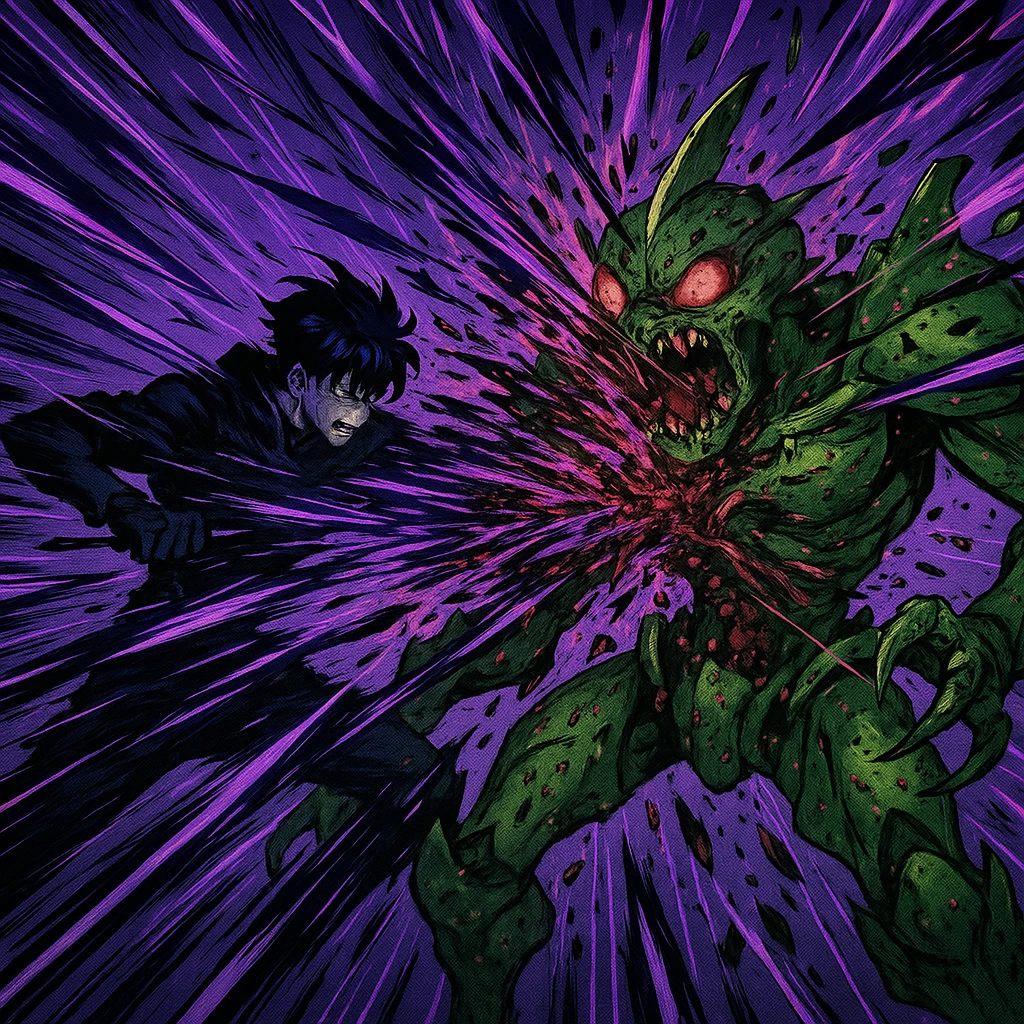
The death of Querehsha is violent, rapid, and necessary. It is not a duel of honor; it is an execution.
The Skill: Mutilate
Sung Jin-Woo utilizes his dagger skill, “Mutilate” (sometimes translated as “Vital Strike” or a rapid slash combo). This isn’t a single powerful blow like the one he used on the Orc Shaman. This is a flurry of thousands of slashes delivered in a fraction of a second.
Why did he choose this skill? Because of her regeneration. Jin-Woo, being the tactical genius he is, recognized that slashing her once or twice would be futile. She would just heal. To kill the Queen of Rot, he had to destroy her structural integrity entirely.
The Brutality
The paneling of this scene is frantic. Jin-Woo becomes a blur of black and purple motion. His daggers, Kamish’s Wrath (or the Demon King’s Daggers, depending on the specific timeline of the gear), move faster than the eye can see.
He shreds her. He cuts her limbs off, then cuts the limbs into pieces, then cuts the pieces into ribbons. He dissects the insect queen while she is still standing. It is a brutal display of DPS (Damage Per Second). He overwhelms her regeneration factor by inflicting damage faster than her cells can knit together.
He targets the joints, the eyes, the thorax. It is a storm of blades. Querehsha tries to scream, but her vocal cords are severed. She tries to strike back, but her arms are gone.
The Silence
And then, the buzzing stops.
The moment Querehsha dies, the sound design of the scene shifts instantly. That oppressive, low-frequency hum of a billion wings cuts out. The heavy, humid atmosphere of the jungle dissipates. The parasites in the zombies go dormant or die.
The silence that follows the skill “Mutilate” is heavy. Jin-Woo stands amidst the gore, flicking the green blood off his daggers. The Queen is dead. Her body, now just a pile of insect meat, begins to turn to gray ash as the mana leaves it.
The Aftermath
Her death was a pivotal turning point. Up until this moment, the Monarchs seemed invincible. They had ambushed Jin-Woo, they had killed the Chairman, and they had destroyed Seoul. The hunters were losing hope.
By butchering the Plague Monarch so decisively, Jin-Woo sent a message to the remaining Monarchs (Iron Body, Beast, and Frost): You can die. It broke the illusion of their godhood. It was the first real victory in the final war, and it was bought with the complete obliteration of the most disgusting creature on the planet.
7. Conclusion: A Villain Designed to be Hated
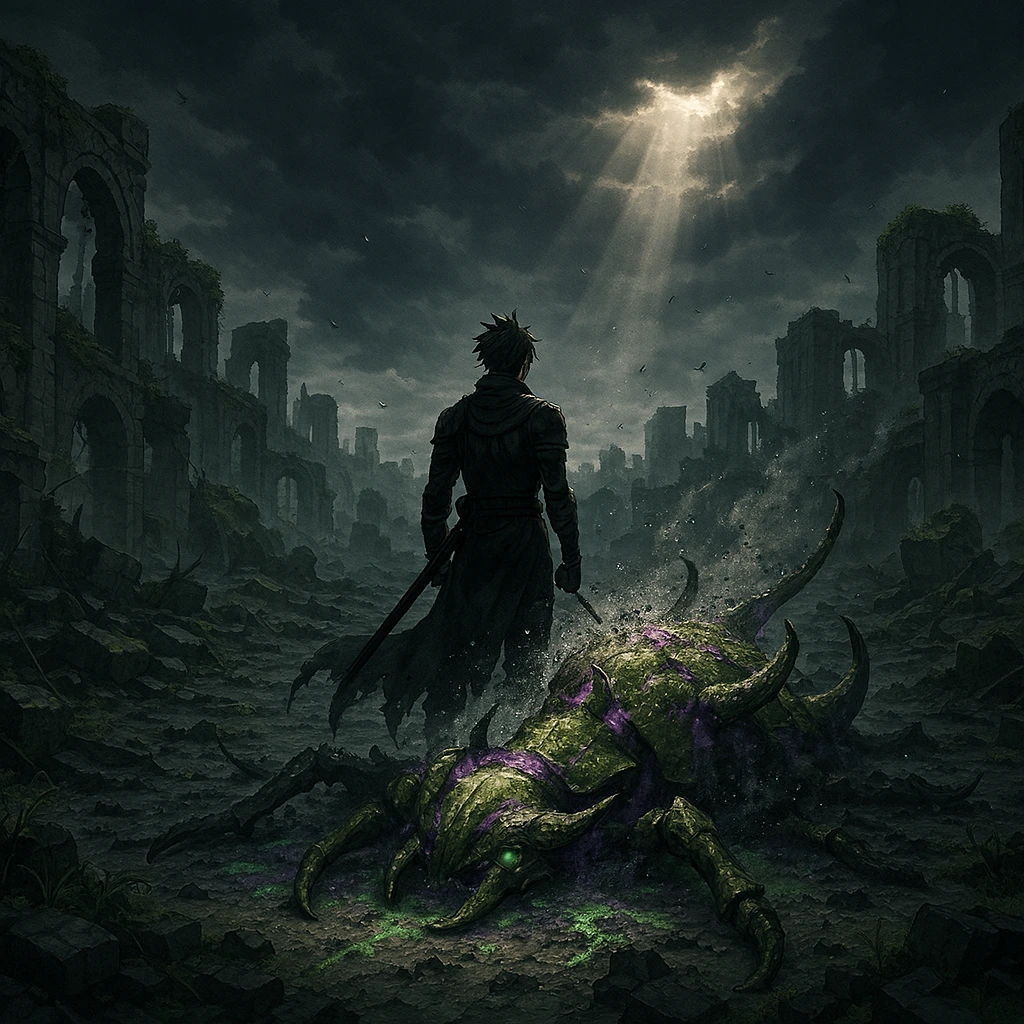
Querehsha, the Plague Monarch, will not be remembered as the strongest villain in Solo Leveling. That title belongs to Antares. She won’t be remembered as the most personal villain (that’s the Architect or the Beast Monarch). But she will be remembered as the most visceral villain.
The Visual Legacy
She was the most visually distinct Monarch. The contrast between her beautiful human guise and her horrific insect form created a lasting impression. The green and purple color palette stood out against the usual black and blue of the shadows. She brought a texture to the story—slime, rot, chitin—that enriched the sensory experience of the reader.
Even Gods Can Be Monsters
Her legacy is the subversion of divinity. In many fantasy tropes, gods are beings of light or pure energy. Querehsha proved that in the world of Solo Leveling, gods can be monsters. They can be dirty, they can be parasites, and they can be rotted from the inside out.
The Satisfaction
Ultimately, Querehsha served her purpose perfectly. She was a villain designed to be hated. She desecrated the dead, tortured the loyal Beru, and turned a city into a cesspool. This buildup made her death incredibly satisfying. Watching Jin-Woo treat her not with fear, but with the cold efficiency of an exterminator, gave the audience exactly what they wanted.
The Plague Monarch was the stuff of nightmares, a buzzing horror that crawled under our skin. And that is exactly why she was a perfect stepping stone for the Shadow Monarch. To prove he was the King of the Dead, he first had to exterminate the Queen of the Living Rot.