
1. The Weapon of Sunlight: Introduction to Demon-Slaying Metallurgy
Nichirin Blades.
The night is a realm of absolute terror, an unforgiving landscape where the apex predator is no longer human, but a biological nightmare driven by an insatiable hunger for human flesh. In the brutal, blood-soaked world of Demon Slayers, the fundamental rules of combat are violently rewritten the moment the sun dips below the horizon. A standard katana, forged from even the finest tamahagane (jewel steel) by the most skilled traditional artisans of Japan, is practically useless against the children of Muzan Kibutsuji.
When a conventional blade strikes the neck of a mid-to-high-level demon, the result is not a clean decapitation, but a sickening metallic crack. Normal steel shatters against demon flesh. The muscle density, bone hardness, and hyper-accelerated cellular regeneration of a demon render conventional weaponry obsolete. To fight a creature of the night, humanity needed a weapon forged from the very essence of the day. This absolute, terrifying necessity gave birth to a specialized, supernatural alloy, and ultimately, the creation of the Nichirin Blade.
To truly understand the Nichirin Blade, one must strip away the romanticized notions of simple swordplay and view the weapon for what it truly is: a highly advanced biological and chemical battery. It is not merely a sharp piece of metal designed to cause traumatic blood loss; demons do not care about blood loss.
Rather, the Nichirin Blade is a meticulously engineered payload delivery system designed to store, conduct, and explosively release lethal doses of solar radiation directly into the nervous system of a demon. When a Slayer executes a technique, they are not just swinging a sword; they are activating a photolytic reaction. The blade acts as a conduit, channeling the absolute antithesis of demon biology—sunlight—straight into their unholy cells.
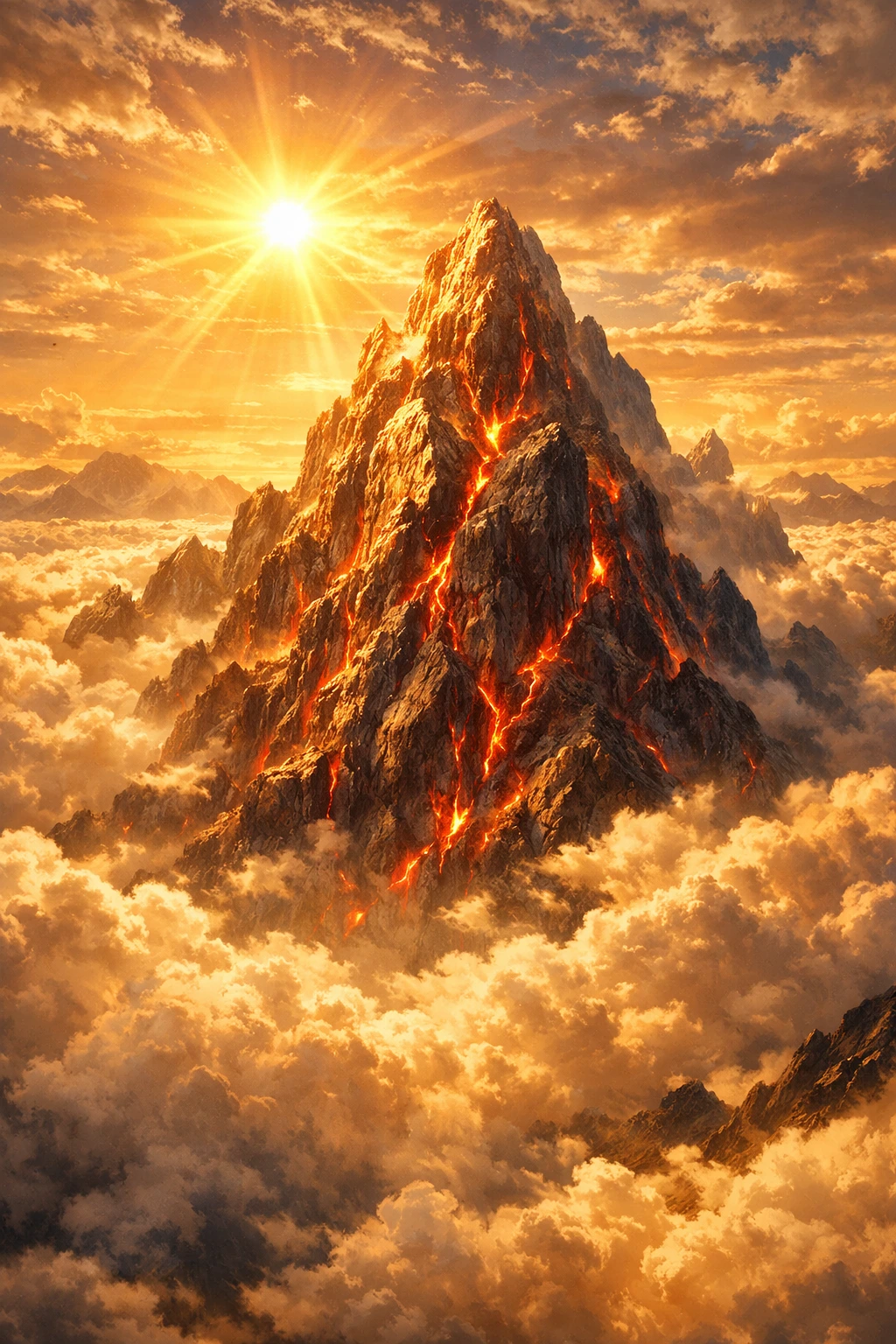
This miraculous alchemy begins far away from the bloodstained battlefields, in a location dictated by unique geographical perfection: the legendary Yoko Mountain (Sunlight Mountain). The geological and astronomical conditions of Yoko Mountain are an anomaly of nature.
It is the peak closest to the sun, a solitary elevation that pierces the cloud line and bathes in perpetual, unyielding daylight. For centuries, perhaps millennia, the raw ores resting at the summit of this mountain have been exposed to relentless solar radiation. In our normal world, materials degrade under constant ultraviolet bombardment. But on Yoko Mountain, the ore does not degrade; it adapts, evolves, and absorbs. From the moment the morning sun crests the horizon to the final fading embers of twilight, this ore drinks in the light, fundamentally altering its molecular structure to become the single most lethal substance to demon-kind on the face of the earth.
This introduction to the Nichirin Blade is just the precipice of its complexity. To comprehend the full magnitude of these color-changing swords, we must delve deeply into the mineralogy of the ore, the agonizing thermal challenges of the smelting process, the theoretical physics behind the absorption of sunlight, and the profound, almost spiritual connection the metal forms with the human soul. The Nichirin Blade is the ultimate fusion of extreme metallurgy, biological warfare, and the indomitable human spirit.
2. The Mineralogy & Alchemy: Scarlet Ore and Crimson Iron Sand
The foundation of every Nichirin Blade rests entirely upon two incredibly rare, highly volatile, and scientifically baffling materials: Scarlet Crimson Iron Sand (Hihakutetsu) and Scarlet Crimson Ore (Hihikane). Mined exclusively from the sun-drenched peaks of Yoko Mountain, these are not mere iron deposits. They are metallurgical anomalies that defy standard thermodynamics.
To understand the science of sunlight absorption within these materials, we must look at them through the lens of theoretical physics and quantum mechanics. Standard metals reflect light or absorb it purely as heat, which eventually dissipates. The Scarlet Ore, however, possesses a unique crystalline lattice structure—a microscopic network of metallic bonds that act as infinite quantum wells. When ultraviolet (UV) photons from the sun strike the surface of the ore, they are not reflected.
Instead, the photons are trapped within the atomic structure of the metal. The electrons in the ore are constantly maintained in a state of high-energy excitation, essentially holding the sunlight in a state of stasis. The ore becomes a physical battery for solar energy, trapping the UV radiation without degrading its own structural integrity. It is an alchemical miracle: solid, heavy light.
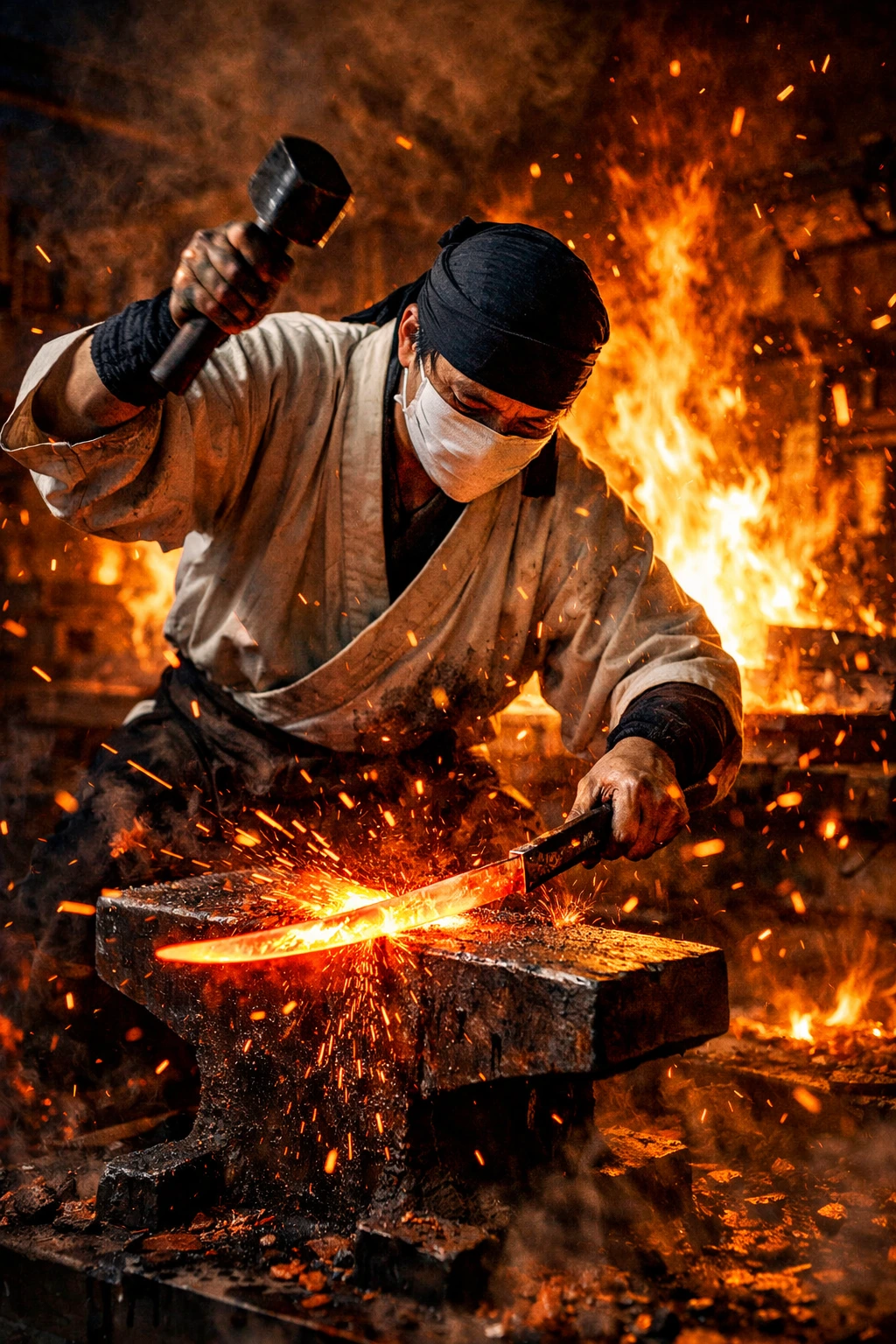
This incredible property—the ability to hold immense amounts of solar energy—creates an unprecedented nightmare for the artisans tasked with forging it. The smelting process of Nichirin steel requires extreme, almost suicidal thermal conditions. Consider the paradox: how do you melt and purify a material that naturally absorbs immense amounts of heat and energy?
Standard charcoal furnaces and traditional tatara smelters are woefully insufficient. The Swordsmiths of the hidden village must push the boundaries of pyrotechnics. They utilize specially cultivated charcoal that burns at exponentially higher temperatures than normal wood, fueled by colossal bellows that require immense physical strength and specialized breathing techniques just to operate. The ambient temperature of a Nichirin forge is enough to induce heatstroke in minutes.
The smiths must pound the steel with rhythmic, relentless precision, trapping the solar energy within the folds of the metal while simultaneously purging impurities. If the heat is too low, the metal will not bind; if it is too high, the trapped solar energy could theoretically destabilize, ruining the batch. It is a dance on the edge of a volcano, a masterclass in extreme thermal management.
But what happens when this perfectly crafted, sunlight-infused steel finally meets demon flesh? The biological reaction is instantaneous, catastrophic, and deeply horrific for the demon. When a Nichirin Blade severs a demon’s neck—the critical juncture of their central nervous system—it triggers localized cellular destruction on an atomic level.
Demons survive through hyper-regeneration, a process dictated by Muzan Kibutsuji’s mutated cells within their bloodstream. When cut by normal steel, a demon’s cells rapidly multiply to bridge the gap and heal the tissue almost before the blade has passed through. However, the Nichirin Blade disrupts this entirely. As the blade slices through the flesh, the kinetic friction and the bio-electric energy of the Slayer’s breathing style act as a catalyst, forcefully discharging the stored ultraviolet radiation directly into the wound.
This UV payload instantly necrotizes the demon cells. It breaks down the DNA strands within the demon’s blood, triggering aggressive, unstoppable apoptosis (cellular death). The regeneration factor is not just halted; it is violently overridden. The demon’s cells literally burn from the inside out, turning into ash as the solar energy consumes the demonic biomatter. By striking the neck—the bridge between the brain and the body—the Nichirin Blade severs the command center of the regeneration process, ensuring the UV necrotization spreads, resulting in the complete disintegration of the demon’s body. It is precise, chemical warfare delivered via the edge of a sword.
3. The Spectrum of Spirit: Why the Metal Reacts to the Soul
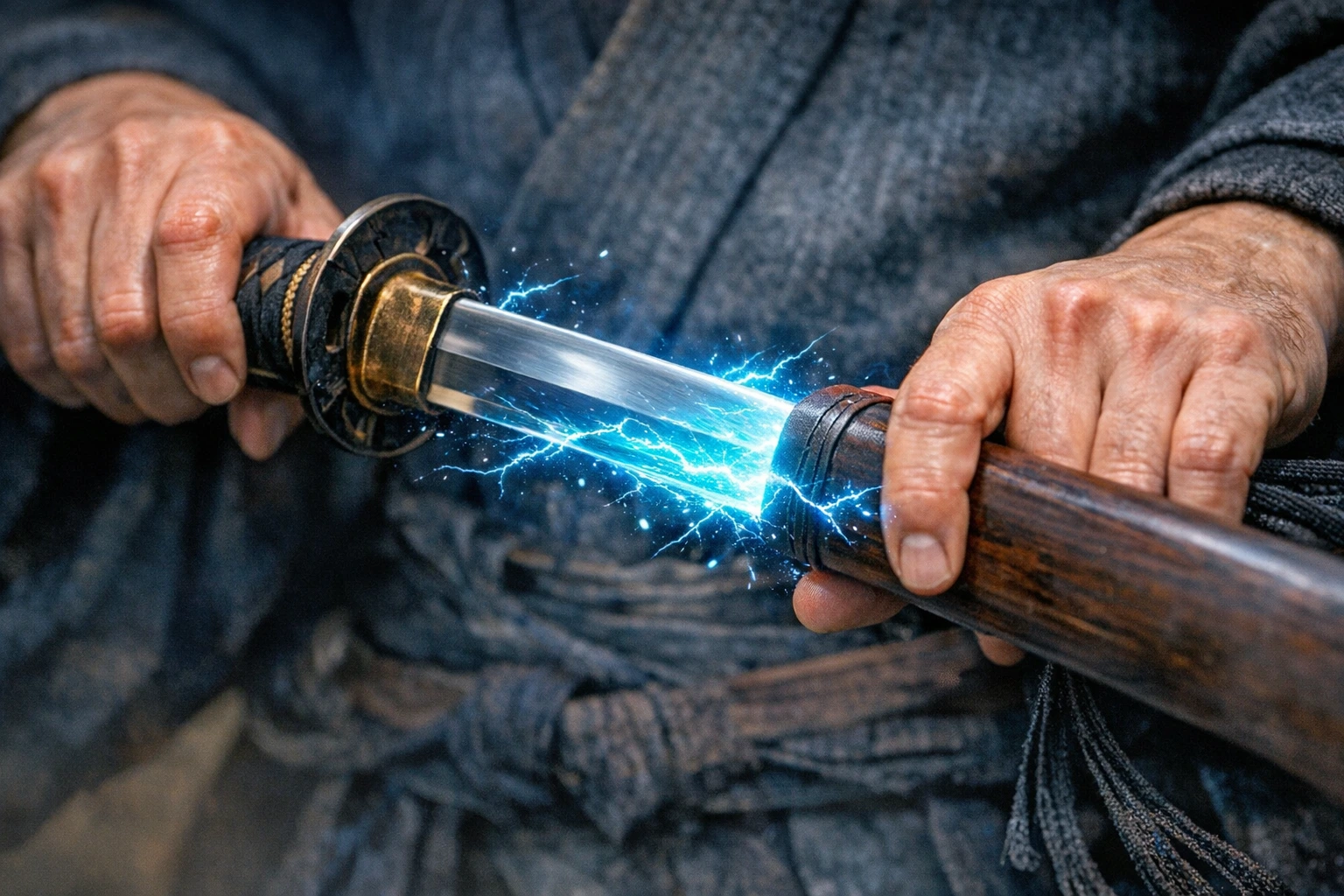
The true alchemy of the Nichirin Blade is not fully realized in the forge; it is born in the hands of the warrior. A freshly forged Nichirin Blade, polished and sharpened to a mirror finish, possesses a standard, metallic silver hue. The blade is essentially a blank canvas, brimming with dormant solar energy, waiting for an ignition source. This ignition is the legendary color-changing phenomenon—a mesmerizing, supernatural reaction that occurs the exact moment the sword is first drawn from its scabbard by its destined owner.
This change is not merely cosmetic; it is a complex chemical and spiritual oxidation process. When a Demon Slayer grasps the hilt and draws the blade, they are unconsciously channeling their “Fighting Spirit”—a tangible bio-electric frequency generated by their Total Concentration Breathing. Every human being has a unique physiological and psychological makeup, which translates into a specific resonant frequency when they breathe. The highly conductive, sunlight-saturated lattice of the Nichirin steel reads this bio-electric frequency.
The isotopes within the metal instantaneously rearrange themselves, shifting the absorption and reflection of light, fundamentally permanently altering the color of the blade. The sword literally reads the user’s soul, aligning its molecular structure with the warrior’s physical and psychological traits to maximize the efficiency of their specific combat style.
This phenomenon gives rise to the five foundational breathing colors, each representing a core truth about the user:
Water Breathing (The Blue Blade): Water is fluid, adaptable, and formless, yet possesses the power to carve through solid rock over time. A blue blade signifies a user with a calm, flexible, and defensively sound psychological profile. The metal likely shifts to allow for smoother kinetic energy transfer, reducing drag through the air and flesh, making it ideal for the flowing, continuous strikes characteristic of Water Breathing. It reflects a soul that can adapt to any container or situation.
Flame Breathing (The Red Blade): Red is the color of combustion, passion, and explosive outward energy. A user who draws a red blade possesses a fiercely intense, unwavering spirit and immense physical vitality. The molecular shift in a red blade likely heightens its thermal conductivity. While it is not the bright crimson of an awakened blade, the red metal is highly volatile, perfectly suited for the devastating, heavy, single-strike decapitations that define the Flame Breathing forms.
Wind Breathing (The Green Blade): Wind is erratic, invisible, and inherently destructive. The green blade indicates a user with a volatile, highly aggressive, and relentlessly offensive psychological state. The metal of a green blade likely micro-serrates or alters its edge geometry to maximize the sheer cutting power and the creation of vacuum-like wind blades. It is meant to shred and tear, mirroring a spirit that refuses to be contained.
Thunder Breathing (The Yellow Blade): Yellow signifies blinding speed, instantaneous acceleration, and a singular, piercing focus. A user with a yellow blade typically possesses explosive fast-twitch muscle fibers and a psychology that operates on sheer, instinctual reaction. The metal aligns to minimize air resistance to an absolute zero, becoming a perfect conductor for the bio-electric sparks generated by the user’s legs. It is the color of the one-hit kill.
Stone Breathing (The Gray Blade): Gray is the color of the earth, unyielding, foundational, and absolute. The gray weapon signifies a user with unparalleled physical density, emotional stoicism, and an unshakable core. The molecular structure of a gray blade likely shifts to maximize sheer mass and density, prioritizing crushing blunt-force trauma and unbreakable defense over razor-sharp elegance.
Beyond these foundations lie the Derivative Mutations. These occur when a user’s physical quirks or psychological eccentricities are so pronounced that they warp the core styles into highly specialized, niche forms.
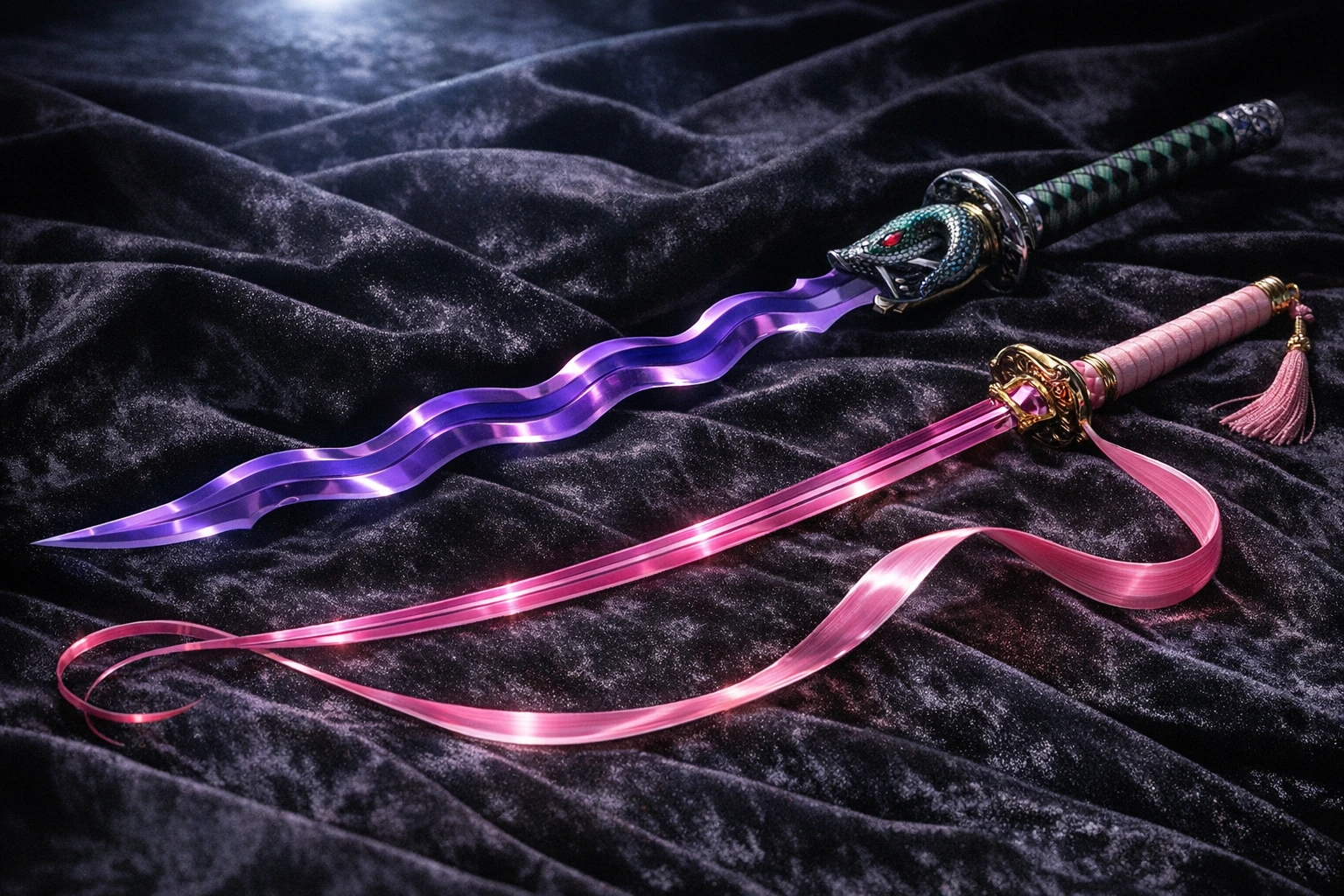
- Love Breathing (Pink): Derived from Flame, the pink blade reflects Mitsuri Kanroji’s unique muscle density and immense flexibility. The metal undergoes a radical shift, becoming incredibly elastic while retaining its razor edge, acting more like an extremely dense ribbon than a sword.
- Serpent Breathing (Purple): Derived from Water, the purple blade signifies Obanai Iguro’s slithering, precise, and unpredictable psychology. The metal adapts to a highly irregular, wavy shape (a flamberge-style) that allows for strikes from impossible angles, bypassing standard blocks.
- Sound Breathing (Amber): Derived from Thunder, Tengen Uzui’s amber blades reflect an explosive, kinetic, and highly rhythmic spirit. The metal is designed for immense concussive force, generating friction and sparks that detonate his specialized anti-demon bombs.
- Mist Breathing (White): Derived from Wind, the white blade signifies a detached, ephemeral, and incredibly swift psychology. The metal’s edge likely becomes so microscopically thin that it produces almost no sound or air displacement, making the user’s attacks appear as elusive as morning fog.
The Nichirin Blade does not just reflect the user; it symbiotically evolves with them, ensuring that the weapon is the truest possible extension of their fighting spirit.
4. The Black Blade Anomaly: The Physics of Sun Breathing
Within the vibrant, colorful spectrum of the Demon Slayer Corps, there exists one color that brings no joy, inspires no hope, and carries with it a heavy, suffocating weight: the pitch-black blade. For generations, the black sword has been viewed not as a unique blessing, but as a grim omen of death.
The superstition surrounding the black blade is deeply entrenched in the history of the Corps. Records show that swordsmen who draw black blades rarely survive their first few years, and none have ever reached the rank of Hashira in modern, recorded history. They are considered “jacks of all trades, masters of none,” individuals whose fighting spirit is supposedly too muddled or weak to commit to a foundational element. They are seen as tragic figures, cursed with a weapon that offers no specialized advantage, destined to die young and forgotten in the mud.
However, true science and forgotten history paint an entirely different, vastly more awe-inspiring picture. To understand the black blade, we must apply real-world physics, specifically the concept of blackbody radiation and the absorption of light.
In the visible spectrum, colors are determined by the wavelengths of light that an object reflects. A blue blade reflects blue light; a red blade reflects red light. But black is not a color; black is the absence of reflection. A perfectly black object absorbs all wavelengths of light and heat across the entire spectrum. It consumes energy. When we apply this scientific fact to the photolytic, sunlight-absorbing nature of Nichirin steel, the horrifying truth of the black blade reveals itself.
The black blade is not a weak sword. It is the ultimate, perfect vessel for solar energy. It does not reflect any aspect of the sun; it absorbs it entirely.
This directly connects to the absolute pinnacle of swordsmanship: Sun Breathing (Hinokami Kagura). Sun Breathing is the primordial root, the original and most powerful breathing style from which all other styles (Water, Flame, Wind, Thunder, Stone) were diluted and derived. Because Sun Breathing requires the user to emulate the sun itself—a perfect, continuous, and all-encompassing cycle of energy—the blade reacts by turning pitch black to absorb and channel the absolute maximum amount of solar radiation possible. It is a sword designed not to cut like wind or flow like water, but to burn with the localized intensity of a dying star.
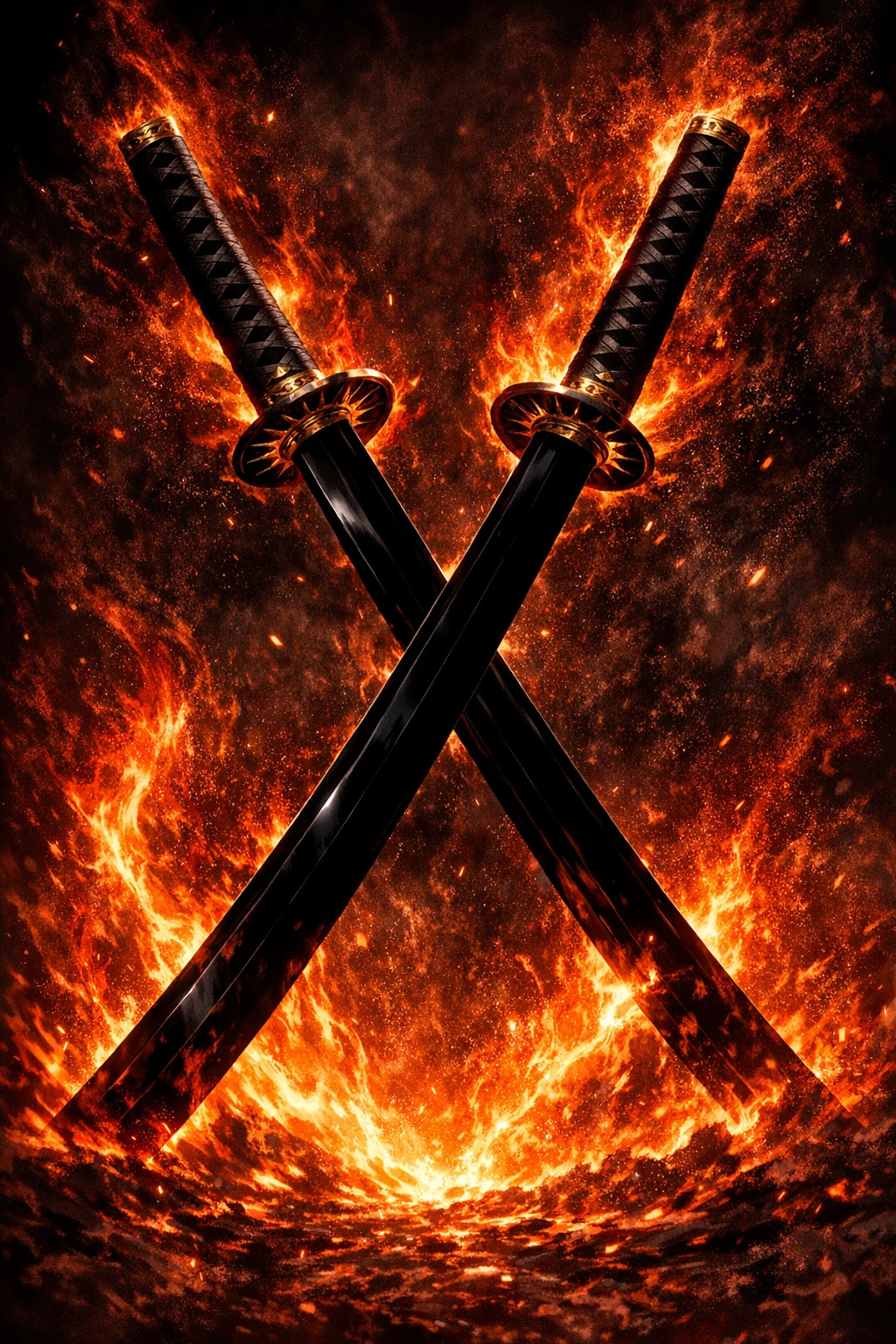
The tragic omen of death associated with the black blade is a direct result of generational trauma and deliberately erased history. The original wielder of the black blade was Yoriichi Tsugikuni, a demigod among men, the only being to ever bring Muzan Kibutsuji to his knees in absolute, shaking terror. The scars Yoriichi left on Muzan burned at a cellular level for centuries. Driven by profound PTSD and a desperate need for survival, Muzan and his Upper Rank One demon, Kokushibo (Yoriichi’s twin brother), spent the subsequent centuries systematically hunting down and slaughtering anyone who showed signs of knowing Sun Breathing.
Through this systematic extermination, the knowledge of Sun Breathing was lost to the Demon Slayer Corps. However, the genetic potential for it occasionally popped up in specific individuals. These individuals would draw a sword, and it would turn black. But without the knowledge of Sun Breathing—the only style capable of properly utilizing a black blade’s immense energy capacity—these swordsmen were forced to learn derivative styles like Water or Wind.
Because a black blade is fundamentally incompatible with these diluted styles, the swordsmen were incredibly inefficient, their true potential locked away. They fought with an overwhelming handicap, leading directly to their high mortality rates. The black blade is not a curse of weakness; it is the physical manifestation of Yoriichi’s forgotten legacy, hiding in plain sight, waiting for a user capable of wielding the power of the sun.
5. Engineering Lethality: Tsuba, Sheath, and Weapon Mechanics
While the blade itself is the biological payload delivery system, the surrounding hardware—the tsuba (handguard), the sheath, and the overall weapon geometry—are masterclasses in specialized mechanical engineering. The swordsmiths do not simply attach a standard hilt to a magical blade; they engineer every micro-component to maximize the lethality of the user’s specific breathing style.
The Tsuba (Handguard) Design: To the untrained eye, the tsuba is merely a piece of metal to protect the fingers from an opponent’s sliding blade. However, in the context of Total Concentration Breathing, the tsuba acts as a critical counterweight and aerodynamic stabilizer.
- Consider Kyojuro Rengoku’s Flame Tsuba: Shaped like a blooming flame, it is not just aesthetically pleasing. Flame Breathing requires massive, arcing, heavy swings. The wide, somewhat hollowed-out flame design provides a larger surface area for air resistance to stabilize the blade during a heavy downward cleave, while the specific weight distribution anchors the sword in the hand against the immense recoil of the strikes.
- Contrast this with Giyu Tomioka’s Hexagonal Tsuba: Water Breathing relies on fluid, defensive redirection and continuous motion. The solid, symmetrical hexagon provides perfect, centralized balance. It has no protruding edges that could catch on clothing or alter the aerodynamics during rapid, spinning water-wheel motions. It is pure, defensive geometry.
The Sheath Mechanics: The scabbard (saya) is arguably as important as the blade for certain styles, particularly Thunder Breathing. Zenitsu Agatsuma’s technique, Thunderclap and Flash, is rooted in iaijutsu—the martial art of drawing the sword, striking, and resheathing in one fluid motion. For Zenitsu, the sheath is not a carrying case; it is a pressure cooker and an electromagnetic railgun barrel. The internal mechanics of a Thunder user’s sheath are highly specialized.
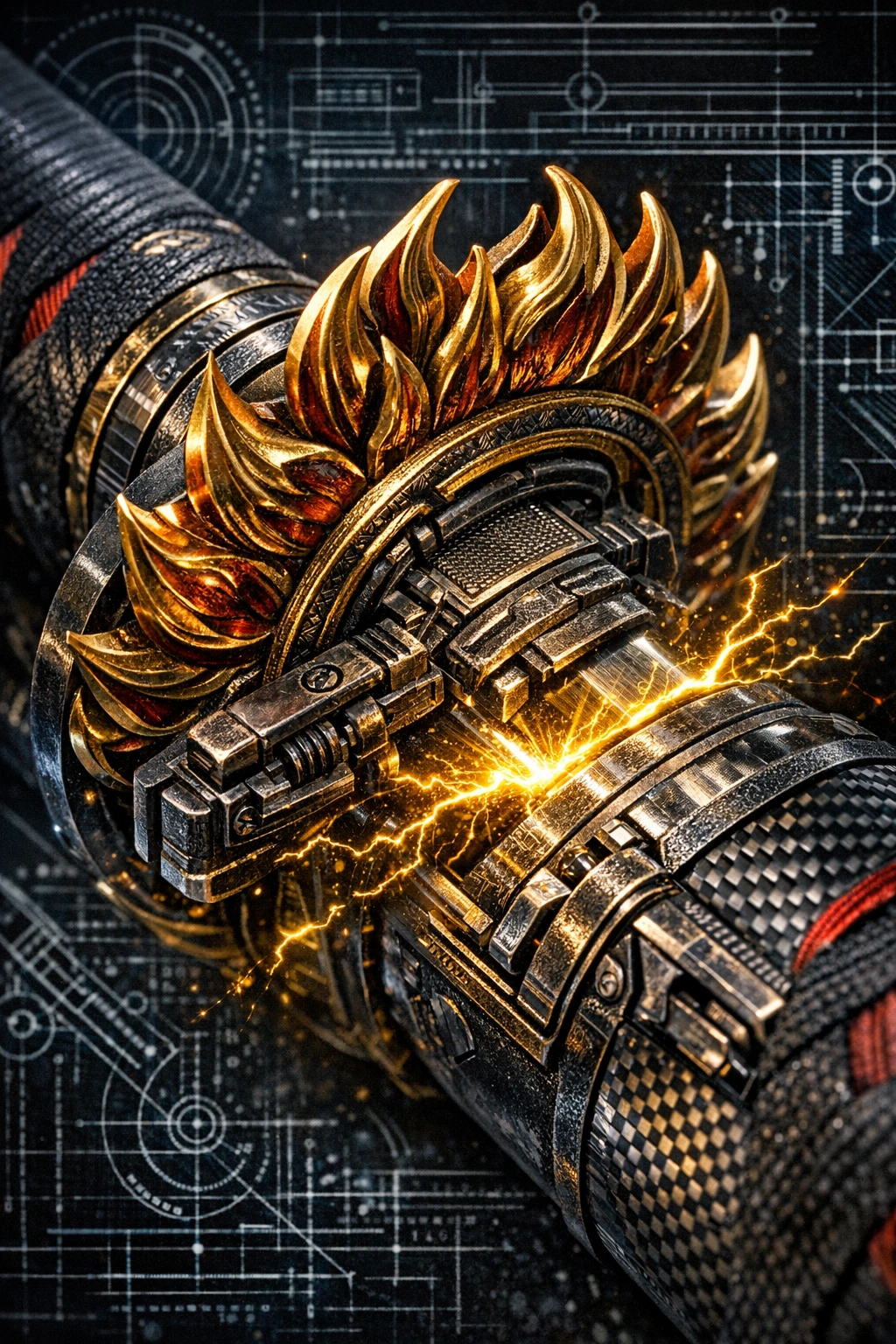
It is engineered with extreme internal friction and a tightly locked habaki (blade collar). When Zenitsu assumes his stance, he is building immense bio-electric energy in his legs, but he is also using his thumb to build immense mechanical pressure against the tsuba. The sheath holds the blade tight until the exact moment of explosive release. The kinetic friction generated as the blade finally breaks the seal and violently slides out of the sheath contributes to the blinding speed and the literal sonic boom of the attack. The sheath must be reinforced to survive this repeated, explosive trauma without splintering.
Alternative Weaponry and Custom Engineering: Not all fighting spirits can be contained within the geometry of a standard katana. The swordsmiths are capable of extreme custom metallurgical engineering to suit physical anomalies.
- Gyomei Himejima (Stone Hashira): A blind giant of unparalleled physical strength. A katana would snap in his hands. His weapon—a massive spiked flail connected to a heavy broadaxe by a chain—is forged entirely from exceptionally pure Nichirin iron. The genius here is mass. Because the ore absorbs sunlight, the sheer volume and density of Gyomei’s weapon means it holds exponentially more solar radiation than a standard sword. When he crushes a demon’s skull, he is delivering an ungodly amount of UV energy via blunt force trauma.
- Shinobu Kocho (Insect Hashira): Lacking the physical arm strength to decapitate a demon, her blade is a marvel of biological warfare engineering. It is not a sword; it is a stinger-rapier. The blade is heavily modified, missing its edge entirely save for the tip. The interior of the blade is hollowed out to act as a hypodermic needle, connected to a complex sheath that mixes customized, highly concentrated Wisteria poison. Her engineering turns a physical deficit into a lethal advantage, injecting UV-laced poison directly into the demon’s bloodstream.
- Mitsuri Kanroji (Love Hashira): Her weapon resembles a standard katana when sheathed, but functions as an urumi (a flexible whip-sword). The metallurgy required to create a blade that is thin enough to bend and snap like a ribbon, sharp enough to cut through demon flesh, and resilient enough not to shatter upon impact, borders on magical. It is a perfect synthesis of tensile strength and elasticity, mirroring her unique muscle composition.
6. The Swordsmith Village: The Fanatics Behind the Forge
To fully appreciate the Nichirin Blade, one must look at the hands that hammer the steel. Hidden deep within a remote, treacherous mountain range, cloaked in mist and illusion, lies the Swordsmith Village. This is not a quaint town of blacksmiths; it is a hyper-militarized, intensely secretive compound populated by zealots. The artisans, primarily of the Haganezuka clan and their contemporaries, are not merely craftsmen—they are fanatics.
A psychological profile of the swordsmiths reveals a collective mindset bordering on religious obsession. For a smith like Hotaru Haganezuka, forging a sword is not a job; it is the purpose of his existence. They pour their life force, their sweat, and their very souls into the roaring fires of the forge. When a Demon Slayer chips, damages, or breaks a Nichirin blade, the reaction of the smith is famously, terrifyingly violent. This is often played for comedic relief, but the underlying psychology is profoundly tragic and serious.
To a swordsmith, a broken blade represents two things: a failure on their part to create a perfect, unbreakable weapon, and a terrifyingly close call for the swordsman. They know the reality of the Demon Slayer Corps: children are sent into the dark to die. The sword is the only thing keeping them alive. Therefore, absolute, uncompromising perfection in the forge is the only acceptable standard. Their rage is a manifestation of their obsessive care.
This immense value placed on the smiths necessitates absolute anonymity, bringing us to the iconic Hyottoko masks. Every resident of the village wears these comical, distorted masks at all times around outsiders. This is not a quirky cultural tradition; it is hardcore Operational Security (OpSec). The Demon Slayer Corps understands a fundamental rule of warfare: if you want to destroy an army, you don’t fight their frontline soldiers; you sever their supply lines.
If Muzan Kibutsuji were to discover the location of the village and the identities of the master smiths, he would wipe them out in a single night. Without new swords, the Demon Slayer Corps would cease to exist within a month. The masks ensure that even if a smith leaves the village to deliver a sword, their face cannot be remembered, drawn, or tracked by Muzan’s intelligence network of demons and human spies. The ridiculousness of the mask is a perfect camouflage for the vital, deadly serious role they play in humanity’s survival.
In conclusion, the Nichirin Blade is a masterwork of fantasy science and profound emotional resonance. It is not a static object. It is a living, breathing entity forged in the fires of a hidden village, bathed in the eternal sunlight of Yoko Mountain, and awakened by the bio-electric soul of a warrior. The blade requires the perfect, symbiotic synthesis of the creator’s obsessive hammer and the warrior’s desperate, focused breath. Without the smith, the slayer is unarmed; without the slayer, the steel is asleep. Together, they create color-changing alchemy—the only light capable of piercing the eternal night of the demons.