
In the pantheon of modern anime, few characters command the screen presence of Levi Ackerman. To the casual observer, he is the epitome of the “cool factor”—a kinetic blur of spinning blades, deadpan insults, and impossible acrobatics.
He is the Attack on Titan universe’s answer to a force of nature, a one-man army capable of dismantling Titans that entire squads fail to scratch.
The internet is flooded with compilations of his “God Mode” moments, set to aggressive phonk music, celebrating his lethality.
However, if you strip away the Vertical Maneuvering Gear, silence the roaring soundtrack, and look past the blood-soaked cape, you are left with something far more unsettling. You don’t find a glorious hero basking in triumph.
You find a man sitting alone in a sterile room, holding a teacup by the rim, staring into a void that no amount of cleaning can fill.
Levi Ackerman is not a celebration of strength; he is a study in its cost. In the brutal world of Attack on Titan, where hope is often a delusion and reality is a meat grinder, Levi represents a cruel paradox: he is the strongest soldier humanity has, yet he is utterly powerless to save the people he actually cares about.
His story is not about the glory of victory, but the agonizing endurance required to survive loss. He is the God of Death who never wanted to be a god—he just wanted a family.
This analysis will dismantle the “Cool Guy” image to reveal the tragic, lonely figure beneath. We must understand that in Hajime Isayama’s cruel narrative, being the strongest is not a blessing. It is a curse.
Introduction: The Sadness Behind the Speed
The first time we truly see Levi’s capability, it is terrifying. He moves with a fluidity that mocks the laws of physics, a blur of steel and gas that turns predators into prey. He is precise, efficient, and lethal.
The world looks at him and sees a savior, a weapon that might finally turn the tide of a losing war. But look closer at his eyes.
They are dull. Heavy. Bored, almost.
There is a dissonance between Levi’s actions and his demeanor that defines his entire character arc. Most Shonen heroes scream their intentions; they fight with passion, rage, or a burning desire to protect.
Levi fights like he is taking out the trash. This isn’t arrogance; it’s exhaustion. It is the muscle memory of a man who has done this a thousand times and knows he will likely have to do it a thousand times more.
His violence is not an expression of anger, but of duty—a chore he must perform because no one else can.
The Clean Freak Persona
Off the battlefield, the “God of Death” transforms into a neurotic clean freak. He obsesses over dust motes under a table with the same intensity he applies to slicing a Titan’s nape. Why? Because cleaning is the one thing he can control.
In a world where walls fall, friends get eaten, and governments lie, a clean room is a small, attainable order in a universe of chaos.
It is his coping mechanism, a desperate attempt to scrub away the filth of the Underground and the blood of his comrades.
Every speck of dust is a reminder of the imperfections he cannot fix, the chaotic variables he cannot account for. If he can just clean this room, maybe, just maybe, he can keep the chaos at bay for one more hour.

The Survivor’s Guilt
Levi represents the Cruelty of Survival. His “superpower” isn’t his Ackerman bloodline or his spinning slash; it is the curse of always surviving.
He is the designated survivor in a story of martyrs. While Erwin Smith screams for his soldiers to rage, and Eren Yeager burns with the desire for freedom, Levi is the one who has to walk through the aftermath, stepping over the corpses of those who burned too bright.
The tragedy of Levi Ackerman is that he is too strong to die, which means he is forced to live long enough to watch everyone else perish.
He stands on a mountain of Titan corpses, not in triumph, but in solitude. The higher the pile of bodies grows, the further he gets from humanity, isolated by his own competence. He is trapped in a loop of violence where his reward for victory is simply the burden of remembering the faces of the fallen.
From the Gutter to the Wings: The Underground Origin
To understand the man, we must descend into the dark. Levi was not born a hero; he was born a mistake in the subterranean hell of the Underground. This is the first lens through which we must view him: Destiny vs. Effort.
While it is later revealed that he carries the Ackerman blood—a biological destiny of sorts—his early life was defined by the utter absence of privilege. He was the son of Kuchel, a prostitute working in the slums, and an unknown client.
He watched his mother rot away from disease, sitting by her corpse, emaciated and waiting for his own death. He was not “destined” for greatness; he was destined to be a stain on the floor of a brothel.
The darkness of the Underground wasn’t just physical; it was a crushing sociological weight. There was no sun, no future, and no hope.
This environment shaped his worldview fundamentally. He learned that the world is inherently cruel and that cleanliness is a luxury. His obsession with hygiene later in life is a direct rebellion against the filth he was born into.
The Mentor: Kenny Ackerman
Enter Kenny Ackerman. Kenny the Ripper. A serial killer, a mercenary, and arguably the worst father figure in anime history.
Yet, Kenny is crucial to understanding Levi’s worldview. Kenny didn’t save Levi out of love; he saved him on a whim. And he didn’t raise Levi with warmth. He raised him with violence.
Kenny’s philosophy was simple: the weak die, and the strong survive. He taught Levi how to hold a knife, how to interact with scum, and how to kill. He taught him that speech is secondary to action, and that hesitation is a death sentence.

But crucially, Kenny eventually abandoned him. In the bar scene in Season 3, Kenny explains why: “I wasn’t fit to be a parent.”
Kenny realized that he could only teach Levi how to be a monster, not a human. By leaving, he gave Levi the chance to forge his own path, even if it began with abandonment.
This upbringing instilled in Levi a harsh internal reality: No one is coming to save you. If you want to eat, you fight. If you want to live, you kill. This is the bedrock of his character.
Even when he ascends to the surface and becomes a “hero,” he never loses that Underground edge. He doesn’t salute like a soldier; he holds his blade backhanded like a thug.
He doesn’t speak with the flowery patriotism of the military; he speaks the coarse language of the slums. He views the pomp and circumstance of the military with disdain because he knows the ugly truth beneath it: power is the only law that matters.
The “No Regrets” Philosophy: The Birth of a Trauma Response
The No Regrets OVA is essential reading for Levi’s psychology. It details his transition from an Underground thug to a Scout, alongside his first “family,” Furlan and Isabel.
Levi joins the Scouts not out of patriotism, but as part of a scheme to kill Erwin. He is arrogant, trusting only in his own strength and the competence of his two friends. He views the surface dwellers as soft, and the Titans as just another obstacle to be overcome with skill.
But the world of the surface is cruel. During an expedition in the fog and rain, Levi makes a choice. He chooses to leave Furlan and Isabel to take out the Titan leader solo, believing his strength is better used on the offensive. He believes that by removing the biggest threat, he is protecting them.
It is a logical, tactical choice. And it is the wrong one.
When he returns, the scene is a nightmare. He finds Isabel’s severed head, eyes wide open in shock, and Furlan’s broken body being chewed apart. The rage that follows is iconic—Levi shreds the Titan into ribbons in a display of speed that defies comprehension—but the lesson is internalized instantly.
He trusted his own judgment, his own arrogant belief that he could manage the battlefield, and his family died because of it. It wasn’t just that they died; it was that his decision to leave them directly facilitated their deaths.
This is the birth of his “No Regrets” philosophy, which he later articulates to Eren in the Forest of Giant Trees. He tells Eren that no one knows the outcome of a choice. Not him, not Erwin, not anyone. Therefore, the only thing you can do is make the choice that will result in the fewest regrets.
Note the phrasing. He doesn’t say “make the right choice.” He doesn’t say “make the choice that wins.” He says “fewest regrets.” Levi knows that in this world, tragedy is inevitable. You cannot avoid pain; you can only choose which pain you can live with.
This fatalism is the direct result of his origin. He climbed out of the gutter, but he never truly scrubbed the grime off his soul. He knows that hope is fragile, and reality is a beast that eats dreamers alive.
This philosophy shields him from the paralyzing weight of hindsight. If he dwelled on every “what if,” the ghosts of Furlan and Isabel would have crushed him long ago.
He forces himself to look forward because looking back is too painful.
The Curse of the Strongest: Always the Survivor, Never the Savior
If we apply the lens of Hope and Reality, Levi functions as the anchor of Reality in a world drunk on Hope. Erwin sells hope; he sells the dream of a world without Titans, of truth in the basement.
Eren represents the violent hope of freedom. Levi? Levi is the reality check. He is the blade that ensures the dreamers don’t get eaten before they can speak.
But the cruel irony of Levi’s narrative is that while he can kill any enemy, he cannot save his friends. His strength is offensive, not defensive.
He is a sword, not a shield. Being the “Strongest Soldier” implies he has the power to protect, but the narrative constantly reinforces his impotence in saving individuals.
The Squad Levi Tragedy (Season 1)
Levi builds a team of elites. Petra, Oluo, Eld, Gunther. They are the best of the best. They trust him implicitly, and he trusts them.
We see moments of their domestic life—cleaning the castle together, bickering, sharing meals. These aren’t just subordinates; they are his hand-picked family.
In the Forest of Giant Trees, when the Female Titan attacks, Levi faces a dilemma: engage, or trust his squad? Remembering the lesson from No Regrets, he chooses to suppress his individual instinct to kill.
He chooses to trust his team. He chooses to believe in the collective strength of his comrades rather than acting as the lone hero. He leaves them to handle Annie, believing in their coordination.
And they are slaughtered.
When Levi returns, he doesn’t scream. He doesn’t cry. He passes Petra’s body, sees the broken forms of the people he ate dinner with, and simply… continues.
The scene where he flies through the forest, eyes dead, cutting Annie down, is not a “cool fight.” It is a tantrum of grief expressed through violence.
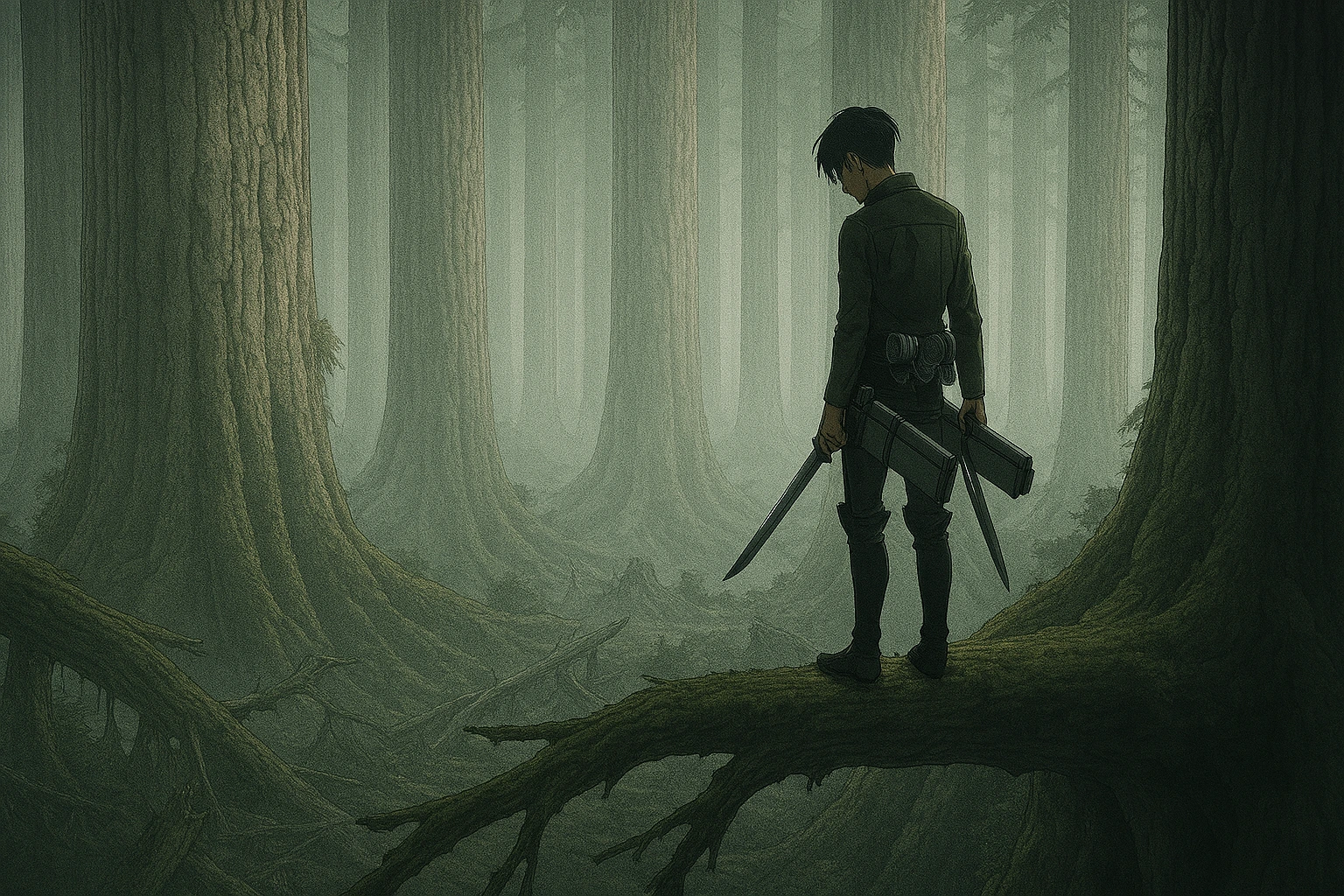
The true heartbreak comes later. When the Scouts are retreating, dumping bodies to outrun the Titans, Levi orders the bodies of his squad to be discarded to save the living.
He has to watch Petra’s body hit the dirt and roll away, abandoned. Then, when a dying soldier asks if he was useful, Levi takes the “Wings of Freedom” patch from a different dead soldier—claiming it was Petra’s—to comfort him.
He lies. He tells the dying boy that his death has meaning, that he will carry his will. He absorbs the trauma of others to grant them a peaceful death, while he himself is left with the living nightmare.
The Courtroom of Tough Love
Before discussing Erwin, we must acknowledge the courtroom scene with Eren. Levi beats Eren to a pulp in front of the entire military tribunal. On the surface, it’s brutality. But in reality, it is Levi’s twisted form of protection.
He knows the Military Police want to dissect Eren. By demonstrating that he can “tame” the beast through violence, he saves Eren’s life.
This is Levi’s language. He cannot offer soft words or hugs. He offers survival. He hurts you to save you. It is a lonely, misunderstood form of love that isolates him further.
He becomes the monster so that others don’t have to be. He accepts the role of the villain in the eyes of the public (who see him beating a child) to secure the strategic asset necessary for humanity’s survival.
Erwin Smith and the Serum Bowl (Season 3)
Erwin was more than a commander to Levi; he was his compass. Levi followed Erwin not because of rank, but because Erwin saw something in the world that Levi couldn’t.
Erwin gave the gutter-rat a purpose. Their bond transcends friendship; it is a symbiosis of vision and power.
The climax of the Return to Shiganshina arc is arguably the peak of Levi’s character. Erwin is wounded, the Beast Titan is decimating the recruits, and hope is lost.
Erwin wants to go to the basement. He wants to see the truth. It is his lifelong dream, right there, within grasp.
Levi looks at his best friend—a man who has become a devil for the sake of humanity—and sees the immense burden he carries.
He sees the guilt of the thousands of soldiers Erwin has sent to their deaths. In a moment of supreme love and cruelty, Levi makes the choice for him. “Give up on your dream and die.”
He orders his best friend to suicide-charge the Beast Titan so that Levi can get a chance to kill the enemy. But the tragedy deepens during the “Serum Bowl.”
Levi has the spinal fluid. He can save one person. He intends to save Erwin. He fights Mikasa and Eren for the right to save him.
But then, he looks at Erwin. He sees a man who has been living in a hell of his own making, driven only by a childhood obsession.
Bringing Erwin back would mean dragging him back into this hell. It would mean forcing him to become the devil once more. Levi looks at Armin, who dreams of the sea—a pure, innocent dream of the future.
And Levi chooses to let Erwin die.
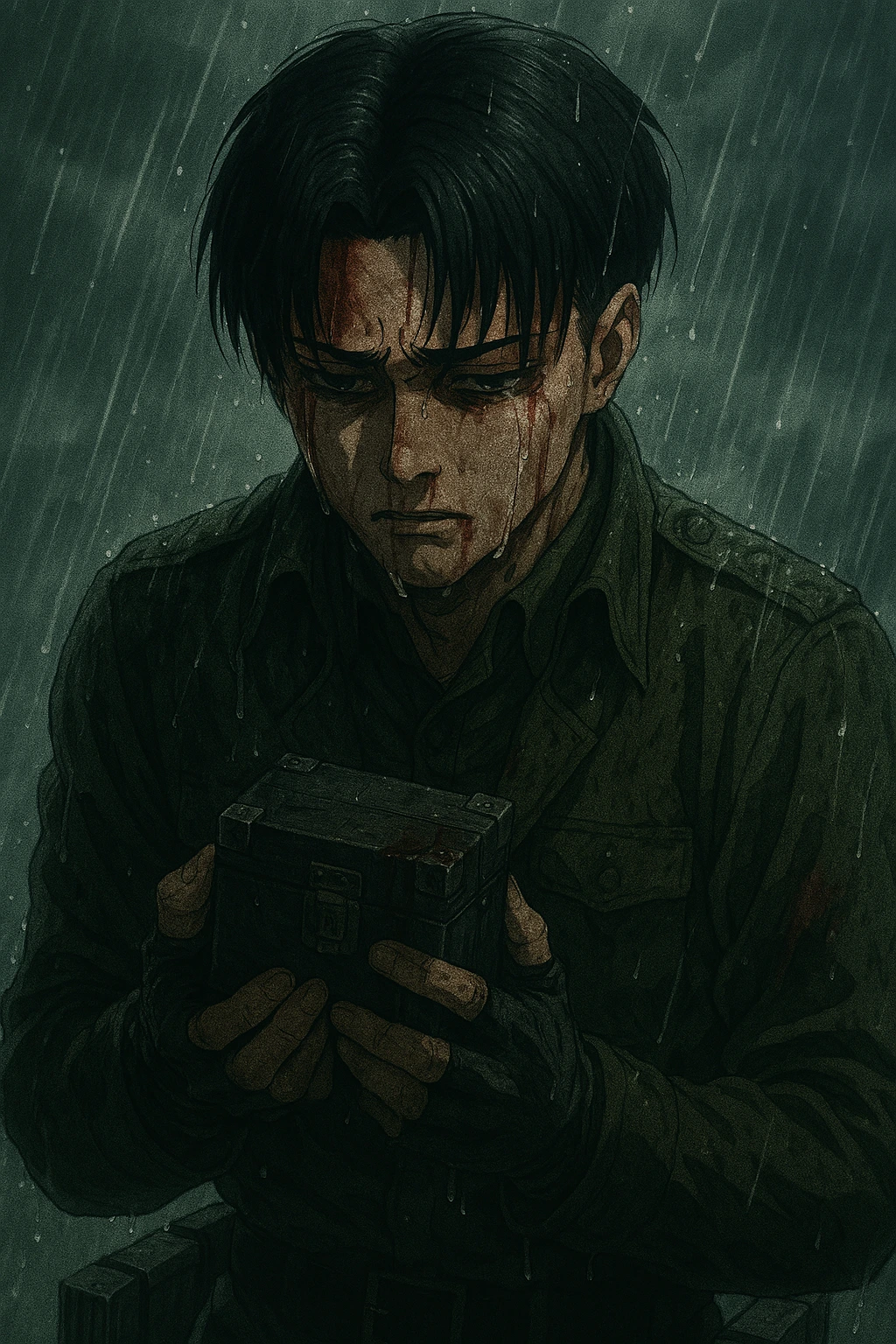
He doesn’t choose Armin because Armin is “better.” He chooses Armin because he loves Erwin too much to force him to keep fighting.
It is an act of mercy. He chooses to lose his best friend to grant that friend peace. It is the ultimate act of self-sacrifice: Levi chooses to be alone, to lose his guide, so that his guide can finally rest.
Hange Zoë: The Last Friend (Season 4)
By the end, Hange is all that is left. The last remnant of the old Survey Corps. They are the eccentric scientist to his grumpy cleaner.
During the timeskip, they function almost like the divorced parents of the Scouts—Hange managing the politics, Levi managing the threat. They share the burden of leadership that Erwin left behind.
When the Rumbling begins, Hange decides to stay behind to buy the alliance time. Levi, battered, missing fingers, covered in bandages, watches Hange prepare to die. He doesn’t stop them. He knows he can’t. He knows that stopping Hange would be an insult to their spirit.
His final words to Hange—“Shinzou wo Sasageyo” (Dedicate your heart)—are devastating. It is the first time we see him use the phrase earnestly.
He usually mocked it, or used it as an order. Here, it is a farewell. He sends his last friend into the fire, and once again, he is left behind. He is the last man standing, the custodian of a graveyard.
The Slave to the Promise: The Hunt for the Beast Titan
Every Shonen hero needs a rival. For Levi, that rival is Zeke Yeager, the Beast Titan. But this isn’t a rivalry of mutual respect like Goku and Vegeta, nor is it an ideological clash like Naruto and Sasuke.
Zeke is Levi’s Obsession. He is the living embodiment of Levi’s failure.
The relationship between Levi and Zeke is fascinating because it is entirely one-sided emotionally. Zeke sees Levi as a terrifying nuisance, a monster that refuses to die, an anomaly in the Titan stats. Levi sees Zeke as a promise he failed to keep.
“I promised him! I promised I’d kill you no matter what!” Levi screams this internally and externally. The promise he made to Erwin before the suicide charge becomes the only thing tethering Levi to the world.
Without Erwin, Levi is a weapon without a wielder. He feels rudderless. Fulfilling that final order is the only way he can justify his continued survival. If he kills Zeke, he validates Erwin’s sacrifice. If he fails, Erwin died for nothing.
This obsession drives Levi to the brink of insanity, pushing him to ignore his own injuries and the changing political landscape just to put a blade in the Beast’s neck.
He becomes a slave to the dead, unable to live in the present because he is shackled to a promise made in the past.
The Forest Fight (Round 2)
The second battle between Levi and Zeke in the giant forest (Season 4) is a masterclass in animated storytelling, but the emotional context is horrific.
Levi has been guarding Zeke for weeks. He has been forced to exist in a stalemate. But Zeke has played him. Zeke screams, turning all of Levi’s subordinates—men who drank the wine, men Levi was just drinking tea with—into pure Titans.
Levi is surrounded by the faces of his comrades, now warped into mindless monsters. Zeke assumes Levi won’t be able to kill them. He assumes Levi’s “softness” for his comrades will make him hesitate.
He is wrong.
Levi butchers them all. But don’t mistake this for coldness. As he slices through the napes of his own men, his face is a mask of pure fury.
He isn’t just killing Titans; he is killing the betrayal. When he catches Zeke, the brutality is shocking. He doesn’t just defeat him; he tortures him. He chops off his legs, then his heels, pinning him with a thunder spear.
He drags him through the mud. This isn’t tactical necessity. This is pure, unadulterated hatred. It is Levi lashing out at the unfairness of the world.
He is angry that he had to kill his comrades again. He is angry that Zeke doesn’t value life. He is angry that he is the only one left to clean up the mess.
The Explosion
Then comes the moment that breaks the god. Zeke detonates the thunder spear. Levi, usually the one two steps ahead, is caught in the blast. He is blown apart. He loses fingers, his face is scarred, and one eye is blinded.
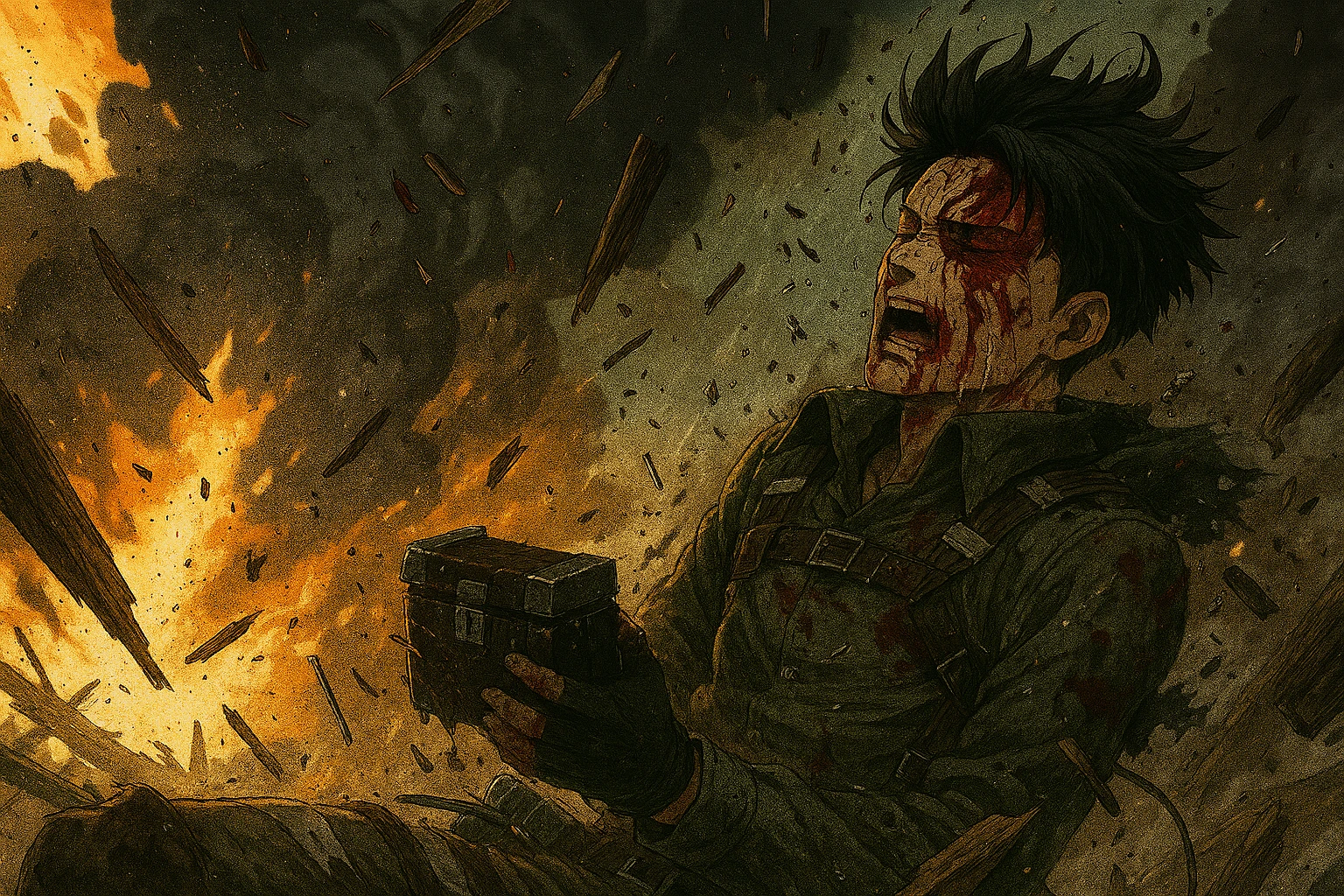
This moment is crucial. It symbolizes that even the Strongest cannot escape the cycle of violence unscathed. The “God of Death” is finally mortalized.
He is broken, physically and spiritually. This injury shifts Levi’s role. He can no longer be the one-man army. He becomes dependent on Hange and the alliance.
It forces him to confront his vulnerability. He is no longer fighting because he is “Humanity’s Strongest”; he is fighting because he is a man who made a promise. He is literally holding himself together with bandages and spite.
The Choice of “The End”: Choosing the Future Over the Past
In the finale, Levi is a wreck. He is swaddled in bandages, missing fingers, spitting blood. He looks nothing like the whirlwind from Season 1. Yet, this is where he shines the brightest.
Throughout the final battle on the back of the Founding Titan, Levi’s priority shifts. He is still hunting Zeke, yes, but he is also protecting the new generation—Mikasa, Jean, Conny, Armin.
We see the Destiny vs. Effort theme culminate here. Levi, the relic of the old world, uses his remaining strength to clear the path for the new world. He realizes that his era—the era of Erwin and the Scouts charging to their deaths—is ending. His role now is not to lead the charge, but to ensure the kids survive it.
When Mikasa needs to enter the mouth of the Titan to kill Eren, it is Levi who uses his last Thunder Spear to blow open the path. In doing so, he breaks his leg even further.
He sacrifices his body completely to allow the next generation to finish the fight. He puts his faith in Mikasa, another Ackerman, passing the torch of responsibility. He accepts that he is no longer the main character of the fight, but the support that makes victory possible.
The Moment of Rest
After the battle is won, Levi sits against a rock. The steam of the Titans fading away marks the end of an era. The curse of the Titans is gone.
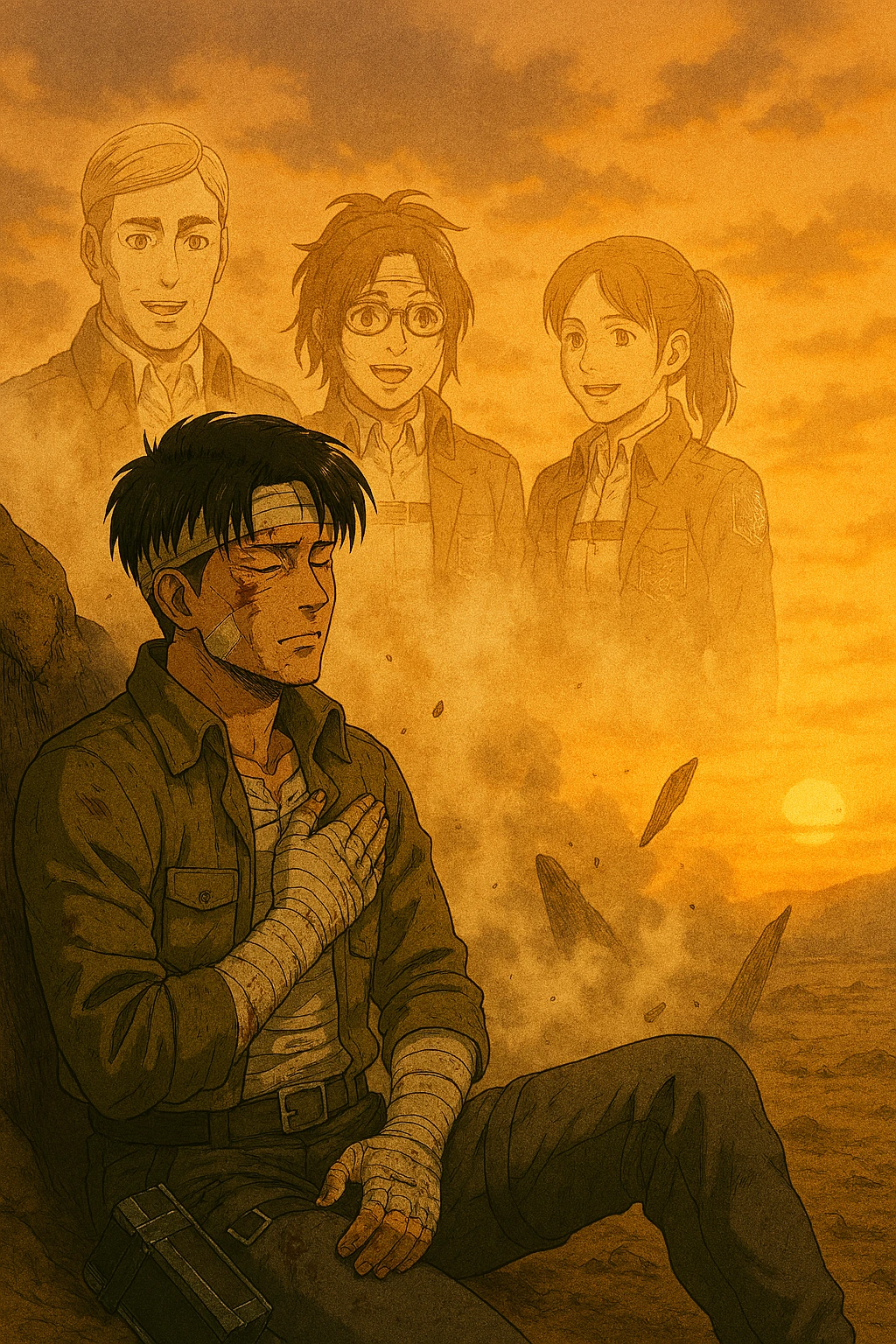
In the haze, he sees them. The ghosts. Erwin, Hange, Petra, Mike, Moblit, and the faceless hundreds of the Survey Corps. They are watching him.
For years, Levi carried the weight of their deaths. He felt their eyes on his back, judging his choices, demanding meaning for their hearts. He lived with the constant anxiety that their deaths were meaningless. Now, he sees them clearly. And he doesn’t see judgment. He sees peace.
Levi lifts his remaining hand, fist to chest. The salute. “Dedicate Your Heart.” He has never done this for himself. He always did it to command others or to mock the establishment. But here, alone on a wasteland, he salutes his fallen family.
It is a silent communication: It’s over. We did it. Your deaths meant something. A single tear trails down his bloodied face. The God of Death finally cries. Not from despair, but from relief.
The burden is lifted. The curse is broken. He has fulfilled his duty. He has survived the hell, and he has brought meaning to the mountain of corpses he stands upon.
Conclusion: The Old Man in the Wheelchair
The final pages of Attack on Titan give us a glimpse of the survivors three years later. We see Gabi and Falco pushing a wheelchair.
In it sits Levi Ackerman. He is dressed in plain civilian clothes. He looks smaller, frailer. He is reading a newspaper. He accepts candy from the kids.
Some fans hated this. They wanted Levi to go out in a blaze of glory, dying in battle like a warrior, or to become the new Commander leading the army. They wanted the “cool” ending that fit the “God of Death” persona. But this? This is the perfect ending.
Levi Ackerman spent his entire life in a war zone. From the knife fights of the Underground to the Titan wars of the surface. He never had a childhood. He never had peace. He was a tool, a weapon, a soldier. He was defined by his utility to others—first to Kenny, then to Erwin, then to humanity.
Ending up in a wheelchair, unable to fight, is not a punishment. It is a retirement. The universe has finally granted him permission to stop. He no longer has to be strong.
He no longer has to be the survivor who carries the weight of the world. He can just be a guy who likes tea and reads the paper. He has lost the physical strength that defined him, but he has gained the peace that always eluded him.
He broke the curse of the Ackerman bloodline—a bloodline bred for violence and servitude—by finding a life outside of war.
He didn’t become the next Kenny, dying alone and power-hungry, lamenting that everyone is a slave to something. He found a strange, patchwork family in Gabi, Falco, and Onyankopon—former enemies and outcasts. He found the very thing he wanted when he was a starving child in the Underground.
The Final Verdict
Levi Ackerman didn’t fight because he loved violence. He fought so that one day, he wouldn’t have to.
The tragedy of his life was the mountain of corpses he had to climb to get there; the beauty of his ending is that he finally reached the summit, sat down, and watched the sun rise on a world that no longer needed a God of Death.
He is the strongest character in Attack on Titan, not because he killed the most Titans, but because he endured the most pain and still retained his humanity.
The “Cool Guy” was just armor. The real Levi was the heart beneath it—bruised, beaten, but beating until the very end. The curse of the strongest was finally lifted, not by death, but by the simple, quiet act of living.
next article is levi’s scout person erenyeager.