
I. Introduction: The Rise of the Dark Trio and the Death of Optimism
For two decades, the landscape of Shonen manga was dominated by a specific brand of solar-powered optimism. We lived in the era of the “Big Three”—One Piece, Naruto, and Bleach. These titans defined a generation where the formula was clear: a plucky underdog protagonist dreams of a high-ranking title (Hokage, Pirate King), screams about the power of friendship, and eventually reshapes the world through sheer determination and moral purity. The world was dangerous, yes, but it was fundamentally just. If you tried hard enough, screamed loud enough, and believed in your friends, you won. The narrative universe bent to accommodate the moral righteousness of the hero.
Then, the world changed. And so did the stories we craved.
Enter Jujutsu Kaisen (JJK).
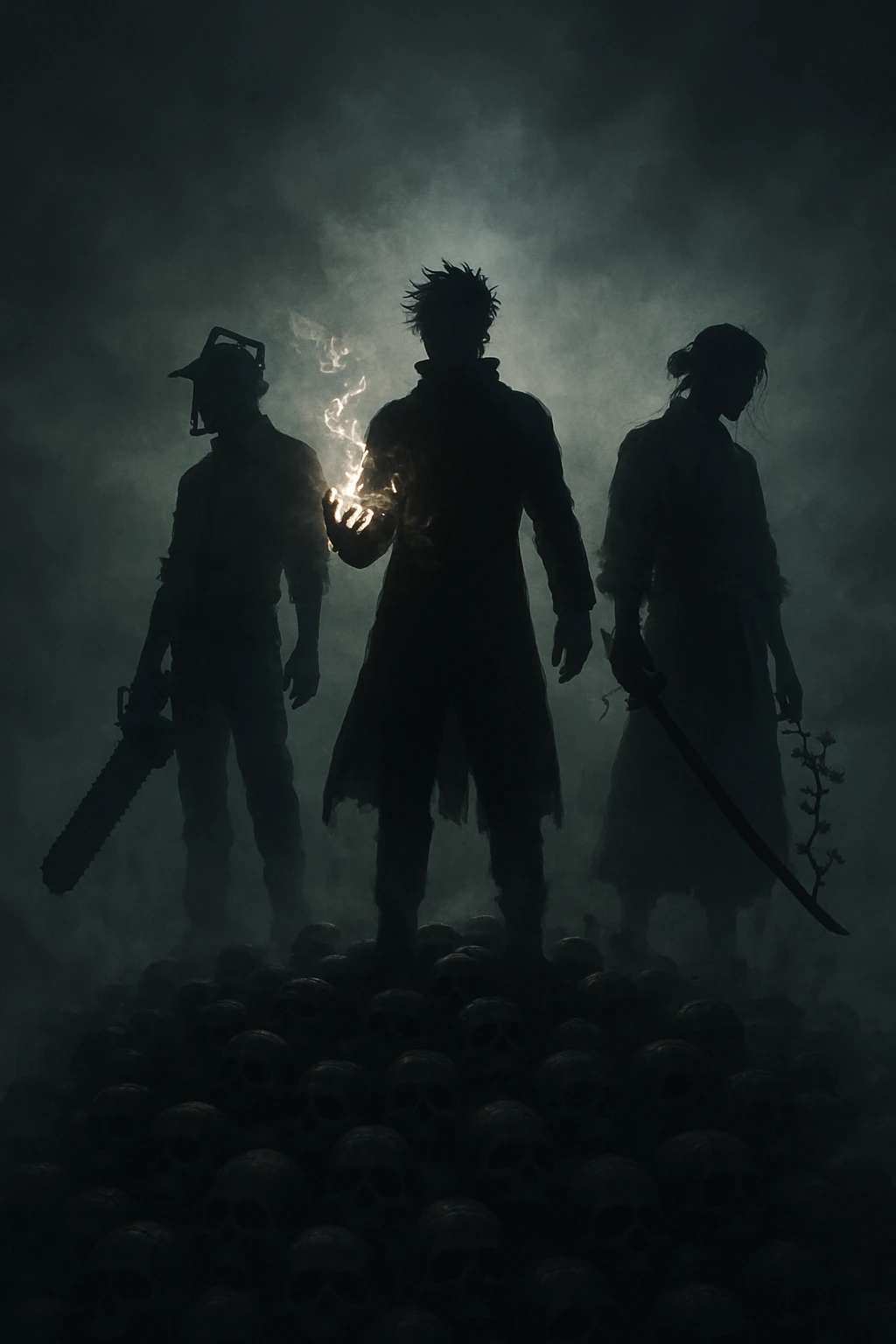
JJK, alongside Chainsaw Man and Hell’s Paradise, forms what the community has dubbed the “Dark Trio.” This new generation of Shonen emerged not from the economic optimism of the early 2000s, but from the cynicism, burnout, and complexity of the modern era. While Chainsaw Man represents chaotic dadaism and the struggle for basic needs, and Hell’s Paradise serves as a twisted theological thriller about finding beauty in hell, Jujutsu Kaisen holds a unique and perhaps more insidious position: it is the Anti-Shonen disguised as a Shonen.
On the surface, Gege Akutami’s magnum opus wears the skin of its predecessors like a camouflage suit. It checks the standard boxes that editors love:
- A high school setting? Check.
- A trio of main characters (two boys, one girl)? Check.
- A hidden power sealed within the protagonist? Check.
- A masked, overpowered mentor figure? Check.
- A tournament arc? Check.
But this skin is rotting from the inside out. Jujutsu Kaisen lures the reader in with familiarity, only to brutally subvert every expectation of the genre. It does not preach that friendship conquers all; it preaches that, fundamentally, you die alone. It does not promise that hard work beats talent; it creates a world defined by unfair biological advantages where some gaps are insurmountable regardless of effort.
The thesis of Jujutsu Kaisen—and its lasting legacy—is the rejection of narrative comfort. It replaced the “Power of Friendship” with the “Power of Solitude.” It normalized consequence-heavy storytelling where trauma isn’t a hurdle to jump over, but a permanent scar that changes the shape of the runner. In JJK, the good guys don’t always win, the bad guys don’t always learn, and sometimes, the only reward for surviving a battle is the trauma you carry into the next one.
This article explores how Jujutsu Kaisen didn’t just participate in the Shonen genre; it broke it, creating a new blueprint built on the foundations of horror, consequence, and the unvarnished truth of human ugliness.
II. The Protagonist Problem: Yuji Itadori and the Cog Mentality

To understand how JJK breaks the mold, we must look at its heart: Yuji Itadori.
In traditional Shonen, the protagonist is an additive force. Naruto Uzumaki wants to add titles to his name; he wants recognition, respect, and the Hokage hat. Luffy wants to add freedom, territory, and the title of Pirate King. They are agents of change who impose their will upon the world. They are the gravity centers of their distinct universes, and the plot bends to accommodate their dreams. Their ambition is the engine of the story.
Yuji Itadori begins with no dream. He has no desire to be the “King of Curses,” the “Head Sorcerer,” or the strongest in the world. His initial motivation is reactive and subtractive. Following his grandfather’s dying wish to “help people,” he simply wants to ensure that he and those around him have a “proper death.”
The Subtractive Goal
This desire for a “proper death” is the first red flag that JJK is telling a different kind of story. It is morbid, finite, and inherently tragic. Yuji isn’t fighting for a bright, expansive future; he is fighting to mitigate a tragic end. He accepts early on that he is a dead man walking. He has eaten the finger of Ryomen Sukuna, and the rigid laws of Jujutsu society dictate that he must eventually be executed.
Most Shonen protagonists fight to live to see another day. Yuji fights to die on his own terms. This shift recontextualizes every battle. When Naruto fights, the tension comes from how he will win. When Yuji fights, the tension comes from the question: “How much of his soul will he lose before the inevitable end?” He is a martyr in training, a boy who has accepted his expiration date before his life has truly begun.
The Cog in the Machine
The most devastating deconstruction of the hero archetype comes in the aftermath of the Shibuya Incident, during Yuji’s second confrontation with Mahito. In a typical story, this is the moment where the hero stands tall, refutes the villain’s nihilistic philosophy with a grand speech about hope or human connection, and delivers the finishing blow in the name of justice.
Yuji, however, does not speak of justice. He looks at the embodiment of human evil—a creature that has killed his mentor and disfigured his friend—and says:
“I don’t need to find a meaning or a reason… I’m just a cog. And I’ll keep killing curses until I rust away.”
This is the “Cog Mentality.” It is the psychological surrender of the self. Yuji accepts that he is not the “chosen one” in a glorious sense, but a replaceable component in a grinding machine of violence. He strips away his ego, his desire for validation, and his humanity to become a function. It is a moment of profound sorrow, framed as a heroic resolve. It highlights a brutal truth of the JJK world: Heroism is a job, and it is a job that consumes you. It suggests that to defeat monsters, one must abandon the very humanity they are trying to protect.
Suffering as a Feature, Not a Bug
Gege Akutami treats Yuji with a ruthlessness that borders on narrative cruelty. In other series, suffering builds character; the hero gets beaten down so they can rise up stronger (the “Zenkai Boost” trope). Pain is a stepping stone. In JJK, suffering just breaks things. It leaves cracks that don’t seal.
- The Detention Center: Yuji loses his hand and “dies” within the first arc, forcing him into a binding vow with the devil inside him.
- Junpei Yoshino: Yuji fails to save his new friend, watching him warp into a monster in a mockery of their bond. He doesn’t just fail; he is forced to watch his failure die in agony.
- Shibuya: Yuji is forced to bear witness to Sukuna’s mass murder, regaining consciousness in a crater filled with the dust of thousands of innocent people. He carries the guilt of a mass shooter, despite pulling no trigger.
Yuji rarely gets a clean win. His victories are Pyrrhic. He doesn’t overpower his enemies with a hidden wellspring of rage or a sudden power-up fueled by friendship; he jumps them with his allies, kicks them while they are down, and survives by the skin of his teeth, often covered in his own blood and vomit. He is the most human protagonist in modern Shonen because he is allowed to be traumatized, weak, and ultimately, a small part of a very large, uncaring world.
III. The Death of Plot Armor: The “Game of Thrones” Effect
If you grew up watching Dragon Ball Z or Bleach, you were trained to believe in the safety net. No matter how bad things got, the main cast would survive. If they died, there were Dragon Balls, healing arts, or miraculous recoveries. Death was a temporary inconvenience, a dramatic pause before the triumphant return. The audience felt safe because the author implicitly promised that the toys would be put back in the box unharmed.
Jujutsu Kaisen burned the safety net. It established early on that anyone, at any time, could be removed from the board.
The Bait and Switch of Junpei
The early introduction of Junpei Yoshino was a masterclass in gaslighting the audience. He was featured prominently in the anime’s opening sequence, standing alongside Yuji, Nobara, and Megumi in a quintessential “group of friends” shot, laughing under a cherry blossom tree. He had a tragic backstory involving bullying, a unique jellyfish-based power, and a developing bond with the hero. By all Shonen laws, he was destined to join the team as the fourth ranger.
Then, Mahito transfigured him. He died an ugly, confused, and meaningless death in front of Yuji. There was no last-minute save. There was no resurrection. The opening sequence was a lie. This was Akutami telling the audience: Do not trust the tropes. They will not save you here. Your expectations are a weakness.
The Shibuya Massacre: A Paradigm Shift
The Shibuya Incident arc is effectively the Jujutsu Kaisen equivalent of the “Red Wedding.” It is the moment the series transitioned from a dark action manga to a full-blown tragedy. It wasn’t just a battle; it was a systemic dismantling of the protagonist’s support system.
In Shibuya, Akutami dismantled the “good guys” with frightening efficiency.
- Nanami Kento: The fan-favorite salaryman sorcerer, the symbol of adulthood and stability, didn’t get a warrior’s death fighting a boss. He was burned, exhausted, delirious, dreaming of a retirement in Malaysia, and then blown apart by a casual touch from Mahito. His death was sudden, brutal, and uncomfortably realistic in its sudden cessation of life. There was no final speech to Yuji, just a weary passing of a curse.
- Nobara Kugisaki: One of the main trio. In any other show, she would be safe until the final arc. In Shibuya, she takes a hit to the face and is removed from the narrative. Her status was left in limbo for years, maximizing the despair and denying the audience the closure of a funeral or a recovery.
These deaths (or near-deaths) are unceremonious. Characters die mid-sentence. They die with regrets. They die wondering if they did enough. This mirrors reality far more than the melodramatic, speech-heavy deaths of older anime, where characters hang on for ten minutes to say goodbye. In JJK, death is instant, ugly, and indifferent to your narrative importance.
Removing the Ceiling: The Sealing of Gojo Satoru
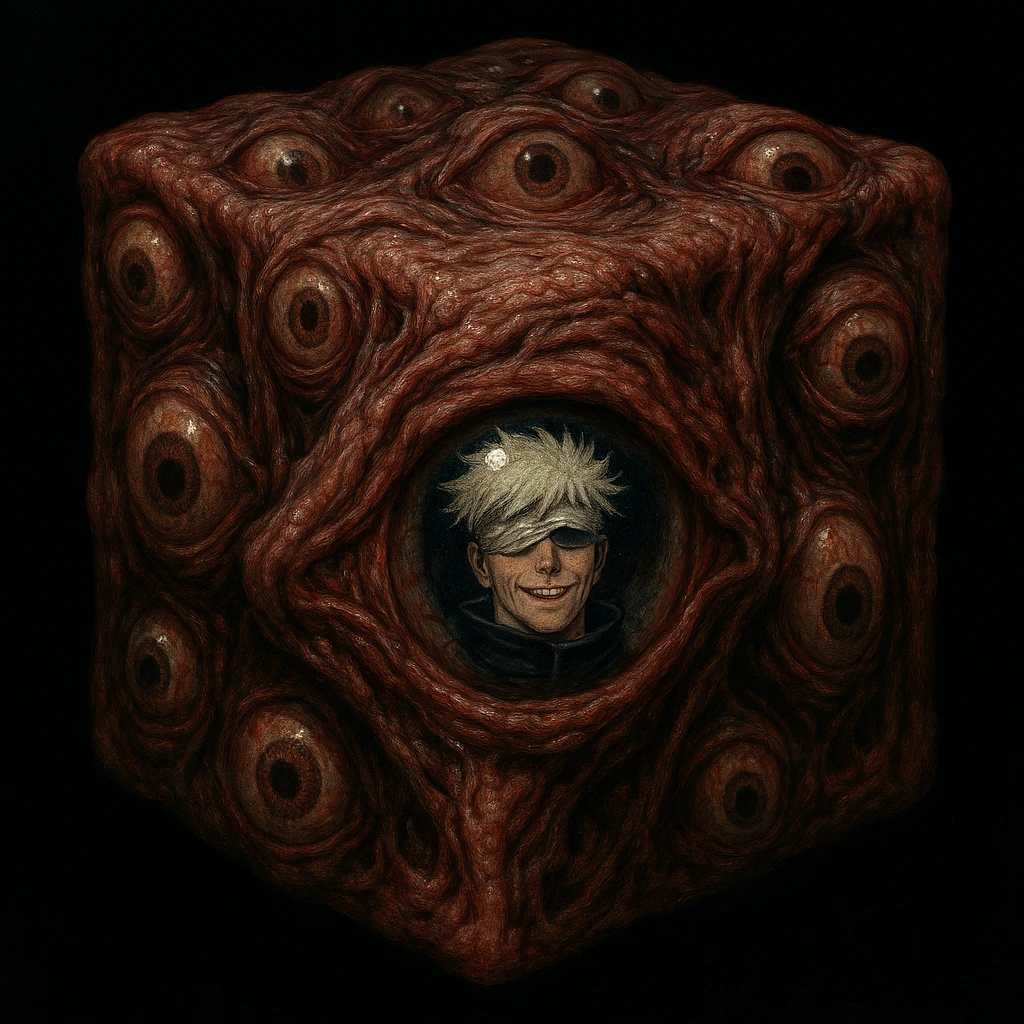
Gojo Satoru acts as the ultimate safety net. As long as Gojo is there, the good guys can win. He is the ceiling of the power system, a god walking amongst mortals. Akutami realized that for the story to have genuine tension, God had to be removed.
The sealing of Gojo in the Prison Realm was a brilliant narrative device. It didn’t just raise the stakes; it changed the genre. It turned the story from a “Superhero” narrative (where Superman saves the day) to a “Survival Horror” narrative (where the civilians are left to fend off the wolves). Without Gojo, the balance of the world collapsed. The panic felt by the characters was shared by the audience. We genuinely didn’t know if Yuji or Megumi would survive the next chapter because the one person who could guarantee their safety was gone.
In Jujutsu Kaisen, you don’t read to see how they win. You read to see who survives. The question changes from “How will they beat the villain?” to “Who will be left standing to mourn?”
IV. The Villain Standard: Pure Evil Returns
For a long time, Shonen suffered from the “Sympathetic Villain Syndrome.” Thanks to the massive influence of Naruto, every villain needed a tragic flashback. Pain wanted peace; Obito did it for love; Madara wanted a world without suffering. This “Talk-No-Jutsu” approach humanized villains but often diluted the threat. It suggested that every monster was just a misunderstood hero waiting to be saved.
Jujutsu Kaisen brought back the monster. It reintroduced the concept that some people are just evil, and that’s okay.
Mahito: The Mirror of Humanity
Mahito is arguably one of the best-written antagonists of the last decade because he is essentially a child with a shotgun. He is a curse born from the hatred humans have for each other. He has no grand plan for world domination; he just wants to experiment, kill, and break souls.
He is the perfect foil for Yuji. Where Yuji seeks meaning in death, Mahito seeks pleasure in it. He grows alongside the hero, unlocking new forms and powers just as Yuji does. He isn’t a wall to be overcome; he is a predator evolving in real-time. His cruelty is intimate; he doesn’t just blast you with energy, he twists your body and soul into a mockery of life. He represents the ugliness of human nature reflected back at us, laughing.
Ryomen Sukuna: The King of Hedonism
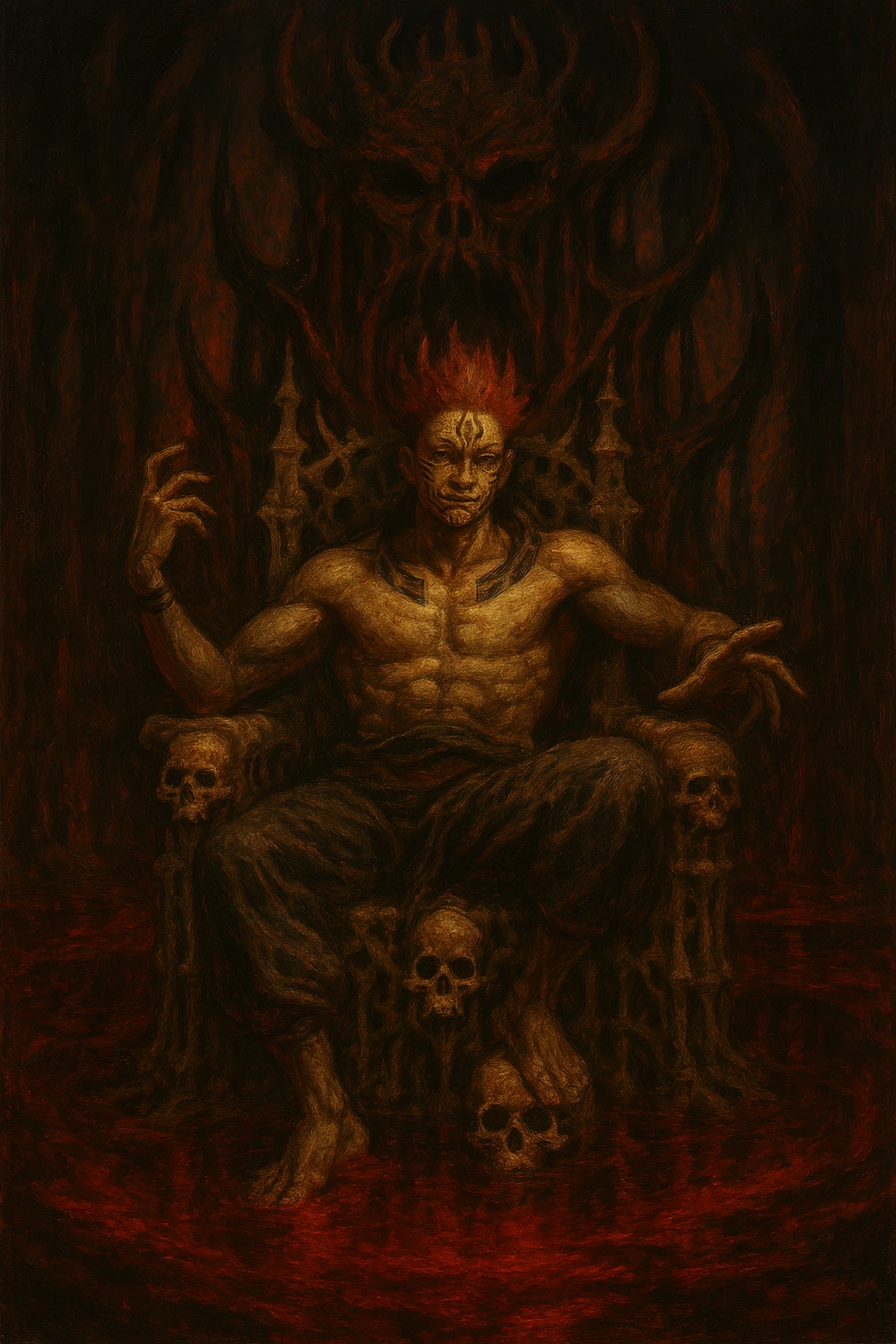
Then there is Sukuna. In an era of complex, gray morality villains (like Eren Yeager or Griffith), Sukuna is refreshing in his absolute simplicity. He is not misunderstood. He was not abused as a child (that we know of, or that matters). He is a natural disaster in human form.
Sukuna operates on a philosophy of absolute selfishness and hedonism.
“Compare yourselves not to others, but to the burnt earth.”
He eats when he’s hungry. He kills when he’s annoyed. He fights because it’s fun. He is a return to the “Pure Evil” archetype, but elevated by extreme charisma and competence. He represents the “Heian Era” mindset—a time where might made right and the weak were merely food for the strong. He treats the modern world and its morals as a joke, a passing amusement.
Sukuna’s refusal to redeem himself is his greatest strength. He rejects the main character’s attempts to connect. He rejects the concept of love as a salvation. He stands alone, the ultimate testament to the series’ theme of “The Power of Solitude.” He proves that in JJK, you don’t need a tragic reason to be a villain; you just need the power to enforce your will.
Kenjaku: The Mad Scientist
If Sukuna is the brawn, Kenjaku is the brain. He represents a terrifying kind of detached curiosity. He views the world not as a kingdom to rule, but as a petri dish to observe. His orchestration of the Culling Games isn’t born out of malice, but out of a twisted scientific desire to see “something interesting.”
He is the cold, unfeeling chaos of evolution. He is willing to merge humanity with Tengen just to see what happens, treating billions of lives as variables in an equation. This triad of villains—the childish mirror (Mahito), the hedonistic calamity (Sukuna), and the amoral scientist (Kenjaku)—presents a united front of irredeemability. You cannot talk them down. You cannot appeal to their humanity. You can only kill them, or be killed by them.
V. The Female Cast: The New Gold Standard
The “Shonen Female Lead” has historically been a cursed role. Often reduced to healers, love interests, or damsels in distress, female characters in the “Big Three” era struggled for agency (with a few notable exceptions). They were often defined by who they wanted to marry, rather than who they wanted to kill.
Jujutsu Kaisen obliterated this trope, setting a new bar for how women are written in action manga.
No Fanservice, Just Violence
The first thing one notices about the women in JJK is the design philosophy. There are no bikini armor sets. There are no gratuitous panty shots or “accidental” falls. The women wear practical, modest uniforms designed for combat. They have scars that they don’t hide. They have muscles that function. They look like soldiers, not pin-ups. This visual respect translates immediately to narrative respect.
Maki Zenin: The War Goddess
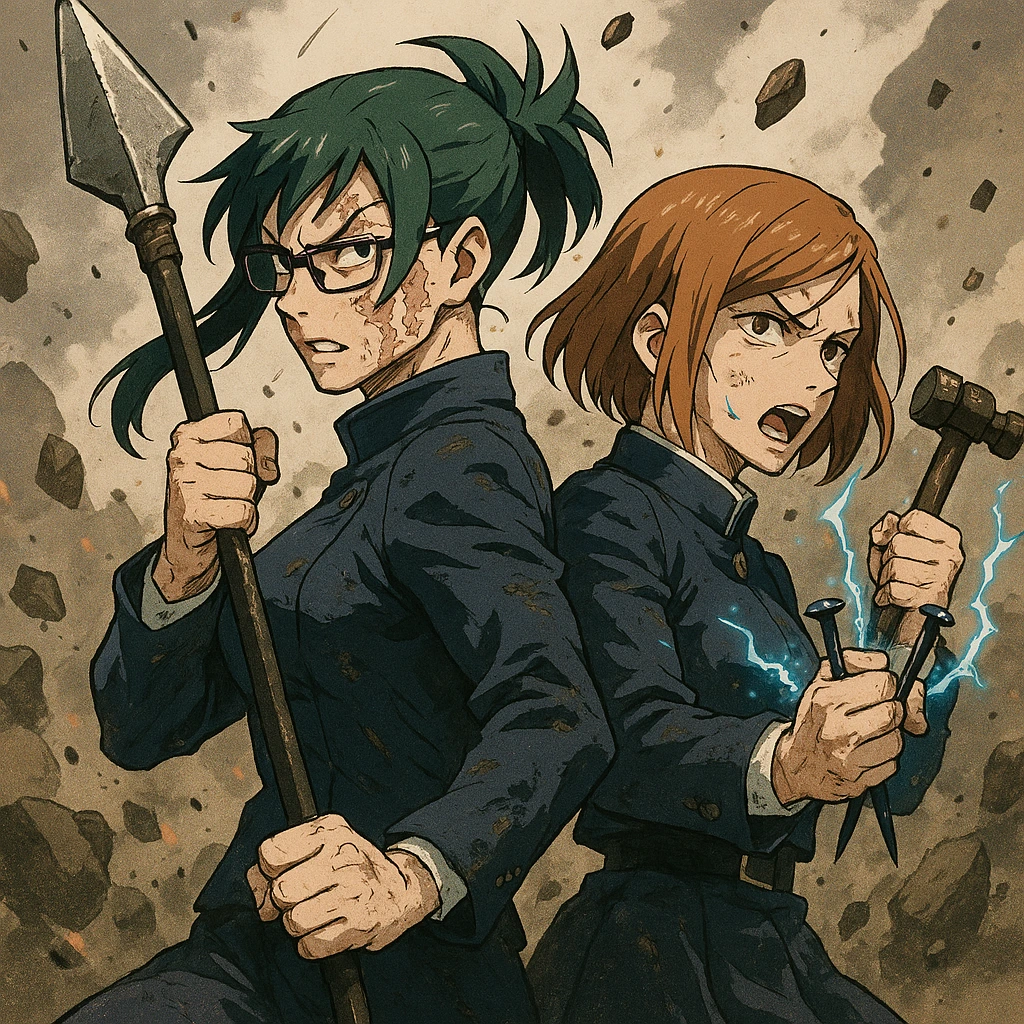
Maki Zenin is perhaps the crowning achievement of female writing in Shonen. Born with no cursed energy in a hyper-conservative, patriarchal clan, she is initially positioned as the “Rock Lee” underdog—the one who works hard to prove she belongs. But her arc goes much darker and much further.
Maki doesn’t just want to prove the Zenin clan wrong; she wants to dismantle them. Her awakening following the death of her sister, Mai, is a sequence of pure horror and liberation. She doesn’t defeat her oppressors in a tournament; she butchers her entire family, including her own mother, in a blood-soaked rampage. It is visceral, cathartic, and terrifying. She becomes the “Monster of the Zenin,” inheriting the physical prowess of Toji Fushiguro.
Her story isn’t about finding love or being accepted. It is about burning down the systems that oppressed her. She is a force of nature, equal to the strongest men in the series, and she demands respect through fear, not charm. She stands as a solitary warrior who needs no one to validate her existence.
Nobara Kugisaki: The Rejection of Roles
Nobara Kugisaki introduced herself with a declaration that defined her character:
“I am Nobara Kugisaki.”
She explicitly rejects the binary choice often given to women in media. During her fight with Momo at the Goodwill Event, she delivers a speech that should be studied in literature classes:
“I don’t give a damn about ‘men’ this and ‘women’ that… I love myself when I’m pretty and dressed up! And I love myself when I’m strong!”
She fights with a hammer and nails—brutal, visceral weapons that require her to get close to the enemy. Her “Resonance” technique involves hurting herself (hammering nails into her own limbs or effigies) to hurt her opponent, showcasing a terrifying pain tolerance. She is petty, loud, arrogant, and confident. She refused to be the “healer” of the group (a role ironically given to Shoko Ieiri, who is cynical, exhausted, and smokes chain-cigarettes). Nobara proved that a female lead could be just as brash, violent, and “unlikable” as the boys without losing her femininity.
VI. The Power System: Weaponized Complexity

A great Shonen needs a great power system. Dragon Ball had Ki (simple, output-based). Naruto had Chakra (versatile, elemental). Hunter x Hunter had Nen (complex, logic-based).
Jujutsu Kaisen introduces Cursed Energy, a system that sits between Naruto and Hunter x Hunter in terms of complexity, but exceeds both in terms of narrative integration. It is a system built on negative emotion, meaning the magic itself is toxic.
Negative Emotion as Fuel
The core premise—that power comes from negative emotions (anger, fear, grief, jealousy)—perfectly suits the tone of the series. To be a great sorcerer, you must be intimate with your own darkness. The more you suffer, or the more you understand human suffering, the stronger you are. This creates a feedback loop where the world inevitably gets darker because the fuel for its magic is darkness itself. It implies that happy, well-adjusted people make terrible sorcerers.
The Binding Vow: The Economy of Power
The genius of Akutami’s system is the “Binding Vow.” In most series, characters just get stronger by training or believing in themselves. In JJK, power is often transactional. It operates on an economy of risk.
You want more power? What will you give up?
- Nanami: Restricts his power output during the day (9-to-5) to get a massive boost during “overtime.” He turns his work-life balance into a weapon.
- Mei Mei: Sacrifices a crow’s life (a living being) to launch a suicide strike that can kill almost anything.
- Sukuna: Modifies the conditions of his techniques on the fly to bypass defenses, trading the “sure-hit” effect for increased range or destructive power.
- Heavenly Restriction: The ultimate vow, where one is born with zero cursed energy (Maki/Toji) in exchange for a superhuman body. The universe balances the scales forcibly.
This adds a layer of strategy and risk. It prevents “ass-pull” power-ups because every sudden boost usually comes with a terrible cost or a strict condition. If you break a vow, the consequences are unknown and catastrophic.
Domain Expansion: The Peak of Anime Battles
The “Domain Expansion” is the most iconic addition JJK has made to the anime lexicon. It is the pinnacle of sorcery. It isn’t just a big laser beam; it is the imposition of one’s inner world onto reality. It forces the opponent to exist inside your soul.
It guarantees a hit. It changes the environment. It is a “checkmate” move. The visual spectacle of a Domain Expansion—Gojo’s Infinite Void (overloading the brain with infinite information) or Sukuna’s Malevolent Shrine (a shrine that slashes everything in range)—turns battles into surrealist art. It shifted the meta of anime fights from “Who can punch harder?” to “Who has the more refined soul?” It turned the battlefield into a psychological landscape.
VII. The Horror Aesthetic and Cinematic Direction
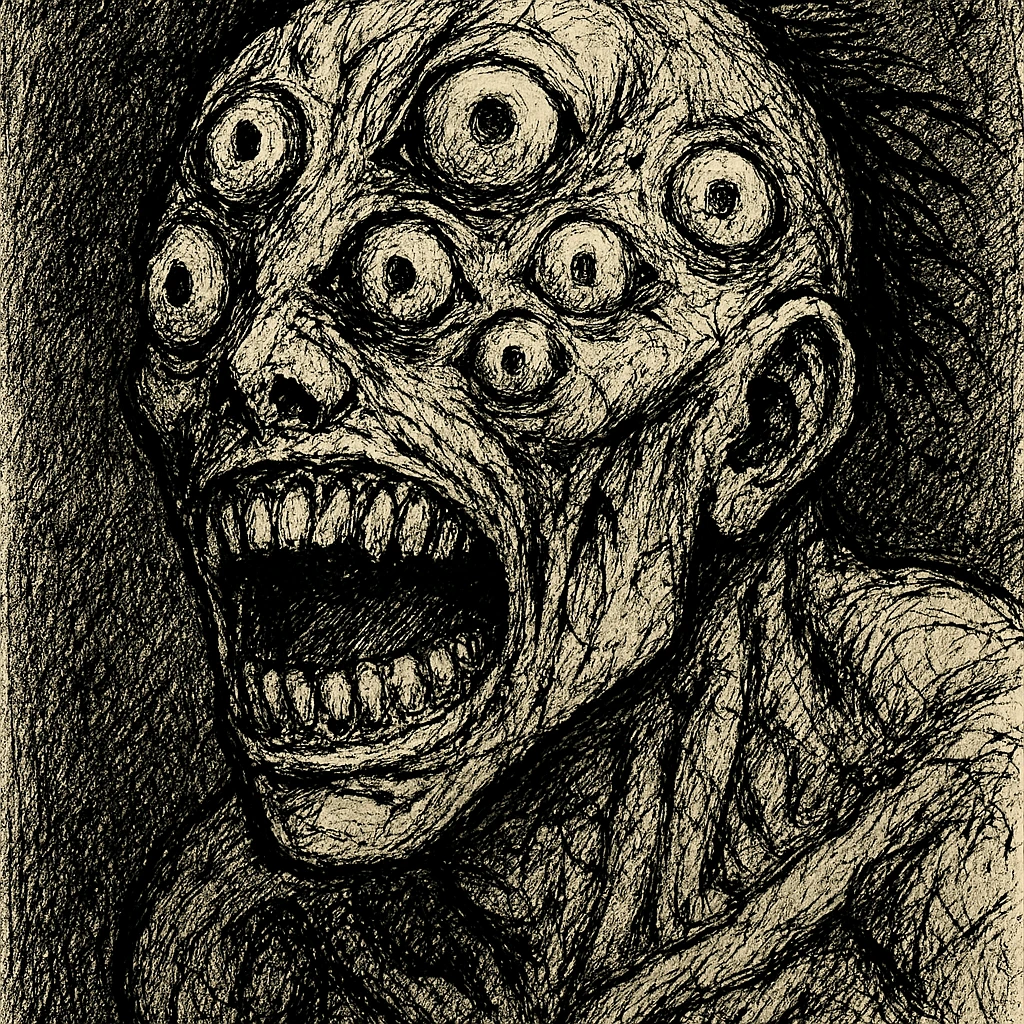
Jujutsu Kaisen is, at its core, a horror story dressed up in action tropes. This is evident in Gege Akutami’s manga art style, which draws heavy inspiration from horror mangaka Junji Ito. The curses are not “cool monsters”; they are grotesque amalgamations of flesh, teeth, and eyes. They trigger trypophobia and revulsion. The Finger Bearers look like aborted fetuses; Mahito’s transfigured humans are tragedies of body horror, retaining just enough humanity to be heartbreaking before they attack.
This “sketchy,” rough artistic style conveys a sense of instability and madness that clean, polished art styles (like My Hero Academia) cannot replicate. The lines feel frantic, as if drawn in a hurry before the monster attacks.
The MAPPA Elevation
We cannot discuss JJK’s legacy without crediting Studio MAPPA. The anime adaptation didn’t just animate the manga; it elevated it to cinema. The production team understood that the source material was closer to a thriller than a cartoon.
The direction, particularly in Season 2 (Hidden Inventory and Shibuya), utilized a visual language rarely seen in long-running Shonen. They used:
- Fish-eye lenses and Dutch angles to create disorientation and unease.
- Impact Frames that flash abstract art, sketches, or black-and-white stills during hits to convey sheer, bone-breaking force.
- Dynamic lighting that mirrors live-action film, utilizing neon city lights and deep shadows to frame the characters.
- Silence: Using the complete lack of music to accentuate the horror of a scene, letting the wet sound of tearing flesh take center stage.
The fight between Sukuna and Jogo, or the chaotic, claustrophobic beatdown of Mahito in the subway, felt less like anime episodes and more like high-budget disaster films. This raised the bar for what audiences expect from TV anime animation, proving that television anime can rival feature films in visual fidelity.
VIII. Conclusion: A Modern Classic and the Blueprint for the Future
Jujutsu Kaisen is a product of its time. It resonates with a generation that feels like “cogs” in a massive, uncaring machine. It speaks to a generation surrounded by systemic issues that feel like curses—climate change, economic instability, social isolation—and a generation that is deeply skeptical of happy endings.
It broke Shonen by stripping away the sugar coating. It proved that you don’t need to coddle the audience to be popular. You can kill the mentor. You can maim the protagonist. You can let the villains win for huge stretches of the story. You can end an arc with the city in ruins and the heroes in tears. As long as the writing is honest and the stakes are real, the audience will follow you into the dark.
The Legacy of JJK is the normalization of despair.
It has paved the way for the next wave of manga—stories that will likely be even darker, more complex, and more morally ambiguous. Future creators will look at the success of the Shibuya Incident and realize that safety is boring. They will look at Maki Zenin and realize that female characters can be warlords. They will look at Yuji Itadori and realize that a hero doesn’t have to be a king; he can just be a guy trying to die a good death.
Jujutsu Kaisen didn’t just break the glass ceiling of the Shonen genre; it expanded a Domain over it, trapping us all in its beautiful, violent, and tragic world. And despite the pain, we are grateful for it.
IX. Frequently Asked Questions (FAQs)
Q1: Why is Jujutsu Kaisen considered a “Dark Shonen”? A: Unlike traditional Shonen that focus on adventure, friendship, and achieving dreams, “Dark Shonen” (like JJK, Chainsaw Man) focuses on trauma, moral ambiguity, high stakes, and horror elements. JJK is defined by its high character death count, the psychological suffering of its protagonist, and a world where the “good guys” are part of a corrupt system.
Q2: How does JJK handle female characters differently than Naruto or Bleach? A: JJK avoids sexualizing its female cast (fanservice) and gives them agency, complex motivations, and brutal fight scenes. Characters like Maki and Nobara are defined by their strength, ambitions, and personalities rather than their romantic interest in the male leads. They are active participants in the plot who rescue themselves.
Q3: What is the influence of Hunter x Hunter on JJK? A: Gege Akutami is a massive fan of Hunter x Hunter. This influence is seen in the power system (Cursed Energy is remarkably similar to Nen in its complexity), the tactical nature of the battles, the heavy use of narrator explanations, and the “Binding Vow” mechanic (similar to Vows and Limitations in HxH).
Q4: Why does Gege Akutami kill off so many characters? A: Akutami believes in consequence-driven storytelling. To make the villains feel like genuine threats, they must successfully kill important characters. This removes “plot armor” and creates genuine tension, as the audience knows that anyone, even fan favorites, can die at any moment. It prevents the story from becoming predictable.
Q5: Is Ryomen Sukuna the best villain in Shonen history? A: While subjective, many critics argue Sukuna is one of the best because he subverts the “tragic villain” trope. He is unapologetically evil, charismatic, and serves as a force of nature. His lack of a “sad backstory” makes him a terrifyingly pure antagonist compared to complex figures like Madara Uchiha or Aizen. He demands attention whenever he is on screen.
Q6: What is a “Binding Vow” in Jujutsu Kaisen? A: A Binding Vow is a pact made with oneself or another person using Cursed Energy. By accepting a handicap or penalty (e.g., explaining your technique to the enemy, or limiting your range), a sorcerer gains a boost in power or effectiveness. It is the concept of “high risk, high reward” weaponized.