
Introduction: The Tower of Violence
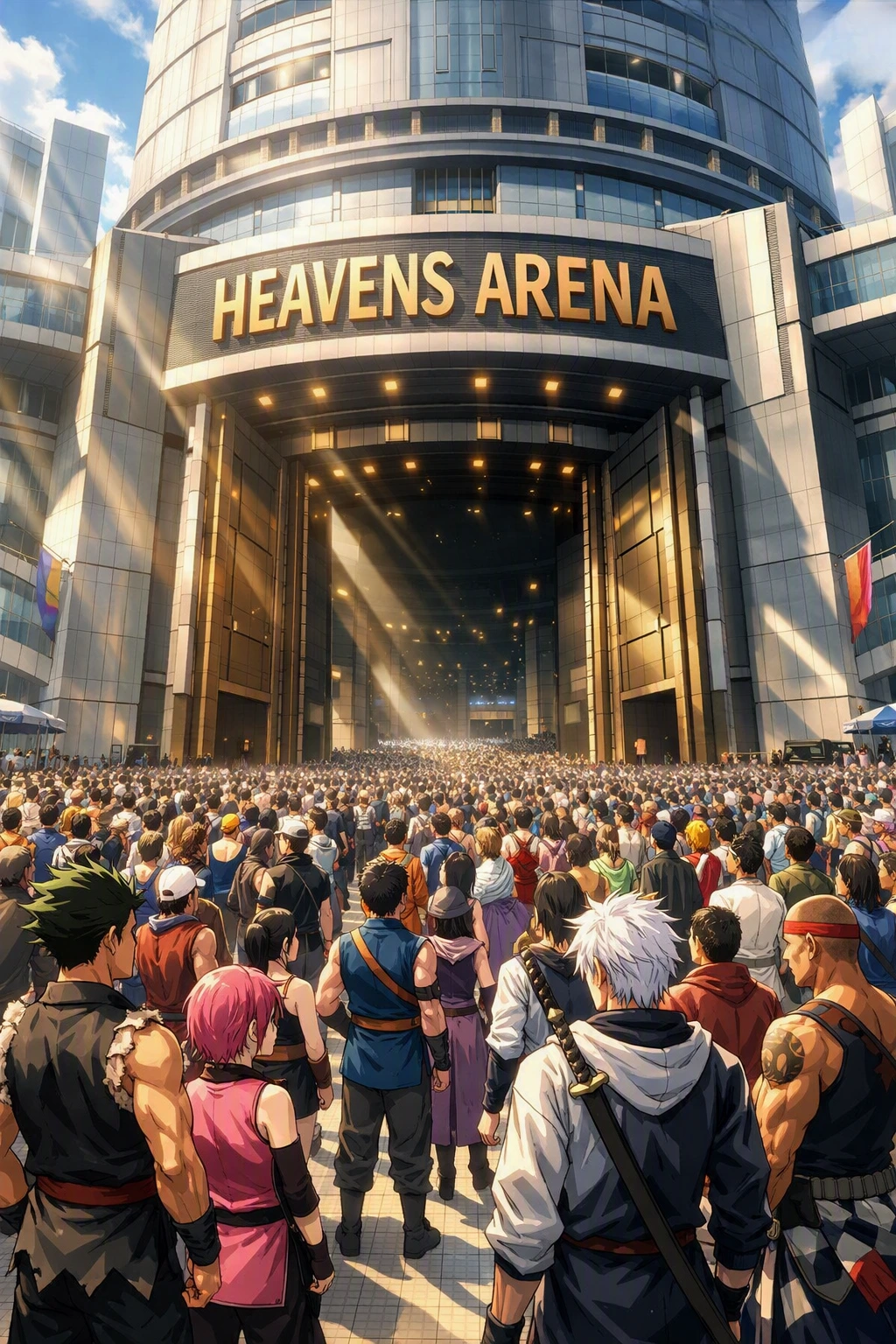
Rising piercingly into the sky above the bustling metropolis of the Republic of Padokea, the Heavens Arena is not merely a building; it is a monument to humanity’s primal fascination with combat, ambition, and the absolute limits of physical prowess. Standing at an awe-inspiring 3,214 feet (991 meters) tall and boasting 251 floors, it is the fourth tallest building in the Hunter x Hunter universe and the undisputed global mecca of martial arts.
Every single day, a staggering 4,000 challengers from across the world flock to its massive entrance doors. They arrive carrying dreams of unimaginable wealth, worldwide fame, or simply the desperate desire to test the honed steel of their bodies against the strongest fighters the globe has to offer. It is a towering colosseum for the modern age, a vertical city dedicated entirely to the art of fighting.
However, beneath the gleaming facade of athletic competition lies a brilliantly orchestrated system of gamification. The Heavens Arena is a perfectly tuned micro-economy that fundamentally monetizes human conflict. It transforms raw violence, bloodshed, and martial arts mastery into mass entertainment, broadcasting it to millions of viewers and fueling an underground and above-ground gambling syndicate of astronomical proportions.
Every drop of sweat, every shattered bone, and every spectacular knockout is converted into capital. The arena operates as an independent city-state of commerce, complete with its own massive stadiums, luxury accommodations, ticketing bureaus, and broadcasting networks. It thrives on the constant influx of hopeful amateurs at the bottom and the terrifying, god-like spectacles provided by the masters at the top. The house always wins because the product they are selling—human struggle—is inherently infinite.
From a narrative standpoint in Yoshihiro Togashi’s masterpiece, the Heavens Arena arc serves as the most crucial stepping stone in the entire series. For the young protagonists, Gon Freecss and Killua Zoldyck, the tower serves dual purposes.
Initially, it acts as a highly lucrative training ground, a place where Gon can earn enough money to repay his debt to Hisoka while simultaneously sharpening his combat instincts, and where Killua can indulge in a familiar, nostalgic playground of violence. But more importantly, the Heavens Arena is the harsh, unforgiving transition point where the veil of the normal world is violently torn away.
It is here that the true, supernatural power system of Hunter x Hunter—Nen—is formally introduced. The arena transitions from a simple fighting tournament into a horrifying crucible that separates ordinary humans from awakened monsters, forcing Gon and Killua to confront a reality far more complex, dangerous, and esoteric than anything they encountered during the Hunter Exam.
Floors 1-199: The Economy of the Amateurs
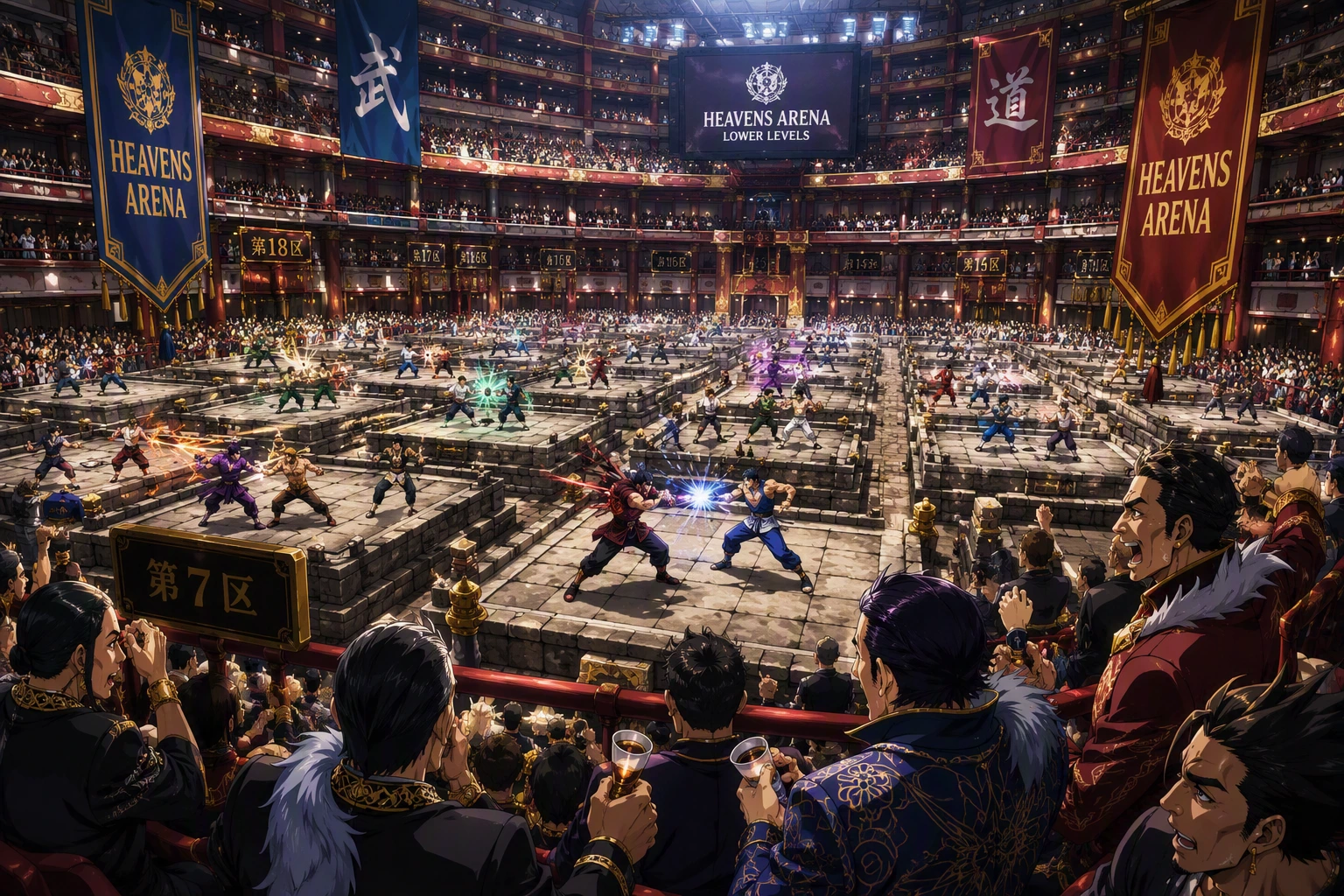
The ascent of Heavens Arena is governed by a rigidly structured, highly bureaucratic tier system that serves to filter out the weak with brutal efficiency. The progression is divided into ten-floor increments, creating a linear scale of difficulty that rapidly separates casual brawlers from seasoned killers. A fighter’s journey begins on the massive, chaotic first floor, a sprawling gymnasium where dozens of rings operate simultaneously.
Here, fighters are given a mere three minutes to demonstrate their worth. A referee evaluates their striking power, technique, and defensive capabilities, instantly assigning them to a floor that matches their estimated skill level. From there, the climb is grueling.
A victory advances a fighter to the next ten-floor bracket (e.g., from floor 50 to 60), while a loss results in immediate demotion or, in the case of severe injury, an unceremonious exit from the tower. This linear scaling requires fighters to adapt rapidly; the margin for error shrinks exponentially with every ten floors ascended.
Tied directly to this progression is the arena’s fascinating, inherently capitalistic financial ladder. Heavens Arena does not just test a fighter’s body; it actively plays on their financial desperation. The prize money structure is designed to hook challengers early and keep them climbing until they are inevitably broken. A single victory on the first floor yields a paltry 152 Jenny—an amount barely sufficient to buy a can of soda from one of the arena’s vending machines.
It is an insulting sum, yet it acts as the initial psychological hook. As fighters reach the 50th floor, the payouts increase to 50,000 Jenny. By the 100th floor, the compensation explodes into the millions (approximately 1,000,000 Jenny), fundamentally altering the socio-economic status of the victor. Reaching the 150th floor yields payouts in the tens of millions, and cracking the 190th floor grants staggering wealth pushing 200,000,000 Jenny.
Furthermore, upon reaching the 100th floor, fighters are granted their own private luxury rooms, transitioning from nameless challengers in a locker room to pampered athletes. This economic ladder guarantees a constant stream of fresh blood, as poor fighters risk their lives for a chance at vertical mobility.
The fighters inhabiting these first 199 floors represent the absolute baseline of the human peak. Before the introduction of Nen, this is what the apex of human biology and martial training looks like. We see a diverse array of combatants: gigantic sumo wrestlers, lightning-fast kickboxers, masters of obscure weaponry, and seasoned assassins.
Characters like the young martial arts prodigy Zushi demonstrate the incredible discipline required to ascend these ranks, while average professional fighters showcase the ceiling of normal physical trauma. The lower floors are a testament to human limits; they establish the “normal” laws of physics and biology in the Hunter x Hunter world.
When Gon easily pushes massive men out of the ring without striking, or when Killua effortlessly chops a man’s neck with the speed of an assassin, they are demonstrating that their baseline—even without Nen—is already anomalous. The 199th floor is the final frontier of the mundane, the highest peak a human can climb before they must step into the realm of the supernatural.
Maintaining the integrity of this climb is the arena’s strict ticket system and rigid rules of advancement and demotion. The arena’s bureaucracy is cold and uncompromising. Fighters are given a set time limit to schedule their matches. Failure to fight results in forfeiture and demotion. If a fighter loses a specific number of matches in a row, they are bumped down a tier, forcing them to fight their way back up for a fraction of the prize money.
This ensures that only the most consistently dominant, physically resilient, and adaptable fighters survive the climb. It prevents flukes and lucky strikes from carrying a weak fighter to the upper echelons. The bureaucracy of the lower floors is a relentless sorting machine, chewing up the inadequate and spitting out a highly refined concentration of peak human athletes, all unknowingly marching toward the invisible, terrifying wall that awaits them on the 200th floor.
The 200th Floor: The Invisible Wall
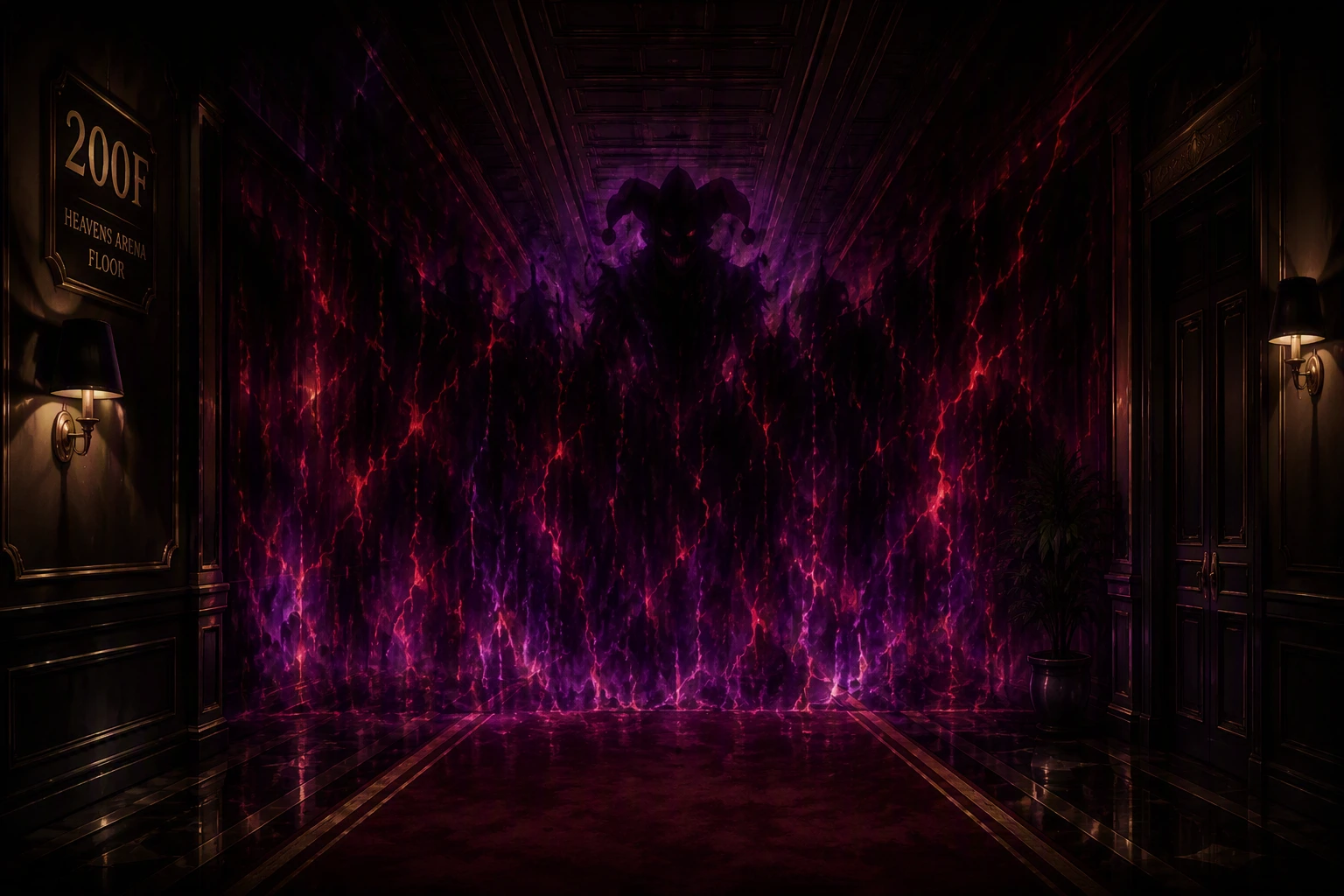
Stepping off the elevator onto the 200th floor of the Heavens Arena is akin to stepping onto a different planet. The roaring crowds, the flashy scoreboards, and the smell of cheap concessions vanish, replaced by an oppressive, suffocating silence and a deeply unsettling atmosphere. This is the domain of the invisible wall, the brutal threshold where the realm of mundane martial arts ends and the esoteric, terrifying world of Nen begins.
The gatekeeper to this new reality for Gon and Killua is none other than the murderous magician, Hisoka Morow. As the two prodigies attempt to walk down the hallway to register for their fights, they are physically stopped by an impenetrable barrier of malicious Ren—a manifestation of Hisoka’s bloodlust and raw aura. This invisible wall acts as a lethal, unwritten filter.
It is an evolutionary bottleneck. It physically prevents normal martial artists from progressing, crushing their spirits and bodies with an overwhelming pressure that triggers humanity’s most primal fight-or-flight instincts. Hisoka’s wall is a warning: to walk this floor without the shield of Nen is to invite certain death.
For those unfortunate enough to cross this threshold without the proper training or a protective mentor like Wing, the result is a horrifying phenomenon known as the “Baptism by Fire” (or Geho in the series’ terminology). Because Nen is the manipulation of life energy, a direct attack infused with aura against an unprotected body is devastating. The “initiations” carried out by existing 200th-floor fighters against ignorant newcomers are not matches; they are executions.
When an unprotected fighter is struck by Nen, it can result in permanent physical mutilation, severed limbs, shattered spines, and total psychological destruction. Even worse, surviving such an attack forcefully and dangerously rips open the victim’s Aura Nodes—the pores through which life energy flows.
While this can awaken one’s ability to use Nen, it does so in a chaotic, hemorrhaging manner that will quickly drain the victim of their life force, resulting in death by exhaustion if they do not learn to control it immediately. The 200th floor is littered with the broken bodies and shattered minds of champions who thought their mundane strength was enough.
Accompanying this sheer escalation in danger is a fundamental shift in the arena’s stakes and rule structure. The capitalistic allure of the lower floors vanishes entirely. On the 200th floor, there is absolutely no prize money. The millions of Jenny that drove fighters up the tower are replaced by a pursuit of pure prestige, lethal pride, and the ultimate right to challenge for Floor Master status.
Weapons of all kinds are suddenly permitted, transforming standard boxing matches into deadly gladiatorial combat. Furthermore, the implicit allowance of killing—so long as it falls within the parameters of the point system or a knockout—changes the psychology of the fighters. They are no longer athletes fighting for a paycheck; they are supernatural warriors fighting for their lives, testing their newly awakened Hatsu (special abilities) in a legally sanctioned death ring. The absence of money purifies the violence, stripping it down to raw ego and survival.
This lawless ecosystem breeds a specific, parasitic type of combatant: the Rookie Crushers. A deep dive into predators like Gido, Riehlvelt, and Sadaso reveals the tragic and pathetic underbelly of the 200th floor. These three men are victims of the Baptism by Fire themselves—Gido lost his legs, Riehlvelt is confined to a wheelchair, and Sadaso lost his arm and part of his face.
Instead of leaving the arena, they stayed, developing highly specialized, albeit mediocre, Nen abilities (like Gido’s spinning tops or Riehlvelt’s aura-infused whips). They represent the stagnant middle-class of Nen users. Because they lack the immense talent or drive to actually challenge the Floor Masters, they maintain their artificial status, lavish lifestyle, and fragile egos by explicitly targeting newly initiated, naive fighters.
They exploit the 90-day registration rules, using intimidation, kidnapping, and psychological warfare to force rookies into matches before they can learn to defend themselves against Nen. They are the ultimate bullies, using the very trauma that broke them to break others, illustrating how the Heavens Arena’s lack of regulation on the upper floors rewards predatory, sociopathic behavior.
The Combat Mechanics and Point System
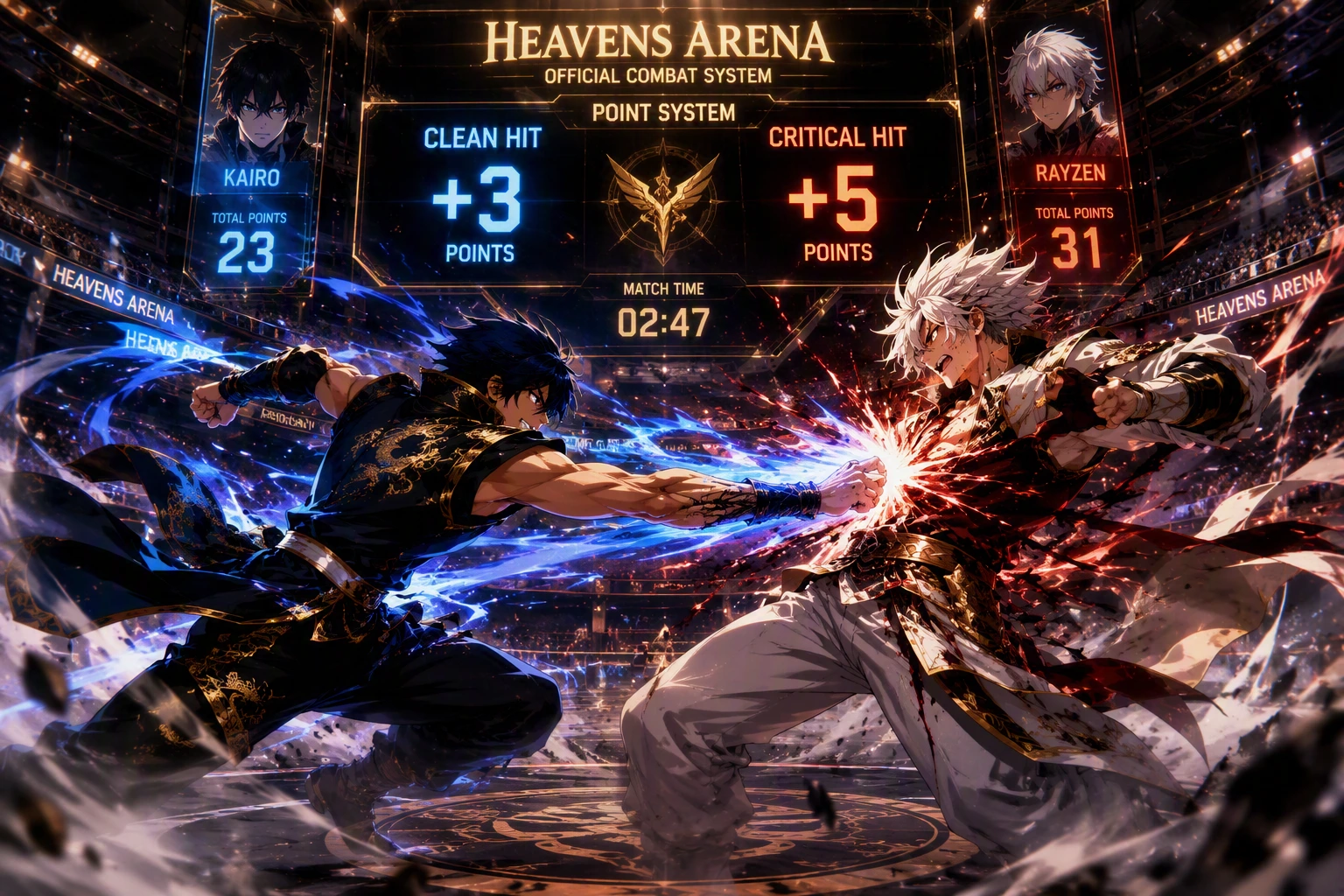
Despite the supernatural chaos that reigns on the 200th floor, the violence is still technically governed by a strict, mathematical scoring system. Heavens Arena is, at its core, a spectator sport, and the audience requires a metric to understand the flow of the battle.
The mathematics of victory are absolute, determined by highly trained referees whose eyes are sharp enough to track the blinding speed of Nen-enhanced combat. The scoring is broken down into three distinct categories. A “Clean Hit” is awarded when a fighter lands an attack with excellent technique, precision, and noticeable damage, granting 1 point.
A “Critical Hit” is a rarer, more devastating variation, awarded for an attack that displays exceptional timing, overwhelming power, and inflicts severe damage or turns the tide of the battle, granting 2 points. Finally, a “Down” is called when a fighter is knocked to the floor and cannot immediately rise, granting their opponent 1 point, similar to a knockdown in traditional boxing, accompanied by a standard referee count.
Winning a match on the 200th floor requires a fighter to navigate these conditions strategically. A combatant achieves a Technical Knockout (TKO) the moment they accumulate 10 points. Alternatively, an outright Knockout (KO) occurs if an opponent is rendered completely unconscious or unable to stand before the referee’s ten-count, rendering points entirely moot. This duality in winning conditions creates fascinating tactical differences among the fighters.
Some combatants are pure “point fighters,” relying on speed, evasion, and quick, technical strikes to rapidly rack up Clean Hits and Downs, winning via a 10-point TKO without necessarily risking a close-quarters brawl. Others, like Hisoka or the phantom assassins, are “killers.”
They care very little for the point system, using it only to gauge their opponent or toy with them, constantly seeking the singular, lethal blow that will secure a KO or a death. A fighter might be losing 9-0 on the scoreboard, but if their Hatsu allows for a one-hit assassination technique, the math becomes instantly irrelevant.
Adding an intense layer of strategy and tension to the point system is the strict 90-day window. Upon registering on the 200th floor, a fighter is given exactly 90 days to prepare for, schedule, and fight their next match. Once a fight concludes, a new 90-day countdown begins. If a fighter fails to participate in a match within this window, they are disqualified and permanently banned from the 200th floor.
This scheduling system is heavily manipulated by strategic combatants. Smart fighters use this time to meticulously heal from the brutal injuries sustained in Nen combat. More importantly, it provides a crucial window for reconnaissance. Because Nen abilities (Hatsu) are highly secretive and uniquely lethal, rushing into a fight blind is suicidal.
Fighters use their 90 days to spy on potential opponents, analyze the intricate rules of their enemy’s Hatsu, and develop tailored counter-strategies. Conversely, manipulators like the Rookie Crushers use the window to corner vulnerable opponents, waiting until the final days of a rookie’s deadline to force a match, knowing the rookie must either fight unprepared or face a lifetime ban. The 90-day window ensures that the battle begins long before the fighters actually step into the ring.
The Floor Masters and Battle Olympia

Ascending past the horrors and point-grinding of the 200th floor brings a fighter to the absolute zenith of the Heavens Arena hierarchy: the Floor Masters. Spanning floors 230 through 250, there are exactly 21 Floor Masters at any given time.
Earning this title requires a fighter to achieve ten victories on the 200th floor before suffering four defeats. These 21 individuals are the elite of the elite, standing as the undisputed kings of this vertical city. They are not merely fighters; they are celebrities, tactical geniuses, and masters of Nen who possess abilities so devastating or complex that they have completely transcended the petty squabbles of the lower floors.
Their Nen mastery is immense, often rivaling or exceeding that of highly ranked, licensed Hunters. The authority they wield within the arena is supreme; they are untouchable deities in the eyes of the millions who watch their matches.
The ultimate goal for any Floor Master, and the absolute pinnacle of combat sports within the Hunter x Hunter universe, is the Battle Olympia. Held biennially on the staggering 251st floor—the very top of the Heavens Arena—this grand tournament is an invite-only spectacle where the Floor Masters compete against one another in a clash of titans.
The Battle Olympia is essentially the Super Bowl, World Cup, and Olympics of martial arts combined into one hyper-violent, world-stopping broadcast. While Togashi has kept the full details of this tournament shrouded in mystery, its narrative weight is immense.
The winner of the Battle Olympia is not just given money or a title; they are awarded the entire 251st floor for themselves, effectively becoming the reigning monarch of the world’s most famous building. It is a spectacle of such high level that it is presumed only the absolute strongest Nen users on the planet could even hope to survive the opening rounds.
The perks of power associated with being a Floor Master extend far beyond the arena walls. The luxury afforded to them is boundless—sprawling penthouses, unlimited resources, and every worldly desire catered to by the arena’s administration. But more importantly, the title brings massive political influence and global recognition.
In the public eye, Floor Masters are often elevated above standard members of the Hunter Association. While Hunters operate in the shadows, taking on dangerous, classified missions, Floor Masters are highly visible superstars.
Their faces are plastered on billboards, their matches break global viewing records, and their influence can sway economies and local governments. Achieving Floor Master status grants a level of systemic privilege and societal worship that turns a martial artist into an untouchable global icon, perfectly illustrating the Hunter x Hunter world’s deep-seated reverence for supreme, undeniable power.
Case Study: The Ultimate Deathmatch
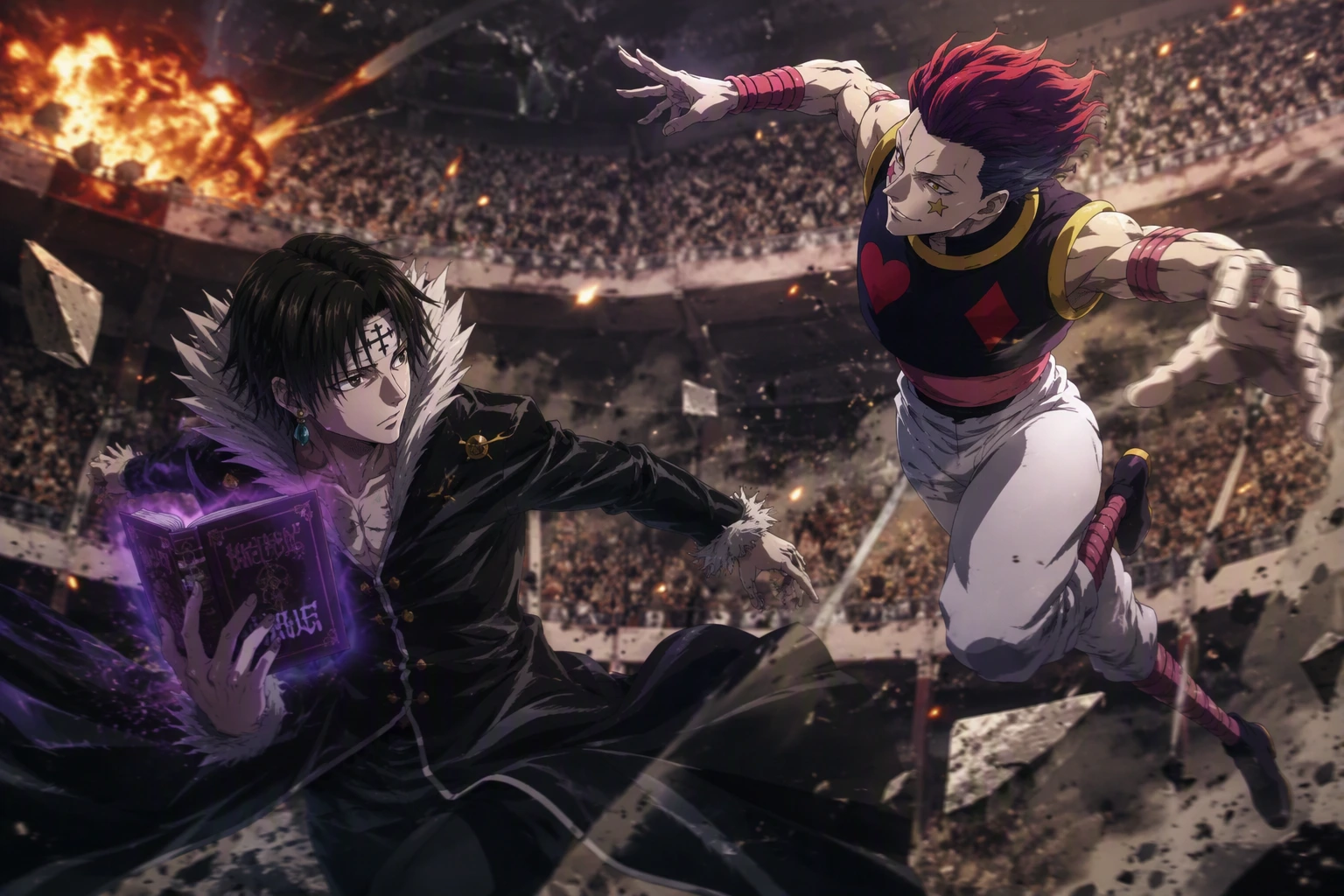
To truly understand the absolute peak of Heavens Arena combat, one must analyze the tactical masterpiece and utter bloodbath that was the fight between Chrollo Lucilfer and Hisoka Morow. This highly anticipated clash was years in the making. Chrollo, the enigmatic and lethal leader of the Phantom Troupe, accepted Hisoka’s challenge after regaining his Nen, doing so under the guise of his status as a Heavens Arena Floor Master.
Unlike standard 200th-floor matches, this was officially declared a deathmatch. The referee confirmed the conditions: the fight would only end when one combatant was dead. This entirely negated the 10-point TKO system, stripping away the safety nets of standard arena rules and turning a heavily regulated sporting event into a lawless slaughterhouse.
What elevates this fight to a masterclass in Nen combat is how Chrollo weaponized the environment itself. Chrollo did not just fight Hisoka; he fought Hisoka using the Heavens Arena as his primary weapon. Recognizing Hisoka’s incredible proficiency in one-on-one melee combat and his unpredictable Bungee Gum, Chrollo opted for a strategy of overwhelming, indirect chaos.
He utilized his Hatsu, Skill Hunter (a book that allows him to steal and use others’ abilities), in conjunction with a newly acquired bookmark that allowed him to use two stolen abilities simultaneously. Chrollo unleashed a flawlessly executed, multi-layered Nen strategy using five distinct abilities: Sun and Moon (placing explosive seals), Gallery Fake (creating perfect inanimate copies), Order Stamp (controlling those copies), Black Voice (manipulating living humans via cell phone antennas), and Convert Hands (swapping physical appearances).
Chrollo’s genius lay in utilizing the dense crowd of spectators and the physical architecture of the stadium. He seamlessly blended into the massive audience, using Black Voice to take control of random spectators, including the referee, turning them into suicidal attackers.
When Hisoka easily dispatched them, Chrollo escalated. He used Gallery Fake to mass-produce hundreds of copies of the audience members, stamped them with Order Stamp with the simple command to “break Hisoka,” and, most horrifyingly, affixed Sun and Moon explosive seals to the puppets.
Because Sun and Moon creates explosives that do not disappear even if the original Hatsu is deactivated, Chrollo created an unstoppable, self-sustaining army of suicide bombers. The massive Heavens Arena crowd, usually the lifeblood of the economy, was transformed into an endless supply of ammunition and meat shields.
This deathmatch subverted every rule the Heavens Arena stood for. The referee was murdered early on. The point system was rendered a joke as the stadium literally began to explode. The safety of the audience, usually paramount in a televised sporting event, was completely disregarded as Chrollo blew up sections of the seating to corner the murderous clown.
The match culminated in Hisoka being overwhelmed by a swarm of exploding human puppets, his body blasted apart, resulting in his temporary death (before his own Nen resurrected him). This fight stands as the ultimate case study of the Heavens Arena: it proves that at the absolute highest levels of Nen mastery, the rules, the arena, and the spectators are all just variables to be manipulated in a brutal game of survival and intellect.
Conclusion: The Ultimate Training Ground
Ultimately, the Heavens Arena arc functions as the perfect crucible for power-scaling within the Hunter x Hunter series. By establishing a rigid, 251-floor hierarchy, Togashi gave the audience a tangible, easily digestible metric for strength. We watched Gon and Killua easily conquer the pinnacle of normal humanity on the 199th floor, only to be utterly humbled by the entry-level supernatural horrors of the 200th.
The arena provided a contained, logically structured environment to introduce the staggeringly complex rules of Nen—Ten, Zetsu, Ren, and Hatsu—without overwhelming the reader. It transformed abstract concepts of aura into measurable combat mechanics, perfectly bridging the gap between the whimsical trials of the Hunter Exam and the dark, lethal realities of the broader world.
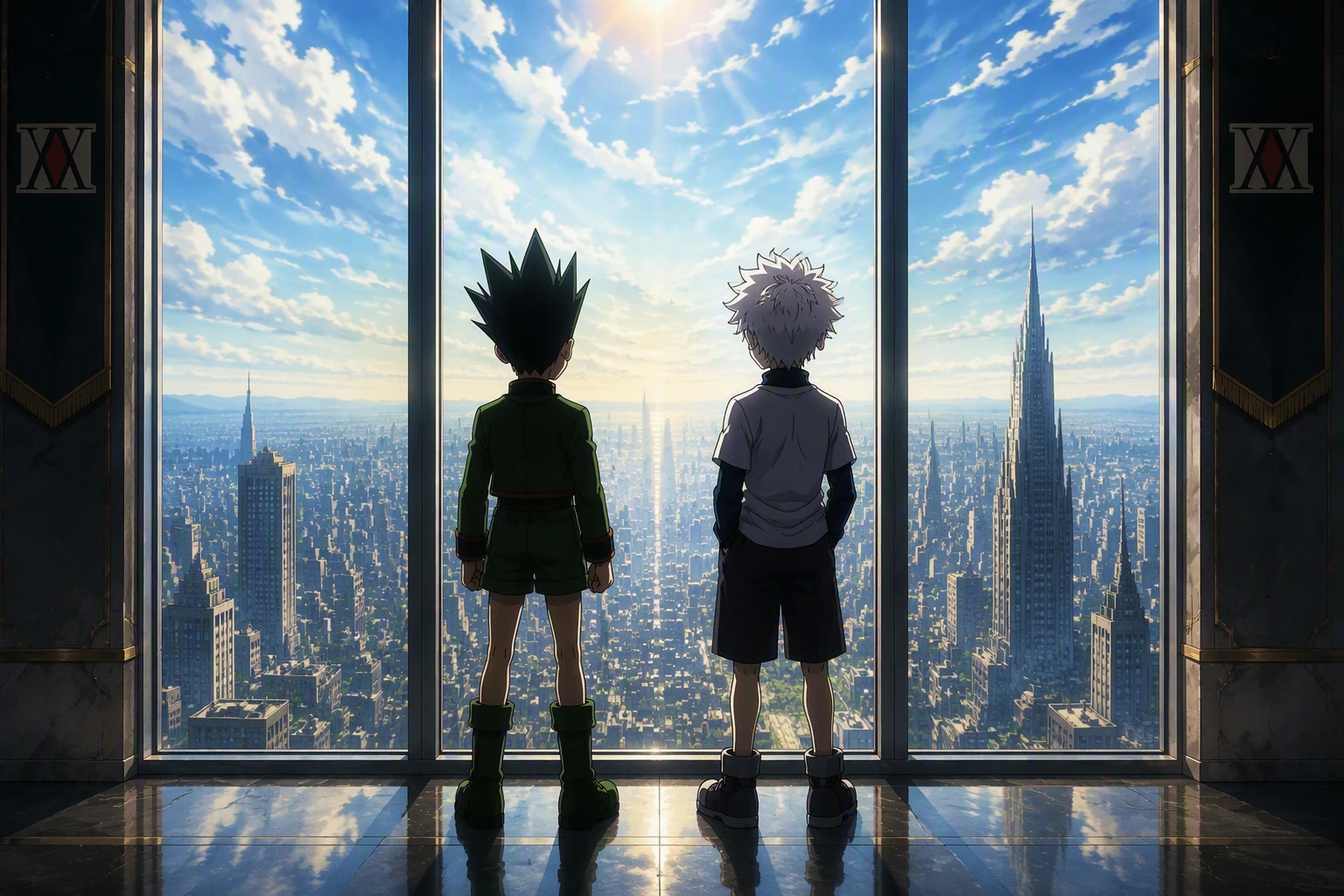
Mastering the Heavens Arena’s ecosystem was not just about earning money or learning to fight; it proved Gon and Killua’s readiness to face the true, unregulated horrors of the Hunter x Hunter universe. By conquering the Baptism by Fire, defeating the parasitic Rookie Crushers, and holding their own against established masters like Hisoka, the boys graduated from talented children into legitimate, lethal Hunters.
The lessons learned in the tower—aura management, tactical analysis, and the psychological fortitude required to face malicious intent without flinching—were the precise tools they needed to survive their impending encounters with the sociopathic murderers of the Phantom Troupe in Yorknew City and the lethal, high-stakes game of Greed Island. The Heavens Arena did not just teach them how to punch harder; it taught them how to survive in a world where power is absolute and the rules are written in blood.