
I. Introduction: The Ultimate Nen Construct
The Virtual Reality Myth
Within the universe of Hunter x Hunter, Greed Island is widely regarded as a mythical, impossibly rare video game. To the general public, collectors, and even the vast majority of professional Hunters, it is perceived as the ultimate virtual reality experience—an exclusive, esoteric piece of software played on the Joystation console.
This grand illusion is a testament to the game’s flawless design, but it is fundamentally a lie. Dispelling this in-universe misconception reveals the terrifying and awe-inspiring truth: Greed Island is not a digital environment, nor does it consist of pixels, code, or virtual servers.
It is a tangible, physical location existing in the real world. Specifically, it is situated on an isolated island located due east of the Yorbian continent. When players "log in," their physical bodies are not left comatose in front of a screen like traditional Isekai or virtual reality tropes; rather, they are physically teleported across the globe to this isolated landmass.
Every monster they fight, every meal they eat, and every fatal blow they take is entirely, physically real. This geographical isolation is protected not by digital firewalls, but by complex, island-wide Nen barriers and the sheer physical distance from mainland civilization, making it a masterpiece of misdirection.
The Architects (G.I.)
The creation of such a monumental undertaking was not the work of a single game developer or a tech corporation, but the collaborative genius of Ging Freecss and his hand-picked team of eleven elite Hunters. The name "GREED ISLAND" is an acronym derived from the first letters of the names of these founding creators (Ging, Razor, Elena, Eta, Dwun, etc.).
These architects were not programmers in the traditional sense; they were masters of Nen. By combining their distinct Nen affinities—spanning Conjuration, Emission, Manipulation, and Enhancement—they wove together a massive, autonomous, island-wide system. The rules of the game are enforced not by binary code, but by absolute Nen contracts and conditions.
The creators effectively localized a massive, shared Hatsu over the entire island, creating an ecosystem where the laws of physics are seamlessly blended with the rigid, unbreakable rules of their collective Nen design. This collaborative effort represents one of the most astonishing feats of Nen mastery ever recorded in the series, operating continuously for over a decade without degradation.
The Barrier of Entry

Accessing Greed Island is designed to be an insurmountable hurdle for the unworthy. The barrier of entry is threefold: financial, technological, and spiritual. First is the astronomical financial cost. With only 100 copies of the game ever produced, the scarcity drove the market price into the tens of billions of Jenny.
This necessitated the involvement of billionaire sponsors, most notably the tycoon Battera, who monopolized the market by purchasing almost every available copy and console, hiring private armies of Hunters to clear the game for his own desperate ends. Second, the hardware itself—the Joystation and the specific memory cards—acted as physical keys that were incredibly difficult to track down.
However, the true, ultimate barrier is the requirement of Nen proficiency. A normal human cannot simply plug in a controller and press start. To boot up the hardware, a prospective player must channel their aura, specifically using the application of Hatsu, directly into the console. The game actively filters out non-Nen users, acting as an elite gateway that ensures only those capable of surviving the island's brutal reality are allowed to step foot on it. It is a lethal examination disguised as consumer electronics.
II. The Hardware and Transportation Protocols
The Console and The Ring
The physical architecture required to interface with Greed Island is deceptively mundane, yet intricately bound by Nen. The system utilizes a standard Joystation console and a specialized Greed Island memory card. However, these items serve merely as the binding contract for a much larger supernatural transaction. When a player successfully interfaces with the system, they are materialized at the starting point wearing a specialized Ring.
This Ring is the most crucial piece of hardware in the player's arsenal; it is not merely a cosmetic accessory, but the player's permanent tether to the game's operating system. The Ring acts as a conduit for the player's Nen, a storage device for their progress, and the physical anchor that allows them to interact with the island's unique card-based physics.
Without the Ring, a player cannot summon their binder, use spell cards, or even properly log out. It is a materialized Nen construct that functions as a supernatural smart-device, continuously syncing the player's biological signature with the island's overarching administrative network.
Nen Ignition
The initiation process of Greed Island completely bypasses traditional electronic inputs. The console does not read button presses on a controller to start the game; it reads life energy. This process, which can be termed "Nen Ignition," requires the user to project their Hatsu into the console. This acts as a biometric security measure of the highest order.
The console evaluates the presence and quality of the user's aura. If the aura is sufficient, the system accepts the user as a "Player." This built-in filter is brilliant because the island itself is saturated with lethal Nen beasts, criminal elements, and hostile players. By requiring Hatsu to even turn the machine on, Ging and his team ensured that no ordinary civilians could accidentally stumble into a death trap.
Furthermore, the specific nature of the aura channeled into the console is logged, effectively creating a unique player ID based on their Nen signature, which is then used by the system to track their progress, card ownership, and physical location on the island.
Elena and Eta's Gatekeeping
The actual transportation of the player's physical body from the real world to Greed Island is a marvel of Emission and teleportation mechanics, primarily managed by the twin Game Masters, Elena and Eta. When the Nen Ignition is successful, the console acts as a targeted relay. The player's body is instantly teleported across the world to the island's arrival chamber.
Elena handles players entering the game, while Eta manages those exiting. This is not a simple portal; it is a highly complex Emission technique that perfectly tracks, transports, and logs players upon entry and exit. When a player arrives, Elena's system imprints them with the rules, binds the Ring to their aura, and registers them in the active player database.
When a player chooses to leave (using a specific Leave card or reaching a designated exit point), Eta reverses the process, safely transporting their physical body back to the exact physical Joystation they logged in from. This flawless gatekeeping ensures that no one can smuggle unauthorized items on or off the island, as the Emission network strictly filters out anything that does not comply with the game's strict inventory parameters.
The Death Penalty

Perhaps the most sobering mechanic of Greed Island is its approach to player mortality. Because the game is not virtual, the safety nets traditionally associated with gaming do not exist. There are no extra lives, no respawn points, and no loaded save files to undo a fatal mistake.
The harsh reality of the transportation protocol is that dying in the game means dying in the real world. If a player is killed by a monster, executed by a rogue NPC, or murdered by a rival player, their physical body ceases to function. Their Ring drops to the ground, their binder dissolves, and their life is permanently extinguished. This absolute permanence strips away the psychological comfort of traditional gaming, replacing it with sheer, visceral terror.
The stakes instantly transform Greed Island from a whimsical adventure into a ruthless survival scenario. This mechanic forces players to operate with extreme caution, often leading to paranoia, betrayal, and the formation of heavily guarded syndicates, as every encounter on the island carries the very real threat of permanent annihilation.
III. The Binder and The Card System
Summoning the System
At the core of Greed Island's gameplay loop is the Binder, an intricate, indestructible menu system manipulated entirely through vocal commands and Nen interaction. To access their inventory, a player must simply raise their hand wearing the Ring and issue the vocal command, "Book!" This trigger word channels a minute amount of the player's aura through the Ring, prompting the system to manifest the Binder out of thin air.
The Binder is a masterpiece of Conjuration. Unlike a physical book that can be torn, burned, or stolen by conventional means, the Binder is an unbreakable Conjured construct tied directly and exclusively to the specific player's Ring and Nen signature. Only the owner can open it, and it cannot be forcefully taken.
It serves as a visual UI (User Interface) brought into the physical world, organizing the player's progression, wealth, and arsenal. It represents the absolute fusion of RPG inventory mechanics with high-level Hunter x Hunter Nen applications, providing a seamless, real-time method to interact with the island's complex economy.
Inventory Management
The internal architecture of the Binder is strictly divided into two distinct sections, enforcing rigid tactical inventory limitations upon the player. The primary section consists of the 100 Specified Slots, numbered 000 to 099. These slots are exclusively reserved for the 100 specific items and phenomena required to clear the game.
A Specified Slot will only accept its corresponding numbered card. The secondary section consists of 45 Unspecified Slots (often referred to as free storage). These slots can hold any card in the game—duplicate Specified cards, spell cards, food, weapons, or generic items.
This seemingly simple division creates a profoundly deep system of inventory management. Because players need to collect 100 specific cards to win, but only have 45 free slots to hold tools, spells, and trade fodder, they are constantly forced to make agonizing choices.
A player cannot simply hoard infinite spell cards for defense; every spell card kept is a slot that cannot be used for trading or holding a duplicate rare card. This restriction actively punishes hoarders and forces dynamic gameplay, requiring players to constantly cycle their inventory, trade actively, and carefully calculate the exact ratio of offensive, defensive, and utility cards they need to survive.
The One-Minute Rule

One of the most defining and strictly enforced laws of Greed Island's physics is the physical-to-card conversion system, governed by the infamous "One-Minute Rule." On the island, almost every item of value—from a loaf of bread bought in a town to a magical sword dropped by a monster—initially exists as a physical object. The moment a player picks up or claims one of these items, it instantly and magically transforms into a standardized card, complete with a rank, title, and description.
However, this conversion is highly volatile. Once an item becomes a card, the player has exactly 60 seconds to place it safely into either a Specified or Unspecified slot within their Binder. If they fail to do so, or if they drop the card, the card permanently reverts to its physical, original form. Crucially, once an item has reverted from a card back into a physical object, it can never be turned into a card again.
It permanently loses its data properties. Similarly, if a player uses the vocal command "Gain" to materialize a card from their Binder into the physical world (to eat a piece of food or wield a weapon), that item can never be re-carded. This rule dictates the pace of looting, the urgency of post-battle recovery, and prevents players from simply dropping piles of cards on the floor; it demands constant, immediate interaction with the Binder system.
Card Limits and Rarity
The economic genius of Greed Island lies in its implementation of the "Maximum Issuance Limit," a system that creates artificial scarcity and drives the entire geopolitical landscape of the game. Every single card in the game, from the lowest H-rank junk to the mythical SS-rank treasures, has a hard-coded limit on how many copies can exist in the game at any given time. For example, a common card might have an issuance limit of 10,000, meaning it is easily found. However, a highly coveted S-rank card like "Breath of Archangel" might have a limit of only 3.
If three players already have "Breath of Archangel" in their Binders, the card will simply stop spawning in the world. Even if another player completes the excruciatingly difficult quest required to earn it, they will receive a useless, physical dud instead of the card. This mechanic forces a cutthroat, player-versus-player hoarding economy.
To obtain a card that has hit its maximum issuance limit, a player must either convince a current owner to trade it, steal it using spell cards, or physically murder the owner (which causes their Ring to deactivate and their cards to be erased from the system, freeing up the issuance limit). This system transforms a simple collection quest into a brutal, high-stakes game of monopoly, where information regarding who holds what card is more valuable than gold.
IV. Spell Card Meta and Psychological Warfare
The 40 Spell Cards
While physical Nen combat (like Jajanken or Lightning) is a constant threat, the true warfare of Greed Island is fought entirely through the Binder. This is the domain of the Spell Card Meta, an exclusive arsenal of 40 specific spell cards used for PvP (Player versus Player) interactions, thievery, and map traversal.
These spells are generated and distributed through specialized shops in cities like Masadora, or obtained through specific packs. The spell cards effectively level the playing field; a physically weak player armed with the right spells can outmaneuver, rob, and absolutely devastate a physically superior combatant.
The meta revolves entirely around anticipating the opponent's binder composition, baiting out their spells, and managing one's own limited Unspecified slots. Mastery of the 40 spell cards is the absolute prerequisite for surviving the mid-to-late stages of Greed Island, shifting the genre of the game from an action-RPG to a high-speed, paranoid game of esoteric chess.
Offensive Thievery
The island's atmosphere of constant paranoia is driven largely by the varied and nuanced mechanics of offensive thievery spells. The game provides multiple ways to steal from an opponent, each with distinct tactical differences and ranges, forcing players to be hyper-vigilant.
- Thief: A close-range spell that allows a player to randomly steal one card from another player they have made physical contact with or are in immediate proximity to.
- Rob: A more advanced, targeted spell that allows the user to choose exactly which card they want to steal from a specific player, usually requiring closer range or specific targeting conditions.
- Mug: Similar to Rob but often utilized in direct confrontations, forcing a transfer of assets.
- Falsify: A devious spell used to alter the data of a card, tricking opponents during trades or sabotaging their binders.
- Pickpocket: Allows for theft without the victim receiving an immediate system notification.
These spells dictate the flow of interaction. Players will actively avoid coming within a 20-meter radius of each other for fear of being targeted by a rapid-fire Thief or Rob spell. Trust is nonexistent, as a friendly handshake can easily be a pre-condition for a devastating theft.
Defensive Counters

In a meta dominated by offensive thievery, the necessity of spell-defense is paramount. A player with a binder full of rare Specified cards but no defensive spells is merely a walking loot piñata. The system provides several defensive counters, creating a rock-paper-scissors dynamic.
- Defensive Wall: A passive spell that protects the user from the next incoming offensive spell aimed at them.
- Reflect: A highly prized card that not only blocks an incoming spell but bounces its effect back onto the caster.
- Barrier: Protects specific cards or the entire binder for a limited duration.
The crucial element of the defensive meta is the opportunity cost. Because a player only has 45 Unspecified slots, every Defensive Wall or Reflect they carry is a slot they cannot use for an Accompany card, a rare weapon, or a tradeable asset. Players must deliberately sacrifice their offensive capabilities and inventory space to ensure absolute card security, leading to meticulous inventory balancing acts.
Travel and Trajectory
Physical travel on Greed Island—walking or running—is essentially a death sentence for a competitive player. It is too slow, exposes the player to monster ambushes, and leaves them vulnerable to roaming PK (Player Killer) squads. The strategic supremacy of the game belongs to two specific traversal spell cards: Accompany and Magnetic Force.
- Magnetic Force: This spell teleports the user (and only the user) to the location of a specific, previously visited city or landmark. It is essential for navigating the macro-map and completing quests efficiently.
- Accompany: This is arguably the most powerful tactical card in the game. It teleports the user—and anyone physically touching them—to the current location of a specific player they have previously met (registered in their Binder's contact list).
These two cards dictate the flow of combat, evasion, and team dynamics. Accompany allows a coordinated team to instantly ambush a target from across the island, turning a 1v1 fight into a 5v1 slaughter in seconds. Conversely, a well-timed Magnetic Force acts as an instant emergency escape hatch. Controlling the supply of these travel cards is equivalent to controlling the airspace in modern warfare.
The Meta Game
When the mechanics of the Binder, Issuance Limits, and Spell Cards combine, they give birth to "The Meta Game"—a layer of psychological warfare far more complex and lethal than physical Nen combat. Brute strength means nothing if an opponent can teleport away, steal your victory condition remotely, or monopolize the cards you need. The meta game revolves around alliances, monopolies, and information brokering. Syndicates form to pool resources, collectively holding enough defensive spells to protect a central "binder holder."
Groups like the one led by Genthru (The Bomber) utilized the meta game perfectly. Instead of hunting for cards, they allowed others to do the work, tracking their progress, and then using a combination of Accompany, extortion, and mass murder to steal the completed binders.
Information regarding who has met whom (allowing for Accompany targeting) and who holds which restricted cards becomes the most valuable currency. Players will sell out their friends just to acquire the knowledge of a rare card's location, making Greed Island a fascinating study in game theory and the dark side of human collaboration.
V. NPCs, Quests, and the Island's Ecosystem
Nen-Constructed Life
To make Greed Island function as a living, breathing RPG world, Ging and his team had to populate it with thousands of Non-Player Characters (NPCs). Analyzing the mechanics behind these NPCs reveals a terrifying scale of Nen proficiency, primarily relying on god-tier Manipulation and Emission. These NPCs are not digital avatars; they are physical entities (often Nen beasts or highly conditioned constructs) programmed with unique dialogue trees, daily schedules, and specific reactions to player inputs.
The sheer aura capacity required to maintain thousands of these autonomous constructs simultaneously across a massive island is virtually unfathomable. Some NPCs act as simple shopkeepers in Masadora, perfectly executing the transaction of Jenny for Spell Cards.
Others are quest givers with complex conditional triggers, refusing to yield their information or items until a player performs a highly specific sequence of actions, answers riddles, or brings them exact items. The perfection of these Nen-constructed lives is so complete that many players spend years on the island entirely forgetting that the cheerful townsfolk they interact with are essentially localized, pre-programmed clumps of aura.
City Dynamics
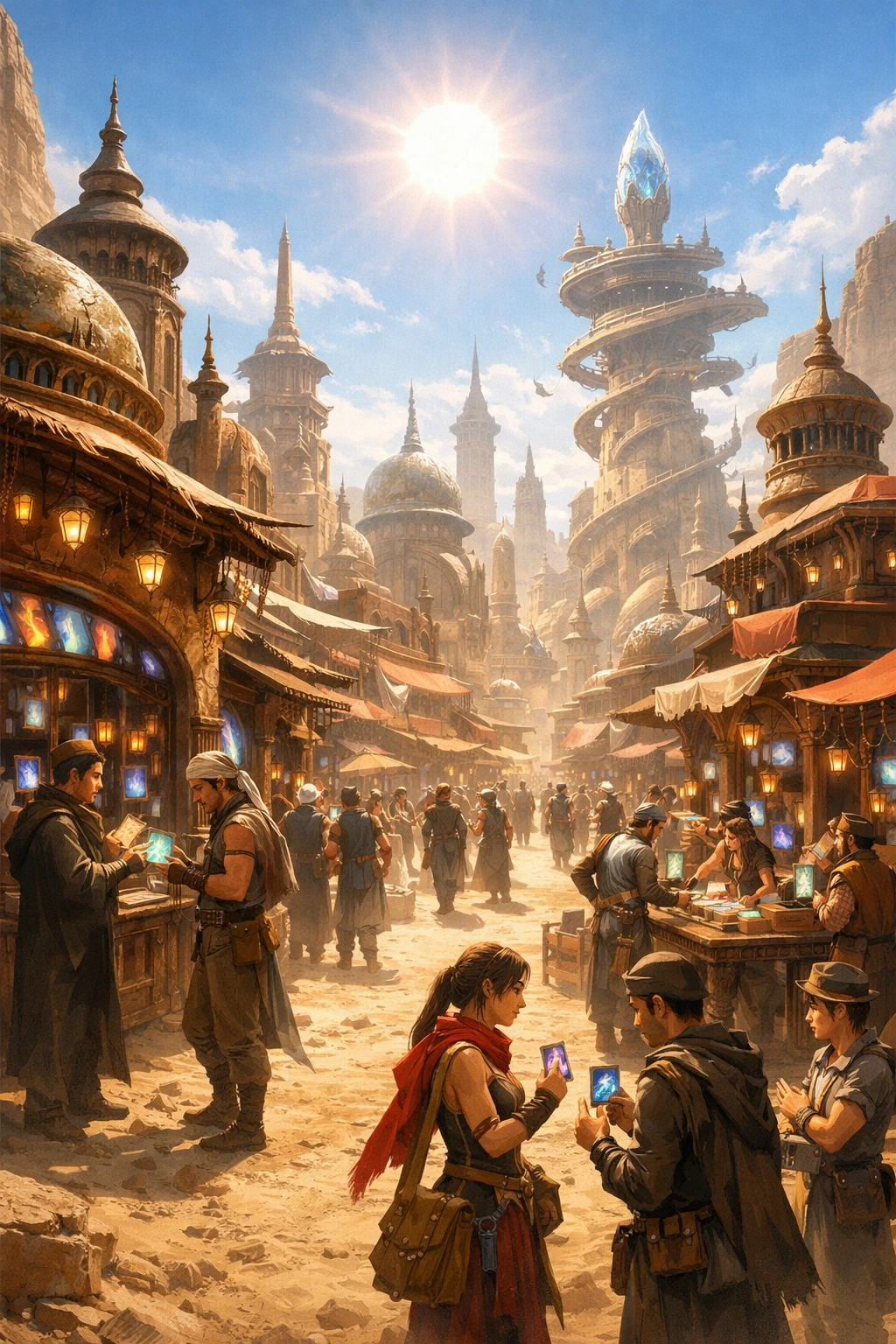
The ecosystem of Greed Island is anchored by several distinct cities, each serving highly specific economic and quest-based functions that guide player progression.
- Antokiba (The City of Prizes): This city functions as the primary introductory hub and a vital faucet for early-game rare cards. It hosts monthly tournaments featuring bizarre, specialized challenges (like rock-paper-scissors tournaments or eating contests). Winning these physical and mental trials rewards players with specific cards, making Antokiba a constant hotspot for player convergence and, consequently, a prime hunting ground for PKers.
- Masadora (The City of Magic): The absolute economic heart of the spell card meta. Masadora contains the only shops that sell the essential spell cards in booster packs. A player's ability to safely travel to and from Masadora dictates their survival, as running out of spell cards means instant vulnerability.
- Aiai (The City of Love): A bizarre, niche city heavily leaning into dating-sim tropes. It exists to distribute specific, romance-themed cards through elaborate, melodramatic questlines involving the NPCs.
These cities act as geographical anchors, forcing players to move across the map and engage with different mechanics, preventing anyone from simply hiding in a cave to win the game.
Convict Integration
In a dark, pragmatic twist that highlights the moral ambiguity of Hunters, the creators of Greed Island did not rely solely on Nen beasts to populate the world's hazards. To create truly unpredictable, lethal encounters, they integrated real-world death row inmates into the game's ecosystem. Criminals facing execution were given a choice: die, or be transported to Greed Island to act as physical game hazards, bandits, or specific quest bosses.
These convicts are bound by strict Nen contracts orchestrated by the Game Masters. For example, Razor commands a crew of 14 such convicts. Another notable example is Binolt, a serial killer who roamed the badlands.
These humans add a layer of visceral danger to the game, as they are not bound by simple NPC programming; they possess their own cunning, Nen abilities, and a desperate desire to survive. They serve the island's progression systems by acting as high-level mobs that players must defeat to clear certain areas or obtain specific bounties, seamlessly blending real-world criminal punishment with the island's ruthless gameplay loop.
VI. System Administration and Game Masters
Razor's Domain

Maintaining a system as massive and complex as Greed Island requires active administration, spearheaded by the Game Masters. Among them, Razor stands out as the fundamental pillar of the game's physical and systemic integrity. Razor is an Emitter of monumental, almost unparalleled power. His domain extends far beyond simply acting as a final boss for a specific questline; he is the literal engine powering a massive portion of the island.
Razor is entirely responsible for the Emission systems that dictate the spell card traversal mechanics. Every single time a player uses an Accompany or Magnetic Force card, it is Razor's aura that successfully teleports them across the island. To process hundreds of these teleportations simultaneously, 24 hours a day, without fail, requires a monstrous reserve of aura.
Furthermore, Razor maintains the island's external defensive perimeter. If intruders attempt to physically sail to the island without using a Joystation, Razor senses them, intercepts them, and brutally eliminates them (or deports them) using overwhelmingly powerful Nen blasts. He is the ultimate bouncer, ensuring the absolute sanctity of the game's borders.
Maintenance of the Rules
While Razor handles the heavy lifting of Emission, the other Game Masters operate from the shadows, monitoring the intricate clockwork of the game. Their primary directive is the absolute maintenance of the rules.
They monitor the issuance limits of every single card, ensuring that the artificial scarcity is never broken. They oversee the complex physical-to-card conversion mechanics, making sure the one-minute rule applies perfectly to every single grain of sand or mythical sword on the island.
Crucially, the Game Masters operate under a strict policy of non-interference regarding player politics. They do not care if a player is murdered, extorted, or betrayed. They will not step in to save a child from a serial killer, nor will they stop a syndicate from monopolizing healing items.
Their only concern is the integrity of the game system itself. If a player attempts to hack the system, break a fundamental Nen rule, or smuggle contraband, the Game Masters will instantly intervene with lethal force. They act as impartial, omnipotent referees to a blood sport, ensuring the playing field remains mathematically fair, regardless of the moral atrocities committed upon it.
VII. The Endgame and Real-World Transfer
The Victory Condition
The grueling journey through Greed Island culminates in a fiercely protected endgame designed to reward only the most knowledgeable and capable Hunters. The fundamental victory condition is the completion of the Binder—specifically, filling slots 001 through 099 with their corresponding Specified cards. This feat alone requires conquering monsters, solving riddles, managing complex economies, and surviving relentless PvP warfare.
However, simply acquiring the 99 cards is not the final step. Upon placing the 99th card in the Binder, a system-wide event triggers. The ultimate challenge is not a final boss fight, but a massive, island-wide trivia quiz involving all active players who meet the criteria. The quiz tests the player's intimate knowledge of the cards, the lore, and the mechanics they have interacted with.
This brilliant design prevents a group from simply brute-forcing or stealing a completed binder without actually understanding the game. The player who scores the highest on this quiz is finally awarded the #000 card: Ruler's Blessing, officially crowning them the victor of Greed Island.
The Ultimate Reward
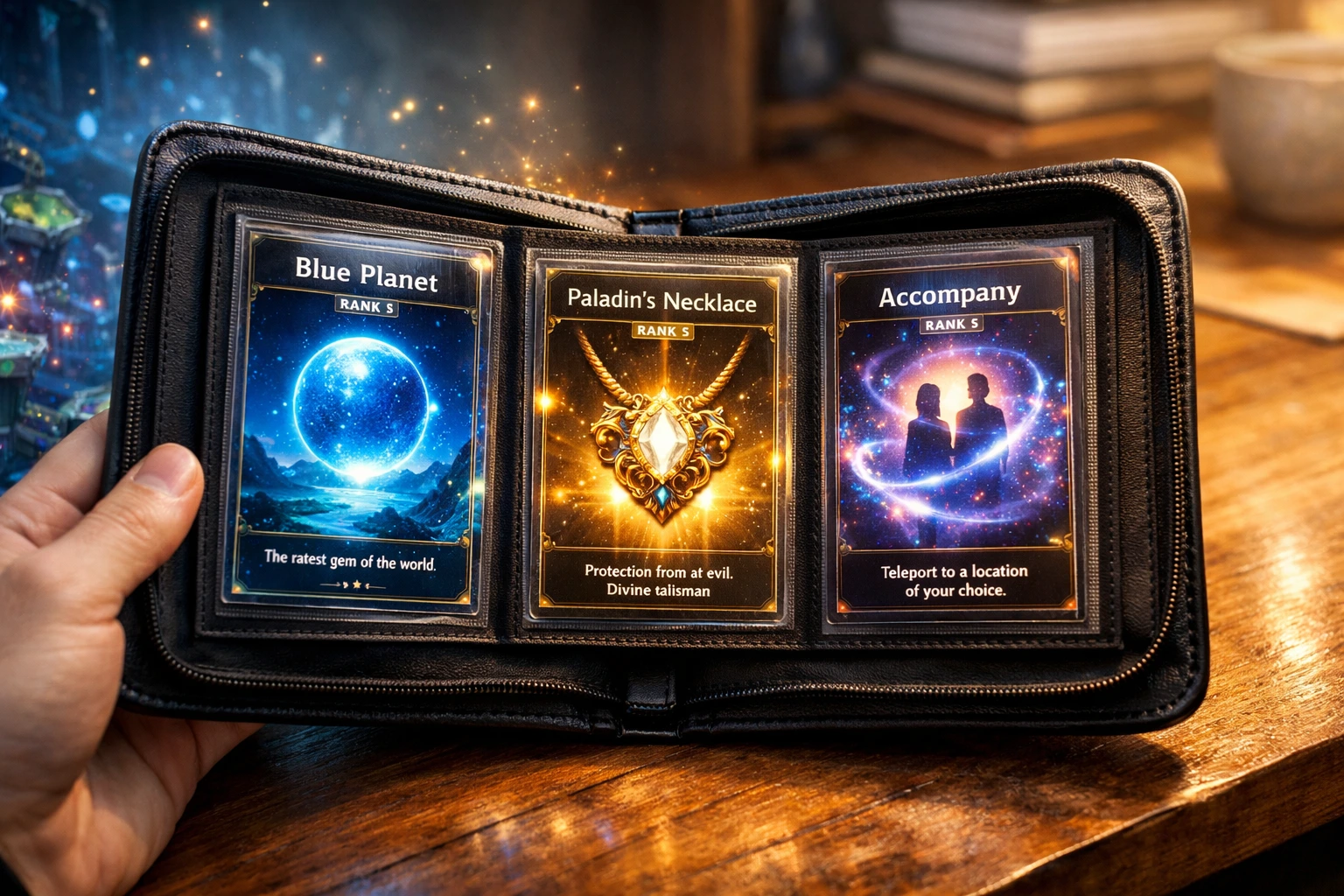
The true genius of Greed Island's design is revealed in its ultimate reward, which shatters the boundary between the "game" and reality. Upon winning, the victor is presented with a specialized, miniature binder containing only three slots. The mechanics of this reward allow the victor to select exactly three cards from their completed Specified Binder, place them into the special binder, and log out.
When the player returns to the real world, the three chosen cards do not disappear. They are permanently materialized in the real world as physical items or active phenomena. This bridging of the gap between the game and reality is the ultimate prize, allowing a player to bring back miraculous healing items like Breath of Archangel, priceless gems like Blue Planet, or powerful magical tools.
It is a reality-altering reward that justifies the billions of Jenny and countless lives spent trying to clear the game, proving that Ging Freecss did not just create a simulation, but a localized engine of creation capable of exporting miracles into the real world.