
I. Introduction: The Clash of Eras
The Hype of the Decade
In the annals of modern Shonen manga, few events have carried the seismic weight of the showdown between Gojo vs. Sukuna. This was not merely a fight; it was a cultural phenomenon that transcended the pages of Gege Akutami’s Jujutsu Kaisen. For years, since the very first chapter released in 2018, the question hung over the series like a Damocles sword, fueling forum debates,
YouTube video essays, and playground arguments alike: “If Sukuna regained all his power, could you beat him?” Gojo’s confident, smiling reply, “Nah, I’d win,” became the defining meme and the central promise of the narrative. It was a check written in Chapter 3 that the author finally had to cash in Chapter 223.
This battle represented the collision of two distinct, incompatible epochs of sorcery. On one side stood Gojo Satoru, the pinnacle of the Modern Era. He was a prodigy born with gifts—the Six Eyes and Limitless—not seen in the Gojo clan for four hundred years. His very birth shifted the balance of the world, causing Cursed Spirits to grow stronger simply to survive in a world he inhabited. He represented a philosophy of individual excellence utilized for the protection of the weak and the fostering of the next generation.
On the other side stood Ryomen Sukuna, the Disgraced One, the undisputed King of Curses from the Heian Era—the golden age of Jujutsu. Sukuna represented the ancient definition of strength: ruthless, solitary, and defined by a hedonistic consumption of one’s foes. He was a calamity in human form, a being who viewed others not as people, but as flavors to be tasted and discarded.
It was a contest between the modern “strongest,” defined by innate talent and overwhelming technique, and the ancient “strongest,” defined by tactical adaptability, biological perfection, and a complete disregard for morality.
The Stakes: The Title of “The Honored One”
The stakes of the Shinjuku Showdown extended far beyond the physical survival of Yuji Itadori and his classmates. It was a battle for the philosophical title of “The Honored One.” This title is a reference to the Buddha’s declaration, “Throughout heaven and earth, I alone am the honored one.” Both men had claimed this title—Sukuna in his narration against Jogo during the Shibuya Incident, and Gojo in his drug-like high of awakening against Toji Fushiguro during the Hidden Inventory arc.
For Gojo, victory meant validating the modern philosophy of nurturing a new generation. It meant proving that humanity had evolved past the barbaric “might makes right” strength of the Heian era. If Gojo won, the safety of his students—Yuji, Megumi, Yuta, Maki—would be secured, and his dream of resetting the rotten Jujutsu society would be within reach.
For Sukuna, victory was a reaffirmation of his solipsistic worldview: that strength is the only truth, and existence is merely a canvas for his pleasure. He fought to prove that love, connection, and ideals were “worthless” compared to the pure, unadulterated application of power. The loser of this bout would be stripped of their divinity, reduced to a mere challenger in the history books, while the winner would ascend to an untouchable status, their philosophy vindicated by the blood of the other.
Thesis Statement
The conclusion of this thirteen-chapter bout (Chapters 223–236) left the fandom fractured, with debates raging over “fraud” allegations, plot armor, and off-screen deaths. However, a superficial reading misses the intricate layer of tactical warfare Gege Akutami wove into the choreography.
This was not a contest of who could punch harder; it was a battle of information, biological limits, and barrier mastery. This article provides the definitive analysis of the fight, debunking the allegations of cheating, dissecting the complex barrier mechanics that defined the early stages, offering a technical interpretation of the controversial “World-Cutting Slash,” and ultimately explaining why the outcome was the only logical conclusion to the series’ central power struggle.
II. Tale of the Tape: The Arsenal Analysis

Gojo Satoru (The Challenger): The Untouchable God
To understand why this fight reached such a stalemate, we must first break down the “cheat codes” that Gojo Satoru brought to the battlefield. His kit is often misunderstood as simply “controlling gravity,” but it is actually the manipulation of space through the application of the concept of infinity.
- The Six Eyes (Rikugan): This is the engine of Gojo’s endurance. The Six Eyes are not a technique, but a rare ocular trait. They grant him atomic-level perception of Cursed Energy, allowing him to read flows, analyze techniques, and most importantly, optimize his energy consumption to essentially zero.
- While other sorcerers run out of gas, Gojo drives a hybrid that generates its own fuel. This efficiency allowed him to chain Domain Expansions and use high-output techniques that would kill a normal Special Grade, all while maintaining a fresh brain. It turns the complex calculations of Jujutsu into an automatic background process.
- The Limitless (Mukagen):
- Neutral (Infinity): An automatic barrier that slows incoming objects to a halt by dividing the space between them and Gojo infinitely. It is the Zeno’s Paradox brought to life. It filters objects by mass, speed, and Cursed Energy danger levels. It is the ultimate defense, forcing opponents to rely on domain amplification or domain expansion just to touch him.
-
- Blue (Cursed Technique Lapse): The amplification of negative numbers, creating a vacuum that pulls space and matter together. It allows for high-speed movement (teleportation via compression), magnetic-like attraction, and crushing telekinesis.
-
- Red (Cursed Technique Reversal): By flowing positive energy (generated by Reverse Cursed Technique) into the Limitless, Gojo inverts the effect of Blue. Instead of attraction, Red generates a massive repulsive force with twice the output of Blue. It is a shockwave that repels everything in its path.
-
- Hollow Purple: The collision of Blue (attraction) and Red (repulsion). When these two opposing infinities collide, they create an imaginary mass that erases matter on contact. It is a virtual sphere of destruction that ignores durability.
- Unlimited Void (Muryokuso): Gojo’s win condition. A sure-hit Domain that floods the target’s brain with infinite information. It forces the target to see everything and feel everything, rendering them unable to do anything. A split second of exposure is enough to cause months of rehabilitation; ten seconds is death.
Ryomen Sukuna (The King): The Strategic Monster
Sukuna entered this fight not just with his own arsenal, but with a stolen one. His possession of Megumi Fushiguro changed the nature of this battle from a brute-force contest to a specific counter-strategy. He effectively brought two Special Grade kits to the fight.
- Malevolent Shrine (Fukuma Mizushi): An open-barrier domain that relentlessly slashes everything within a 200-meter radius. It is described as “painting on air,” a divine feat that no other sorcerer (except Kenjaku) can replicate. It utilizes two types of slashes: Dismantle for inanimate objects and Cleave (which adjusts to the target’s toughness) for living beings.
- The Ten Shadows Technique: This was Sukuna’s chosen answer to the Limitless. While his own technique, Shrine, is lethal, it generally requires physical contact or a domain to bypass Gojo’s Infinity. The Ten Shadows offered Mahoraga, the Divine General. Mahoraga is a Shikigami with the ability to adapt to any and all phenomena. If it is hit by an attack, the wheel above its head turns, and it develops a counter.
- The Strategy: Sukuna knew that Shrine alone might result in a stalemate or a loss if Gojo shrunk his domain or teleported. He needed a model to bypass Infinity entirely. He didn’t just want to kill Gojo; he wanted to dissect his technique. He purposefully chose to fight in a way that utilized the Ten Shadows to strip Gojo of his “Untouchable” status permanently.
The “Immeasurable Void” Constraint
The defining constraint of the entire battle was Gojo’s Unlimited Void. Sukuna could not afford to be hit by it—not even for a moment. While Gojo could survive hundreds of slashes from Malevolent Shrine using Falling Blossom Emotion and simple Reverse Cursed Technique (RCT) to knit his body back together, Sukuna had no defense against the information overload of Unlimited Void.
Physical damage can be healed; mental damage from infinite information cannot. If Sukuna took a direct hit, he would be stunned, and Gojo would simply rip his heart out or decapitate him. This asymmetry—Gojo tanking physical damage vs. Sukuna needing to avoid mental damage—dictated every move on the 3D chess board. It forced Sukuna to play defensively in the early stages, relying on the adaptation wheel rather than aggression.
III. Phase 1: The Domain Expansion Clash
Open vs. Closed Barrier: The Divine Technique
The opening phase of the fight was a masterclass in Jujutsu theory, specifically focusing on Domain Expansion mechanics. The clash between Unlimited Void and Malevolent Shrine highlighted the fundamental difference in their construction.
Gojo’s Domain, like 99% of domains, uses a closed barrier to separate the internal space from the external world. It creates a pocket dimension. Sukuna’s Domain is “divine” because it does not use a barrier to create a separate space; it manifests the domain directly into reality, using a Binding Vow to allow an escape route in exchange for a massive range increase (up to 200 meters).
When they clashed, the “sure-hit” effects inside the barriers canceled each other out perfectly. Inside the shell, it was a stalemate. However, a closed domain has a shell—the barrier itself. Sukuna’s domain extended beyond the range of Gojo’s barrier. This allowed Sukuna to attack the outside of Gojo’s barrier with Malevolent Shrine’s slashes. Since barriers are incredibly tough from the inside but weak from the outside, Sukuna shattered Gojo’s domain repeatedly, causing Gojo to suffer Cursed Technique Burnout and stand defenseless in the rain of slashes.
The Spectator’s Perspective
A crucial element of these chapters was the commentary from the “watch party” consisting of Yuta, Hakari, Maki, Kusakabe, and the others. Their confusion mirrored the audience’s. Kusakabe, the master of simple domains, served as the exposition vehicle, explaining why Gojo couldn’t just “warp out” (his technique was burnt out) or why Sukuna didn’t just seal the barrier.
This commentary highlighted the sheer absurdity of what Gojo and Sukuna were doing. They were rewriting the laws of magic on the fly. When Gojo began changing the conditions of his domain—first inverting the barrier strength, then shrinking it—the students were terrified because such feats should be impossible. It emphasized that these two were not just powerful; they were operating on a completely different software version of Jujutsu than everyone else.
The Basketball Domain: Improvisation at the Limit
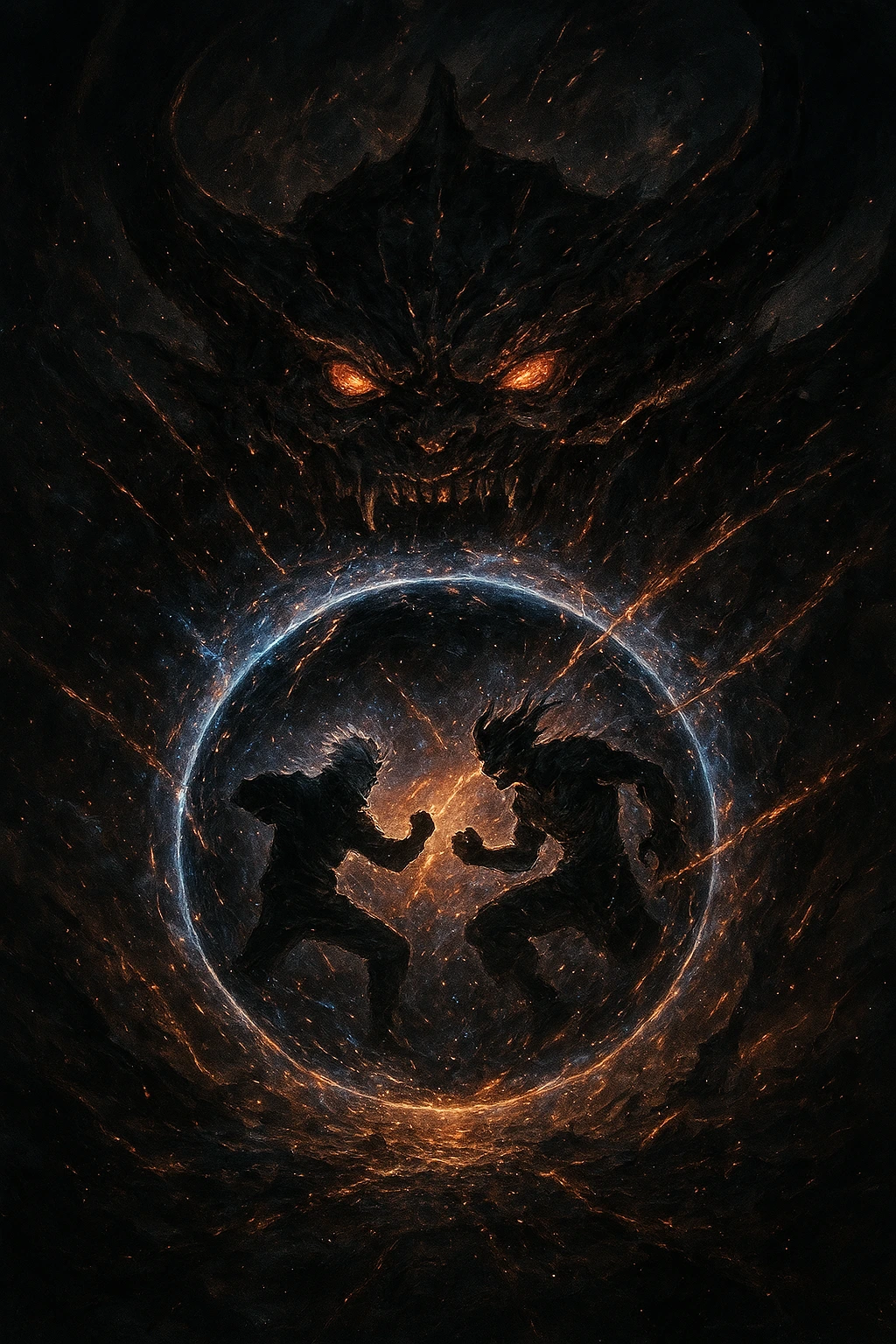
Gojo’s solution to the open-barrier problem showcased his genius. After having his domain broken twice, he realized he needed a shell that could withstand the external attacks. He inverted the barrier conditions, making the shell tough on the outside, but that wasn’t enough. His final adaptation was to shrink the Domain to the size of a basketball.
This visual was jarring. Gojo trapped himself and Sukuna inside a tiny, floating sphere. By compressing the massive space of Unlimited Void into such a tiny physical volume, the density and stability of the barrier skyrocketed. This allowed the barrier to withstand the relentless external bombardment of Malevolent Shrine for three minutes. It forced Sukuna to engage Gojo in hand-to-hand combat inside the cramped space to sustain the domain, turning a magical shootout into a claustrophobic brawl where Gojo’s superior martial arts shone.
The Burnout Mechanic and Biological Limits
This phase introduced a terrifying cost to Domain usage: Cursed Technique Burnout. After a Domain closes or is broken, the user’s technique is temporarily unusable.
Both Gojo and Sukuna circumvented this by using RCT to destroy the part of their brain (the prefrontal cortex area associated with techniques) where the technique is engraved and then instantly healing it to reset the cooldown. This is a feat of madness. They were effectively lobotomizing themselves and regenerating their gray matter mid-combat.
This highlighted that the battle wasn’t just about Cursed Energy reserves; it was about biological endurance. Gojo hit his limit first because his brain was healing while also processing the constant, heavy stream of information from the Six Eyes. This led to the chilling moment where Gojo attempts to open his domain for the fifth time, only for blood to pour from his nose as his brain refused to cooperate. Sukuna mocked him, only to immediately suffer the same fate—bleeding from his eyes—because he had taken too much damage from Unlimited Void in the previous exchange.
The Stalemate and the 0.01 Second
The Domain clash ended in a pyrrhic victory for Gojo. In their final collision, Gojo was a fraction of a second faster in deploying his domain because Sukuna had to pause to heal physical damage sustained in the previous brawl.
That 0.01-second delay meant Unlimited Void landed before Malevolent Shrine could neutralize it. For less than ten seconds, Sukuna was exposed to the void. This was Gojo’s win condition. He moved to crush Sukuna’s heart. However, Sukuna had secretly summoned Mahoraga in the shadows to adapt to the void, shattering Gojo’s domain from the inside just as Sukuna was incapacitated. This proved that Sukuna was willing to risk brain damage to ensure Mahoraga’s adaptation wheel kept turning.
IV. Phase 2: The Mahoraga Adaptation Strategy

The Wheel of Adaptation
Once the Domains were off the table due to brain damage on both sides, the fight shifted to the usage of the Ten Shadows. Here, we saw the full extent of Sukuna’s cunning.
The Dharma Chakra (the wheel above the head) represents Mahoraga’s adaptation process. It requires time and exposure to the enemy’s technique to turn. Once it turns four times (typically), the adaptation is complete.
Sukuna did not wear the wheel himself; he placed it on Megumi Fushiguro’s soul. This was a critical revelation that horrified the students. When Sukuna was hit by Unlimited Void, he transferred the burden of the technique’s effect to Megumi’s soul (which was submerged in the darkness), allowing the wheel to turn and adapt without Sukuna himself being incapacitated by the adaptation process. He essentially used Megumi as a human shield for the mental damage.
Furthermore, Sukuna utilized “Domain Amplification” to neutralize Gojo’s Infinity to land punches. The catch? You cannot use an innate technique (Ten Shadows) while using Domain Amplification. So, Sukuna toggled between them rapidly—using Amplification to defend, then switching it off to allow the wheel to turn and adapt to Gojo’s “Blue” and “Red.” This was a high-risk game of “Red Light, Green Light” played at supersonic speeds.
The “Fraud” Allegations: Analyzing the Controversy
This phase birthed the “Fraudkuna” memes. Fans argued that Sukuna, the King of Curses, relied too heavily on a stolen technique (Ten Shadows) rather than his own power. Images of Sukuna shouting “Mahoraga, save me!” circulated the internet.
However, this critique deeply misunderstands Sukuna’s character. Sukuna is not a warrior seeking an honorable duel; he is a calamity. His mindset is total utilization of available resources. He saw the Ten Shadows not as a crutch, but as a fascinating puzzle piece he acquired through planning (taking over Megumi’s body).
Moreover, without the Ten Shadows, Sukuna would have likely fought differently. He engaged in the Domain clashes specifically to buy time for the wheel to turn. If he only had Shrine, he might have focused on breaking Gojo’s barrier from the inside or utilizing other binding vows. The “Fraud” allegation ignores that managing Mahoraga—a shikigami that has killed every previous user of the Ten Shadows—is a feat of strength in itself. Sukuna tamed the untamable beast and weaponized it.
The 3v1 Battle: The Black Flash Zone

The battle escalated into a 3v1 handicap match: Gojo vs. Sukuna, Mahoraga, and Agito (a chimera beast composed of Nue, Totality, and the Great Serpent).
This section cemented Gojo’s status as the greatest combatant in the series. Even outnumbered, Gojo dominated. The visual storytelling here was peak Akutami. Gojo utilized the environment, his speed, and his creativity to juggle three Special Grade-level threats. He used his attraction (Blue) to pull Agito into punches and his repulsion (Red) to keep Mahoraga at bay.
The pivotal moment was Gojo landing a Black Flash. In JJK lore, a Black Flash is a distortion in space that occurs when cursed energy is applied within 0.000001 seconds of a physical hit. It raises the power to the power of 2.5. More importantly, it puts the sorcerer “in the zone,” heightening their awareness and restoring their Cursed Energy output.
Gojo landed not one, but four Black Flashes. This allowed him to regenerate his lost output from the brain damage. He identified Agito as the healer of the group and annihilated it with a maximum output Blue, crushing it into a sphere of gore. This proved that quantity cannot beat absolute quality.
V. The Climax: The Hollow Purple Nuke
The Tactical Setup
Chapter 235 is arguably the high-water mark of Gojo’s tactical brilliance. He realized that Mahoraga had adapted to “Blue” (attraction) and “Red” (repulsion) individually, but it had not yet adapted to the combination: “Hollow Purple.”
Sukuna, realizing Gojo was charging up a high-output attack, panicked. This was the first time the King of Curses looked truly rattled. He ordered Mahoraga to intercept the “Red” orb Gojo fired. But Gojo hadn’t fired it at Sukuna; he fired it upwards. He had left a “Blue” orb lingering in the sky from a previous attack, hidden within the debris of the destroyed Shinjuku buildings.
The Chant: “Scale of the Dragon…”
To ensure the “Hollow Purple” had maximum output despite his fatigue, Gojo utilized a full incantation. In Jujutsu Kaisen, sorcerers can boost the effectiveness of their techniques by reciting the technique’s origin or poetic verses associated with it. This is called “subtracting omens” (doing it without signs) vs “adding omens” (using signs and chants).
Gojo began the chant: “Phase, Twilight, Eyes of Wisdom. Scale of the Dragon, Recoil, Twin Meteors.”
These words served to focus his remaining energy and restore the output of the technique to over 100%. While Sukuna tried to detonate the Red with his own piercing blood attack, Gojo simply chanted to strengthen the Blue, causing it to absorb Sukuna’s attack harmlessly.
The Suicide Nuke
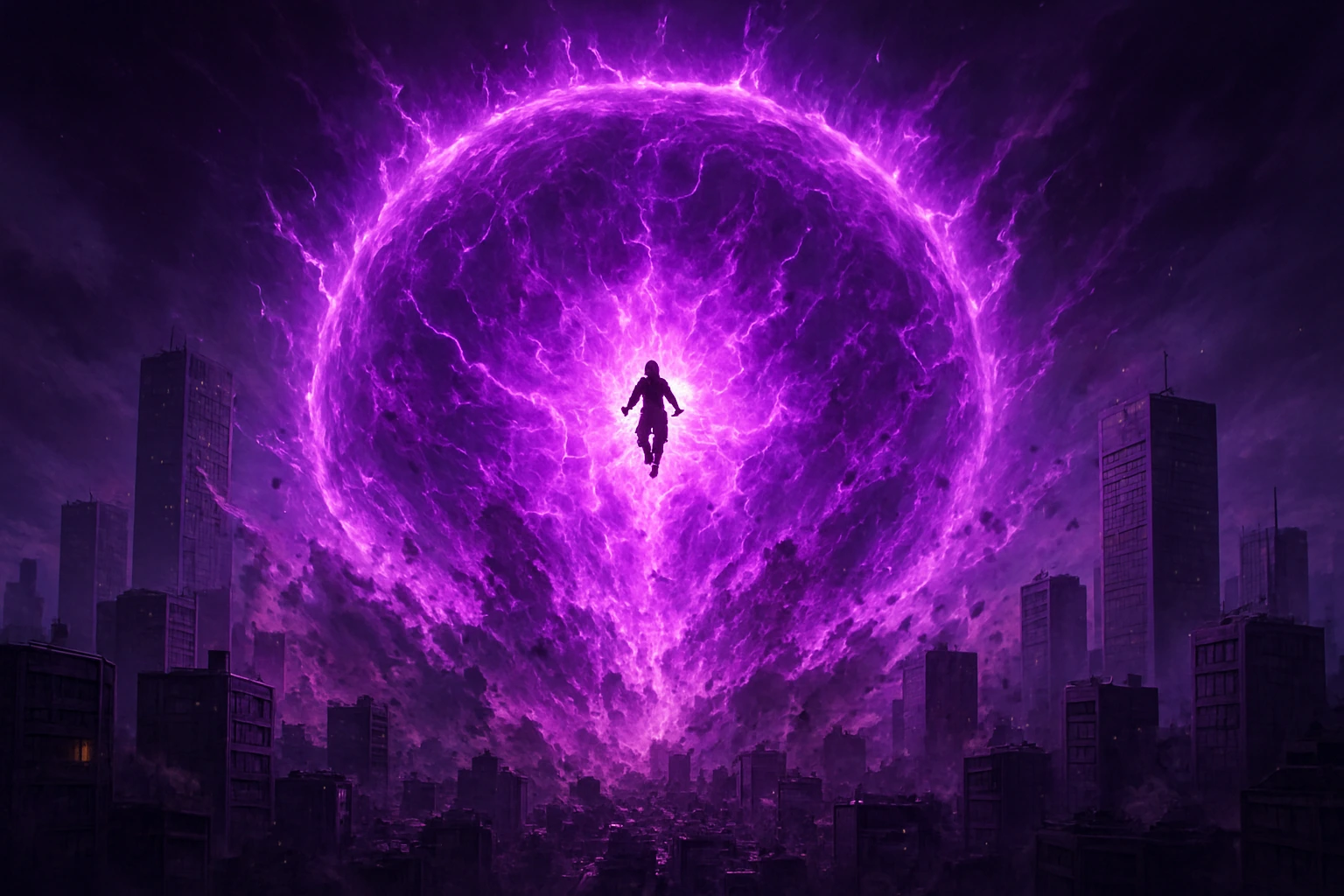
Gojo merged Blue and Red not at his fingertips, but remotely, creating an unsupervised Hollow Purple that exploded across the entire Shinjuku battlefield. It was an indiscriminate tactical nuke.
Why did Gojo survive? As he noted in the aftermath, the Cursed Energy was his own. In the logic of Jujutsu, one is naturally resistant to their own energy signature. It’s the difference between being hit by your own bomb versus someone else’s. Gojo took damage, but it was superficial compared to the devastation wrought on Sukuna.
The result was catastrophic. Mahoraga was vaporized instantly. Sukuna was left missing a hand, battered, slowed, and stripped of his Shikigami. Gojo stood tall, his RCT output returning due to the Black Flashes, looking down at the King. Kusakabe declared, “Gojo Wins.” It felt definitive. It felt earned.
VI. The Ending: The World-Cutting Slash
The “Off-Screen” Shock
The transition from Chapter 235 to 236 is the most controversial narrative cut in recent memory. We went from a victorious Gojo to a Gojo bisected at the waist, conversing in the afterlife. There was no panel of the slash hitting him, no moment of realization.
The “off-screen” nature of the final blow felt jarring to many, but it served a specific narrative purpose: to mirror the suddenness of death in the world of Jujutsu. It snapped the reader out of the “Gojo won” high instantly, placing them in the same bewildered shock as the other characters. It was a stylistic choice to emphasize that against the King of Curses, death comes without warning.
The Explanation (The Blueprint)

Sukuna explains the mechanism immediately after. This was the payoff to the Mahoraga strategy. Sukuna revealed that he wasn’t waiting for Mahoraga to kill Gojo; he was waiting for Mahoraga to show him how to kill Gojo.
Mahoraga does not just adapt once; it continues to adapt.
- First Adaptation: Mahoraga changed its own cursed energy to neutralize Gojo’s Infinity (like touching a positive magnet to a positive magnet). Sukuna could not copy this, as he cannot change the nature of his CE.
- Second Adaptation: Mahoraga launched a slash that didn’t target Gojo, but the space Gojo occupied.
This was the blueprint Sukuna waited for. The logic is as follows: Gojo is untouchable because of the Infinity surrounding him. However, the space and the world itself are not protected by Infinity. Infinity exists within the world.
If you can cut the coordinates of the world (X, Y, Z) where Gojo exists, Gojo is cut as a byproduct of the world being severed. It is a target extension technique. Sukuna didn’t cut Gojo; he cut the reality Gojo was standing in.
The Binding Vow Controversy
Crucial context added in later chapters (specifically Chapter 255) reveals that Sukuna could not simply fire this “World-Cutting Slash” at will. He was in a desperate state after the Hollow Purple nuke—missing a hand and low on output.
To perform the slash instantly, without the required hand signs (Enmaten), Sukuna undertook a Binding Vow. A Binding Vow is a contract with Jujutsu itself: “I will gain X now, in exchange for giving up Y.”
Sukuna sacrificed the ability to use the World Slash freely in the future. The vow likely stipulated that to use it this one time without signs, he would thereafter require a much more complex activation (three hands, chants, and direction) to ever use it again. This vow was the only reason he could catch Gojo—with his Six Eyes—off guard. It was an undetectable, instant strike bought at a heavy future price, a desperate gamble that paid off.
VII. The Afterlife: Decoding the “Airport Scene”
Gojo’s Satisfaction
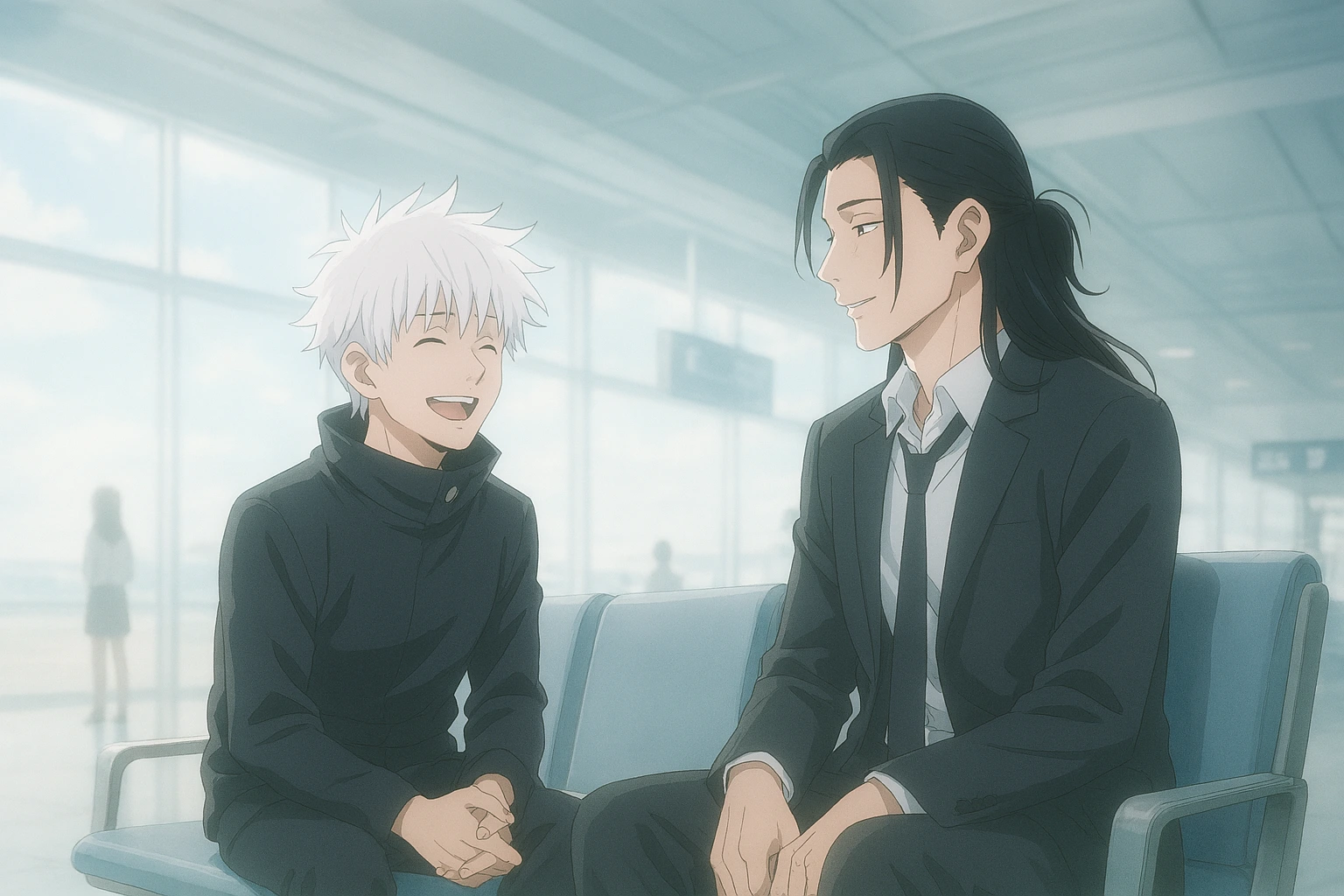
The “Airport Scene” is Gojo’s internal transition to death. It takes the form of an airport terminal where he meets his deceased friends: Geto, Nanami, Haibara, Yaga, and Riko.
His conversation with Geto Suguru reveals a side of Gojo rarely seen: the battle junkie. He admits he felt sorry for Sukuna. This line enraged fans who felt it disrespected his students, but it aligns with his character arc. Gojo has always been defined by the loneliness of being at the top. He viewed Sukuna not just as an enemy, but as the only other being who could understand the burden of absolute strength.
He felt sorry that he couldn’t force Sukuna to go “all out” (reveal his Heian form) in the same way Sukuna forced him to. Gojo died satisfied because, for the first time in his life, he wasn’t holding back to protect the weak; he was simply being.
The Theme of Solitude
The core theme of the fight, and indeed the series, is: “The one who will teach you about love is…”
Yorozu told Sukuna this, implying that finding an equal is the only way to cure the solitude of strength. Gojo hoped to be that person for Sukuna, or have Sukuna be that for him. Ultimately, the tragedy is that strength does create isolation. Even in their connection through combat, they remained distinct entities with different philosophies.
Gojo found his “love” or connection not in defeating Sukuna, but in the act of the fight itself, and ultimately, in reuniting with his lost friends in the afterlife. He realized that his students were not just weaklings to be protected, but flowers that would eventually bloom without him.
Character Assassination or Conclusion?
Did this undermine Gojo? No. Gojo Satoru was a character trapped by his own godhood. He wanted to raise a generation that wouldn’t leave him alone, but he also craved the thrill of being challenged. His death achieved both: he entrusted the future to his students (who now had a weakened Sukuna to fight) and he achieved his personal desire for a fulfilling death. It was the conclusion of Gojo the Human, shedding the skin of Gojo the God.
VIII. Conclusion: The Final Verdict
Who is Stronger?
The uncomfortable truth for Gojo fans is that Ryomen Sukuna is the strongest sorcerer in history.
Gojo Satoru dominated the hand-to-hand exchanges. He had a better Cursed Technique (Limitless is generally superior to Shrine). He forced the King of Curses to feel fear. However, Jujutsu battles are not just about stats; they are about preparation, adaptability, and mindset.
Sukuna treated the battle as a means to an end (learning a new technique: the World Slash), while Gojo fought to win the match. Sukuna’s ability to create a plan involving a stolen technique, execute it over dozens of chapters, manage the wheel of adaptation while taking brain damage, and utilize a Binding Vow in a split second to secure victory proves his superiority as a Sorcerer, even if Gojo was superior as a force of nature. Sukuna won because he was willing to throw away his pride, use a stolen body, and hide in the shadows to secure the W, whereas Gojo fought “fairly.”
Impact on the Series
Gojo did not die in vain. The “shave” he put on Sukuna was immense and set up the rest of the arc:
- Sukuna lost the Ten Shadows (Mahoraga is destroyed).
- Sukuna lost his Domain Expansion capability (brain damage preventing him from casting it for many chapters).
- Sukuna’s RCT output was severely crippled.
- Sukuna was forced into his Heian form incarnation to heal fully, using up his “extra life.”
Gojo Satoru chipped the raid boss down to 50% HP, stripping him of his most broken tools, so that Yuji, Yuta, and the others stood a chance. He cleared the board of the “infinite” threats.
Final Thought
Gojo Satoru was the “Strongest of the Modern Age,” a ceiling that protected the weak. Ryomen Sukuna is the “Strongest in History,” a calamity that devours the strong. The fight was a masterpiece of technical writing and thematic storytelling that will be analyzed for years to come. In the end, the challenger reached the sky, but the King owned the horizon.
IX. Frequently Asked Questions (FAQs)
How exactly did Sukuna cut Gojo through the Infinity?
Sukuna did not cut through the Infinity. He expanded the target of his technique. Instead of targeting “Gojo Satoru” (who is shielded by Infinity), he targeted “The World” at the coordinates where Gojo was standing. Since the Infinity exists within the world, cutting the world itself severs everything inside it, bypassing the shield entirely. It’s like cutting a piece of paper: you don’t need to touch the drawing on the paper to cut it in half if you cut the paper itself.
Why didn’t Gojo teleport away from the final slash?
The slash was nearly instantaneous and invisible. Furthermore, Gojo was in a state of relaxed victory (the “zone” cooldown) and his output was dropping. But the most technical reason is the Binding Vow. Sukuna sacrificed future utility to launch the slash without any “tell” or “spark” (like hand signs or chants). Without the preparatory spark of Cursed Energy that the Six Eyes usually detect, Gojo had no warning. By the time the slash existed, Gojo was already cut.
Did Sukuna hold back against Gojo?
Yes and No. Gojo stated Sukuna “didn’t give it his all,” referring to the fact that Sukuna didn’t use his “Open” (Fire Arrow) or his Heian Era form. However, Sukuna could not use those techniques because they wouldn’t bypass Infinity. He was forced to use the Ten Shadows strategy. So, Sukuna held back his full arsenal, but he tried his absolute hardest within the specific strategy required to win. If he had used the Fire Arrow, it would have been stopped by Infinity, and he would have lost.
What happened to the 10 Shadows technique after the fight?
With Mahoraga destroyed by the Hollow Purple, the technique is severely damaged. In Ten Shadows lore, when a Shikigami dies, its power is inherited by the others (Totality). However, since Sukuna later fully incarnates into his Heian form, abandoning Megumi’s body (mostly), the status of the technique is ambiguous. Effectively, Sukuna stopped using it in favor of his original Shrine technique because Mahoraga—the crown jewel of the technique—was gone.
Is Gojo Satoru dead permanently?
As of the conclusion of the Shinjuku Showdown arc, yes. His body was physically destroyed (cut in half), and we saw his soul move on in the airport scene. While Yuta Okkotsu later utilized Gojo’s body via Kenjaku’s brain-hopping technique to fight Sukuna briefly, the soul of Gojo Satoru has departed. He died without regrets, choosing to leave the rest to his students.
Why didn’t Gojo use his Domain Expansion one last time at the end?
He couldn’t. After the clash in Phase 1, Gojo inflicted brain damage on himself to reset his technique. He reached his limit of 5 domains. His brain was physically unable to construct the barrier again without risking permanent death or vegetative state. Even at the end, despite the Black Flashes restoring his output, his brain structure for the Domain was likely still recovering.
What is the “Spark” that Gojo missed?
In Jujutsu Kaisen, every powerful technique is preceded by a “spark” or a swell of Cursed Energy. The Six Eyes allows Gojo to see this spark before the technique activates, giving him precognition. Sukuna’s Binding Vow allowed him to bypass the need to charge up the energy or make signs, effectively deleting the “spark” for that one specific attack. This is why Gojo, who can see everything, didn’t see his death coming.