
I. Introduction: The Paradox of Strength
In the modern landscape of shonen anime, power is often portrayed as a ladder—a climb from weakness to strength, fueled by friendship, training, and grit. But Jujutsu Kaisen presents us with an anomaly from the very first frame: Gojo Satoru.
He does not climb the ladder; he is the ceiling against which everyone else hits their head. He is introduced not as a protagonist struggling to find his place, but as the apex predator of the sorcery world, a being so overwhelmingly powerful that his mere birth shifted the balance of the entire world.
When Gojo Satoru was born, the difficulty setting of the universe changed. Curses became stronger simply to survive in a world that contained him. He is the pinnacle of the series, a character who treats special-grade threats like minor inconveniences and approaches life-or-death battles with the casual demeanor of someone grocery shopping.
Yet, beneath the blindfold, the infinite void, and the playful arrogance lies a profound tragedy that serves as the central thesis of his character: Absolute strength does not grant absolute freedom; it creates absolute isolation.
This is the paradox of Gojo Satoru. To be the “Strongest” is not a blessing, but a curse of its own making. It is a title that strips away one’s humanity, replacing connection with responsibility and camaraderie with idolatry. He is a god walking among mortals, capable of doing anything, yet ultimately unable to do the one thing he desires most: to not be alone.
In this comprehensive analysis, we will dissect the anatomy of this lonely god. We will explore the complex Buddhist mythology behind his “Honored One” status, break down the theoretical physics that make his “Limitless” technique possible, and trace the tragic arc of his life—from the arrogance of his youth to the heartbreaking solitude of his death. This is not just a recounting of feats; it is an autopsy of the burden of being the strongest.
II. The “Honored One”: Meaning & Mythology

The Quote that Defined a Generation
During the Hidden Inventory arc, hovering in the blood-red sky after a near-death experience, Gojo utters the words that would define his existence: “Throughout Heaven and Earth, I alone am the honored one.”
To the casual viewer, this is the ultimate flex—a declaration of supreme arrogance. But to understand Gojo, one must understand the weight of this sentence. It is a direct reference to the words spoken by Shakyamuni Buddha immediately after his birth. In Buddhist tradition, the infant Buddha took seven steps in each cardinal direction, pointed one hand to the sky and one to the earth, and declared his enlightenment and supremacy over the cycle of suffering.
However, the context in Jujutsu Kaisen twists this holy declaration into something darker. When Buddha spoke these words, they signaled a detachment from the ego and the material world to achieve Nirvana. Buddha’s “honored” status came from selfless enlightenment. Gojo’s realization is the exact inverse.
The Ego as Enlightenment
Gojo’s “enlightenment” does not come from shedding his ego; it comes from embracing it fully. At that moment, facing Toji Fushiguro, Gojo ceases to care about Riko Amanai’s death. He ceases to feel anger or vengeance. All he feels is the pleasantness of the world. He realizes that he is not part of the machinery of jujutsu society; he is the mechanic. He exists above the system, above the moral binary of “good” and “evil.”
He achieves a state of divine selfishness. In Buddhism, the “self” is an illusion to be dispelled. For Gojo, the “self” is the only reality that matters. This creates a fundamental disconnect between him and the rest of humanity. A god cannot truly relate to the ants he protects.
By asserting himself as the “Honored One,” he inadvertently severs the tether that kept him grounded to his humanity—his reliance on others. Before this moment, he was part of a duo, “We are the strongest.” After this moment, the “We” evaporates, leaving only “I.”
Symbolism of the Hand Signs
The visual language Gege Akutami uses for Gojo further cements this divine imagery. Gojo’s Domain Expansion hand sign is associated with Indra (Taishakuten in Japan), the King of Gods in Hindu and Buddhist cosmology. Indra is a deity of lightning, thunder, and war, known for his immense power but also for his arrogance and occasional recklessness.
Indra resides in the center of the heavens, just as Gojo resides at the center of the Jujutsu world. Furthermore, the Mudra used for “Unlimited Void” (Teishaku-ten-in) signifies the command over the cosmos. By using this sign, Gojo isn’t just casting a spell; he is asserting his dominance over the fabric of reality itself. He is forcing the universe to acknowledge his position at the center.
This symbolism creates a tragic irony. Indra is often depicted as a lonely king, constantly defending his throne, surrounded by subordinates but devoid of equals. Gojo mirrors this perfectly. He is worshipped, feared, and relied upon, but he is never truly understood. He is a bodhisattva who refused to ascend, staying in the muddy world of mortals not out of humility, but out of a desperate need to foster a new generation that might one day stand beside him.
III. The Physics of Infinity: Expert Analysis

To understand why Gojo is untouchable, we must move beyond “magic” and delve into theoretical physics and mathematics. Akutami has constructed a power system for Gojo that is surprisingly grounded in high-level mathematical concepts, specifically Zeno’s Paradox and the manipulation of spatial relativity.
The Six Eyes: The Atomic Processor
Before explaining the Limitless, we must explain the engine that runs it: the Six Eyes. Many fans mistake the Six Eyes for a vision-enhancing ability, like a super-powered telescope. This is incorrect. The Six Eyes are effectively a supercomputer for cursed energy.
Imagine the world as a stream of raw data. Normal sorcerers see the interface—the finished picture. The Six Eyes allow Gojo to see the source code. He perceives cursed energy at an atomic level. This grants him three crucial advantages:
- Infinite Efficiency: He can calculate the precise amount of energy needed for a technique down to the infinitesimal decimal, reducing energy waste to effectively zero. This is why he never runs out of cursed energy, despite using high-cost techniques.
- Automated Defense: Combined with his Reverse Cursed Technique, the Six Eyes allow him to run his brain on autopilot, refreshing his neural pathways constantly so he can keep his Limitless active 24/7 without frying his brain.
- Analysis: He can deconstruct an opponent’s technique instantly by seeing how their energy flows, making surprise attacks nearly impossible.
Infinity (The Neutral Limitless): Zeno’s Tortoise
The “shield” that stops attacks from hitting Gojo is not a physical barrier. It is the manifestation of the convergent series in mathematics, famously illustrated by Zeno’s Paradox of Achilles and the Tortoise.
The paradox states that to reach a target, you must first cross half the distance, then half the remaining distance, then half of that, ad infinitum. Mathematically, you can divide the space between two points an infinite number of times. Usually, in physics, we ignore this because we move through space continuously.
Gojo brings this mathematical concept into reality. When an object approaches him, his technique divides the space between the object and his body infinitely. The object continues to move forward, but it is traversing an infinite number of “halves.” It slows down not because of friction, but because the distance it has to travel is being conceptually stretched to infinity. The closer you get to Gojo, the slower you move, until you appear stopped. You are stuck in a convergent series, forever approaching but never arriving.
Blue (Cursed Technique Lapse): Negative Distance
If “Infinity” is the neutral state, “Blue” is the active application of negative numbers to space. In reality, “negative distance” cannot exist. If you have two points, A and B, the distance is a positive value.
Gojo’s technique forces a “negative distance” into existence. The universe, abhorring this impossibility, attempts to correct the error by rushing matter into the gap to fill the void. This creates a vacuum effect—a powerful magnetic attraction.
By creating a point of “negative space” (Blue), Gojo compels the surrounding reality to collapse inward to eliminate the anomaly. He can use this to teleport (by compressing the distance between him and a destination), to drag enemies around like ragdolls, or to implode structures. It is a forced implosion of space-time.
Red (Cursed Technique Reversal): Divergence
“Red” is the opposite. By pouring positive energy (Reverse Cursed Energy) into the Limitless technique—which inherently governs “negative” space manipulation—Gojo creates a repulsive force.
Mathematically, this represents divergence. Instead of dividing space or subtracting space, he is expanding infinity explosively. He creates a point of infinite expansion, pushing everything away with tremendous force. Because creating positive energy requires multiplying negative energy (negative x negative = positive), “Red” is twice as potent as “Blue” but much more difficult to execute. It is a shockwave of pure spatial rejection.
Hollow Purple: Virtual Mass
The most destructive technique, “Hollow Purple,” is the collision of the impossible. Gojo smashes the attraction of Blue (negative distance) against the repulsion of Red (infinite divergence).
When you combine infinite attraction and infinite repulsion, you don’t just get zero; you get a singularity. You create “Virtual Mass.” This is a concept in physics describing particles that exist mathematically but not physically in a standard sense.
Purple is a mass of “imaginary” matter that the universe cannot process. Because this mass shouldn’t exist, it bypasses the laws of physical resistance. It doesn’t “hit” things; it erases the space they occupy. It deletes reality at a subatomic level. It is a glitch in the simulation of the universe that wipes out whatever it touches because the logic of the world breaks down upon contact.
Unlimited Void: Information Overload
Gojo’s Domain Expansion is the final evolution of the Limitless. If the Limitless brings the concept of “Infinity” to physical space, Unlimited Void brings it to information processing.
The Domain forces the target to perceive everything. Not just everything they see, but everything. Every wavelength of light, every sensation of wind, every conceptual possibility of the universe is flooded into their brain at once.
The human brain relies on filtering. You ignore the feeling of your shirt on your skin, the hum of the fridge, the peripheral colors, so you can focus on survival. Unlimited Void removes the filter. The target is forced to process an infinite stream of information. They can see everything and feel everything, so they can do nothing. Their brain enters a loop of infinite processing, freezing their body while their mind burns out. It is a poetic death: killed by the sheer weight of existence.
IV. Hidden Inventory: The Turning Point
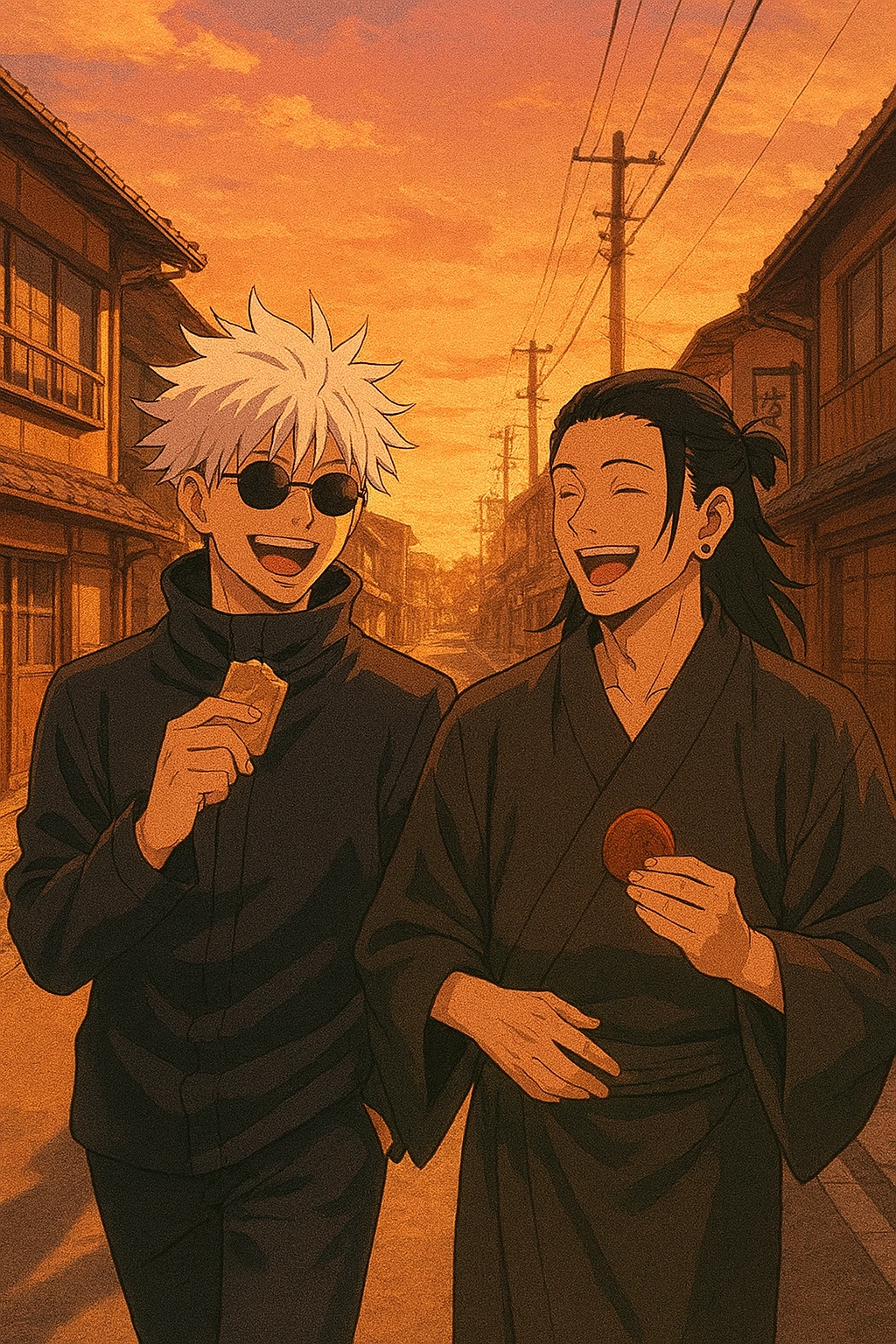
To understand the God, we must look at the boy. The “Hidden Inventory” arc is not just a flashback; it is the origin story of Gojo’s solitude.
“We Are The Strongest”
In his youth, Gojo was arrogant, yes, but he wasn’t alone. He had Suguru Geto. Geto was his moral compass, his partner, and his equal. The phrase “We are the strongest” was crucial. It meant the burden of the world was shared. Gojo had someone who understood the view from the mountaintop.
Geto provided the “why” to Gojo’s “how.” Gojo had the power, but Geto had the philosophy of protecting the weak. They were a perfect dichotomy: Gojo was the chaotic power, Geto was the principled order.
The Failure of God
The death of Riko Amanai shattered this dynamic. It was the first time Gojo Satoru, the prodigy, truly failed. He was outsmarted and outmuscled by Toji Fushiguro, a man with zero cursed energy—a “monkey” in the eyes of the sorcery elite.
This failure did two things. First, it forced Gojo to awaken. To survive Toji, he had to abandon his humanity and tap into the core of cursed energy, learning the Reverse Cursed Technique. He became the “Honored One” not through training, but through the trauma of near-death.
Second, it proved that being “good” wasn’t enough; you had to be absolute. Riko’s death taught Gojo that the system was broken. The higher-ups, the barriers, the rules—none of it saved the girl.
The Great Divergence
The aftermath of Riko’s death is where the tragedy solidifies. Gojo continued to ascend, perfecting his technique to become an untouchable god. He perfected an automatic defense system so he would never be caught off guard again. He became literally untouchable.
But as Gojo became a god, Geto became a monster. The gap between them widened. Gojo could no longer say “We are the strongest.” He had left Geto behind. When Geto defected, choosing a path of genocide, Gojo was forced to confront the reality that his strength could not save his friend’s heart.
The final confrontation in Shinjuku is the most heartbreaking scene in the series. Gojo, the man who can control space and time, could not bridge the emotional distance between him and his best friend. He had to kill the only person who truly understood him. This moment cemented his isolation. He was now truly the “Strongest,” and he was truly alone.
V. The Teacher’s Dream: Breaking the System

Why did Gojo Satoru become a teacher?
It seems counterintuitive. A man of his ego and power could easily rule the Jujutsu world as a dictator. He admits he could kill all the higher-ups in a single afternoon. But he chooses not to. Why?
The Revolution of Education
Gojo realizes that violence is a temporary solution. If he kills the higher-ups, new corrupt leaders will simply replace them. The rot is systemic. To change the world, he needs to change the culture. He needs a revolution, but not a bloody one—an ideological one.
He chooses education as his weapon. His goal is to raise a generation of sorcerers who are strong, smart, and unbound by the archaic traditions of the conservative elders. He wants allies, not servants.
The Students as Hope
His investment in Yuji Itadori, Megumi Fushiguro, and Yuta Okkotsu is deeply personal.
- Yuta Okkotsu: A reflection of his own immense power, a potential successor who can shoulder the burden.
- Megumi Fushiguro: The son of the man who nearly killed him (Toji), yet Gojo raises him. He sees Megumi’s potential to rival him, pushing him to be “greedier” and visualize a stronger self.
- Yuji Itadori: The vessel of Sukuna. Gojo fights for Yuji’s life not just because he’s a good kid, but because Yuji represents the capacity to handle the unbearable—just like Gojo does.
The Flaw in the Dream
However, Gojo’s teaching style is flawed. He loves his students, but he struggles to teach them because he is a genius who never had to struggle. He relies on “feeling” and “instinct,” which frustrates logical learners like Megumi.
More importantly, his mere existence creates a safety net that hampers their growth. As long as Gojo is there, the students know that “Sensei will handle it.” He is the ultimate deus ex machina. His dream of raising strong allies is constantly undermined by the fact that he is too strong to let them truly face the abyss on their own—until he is gone.
VI. The Shibuya Incident: Sealed Away
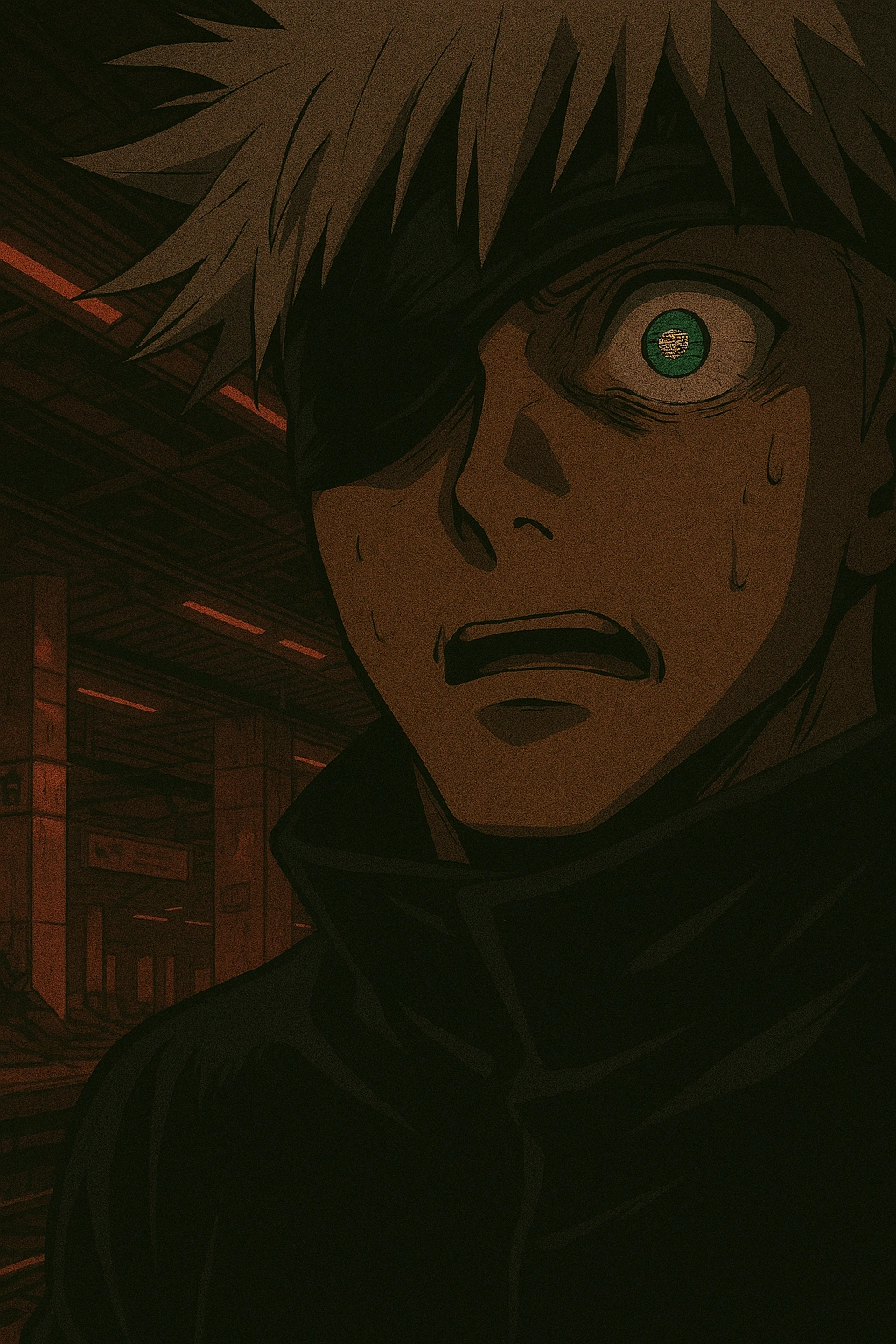
The Shibuya Incident arc is the narrative pivot of Jujutsu Kaisen, and it revolves entirely around one problem: How do you solve a problem like Gojo Satoru?
For the villains (Kenjaku and the Disaster Curses), killing Gojo is impossible. He is a force of nature. You don’t fight a hurricane; you board up the windows and wait for it to pass. Or, in this case, you trap it in a box.
The Necessity of the Seal
From a storytelling perspective, Gojo had to be removed. He breaks the tension. If Gojo is present, there is no stakes. “Will they survive?” becomes “When will Gojo show up?” By sealing him in the Prison Realm, Akutami returned the stakes to the story. The safety net was cut.
The Strategy of Kenjaku
Kenjaku’s plan to seal Gojo was a masterclass in psychological warfare. He didn’t overpower Gojo; he overwhelmed him.
- Civilian Shields: He forced Gojo into a situation where he couldn’t use his mass-destruction techniques (Blue, Red, Purple) without slaughtering thousands of innocents.
- Mental Fatigue: He forced Gojo to use a 0.2-second Domain Expansion and then manually slaughter transfigured humans, taxing his mental state.
- The Trigger: The appearance of “Suguru Geto.” The Prison Realm requires the target to be held in place for one minute in their mind. By showing Gojo the face of his dead best friend, Kenjaku triggered three years of memories—the “blue spring” of his youth. Gojo froze. His strength was bypassed by exploiting his one weakness: his love for his lost friend.
The World Without God
The moment Gojo was sealed, Japan collapsed. The Culling Games began. Curses ran rampant. Politics dissolved into chaos. This proved Gojo’s thesis: the world was relying too much on one pillar. Without the “Strongest,” the structure could not hold. It was a harsh lesson for his students: the world is cruel, and God is no longer watching.
VII. The Final Battle: Shinjuku Showdown

When Gojo is finally unsealed, the manga hurtles toward the inevitable clash: The Strongest Sorcerer in History (Ryomen Sukuna) vs. The Strongest Sorcerer of Today (Gojo Satoru).
The Battle of Concepts
This fight was not just a brawl; it was a dissertation on Jujutsu. It was a constant flux of changing Domain conditions, burning out brains and healing them with RCT, and improvising vows.
Gojo displayed brilliance we had never seen. He shrank his domain to the size of a basketball to resist Sukuna’s attacks. He utilized Blue to increase his speed to teleportation levels. He even improvised a “Remote Hollow Purple” by merging Red and Blue that were already on the battlefield.
For the first time, Gojo looked… happy. He wasn’t fighting to protect; he wasn’t fighting to teach. He was fighting for the sheer thrill of testing his limits against an equal. He was finally not alone.
The Airport: The Afterlife
The controversy of Gojo’s death lies in the “Airport Scene.” After being bisected by Sukuna’s “World-Cutting Slash,” Gojo awakens in an afterlife resembling an airport, greeted by Geto, Nanami, and Haibara.
Critics argue that Gojo praising Sukuna (“I’m not sure I could have beaten him even without the Ten Shadows”) was a betrayal of his character. But viewed through the lens of the “Lonely God,” it makes sense. Gojo spent his life being misunderstood because of his strength.
In Sukuna, he found someone who understood the solitude of the peak. His praise wasn’t submission; it was gratitude. He was grateful that Sukuna gave him a fight where he could go all out—where he could be “Satoru Gojo” the sorcerer, not “Gojo Satoru” the institution.
The Smile
He died with a smile. Why? Because he reconnected with Geto. In the airport, he wasn’t the “Honored One.” He was just Satoru, the high school student, joking with his best friend. He shed the burden of godhood and reclaimed his humanity in death. He expressed no regrets about his students because he had faith. He had successfully raised them to a point where he believed they could finish what he started.
VIII. Conclusion: The Human Behind the God

Gojo Satoru is a tragedy wrapped in the aesthetic of a power fantasy. We cheer for his strength, his arrogance, and his style. We laugh at his jokes and marvel at his violence. But at his core, he is a deeply sorrowful figure.
He is a man who possessed the power to reshape the universe but could not stop his best friend from walking into the darkness. He is a teacher who built a family because he lost his own, only to be forced to leave them behind to fight a war he couldn’t win alone.
Was his life a success? He failed to save Riko. He failed to save Geto. He failed to defeat Sukuna. By traditional metrics, the “Strongest” lost all his major battles.
But his victory lies in his legacy. He broke the cog-wheel mechanism of Jujutsu society. He raised Yuji, Yuta, and Megumi. He planted the seeds of a forest that would grow tall enough to weather the storm after the great tree fell.
Gojo Satoru was the Lonely God who sacrificed his humanity so that others wouldn’t have to. His story serves as a poignant reminder that connection, not power, is the true substance of life. In the end, the “Honored One” didn’t want to rule the heavens; he just wanted to walk on the earth with his friends one last time.