
Introduction
The Walking Calamity: Defining Gigantomachia
In the sprawling, hyper-powered universe of My Hero Academia, antagonists come in a multitude of forms, ranging from ideologically driven zealots to cunning criminal masterminds. However, to classify Gigantomachia merely as a “villain” is a profound understatement that fails to capture the sheer, unadulterated terror of his existence.
Gigantomachia is not a scheming mastermind, nor is he a street-level rogue with a grand vision for societal reform. He is, by every conceivable metric, a biological weapon of mass destruction. He is a walking calamity, a force of nature draped in human skin, and the ultimate physical manifestation of All For One’s terrifying, god-like power.
If Tomura Shigaraki represents the ideological decay of hero society, Gigantomachia is the hammer meant to shatter its physical foundations. He is a living siege engine, engineered and conditioned for a singular, apocalyptic purpose: to shatter armies, topple towering cityscapes, and break the indomitable spirit of anyone who dares stand against the demon lord of the underworld. When Gigantomachia moves, the earth does not just shake; it fractures under the weight of an era-ending catastrophe.
The Loyal Beast
At the core of this unfathomable destructive capability lies a psychological trait that renders him uniquely terrifying: his absolute, fanatical, and unbreakable devotion to his “Lord,” All For One. In a criminal underworld defined by treachery, shifting allegiances, and self-serving ambition, Gigantomachia stands alone as an anomaly of pure, untainted loyalty. His existence does not revolve around personal gain, wealth, or even the sadistic pleasure of destruction.
It revolves entirely around servitude. This unconditional subservience makes him the most dangerous and un-bribable asset in the villainous landscape. He cannot be reasoned with, he cannot be bought, and he cannot be intimidated. To attempt to sway his loyalty is as futile as attempting to command the tides. His loyalty is so absolute that it transcends mere obedience; it is a spiritual, almost pathological compulsion that binds his colossal physical might to the whims of a single master.
Article Scope
This article serves as the definitive, expert-level breakdown of Gigantomachia’s existence. We will venture far beyond surface-level observations to deconstruct the terrifying synergy of his multi-Quirk biology, exploring how Dr. Garaki engineered a monster that defies the laws of physics and thermodynamics.
We will delve into the complex, disturbing psychological threshold required to command such a beast, examining the fragile emotional core hidden beneath his indestructible exterior. Furthermore, we will analyze the sheer, catastrophic physics of his rampage across Japan, measuring the devastating impact of his movements on both infrastructure and human life. Finally, we will explore his tragic, cataclysmic role in the final war—a journey from blind obedience to a devastating awakening of hatred. This is the comprehensive anatomy of a walking disaster.
The Bio-Engineered Behemoth (The Seven-Quirk Anatomy)
The Core Anomaly
To truly understand the threat Gigantomachia poses, one must first recognize him as the undisputed magnum opus of Dr. Kyudai Garaki’s horrific bio-engineering career, surpassing even the formidable High-End Nomus. The Nomu are, fundamentally, reanimated corpses—frankensteinian monsters artificially stuffed with multiple Quirks.
However, the human brain is not designed to handle the neurological load of multiple Quirks, leading to catastrophic cognitive failure. Nomus lose their personalities, their higher reasoning, and their very souls when overloaded. Gigantomachia is the terrifying exception.
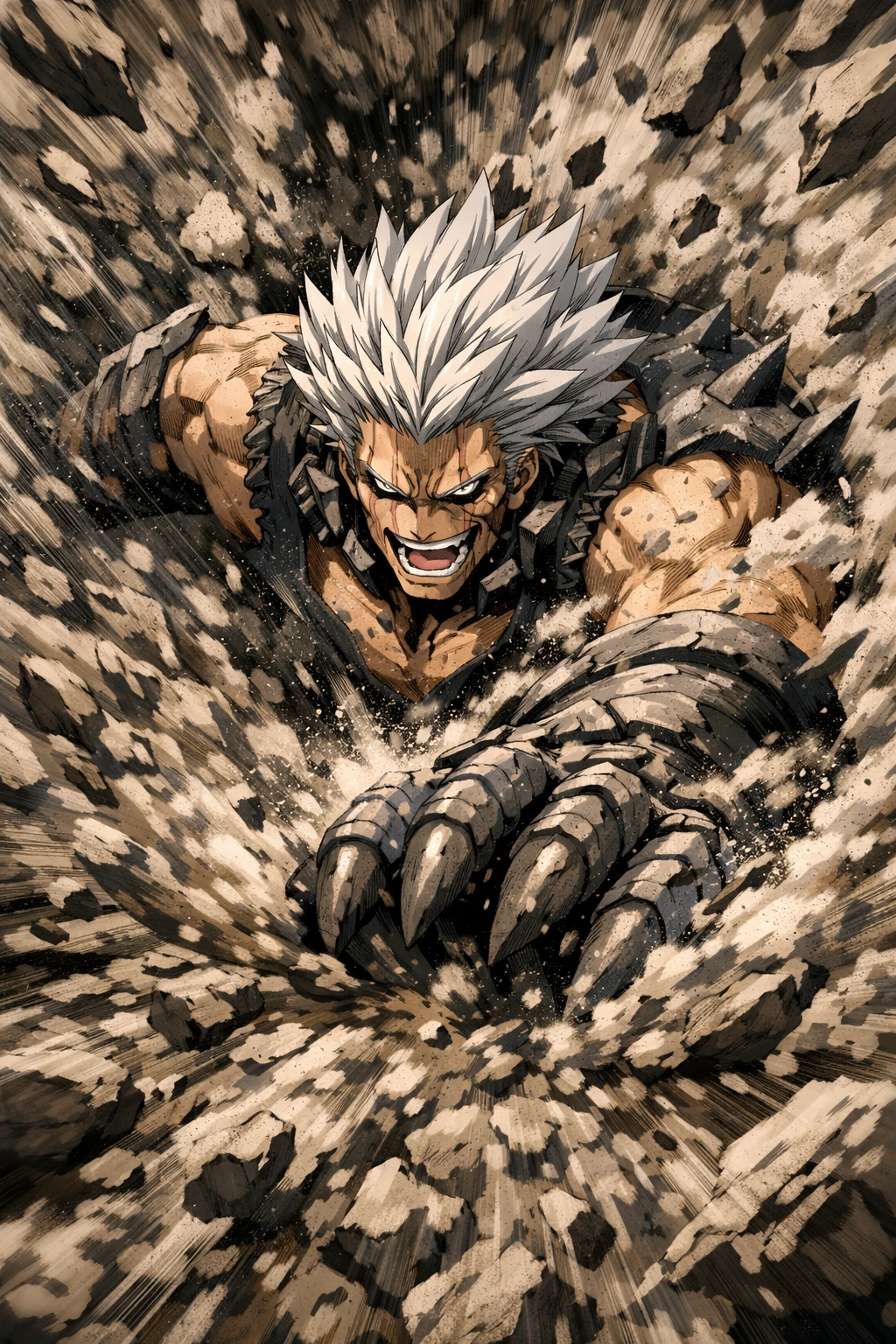
He is the core anomaly. Unlike the Nomu, Machia possesses a naturally absurd, superhuman physical constitution—a baseline durability so incredibly immense that it allowed him to seamlessly absorb multiple, powerful Quirks directly from All For One without suffering a total cognitive breakdown.
He retained his personality, his memories, and, most importantly, his capacity for absolute loyalty. He is a living, breathing testament to what happens when a naturally perfect vessel is filled with dark, engineered power.
The Synergy of Destruction
The true genius of Gigantomachia’s design is not merely the number of Quirks he possesses, but the terrifying, flawless synergy between them. Each Quirk covers a potential weakness, creating a closed-loop system of perpetual destruction.
First, the combination of Endurance and Pain Blocker forms his impregnable defense. Endurance grants him unfathomable stamina, allowing him to engage in high-intensity, cataclysmic combat continuously for weeks without a single moment of sleep. When coupled with Pain Blocker, which completely nullifies the brain’s reception of physical trauma, Machia becomes an unstoppable juggernaut.
He does not feel the sting of fire, the crush of gravity, or the piercing of blades. A shattered bone or torn muscle does not register as a reason to stop; it is merely an unacknowledged inconvenience. This combination turns him into a nightmare for conventional heroes, who rely on wearing their opponents down or forcing submission through pain.
Second, the offensive core of his power lies in Gigantification and Fierce Gains. While Gigantification allows him to grow to the size of a mountain, Fierce Gains operates on a terrifying feedback loop. His physical mass, muscle density, and raw kinetic output expand exponentially in direct correlation to his emotional state—specifically his excitement, battle lust, and anger. The harder he is fought, the more his blood boils, and the denser, larger, and more indestructible he becomes. It is a biological punishment for his enemies; the act of resisting him only serves to make him stronger.
Third, the Quirks Dog and Mole transform him into an inescapable, all-terrain predator. Gigantomachia is not a lumbering, blind giant. He possesses unparalleled, hyper-refined olfactory senses via the Dog Quirk, allowing him to isolate and track a specific scent—such as his master’s—across hundreds of miles, through the confusing stench of burning cities and thousands of people.
Once he has a target, the Mole Quirk allows him to disregard physical barriers entirely. He possesses the ability to burrow through solid earth, concrete, and bedrock as easily as a human swims through water. Walls, fortresses, and underground bunkers are utterly meaningless against a monster that can treat the earth’s crust as a fluid medium.
Finally, the ultimate biological cheat code: Energy Saver. A creature of Gigantomachia’s immense size, constantly regenerating tissue and outputting the kinetic energy of a small nuclear device, should theoretically require tons of raw caloric intake every single hour just to survive. The laws of thermodynamics demand fuel for energy.
Energy Saver bypasses this entirely, acting as a hyper-efficient biological battery that allows him to function at maximum output with virtually zero nutritional intake. He does not need to stop to eat, forage, or refuel. This Quirk alone elevates him from a biological organism to an unnatural, perpetual motion machine of death.
The Psychology of Fanaticism (The Radio and the Master)
The God Complex
Beneath the impenetrable hide and towering muscle lies a psychological landscape entirely defined by pathological fanaticism. Gigantomachia’s relationship with All For One cannot be accurately described using conventional terms like “boss,” “leader,” or “commander.” To Machia, All For One is a literal, infallible deity.
This god complex is the foundation of his entire worldview, dictated entirely by a rigid master/servant dynamic. He does not obey out of fear of punishment, nor does he serve for the promise of a reward. He obeys because, in his mind, serving All For One is the fundamental purpose of his existence, the very reason he draws breath.
He views the world in absolute, binary terms: there is the Lord, and there is everything else, which is nothing but dust waiting to be swept away. This total psychological surrender makes him immune to interrogation, psychological manipulation, or intimidation. You cannot break the spirit of a creature whose spirit completely belongs to someone else.
The Tears of the Behemoth
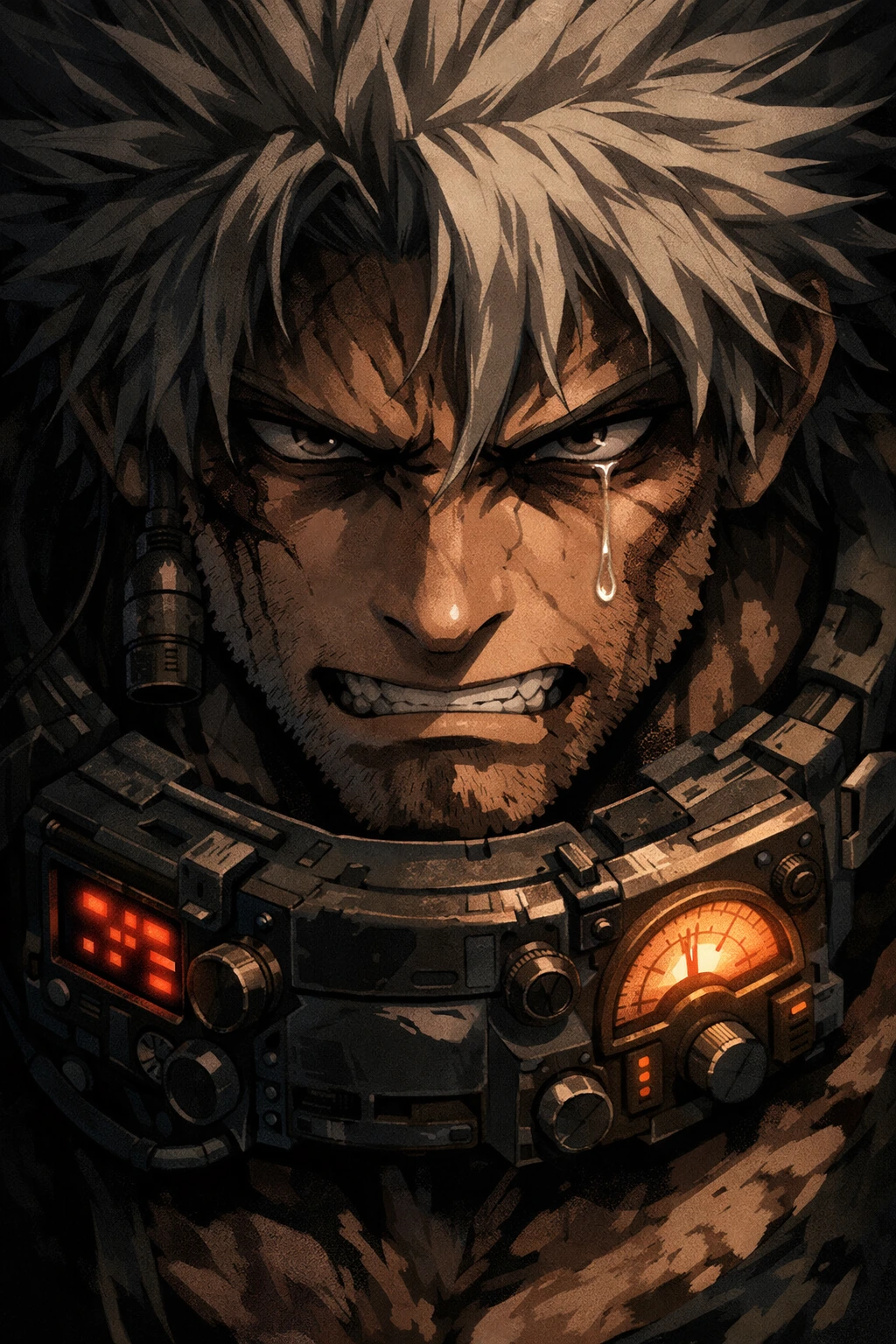
This intense fanaticism breeds a bizarre and deeply unsettling paradox: a monster capable of casually flattening mountain ranges spends a significant portion of his time weeping. Gigantomachia is highly prone to massive, violent outbursts of tears. These are not tears of physical pain—which he cannot feel—nor are they tears of empathy or sadness for his victims.
His emotional fragility stems entirely from acute, paralyzing separation anxiety. When disconnected from his Lord, or when he feels he cannot immediately fulfill a command, he falls into a deep, volatile despair. He weeps for the absence of his god. He cries out of the desperate, burning need to be useful to the only being that gives his life meaning. This juxtaposition of world-ending physical might and infantile emotional dependence creates a deeply disturbing psychological profile, highlighting the complete erosion of his independent self.
The Radio Receiver
Because of this intense separation anxiety, Machia requires a strict, physical trigger mechanism to maintain his focus and obedience: the customized radio he wears around his neck. This oversized device is not merely a tool for two-way communication; it is his lifeline to sanity.
Hearing All For One’s voice, even a pre-recorded or synthetically replicated transmission, is the only thing that gives his chaotic life immediate direction and peace. The radio is a tether that pulls the rabid beast back into a state of focused servitude. Without the voice coming through the static, he is prone to aimless, destructive tantrums.
When the voice speaks, however, the tears dry instantly, the erratic behavior ceases, and the weeping giant transforms into a cold, hyper-focused weapon locked onto its target. The radio is the leash, and the voice is the only hand capable of holding it.
The Crucible of Succession (Taming the Beast)
The Rejection of the Heir
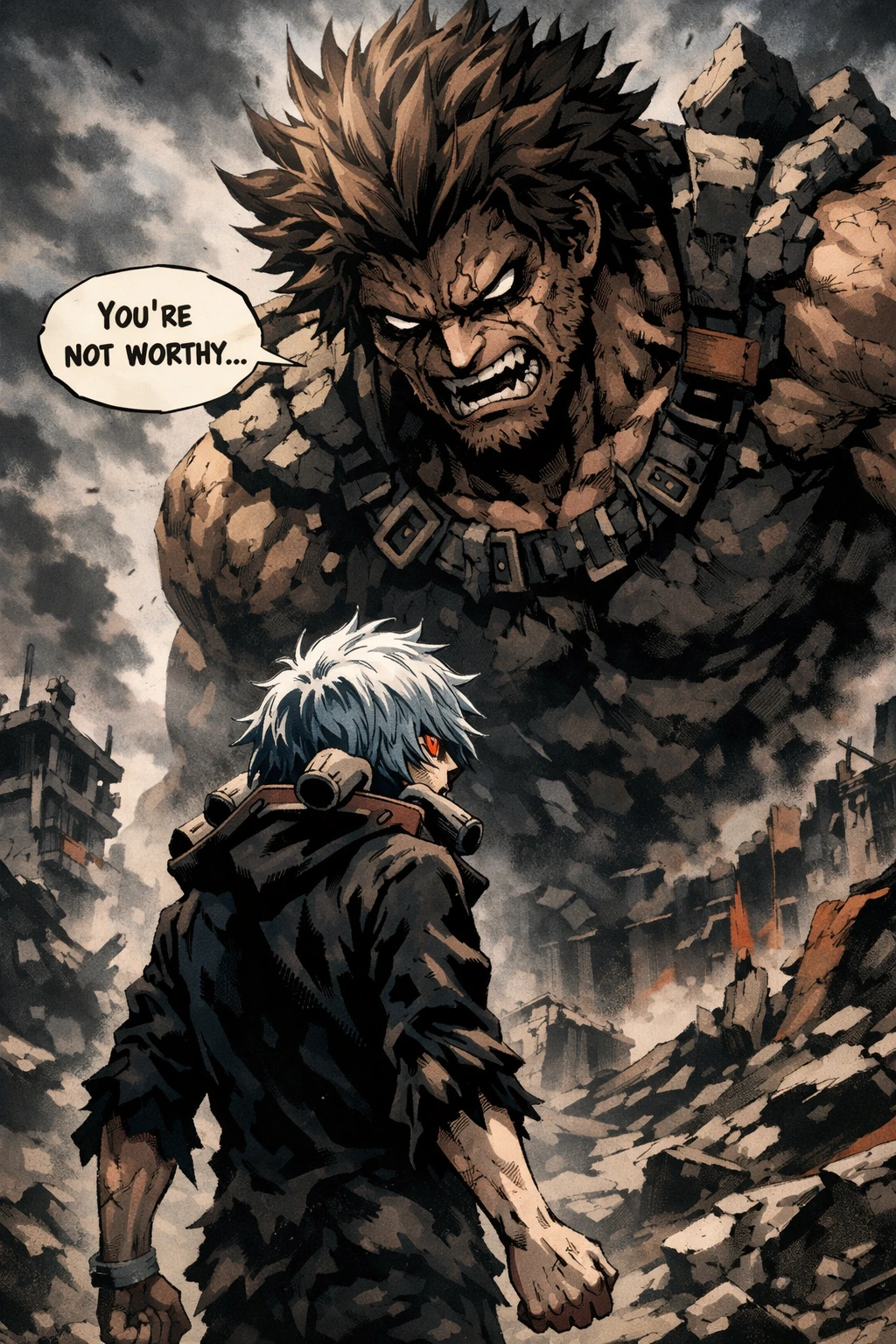
The transition of power from All For One to his chosen successor, Tomura Shigaraki, presented the ultimate stress test for Gigantomachia’s programming. When first introduced to Shigaraki, Machia’s reaction was one of visceral, violent disgust. He engaged in a profound rejection of the heir. To the beast, the remnants of the League of Villains were nothing more than weak, pathetic children playing at being criminals.
They lacked the overwhelming aura, the terrifying presence, and the sheer, unadulterated power of his beloved Lord. Machia viewed Shigaraki not as a prince, but as an insult to All For One’s legacy. He could not comprehend why his god would leave his empire to a fragile, dusty boy.
This rejection was not passive; it was violently aggressive. Machia actively sought to crush the League, viewing them as unworthy insects that needed to be purged for daring to associate themselves with the master’s mantle.
The Month-Long Siege
What followed was the most grueling, agonizing crucible the League of Villains ever faced: a desperate, tactical siege to tame a seemingly untamable monster. The parameters of this conflict were horrifyingly skewed against Shigaraki and his crew. They were forced into a relentless combat scenario against a behemoth that required no sleep, took no breaks, and felt absolutely no physical pain.
For weeks, Machia would engage them for forty-eight hours straight, forcing the League to fight for their lives without a moment’s rest, before he would abruptly fall asleep for a mere three hours, only to wake up and resume the slaughter. This tactical nightmare completely exhausted the League’s physical, mental, and emotional reserves.
Shigaraki, operating on microscopic amounts of sleep, was pushed to the absolute ragged edge of human endurance. It was a brutal war of attrition where the villains were forced to level up their Quirks, their teamwork, and their sheer willpower just to survive another hour against the walking mountain.
The Submission
The turning point of this hellish month occurred amidst the chaos of Deika City, during the clash with the Meta Liberation Army. Exhausted, bleeding, and pushed beyond all mortal limits, Shigaraki underwent a profound psychological and physical awakening. His Quirk, Decay, evolved from requiring a direct, five-finger touch to a spreading, unstoppable wave of disintegration that leveled massive sections of the city in seconds. But more importantly, Shigaraki’s aura changed.
As he laughed amidst the falling debris, radiating pure, unrestrained destructive intent, he ceased to be a mere successor playing a role; he became a terrifying monarch in his own right. Gigantomachia, rushing to the scene, witnessed this apocalyptic display of power. He felt the sheer, terrifying supremacy radiating from the young man. For the first time, Machia saw the shadow of All For One overlapping with Shigaraki.
The beast was not conquered by bloodline, legal succession, or polite requests; he was forced to his knees by raw, undeniable, terrifying power. Machia wept, finally recognizing a master worthy of his absolute devotion, formally submitting his immense power to Shigaraki’s cause.
The Jaku City Rampage (A Weapon of Mass Destruction)
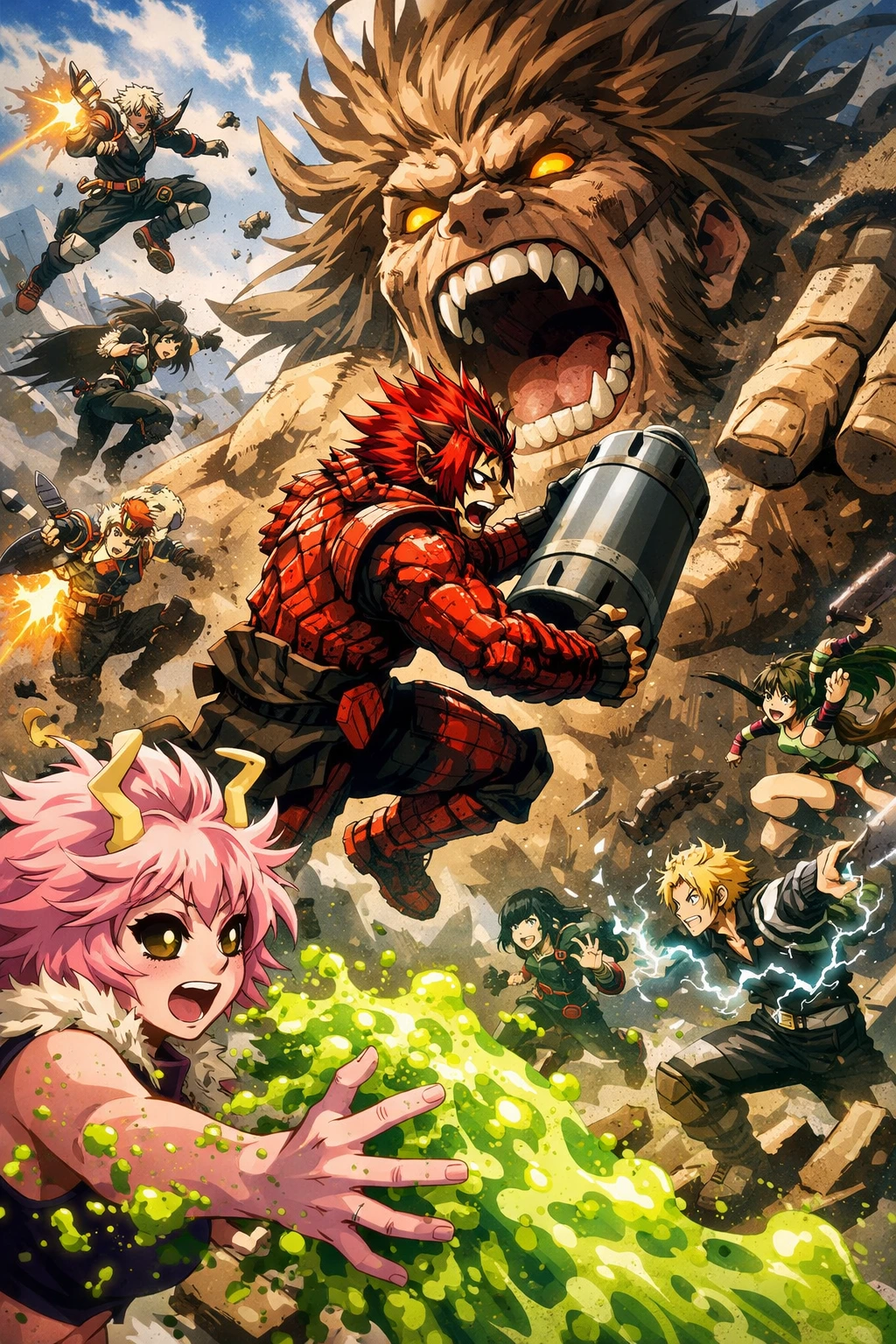
The Scent of the King
The true, horrifying scale of Gigantomachia’s power was unleashed during the climax of the Paranormal Liberation War. Held in reserve miles away from the primary conflict, Machia remained dormant, awaiting a command. The catalyst was the exact, chilling moment Tomura Shigaraki awoke from Dr. Garaki’s vat, his body enhanced and his Quirks multiplied.
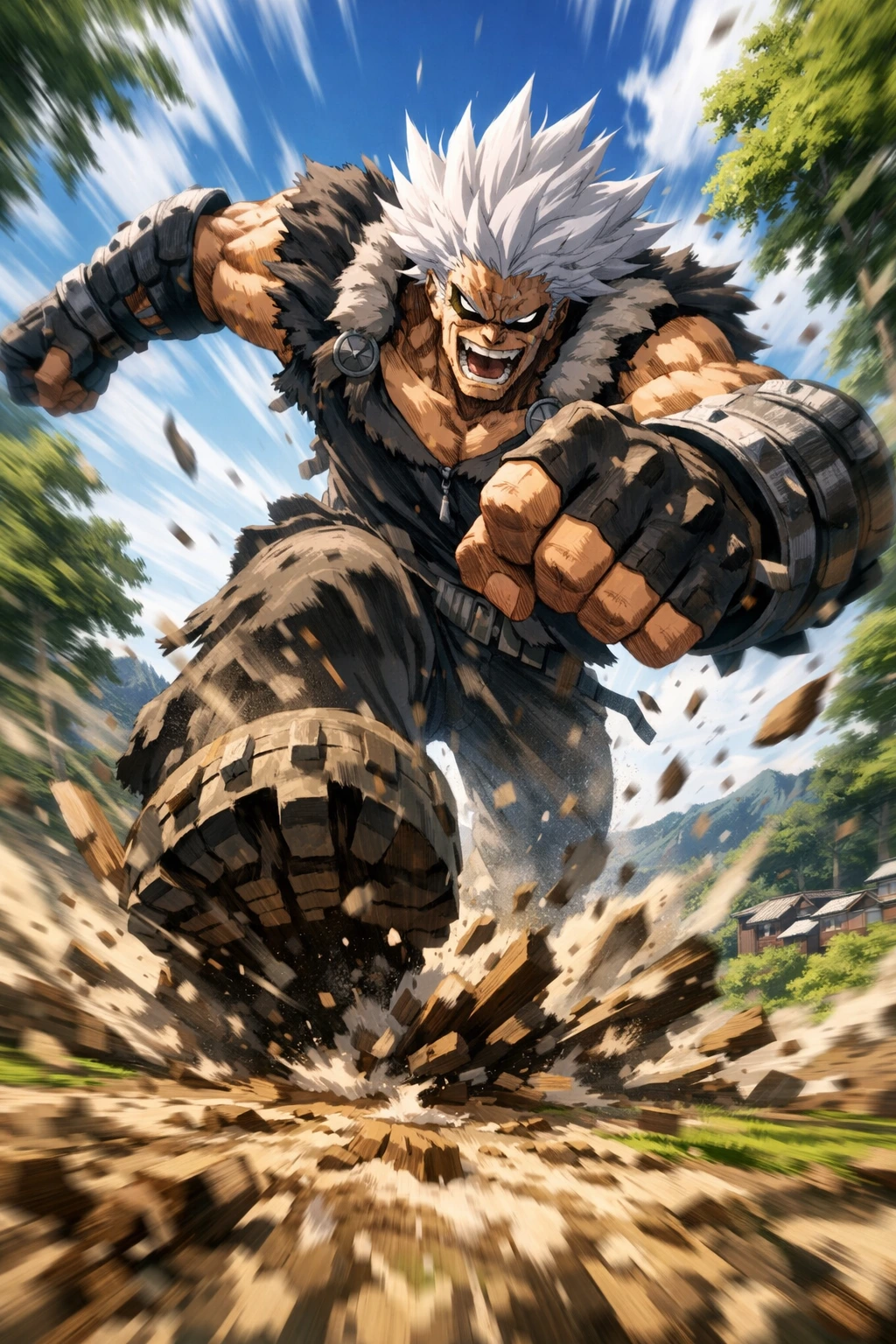
Even from miles away, through his heavily augmented canine senses, Machia instantly detected the scent of his newly awakened king. It was a scent that commanded obedience, a primal olfactory trigger that flipped a switch deep within the beast’s brain. Without hesitation, without needing a radio transmission, Machia rose from the earth and began a dead sprint across the Japanese countryside. His destination was fixed; his master was calling, and absolutely nothing in the mortal realm was going to stop him from reaching Shigaraki’s side.
The Unstoppable Force
What followed was a terrifying display of localized physics breaking down. Gigantomachia did not “fight” the Pro Heroes attempting to intercept him; he simply walked through them. The concept of combat implies a two-sided exchange of blows; for Machia, it was merely the act of traversing terrain. He trampled entire cities under his colossal feet, crushing multi-story buildings as if they were made of brittle sugar glass.
When Mt. Lady, a Pro Hero capable of her own massive gigantification, attempted to physically restrain him, the visual was striking and deeply disturbing. Despite being roughly the same height, the difference in sheer, dense mass and kinetic output was staggering. Machia casually brushed her aside, overpowering a fellow giant with the careless effort a human might use to swat away a persistent fly.
The sheer physics of his march caused catastrophic civilian casualties and infrastructure collapse simply by the act of him taking a stroll. Every footstep triggered localized seismic events; every swing of his arms generated hurricane-force winds that tore rooftops from houses.
The Fall of Midnight
The brutal, tactical reality of his wake was nowhere more evident than in the tragic fate of the R-Rated Hero, Midnight. Machia was not aiming for her; she was merely an obstacle in his direct path. Attempting to deploy her somnambulist Quirk, Midnight was caught in the peripheral devastation of his passing.
The sheer kinetic shockwave of his movement, combined with the lethal spray of shattered concrete and debris he kicked up, was enough to critically wound a top-tier Pro Hero. Machia did not even register her existence as he barreled past.
Her catastrophic injuries, sustained simply by being too close to his horrifying momentum, left her incapacitated and bleeding in the forest, ultimately leading to her tragic execution at the hands of trailing Paranormal Liberation Front soldiers. Her death stands as a grim testament to the fact that fighting Gigantomachia is akin to fighting a hurricane—the collateral damage is just as lethal as a direct strike.
The Majestic Defense (Class 1-A’s Masterpiece)
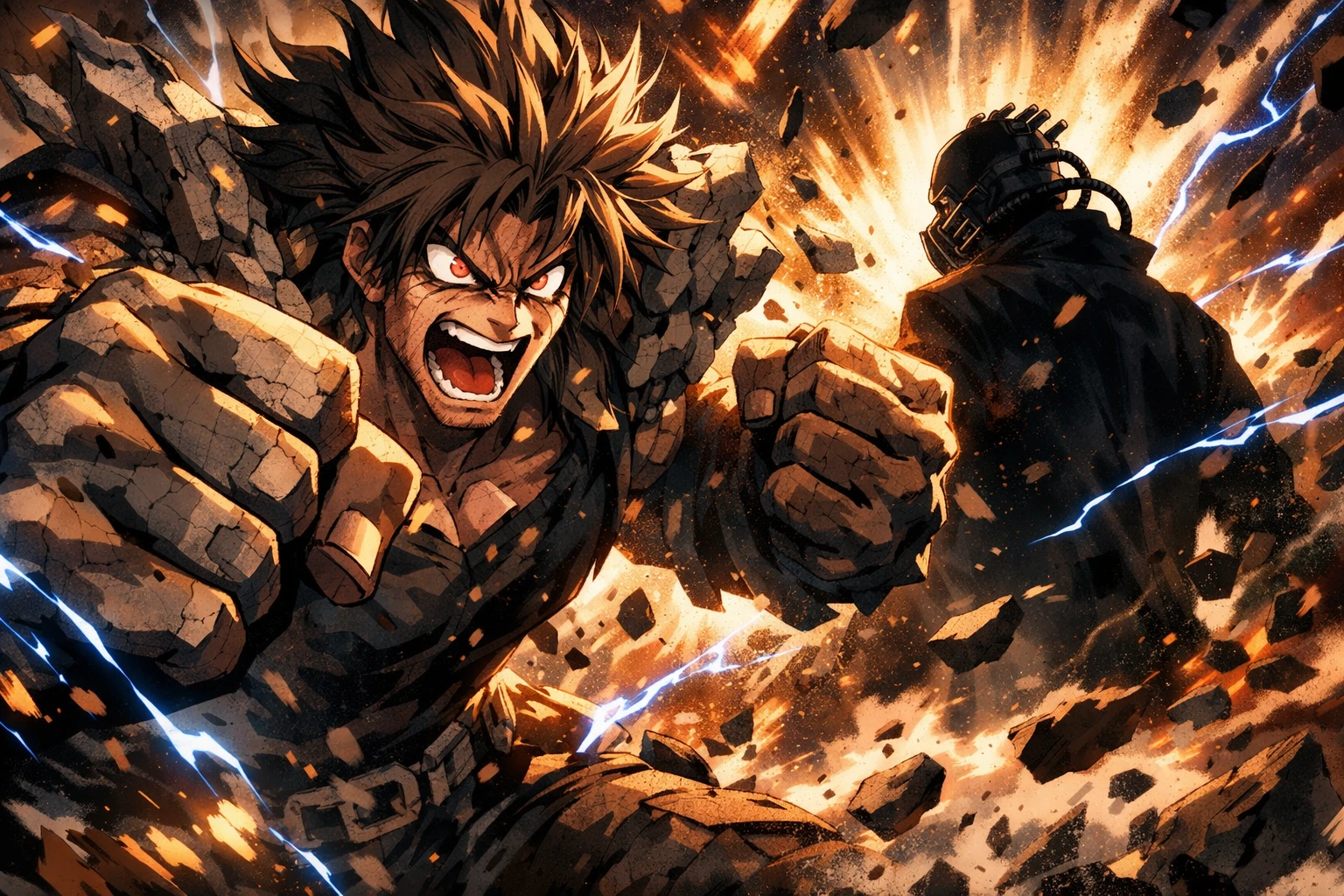
The Improvised Trap
As Gigantomachia carved his apocalyptic path toward Jaku City, leaving veteran Pro Heroes broken in his wake, the desperate task of halting his advance fell to the students of U.A.’s Class 1-A. Faced with a monster that had literally walked through the country’s greatest defenders, Momo Yaoyorozu executed a brilliant, on-the-fly tactical pivot.
Her analytical mind quickly deduced the horrifying truth: blunt force, fire, ice, and conventional Quirks were mathematically useless against a mountain that possessed infinite stamina and felt zero pain. To continue a traditional physical assault was suicidal.
Therefore, she shifted the entire paradigm of their defense, pivoting away from kinetic combat and entirely toward chemical warfare. The goal was no longer to beat him into submission—an impossible task—but to exploit his biological functions against him by introducing an overwhelmingly powerful, concentrated sedative into his bloodstream.
The Sedative Delivery
Executing this improvised trap required a precise, highly coordinated strike from the students, relying on immense bravery and perfect timing. The operation hinged on breaching Machia’s impenetrable defense. Mina Ashido, conquering her own deep-seated, paralyzing childhood trauma involving the giant, utilized her maximum-output acid to literally melt away the hardened, rocky armor protecting Machia’s face and jaw. This created a microscopic window of vulnerability.
When Mina was violently swatted away, Eijiro Kirishima, embodying the absolute pinnacle of unbreakable resolve, caught the falling vial of sedative. Activating his Red Riot Unbreakable form, Kirishima scaled the screaming, thrashing behemoth, weathering a storm of debris and physical blows that would have pulverized a normal human. With pinpoint accuracy born of pure desperation, he physically hurled the concentrated canister of anesthetic directly into the beast’s roaring mouth. It was a masterpiece of student coordination, succeeding where seasoned military tactics had failed.
The Delayed Biological Collapse
However, the terror of Gigantomachia did not end the moment he swallowed the chemical. In a horrifying display of his unnatural biology, his massive metabolism and the continuous activation of his “Fierce Gains” Quirk actively fought off the immense dose of anesthetic. His sheer rage and forward momentum forced his body to burn through the sedative, allowing him to continue his rampage for several more devastating miles.
The students watched in horror as their ultimate trump card seemingly failed. But science, unlike heroics, operates on strict biological laws. Slowly, inevitably, the chemicals overwhelmed even his monstrous liver and nervous system. The delayed collapse occurred at the most dramatically critical moment—precisely when he finally breached the ruined perimeter of Jaku City and arrived at Shigaraki’s side.
Just as he prepared to annihilate the remaining, exhausted Pro Heroes, his eyes rolled back, his colossal muscles went slack, and the mountain finally crashed to the earth. The delayed effect underscored just how incredibly durable Machia was, while also highlighting that even a bio-engineered god must eventually succumb to chemistry, saving the heroes from total, unmitigated annihilation.
The Final War: The Master Betrayed
The Brainwashing Gambit
In the grueling aftermath of the Paranormal Liberation War, the subdued Gigantomachia was heavily contained, heavily sedated, and locked within an underground, maximum-security facility. He was deemed too dangerous to execute and too volatile to move. However, as the final, apocalyptic war against All For One and Shigaraki loomed, the heroes conceived a desperate, highly risky trump card.
Realizing they lacked the sheer physical firepower to hold the line, they decided to weaponize the calamity. The gambit relied on Hitoshi Shinso, whose “Brainwashing” Quirk allowed him to control anyone who verbally responded to him. By utilizing his Persona Chords to flawlessly replicate the voice of All For One, Shinso triggered Machia’s deeply ingrained, fanatical obedience. When the giant responded to what he believed was his Lord’s voice, Shinso snapped the mental trap shut, successfully hijacking the mind of the underworld’s greatest beast.
The Aerial Assault
The deployment of this hijacked weapon resulted in one of the most cinematic and awe-inspiring spectacles of the final war. The heroes did not simply march Machia to the battlefield; they airlifted him. Strapped heavily to the underside of a massive cargo aircraft, the slumbering, brainwashed behemoth was flown directly over the intensely contested airspace where All For One was dominating the Pro Heroes.
In a breathtaking tactical maneuver, the restraints were cut. Dropping a multi-Quirk giant—weighing thousands of tons—out of the sky directly onto a battlefield was the equivalent of calling in a localized meteor strike. The sheer seismic impact of his landing cratered the earth, instantly shifting the momentum of the battle and presenting All For One with his own creation turned violently against him.
The Awakening of Hatred
The true emotional climax of Gigantomachia’s arc, however, was not his grand entrance, but his violent awakening. During the chaotic clash, the intense physical trauma and the sheer volume of competing voices eventually shattered Shinso’s brainwashing hold. Machia awoke, confused and disoriented, searching frantically for his master. When his eyes finally locked onto All For One, the beast expected praise, guidance, or at least acknowledgment.
Instead, he found cold indifference. Through the ensuing dialogue and the realization that he had been left behind in Jaku City, the horrifying truth dawned on his simple mind: All For One had intentionally abandoned him. The master had left his most loyal hound to be captured, viewing him not as a devoted servant, but as disposable, expired trash.
The emotional whiplash was absolute. The unbreakable fanaticism fractured, replaced instantly by a sheer, unprecedented fury. The ultimate loyalist, a creature whose entire existence was predicated on love for his creator, experienced the profound, agonizing sting of ultimate betrayal.
The Final Clash
This realization birthed a new, terrifying emotion within the beast: pure, unadulterated hatred. Machia, weeping tears not of separation anxiety, but of profound, heart-shattering rage, turned his catastrophic power directly against his former master. The ensuing clash was a violent, titanic spectacle of poetic justice.
It proved that even a bio-engineered beast, programmed down to its very DNA for blind, unquestioning obedience, possesses a definitive breaking point when its absolute loyalty is spat upon. Machia battered All For One with the very strength the villain had bestowed upon him, a living manifestation of the dark lord’s hubris returning to destroy him.
Though All For One ultimately dealt with the treacherous beast, Machia’s rebellion was a vital, time-buying distraction that severely depleted the villain’s resources, cementing the giant’s tragic but impactful legacy in the final conflict.
Conclusion
The Hurdle of Raw Power
In analyzing the entirety of his existence, Gigantomachia stands as the ultimate physical ceiling of the My Hero Academia universe. He was a force of nature—a hurricane wrapped in bedrock and muscle—that fundamentally changed the rules of engagement.
He proved, emphatically, that there is a threshold of raw, overwhelming power that simply cannot be defeated by courage, willpower, or matching strength with strength. When faced with an indestructible, unfeeling calamity, the heroes were forced to evolve.
He could not be punched into submission; he could only be defeated through intellect, tactical sacrifice, and precise chemical science. He forced characters like Momo Yaoyorozu to embrace their strategic genius, proving that in a world of gods and monsters, sometimes a well-placed vial of sedative is more powerful than the hardest punch.
Closing Thoughts
From a narrative perspective, creator Kohei Horikoshi utilized Gigantomachia masterfully to transition the series from its localized, episodic roots into a grim, sprawling saga of apocalyptic warfare. Prior to Machia’s rampage, villain attacks were largely contained incidents—a raid on a training camp, a skirmish in an alleyway, or a localized strike on a city ward.
Gigantomachia shattered that localized scale. His march across Japan expanded the scope of the story to a national, catastrophic level, bringing the reality of civilian casualties, widespread infrastructure collapse, and the death of veteran heroes to the forefront. He was the bridge between the ‘school days’ of U.A. and the grim, militaristic reality of the final war. Gigantomachia was never just a henchman; he was the monstrous herald of the end times, and his terrifying legacy will forever scar the landscape of hero society.