
Introduction: The Commander Standing on a Mountain of Corpses
Erwin smith hero or monster
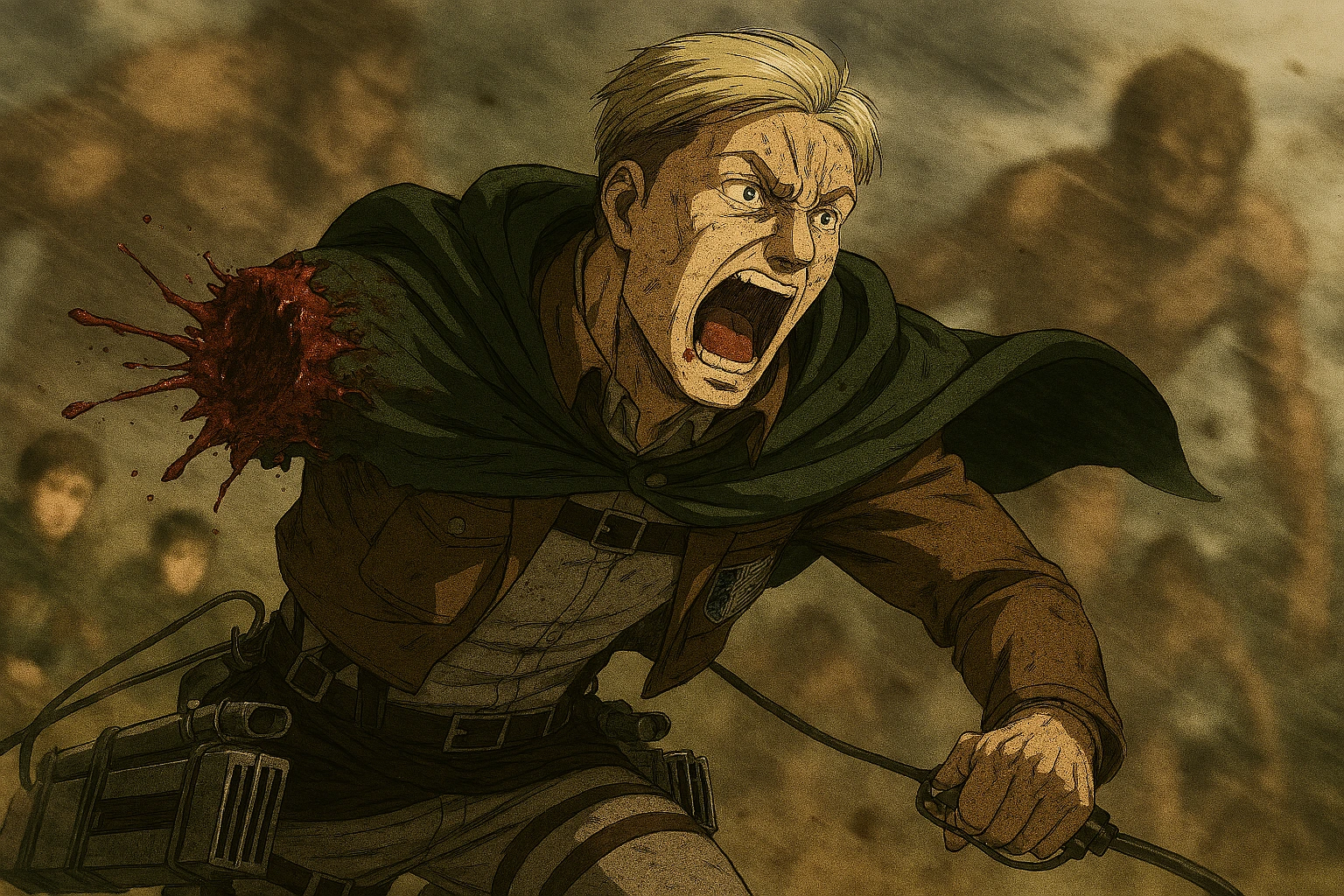
The air is thick with the scent of pulverized rock and iron-scented blood. The ground trembles rhythmically, a terrifying bass drum announcing the approach of the Beast Titan, a creature that seems to treat warfare as a grotesque game.
In the face of absolute annihilation, where the evolutionary instinct of every living creature screams to flee, one man rides forward against the tide of fear. He does not offer safety. He does not promise survival. He offers only a glorious, agonizing end.
“My soldiers, rage! My soldiers, scream! My soldiers, fight!”
This moment—the suicide charge at Shiganshina—is arguably the single most iconic sequence in the history of anime. It is a crescendo of despair and heroism that defines the brutal world of Attack on Titan.
But to view it simply as a heroic sacrifice is to misunderstand the complex, tragic architecture of Erwin Smith’s character entirely. How does a man convince hundreds of terrified recruits, young men and women with their entire lives ahead of them, to ride directly into a barrage of crushed boulders that will turn them into red mist?

He does not do it with truth. He does not do it with cold logic. He does it with a masterful, necessary lie. He does it by becoming something larger than a man, something terrifying enough to eclipse the Titans themselves.
Erwin Smith was not the noble paladin that the sanitized history books of Paradis might eventually paint him to be. He was a monster. But in a world besieged by literal man-eating giants, he was the necessary monster.
He understood a fundamental, uncomfortable truth about the cruel world he inhabited: to defeat demons, humanity could not rely on a saint. They had to send the Devil himself.
In the vast lore of Shonen anime, leaders are often depicted as beacons of unwavering morality—the pillars of pure justice whose internal compass never wavers. Erwin Smith deconstructs and obliterates this archetype.
He is a walking tragic paradox: the 13th Commander of the Survey Corps who sacrificed everyone for the sake of humanity, yet did it all primarily for himself.
He was a leader who preached with fiery charisma about the survival of the species while secretly harboring a selfish, almost childish dream that predated his military career.
He was a monumental con artist who scammed soldiers into dying for a meaning he fabricated, only to become the very hero he pretended to be in his final, blood-soaked moments.
This analysis seeks to excavate the soul of the man who stood on a mountain of corpses. We will dissect his journey through the rigorous lenses of Destiny vs. Effort and the crushing, often fatal weight of Hope vs. Reality,
ultimately aiming to answer the question that defined his existence: Was Erwin Smith humanity’s greatest savior, or was he merely the King of Corpses, building a throne from the dead to satisfy his own curiosity?
The Origin of the Devil: A Child’s Curiosity, A Father’s Death
To truly understand the “Devil,” we must strip away the green cape and the prestigious title and look at the man through the lens of Destiny vs. Effort. Unlike many protagonists or leaders in fiction who are born with a “chosen one” destiny, inherited powers, or royal lineage,
Erwin Smith was extraordinary because he was fundamentally ordinary. He possessed no Titan ability, no supernatural Ackerman reflexes, and no divine mandate. He was forged entirely by human guilt and intellectual obsession. His leadership wasn’t a gift endowed by fate; it was a lifelong penance for a childhood mistake.
The Question That Killed a Father
Erwin’s journey began in a classroom, not on a battlefield. As a child, he possessed an inquisitive mind that refused to accept the surface-level reality presented by the government within the Walls.
He was not satisfied with the comfortable dogma that humanity outside was extinct. When he raised his hand in class and asked his father—a humble teacher—about the glaring inconsistencies in the history books regarding humanity’s life before the Walls, he committed an innocent sin.

His father, trusting his son’s intelligence and perhaps underestimating the state’s paranoia, shared a private, dangerous theory in the safety of their home: the King had altered humanity’s memories.
The walls were not meant to keep Titans out; they were meant to keep humanity in, caged in ignorance. Erwin, in his youthful naivety, shared this fascinating theory with his peers in the town square. The Military Police heard the chatter. Days later, his father “died in an accident” far from home.
This is the “Inciting Trauma” that defined every waking moment of Erwin’s subsequent existence. He realized with shattering clarity that his curiosity, his simple, innocent desire for truth, had murdered the person he loved most.
The blood of his father was on his hands before he ever picked up a blade. This trauma stripped him of the luxury of innocence. While other children played at being soldiers, Erwin realized the government meant to protect them was actually the enemy of truth.
The Mechanism of Guilt and the Burden of “Effort”
From that day forward, Erwin’s life stopped being his own. He didn’t join the military out of a generic desire to “save humanity.” That is the narrative the public believes; that is the statue they would build in the town square.
In reality, Erwin joined the Training Corps and later the suicidal Survey Corps for a singular, focused purpose: to prove his father’s theory right.
He needed to reach the basement in Shiganshina, to find the truth about the world, to absolve himself of the crushing guilt that he had killed his father for a delusion.
The stakes of his life became deeply psychological: If his father’s theory was true, his father’s death was a tragedy, but a meaningful one—a martyrdom for knowledge. If the theory was false, Erwin had killed him for absolutely nothing.
This creates a fascinating, almost sociopathic friction between the public perception of Commander Smith and his internal reality.
The world saw a selfless commander dedicated to the wings of freedom. Erwin, looking in the mirror, saw a selfish child dragging a trail of bodies behind him to validate his own ego. His immense “Effort”—his obsessive study of strategy, his calculated rise through the ranks, his chilling political maneuvering—was not driven by altruism.
It was driven by a desperate need for personal redemption. He became the best commander in history not because he loved humanity more than anyone else, but because he loved the Truth more than he loved human life.
This distinction is crucial. It separates him from characters like Armin Arlert. Armin wants to see the ocean because he loves the world and its wonders; Erwin wants to see the basement because he needs to know he wasn’t wrong.
Armin looks outward with hope; Erwin looks inward with obsession. Erwin’s effort was a frantic, decades-long attempt to outrun his own guilt, building a mountain of corpses high enough to reach the window of truth his father had cracked open.
The Gambler’s Strategy: Cold Logic in a World of Madness
Erwin Smith’s greatest contribution to humanity was transforming the Survey Corps from a gloried suicide squad into a functional, lethal military force.
Before his command, the Scouts operated on blind bravery and fervor. They rode out, fought Titans head-on in chaotic melees, and died in droves.
Erwin introduced the chilling concept of calculated “acceptable losses” to a world that only knew “total loss.”
The Long-Range Scouting Formation: Operationalizing Survival
Erwin’s strategic genius lay in his ability to separate Hope from Reality. He understood earlier than anyone else that fighting Titans in open combat was a losing game.
The physical disparity was too great; the intelligence gap too wide. The only winning move was information and avoidance.
The Long-Range Scouting Formation was a masterclass in logistics, communication, and spatial awareness. By spreading his forces thin and using colored signal flares to relay the position of Titans across vast distances, Erwin turned the scattered Survey Corps into a single, fluid organism with a massive sensory radius.
This formation increased the survival rate of the Scouts exponentially on expeditions.
However, the brilliant mechanics of this strategy also highlighted his fundamental ruthlessness. The formation relied entirely on the outer flanks spotting Titans first.
Those soldiers were essentially bait—biological sensors doomed to likely die or flee in terror just to buy seconds for the center column to adjust course. Erwin quantified human life into data points on a map.
If sacrificing three soldiers on the right flank saved thirty in the center column where the supplies and elites were, Erwin made that trade without a flicker of hesitation.
This is the “Cruelty” of the world embodied in a commander. He did not waste lives recklessly, but he spent them freely like currency when the mathematical odds favored the mission.
The Female Titan Trap: The Stohess District Raid
The capture of the Female Titan (Annie Leonhart) in the Stohess District within Wall Sina is the perfect case study of Erwin’s governing philosophy: The outcome justifies the horrific process.
To catch a monster hiding in human skin, a being capable of intelligence and foresight, Erwin realized standard tactics would fail.
He had to turn a populated city into a trap. He did not evacuate the civilians. He did not warn the local government. Why? Because doing so would have alerted the spy within their ranks.
Erwin coldly calculated that the civilian casualties resulting from a Titan battle erupting in densely packed city streets were an “acceptable loss” compared to the potential extinction of humanity if the spy escaped with Eren.
The streets ran red with the blood of innocents crushed by debris and Titan footsteps. When Nile Dok, the Commander of the Military Police, pointed a gun at Erwin’s head amidst the carnage and demanded an explanation for turning the capital into a slaughterhouse, Erwin didn’t flinch.
“If you can’t abandon your humanity, you can’t change anything.”
This quote is the core of his strategic mind. He realized that playing by moral rules in a war against man-eating giants was a death sentence.
To defeat monsters, one must adopt their methods. He was willing to be the villain, to be hated by the populace, to face execution for treason, as long as the mission succeeded.
This is a stark, jarring contrast to typical Shonen heroes who strive to save everyone, often succeeding through sheer willpower.
Erwin knew he couldn’t save everyone, so he chose to save the future by ruthlessly spending lives in the present.
The Architecture of a Coup: Winning Without Blades
While his strategies against Titans are legendary, Erwin’s true brilliance shines in the Uprising Arc. This arc removes the Titan threat and pits Erwin directly against the corrupt Monarchy and the Interior Military Police.
It is here that we see the “Con Artist” and political manipulator at his absolute peak.
Erwin realized that the true enemy blocking humanity’s progress was not just outside the walls, but inside the capital, hoarding secrets and suppressing technology.
To save humanity, he had to overthrow the government. But how does a military commander overthrow a King respected by the people without causing a civil war that destroys the very society he wants to save?
He gambled everything on theater.
In the Royal Throne room, stripped of his uniform, beaten, and facing certain execution for treason, Erwin did not fight physically.
He simply waited for his trap to spring. He had orchestrated a false alarm—a lie that the Armored Titan and Colossal Titan had breached Wall Rose, sending refugees flooding toward the capital.
He bet his life on the selfishness of the ruling class. He forced the nobility to show their true colors in front of the supreme military commanders, Darius Zackly and Dot Pixis.
Predictably, the nobles ordered the gates of the capital closed, condemning half of humanity to death to save their own skins. In that moment, they lost their mandate to rule.
This was not a battle of strength; it was a masterclass in psychological warfare. Erwin manipulated the entire political structure of Paradis, orchestrating a bloodless coup from the position of a prisoner in handcuffs.
This proves that his “power” did not come from physical might, but from a supreme intellect and a terrifying ability to predict and manipulate human fear and greed.
He outplayed the King at his own game, revealing that the greatest weapons in Attack on Titan were often words and deception.
The Great Lie: “Dedicate Your Hearts”
We must critically deconstruct the most famous, adrenaline-inducing phrase in the series: Shinzou wo Sasageyo (“Dedicate your hearts”).
To the soldiers standing in formation, this phrase was a sacred vow. It meant: “Give your life for the survival of humanity. Your death means our species lives another day.”
To Erwin Smith, the man shouting it from the podium, this phrase often meant something far darker: “Give your life so I can get one step closer to the basement.”
The Con Artist of the Corps
Erwin Smith is arguably the greatest con artist in anime history. He didn’t scam people out of money; he scammed them out of their futures. He utilized the dynamic conflict between Hope and Reality as a weapon to manufacture consent for suicide missions.
He understood the fundamental psychology of soldiers facing Titans. Human beings cannot face certain death for a statistic. They cannot die for “logistics” or a slightly improved supply line.
They need meaning. They need a grand narrative that elevates their gruesome death into something noble. So, Erwin crafted the narrative of the “brave Survey Corps soldier dying for freedom.”
He stood on podiums, his voice booming with practiced charisma, his eyes shining with an intensity that looked like hope, selling a dream that he knew was largely a fabrication designed to keep the meat grinder turning.
He admitted this in a moment of rare, chilling vulnerability to Dot Pixis over drinks. He confessed that he was tricking his subordinates.
He admitted he was leading them to their deaths not solely for the noble cause they fervently believed in, but to satiate his own “childish curiosity.”
He self-deprecatingly compared himself to a child who never grew up, still trying to prove his father right, while everyone around him was forced to grow up and die for his obsession.
This confession recontextualizes every inspiring speech he ever gave. Was he inspiring them, or was he manipulating them?
The uncomfortable answer, central to his tragedy, is: both. And that is why he is the “Devil.” A true hero inspires with truth; a Devil manipulates with necessary lies to achieve a greater good that only he can see.
The Throne Room of Guilt
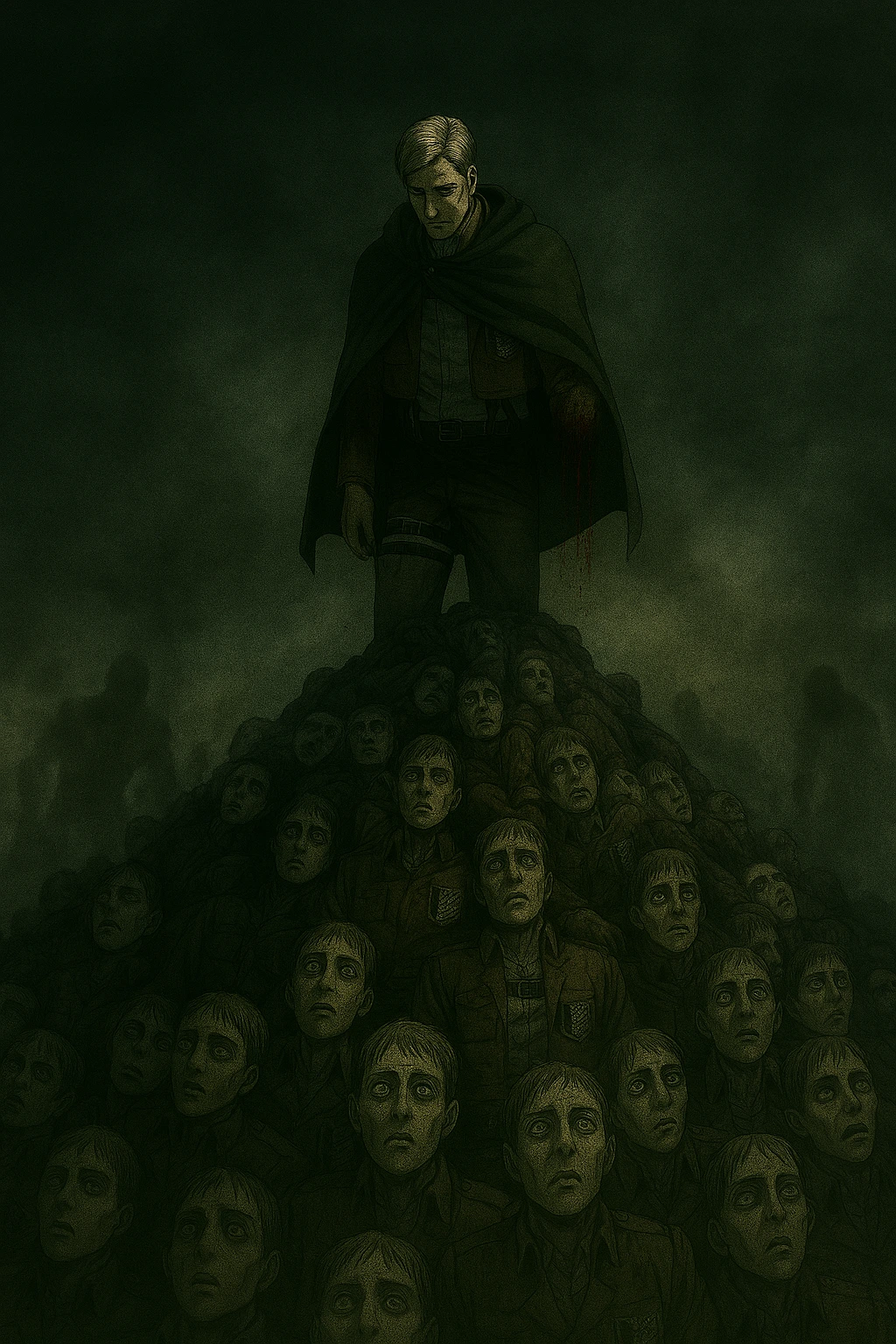
This internal conflict is not without cost. It manifests physically in his haunting hallucination of the “Mountain of Corpses.”
In private moments of despair, Erwin sees the ghosts of the soldiers he sent to their deaths standing on a massive pile of their own broken bodies, staring at him with hollow eyes.
Crucially, they are not angry. They are not screaming for revenge. They are simply waiting. They are waiting for him to fulfill his end of the bargain. They are waiting for him to reach the truth and prove that their deaths had meaning.
This is where the “Con Artist” persona cracks, revealing the human beneath. If Erwin were truly a sociopath, he wouldn’t care about the dead.
But he cares deeply. He remembers their names. He remembers their faces. The profound irony of Erwin Smith is that he feels the crushing weight of every single life he spends, yet he possesses the fortitude to spend them anyway.
He is a man who weeps internally while his face remains a mask of stone resolve.
He trapped himself in his own long con. To make the deaths of his comrades mean something, he had to keep going.
He had to reach the basement. If he stopped, he was just a mass murderer who got everyone killed for a fantasy. If he succeeded, retroactively, he became a savior.
He was gambling with human souls to clear his own conscience.
The mountain of corpses was not a trophy of war; it was a ticking clock. He had to reach the summit before the sheer weight of the dead crushed his mind completely.
The Ultimate Sacrifice: Giving Up the Dream at the Gates of Hell
The climax of Erwin’s character arc—and perhaps the zenith of the entire series’ exploration of leadership—occurs in the Shiganshina District during the “Return to Shiganshina” arc.
This is where the themes of Destiny vs. Effort and Selfishness vs. Selflessness collide in a violent resolution.
The Beast Titan has trapped the Scouts. He is decimating them with a barrage of crushed rocks that shreds buildings and bodies alike.
The situation is mathematically hopeless. Erwin, ever the strategist, devises one final, horrific plan: a suicide charge of the remaining recruits straight into the rock barrage to create a smoke screen, allowing Levi to flank and assassinate the Beast Titan.
But there is a catch. To make the green troops charge into certain death, Erwin must lead them. He must be at the front. He must be the first to die.
The Tragedy of Proximity and Kenny’s Philosophy
The tragedy of this moment is absolute. The basement—the object of his lifelong obsession, the answer to the question that killed his father, the reason he sacrificed thousands of soldiers, the justification for his entire existence—is right there. It is a few hundred meters away. He can see the roof of Eren’s house.
If he flees now, he could hide in the ruins. He could wait for the battle to end. Win or lose, he could sneak away and finally see the basement.
He could finally know the truth. But if he does that, Levi fails, the Scouts are wiped out, and humanity loses its last hope.
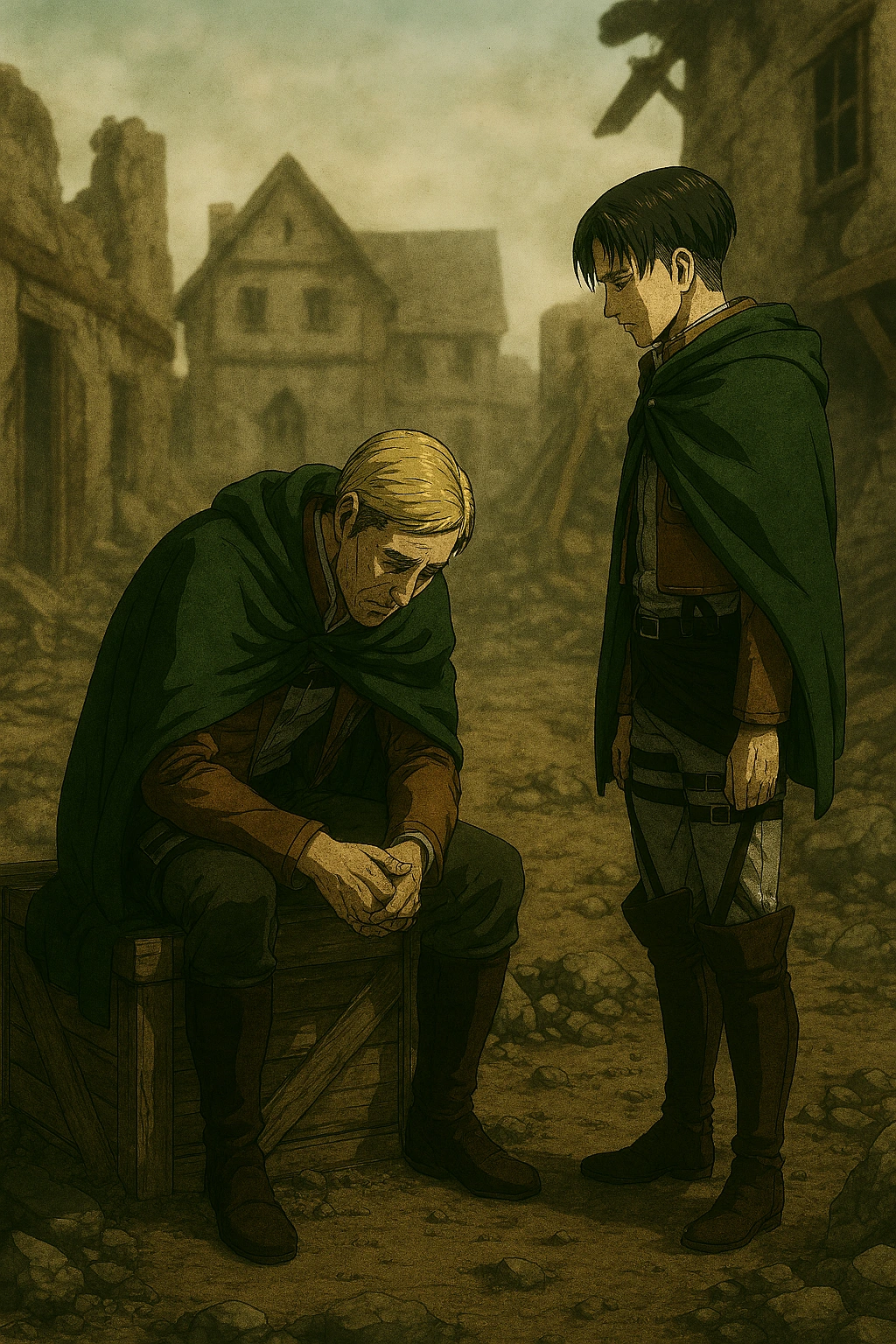
Erwin sits on a crate, his head bowed low, the weight of the world finally breaking his posture. For the first time, the towering commander looks small.
He confesses to Levi in a voice stripped of all charisma: “I want to go to the basement.” It is a heartbreaking admission of humanity.
After all the grand speeches about saving the species, all he wants, with the desperate simplicity of a child, is to see what’s in the basement.
To understand this moment, we must reference the final words of Kenny Ackerman, another man defined by violence: “Everyone I’ve met… was all the same.
Drinking, women, worshiping God, even family, the King, dreams, children, power… Everyone had to be drunk on something to keep pushing on… Everyone was a slave to something.”
Erwin was a slave to his dream. He was drunk on the “Truth.” For years, this drunkenness fueled him, giving him the unnatural fortitude to send men to their deaths without breaking.
But now, at the finish line, that addiction was paralyzing him. He was stuck between the selfish child who wanted to know and the selfless commander the world needed him to be.
Levi’s Choice: The Act of Mercy
This is where Levi Ackerman plays his role not just as a subordinate or a weapon, but as a savior and a friend. Levi sees Erwin crumbling. He sees that Erwin is trapped by his own obsession.
As long as Erwin lives, he will be tormented by the need to chase this truth.
Even if he reached the basement, what then? Would the guilt vanish? Or would he simply find a new obsession to be slave to?
Levi kneels before his commander and delivers the sentence that is simultaneously a death warrant and an act of profound liberation: “Give up on your dream and die. Lead the recruits into hell.”
Levi does not command him to fight for humanity. He commands him to let go. He tells Erwin that it is okay to rest. It is okay to leave the dream unfinished.
He takes the agonizing burden of the choice away from Erwin. He forces the “Hero” to kill the “Dreamer.”
Erwin’s reaction is subtle but devastating. A look of shock, followed by a serene, almost gentle acceptance. He smiles—a genuine, relieved smile that we rarely saw.
He realizes he can finally stop conning people. He can finally become the hero he pretended to be for so long. He is freed from his slavery to the basement.
The Final Speech: Turning Lies into Truth
Erwin mounts his white horse and faces the terrified, crying recruits. He does not lie to them this time. He does not promise they will survive. He tells them the brutal, unvarnished truth: They are all going to die in the next few minutes.
But then, in his greatest act of leadership, he recontextualizes death itself. He explains that meaning does not come from survival; it comes from how you spend your final, raging moments.
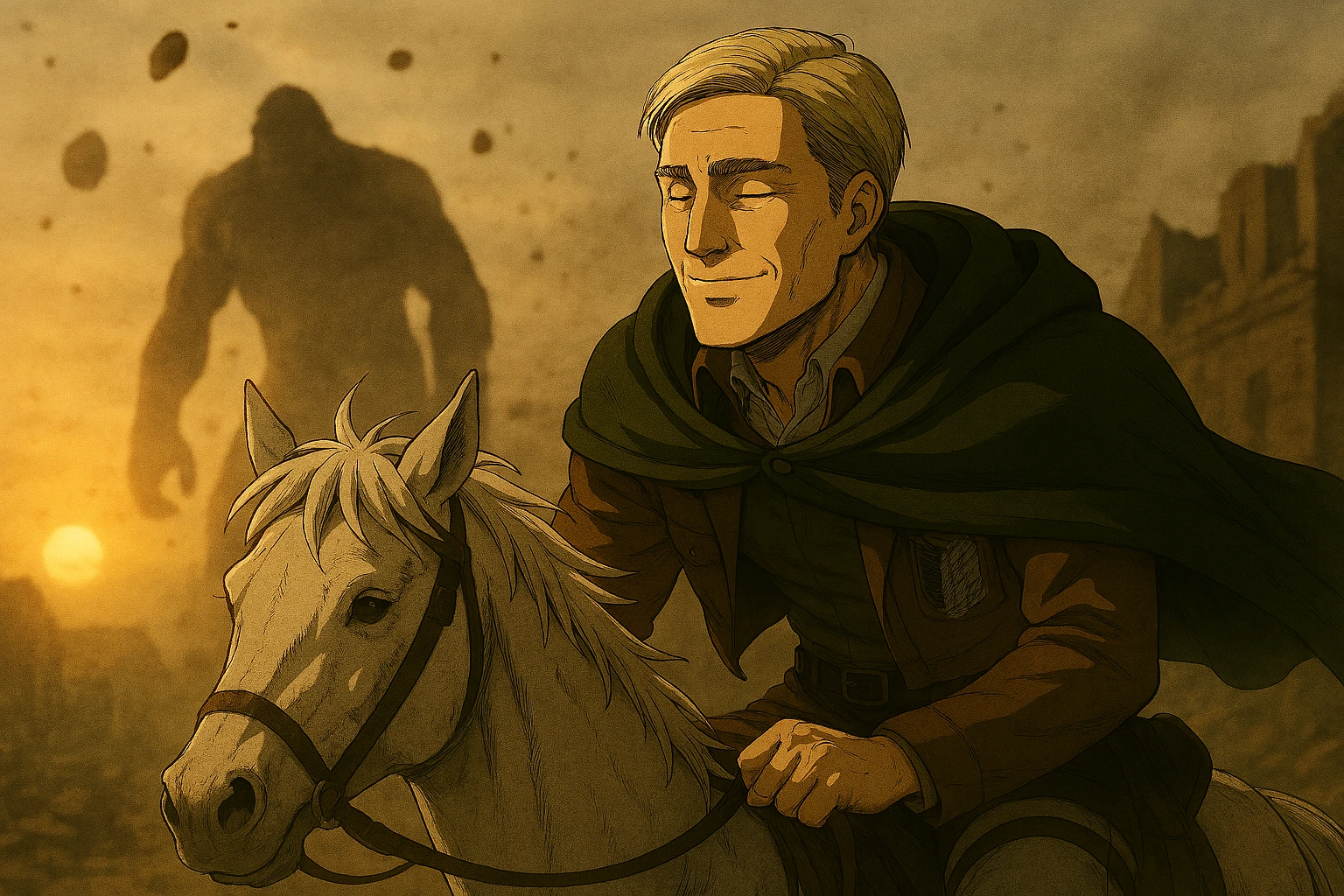
“Does that mean our lives are meaningless? No, it does not! It is us who gives meaning to our comrades’ lives! The brave fallen! The anguished fallen!
The ones who will remember them… are us, the living! We die trusting the living who follow to find meaning in our lives!”
In this moment, the “Con Artist” dies, and the true “Hero” is born. Erwin is no longer tricking them for his own gain. He is dying with them.
He is investing his own life in the same terrible gamble he forced upon so many others. He validates every lie he ever told by making this final truth absolute.
He leads the charge not towards the basement, but away from it, directly into the jaws of the Beast Titan.
He dies without ever knowing the truth of the world. He dies with his lifelong curiosity unsatisfied. And that is precisely why his sacrifice is so powerful.
He gave up the one and only thing he truly lived for, so that others could have a future he would never see.
The Aftermath: The Serum Bowl and the Ghost of Erwin
Erwin’s death did not end his influence over the story. The immediate aftermath—the debate over who should inherit the Colossal Titan via the Titan serum—tears the survivors apart and serves as the final thematic judgment on Erwin’s life.
The Future vs. The Past: Why Levi Chose Armin
The choice between saving the seasoned, brilliant Commander Erwin or the young, ingenious Armin Arlert is a debate between logic and hope.
Floch, the sole survivor of the suicide charge, argues fervently that Erwin must be revived because he is a “Devil.”
Floch believes that only a monster, someone capable of discarding their humanity, can lead them into the hell that awaits beyond the ocean.
From a purely strategic, militaristic standpoint, Floch is absolutely correct. Erwin was the superior tactician.
However, Levi ultimately chooses to save Armin. Why?
Levi realized that bringing Erwin back to this cruel world would be an act of cruelty itself.
It would be dragging him back into hell just as he had found peace. Erwin had finally been set free from his “drunkenness.”
Bringing him back would mean enslaving him to the dream again, or forcing him to find a new horror to be drunk on in a world that was even bleaker than before.
Furthermore, there is a fundamental philosophical difference between Erwin’s dream and Armin’s dream that dictated the future of the story.
- Erwin’s Dream was anchored in the Past: He wanted to confirm his father’s theory. His dream was about looking backward, validating what had already happened. It was a finite goal. Once he saw the basement, his driving force might have evaporated, leaving a hollow man.
- Armin’s Dream was anchored in the Future: Armin wanted to see the sea. He wanted to explore the unknown outside world. His dream was about looking forward with hope and wonder, not obsession. It was infinite.
Levi chose the future over the past. He chose the boy who could still see beauty in the world (Armin holding the seashell with wonder) over the man who only saw the bars of the cage he needed to break. Levi allowed Erwin to rest as a human, rather than forcing him to continue living as a tool of war.
The Split Legacy: Hange and Floch

The void Erwin left behind was never truly filled. Instead, his complex legacy fractured into two imperfect successors, highlighting just how unique he was.
Hange Zoë (and to an extent, Armin) inherited his intellect, his insatiable curiosity, and his fundamental idealism that understanding could lead to peace. However, they lacked his necessary ruthlessness. Throughout the final arcs, Hange struggles under the burden of command, often paralyzed by the moral weight of the “devilish” choices required to maintain order in a collapsing world. They were too human to be the monster Erwin was.
Floch Forster inherited the “Devil” persona, but twisted it. Radicalized by surviving Erwin’s final charge, Floch adopted the nationalism and the “victory at all costs” mentality, becoming the face of the Jaegerists. He mimicked Erwin’s rhetoric—shouting Shinzou wo Sasageyo while executing dissenters—but he lacked Erwin’s towering intellect, his deep empathy, and his moral complexity. Floch became a grotesque caricature of Erwin—a monster who worshipped the method (cruelty) without understanding the purpose (humanity’s survival).
Erwin was the only one capable of balancing both halves: the mind of a scholar and the heart of a killer. Without him, the center could not hold.
Conclusion: The Verdict on the King of Corpses
The question remains: Was Erwin Smith a hero or a monster?
If we judge him by the standards of a peaceful world, he was a monster. He was a manipulative gambler who played poker with human souls, a man who sent thousands to their deaths to satisfy a personal itch that began in a childhood classroom.
He built a throne upon a mountain of corpses and sat atop it, weeping internally while ordering more bodies to be piled higher.
But in the context of Attack on Titan—a world defined by unimaginable cruelty, where humanity was caged and facing extermination by mindless giants—he was the supreme hero.
He proved that in extreme circumstances, purity and righteousness are not enough to ensure survival.
Sometimes, to save the sheep from the wolves, you cannot just be a shepherd; you must become a wolf yourself, one terrifying enough to scare the others away.
Erwin Smith stands as a testament to the idea that the greatest sacrifices in war are not physical, but psychological.
He didn’t just give his right arm for humanity; he gave his soul. He didn’t just give his life in a final charge; he gave up the dream that defined his entire existence moments before realizing it.
He was the Devil who wept for the lives he took.
And precisely because he was willing to bear the unbearable burden of becoming that Devil, humanity was finally given the chance to step out of the darkness and into the blinding, complicated light of the truth.
Visit Full Series Attack on Titan
Shinzou wo Sasageyo.