
I. Introduction: The Basement Meeting—When the Mirror Cracked
Eren and Reiner Narrative Mirror.
The entire philosophy of Hajime Isayama’s Attack on Titan can be distilled into four seconds of silence and five simple words.
The scene takes place in a dimly lit basement in Liberio. Above, the festival is in full swing. The air is filled with the scent of roasted nuts and the sound of children cheering. Music plays, vibrant and loud, masking the tension building beneath the earth.
The world is celebrating a declaration of war against a distant island of devils, united by a common enemy. Below the surface, in the suffocating quiet, two men sit across from each other. One is a war hero of Marley, the Armored Titan, Reiner Braun. The other is the devil of Paradis, the Usurper, Eren Yeager.
The contrast in audio design here is deliberate and crushing. The muffled sounds of joy from above serve as a haunting soundtrack to the despair below. Reiner sits in terrified paralysis, his posture collapsed, his eyes wide with the recognition of a ghost. Eren sits in calm, almost melancholic resolve, his hand bleeding, his eyes dead but focused. And then, Eren delivers the line that shatters the moral binary of the series forever:
“I think… I am the same as you.”
For the casual viewer, this might sound like a moment of empathy or a simple tactic to lower Reiner’s guard. But to the analytical eye, this is the thesis statement of the entire show.
This moment is the narrative pivot point where the protagonist and the antagonist cease to exist as separate entities and merge into a singular reflection of the human condition under the weight of war.
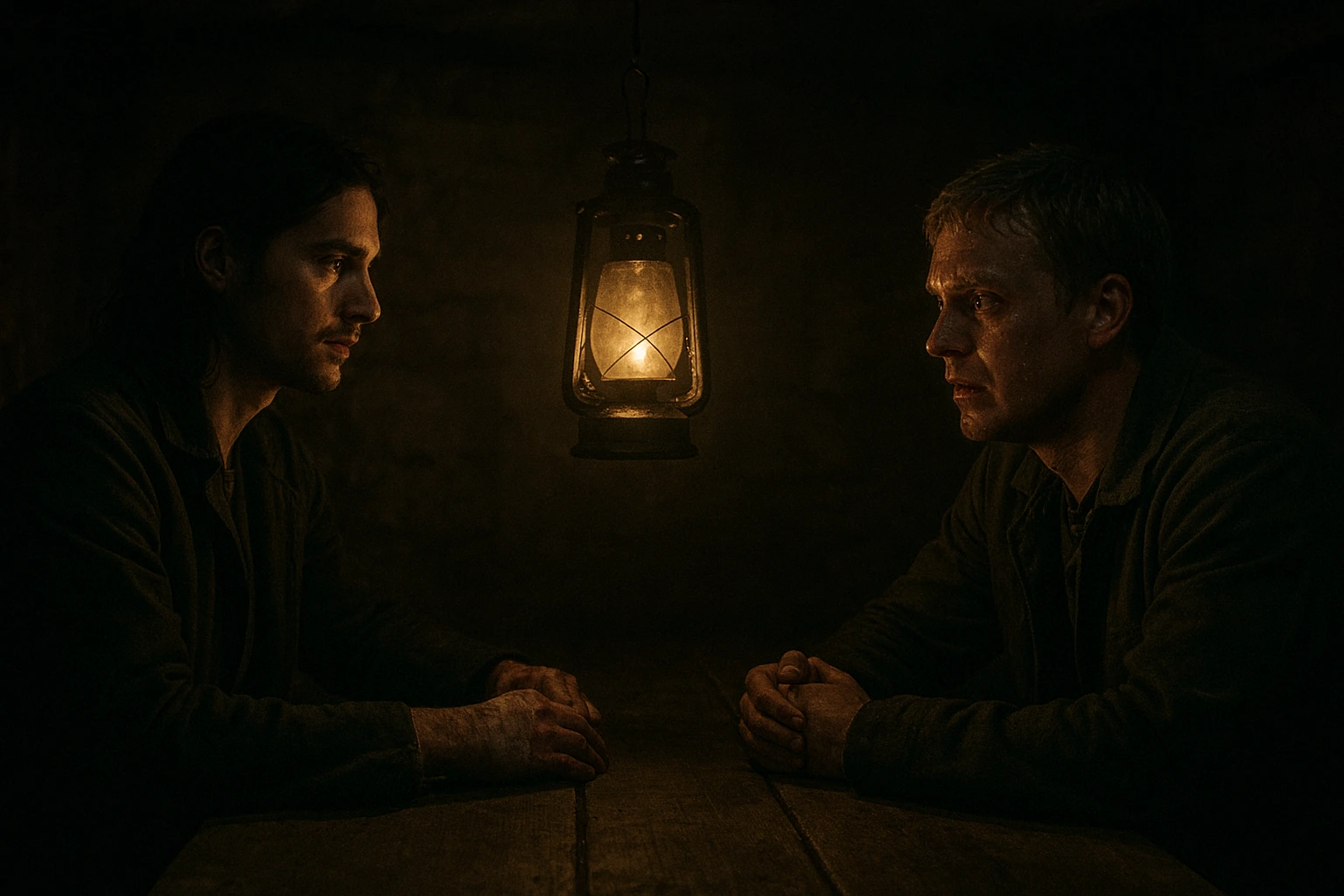
Eren and Reiner are not opposites. They are not a dichotomy of Good vs. Evil, or Hero vs. Villain. They are the exact same character, born into different cages, fed different lies, and driven by the same desperate need to find meaning in a cruel world. Reiner is what Eren could have been if he were born in Marley; Eren is what Reiner feared becoming.
To understand Attack on Titan, one must understand that the story isn’t about Titans eating humans. It is about the boy who wanted to save the world destroying it, and the boy who wanted to destroy the world trying to save it. This is the Master Structure of Isayama’s tragedy: the mirror between the Attack Titan and the Armored Titan.
II. Born in Cages: The False Dream of Heroism
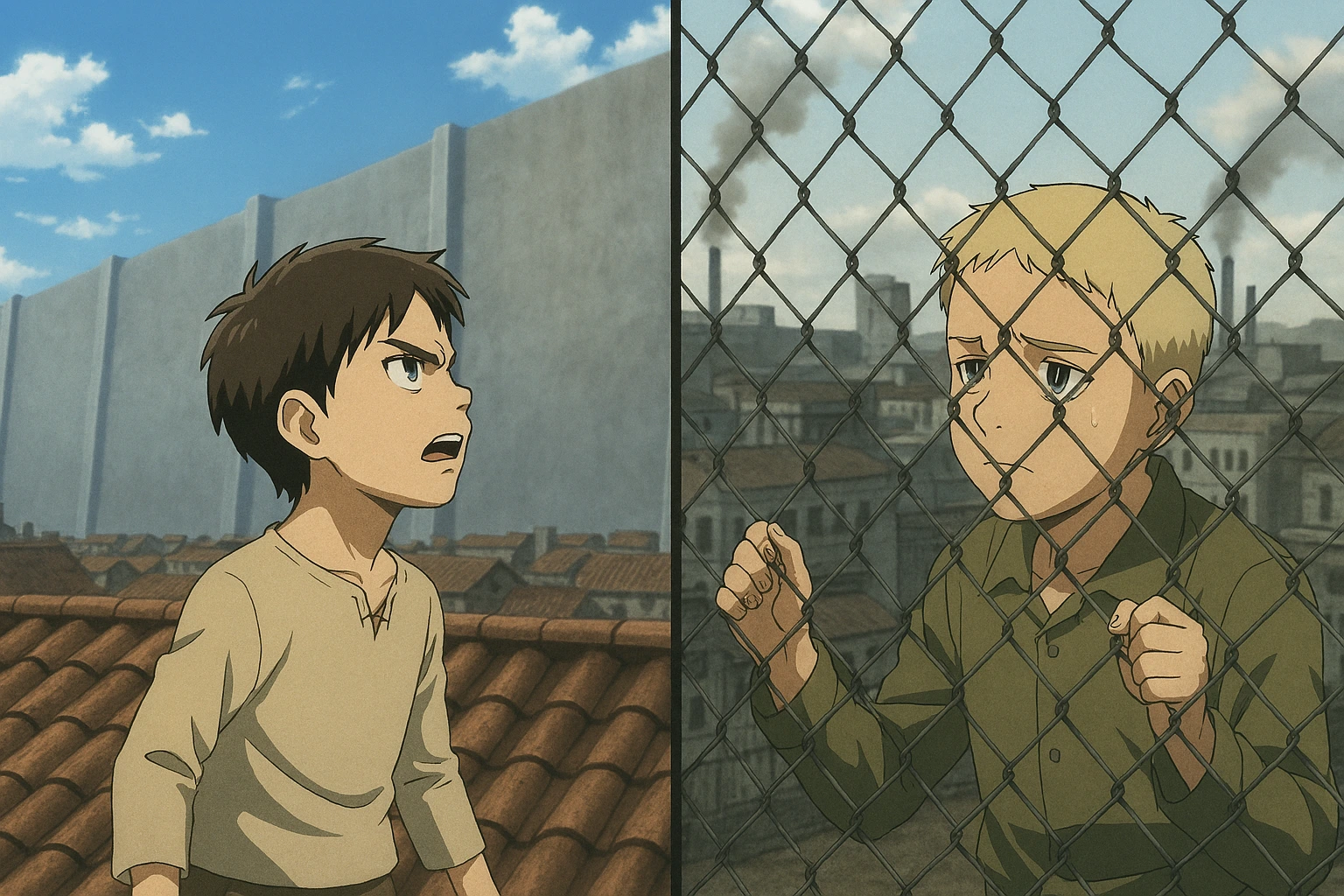
The tragedy of Eren and Reiner begins long before they inherit their Titans. It begins in their childhoods, separated by an ocean but united by the architecture of oppression. Isayama meticulously crafts their origin stories to mirror one another, using the lens of Destiny vs. Effort to highlight their similarities.
The Cage of Ignorance vs. The Cage of Guilt
Eren was born inside the Walls, a cage built on the foundation of Ignorance. The King of the Walls stole the memories of his people to create a false paradise. Eren’s oppression was physical; he was trapped like cattle, unable to see the horizon.
His driving force was an innate, almost violent desire for Freedom. He looked at the walls and saw a prison. He looked at the Survey Corps and saw wings. He burned with an anger that had no specific target until the Colossal Titan appeared.
Reiner was born in the Internment Zone, a cage built on the foundation of Guilt. The Marleyan government instilled a self-loathing ideology into the Eldians, forcing them to repent for the sins of ancestors they never knew. Reiner’s oppression was psychological.
He looked at the walls of the Internment Zone and saw a proving ground. He looked at the Warrior Unit and saw a path to redemption. He burned with a desire to be “good,” to scrub away the “devil” blood that flowed in his veins.
Both boys were suffocating. Both boys looked up at the sky and wished to be somewhere else. But their motivations for escaping their cages reveal the first layer of their tragic symmetry.
The Motivation of the Lie
Both Eren and Reiner were motivated by a fundamental lie that defined their worldviews.
- Eren’s Lie: “The outside world is empty/full of wonders.” Eren believed that if he killed all the Titans, he would find a land of ice and fire, a place of freedom. He thought the enemies were mindless monsters that prevented humanity from reclaiming its birthright. He fought for a world that didn’t exist.
- Reiner’s Lie: “The Island is full of devils.” Reiner believed that the people of Paradis were existential threats to humanity, monsters waiting to flatten the earth. He thought that by killing them, he would be saving the world. He fought against a world that didn’t exist.
The Absent Father and the Desperate Need for Validation
Perhaps the most heartbreaking parallel is their relationship with their fathers and their own lack of innate talent.
Neither Eren nor Reiner were “chosen ones” in the traditional sense. In the Cadet Corps, Eren was noted for having no special talent other than his “suicidal drive.” He failed the balance test initially (though due to broken gear), struggling to even stand while others excelled.
In the Warrior Candidate program, Reiner was the runt of the litter. He was physically weaker than Marcel, less agile than Annie, and less intelligent than Bertolt. He was never meant to be the Armored Titan; he was a political pick, chosen only because of Marcel’s manipulation.
So why did they push so hard? Because of their fathers.
Reiner’s motivation was explicitly tied to his Marleyan father, a man he was forbidden to see. His mother, Karina, brainwashed him into believing that if he became an Honorary Marleyan, they could live together as a family. Reiner pushed himself through hell not to save the world, but to be acknowledged by a father who wanted nothing to do with him.
He sought Status and Honor to fill the void of parental love. When he finally met his father, he was rejected, shattering his core motivation.
Eren’s relationship with Grisha is more complex, but equally driving. Grisha Yeager, having failed with Zeke, projected his desire for freedom onto Eren. While Eren had the drive naturally, the burden of the Attack Titan was thrust upon him by a father who ran out of time.
Eren sought Strength and Vengeance to validate the death of his mother and the expectations of his father. He carried the basement key—a symbol of his father’s secrets—like a holy relic.
Both boys were children used as tools by adults who were fighting old wars. They were child soldiers before they ever held a blade, radicalized by their environments to believe that violence was the only path to salvation.
The Annie Connection: The Teacher of Monsters
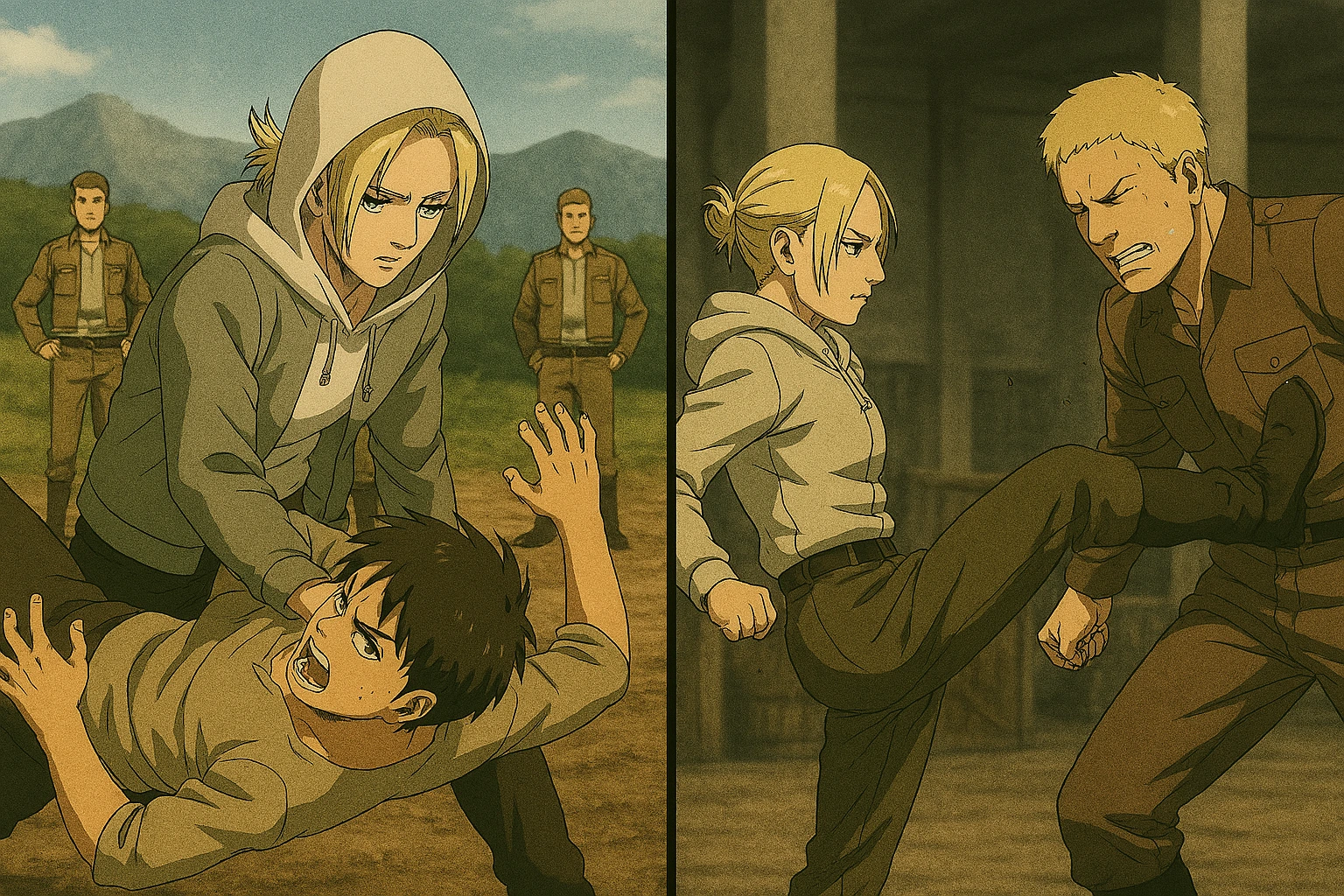
A crucial, often overlooked link between the two is Annie Leonhart. Annie serves as the harsh mentor for both Eren and Reiner, shaping their fighting styles and their understanding of reality.
- For Reiner: Annie was the reality check. She beat him brutally during their training in Marley, exposing his delusions of heroism. She was the one who constantly reminded him of the absurdity of their mission and his own weakness. Yet, Reiner adopted her techniques, learning to protect his vitals and use his weight.
- For Eren: Annie was the teacher of technique. During the 104th Cadet training, while Reiner was playing the “big brother,” Annie was teaching Eren how to fight opponents bigger than himself. Eren’s Titan fighting style—the grappling, the throws, the submissions—is entirely derived from Annie.
In a poetic twist, Eren uses the moves Annie taught him to defeat Reiner. The “Hero” (Reiner) is defeated by the “Monster” (Eren) using the techniques of the “Outcast” (Annie).
III. The Role Reversal: Who is the Villain Now? (Narrative Structure)
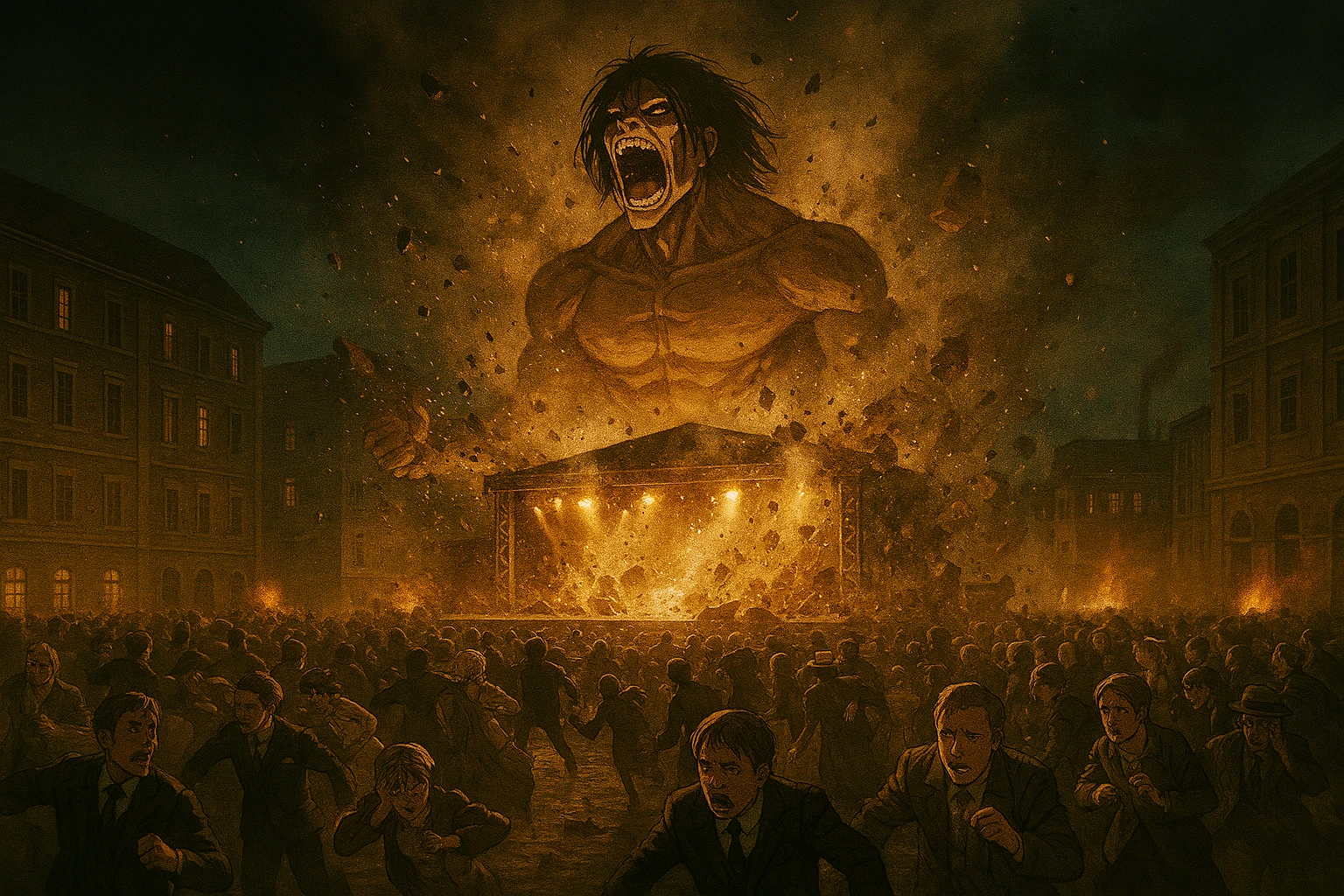
Hajime Isayama is a master of perspective. The brilliance of Attack on Titan lies in how it utilizes time skips to flip the narrative board, turning the hero into the villain without changing the character’s core nature.
The “Grim Reminder” vs. The “Declaration of War”
The structural symmetry between Season 1, Episode 1 (“To You, in 2000 Years”) and Season 4, Episode 5 (“Declaration of War”) is absolute. It is a mirror image designed to induce cognitive dissonance in the audience.
In Season 1:
- The Perspective: We watch through Eren’s eyes, low to the ground, looking up.
- The Event: The Colossal Titan appears over the wall. The Armored Titan (Reiner) charges through the gate.
- The Victim: Shiganshina, a peaceful town of ignorant civilians eating their lunch.
- The Trauma: Eren watches his mother, Carla, get eaten. Debris flies everywhere. The peace is shattered by a sudden, inexplicable act of terror. The color palette is vibrant, then blood-red.
- The Verdict: Reiner is the Villain. Eren is the Victim.
In Season 4:
- The Perspective: We watch through Falco and Reiner’s eyes, grounded, looking up at the stage and then the building.
- The Event: Eren Yeager (The Attack Titan) bursts through the building behind the stage.
- The Victim: Liberio, a crowded internment zone of ignorant civilians and international diplomats watching a play.
- The Trauma: Reiner watches as Zofia is crushed by debris (mirroring Carla’s death/the destruction of the wall) and Udo is trampled by the fleeing crowd. The “peace” of the festival is shattered by a sudden, inexplicable act of terror. The color palette is muted, dusty, and grey.
- The Verdict: Eren is the Villain. Reiner (and the Warrior candidates) are the Victims.
Isayama frames Eren’s transformation almost exactly like Reiner’s. When Reiner broke Wall Maria, he claimed he was “saving the world.” When Eren destroyed Liberio, he claimed he was “saving Eldia.”
The camera angles in the Declaration of War are deliberately chosen to mirror the fall of Shiganshina. We see the Titan looking down on the humans. We see the panic in the streets. We see the sheer scale of the monster against the fragility of the populace. The only difference is that the monster is now the boy we cheered for in Season 1.
The Theater of War
The setting of Liberio adds another layer to this reversal. The “Declaration of War” happens on a stage. Willy Tybur is performing a play, narrating a twisted history to manipulate the world into war.
Eren chooses this exact moment to strike. He doesn’t attack a military base; he attacks the stage. By destroying the stage, Eren rejects the narrative control of Marley. But in doing so, he validates Willy Tybur’s propaganda. Willy needed a devil to appear to unite the world, and Eren obliges, playing the role perfectly.
Just as Reiner and Bertholdt played the role of “Breakers of the Wall” to unite the island in fear (unintentionally strengthening the military), Eren plays the role of the “Devil of All Earth” to unite the world in fear. Both actions, born of desperation, ultimately serve to accelerate the cycle of violence they hoped to end.
The Cycle of Motherhood and Loss
The “Mother” parallel serves as the emotional anchor of this reversal. Reiner is directly responsible for the death of Carla Yeager. It was his mission that breached the wall, letting the Smiling Titan in. This loss is what radicalized Eren.
In a cruel twist of fate, Eren’s attack on Liberio results in the near-death of Reiner’s mother (she survives, but witnesses the horror) and the death of the “mother figures” or innocents that Reiner swore to protect (Zofia, Udo, Gabi’s innocence).
But the irony goes deeper. We learn later that Eren, through the power of the Founding and Attack Titans existing outside of time, may have influenced the path of the Smiling Titan, indirectly causing his own mother’s death to ensure the timeline remained intact.
In this sense, Eren becomes the architect of his own trauma, just as Reiner’s obsession with becoming a Warrior made him the architect of his own suffering.
They both destroyed their own homes. Reiner brought the war to Paradis, destroying the peace he essentially infiltrated. Eren brought the war to Liberio, destroying the home his grandfather lived in.
IV. The Psychology of Guilt: Moving Forward vs. Wanting to Die
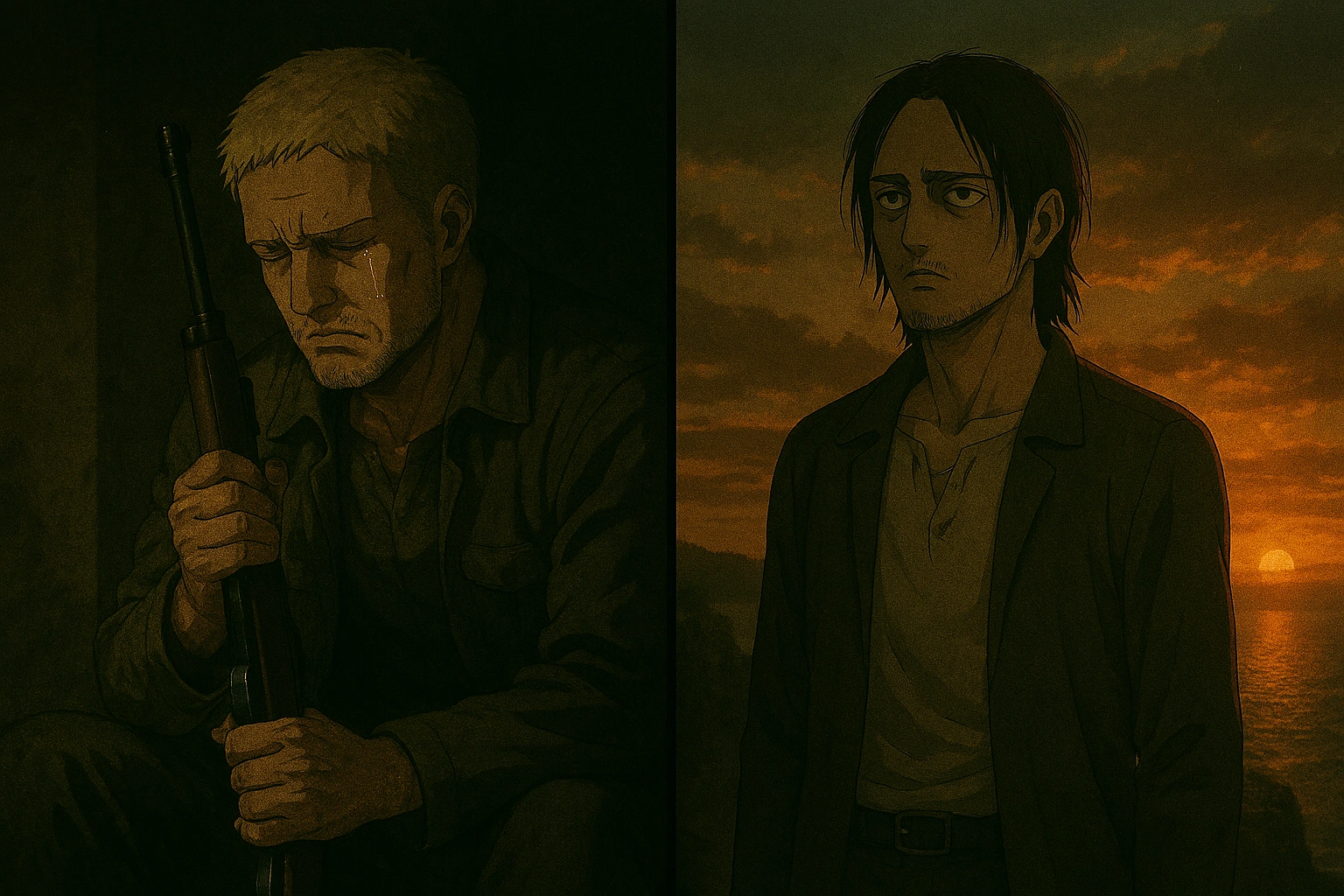
While their actions and origins are symmetrical, their psychological responses to their sins are where they diverge. This divergence creates the dynamic tension that drives the final arc.
Reiner’s Path: The Crumbled Shield and the Split Mind
Reiner represents the Collapse under Guilt. Reiner is arguably the most human character in the series because he cannot handle the weight of his sins. To cope with the horror of betraying his friends in the 104th Cadet Corps, Reiner fractures his psyche.
He creates a “Soldier” persona—the reliable big brother who protects humanity—to hide the “Warrior” persona—the mass murderer on a mission.
This dissociation is a survival mechanism. Reiner literally forgets he is a Warrior at times because the truth is too painful to bear. Upon returning to Marley, stripped of the “Soldier” mask, he is haunted. He cannot sleep. He cannot eat without remembering.
By Season 4, Reiner is suicidal. We see him putting a rifle in his mouth. He is crushed by the realization that the “Island Devils” were just people. When he meets Eren in the basement, Reiner does not make excuses. Eren asks, “Why did my mom get eaten?” Reiner could have blamed Marley.
He could have blamed the brainwashing. He could have blamed the mission. Instead, Reiner breaks down: “I wanted to be a hero. I wanted people to respect me. It’s my fault. I’m sorry.”
Reiner seeks Judgment. He wants Eren to kill him. He wants to be punished for his sins because he cannot forgive himself. He is the Armored Titan, built to endure physical damage, but his mind is glass.
Eren’s Path: The Monster Who Accepts and the Future Sight
Eren represents the Acceptance of Horror. Eren, unlike Reiner, does not develop a split personality. Instead, he hollows himself out. By kissing Historia’s hand and seeing the future, Eren learns that the rumbling is inevitable. He learns that he is the one who will kill billions.
This knowledge acts as a reverse-trauma. While Reiner is traumatized by the past, Eren is traumatized by the future. He walks through Marley seeing the faces of the people he will kill.
When Eren meets Reiner, he isn’t looking for an apology. He is looking for confirmation. “I am the same as you. I didn’t have a choice either… or that’s what I want to think.”
Eren realizes that, like Reiner, he is about to commit an atrocity for the sake of his people. But unlike Reiner, Eren does not seek judgment.
He does not ask for forgiveness. He accepts the role of the devil. Eren’s response to guilt is to Move Forward. He suppresses his humanity not because he lacks it, but because he knows that if he stops to feel, he will crumble like Reiner.
He becomes the monster Reiner pretended to be. He enters a state of “sleepwalking” through the genocide, dissociating not to survive the past, but to survive the present act of killing.
The “Half-Hearted” Apology
In Season 2, when Reiner reveals his identity, Eren calls him a “half-hearted piece of shit.” He is furious that Reiner could play “soldier” while plotting genocide. In Season 4, Eren repeats the sentiment but recontextualizes it. He understands why Reiner was half-hearted.
Because it is impossible to be a whole-hearted murderer when you know your victims are human. Eren’s apology to Reiner (“Stand up, Reiner. I get it now.”) is the moment Eren acknowledges that they are both tragic figures. He validates Reiner’s suffering, effectively saying: I know you are in hell, because I am already there.
V. The Ghosts of the Predecessors: The Owl and The Jaw
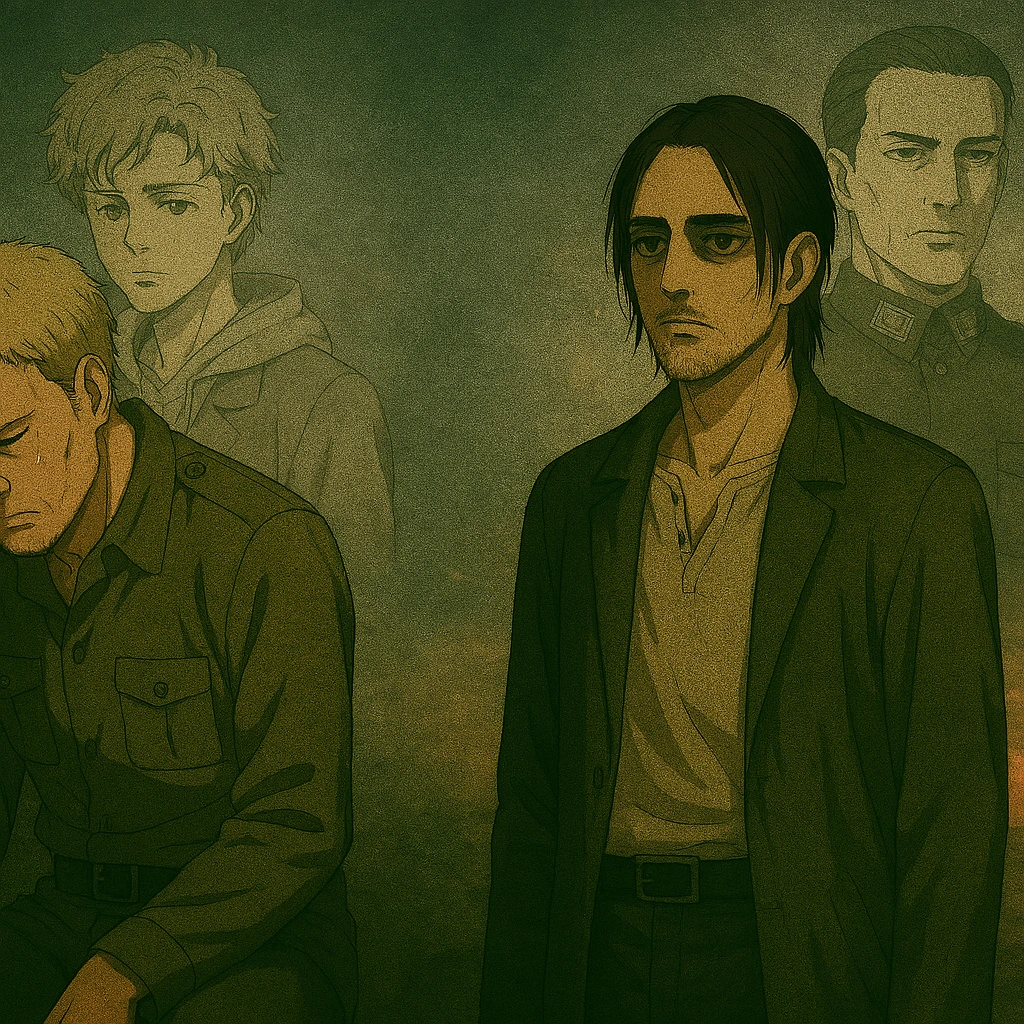
To fully grasp the “Same as You” dynamic, we must look at the ghosts standing behind them. Both Eren and Reiner inherited their Titans and their missions from men who sacrificed others to save a select few.
Marcel Galliard: The Lie of Love
Reiner’s path was paved by Marcel Galliard. Marcel was the leader of the Warriors, the sharpest and most capable. But Marcel held a secret: he sabotaged his own brother, Porco, to save him from becoming a Titan, manipulating the army into choosing Reiner instead.
Reiner’s entire existence as the Armored Titan is built on a lie told out of love. Marcel died to save Reiner, thrusting the burden of leadership onto a boy who was never meant to lead. Reiner spends the rest of his life trying to be Marcel, mimicking his mannerisms and leadership style, living as a ghost of a dead boy.
Eren Kruger: The Truth of Duty
Eren’s path was paved by Eren Kruger (The Owl). Kruger was a spy who tortured and killed thousands of his own people to maintain his cover, all for the sake of the Restoration. Kruger imparted the Attack Titan to Grisha with a chilling message: “If you want to save Mikasa, Armin, and everyone else, you must complete your mission.” Eren Yeager inherited not just the Titan, but Kruger’s ruthless calculus.
Just as Marcel sacrificed Reiner’s innocence to save Porco, Kruger sacrificed thousands of Eldians to save the future. Eren Yeager becomes the embodiment of Kruger’s philosophy: “Keep moving forward, even if you die, even after you die.”
Both protagonists are living out the wills of dead men, trapped in a stream of memories that are not their own, forcing them to fulfill promises made before they were born.
VI. The Rival’s Role: The Irony of the Armored vs. The Attack
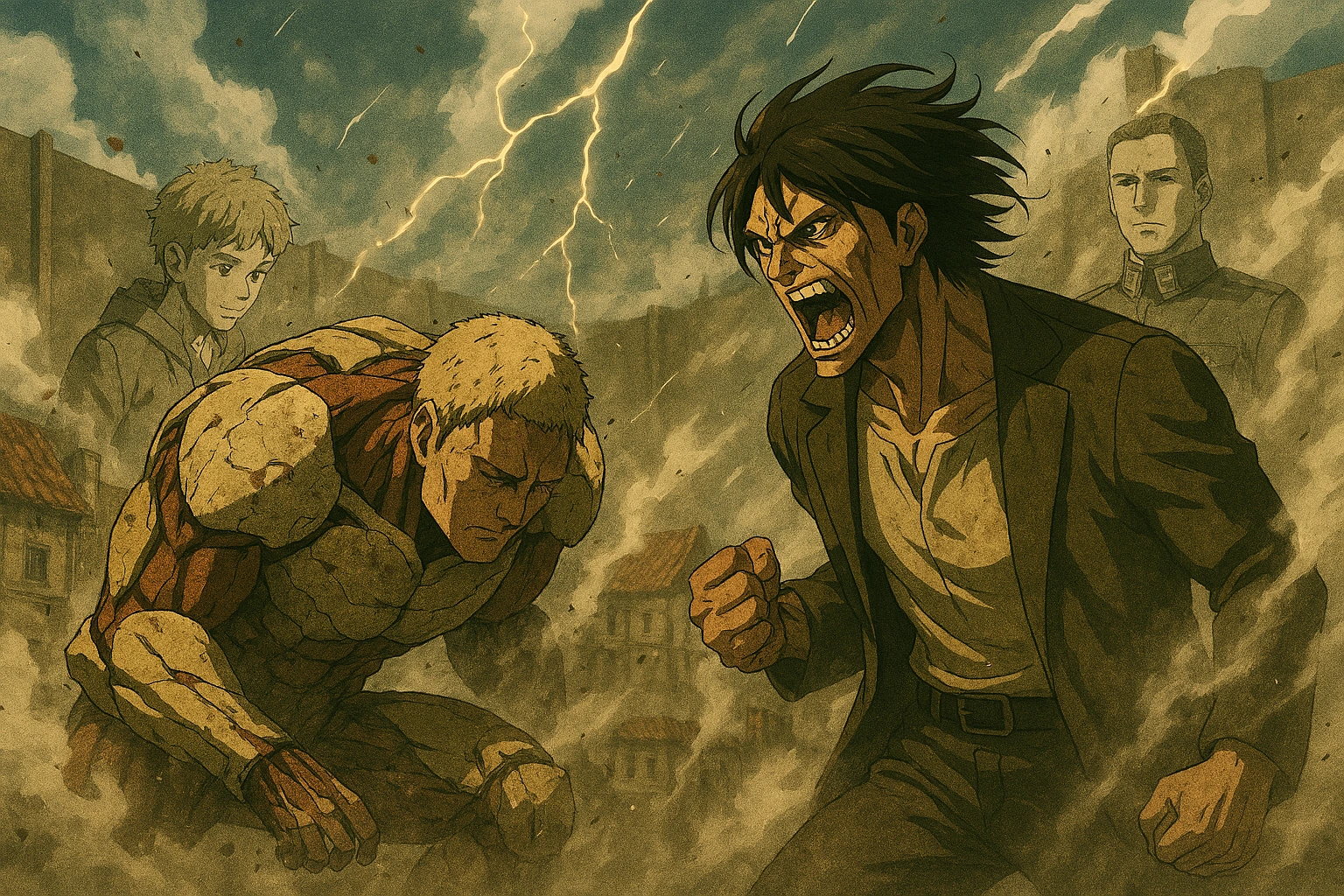
The Titans themselves are symbols of their users’ tragic fates. The duality of the Armored and the Attack Titans is the engine of the show’s action.
The Armored Titan: The Shield That Cannot Break
Reiner’s Titan is the embodiment of Endurance. It is covered in hardened plates. It is designed to take a beating and keep standing. This is Reiner’s curse. He wants to die. He wants the pain to end. But his Titan—and his narrative role—won’t let him.
- He survives the neck slice by Levi.
- He survives the thunder spears in Shiganshina.
- He survives Eren’s beatdown in Liberio.
- He survives the Rumbling.
Reiner is the shield that is forced to protect the very world he tried to destroy. His “armor” is both his greatest weapon and his prison cell.
He is forced to live with his guilt, shielding Gabi, Falco, and the Alliance, playing the “big brother” role until the bitter end. He is the tragic hero who is denied the release of death.
The Attack Titan: The Spear That Cannot Stop
Eren’s Titan is the embodiment of Rebellion. The Attack Titan (Shingeki no Kyojin) has a unique trait: it can see the memories of future inheritors.
It is the only Titan that has always moved forward, seeking freedom. This is Eren’s curse. He is a slave to freedom. The Attack Titan forces him to advance, to fight, to escalate.
- He fights Annie in the city.
- He fights Reiner at the wall.
- He fights the world with the Rumbling.
Eren burns his life force like fuel. While Reiner endures, Eren consumes. The Attack Titan strips Eren of his humanity, piece by piece, until he is nothing but a vehicle for the concept of “Freedom.”
The Evolution of the Fight: From Rage to Resignation
Their fights evolve throughout the series, marking the stages of their relationship.
- Season 2 (The Clash of Ideologies): A grapple in the fields. Eren is fueled by raw, confused rage. Reiner is shedding his armor to move faster, symbolically shedding his lies. Eren loses the strength battle but wins the technical battle using Annie’s moves, proving that ingenuity can overcome destiny.
- Season 3 (The Battle for Shiganshina): A tactical dismantling. Eren is cold and focused. He acts as bait, allowing the Survey Corps to destroy Reiner with Thunder Spears. Here, Eren has surpassed Reiner in resolve. He no longer sees Reiner as a traitor, but as an obstacle.
- Season 4 (The Massacre of Liberio): A brutal beatdown. Eren crushes Reiner, but Reiner finds the strength to save Porco. This fight highlights Reiner’s protective instinct vs. Eren’s destructive drive.
- Season 4 Part 2 (The Brawl in Shiganshina): A weary struggle. Reiner holds Eren back, screaming, “Why won’t you just die?” It’s a plea for Eren to stop the suffering, both his own and the world’s.
By the final confrontation at the Fort (Salta), they are barely fighting out of hate. They are fighting because their roles demand it. Reiner holds the glowing centipede (the Hallucigenia), physically holding back the source of all Titans, while Eren (as the Founding Titan) moves toward his inevitable suicide-by-friend.
The hate is gone. All that is left is two weary soldiers playing their parts in a tragedy written 2000 years ago.
VII. Conclusion: The Tragedy of War
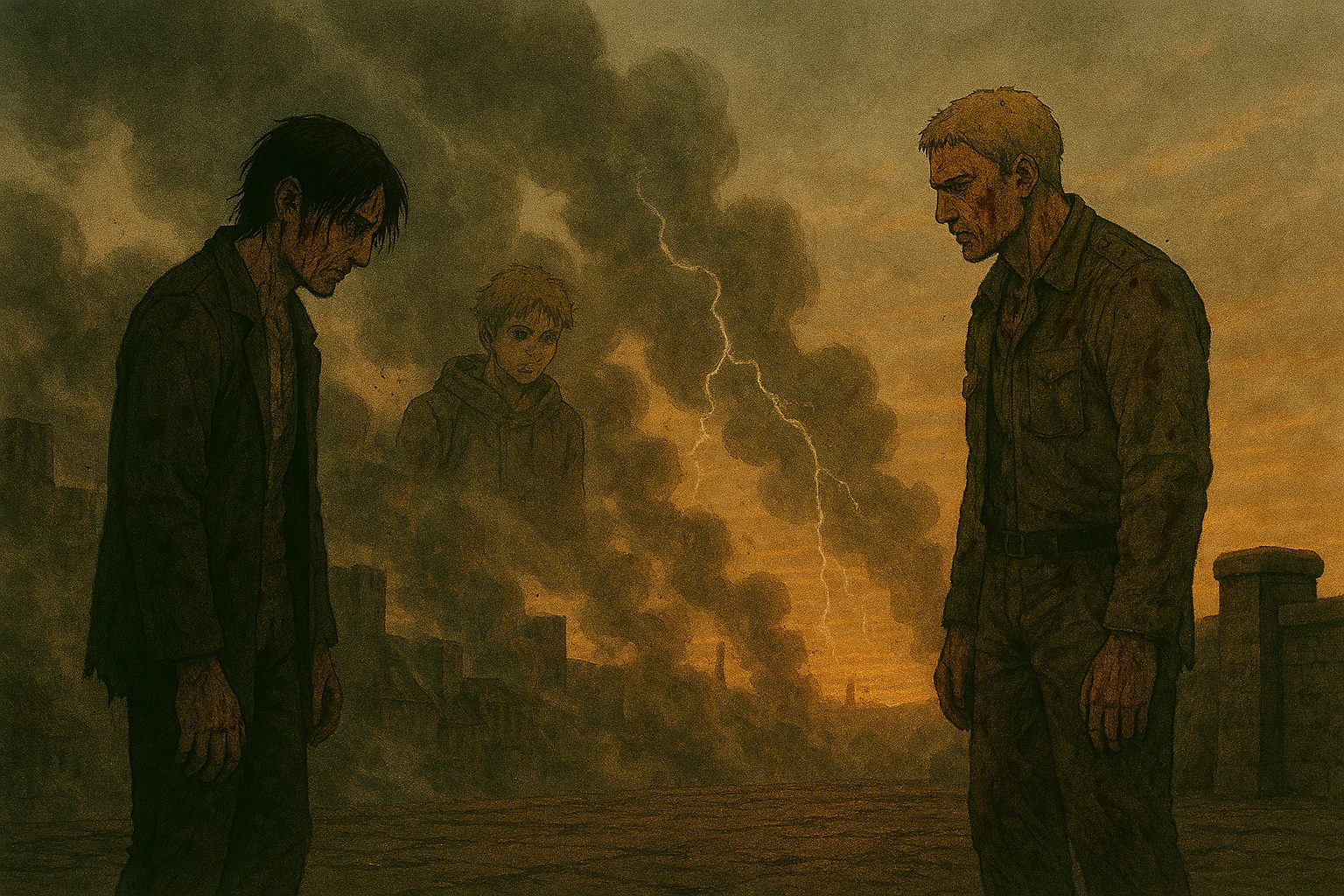
The story of Eren and Reiner forces the audience to confront uncomfortable truths about war, radicalization, and perspective.
If you were born inside the walls, you would be Eren Yeager. You would hate the Titans. You would want to destroy the world that caged you. If you were born in Liberio, you would be Reiner Braun. You would hate the Island Devils. You would want to be a hero to save your family.
Isayama strips away the comfort of “moral superiority.” He leaves us with the wreckage of the Battle of Heaven and Earth, where the lines between friend and foe are erased.
The Alliance that saves the world is composed of the very people who tried to kill each other for three seasons. Reiner fights alongside Jean; Annie fights alongside Mikasa. They are united not by ideology, but by the shared trauma of the forest Eren created.
The Verdict: Who Won?
So, who won? In a way, Reiner “won” because he succeeded in becoming the hero he always wanted to be. He saved the world from the Rumbling. He gained the respect of his mother (who finally apologized for using him) and the world.
But he lives with the scars of a mass murderer. The final panels show him sniffing a letter from Historia—a moment of levity that hides the deep, unhealable cracks in his psyche. He survives, which was his greatest fear.
Eren “won” because he achieved his goal. He eradicated the Titans from existence. He ensured his friends lived long lives. But he died as the greatest villain in human history, buried under a lonely tree on a hill, remembered only by the few who knew the truth.
The “Same as You” speech is the final message of Attack on Titan. It is an indictment of the cycle of hatred. It asserts that monsters are not born; they are made. They are made by history, by propaganda, and by the failure of adults to keep children out of the forest.
Eren and Reiner were not enemies. They were two victims of the same cruel history, running in opposite directions around the same circle, only to meet in the middle and realize they were looking in a mirror.
In the end, the tragedy isn’t that they fought. The tragedy is that they understood each other perfectly, and they fought anyway.
Addendum: Visual Symbolism & The Forest
Note for the Reader: Pay attention to the lighting in their scenes.
- Reiner is often shown in the harsh light of day (the desert, the training grounds) where his failures are exposed. He has nowhere to hide.
- Eren is often shown in shadows (the forest, the basement, the hood) where his intentions are hidden. He becomes the darkness.
- When they meet in the basement, a single lamp hangs between them. As the conversation progresses, the light swings, casting shifting shadows on both their faces. This visual metaphor tells us that the “light” of truth is not fixed; it moves depending on who is speaking.
The “Forest” metaphor (Mr. Braus’s speech) also applies perfectly here. Reiner and Eren were both children lost in the forest of hatred. They couldn’t get out, so they burned the forest down, taking the world with it.