
Introduction: The Moment Magic Becomes Matter
It begins with a sound.
It is the sharp, crystalline shing as a new law of physics is written in real-time. It is the sound of Eren Yeager’s fist, no longer mere flesh and bone, hardening into an opaque, diamond-like gauntlet.
It is the blinding, sapphire light that erupts as Annie Leonhart, cornered and defeated, encases her entire Titan body in a flawless, impenetrable crystal. This is not the roar of a beast; it is the clean, sharp sound of a biological “magic” system breaking its own rules and forging new ones.
This is the sound of willpower manifesting as matter.
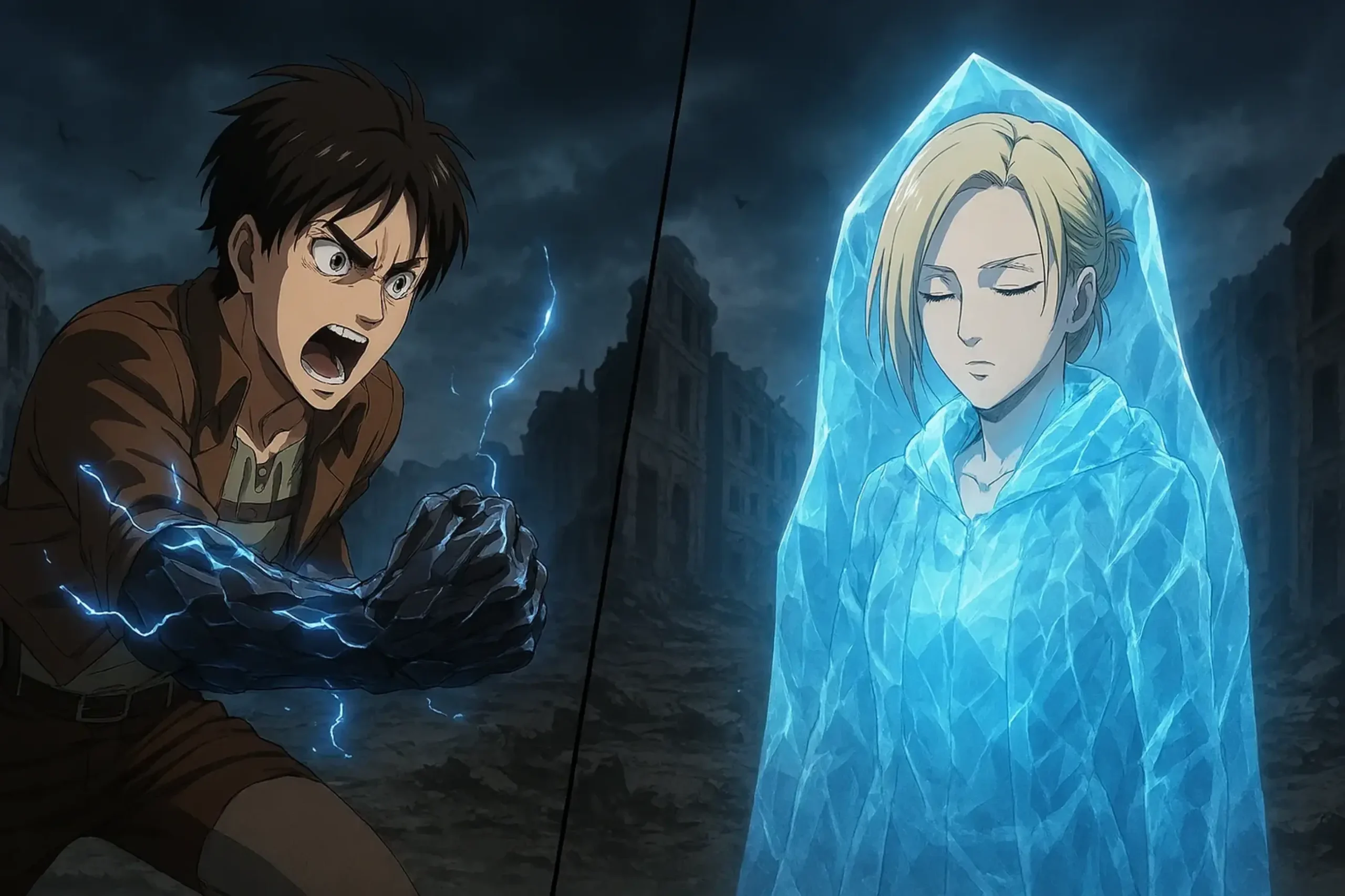
In the brutal, biological Meso-System of Attack on Titan, the abilities of Hardening and Crystallization stand apart.
They are a profound deviation from the fleshy, regenerative, and seemingly “natural” rules that govern the other Titans.
This article will dissect these dual abilities, not as a convenient “plot armor” device, but as the most versatile and profound applications of a Flexible Power System.
We will analyze how this power is a tool for offense, a shield for defense, and a weapon of political stalemate.
More than anything, it is the ultimate proof that Titan power is not a set of rigid laws.
This is the core of the Flexible Power System perspective: the “rule” that Titans are flesh, vulnerable and mortal, is shattered and rewritten by a “new rule” that they can become diamonds.
This new rule is not found in a textbook; it is created by pure, unadulterated wielder’s intent. This article will deconstruct the spectrum of this power, from the learned, effort-driven hardening of Eren to the absolute, prison-like crystallization of Annie and the War Hammer.
We will first deconstruct the types of hardening (Armored vs. Focused), then analyze the absolute form of Crystallization, and finally explore the immense strategic, biological, and poetic price of using this god-like tool.
Section 1: The Spectrum of Hardening: A Tool Forged by Effort
Crystallization and Hardening : Before we can understand the absolute, we must analyze the practical. The most common form of this power, “Hardening,” is not a single ability but a spectrum.
It is the system’s most tangible link to our core perspective of Effort vs. Destiny. For some, it is a destined “shell,” but for others, it is a skill—a weapon to be learned, honed, and mastered through grueling effort.
The “Armored” Principle (The Baseline)
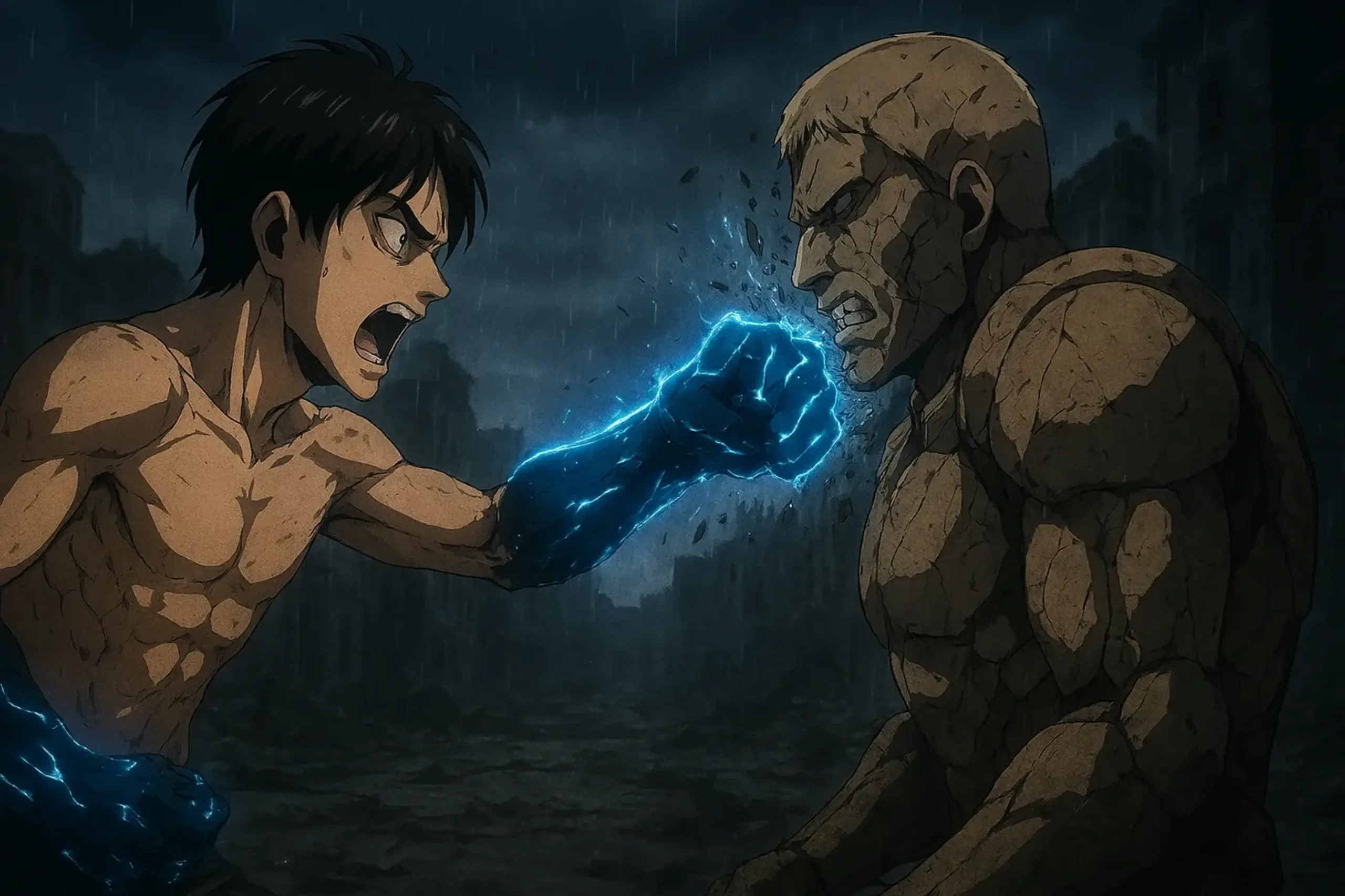
The first and most iconic example is Reiner Braun’s Armored Titan. This is the power’s baseline: a passive, permanent, and seemingly “destined” form of hardening.
It functions as a biological exoskeleton, a complete set of interlocking, bone-like plates that cover the entirety of the 15-meter body. This is the “rule” as it first appears: a specific Titan is “The Armored Titan.”
It is his innate, destined trait.
But this is precisely why it is flawed. Because it is a passive, always-on ability, it is rigid. It is not a flexible tool; it is a permanent state of being.
This permanence creates two critical limitations.
First, it sacrifices speed for defense. The sheer weight of the armor plates makes the Armored Titan a slow, lumbering brawler.
Second, and more importantly, it is not invincible. It is the “destined” armor that can be overcome by “effort.”
The armor is also a psychological prison. It is the physical manifestation of Reiner’s fractured “Soldier” persona. He hides behind the armor, just as his mind hides behind the persona of a loyal soldier of Paradis.
It’s a rigid, brittle defense for a rigid, brittle psyche. And just like his mind, the armor shatters under sufficient, focused pressure. It cannot bend, so it must break.
The system immediately introduces counters. The armor, while resistant to cannon fire and standard blades, can be shattered by the specialized, high-yield “Thunder Spears” developed by the Survey Corps, which target the small gaps and joints.
Even more telling, it is broken by the focused, localized effort of Eren’s martial arts. Reiner’s armor is a full suit, but Eren’s focused punch shatters it.
This proves that a broad, passive “destiny” is vulnerable to a sharp, focused “effort.” Reiner’s armor is the system’s starting point, a rigid rule made to be broken.
The “Eren” Principle (The Flexible Application)
This is the heart of the Flexible Power System and the triumph of Effort over Destiny.
Eren Yeager does not possess the Armored Titan. His “destiny” as the Attack Titan gave him no inherent defensive capabilities beyond regeneration.
He acquires this power the same way a student learns a new skill: he studies.
After consuming a serum bottle labeled “Armor”—a literal injection of knowledge—Eren must learn to use it through sheer, agonizing effort. This is not a simple “power-up” or an instantaneous download.
The show dedicates significant time to Hange and Eren’s brutal experiments. We see his failures, the partial crystallizations that crumble, the flesh that rips away, the exhaustion that overwhelms him.
He is not just “unlocking” a skill; he is inventing the application through a painful, scientific, trial-and-error process. His “Destiny” did not give him this; his Effort unlocked it.
This is where the power’s true flexibility is revealed. Unlike Reiner’s passive suit, Eren’s application is active, localized, and creative.
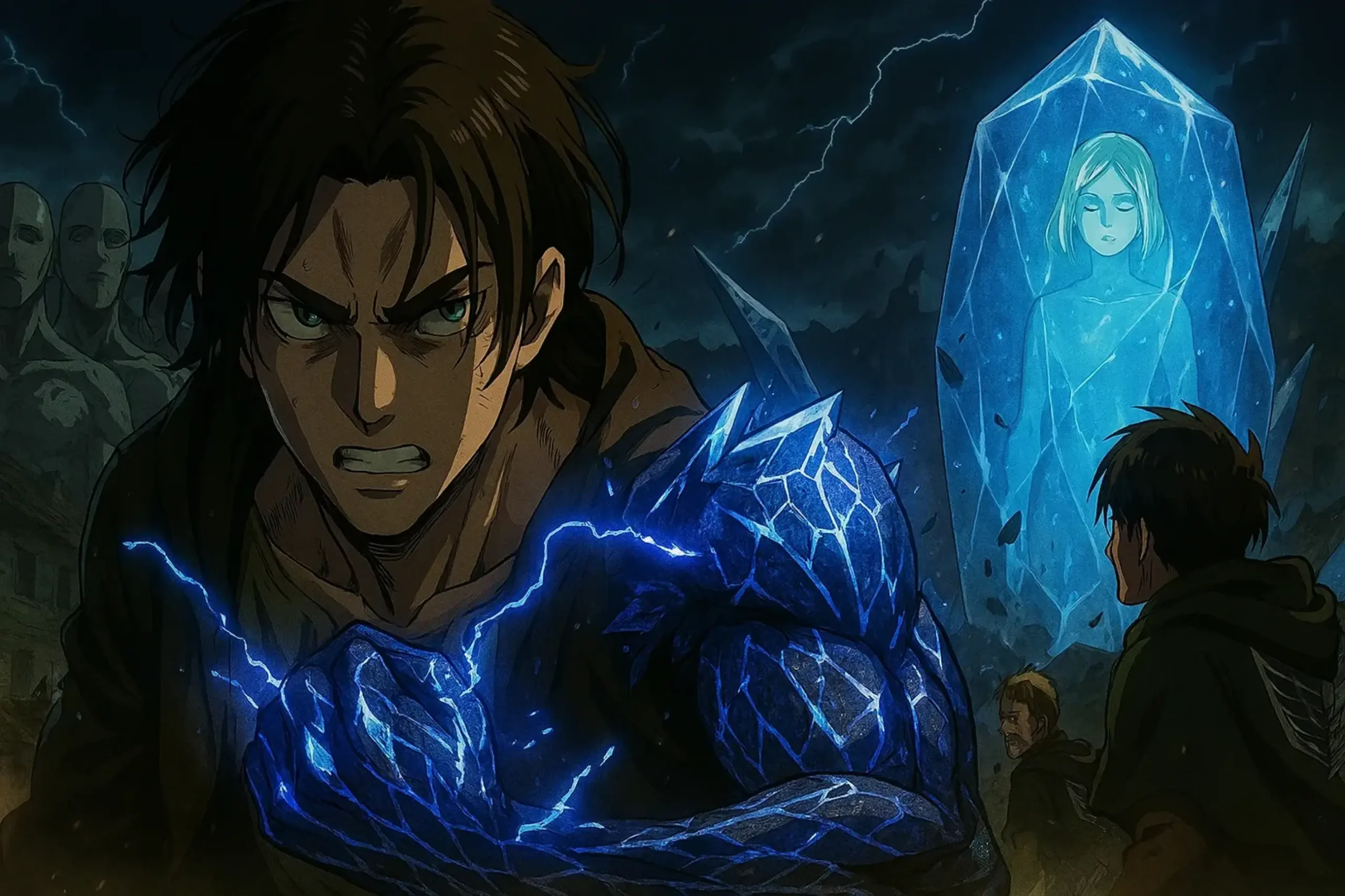
- Case Study: Offense (The Brass Knuckle): During his second confrontation with Reiner, Eren does not try to become the Armored Titan. He uses the power with surgical precision. He hardens his fists and feet, turning his limbs into “brass knuckles.” He isn’t wearing armor; he is weaponizing the very act of hardening. This is willpower as a weapon. He uses Reiner’s own “rigid” power, sharpens it with “effort,” and shatters the “destined” shell. He proves that a focused, flexible application of a learned skill will always defeat a rigid, passive, given trait.
- Case Study: Defense & Creation (The Wall Plug): The power’s flexibility extends beyond combat. When the Survey Corps is trapped in the Reiss Chapel, Eren uses his hardening not as a shield for himself, but as a structure to protect his comrades from a cave-in. He creates a scaffold, a dome of crystalline pillars. This is not offense or defense; this is creation. This is a human will forcing biological energy to mimic inorganic matter. It’s the first hint that the Power of the Titans is not just about becoming a monster, but about creating new reality.
This culminates in the ultimate expression of his effort: plugging the hole in Wall Maria.
Here, Eren is not just a soldier; he is a craftsman. He must use this agonizing, energy-draining power to create a massive, perfectly-shaped structure from nothing but his own will and biological energy.
He is not just using a power; he is becoming a structural component of the world.
This is the Flexible Power System in its most practical form: the user’s need (to plug a hole, to protect friends) dictates the function of the power.
The “Wall” Principle (The Geopolitical Scale)
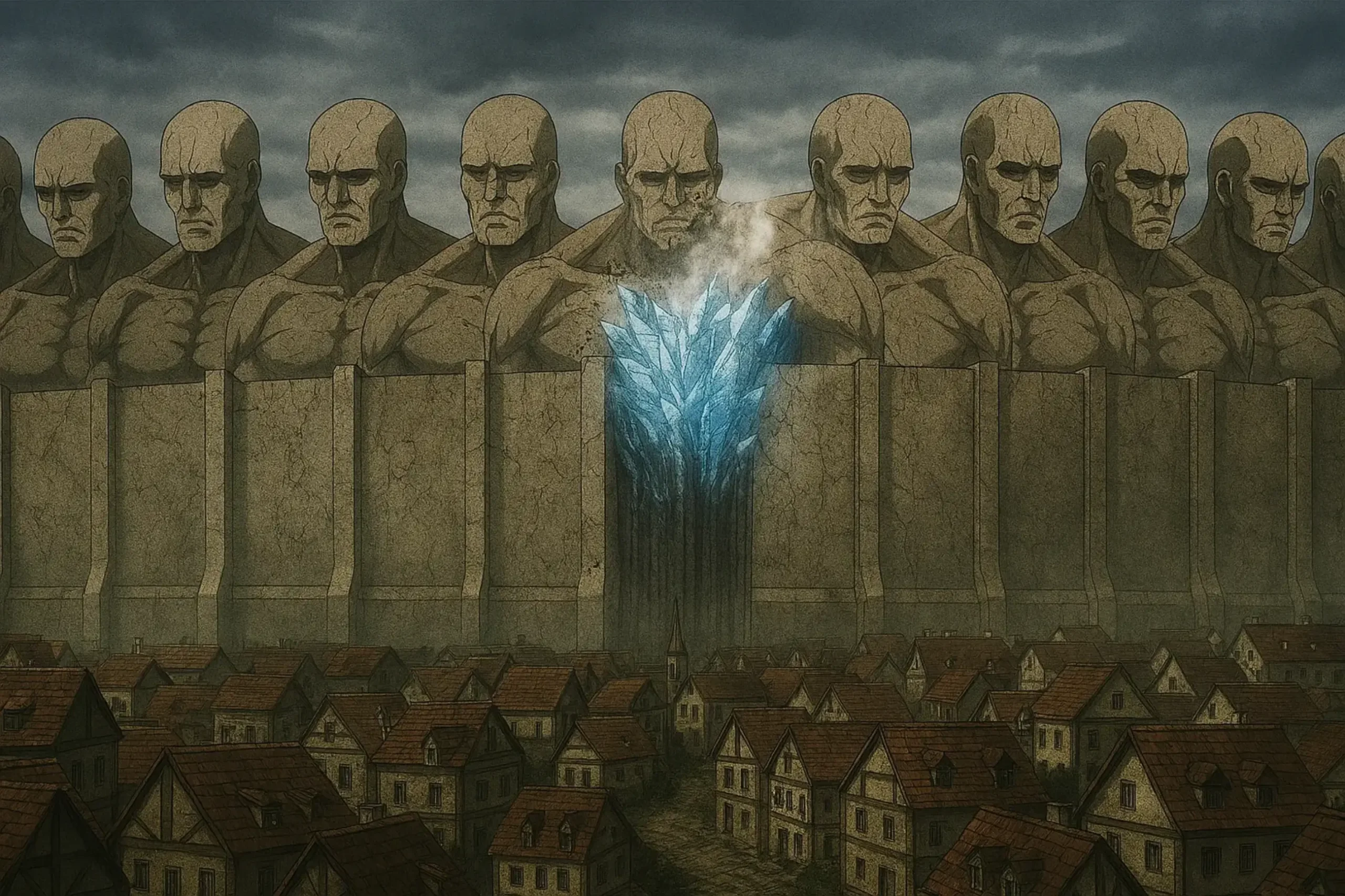
If Eren’s hardening is a localized act of will, the Walls are that same will expanded to a geopolitical, continental scale.
The three Walls—Maria, Rose, and Sina—are the ultimate expression of this power. They are revealed to be composed of millions of Colossal Titans, all standing shoulder-to-shoulder, encased in the very same hardened Titan flesh.
This is hardening used as a political and ideological tool. It is a “vow” made physical. King Karl Fritz, in his despair, did not just build a fortress; he used the Founding Titan’s power to create a 50-meter-high rule.
He forged a “prison-kingdom,” as the structure’s prompt so aptly names it. The Walls are the Meso-System’s largest, most significant piece of crystallized will.
But the Walls are more than a physical barrier; they are a psychological one. They are the ultimate expression of the Hope vs. Reality theme. They provide the hope of safety, a “paradise” for the last of humanity.
But they mask the reality that this “paradise” is a cattle pen, a cage where the populace is kept ignorant and defenseless.
The Walls are a constant, visible reminder of the King’s vow, enforcing his ideology of pacifism by their very existence. They are a “rule” that says “you are safe, but you must never fight back.”
This act sets the stage for the entire political conflict of the Meso-System, a conflict born from a single, monumental act of crystallization.
Section 2: Crystallization: The Absolute Defense and its Prison
Crystallization and Hardening :If the opaque “hardening” used by Eren and Reiner is one side of the coin, the translucent, blue “crystallization” is the other.
This is not the same substance. This is the power’s absolute form—a separate, more perfect “rule” that rewrites the system’s very foundations.
It is here that the power’s flexibility borders on the divine, and where its price becomes most apparent.
The “Female Titan” Method (The Stalemate)
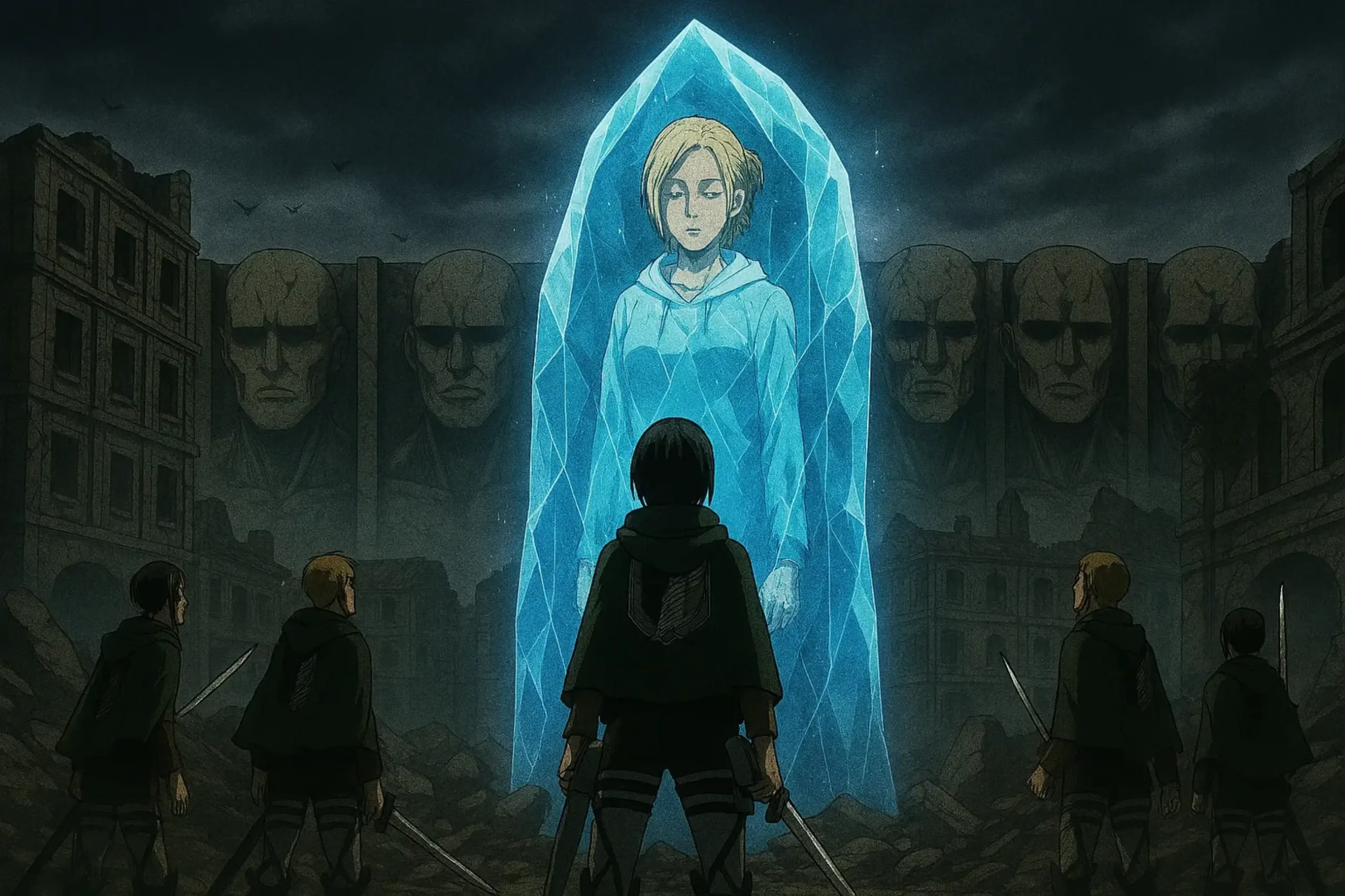
Our first encounter with this perfect form is through Annie Leonhart’s Female Titan. This is not the rough, bone-like armor of Eren.
This is a flawless, beautiful, and impenetrable substance. Annie, like Eren, uses it flexibly—to protect her nape from blades or to shatter her foes’ weapons. But her most profound use of it comes at the moment of her defeat.
Cornered in Stohess, with Levi’s blade at her throat and her identity exposed, Annie makes a choice. This is the ultimate expression of our Hope vs. Reality perspective.
Annie’s hope was to complete her mission and return home. The reality is that she is captured, surrounded, and defeated. She is about to lose everything. In this moment of total desperation, she deploys the “absolute” rule.
She crystallizes her entire 14-meter body. This is not a strategic retreat; it is a total, absolute stop. It is the physical manifestation of her emotional state.
Annie was always isolated, a lone warrior emotionally detached from her comrades. This crystal is her ultimate act of self-isolation. It is her “no” to a world that has given her an impossible choice.
This is the ultimate defensive Price of Power: to achieve total safety (protecting her secrets and herself from interrogation), Annie must sacrifice total freedom. The crystal is a vow of self-imprisonment.
It is a bomb-proof coffin of her own design, a perfect stalemate that freezes the game board. She cannot be touched, but she also cannot move, speak, or live.
The Survey Corps spends years trying to break it; Hange’s experiments all fail. It is an absolute, unbreakable defense.
Annie wins her stalemate but at the cost of her entire existence, becoming a living monument to her own failure.
The “War Hammer Titan” Method (The Apex of Flexibility)
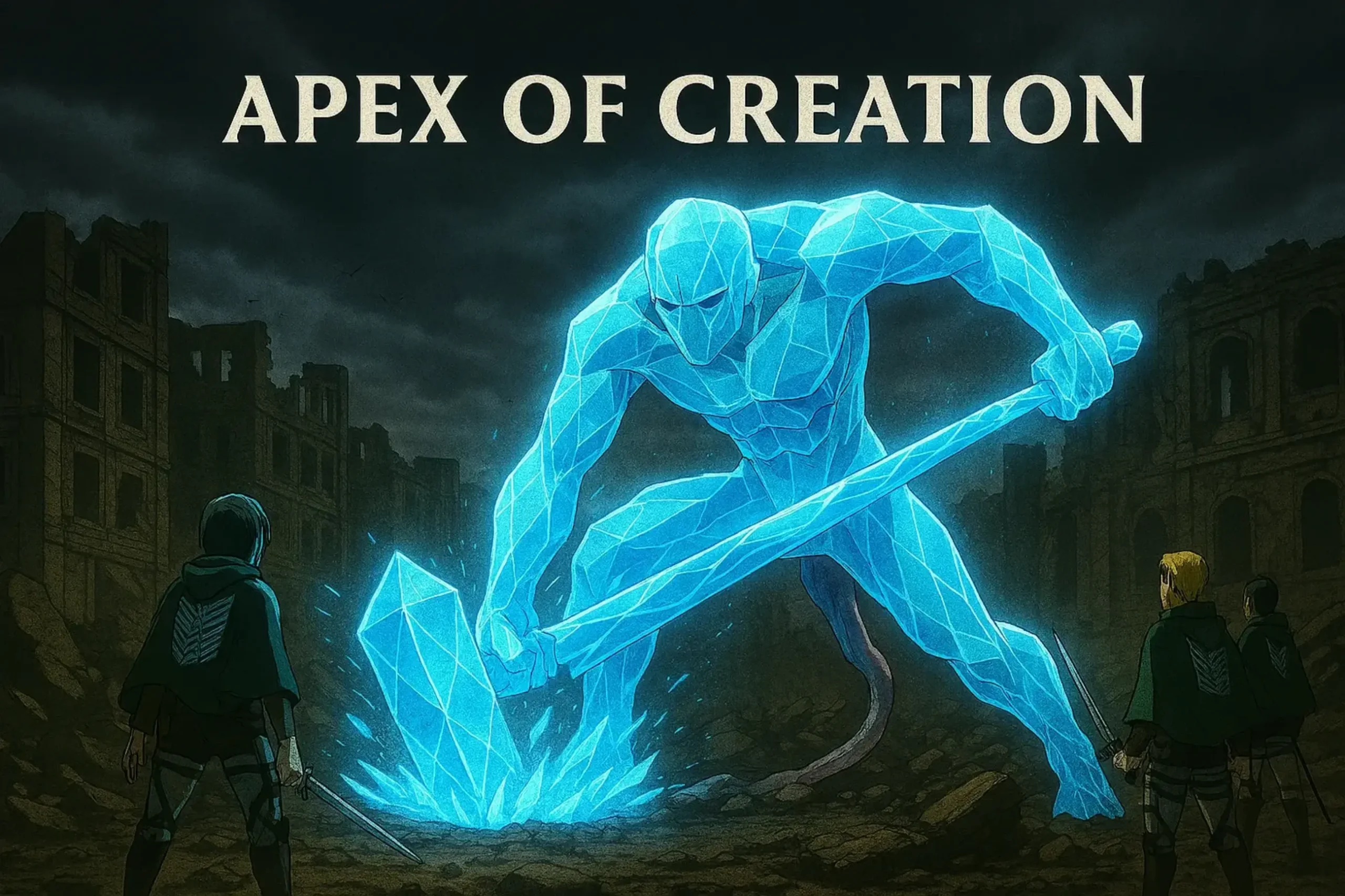
If Annie’s crystal is the ultimate defense, the War Hammer Titan’s is the ultimate weapon. This is the pinnacle, the apex of the Flexible Power System.
It takes the most fundamental “Meso-Rule”—that a Titan’s weakness is its nape, where the user must reside—and shatters it into a million pieces.
When the War Hammer Titan (Lara Tybur) appears, she demonstrates a level of creativity and control that is simply god-like.
The user is not in the nape. Instead, Lara Tybur is encased in a perfect, remote crystal of her own, hidden underground and connected to her Titan by a long, fleshy tether.
This is a “new rule” of combat. She has created a remote-controlled-proxy, a perfect mech, making her invulnerable to the one weakness that defines all other Shifters.
But it goes further. The War Hammer’s ability is pure, unadulterated creation. It is not limited to “hardening” its own skin.
It sculpts this crystal from the ground up, forging complex, instant weapons: massive, sharp spikes to impale Eren, a functional crossbow, and its signature, massive hammer.
This is pure willpower and creativity made manifest. It is not just using a power; it is sculpting reality.
This is the true meaning of a Flexible Power System. Contrast this with the other Shifters: Reiner is armor. Eren uses armor. The Colossal is an explosion.
The War Hammer, however, is an artist. It uses the base material of the Paths as its clay. It’s the difference between a soldier with a rifle and an engineer who can build any weapon they can imagine, on the spot.
This is not just a new ability; it’s an entirely new category of user, one that treats the system’s rules as mere suggestions.
The “Jaw Titan” Anomaly
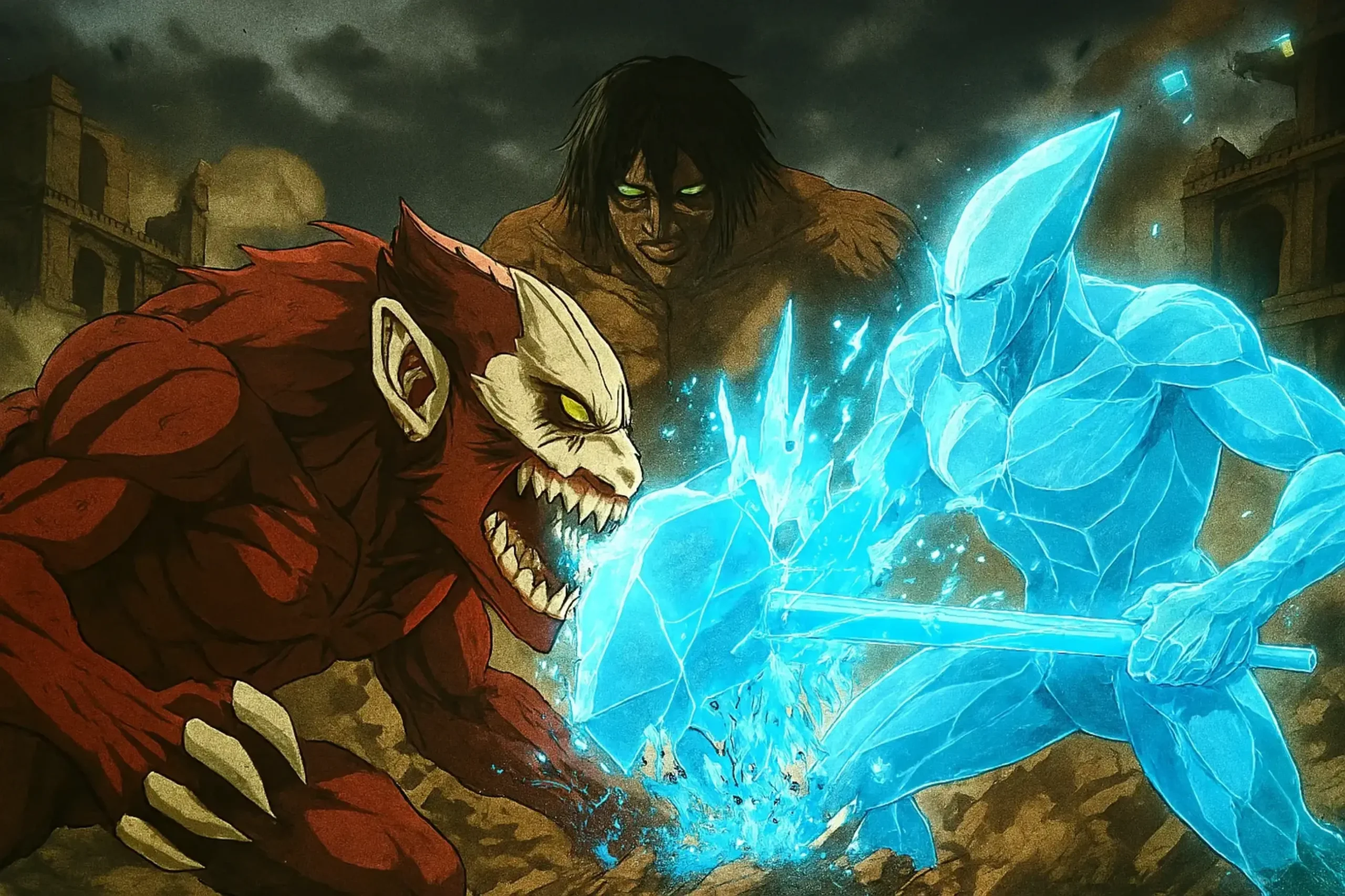
This is where the Meso-System reveals its genius. It has created an “absolute” rule: the perfect, unbreakable crystal of Annie and the War Hammer. But no system is perfect. To maintain balance, it must also create a “counter-rule.”
Eren, in his Attack Titan form, cannot break the crystal. His hardened fists, the Thunder Spears, cannon fire—all are useless. The crystal is absolute. But then, a new rule is introduced: the anomaly of the Jaw Titan.
As Eren is about to be defeated by Lara Tybur, he realizes the solution. He uses the Jaw Titan (Porco Galliard) as a “key.”
The specific, hardened claws and, more importantly, the immense crushing power of the jaw are the one thing in the world capable of shattering the “unbreakable.”
The Jaw Titan is the system’s “rock” to the War Hammer’s “scissors.”
This introduces a complex, “rock-paper-scissors” dynamic. It proves the Meso-System is not a simple, linear hierarchy of power (“who is stronger?”). Instead, it is a balanced, complex web of rules, counters, and specific applications.
The crystal is “unbreakable” until it meets the one, specific counter-tool the system designed to break it. This is brilliant narrative design.
It ensures that no single power, not even the “absolute” crystal, can become truly “god-like” and break the entire game.
It keeps the stakes high and proves the system is self-regulating. Thematically, it is also fascinating: the most “civilized” and “advanced” weapon (the Tybur’s crystal) is shattered by the most primal and beastly (the Jaw).
Section 3: The True Price of the Unbreakable
The power to create matter from will and to forge new rules of reality is god-like. But in this world, nothing is free. The Meso-System is a balanced equation.
For every god-like ability, there is an equal and agonizing price. This is our open-ended question: What is the Price of Power? The answer is written in energy, mobility, and freedom.
The Biological Price: The Energy Drain
The most visible and immediate cost is biological. This power is not “magic”; it is metabolic. It consumes massive, horrifying amounts of the user’s stamina and energy.
We see this most clearly with Eren. Every time he uses hardening, it costs him. His first partial transformations leave him exhausted.
After the battle in the Reiss Chapel, he is drained. After plugging Wall Maria—a monumental act of creation—he is in a coma-like state, his body smoking, his energy reserves utterly depleted.
This is not a power to be used lightly. It is an emergency measure that draws directly from his life force.
The same applies to Reiner. His “destined” armor is not infinitely durable. Under a sustained, focused barrage—first from Eren’s punches, then from the Thunder Spears—it cracks, degrades, and breaks.
Maintaining it costs him, and repairing it costs him even more.
This is the biological price: this power burns the user’s candle at both ends. This leads to a crucial analytical question, linking back to our exploration of the Curse of Ymir (Article #12).
Is the 13-year limit a fixed “timer,” or is it a “fuel tank”? The evidence points to the latter.
Using god-like powers like hardening, or the Colossal’s explosion, must burn that “fuel” faster. It’s logical to assume that the overuse of such an energy-intensive ability accelerates the 13-year “Curse.”
The user is literally burning away their limited lifespan, trading years of life for moments of absolute, hardened power.
Eren’s rapid aging and drained appearance by the time of the Marley arc is a testament to this.
The Strategic Price: The Loss of Mobility
The second price is tactical. The power is a trade-off. In gaining absolute defense, you sacrifice the most crucial element of combat: mobility.
- Reiner is a walking tank, but he is a slow tank. He can be outmaneuvered by faster, more agile opponents like Eren’s Attack Titan or the Survey Corps’ 3D Maneuver Gear. His armor is his strength and his cage.
- The Wall Titans are the ultimate example. They are 50 meters of pure, hardened power. They are an impassable, absolute defense. But they are stationary. They are walls, not soldiers.
- Annie, in her crystal, is the perfect metaphor for this price. She is 100% safe. She is also 100% immobile. She has become an object, a statue.
This trade-off is not just passive; it’s active. When Eren chooses to harden his fists, those punches become slower, more telegraphed. When he plugged the Wall, he was a sitting duck, completely vulnerable had it not been for the Survey Corps defending him.
Every time a user invokes this power, they must make an active, strategic choice: “I will be powerful for this instant, and in exchange, I will be slow and vulnerable.”
It is a constant, calculated risk. The user must sacrifice all flexibility of movement for the inflexibility of armor.
The Political Price: The Prison of Your Own Making
This is the final, and most poetic, price. The ultimate tool of control and defense imprisons the controller.
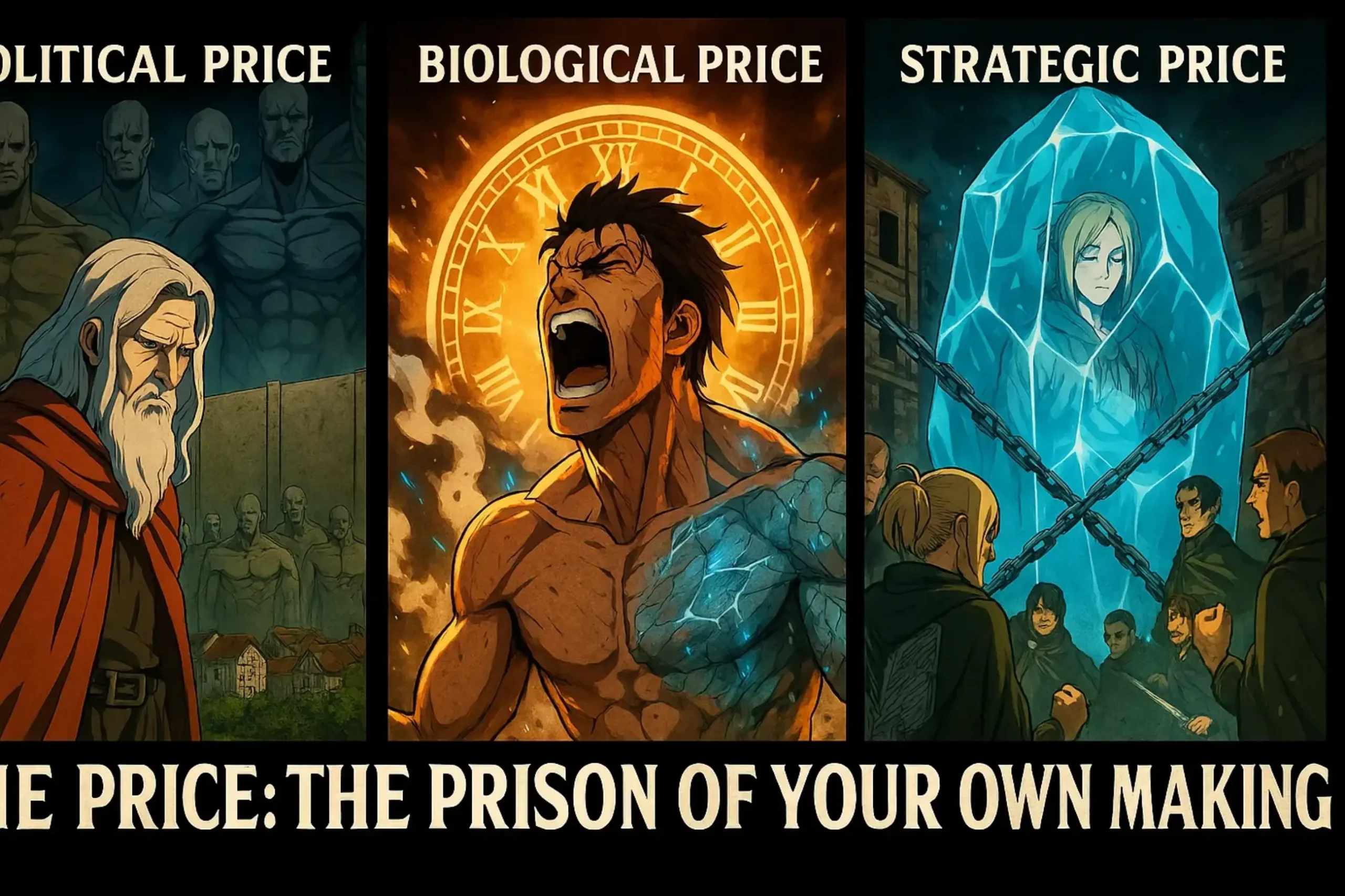
King Karl Fritz used his power to build the ultimate “safe space” for his people. He created the Walls to protect them. In doing so, he turned paradise into a prison.
He trapped his entire race behind his own hardened vow, creating an ignorant, caged populace waiting for slaughter. The tool of “safety” became the tool of “stagnation” and “imprisonment.”
This is the most profound “Price of Power” in the entire series. The King’s “prison” wasn’t just physical; it was ideological.
The Vow Renouncing War, enforced by the very existence of the Walls and the power of the Founder, was a psychological lobotomy on his people. He used the ultimate power to enforce the ultimate weakness.
He created a “Hope” (a peaceful paradise) so perfect that his prisoners forgot the “Reality” (that they were enslaved and awaiting execution).
This theme echoes down to every user. Annie used her crystal to protect her secrets. For four years, she remained “safe” in that crystal… while the entire world she knew was destroyed outside.
Her comrades died, her nation fell, and she was left a relic, a prisoner of her own “perfect” defense. Lara Tybur used her crystal to create the “perfect,” remote-controlled Titan.
She was “safe” underground, tethered to her proxy. But this “safety” made her immobile. When Eren found her tether, she was helpless.
She was a living, conscious heart trapped in a crystal shell, unable to move or escape as Eren used the Jaw Titan to crush her.
This is the ultimate, cynical price of this power. The desire for total control, for an absolute defense, for a “rule” that cannot be broken, leads to a prison. The crystal is a cage.
The Walls are a cage. The armor is a cage. The ultimate power of control is, in the end, the ultimate act of self-imprisonment.
Conclusion: The Will Made Manifest
Hardening and Crystallization are the heart of Attack on Titan‘s Meso-System. They are the pivot point upon which the entire series’ conflicts turn.
They are the ultimate expression of the Flexible Power System—a biological “magic” that proves the rules of this world are not set in stone. They can be rewritten.
This power allows willpower (Eren’s desperate effort to plug a wall), creativity (the War Hammer’s imagination sculpting a weapon), and desperation (Annie’s stalemate against a hopeless reality) to forge new, physical rules.
It is the power to turn flesh into diamonds, to turn a biological function into a political statement, and to turn a soldier into a fortress.
This ability is the perfect double-edged sword. It is the ultimate tool, offering absolute offense and defense to those who can wield it.
But its price is absolute—demanding crippling amounts of energy, sacrificing all mobility, and, in its perfect, crystalline form, demanding total freedom. It is the power to create the perfect shield, only to discover it has become the perfect prison.
This power to break the rules, to create new ones from nothing, is a defining trait of one Titan in particular… a Titan whose very existence challenges the nature of time and destiny itself.