
The Rogue Element in the System
In the intricate, brutal, and meticulously constructed world of Attack on Titan, the power system of the Nine Titans appears, at first glance, to be a set of clearly defined tools.
They are the fragmented remains of a goddess, and each piece operates by a “rule,” a specialty that dictates its function on the battlefield.
The Colossal Titan is the god of destruction, a living nuclear bomb defined by its overwhelming size, scale, and incinerating heat.
The Armored Titan is the immovable shield, a bastion of defense whose hardened plates can repel all but the most specialized weaponry.
The Jaw Titan is the agile assassin, a blur of speed and lethality. They are, for all their world-bending power, tools that operate firmly and logically within the present. They are weapons to be wielded in the now.
But one Titan is a rogue element in this system. One Titan does not play by these established rules. One Titan possesses a power so fundamentally disruptive that it breaks the most unassailable, absolute law of all: time.
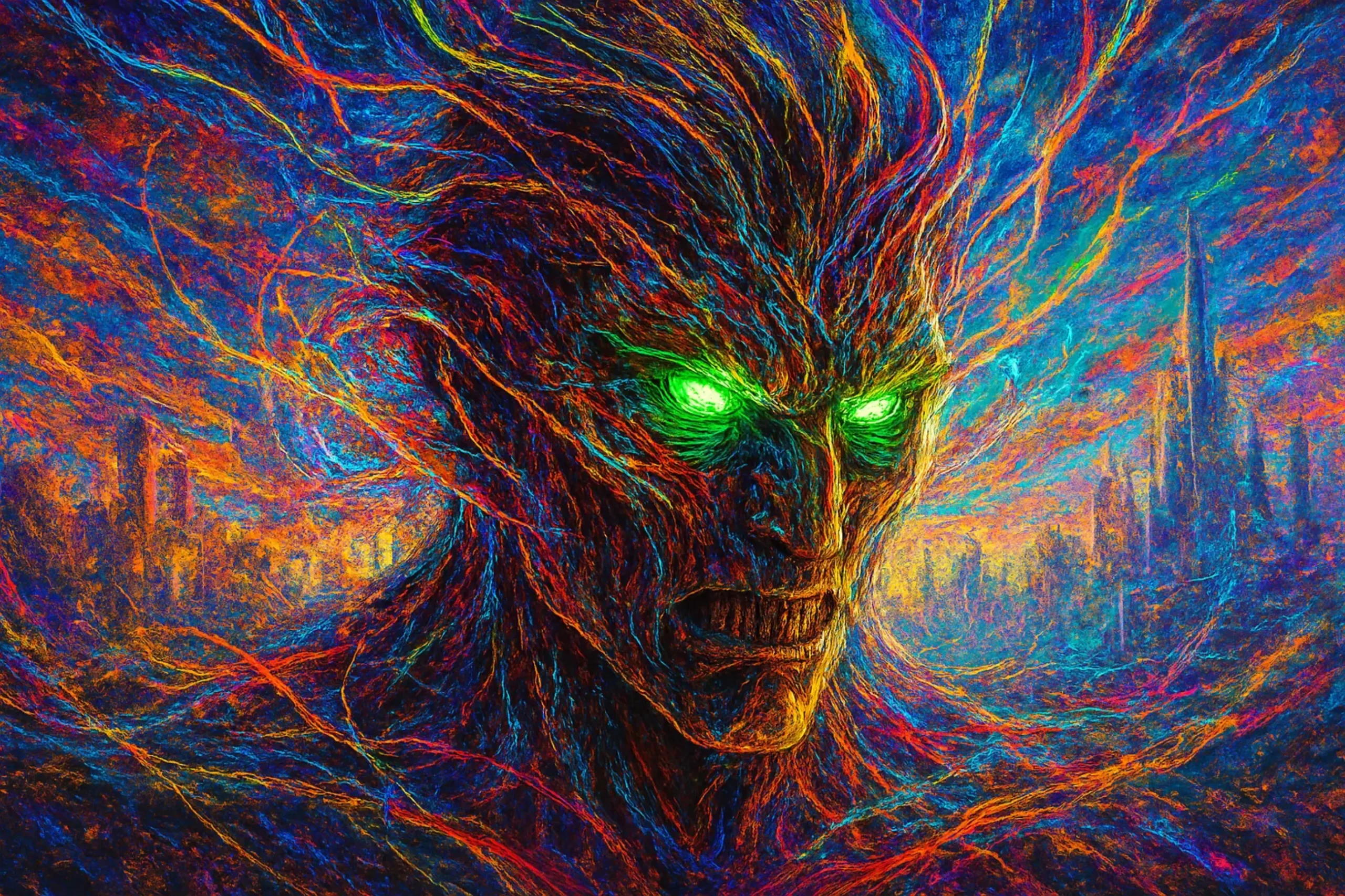
This article will dissect the Attack Titan’s “Anomaly”—its unique, paradigm-shattering ability to see the memories of its future inheritors.
We will challenge the common, fatalistic interpretation of this as a “fixed-timeline destiny,” the suffocating idea that Eren Yeager and his predecessors were merely puppets following a pre-written script.
Instead, we will prove that this power is the ultimate, terrifying manifestation of the Core of Victory, where unwavering, relentless effort does not just overcome destiny, but actively creates it.
The Attack Titan’s foresight is not a passive window into a predetermined future; it is an active, violent weapon forged by an individual will so strong and so rebellious that it imprints itself onto the past.
This ability is the ultimate proof that the series’ power system is not a set of rigid, unchangeable laws, but a flexible narrative tool.
It shatters the very concept of linear time to serve its one, unchangeable theme: the absolute, unyielding, and eternal pursuit of freedom.
To understand this, we must deconstruct the mechanics of this temporal power, analyze the philosophical paradox of free will versus predestination, and ultimately demonstrate how Eren Yeager’s effort is the cause of the timeline, not a symptom of it.
Deconstructing the Anomaly: The Mechanics of a Rogue Titan
To understand why the Attack Titan’s power functions as an engine of effort, we must first and most importantly understand how it functions.
Its ability is not a simple, all-seeing crystal ball gazing into the mists of probability. It is a complex, ideology-driven mechanism, a “Meso-Rule” that governs its very existence and separates it from its eight counterparts.
The Inherent Ideology: The Will to be Free
Long before the audience ever knew the specifics of its temporal power, the Attack Titan was defined by a single, core concept: it has always fought for freedom.
This is the first and most important “Meso-Rule” of this specific Titan. While other Titans, including the Founder itself, could be shackled by the will of others—most notably King Fritz’s “Vow Renouncing War”—the Attack Titan never was. It was constitutionally incapable of being subservient.
It could not be controlled. It could not be tamed. It could only, as its inheritors would come to say, “keep moving forward.”
This fact alone is our first and most critical clue. The Attack Titan’s power is not just a random magical lottery (Destiny); its very nature is intrinsically tied to an ideology (Effort).
This isn’t a power like “super strength” or “hardening” that is simply gifted to a user. This suggests that the power is the ideology, a tangible manifestation of its unquenchable willpower.
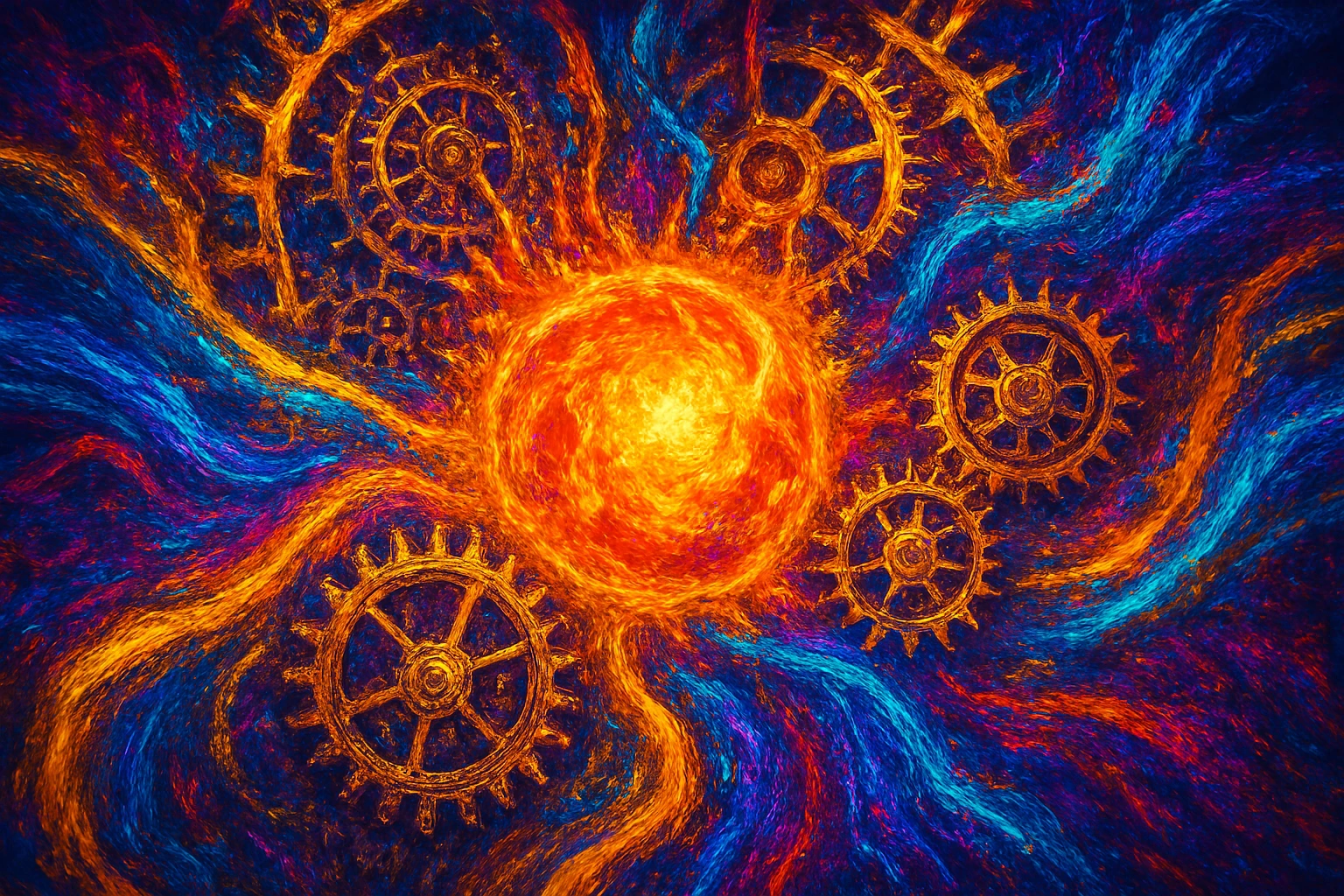
Think of it as source code. The Colossal’s code is “Be big.” The Armored’s code is “Be hard.” The Attack Titan’s code is “Be free.”
How, then, would such a “will” translate into a tangible power? It would have to be a power that ensures this freedom. A will that exists to “keep advancing” would logically develop a power that clears the path ahead. And what is the greatest obstacle to advancement? The unknown.
The future. Therefore, the Attack Titan’s power evolved from its ideology, becoming a tool to guarantee that its core drive—its effort—would never be stopped. It is a power about “advancing,” and its unique ability is the ultimate guarantor of that advance.
The True Mechanism: Receiving Future Memories
The most common misconception is that the Attack Titan “sees the future.” This is incorrect, and the distinction is the key to the entire argument.
The Attack Titan’s user does not gaze into the branching paths of what might be or what could happen. Instead, they “receive memories from its future inheritors.”
This is not foresight; it’s a closed-loop communication system. It is a chain of information, a stream of data passed backward from shifter to shifter.
The future must first happen—it must be created, experienced, and encoded as a memory by a future shifter—for that memory to exist at all.
This memory is then sent back through the Paths, the dimension that connects all Eldians outside of linear time, to a past inheritor.
This mechanism immediately introduces a temporal paradox: for a future memory to exist, the future must be “set.” But as we will see, this “set” future is not dictated by a cosmic entity, a god, or a scroll of destiny.
It is set by the will of the final, most dominant inheritor in the chain. The power is not a window to a future; it is a direct line to the future one specific individual is going to forge.
Case Study 1: Eren Kruger’s “Message”
Our first concrete, chilling proof of this mechanism comes from Eren Kruger, “The Owl.” As he prepares to pass his Titan to Grisha Yeager, he delivers a final, desperate command.
He tells Grisha he must complete his mission, “love someone inside the walls,” and “have a family.” This is his own will, his own “effort” being passed on.
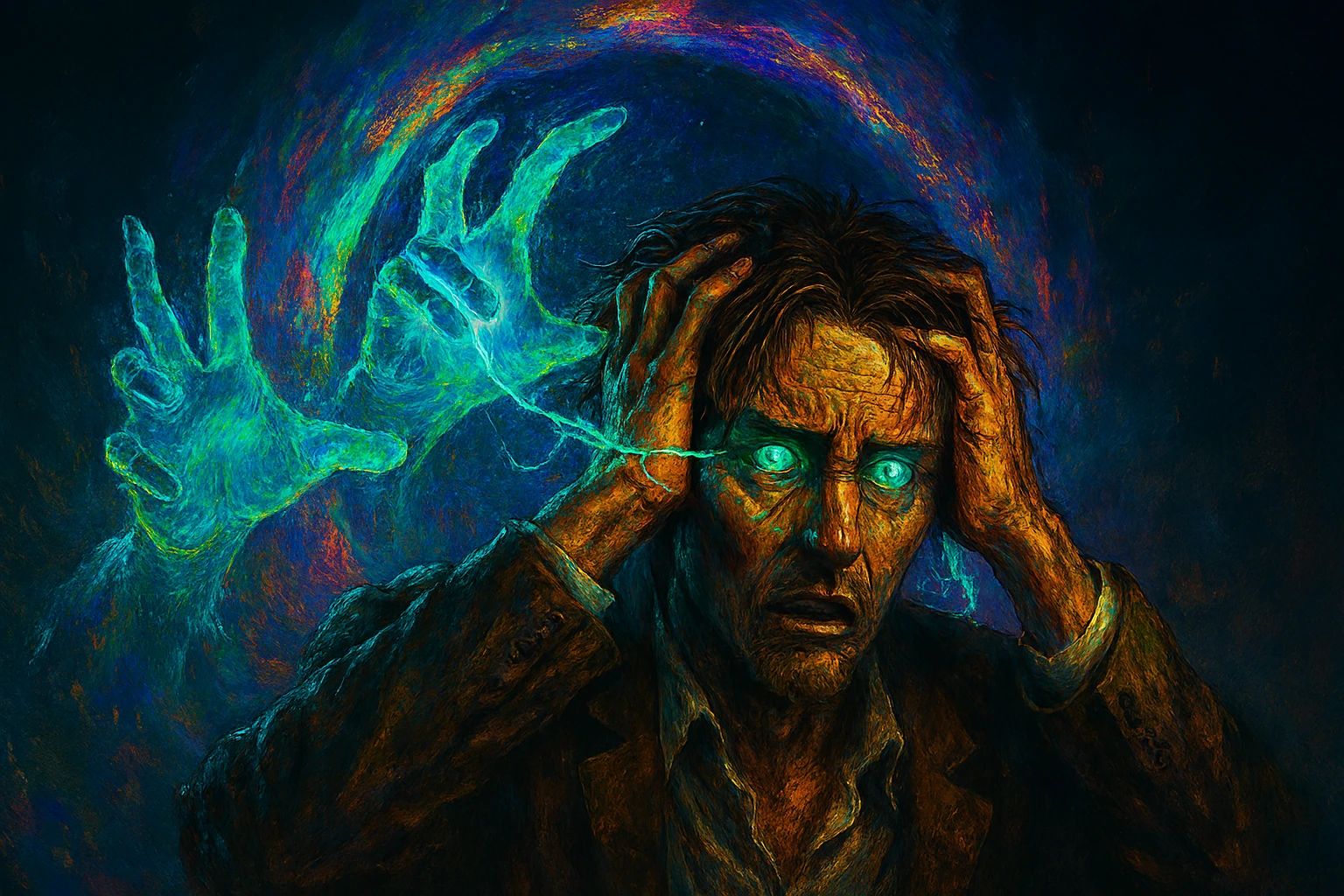
Then, a profound glitch in the system occurs. Kruger, a man who has never set foot on Paradis, a man who has no connection to its people, suddenly clutches his head.
His eyes widen, and he says: “If you want to save them all… Mikasa, Armin…”
He freezes, genuinely confused by the words coming out of his own mouth. He asks Grisha, “Whose memories are these?”
This is the definitive evidence of the mechanism. Kruger is not seeing a random, possible future. He is not a prophet receiving a divine vision.
He is receiving a data fragment, a specific, concrete memory from the final shifter in the line: Eren Yeager.
This memory—Eren’s desperate, foundational drive to “save them,” the two people who represent “home” and “freedom” to him—is so powerful, so fundamental to his being, that it bleeds backward through time.
It travels from Eren, through Grisha (who acts as a temporal conduit), and into the mind of Kruger. This is not destiny being revealed.
This is a future shifter’s unwavering effort and core motivation being imprinted on the past, setting the stage for his own arrival. It is the timeline preparing itself for the will that will one day define it.
Case Study 2: Grisha’s “Push” at the Reiss Chapel
If Kruger’s moment was the proof of concept, Grisha’s experience in the Reiss chapel is the main event. This is the lynchpin of the entire thesis. This is the moment where the Core of Victory shatters the laws of time.
Grisha confronts Frieda Reiss, the inheritor of the Founding Titan. He begs her to use the Founder’s power to save the people of Wall Maria from the impending attack by Reiner, Bertholdt, and Annie. Frieda, tragically bound by the King’s Vow Renouncing War, refuses. She succumbs to the “destiny” of her lineage.
Grisha knows he must take the Founder by force. He knows this is his mission. But he hesitates. He is, at his core, a doctor. He is a father. He cannot bring himself to slaughter an entire family, including screaming, terrified children. He collapses. He is broken.
Based on his own character, his own will, and his own limitations, Grisha’s “Destiny” at this moment was to fail. He was about to give up.
And then, he sees his future son.
This is not just a passive memory. This is not Grisha simply “remembering” the future. This is an active, real-time, causal intervention. Future Eren, having accessed the Founder’s power by touching Zeke at the Coordinate, is actively looking back at his father through Grisha’s own memories. He is present in that cave.
He speaks to Grisha. He reminds him of his sister Faye, of the restorationists, of his life’s purpose. He pushes him.
“Stand up, Dad.” “Keep moving forward.” “Did you forget why you came here?” “This is the story that you started.”
This is the ultimate expression of the Core of Victory. Grisha’s “Destiny,” his path of least resistance, was to fail. But Eren’s “Effort”—his future, unyielding, and terrifying willpower—is sent back in time to force his hand. This is not Grisha following a script. This is Grisha being coerced by a future actor to change the play.
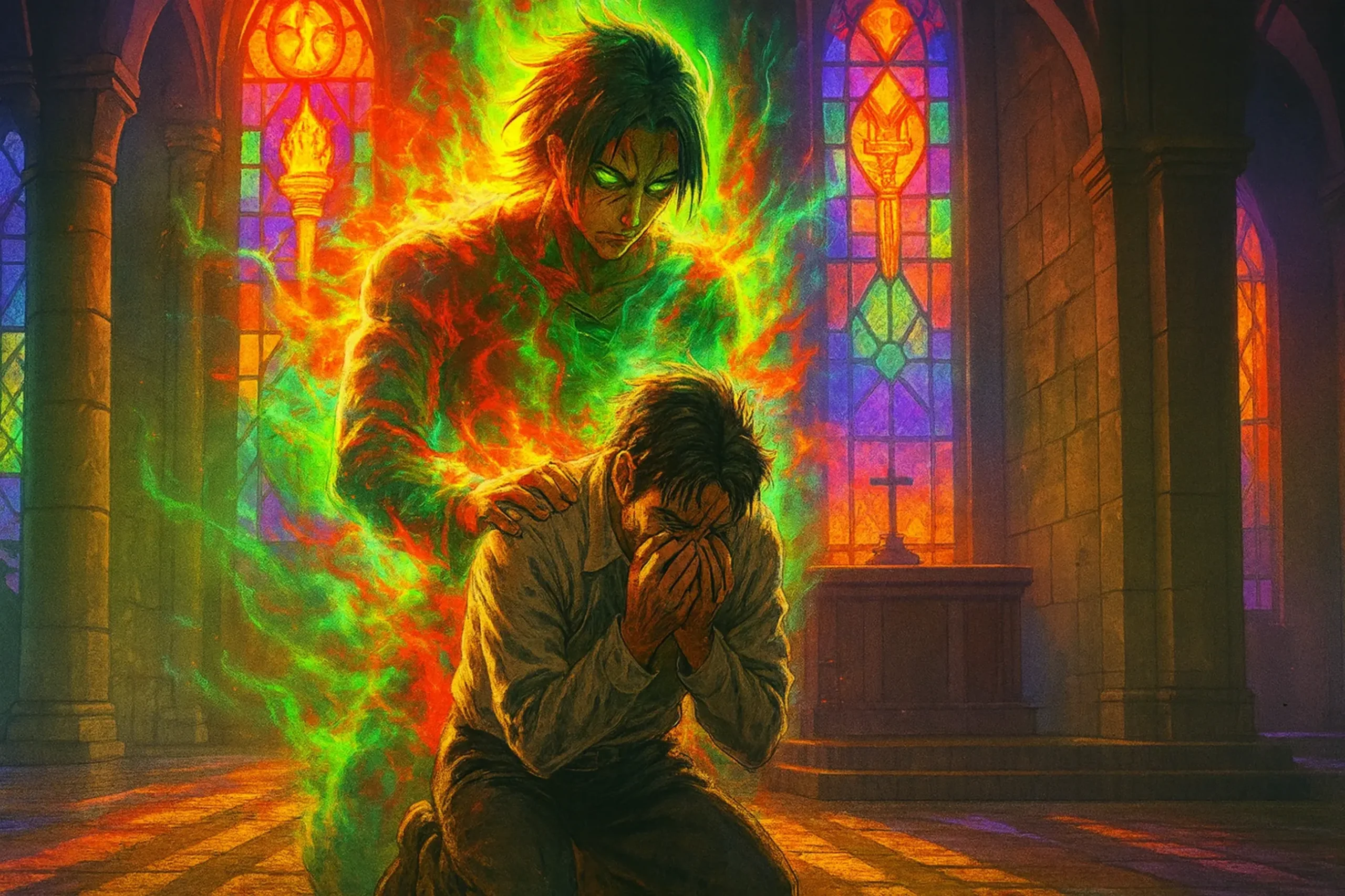
Eren’s will is so absolute that it reaches back through time to ensure its own existence. He makes his father kill the Reiss family to ensure he inherits the Founder, to ensure he reaches the checkpoint with Zeke, to ensure he can send that memory back in the first place. This is not predestination.
This is a temporal bootstrap paradox created by sheer, unadulterated effort. Eren’s will is the cause, and the subsequent events, even those in the past, are the effect.
Resolving the Paradox: Effort Creates Destiny
This brings us to the central philosophical conflict of the entire series, the question that defines Eren Yeager’s entire existence. Is he a free man fighting for his vision, or is he the ultimate slave, a puppet dancing on the strings of a future he cannot change? The answer, through the lens of the Core of Victory, is that this is a false dichotomy.
The “Destiny” Trap (The Dark Reality)
First, we must acknowledge the “cynical” trap, the dark and hopeless reality that the story presents. From this perspective, Eren is the most imprisoned character in the story.
The moment he kisses Historia’s hand at the medal ceremony, his life is effectively over. The past and future collide, and he is flooded with the “scenery” he will create. He sees the future. He must manipulate his father. He must reject his friends. He must move forward, step by agonizing step, toward the Rumbling. He must become the monster that murders 80% of the world.
The most horrific revelation, the absolute nadir of this “dark reality,” is that he must, by manipulating the past, send the Smiling Titan (Dina Fritz) away from Bertholdt and toward his own mother. He is the author of his own trauma. He kills his own mother to forge the very hatred, the very “effort,” that will define his life and set him on this exact path.
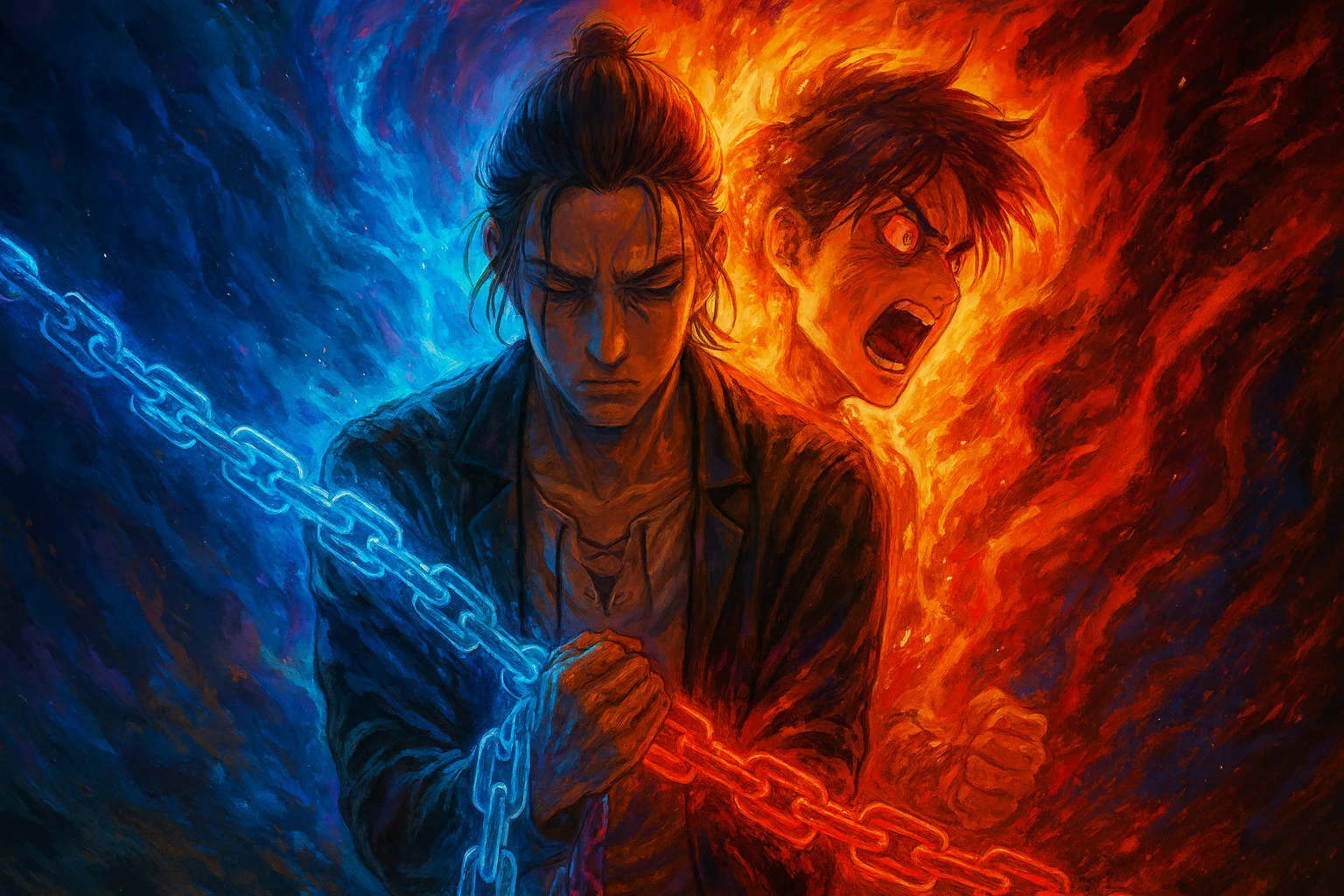
This is the dark reality that the “hope” of freedom seems to mask. Eren’s “freedom” looks like a gruesome, fixed path, a looped nightmare where every choice is already made. He is, by this logic, a slave to the future he has seen. This interpretation is easy to accept. It is also the one that misses the point.
The Agony of the Engine (The Ramzi Encounter)
The most compelling proof that Eren is not a “slave to destiny” is his psychological breakdown in Marley. When he sneaks away from the hospital, he finds Ramzi, a young refugee boy.
As he watches the boy, he is overcome by a vision of the future: he sees himself, via the Rumbling, crushing this boy under his heel.
And he breaks.
He collapses in tears, sobbing, “I’m sorry. I’m sorry.” He confesses to this child that he “wished for it… for all of this to be wiped away.” This is not a man coldly following a script. This is a man in agony.
He hates this future. He wants another way. He is desperately searching for an exit from the path he sees.
This scene is the key. It proves he is not a “slave” to an external script he is forced to read. He is a “slave” to his own unchangeable nature.
He is horrified by what he knows he will do… and he knows he will do it because he is fundamentally incapable of being anyone else. His effort, his core identity, is a curse as much as it is a power.
He is not trapped by “destiny”; he is trapped by “Eren Yeager.”
The “Effort” Resolution (The Core of Victory)
This is the truth of the article, the resolution of the entire paradox: The future Eren saw was not a pre-written scroll. The future he saw was the only possible outcome that his own unchangeable, unwavering effort would allow.
He doesn’t do the Rumbling because he saw it. He saw the Rumbling because he is the kind of person whose fundamental, unyielding, and terrifying drive for his vision of freedom would always lead him to do it.
His will is a constant. His Effort is an absolute. The boy who screamed “Fight! Fight!” in the mirror, the boy who vowed to kill every last Titan, the boy who could only “keep moving forward” is constitutionally incapable of choosing another path.
His despair (with Ramzi) proves this. He hated the future. But when the time came to act, when Sasha was shot, when Marley attacked, when his friends were in danger, his core nature—his unwavering Effort—overrode his own despair. When Mikasa asks him why he is doing this, his ultimate answer is not “because I saw it in a vision” or “because it is destiny.” His truest answer is, “I have to… I was just born this way.”
His will is the one fixed point in the universe. The future he saw was not a future; it was his future, the one he and he alone would forge.
Effort as the Cause: Not Prophecy, but a Mirror
This is what elevates Attack on Titan‘s power system. We must contrast this with traditional “prophecy” tropes. In a story like Oedipus or Harry Potter, a prophecy is an external decree.
It is a “Destiny” spoken by a third party, and the hero either fights against it or accidentally fulfills it while trying to avoid it. The agency is external.
The Attack Titan’s power is the opposite. It is 100% internal. It is not a prophecy of what will happen; it is a mirror reflecting what the user’s will is going to make happen.
It’s a reflection of his own absolute, unchangeable Effort. This shifts the agency entirely from an external “fate” (Destiny) to an internal “drive” (Effort).
Eren Yeager’s core identity is the engine of the timeline. His will is the cause of this “destiny,” not the result of it. The timeline of Attack on Titan is not a river that Eren is helplessly floating down.
It is a river that must carve a new path around the unmovable mountain of his will. His effort is the “why,” and the temporal loop is simply the “how.”
The “power of foresight” is, therefore, the ultimate narrative tool used by the author, Hajime Isayama, to demonstrate this concept. It is not a plot device that controls Eren; it is a window that reveals the terrifying, absolute nature of his will. He is not a slave to destiny.
He is the destiny. His Effort was so total, so singular, that it became the Destiny that all other events, past and future, were forced to obey.
The Price of the Anomaly
This resolution, however, is not a simple, happy victory. This is not a story where “effort” leads to a simple, triumphant win.
This level of power, this kind of reality-bending will, comes at an almost unbearable cost. This is where we must explore the open-ended questions: What is the Price of Power, and what is the Role of the Common Man in the face of such a force?
The Psychological Price: The Prison of Knowledge
The price for the Attack Titan’s anomaly, for this absolute power of Effort, is total, soul-crushing isolation.
When Eren kisses Historia’s hand, he effectively ceases to be a normal person. He is no longer a participant in his own life; he becomes a lonely, haunted observer of his own future actions.
He is fundamentally, irreversibly alienated from his friends, the very people he is doing all of this to save.
He cannot laugh with them, he cannot live in the present with them, because he is perpetually haunted by the future he will unleash upon them.
He becomes a slave, as he himself says. But he is not a slave to a cosmic destiny or a magical script. He is a slave to his own unbreakable will.
He is trapped by the future that his own core identity has already built. He must walk, step by step, toward a future he intellectually abhors but constitutionally cannot prevent himself from creating.
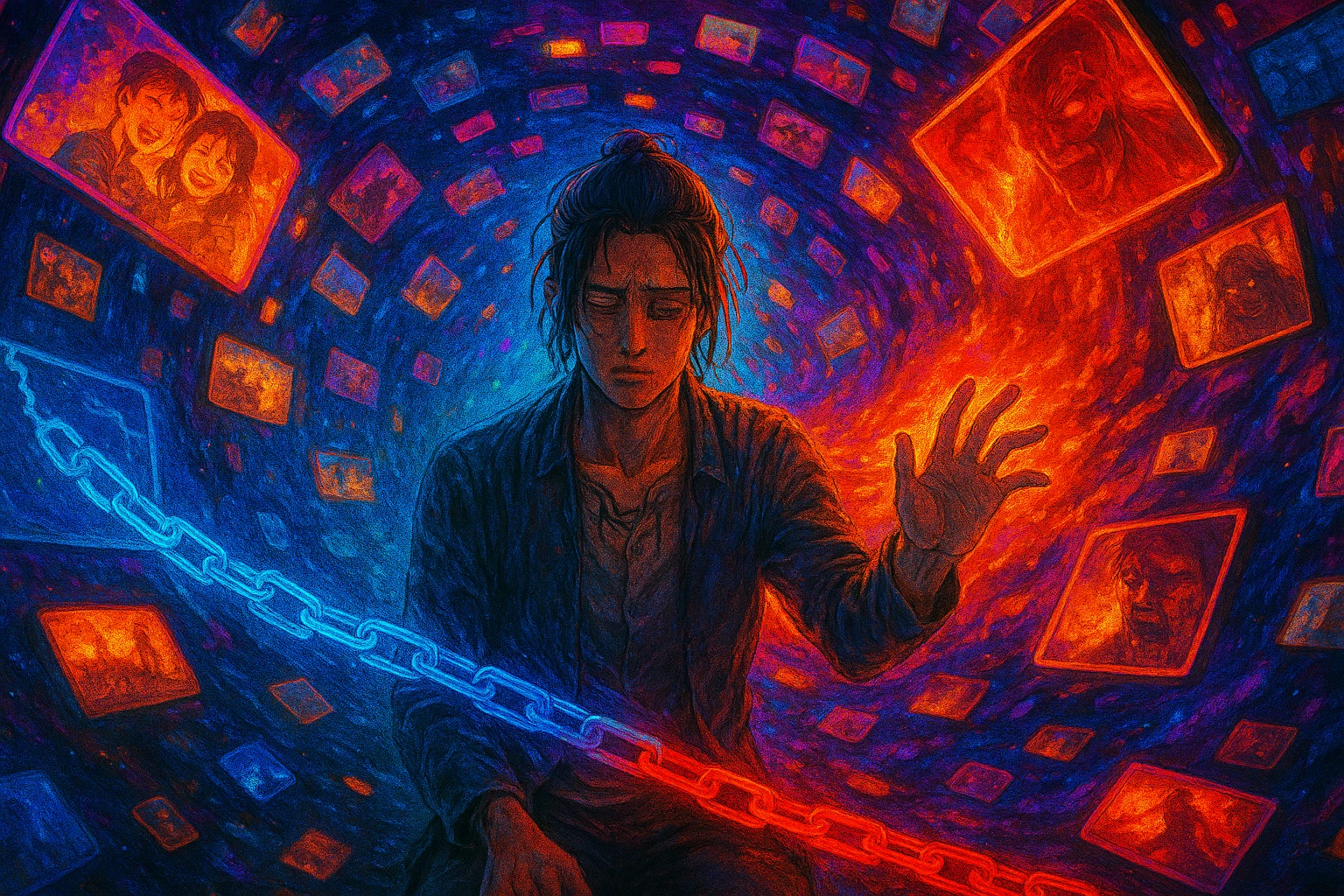
The price of his power is the loss of his present. He is a ghost in his own life, a man already living in the future, forced to watch his past self catch up. This is the tragic, psychological prison built by his own absolute will.
We see this price paid in full in his final conversation with Armin in the Paths. He finally confesses everything. He admits he had to do it.
He even admits he doesn’t entirely know why, beyond a core, internal, unexplainable drive: “I just… had to.” His core drive superseded even his own conscious understanding.
His isolation was so complete that even in this final, honest confession, he is still alone. He has been alone with this knowledge for years, and it has hollowed him out, reducing his complex motivations to a simple, terrifying “I had to.”
The price of his absolute will was, in the end, his own humanity.
The “Rival’s Role” (Applied)
Eren’s “fixed” path, the “destiny” he creates, becomes the ultimate catalyst for his “Rivals”—Armin, Mikasa, Reiner, and the rest of the Alliance.
His unwavering, seemingly predestined march toward the Rumbling is the ultimate threat that forces them to accelerate their own growth. They are no longer just fighting Titans or foreign armies; they are fighting their dearest friend, who has become an apocalyptic, seemingly unmovable object.
To stop him, they must combine their own efforts. They must evolve beyond their old hatreds and traumas. Reiner, a man broken by his “destiny” as a Warrior, finds a new will to live, not for Marley, but to stop Eren. Armin, the strategist, must become a true leader, willing to sacrifice his own emotions and friendship for a global solution. Mikasa must make the impossible choice, finding the strength to act against her own heart.
In this way, they perfectly fulfill the Rival’s Role. They are his “supporter persons,” not by agreeing with him, but by rising to the challenge his will creates. His unchangeable “Effort” is the anvil on which their own “Effort” is forged and tested. His absolute stance forces them to forge their own absolute stance, pushing the central conflict of the entire series to its absolute, necessary, and tragic conclusion.
The “Common Man” (Applied)
What about the “Common Man” in the face of this anomaly? We see the perfect, tragic answer in Floch Forster.
The Common Man is drawn to the certainty of a “destined” leader. Eren’s absolute, unshakeable confidence—a confidence born from knowing the future because he is the one creating it—is magnetic. It gives people like Floch a sense of hope and a divine purpose. Floch doesn’t just see a leader; he sees a prophet. He sees the “devil” who can finally save Eldia, a “destined” savior who will give their lives and their deaths meaning.
This “hope,” as per our analytical perspective, serves to mask the dark reality. The dark reality is that Floch and the Jaegerists are not partners in a revolution; they are tools in one man’s unchangeable, time-bending plan. They are pawns, not in a cosmic game, but in one man’s unwavering internal plan.
Their “hope” in Eren’s “destiny” is a coping mechanism that blinds them to the dark reality that they are sacrificing their own free will to a man who has already sacrificed his. They follow him because his certainty masks their own fear, and in doing so, they become fuel for the engine of his will.
Conclusion: The Will That Forges Time
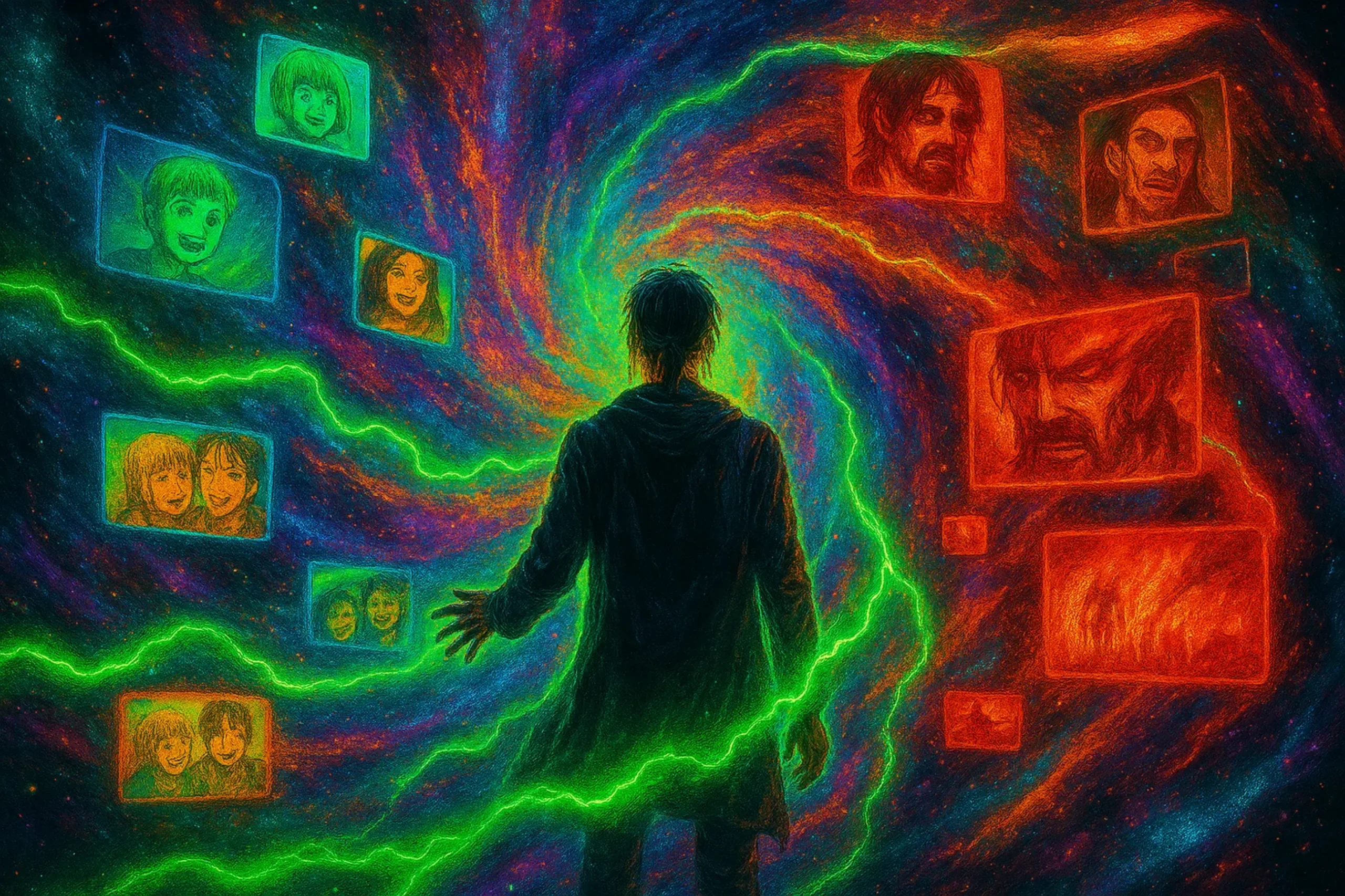
The Attack Titan’s anomaly is not a plot hole. It is not a cynical contradiction of the series’ themes of fighting for freedom. It is the ultimate, most profound, and most terrifying proof of the Core of Victory.
It is the logical and frightening conclusion of the “Effort triumphs over Destiny” perspective. What happens when a character’s effort, their will to “keep moving forward,” is so absolute, so pure, that it cannot be broken by anything? Not by armies, not by monsters, not by despair, and not even by the fundamental laws of physics?
The answer is that the laws of physics break first.
The Attack Titan is not a passive observer of “Destiny.” It is the active, rebellious agent of “Effort,” an ideology given a physical, temporal form. The power to see future memories was never about predestination. It was the ultimate weapon of a single, unbroken will, an engine designed to ensure its own success by building its own past.
Eren Yeager was not shown a path he was forced to walk. He was shown the path that he, by his very nature, was always going to burn. He proves that in the world of Attack on Titan, an effort that is strong enough, unwavering enough, and terrifying enough doesn’t just challenge destiny.
It creates it.
reach full series to read.