
I. Introduction: The Weakest Link Who Became the Biggest Threat
In the visceral, blood-soaked ecosystem of Attack on Titan, value is typically measured in kinetic force. Survival is defined by the razor edge of an ODM blade slicing through nape meat, the unnatural genetic fortitude of an Ackerman crushing bone, or the towering, regenerating flesh of a Titan Shifter leveling a city block.
In this world of apex predators and biological horrors, the initial assessment of Armin Arlert was unanimous, brutal, and seemingly correct: he was prey.
Go back to the beginning. Amidst the smoking ruins of Shiganshina, or huddled in the relentless rain during basic training, Armin was a portrait of paralyzing inadequacy.
He possessed neither Eren Yeager’s suicidal rage—that burning engine of will that defied logic—nor Mikasa Ackerman’s preternatural, terrifying physical gifts.
He couldn’t lift a boulder. He couldn’t master the pendulum swing of the maneuver gear without assistance, dangling helplessly while Shadis mocked him.
In a direct confrontation with a pure Titan, he wasn’t just useless; he was a liability, frozen in a perpetual state of trembling terror, eyes wide with the realization of his own powerlessness.
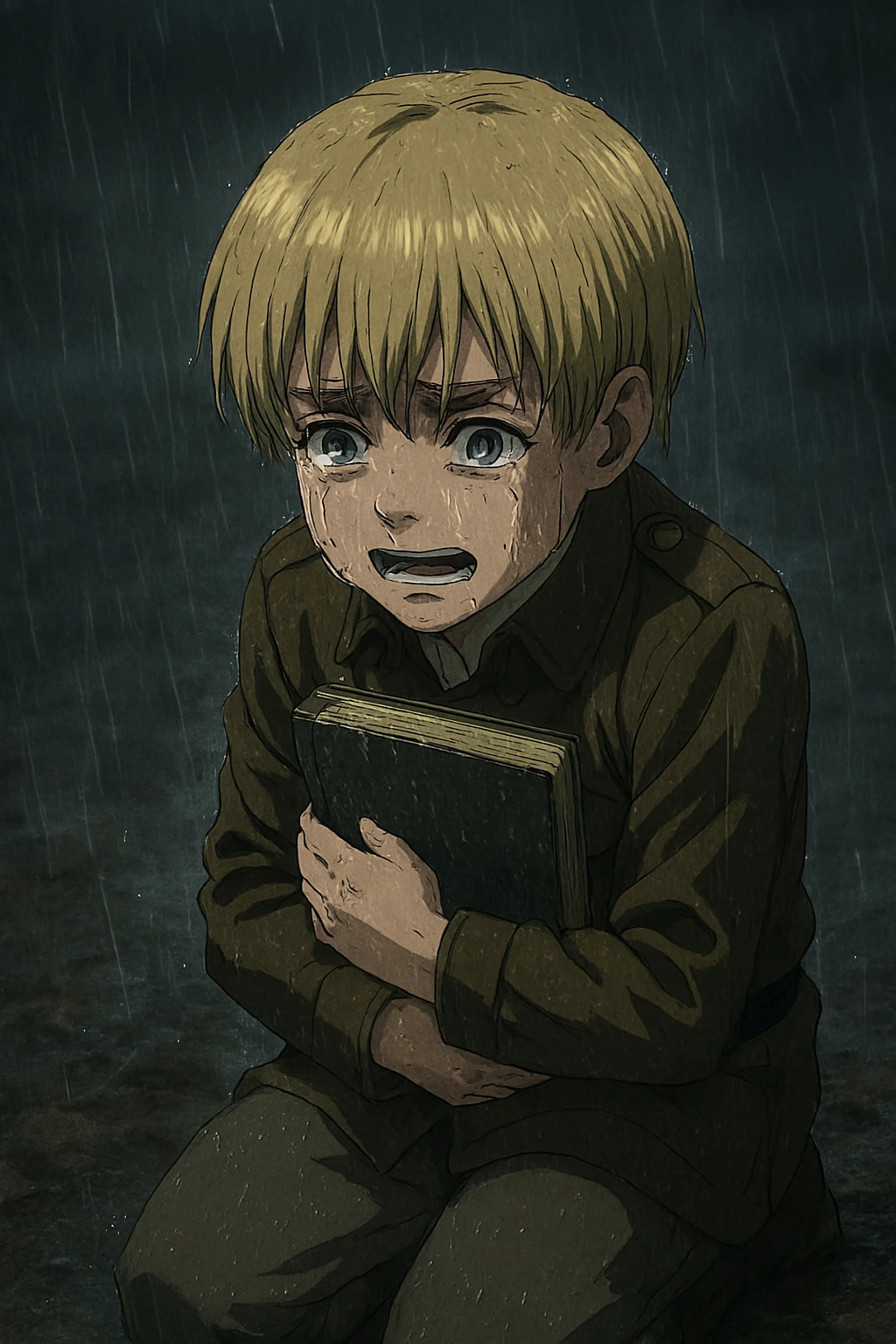
Statistically, by the brutal logic of the world Hajime Isayama created, Armin Arlert should have been among the first to be digested.
He was the runt of the litter, the defect in the machinery of war. He was the kind of character who, in any other Shonen anime, would exist solely to be rescued or to die tragically to motivate the hero.
Yet, this trembling boy became the hinge upon which the fate of humanity turned. Without the “weakest link,” the chain of command would have shattered in Trost.
Eren would have remained a half-digested smear in the stomach of the Santa Titan, and the secret of the basement would have rotted along with the corpse of Grisha Yeager.
The Scouts would have been systematically wiped out by Annie Leonhart in the Forest of Giant Trees had Armin not deduced her identity from the slightest twitch of a muscle and the geography of a formation.
The central paradox of Attack on Titan, and its most unsettling truth, is that Armin Arlert is not the “heart” of the trio. He is not the gentle pacifist dragged kicking and screaming into war, functioning as the moral compass.
That is a misunderstanding of his character. Armin is the series’ most terrifying pragmatist. While others fought with screams of duty, honor, or vengeance, Armin fought with cold, horrifying arithmetic.
He was the first character to truly internalize the darkest lesson of their reality: that to defeat monsters, one must not just gaze into the abyss, but willingly dive into it.
Armin Arlert was a dormant weapon, a dangerous tactician whose true lethality lay in his immediate grasp of the fact that saving millions often required the calculated sacrifice of thousands.
He didn’t just have the smartest mind in the room; he had the most ruthless one. His intellect wasn’t a shield; it was a scalpel, used to excise the weak parts of his own humanity to make room for the necessary cruelty of war.
II. The Philosophy of Sacrifice: “To Rise, You Must Fall”
To understand the terrifying trajectory of Armin Arlert, one must dissect the philosophical engine that drives him. Armin is often viewed as the embodiment of “Hope” within the series—the boy who dreamed of the flaming water and lands of ice, the one who looked beyond the Walls not with hatred, but with pure, unadulterated curiosity.
This is true, but it is only half the picture. In the context of Attack on Titan, Armin represents Hope chained to an unforgiving Reality. He is the bridge between idealistic dreams and the butchery required to achieve them.
This dichotomy crystallized early on, during the pursuit of the Female Titan. It was here that Armin delivered the line that would become his mantra, his curse, and perhaps the scariest thesis statement in the entire series:
“Someone who can’t sacrifice anything, can’t change anything. To defeat a monster, you have to be willing to throw aside your humanity.”
When first spoken, it sounds like a grim necessity of war—a generic soldier’s platitude. Yet, as the series progresses, we see that for Armin, this isn’t an inspirational slogan; it is a frightening permission structure.
It is the moment Armin Arlert intellectually accepted that standard morality was a death sentence. It is a rejection of the Shonen trope where the hero wins by holding onto his values. Armin realized that the high road led only to the grave.
Before Eren fully embraced his path of destruction, before Reiner split his own psyche in two to cope with his crimes, Armin had already made the conscious decision to become a monster in order to fight them. He realized that “talking it out” was a luxury afforded only to the powerful, and until Paradis had power, they had to be willing to stoop lower than their enemies.
We see this manifested in his psychological warfare. Consider his manipulation of Bertolt Hoover in Season 2. Hanging from the side of the Armored Titan, Armin didn’t appeal to Bertolt’s friendship or humanity.
He looked him in the eye and lied about Annie Leonhart being tortured, describing in graphic detail how her screams filled the dungeon. He weaponized a friend’s love against him with chilling precision, smiling a devil’s smile to break Bertolt’s composure.
It was a moment of pure psychological sadism, executed not out of malice, but out of strategic necessity. He needed an opening, and he flayed Bertolt’s mind to get it.
This philosophy sets Armin apart from the “Common Man” archetype he initially inhabits. While he represents the physical frailty of the ordinary citizen, his mind operates on a plane of utilitarian ethics that most people find abhorrent. He is the one who weighs lives on a scale.
If sacrificing 100 soldiers saves 101 civilians, Armin pulls the lever. It is a logic devoid of sentiment, a terrifying rationality that makes him arguably more dangerous than Eren. Eren kills because he is driven by emotion; Armin kills because the math tells him to.
III. The Ghost of Erwin Smith: The Burden of the Survivor
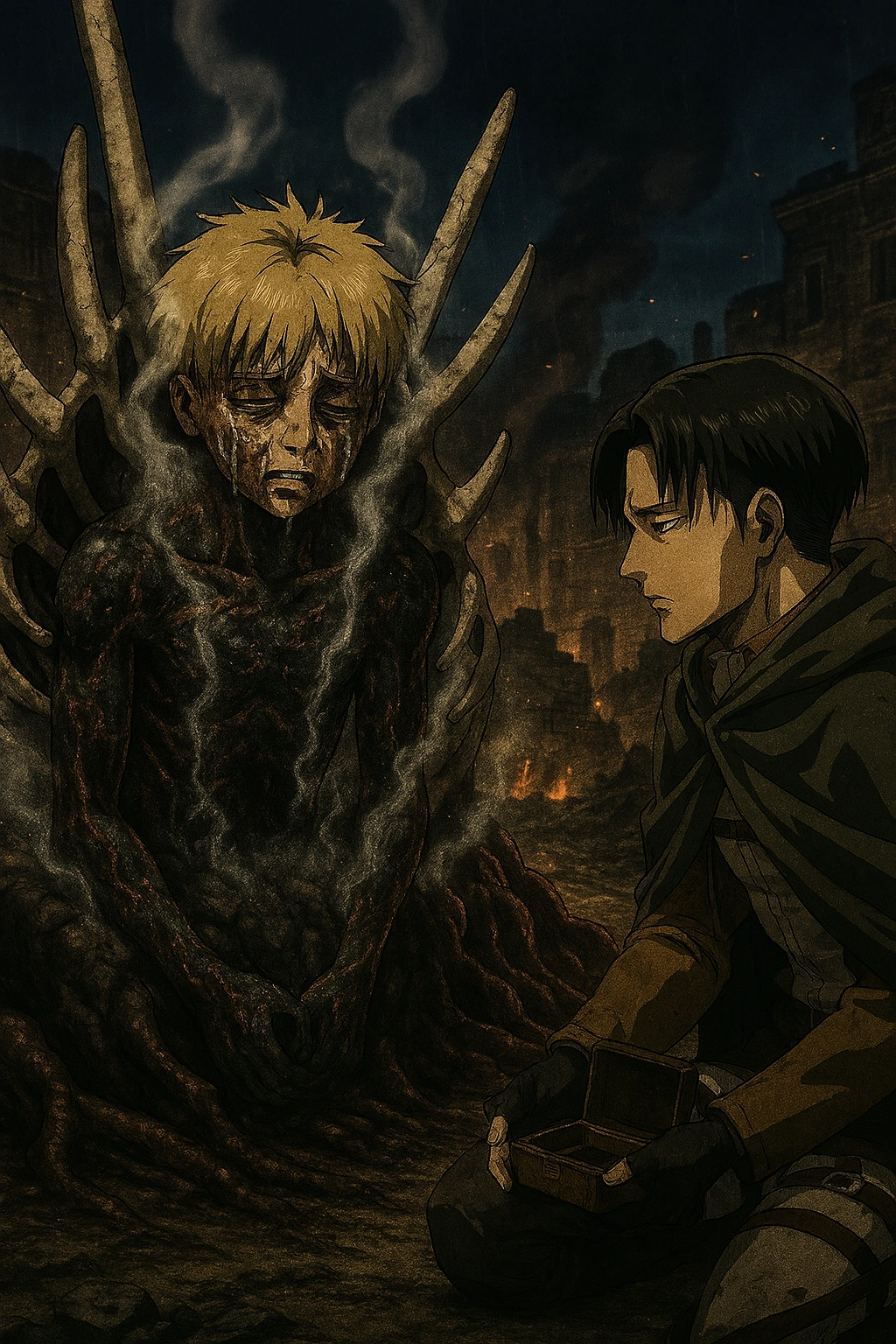
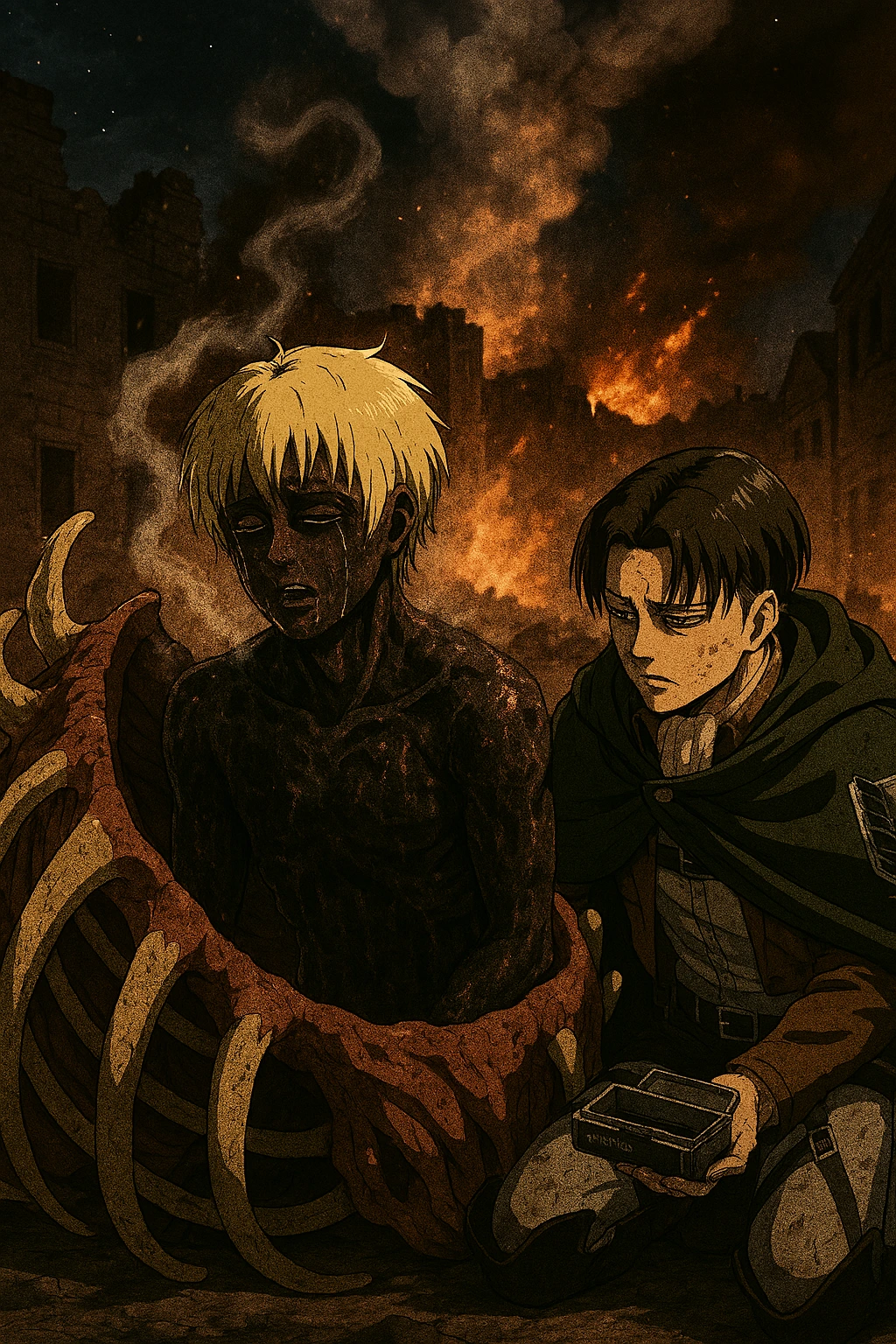
The “Seraphim” choice—Levi choosing to inject Armin with the Titan serum over the seasoned Commander Erwin Smith—is the pivotal fulcrum of the series’ second half.
It is also the source of Armin’s profound Survivor’s Guilt and the root of his complex rivalry with Floch Forster.
Levi’s choice is often misread as an emotional one, a choice for “the future” or “dreams.” While true, there is a darker layer.
Levi didn’t just choose Armin because of his innocence or his bright dreams of the sea. Levi chose Armin because, in Armin’s eyes, he saw the same terrifying spark he had seen in Erwin for years.
Erwin Smith was a “demon” because he could construct a mountain of corpses to stand on if it meant seeing slightly further ahead.
He could look at a suicide charge and see a winning strategy. When Levi looked at Armin, ragged, burned near death, and charred black from the steam of the Colossal Titan, he didn’t see a victim.
He saw the only other person capable of carrying Erwin’s specific burden. He saw someone who could look at hell, repress the visceral horror, and see a path to victory.
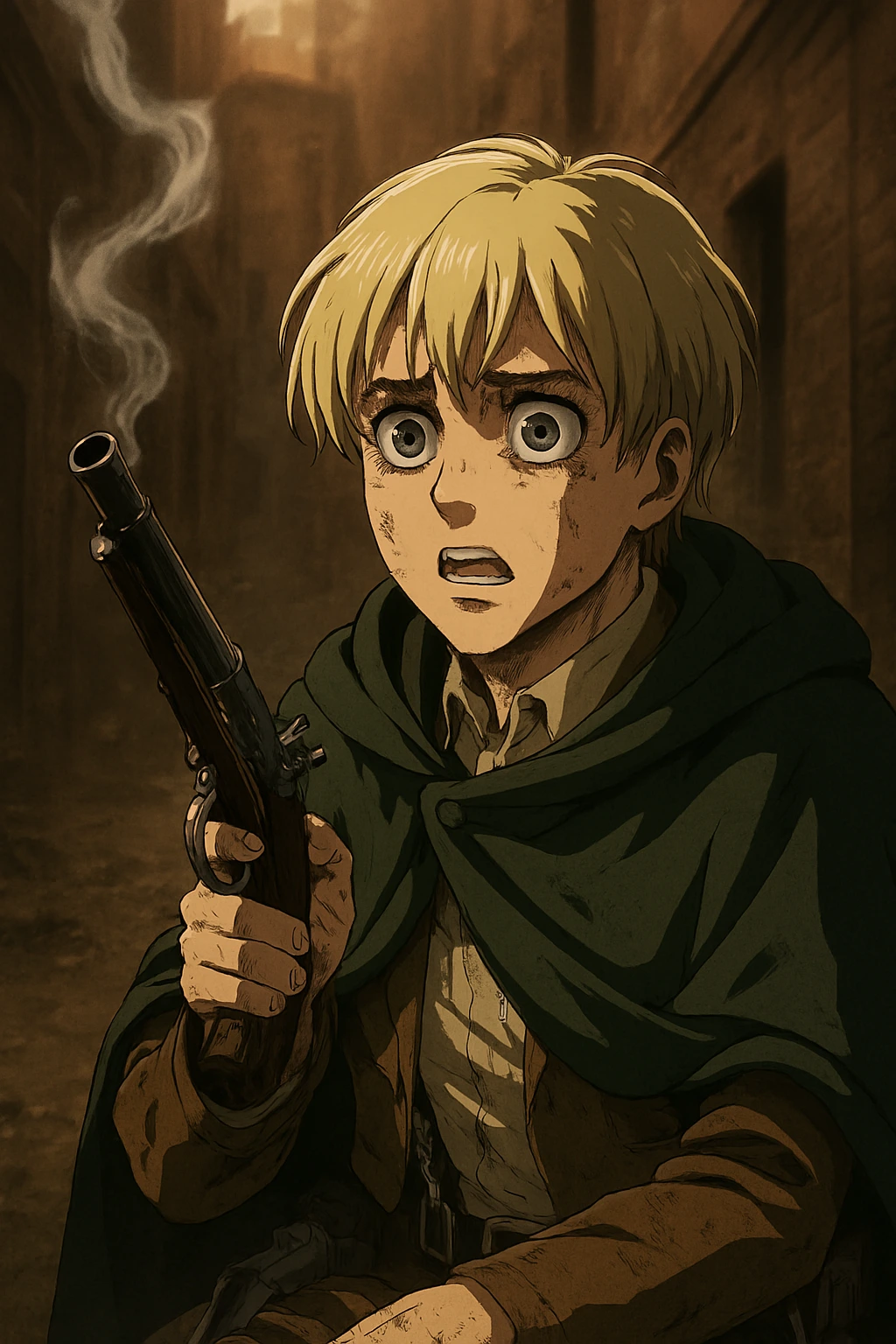
Armin was chosen not because he was the “good” option, but because he was the necessary evil required for Paradis to survive the wars to come.
Levi recognized that Armin possessed the necessary ruthlessness to carry the Commander’s burden—the ability to spend lives like currency to purchase victory.
The Shadow of Floch Forster
This transition created a fascinating ideological conflict with Floch Forster. Floch is often dismissed as a sycophant, but he serves a crucial narrative role: he is the voice of the outcome-oriented “Devil’s Advocate.”
Floch believed that only a Devil (Erwin) could destroy the Titans. When Levi chose Armin, Floch felt betrayed because he looked at Armin and saw only a boy—a weak, sentimental boy.
Floch’s hatred of Armin stems from the belief that Armin is too human to do what is necessary. This conflict drives the political tension of the final season.
Floch represents the path of fascism, nationalism, and brute force (The Yeagerists), while Armin represents the agonizingly difficult path of globalism, understanding, and nuance.
However, the irony—and the tragedy—is that Floch was wrong. Armin was a devil; he just wore a different mask. While Floch was executing volunteers in the street with a pistol, Armin was planning the annihilation of naval fleets. Floch played at being a monster;
Armin became one when it mattered, but hated every second of it. The friction between them is the friction between performative cruelty (Floch) and reluctant, strategic cruelty (Armin). Armin’s struggle to live up to Erwin’s legacy wasn’t about becoming like Erwin; it was about finding his own way to be the monster humanity needed, a monster who cried while he killed.
IV. The Strategist’s Burden: Blood on the Hands
The transition from theorist to executioner is where Armin’s character reaches its terrifying apex. For years, his ruthlessness was theoretical—he planned operations where others did the killing. But the Raid on Liberio in Season 4 changed everything. This was the moment the strategist picked up the gun, or rather, became the bomb.
The destruction of the Marleyan port was not an act of self-defense in the heat of battle. It was a premeditated, tactical atrocity. Armin Arlert, the boy who dreamed of the sea, transformed into the Colossal Titan right in the middle of a populated harbor. The resulting explosion was a miniature nuclear event.
We must linger on the horror of this moment. In an instant, he incinerated the Marleyan naval fleet. But the blast radius did not discriminate. The pressure wave liquefied organs. The heat vaporized flesh.
It consumed civilian homes, dockworkers, children playing by the water, and Eldians trapped in the internment zone. The visuals are apocalyptic: a mushroom cloud rising over a city, with Armin’s Titan peering down from the epicenter like a sorrowful god.
When Bertolt Hoover wielded the Colossal Titan, he did so with hesitation and immense regret. He was often paralyzed by the weight of his actions, needing Reiner to push him forward. Armin surpassed Bertolt in that moment in Liberio.
Once committed to the plan, Armin was surgical. He became the God of Destruction that Bertolt never fully had the will to be.
After the transformation, he climbs out of the nape, surveys the burning hellscape he created, and sees the crushed body of a civilian beneath the Titan’s foot. The look on his face isn’t the manic glee of a villain, nor is it the dissociated shock of a victim.
It is a look of hollow acceptance. He gazed down at the burning city he had created, the screams of the dying rising up to him, and he did not flinch. He accepted the role of the devil because the strategic map demanded that piece on the board.
The Psychological Toll of Intelligence
The psychological toll of this intelligence is unique among the series’ protagonists. The main trio each handles their trauma differently.
Eren represses his humanity through blinding rage and a deterministic drive to “keep moving forward,” insulating himself from guilt by believing he has no choice.
Reiner’s psyche fractures completely under the weight of his sins, creating a split personality just to function.
Armin, however, possesses the burden of total awareness. He does not have the luxury of rage, nor the escape hatch of madness.
He is fully, agonizingly conscious of every life he takes. He feels the weight of the blood on his hands, yet he continues to perform the arithmetic of death because he believes it is the only way to balance the equation for peace.
The scene at the restaurant table in Season 4 exemplifies this. When Eren verbally eviscerates Mikasa and beats Armin to a pulp, Armin is physically helpless. But notice his reaction before the violence starts. He is trying to de-escalate, to analyze Eren’s motives.
Even as he is being beaten, he is thinking. And later, he realizes the truth of Eren’s facade before anyone else. His burden is that he understands everything—the enemy’s perspective, his own monstrosity, and the futility of the violence—yet he is forced to participate in it.
V. The Cursed Inheritance: Losing Identity to Power
We must also address the “Price of Power” in the context of Armin’s character. Shonen anime often treats power-ups as rewards for effort. In Attack on Titan, power is a curse that erodes the self.
When Armin inherited the Colossal Titan, he didn’t just inherit a nuclear option; he inherited Bertolt Hoover. The memories, the feelings, the connection to the Path. Eren accuses Armin of being compromised by Bertolt’s memories, claiming that “part of you has become Bertolt.” While Eren said this to hurt him, there is a grain of terrifying truth to it.
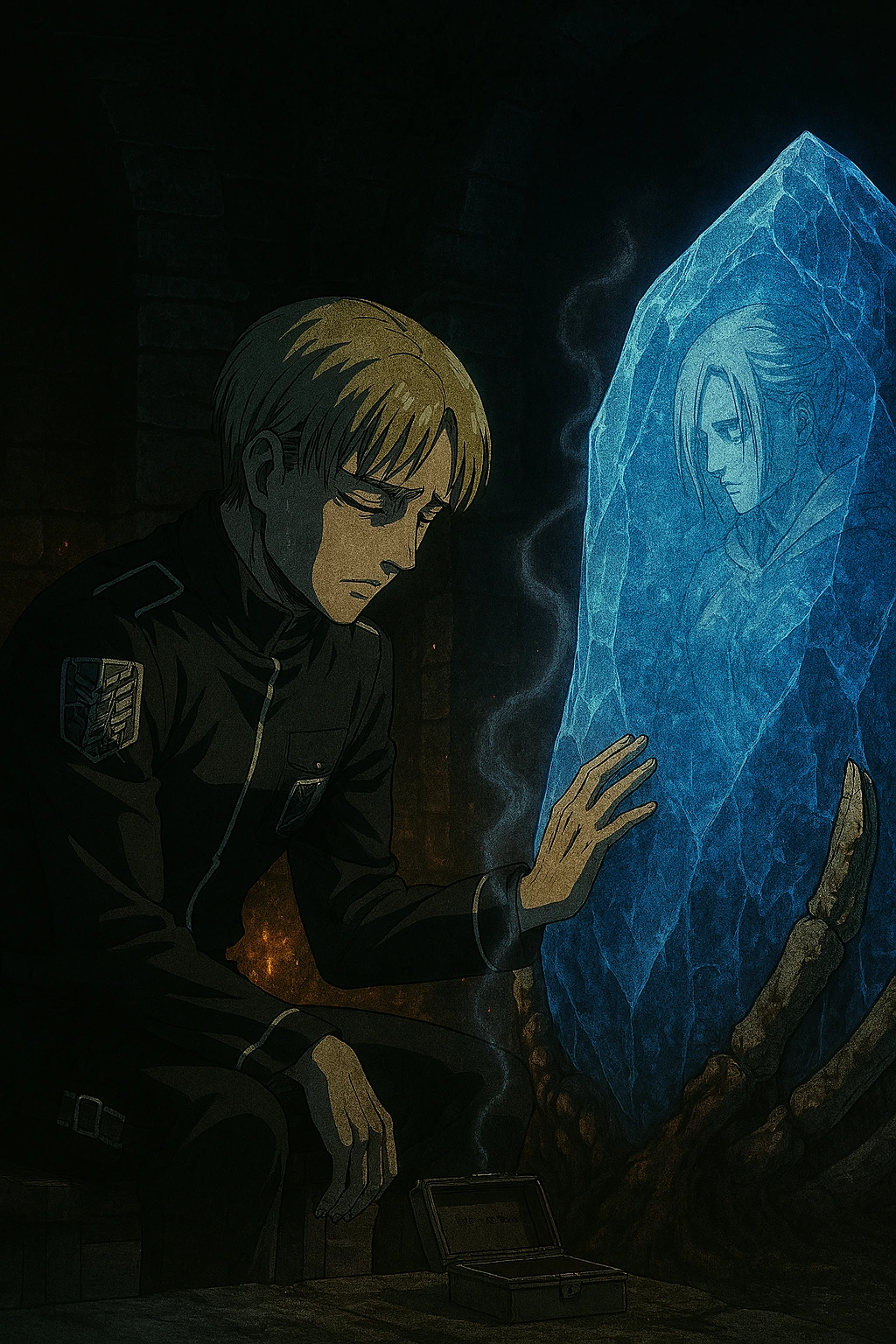
Armin’s visits to Annie Leonhart’s crystal are the manifestation of this cursed inheritance. Is it Armin who loves Annie, or is it the residual ghost of Bertolt influencing him? This ambiguity tortures Armin.
He is a character who prides himself on his mind, his autonomy of thought. To have his very desires and emotions questioned, to wonder if his feelings are merely the biological programming of a dead man, is a violation of his core self.
This is the hidden cost of the victory at Shiganshina. Armin survived, but he lost the purity of his identity. He became a vessel for a weapon of mass destruction and a graveyard for the memories of his enemy.
He carries the ghost of the boy he killed (Bertolt) inside his head, and the ghost of the man he failed to save (Erwin) on his shoulders.
He is a walking amalgamation of the dead, struggling to find the “Armin” underneath the layers of trauma and inherited memory.
VI. The Ultimate Gamble: Talking Down the Monster
As Attack on Titan roared toward its finale, the nature of the conflict shifted. The battle against Eren’s Founding Titan and the Rumbling was not merely a physical struggle against a skeletal behemoth; it was an ideological war.
While Mikasa, Levi, and Reiner fought a desperate physical battle against the endless horde of past Titans on Eren’s back, Armin fought the true decisive battle in the metaphysical realm of the Paths.
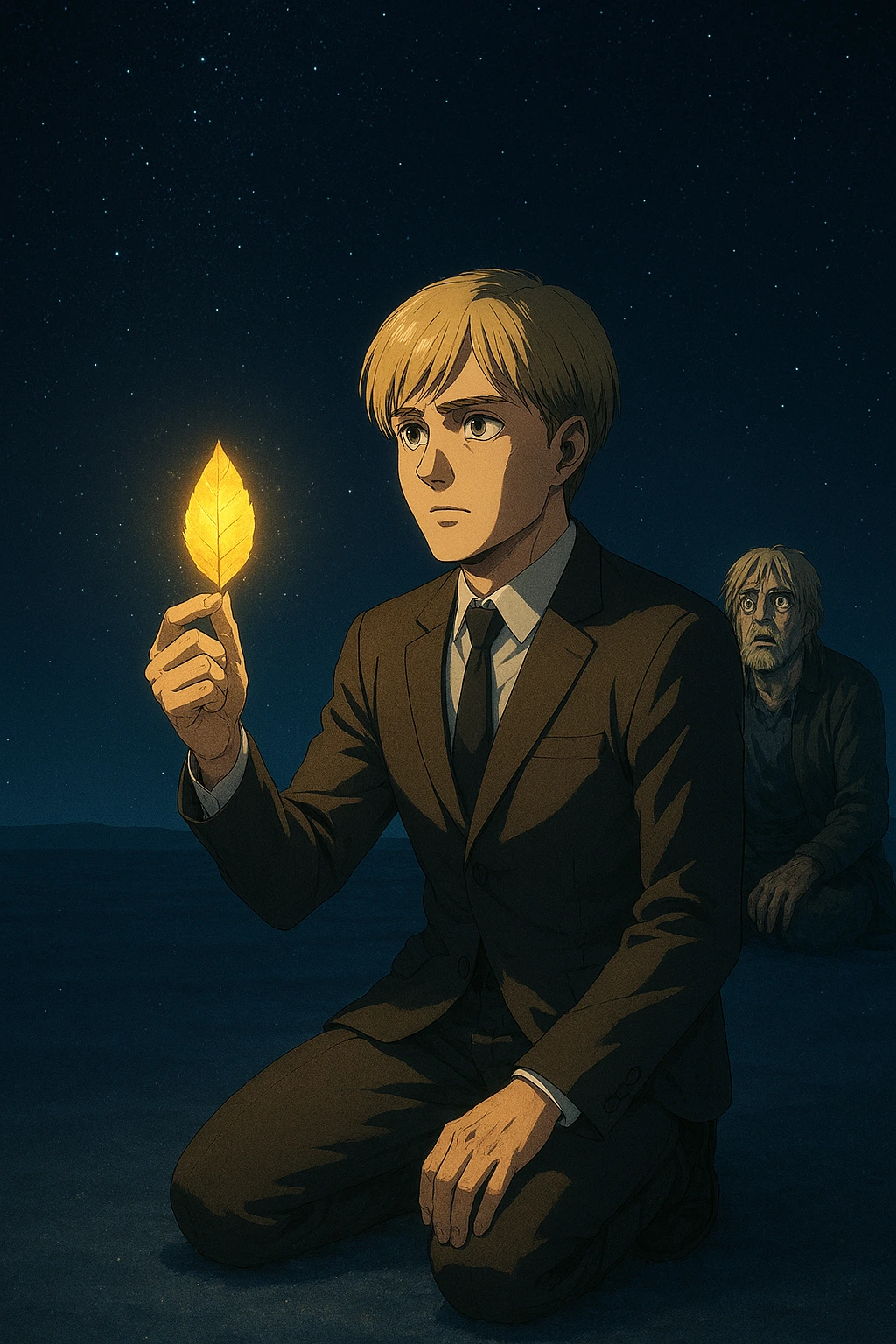
It is fitting that the climax of Armin’s arc was not an action sequence, but a conversation. He realized what the others hadn’t: you cannot defeat an idea—Eren’s apocalyptic drive for freedom, or Zeke’s crushing nihilism—with swords and thunder spears.
You must defeat it with a better idea. This was the ultimate application of mind over muscle.
The Leaf vs. The Baseball
The confrontation between Armin and Zeke Yeager in the Paths is the philosophical centerpiece of the entire series. It is a clash between two supreme intellects holding diametrically opposed views on existence.
Zeke represents supreme Nihilism. Traumatized by his father and burdened by the cruel history of the Eldians, Zeke views life itself as a punishment.
His “euthanasia plan” was rooted in a dark compassion: if life is merely suffering and the endless cycle of hatred, then never being born is the greatest mercy.
Sitting in the timeless sands of the Paths, Zeke has surrendered. He sees the grand, miserable scheme of history—the wars, the Titans, the bloodshed—and believes that nothing matters.
Why build sandcastles if the tide just washes them away? Why struggle to survive if death is the only certainty?
Armin’s counter-argument is a masterclass in Existentialism, echoing the philosophies of Camus and Sartre. He does not deny Zeke’s grand suffering.
He doesn’t offer platitudes about the inherent goodness of humanity or the glory of Eldia. Instead, he counters the massive, crushing weight of Zeke’s worldview with “small truths.”
This is epitomized in the Leaf Scene. In the void, Armin finds a simple leaf buried in the sand. To Zeke, it is just data, matter—useless carbon. To Armin, it is a memory.
He recalls running to a tree on a hill with Eren and Mikasa, trying to beat them there. He recalls the feeling of wind, the warmth of the sun, the texture of the bark. He talks about reading a book on a rainy day, or feeding a squirrel.
Armin argues that while the grand arc of history may be cruel and meaningless, the subjective experience of being alive is not.
The meaning of life is not found in grand victories, serving the state, or ending cycles of hatred; it is found in the mundane, transient moments of connection that make the suffering endurable.
“Even if there’s no deeper meaning to it all… just being able to experience those trivial moments… that’s enough for me.”
It is a profound intellectual victory. Armin doesn’t defeat the series’ greatest pessimist with a grand weapon or a shout of rage.
He defeats him by holding up a leaf and convincing a broken man that the simple act of throwing a baseball with his pseudo-father, Ksaver, was enough of a reason to exist. He weaponized hope, not as a naive dream, but as a philosophical anchor, turning an enemy who wanted to end it all into the savior who awakened the past Titan shifters to aid the Alliance.
Armin didn’t just outfight Zeke; he out-thought him, dismantling his entire worldview with a memory of a sunny day.
VII. The “Monster” of Peace: The Post-Rumbling Diplomat
In the aftermath of the Rumbling, the world was not just broken physically; it was shattered politically and emotionally. The hatred between Marleyans and Eldians was at its peak. Who could possibly navigate this minefield? Only Armin Arlert.
The scene at Fort Salta, known as the “Muller Standoff,” is the final test of Armin’s character. The Marleyan secretary Muller, terrified and armed, demands the Eldians prove they are not Titans. It is a reenactment of the very first season, where Kitts Woermann pointed cannons at a young Eren, Mikasa, and Armin.
Back then, Armin saluted and screamed his worthiness, but he was terrified. Now, faced with the same gun barrels, Armin is calm. He steps forward, not as a soldier, but as a diplomat of the apocalypse. He uses logic to disarm fear: “If we were still Titans, we would use our powers to protect ourselves from your guns. The fact that we are standing here, defenseless, is proof that the power of the Titans is gone.”
This is the “Monster of Peace.” Armin realizes that to maintain peace, he must become a legendary figure. He claims the credit for killing Eren Yeager (a lie agreed upon by the survivors) to give humanity a hero they can trust. He understands that the world needs a narrative more than it needs the truth. He sacrifices the truth of Mikasa’s final act to build a stabilizing myth for the rest of the world.
This connects back to the role of the Common Man. Armin ends the series as an ambassador, traveling by boat to Paradis to negotiate peace. He is no longer a Titan. He is just a man in a suit. But he is more powerful than ever. He represents the idea that the only force capable of stopping the cycle of hatred is not a bigger bomb, but dialogue.
It is a fragile, perhaps cynical hope—the manga’s extra pages suggest that war eventually returns—but it is the only hope that exists. Armin fights for the temporary peace, knowing it won’t last forever, but believing the years of quiet are worth the effort.
VIII. Conclusion: The Brave Coward and the Narrator of History
When the dust settled on the Battle of Heaven and Earth, and the curse of the Titans vanished from the world, it became clear who the true “winner” of the brutal game played in Attack on Titan really was.
Eren was dead, a martyr to his own twisted methodology, his head buried under a tree. Mikasa was left bereaved, forever shadowed by the love she had to kill.
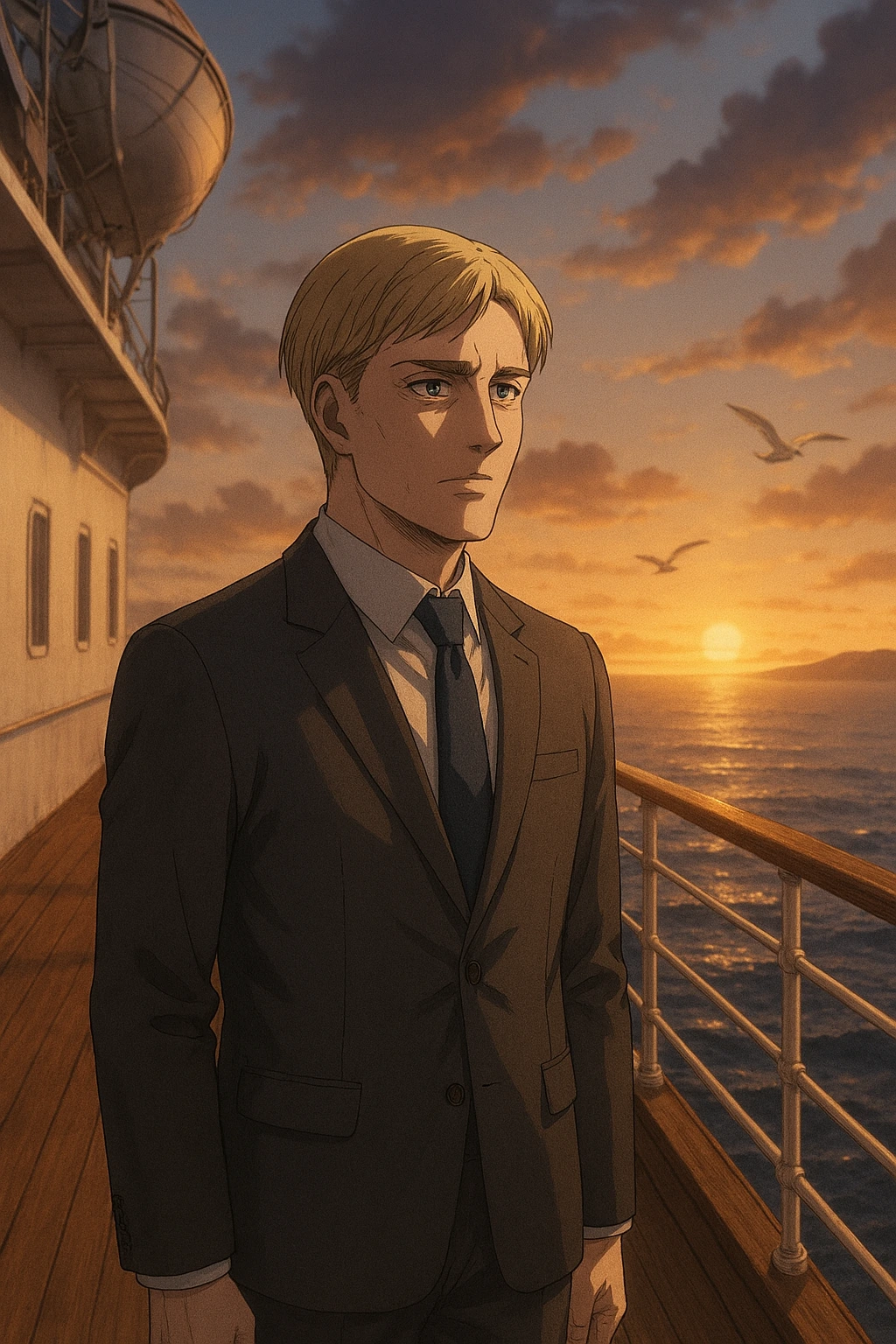
But Armin Arlert survived. He survived the Trost district. He survived being burned alive by the Colossal Titan, his skin charring to ash. He survived the Rumbling. He not only survived the impossible, but he also managed to broker peace between the remnants of humanity and the Eldians. And, crucially, he is the one narrating the story.
From the very first episode, the voice narrating the events of Attack on Titan (in the Japanese dub, Marina Inoue) is Armin’s. History is written by the victors, and Armin is the one holding the pen. He is the chronicler of the tragedy, the one tasked with explaining the madness of Eren Yeager to the future.
Armin’s journey forces a redefinition of bravery within the context of the series. In a world that fetishized the suicidal courage of the Survey Corps, Armin showed a different kind of strength. True strength wasn’t the lack of fear demonstrated by Eren’s berserker rage, nor was it the genetic superiority of the Ackermans.
True strength was being intellectually terrified of the horrors ahead, fully understanding the statistical probability of death, feeling the weight of every future sin, and doing it anyway. Armin was the bravest character in the series precisely because he was the most afraid. He was a coward who refused to let his cowardice dictate his actions. He used his brilliant mind not to escape danger, but to navigate through the very center of it.
The legacy of Armin Arlert is that of the terrible necessity of intellect in the face of annihilation. He proved that while muscle might win a battle, and rage might start a revolution, only the cold, hard calculus of a strategic mind can secure the peace.
Eren Yeager started the story with a scream of rage. Mikasa Ackerman ended the war with a blade of love. But it was Armin Arlert—the boy who couldn’t lift a boulder—who used his mind to save the future. He is the monster who chose to be human, the strategist who chose to talk, and the survivor who kept the story alive.