
 1. The Hakuji Baseline: Human Musculoskeletal Conditioning
In the vast and terrifying hierarchy of Muzan Kibutsuji’s Twelve Kizuki, the Upper Moons represent the absolute pinnacle of demonic evolution. They are nightmares made flesh, wielding abilities that utterly defy the laws of nature and physics.
Gyutaro wields necrotic, virulent blood that acts as a hyper-lethal biological weapon; Daki commands omnidirectional, prehensile sashes capable of slicing through city blocks; Hantengu manifests physical, elemental avatars of his fractured psyche to overwhelm opponents; and Doma manipulates cryogenic necrosis, freezing the very lungs of those who dare breathe near him.
Yet, sitting above almost all of them in the undisputed rank of Upper Moon 3 is a demon who possesses absolutely no elemental magic, no grotesque bodily mutations, and no external weapons whatsoever. Akaza’s entire demonic power is, fundamentally, a massive biological and supernatural amplification of his human martial arts training. He is the ultimate anomaly in the Demon Slayer universe: a creature whose sheer martial arts perfection and terrifying kinetic output allowed him to rival centuries-old monsters of magic.
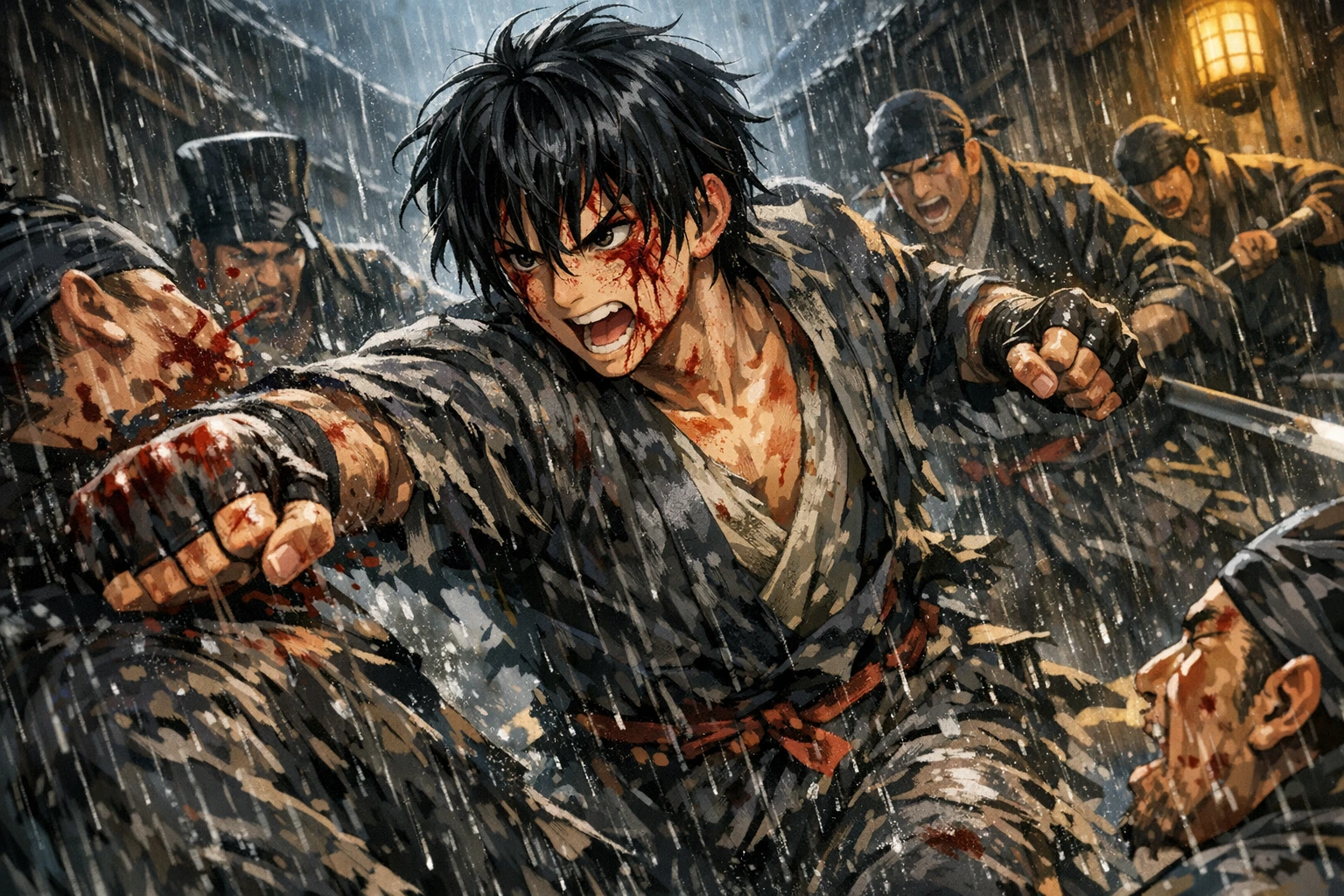
To truly understand the tragedy and terror of Upper Moon 3, one must first deconstruct the biological foundation upon which the demon was built: the human teenager known as Hakuji. Long before Muzan Kibutsuji’s blood ever entered his veins, Hakuji was already functioning as a lethal, biomechanical weapon.
Born into severe, unforgiving poverty during the Edo period, Hakuji’s childhood was not defined by play, education, or safety, but by starvation, trauma, and hyper-violence. Driven by the desperate, agonizing need to afford medicine for his dying father, Hakuji engaged in a relentless crusade of theft and street-fighting. Starvation wasn’t just a state of being for him; it was a biological crucible.
The sheer physical endurance and musculoskeletal density required for an undernourished, starving teenager to systematically beat grown men—often armed with bludgeoning weapons or kendo swords—to death with his bare hands cannot be overstated.
From a purely anatomical perspective, Hakuji’s human body was undergoing a brutal, involuntary form of extreme physical conditioning. Every time he struck a jaw, shattered a rib, or deflected a wooden sword with his bare forearms, he was causing massive micro-tears in his muscle fibers and localized micro-fractures in his bones.
Through the biological process of Wolff’s Law, which states that bone in a healthy person or animal will adapt to the loads under which it is placed, Hakuji’s skeletal structure became unnaturally dense. His knuckles, wrists, and shins were calcified through continuous, agonizing impact trauma, healing thicker and harder after every brutal encounter.
His muscle fascia grew incredibly thick, granting him a baseline of explosive fast-twitch muscle fibers that far exceeded the average human limitation. He was a master of kinetic violence long before he ever stepped foot in a dojo or learned a formal martial art.
When he was eventually taken in by Keizo and taught the Soryu (Blue Demon) Style, his raw, unrefined brutality was forged into a hyper-efficient system of kinetic delivery. Keizo taught him how to align his skeletal structure to deliver maximum force without injuring himself, how to regulate his autonomic nervous system through breathing to sustain impossible stamina, and how to read an opponent’s physical and psychological tells.
Therefore, when profound tragedy struck and his master and fiancée, Koyuki, were poisoned by a rival dojo, the resulting massacre was the terrifying culmination of this lifetime of human conditioning. Hakuji systematically slaughtered sixty-seven armed, highly trained martial artists with his bare hands.
He punched through human torsos and crushed skulls with such overwhelming, devastating force, mutilating their bodies so severely that the investigating authorities logically concluded a wild beast or a demon was responsible. No human could have enacted such carnage.
This is the thesis of Akaza’s tragic paradox: Muzan did not grant Hakuji his strength; he merely removed his human physical limitations and regenerative caps. The demon known as Akaza is the ultimate physical combatant, a creature who subconsciously built his entire Blood Demon Art not to conquer humanity, but to protect the very people he had tragically forgotten he loved. His demonic physiology was merely an immortal canvas upon which his human grief, relentless discipline, and martial perfection were painted in blood.
2. The Compass Needle: Biology of the “Fighting Spirit” Radar

The cornerstone of Akaza’s terrifying lethality is his signature Blood Demon Art: Destructive Death. At the very center of this martial arts framework is a technique that elevates him from a mere brawler to a virtually untouchable deity of hand-to-hand combat: the Compass Needle.
While lesser demons rely on enhanced sight, smell, or basic predatory instinct to track Demon Slayers, Akaza’s Compass Needle operates on a level of advanced physiological and neurological telemetry that borders on modern science fiction. It is not a mystical aura, a magical shield, or arbitrary sorcery; it is a highly evolved, localized biological sensor network perfectly designed to read the autonomic nervous system of his enemies.
To fully understand the Compass Needle, we must break down the neuroscience of intent and what the Demon Slayer universe refers to as “Fighting Spirit” or Touki. When a human being—especially a highly trained, hyper-lethal Hashira—prepares to attack, their body undergoes a massive, involuntary cascade of physiological changes.
The amygdala registers the immediate threat and signals the hypothalamus, which triggers the sympathetic nervous system. This results in an immediate, explosive dump of adrenaline, noradrenaline, and cortisol into the bloodstream.
The heart rate spikes drastically to pump oxygen-rich blood to the major muscle groups, the pupils dilate to gather more visual data, muscle fibers twitch as they prepare for explosive kinetic release, and the body’s bio-electric field shifts subtly due to the sudden, massive electrochemical activity in the nervous system.
Akaza’s Compass Needle acts as an extrasensory organ that detects these microscopic, involuntary physiological changes in real-time. When he deploys the glowing, snowflake-shaped compass beneath his feet, he is casting a highly sensitive, bio-radar net across the entire battlefield.
To Akaza, the battlefield is not a visual landscape, but a topographical map of bio-electric intensity. He is no longer relying on his physical eyes to see a Hashira swing a sword; he is “feeling” the electrical impulses in their brain telling their arm to swing milliseconds before the muscle actually contracts. The greater the opponent’s will to fight, the higher their adrenaline output, and the more intensely their “Fighting Spirit” projects outward.
To Akaza, a Hashira burning with the courageous desire to kill him is quite literally lighting themselves up like a massive, blinding beacon on a radar screen.
This telemetry data is then fed directly into Akaza’s demonic brain, which functions as an autonomous, hyper-advanced targeting computer. Because his neurological processing speed is not hindered by human synaptic latency, he can analyze this biological data and calculate the exact kinetic trajectory of an incoming attack in fractions of a millisecond.
The Compass Needle tells him precisely where the attack is coming from, its exact velocity, its geometric angle, and its intended point of impact. Consequently, it grants him a 360-degree, flawless pre-cognitive defense. He does not need to look at his opponent’s blade or anticipate their feints; he simply allows his body to move along the mathematical vectors of least resistance, intercepting, deflecting, or dodging the strike with absolute, terrifying precision.
This biological radar creates a harrowing, inescapable feedback loop for his opponents. The harder a Slayer fights, the more intensely they wish to win to protect others, the stronger their physiological stress response becomes. And the stronger their physiological response, the more accurately the Compass Needle can read and predict their every twitch.
Akaza effectively turns the very essence of human courage, determination, and heroism into a fatal vulnerability. He weaponizes the baseline neurology of his enemies against them, making traditional combat tactics, speed, and misdirection practically obsolete. To fight Akaza with anger, determination, or “fighting spirit” is to hand him the exact mathematical coordinates required to end your life.
3. The Nutritional Handicap: The Biology of Refusing Women

Within the intricate, parasitic demonic biology of the Twelve Kizuki, physical strength and supernatural power are inextricably linked to cellular nutrition. Muzan Kibutsuji’s blood acts as a potent catalyst for mutation, but the fuel required to sustain, adapt, and advance those mutations comes directly from the consumption of human flesh.
In the macabre nutritional science of demons, not all humans yield the same caloric, bio-energetic, or evolutionary value. Women, particularly young women, are highly prized in demon society because they possess the complex biological machinery necessary to nurture new life, meaning their bodies contain a naturally higher concentration of dense nutrients, specialized fats, and complex proteins. Consuming women allows a demon to rapidly accelerate their cellular growth, regenerative speed, and overall demonic power with significantly less effort.
This brings us to the profound, psychological anomaly of Akaza’s existence and the massive dietary ceiling he deliberately and stubbornly imposed upon himself. To fully grasp the sheer insanity of Akaza’s rank as Upper Moon 3, we must contrast his diet with that of Doma, Upper Moon 2.
Doma is a glutton of the highest order, specifically targeting, hoarding, and devouring young women. He operates an entire religious cult solely to organically harvest their highly nutritious bodies without resistance. Doma actively and lazily exploits the biological advantages of demonic consumption, gorging himself to absorb maximum caloric density with minimal physical effort.
Akaza, conversely, possesses a violent, unbreakable psychological aversion to harming, let alone consuming, females. He flatly, aggressively refuses to kill or eat women, creating a massive, self-imposed nutritional handicap that infuriated his creator, Muzan.
In terms of demonic bio-energetics, Akaza was running on low-octane fuel for over a century. He maintained his dominant position as the third most powerful demon in existence relying entirely on the lower nutritional yield of male combatants.
To bridge the massive gap in caloric and evolutionary intake between himself and demons like Doma, Akaza had to rely on raw, unprecedented muscular development and an agonizing, relentless regimen of physical training. While other demons grew exponentially stronger by simply eating more nutrient-dense humans, lounging in their lairs, Akaza grew stronger by tearing his own immortal muscles apart through endless, grueling combat and letting them regenerate denser and faster.
He forced his body to adapt to the lower nutritional intake through sheer, brute-force kinetic repetition. He practically simulated his brutal human conditioning, but applied it to a demonic physiology that could survive being crushed or torn apart.
This refusal to eat women was not a conscious, moral chivalry chosen by the demon Akaza; it was the result of a profound, subconscious programming deeply embedded in his psyche. It acted as an impenetrable psychological firewall built from the repressed, deeply buried memories of his human fiancée, Koyuki.
Even though the traumatic transformation into a demon violently wiped Hakuji’s conscious memories, the emotional imprint of Koyuki—the fragile woman he swore his life to protect and failed to save—was so powerfully etched into his very soul that it actively overrode Muzan’s parasitic cellular imperatives.
Muzan’s cells strictly dictate that a demon must consume the most efficient food source available to grow stronger and conquer the sun. Yet, Akaza’s neural pathways literally short-circuited when presented with the opportunity to kill a woman.
His body would rather starve, his cells would rather weaken, and he would willingly sacrifice his hierarchical standing than violate the sacred, forgotten vow he made to the girl who gave him a reason to live. This makes his raw physical power even more terrifying; he achieved near-godlike status in the demon hierarchy while intentionally starving himself of the very nutrients required for demonic evolution, proving that his human willpower was, fundamentally, stronger than Muzan’s biological design.
4. Soryu Style: The Physics of Shockwave Combat

When observing Akaza in combat, one must look past the flashy aesthetic of traditional martial arts and analyze the raw, devastating physics of his attacks. Akaza does not merely punch Hashiras; he manipulates the fluid dynamics of the atmosphere around him.
The Soryu (Blue Demon) Style, augmented by his Destructive Death Blood Demon Art, relies on the advanced principles of kinetic displacement, cavitation, and hyper-compressed air pressure. To understand how punching the empty air can shatter a human’s internal organs from dozens of feet away, we must deeply examine the physics of his shockwave combat.
When Akaza executes a technique like “Destructive Death: Air Type,” he is throwing a punch with such immense kinetic velocity and monstrous muscular torque that his fist violently breaks the sound barrier instantly. But it is far more than just raw speed.
By utilizing the perfect skeletal alignment taught to him by Keizo, Akaza transfers the entire rotational mass of his dense, demonic body into a microscopic point on his knuckles. This extreme, localized acceleration displaces the air molecules in front of his fist so violently that it creates a momentary vacuum—a localized pocket of empty space.
The surrounding atmosphere immediately crashes back into this vacuum, creating a concussive shockwave of hyper-compressed air. He is literally rupturing the atmosphere, turning the ambient air itself into a solid, invisible projectile. These localized sonic booms carry enough kinetic energy to crater solid bedrock and shatter the dense ribs of a Hashira without Akaza ever making physical, skin-to-skin contact.
The true mastery of this physics-defying martial art is best observed during the tragic Mugen Train autopsy—the tactical breakdown of his fateful battle with Kyojuro Rengoku, the Flame Hashira. Rengoku’s fighting style was deeply rooted in explosive, wide-arcing swings. Flame breathing utilizes massive bursts of inhaled oxygen to flood the muscles, creating high-power, high-commitment strikes designed to cleave through demonic flesh and bone in a single, devastating motion. It is a style of overwhelming, burning momentum.
Akaza, however, approached this battle as a cold, mathematical equation. Through the Compass Needle, he constantly read the massive, roaring spikes of Rengoku’s adrenaline, heartbeat, and lethal intent. While Rengoku expelled immense energy in wide, sweeping arcs that left microscopic openings, Akaza utilized perfect, tight-guard counter-strikes.
He used the “Destructive Death: Annihilation Type,” directly matching Rengoku’s explosive forward momentum with a highly concentrated, forward-focused kinetic shockwave. Akaza mathematically dismantled the Flame Hashira by letting Rengoku’s massive fighting spirit act as a homing beacon. Every single time Rengoku swung his blade with lethal intent, Akaza’s compass calculated the exact trajectory, allowing Akaza to slip inside the Hashira’s guard and deliver concussive, organ-rupturing force directly to his vitals.
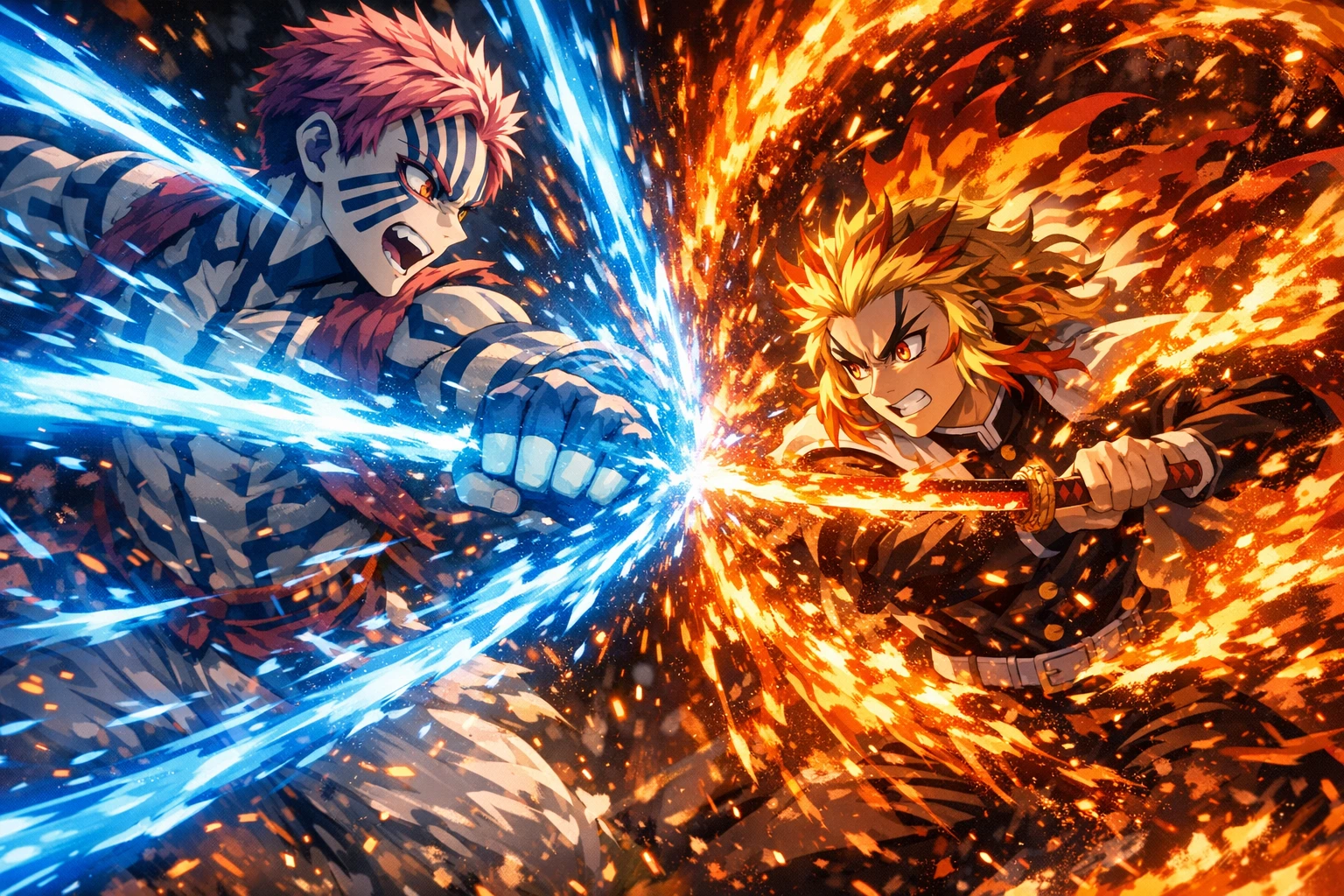
Akaza didn’t just overpower Rengoku through brute strength; he turned Rengoku’s own immense courage, blinding speed, and unwavering fighting spirit into the exact coordinates for his own demise. He weaponized the physics of reaction and the biology of intent, demonstrating a terrifying, absolute dominance over the physical world.
5. The Anomaly of Evolution: Overriding Decapitation
The absolute, undisputed limit of demonic biology in the Demon Slayer universe is the Nichirin blade. Forged from sunlight-absorbing crimson ore, severing a demon’s neck with this weapon instantly halts their cellular regeneration, burning their cells on a microscopic level, and disintegrates their body into ash.
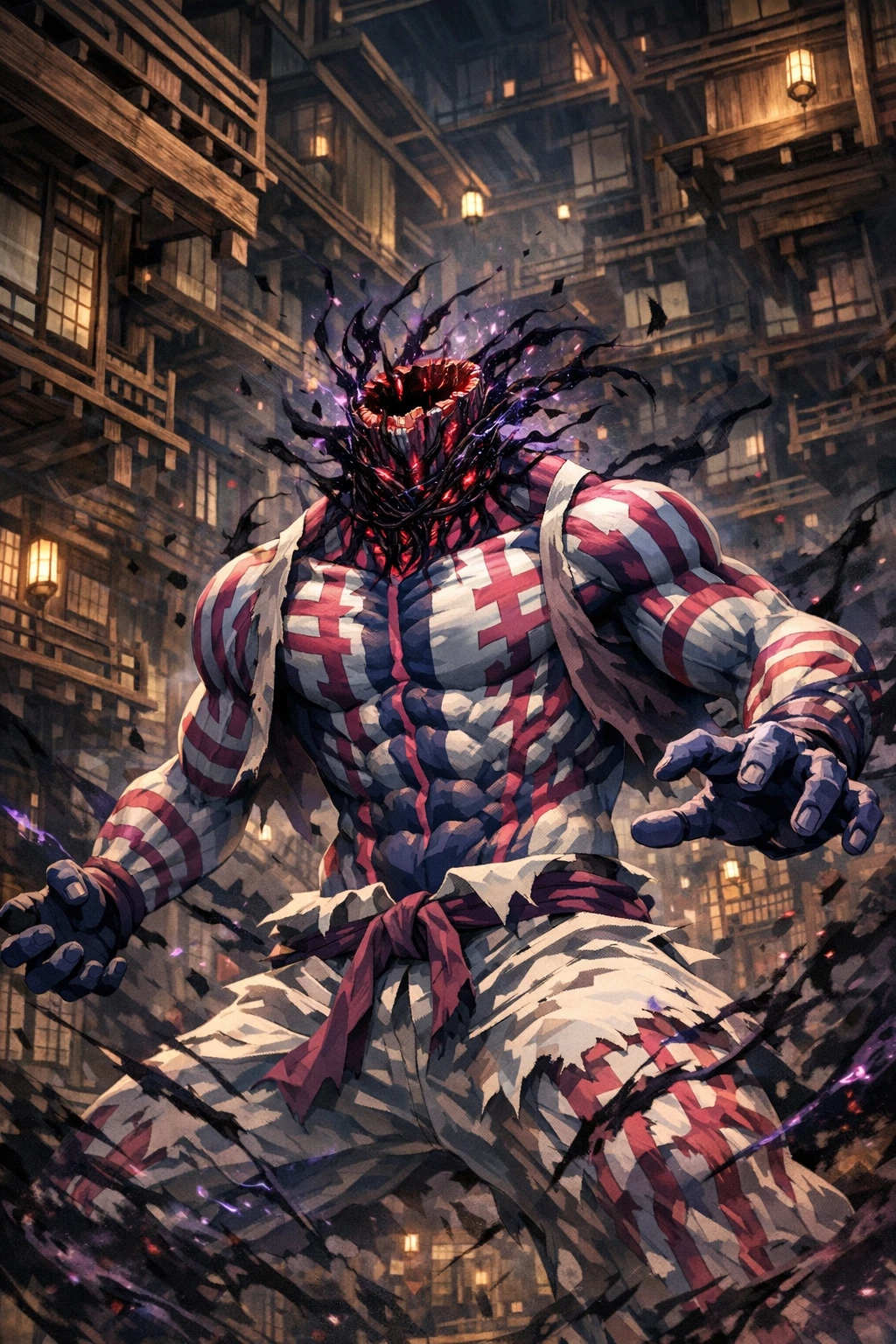
The neck is the vital biological tether that connects the demonic brain—the command center of Muzan’s cellular network—to the rest of the nervous system; severing it is supposed to be the absolute, irreversible end of a demon’s life.
However, during the chaotic final battle in the Infinity Castle against Water Hashira Giyu Tomioka and Tanjiro Kamado, Akaza shattered this fundamental law of demonic biology. He crossed what we can call the “Muzan Threshold,” representing the terrifying anomaly of what happens when a demon’s obsessive willpower completely exceeds their biological programming and physical limitations.
After an exhausting, high-speed kinetic chess match that pushed all combatants to their absolute limits, Tanjiro finally achieves the impossible: he bypasses the Compass Needle and cleanly decapitates Upper Moon 3. From a medical and biological standpoint, Akaza should have crumbled to ash immediately. His brain, the central processor of his existence, was severed from his body and destroyed.
Yet, driven by a deeply ingrained, pathological obsession with “becoming the strongest”—a deeply corrupted remnant of his human desire to be strong enough to protect his loved ones from harm—Akaza’s body flatly refused to die.
This refusal triggered a rapid, unprecedented evolutionary mitosis. Without a brain to send electrical impulses to the muscles, Akaza’s body began to operate via absolute cellular independence. The localized nerve clusters throughout his spinal cord and muscular system essentially became a decentralized, distributed nervous system, similar to a starfish.
His headless body began to fight autonomously, driven purely by the microscopic memory of violence embedded in his muscle tissue. He began to regenerate a new head, not from the stump upward, but by violently re-knitting his nervous system to function completely independent of a central brain, creating a new command center out of thin air.
This evolutionary leap is a terrifying testament to the sheer magnitude of his willpower; his desire to fight was so absolute that it rewrote his own genetic code in real-time to bypass the certainty of death.
However, to truly understand how Akaza was driven to this point of biological anomaly and panic, we must deeply analyze the biomechanics of how Tanjiro defeated the Compass Needle in the first place. Tanjiro achieved the “Selfless State,” a profound psychological and biological cloaking mechanism.
By entering this state, inspired by the memory of his father, Tanjiro completely suppressed his autonomic nervous system. He killed his intent, masked his adrenaline spikes, steadied his heart rate to near zero, and erased the microscopic muscular twitches of aggression. To Akaza’s bio-electric radar, Tanjiro simply ceased to exist. He became biologically invisible, akin to a deep-sea predator masking its electrical output.
By removing his “Fighting Spirit,” Tanjiro created a fatal, gaping blind spot right in the center of Akaza’s infallible defense. When Tanjiro swung the Hinokami Kagura, Akaza’s compass registered absolutely zero threat data. There was no adrenaline spike to track, no malicious intent to calculate, no biological warning whatsoever.
It was the equivalent of a stealth bomber flying completely undetected under a highly advanced radar screen. The Selfless State was the absolute only way to bypass a defense built entirely on reading human aggression, forcing Akaza into the unprecedented evolutionary panic that ultimately led to his decapitation and subsequent headless rampage.
6. Conclusion: The Internal Self-Destruct

The final moments of Akaza’s existence are not defined by a crushing physical defeat at the hands of the Demon Slayers, but by a profound, agonizing psychological collapse and a tragic reclamation of his humanity. The brutal battle in the Infinity Castle was not ultimately won by the edge of Tanjiro’s sword, but by the shattering of Muzan’s cellular firewall deep within Akaza’s own mind.
As his headless body lashed out in a desperate, evolutionary frenzy, the trauma of Tanjiro’s perfectly executed strike, coupled with the sheer exhaustion of his rapidly mutating demonic cells, allowed the repressed memories of his human life to finally break through the darkness to the surface.
This is the return of Hakuji. In the quiet, microscopic battlefield of his own neurology, the vibrant memories of his master, Keizo, and the gentle touch of his beloved fiancée, Koyuki, flooded his consciousness, tearing through a century of demonic conditioning. The resulting psychological cognitive dissonance was absolute and devastating.
The demon Akaza, whose entire existence was predicated on the ruthless pursuit of supreme strength and the hateful destruction of the weak, was violently confronted by the memory of Hakuji, the boy who only ever wanted strength to protect the fragile people he loved. He realized, with crushing clarity, that the “weakness” he had spent over a hundred years despising and annihilating was exactly what he had failed to protect in his human life.
He realized that the Blood Demon Art he had honed to perfection, the Compass Needle that guided his flawless strikes, was subconsciously designed in the exact shape of Koyuki’s snowflake hairpin. Every single punch he threw for over a century was a corrupted, agonized manifestation of his unresolved grief.
Faced with this soul-crushing revelation, Hakuji regained full, dominant control over his demonic physiology, overpowering Muzan’s frantic influence. He did not allow Tanjiro or Giyu to land the final, killing blow. Instead, in a final act of biological suicide and profound redemption, Hakuji turned his ultimate technique inward.
He forced his own demonic body to execute a self-destruct sequence, using his own devastating Destructive Death techniques to completely obliterate his physical core from the inside out. He initiated a conscious, rapid cellular apoptosis—programmed cell death—violently overriding Muzan’s screaming, frantic biological commands to survive, regenerate, and kill.
This final, tragic act cements Akaza as arguably the most compelling, layered, and well-written villain in the entire Demon Slayer series. He was never a creature of pure, innate evil like Muzan Kibutsuji, nor a psychopathic, unfeeling hedonist like Doma. He was a masterclass in how profound human trauma, socio-economic despair, and unimaginable grief can shape and dictate demonic biology.
His strength was born from desperate love, corrupted by horrific loss, and ultimately ended by absolute redemption. Akaza was the ultimate martial artist, an invincible biological weapon possessing an infallible neurological radar, making him the only Upper Moon powerful enough, and human enough, to truly defeat himself.