
Introduction
The True Father of the Apocalypse
When one visualizes the apocalyptic threats that permeate the My Hero Academia universe, the mind instinctively gravitates toward the spectacular and the destructive. One thinks of Tomura Shigaraki decaying entire cities with a mere touch, or the terrifying, god-like silhouette of All For One hovering above a ruined Kamino Ward.
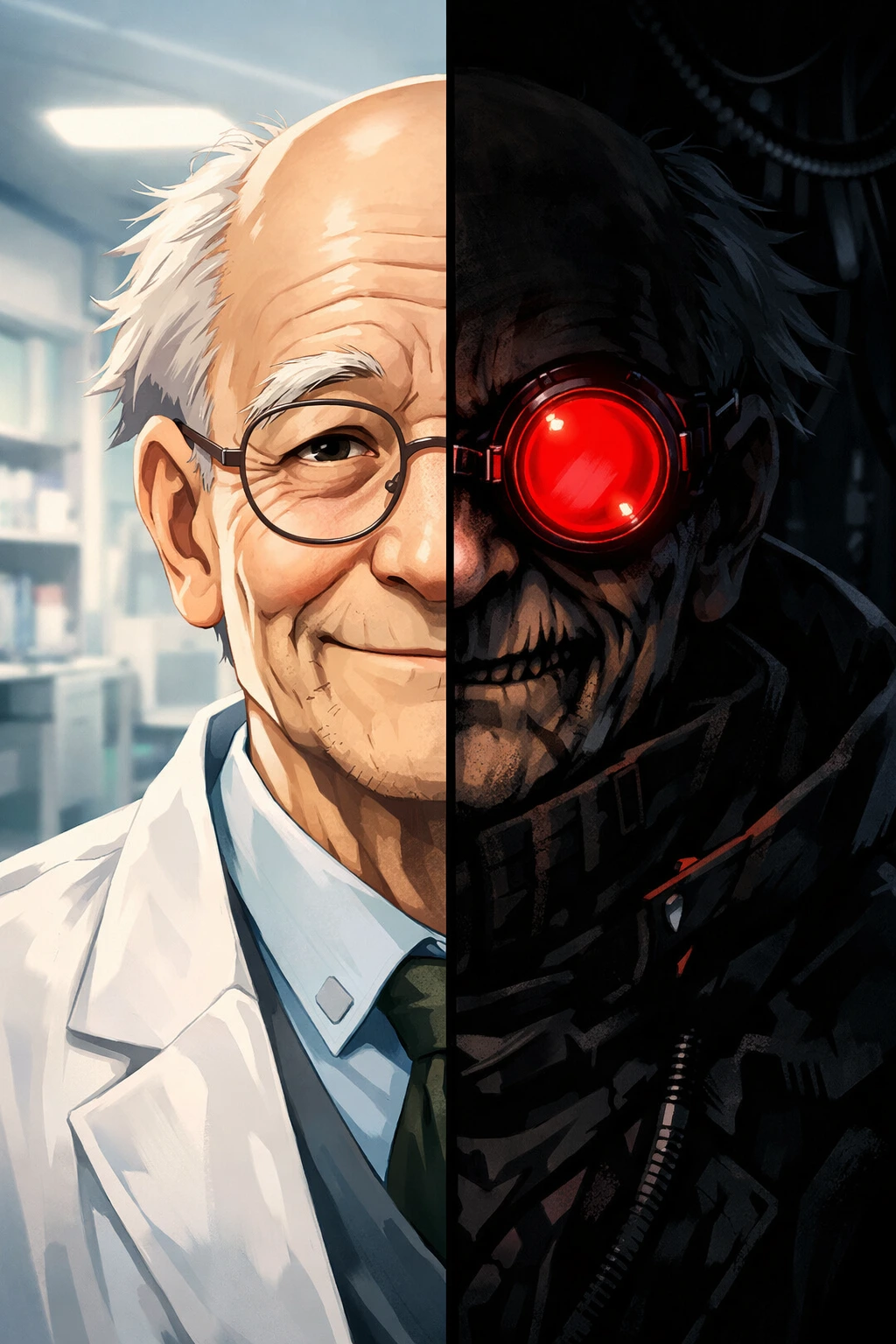
However, this perception represents a fundamental misunderstanding of how power truly operates in the criminal underworld. The true father of the apocalypse is not a frontline combatant, nor is he a vanguard of physical destruction. The darkest, most consequential mind in the history of this superpowered society belongs to an elderly, bespectacled scientist: Dr. Kyudai Garaki.
Garaki is the foundational pillar upon which the entire League of Villains and the Paranormal Liberation Front are built. He is the biological architect who allowed All For One’s empire to mathematically and logistically function. Without his unparalleled genius in the fields of genetics, quirk-splicing, and bio-engineering, All For One would have succumbed to his injuries decades ago, and the villains of the modern era would be nothing more than disorganized street-level thugs lacking the biological weaponry necessary to challenge hero society.
Garaki represents the absolute terror of unchecked, amoral intellect—a man who weaponized the scientific method to dismantle the human species.
The Shadow in the Ward
What makes Dr. Kyudai Garaki’s existence so inherently chilling is the masterful, flawless duality of his life. For decades, he operated in the blinding light of public adulation. To the citizens of society, to the medical boards, and to the countless families he supposedly helped, he was the beloved, philanthropic community doctor.
He was the grandfatherly figure who founded clinics, ran orphanages, and offered gentle, reassuring smiles to children discovering their Quirks. Yet, this benevolent facade was merely the superficial skin stretched over a monster. The reality of Dr. Garaki is a nightmare of duality. While the surface world revered him as a healer, he spent over a century in the pitch-black underground playing God with human corpses, stolen genetics, and abducted children.
His shadow stretched far beyond the confines of his hidden laboratories, infiltrating the highest echelons of heroic society while simultaneously feeding the darkest depths of the villainous underworld. He is a predator who hid entirely in plain sight, using the Hippocratic Oath as a shield while he committed atrocities that would make the most hardened serial killers pale in comparison.
Article Scope
This article serves as the definitive, expert-level breakdown of the life, research, and catastrophic impact of Dr. Kyudai Garaki. We will thoroughly deconstruct the profound implications of his “Life Force” Quirk and how it enabled his century of uninterrupted dark science. We will explore the origins of his madness through his initially rejected, yet undeniably prophetic, Quirk Singularity Doomsday Theory.
Furthermore, this piece will provide a granular analysis of the gruesome surgical reality behind the Nomu project, detailing the horrific bio-engineering required to house multiple Quirks in a single vessel. Finally, we will examine his ultimate, crowning achievement—the god-like ascension of Tomura Shigaraki—and the poetic justice of his eventual downfall during the Jaku Hospital Raid. This is an exploration of the man who turned humanity into raw material, and in doing so, almost brought the world to its knees.
The “Life Force” Quirk: Biological Immortality
Trading Mobility for Time
To understand the sheer volume of Kyudai Garaki’s horrifying achievements, one must first understand the biological mechanism that afforded him the time to accomplish them: his original, natural Quirk, “Life Force.” In the world of My Hero Academia, Quirks are physical abilities that come with physical tolls, and Life Force is the ultimate biological trade-off.
This Quirk mathematically doubles the user’s natural lifespan, allowing Garaki to live well over 120 years. However, this extreme longevity is not the fountain of youth; it is a prolonged, stretched existence. While his cognitive functions, memory retention, and intellectual processing speed remained at absolute peak performance—perhaps even sharpening with decades of accumulated data—the physical cost was immense.
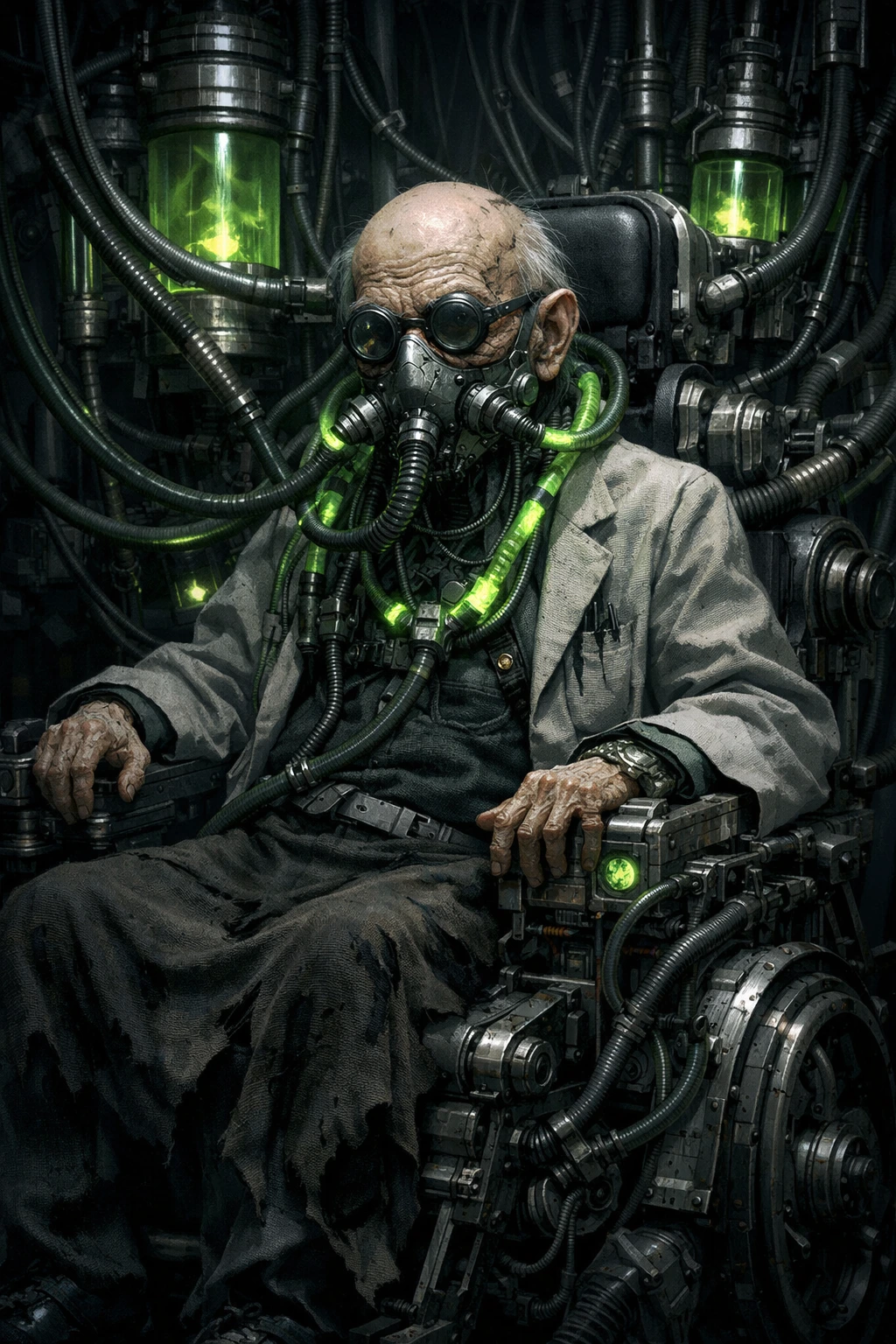
Life Force demands a severe toll on the user’s physical vitality, resulting in extreme frailty, a stunted, withered stature, and a severe lack of natural mobility. Garaki essentially traded his body’s capacity for athletic movement in exchange for an eternity of mental processing. He became a living brain, confined to a deteriorating vessel, requiring mechanical chairs and technological assistance simply to move around his laboratory.
Yet, for a man entirely devoted to the pursuit of knowledge, this trade-off was not a curse; it was the ultimate blessing. It allowed him to sit perfectly still and unravel the secrets of the human genome while the rest of the world rushed blindly toward the grave.
The Ultimate Gift
The most terrifying aspect of Garaki’s longevity, however, is a revelation that fundamentally recontextualizes his relationship with the underworld’s greatest evil. The current Dr. Garaki, the frail man operating the machinery beneath Jaku Hospital, does not actually possess his original Quirk. He operates on a synthetic copy of his own Life Force.
In a staggering display of devotion, Garaki willingly extracted his original Quirk Factor and surrendered it to All For One. This was not an act coerced by violence; it was the ultimate gift from a disciple to his dark messiah. Following All For One’s catastrophic, disfiguring first battle with All Might—a clash that left the villain with no face, destroyed lungs, and relying on life support—the Demon King was dying.
Medical science dictated that he should have perished. It was Garaki’s original Life Force Quirk that anchored All For One’s shattered soul to his ruined body, keeping him alive long enough to orchestrate the rise of Tomura Shigaraki. By giving away his original Quirk and surviving on an artificially engineered duplicate, Garaki proved that his loyalty superseded even his own biological integrity.
The Century of Research
The ramifications of a 120-plus-year lifespan in the hands of an amoral genius are catastrophic. Normal scientific progress is inherently limited by the human lifespan. A brilliant researcher may dedicate forty years to a field, make a breakthrough, and then die, leaving the next generation to pick up the pieces, decode their notes, and slowly push the boundary forward. Dr. Garaki suffered no such limitation. His extended lifespan made him the most dangerous scientist on Earth because he was granted over a century of uninterrupted, hyper-focused research. He did not have to pass the baton.
He was a single, continuous stream of intellectual evolution. Over a hundred years, he witnessed the dawn of the Quirk era, the societal upheaval that followed, and the generational strengthening of Quirks. He had the time to study genetics through trial and error, completely bypassing the limits of mortal scientific progress.
Ethics committees, peer reviews, and moral boundaries—the traditional roadblocks of science—were entirely absent in his subterranean world. He was free to conduct torturous, lethal experiments over and over again, refining his horrific thesis over thousands of iterations. The century he spent in the dark allowed him to map the Quirk Factor in a way that modern society’s brightest minds could not even begin to fathom.
The Architect of the Singularity (The Origin of Madness)
The Prophet of Doom
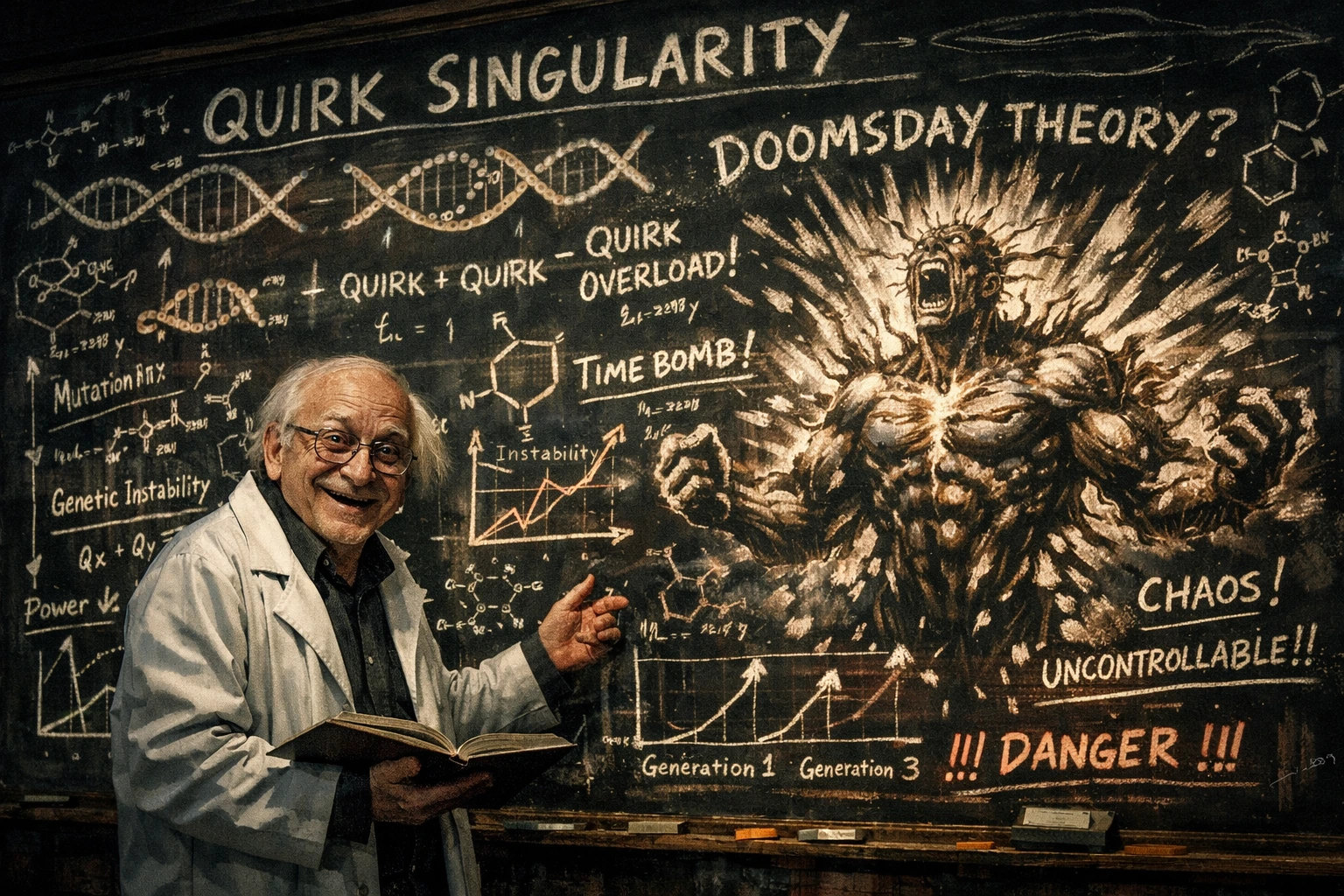
Kyudai Garaki was not born a monster; he was forged into one by a society that refused to look into the abyss he had discovered. Deep diving into his backstory from over 70 years ago reveals a man who was, fundamentally, a prophet of doom. Long before the League of Villains existed, a younger Dr. Garaki published a radical, terrifying proposal that would come to be known as the Quirk Singularity Doomsday Theory.
Through extensive genetic mapping and historical data analysis, Garaki posited a mathematical certainty: Quirks were not static. With each passing generation, as Quirk genes mixed, mutated, and combined through reproduction, they were growing exponentially stronger and vastly more complex.
Garaki hypothesized a terrifying endpoint—the “Singularity”—where Quirks would eventually become so overwhelmingly powerful and fundamentally volatile that the human body, which evolves at a comparatively glacial pace, would no longer be able to physically contain or control them. He predicted a future where children would be born with powers that would instantly tear their bodies apart, leading to the collapse of human civilization not through villainy, but through biological overload.
Ostracized by Science
The response to Garaki’s apocalyptic thesis was not peer review or healthy scientific debate; it was visceral, total rejection. The mainstream academic and medical communities, desperate to maintain the fragile illusion of a peaceful, functioning superhuman society, laughed him out of the room.
To acknowledge Garaki’s theory was to acknowledge that their entire civilization had an expiration date. Consequently, they aggressively silenced him. He was stripped of his credentials, discredited in academic journals, and labeled a deranged lunatic. He became an absolute pariah. Society branded him a crackpot for suggesting they were living on a genetic ticking clock.
This ostracization was the pivotal moment in Garaki’s psychological development. It stripped away his desire to help a society that had so callously discarded the truth. When the light of legitimate science shut its doors to him, he was forced into the shadows, taking his brilliance and his bitterness with him.
The Devil’s Handshake
In the depths of his professional exile and personal humiliation, Garaki found a single patron: All For One. This encounter is the absolute core of Garaki’s fanaticism and the foundation of modern villainy. All For One was the only person in the entire world who read Garaki’s theory and recognized it not as madness, but as undeniable, objective truth.
The Demon King did not just believe his theory; he funded his research, provided him with endless test subjects, and, most importantly, validated his genius. All For One looked at a man whom the world called a monster and called him a visionary. Because of this, the dynamic between the two is profoundly unique. Garaki does not serve All For One out of fear, coercion, or intimidation, which is how the villain controls nearly everyone else.
Garaki worships All For One out of pure, unadulterated gratitude. He views All For One as a god among men, the only being enlightened enough to see the world as it truly is. This devil’s handshake transformed a bitter, disgraced academic into an architect of horrors, willing to commit any atrocity so long as it served the man who gave him his pride back.
The Nomu Project
The Hardware Limit
As Garaki began his dark work for All For One, he encountered a massive biological hurdle that had plagued his master’s empire. While All For One could steal and bestow Quirks at will, the human body is not a limitless hard drive. There is a strict “Hardware Limit.”
A normal human brain mathematically shatters when forced to hold multiple Quirks. The neurological strain of processing multiple distinct, unnatural genetic abilities simultaneously causes catastrophic systemic failure. As seen with All For One’s early, tragic victims, forcing multiple Quirks into an ordinary person results in an instant, vegetative state—
their minds wiped raw, their bodies rendered into mindless, drooling husks incapable of basic function, let alone combat. To create an army of super-soldiers, Garaki had to solve an impossible puzzle: how do you force a human body to hold the power of gods without the brain melting under the pressure?
The Gruesome Solution
Garaki’s solution to the Hardware Limit is where his genius truly crossed the threshold into the macabre. He deconstructed the science of the human mind and arrived at a gruesome, terrifying conclusion: if the conscious mind and personality are what short-circuit under the strain of multiple Quirks, then the conscious mind must be removed entirely. Brain death was the answer.
The complete erasure of personality, memory, and cognitive autonomy was the only way to bypass the psychological shock of Quirk overload. Garaki literally scoops out the humanity to make room for the hardware. By utilizing fresh corpses or rendering living victims completely brain-dead through agonizing chemical and surgical means, he created a blank neurological slate.
Without a personality to reject the foreign Quirk Factors, the body became a pure, unthinking vessel. The Nomu are not just monsters; they are the tragic, mutilated remains of human beings whose very souls were surgically excised to create biological real estate for weapons.
The Tiered Assembly Line
Having solved the biological puzzle, Garaki transformed his laboratory into a horrific bio-engineering assembly line, categorizing his monstrous creations into distinct tiers based on their processing power and physical durability.
- Lower, Middle, and Upper Tiers: These represent the bulk of Garaki’s work—the mindless shock troops of the villain army. Built primarily from the corpses of low-level street thugs, missing persons, and those deemed insignificant by society, these Nomu possess 2-3 Quirks. They are given basic regenerative capabilities to increase their battlefield longevity and are engineered with exposed brains—a morbid signature of Garaki’s surgical handiwork. They lack the capacity for independent thought, operating purely on pre-programmed commands, acting as nothing more than disposable, meaty drones to overwhelm heroes through sheer numbers and brute force.
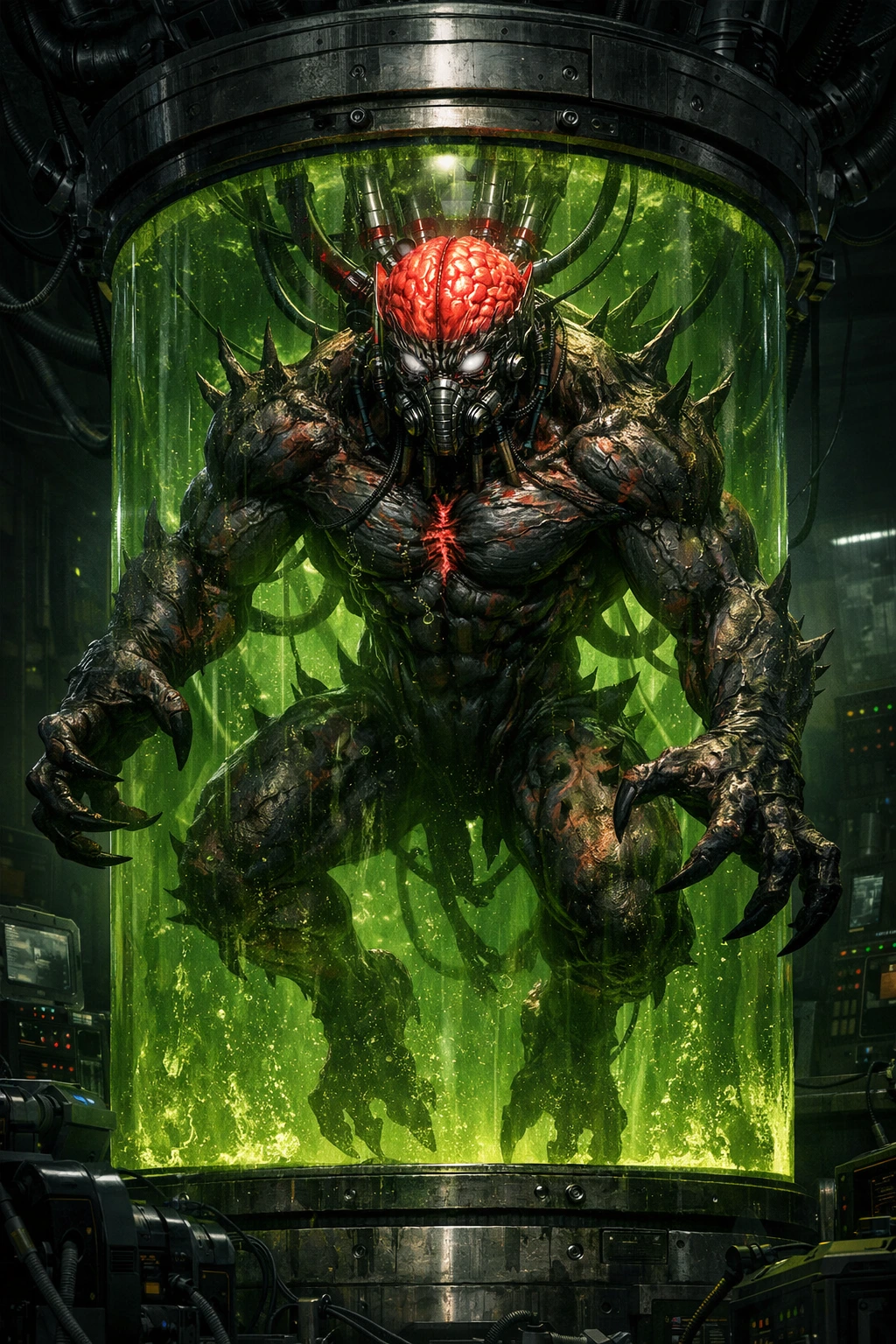
- High-Ends: These are Dr. Garaki’s absolute masterpieces, the Sistine Chapels of his dark science. High-Ends, such as the terrifying creature known as Hood, are highly customized, uniquely sentient monsters. To create them, Garaki could not use ordinary thugs; he required a foundation of extreme willpower and combat prowess. He built them from the corpses of strong-willed, bloodthirsty underground fighters and villains whose innate desire to fight transcended even brain death. High-Ends are engineered to house up to 6 incredibly powerful Quirks concurrently. Furthermore, unlike the lower tiers, they require years of
- incubation in specialized nutrient vats to fully stabilize their cellular structure. Because of the sheer caliber of their base bodies, High-Ends retain a twisted semblance of their original personalities—usually an overwhelming lust for battle—allowing them to think tactically, speak, and adapt dynamically in combat. They are not drones; they are apex predators engineered to hunt the strongest heroes in the world.
The Jaku Hospital Labyrinth
The Perfect Cover
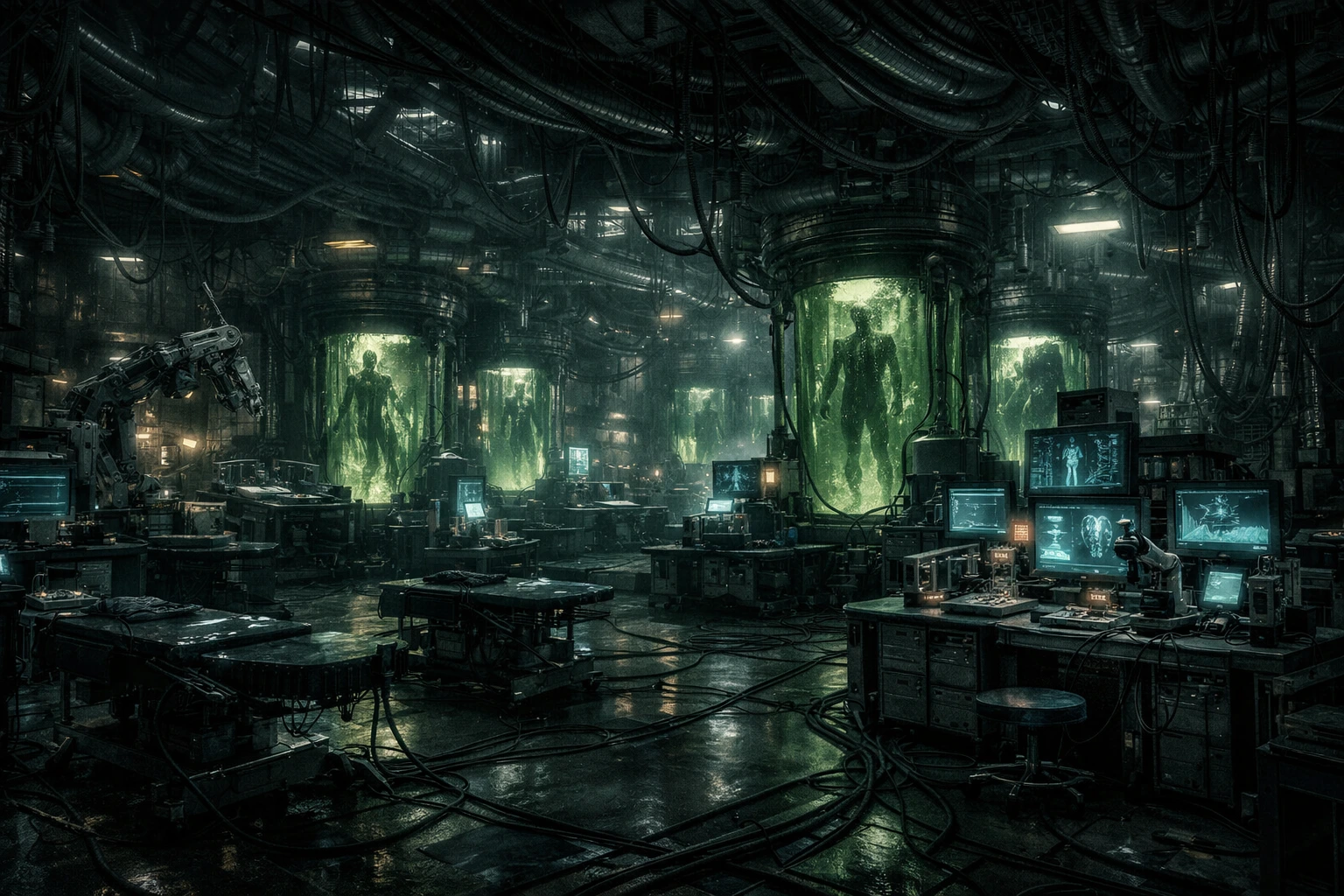
The scale of Garaki’s bio-engineering required infrastructure that could not simply be hidden in an abandoned warehouse. He needed access to state-of-the-art medical equipment, massive amounts of electricity, chemical supplies, and most importantly, biological matter. To achieve this, he utilized Jaku General Hospital as the perfect, unassailable cover.
On the surface, it was a bustling, highly respected civilian medical center, a beacon of health and healing in the community. Garaki operated openly as its chairman, walking the halls in his white coat, surrounded by nurses and oblivious doctors. Yet, directly beneath their feet, accessible only through hidden elevators and biometric locks, lay a massive, subterranean bio-mechanical laboratory.
This labyrinth was a stark, terrifying contrast to the hospital above. Filled with towering incubation vats, surgical theaters stained with blood, and miles of snaking cables, it was a factory of nightmares. He used his impeccable reputation as a gentle, caring doctor to mask the logistics of his evil. Requisitions for massive amounts of chemicals were easily written off as hospital supplies. Unprecedented electrical usage was justified by the hospital’s MRI and life-support machines. It was an evil that existed quite literally under the noses of the heroes.
The Orphan Pipeline
Perhaps the most horrific and deeply upsetting implication of his operation at Jaku Hospital was his connection to the foster care and orphanage systems. Garaki founded and funded numerous orphanages ostensibly as acts of charity. In reality, these institutions functioned as a chilling pipeline for his experiments. He specifically targeted Quirkless children, or those with highly unique but “unwanted” Quirks, who lacked families or advocates.
If a child disappeared from one of his orphanages, who would ask questions? Who would look for a child society had already forgotten? These children acted as the raw, untainted material for his early genetic splicing experiments. It is a dark, sickening parallel to the fate of his own grandson, the winged Nomu recognized by Bakugo. Garaki viewed human life, particularly the vulnerable lives of children, not as things to be protected, but as literal clay to be molded, reshaped, and mutilated in the name of the Singularity.
The Kurogiri Project
While the High-Ends were his physical masterpieces, his sickest, most psychologically devastating achievement was the Kurogiri Project. Tying back to the deep emotional trauma of the heroes, Garaki required a flawless, localized teleporter to act as a permanent guardian and babysitter for Tomura Shigaraki. He found the perfect Quirk in a young, heroic U.A. student: Oboro Shirakumo.
After Shirakumo was tragically killed in a building collapse, his body was intercepted before cremation. Garaki exhumed the corpse of a teenager who dreamed of being a hero of justice, dragged him into the darkness of the Jaku labyrinth, and began to twist him. Through unimaginable biological desecration, Garaki merged Shirakumo’s “Cloud” Quirk with multiple other spatial abilities, fundamentally rewriting the boy’s genetic code.
He erased Shirakumo’s memories, his bright personality, and his humanity, replacing it with a programmed, unwavering loyalty to Shigaraki. The result was Kurogiri—a living, sentient portal composed of dark mist. Garaki did not just steal a Quirk; he desecrated a hero’s soul, weaponizing the corpse of Eraser Head and Present Mic’s best friend to serve the very evil they swore to destroy. It stands as the ultimate testament to Garaki’s utter depravity.
The Masterpiece: Tomura Shigaraki’s Ascension
The Four-Month Hell
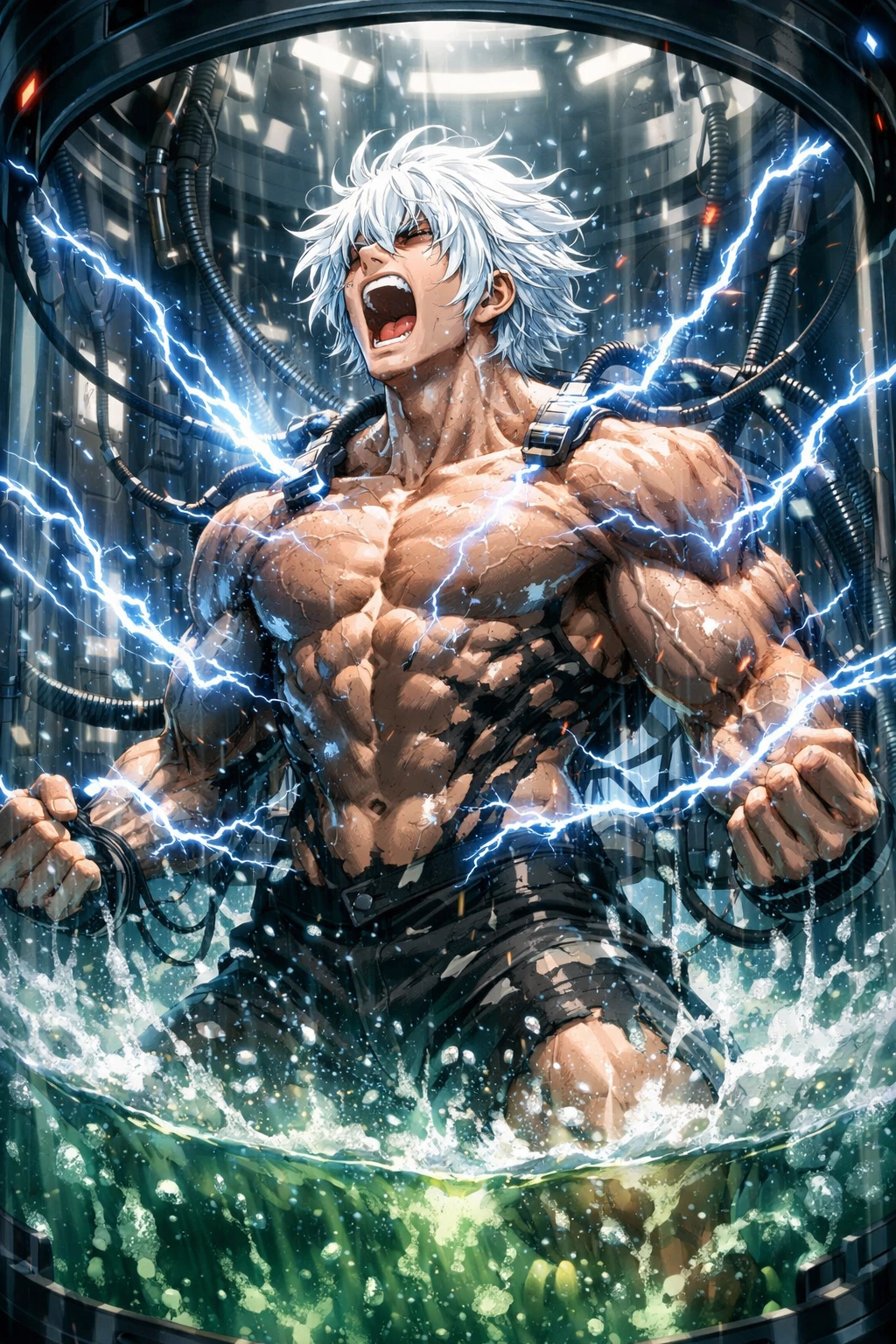
Every experiment, every Nomu, every stolen Quirk over a hundred years was merely a stepping stone toward a singular, apocalyptic goal: the creation of the perfect vessel. That vessel was Tomura Shigaraki. The surgical climax of Dr. Garaki’s entire existence was the four-month procedure designed to physically rebuild Shigaraki’s cellular structure from the ground up.
Shigaraki’s natural body was frail; if he were to receive the original, unadulterated “All For One” Quirk, the sheer density of the power would cause his body to instantly tear itself apart. To prevent this, Garaki subjected Shigaraki to a four-month hell. The procedure was not a simple surgery; it was an agonizing, continuous deconstruction and reconstruction of Shigaraki’s DNA.
He had to mathematically alter the boy’s cells, thickening nerve endings, expanding muscle fibers, and fortifying bone density, all while the patient was submerged in a specialized fluid that constantly ripped his body apart and forced it back together stronger. It was a prolonged, conscious torture designed to break the human limits.
The 100% Threshold
Garaki established extreme, grueling parameters for the vat incubation, constantly monitoring what he deemed the “completion percentage.” To safely house the true power of the Demon King, Shigaraki had to reach 100% completion. The environment inside the vat was a crucible of unimaginable pain. Garaki utilized intense electrical stimulation to shock the cells into accelerated regeneration, bombarding Shigaraki with intense chemical baths that burned away his humanity and replaced it with raw, unyielding power.
Shigaraki was forced to constantly walk the razor-thin line between life and death. The pain was so absolute that it was designed to shatter Shigaraki’s mind, utilizing his pure, unadulterated hatred as the only psychological anchor keeping him alive. Garaki was pushing a human body out of the realm of mortality and into the realm of the divine, forging a biological god of destruction through sheer, relentless torment.
The Erasure Quirk Countermeasure
The true genius of Garaki’s engineering during this four-month ascension was his foresight. He knew the heroes would eventually come. He knew that Eraser Head (Shota Aizawa) posed the ultimate threat to any Quirk-based being. If Aizawa looked at Shigaraki, all the stolen Quirks, all the decay, would instantly vanish, leaving Shigaraki vulnerable.
To counter this, Garaki fundamentally altered Shigaraki’s baseline physical physiology. He didn’t just give him Quirks; he engineered Shigaraki’s base muscle density and skeletal integrity to rival the raw, physical power of All Might in his prime. This was a biological masterpiece. He ensured that even if Aizawa successfully used “Erasure” to shut down Shigaraki’s Quirks, the villain would not be rendered helpless.
Instead, Shigaraki’s raw, Quirkless physical strength, his terrifying speed, and his sheer durability would still be catastrophic. Garaki created a monster who was an apocalyptic threat even when his superpowers were turned completely off. It was a flawless, insurmountable biological checkmate against hero society.
The Jaku Raid: The Fall of the Architect
The Mirko Assault
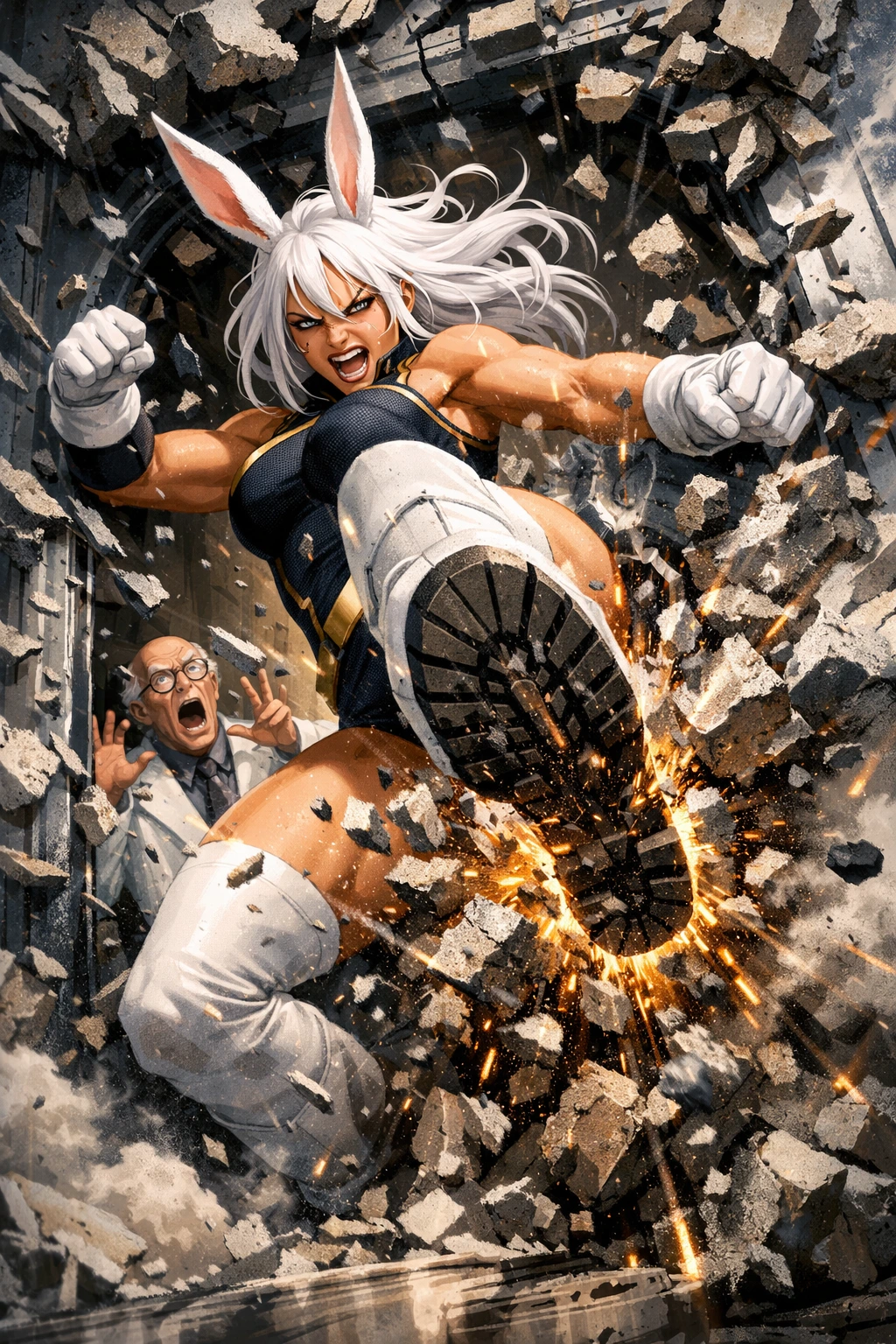
Despite his century of preparation, Dr. Garaki’s reign in the shadows came to an abrupt, violent end during the Jaku Hospital Raid. The catalyst for his downfall was not a rival intellect or a superior scientist, but the visceral, unstoppable force of the Rabbit Hero: Mirko. For a man of science who had spent his life observing pain from the safety of a control room, being confronted by raw, unadulterated violence was a system shock.
Mirko’s assault was a masterclass in feral brutality. Her sheer speed and instinctual combat prowess completely bypassed Garaki’s highly calculated, labyrinthine defenses. She did not bother to solve his puzzles or outsmart his security; she simply kicked through the reinforced blast doors and shattered the ceilings.
In a matter of five chaotic minutes, Mirko tore through his elite High-End Nomu guards, shattering his precious incubation vats and unearthing a century of meticulously hidden secrets. The panic Garaki experienced was palpable; it was the terror of an apex predator realizing he had suddenly become the prey in his own den.
The Desperate Awakening
As his laboratory quite literally crumbled around him, alarms blaring and the agonizing screams of his dying Nomu echoing through the cavernous underground, Garaki was forced into a corner. His life’s work was being systematically dismantled by a single, enraged hero.
With Mirko closing in and the rest of the hero strike team descending upon the facility, Garaki made his final, frantic gamble. He bypassed the safety protocols of the central vat. Shigaraki’s ascension was not complete; he was only at 75% of his required biological stabilization. Yet, with his century of research turning to dust, Garaki violently initiated the awakening sequence.
He flooded the vat with pure electrical current, artificially shocking Shigaraki back to life prematurely. It was an act of supreme desperation, unleashing an incomplete god of destruction upon the world in a final, spiteful attempt to salvage his master’s dream from the ashes of his laboratory.
The Erasure of a God
Following the awakening, Garaki’s attempt to flee the collapsing facility culminated in a moment of sheer, poetic justice. Cornered by the heroes, the arrogant, god-like geneticist who had played with life and death for over a hundred years was finally stripped of his illusions. Eraser Head locked his eyes onto the doctor, using his Quirk to instantly nullify Garaki’s copied “Life Force.” The biological debt of a century came crashing down in a matter of seconds.
Without the Quirk holding his artificial youth together, Garaki physically aged decades before the heroes’ eyes. His spine hunched, his skin withered into deep, skeletal wrinkles, and his minimal strength evaporated. The terrifying mastermind, the architect of the apocalypse, was instantly reduced to exactly what he truly was: a frail, weeping, powerless, pathetic old man. Stripped of his Nomu, his laboratory, and his stolen time, he was unceremoniously handcuffed and dragged into police custody, a broken mortal once more.
Conclusion
The Frankenstein of My Hero Academia
In the grand, tragic tapestry of My Hero Academia, Kyudai Garaki stands alone as the indispensable engine of the villain underworld. He is the ultimate Frankenstein of the modern era. While figures like Overhaul, Re-Destro, and even Shigaraki provided the ideological hatred and physical violence necessary to challenge the status quo, they were ultimately reliant on the biological foundation laid by Garaki.
Without his intellect, his stolen lifespan, and his complete abandonment of human ethics, All For One would have died a broken man decades ago in a sterile hospital room. The League of Villains would have possessed no Nomu to fight All Might at the USJ, no High-Ends to terrorize the city streets, and no means to elevate their leader into a god. Garaki was the logistical, scientific spine of the entire narrative’s conflict.
Closing Thoughts
The terrifying legacy of Dr. Kyudai Garaki forces the audience to confront a deeply unsettling reality about the superhero genre. In a world populated by individuals who can control gravity, summon fire, and shatter mountains with a single punch, the most dangerous weapon of all is not a spectacular Quirk.
The most catastrophic force on Earth is a brilliant, patient mind that has been completely, irrevocably stripped of human empathy. Garaki proves that true evil does not always roar from the skies; sometimes, it sits quietly in a basement for a hundred years, holding a scalpel, patiently waiting for the world to die.