
Introduction
In the vibrant, hyper-commercialised world of My Hero Academia, where superhuman abilities are commodified, and heroism is inextricably linked to celebrity status, the arrival of Chizome Akaguro—known universally by his terrifying moniker, the Hero Killer: Stain—served as a violent course correction.
To dismiss Stain simply as a deranged serial killer or a localised villain of the week is to fundamentally misunderstand his narrative purpose and the profound, inescapable shockwave he sent through the bedrock of superhuman society.
Chizome Akaguro was not merely a murderer; he was a brutal, ideological immune response to a corrupted, dangerously complacent Hero Society. He emerged as a symptom of a systemic disease, a living, breathing, and bleeding critique of a world that had forgotten what it truly meant to save others.
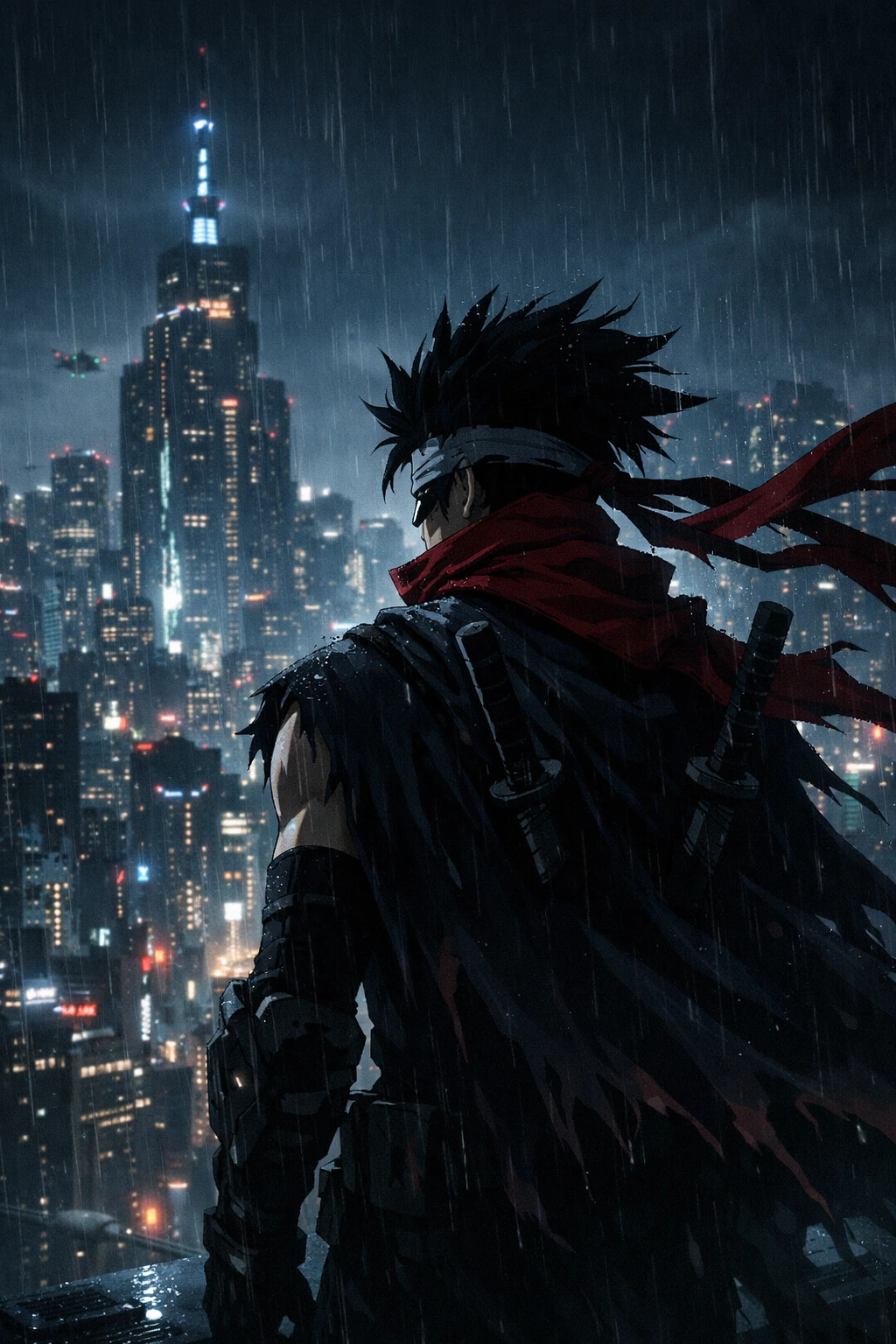
The man behind the blood-red mask and the tattered, scavenged tactical gear did not begin his journey as a monster. His transition is a tragically compelling narrative of radicalization. He began as a deeply passionate, albeit intensely naive, high school student enrolled in a hero course, harboring a pure, unadulterated vision of justice inspired by the Symbol of Peace, All Might.
When reality fractured this pristine worldview, he devolved into a disillusioned street-corner preacher, desperately trying to awaken the masses through rhetoric and pleading. But when society turned a deaf ear to his peaceful sermons, he underwent a terrifying metamorphosis.
Chizome forged himself into a weapon, becoming the most influential domestic terrorist in modern Japanese history within the series’ lore. His blade did not just cut flesh; it severed the comfortable illusions of a society addicted to spectacle.
This article serves as the definitive, expert-level breakdown of the Hero Killer. We will meticulously deconstruct the precise, visceral biology of his “Bloodcurdle” Quirk, analyzing how he weaponizes a seemingly weak ability through unmatched combat intellect and psychological warfare.
We will trace the viral, memetic spread of his extremist manifesto that irrevocably altered the criminal underworld, giving birth to a new age of ideologically driven villainy. Finally, we will explore the emotional and psychological climax of his character arc: his deeply complex, paradoxical relationship with All Might, proving that underneath the blood-soaked fanaticism, Chizome Akaguro was a necessary evil who forced a broken world to look into the mirror.
The “Bloodcurdle” Quirk: Biological Paralysis
To understand the terror of the Hero Killer, one must first deconstruct the visceral, deeply unsettling reality of his Quirk: “Bloodcurdle.” Unlike the explosive, flashy Quirks that dominate the pro-hero billboard charts—abilities that manipulate fire, gravity, or brute physical force—Stain’s Quirk is intimately invasive and inherently parasitic. The ingestion mechanic is central to its horror.
By consuming even a microscopic drop of a target’s blood, Chizome instantly induces a state of total, catastrophic paralysis in his victim. This is not a simple physical restraint; it is a complete, instantaneous override of the target’s central nervous system.
The victim remains entirely conscious, their sensory inputs fully active, allowing them to feel the agonizing terror of their situation, yet their motor functions are completely severed from their brain’s commands. This enforced physical helplessness, combined with the deeply taboo act of blood ingestion, turns every encounter with Stain into an exercise in psychological horror.
However, “Bloodcurdle” is far from an omnipotent, god-tier ability. Its effectiveness is strictly bound by biological limitations, creating a rigid hierarchy based on the victim’s blood type. The duration of the paralysis scales directly with these blood types: Type B suffers the longest paralysis (up to eight minutes), followed by Type AB, then Type A, and finally Type O, which recovers the fastest.
This seemingly arbitrary biological quirk forces Chizome to operate as a battlefield mathematician. When engaging multiple targets, as seen in the Hosu City incident, he cannot simply strike blindly. He must instantly observe, hypothesize, and calculate his strike windows based on internal, invisible countdowns.
He is constantly juggling the terrifying arithmetic of his opponents’ recovery times, prioritizing targets and managing his positioning to ensure no one breaks free before he is ready for the lethal blow.
Yet, the most fascinating aspect of “Bloodcurdle” is its inherent hardware disadvantage. In the context of open combat in a superhuman society, it is objectively a weak Quirk. It provides absolutely zero physical enhancements.
Chizome does not possess superhuman strength to shatter concrete, nor superhuman speed to outrun projectiles, nor regenerative durability to survive a devastating blow. If he is caught in the open, or if an opponent possesses a ranged Quirk that prevents close-quarters engagement, he is essentially just a baseline human.
This means that Chizome must rely entirely on his own raw athleticism, obsessive physical conditioning, and terrifying mastery of stealth just to draw that crucial first drop of blood. Every victory he claims against pro-heroes with vastly superior firepower is a testament not to his Quirk, but to his sheer, uncompromising dedication to mastering the art of the kill. His power is a mere finishing move; the true weapon is the man himself.
The Origin of a Zealot (From Student to Assassin)
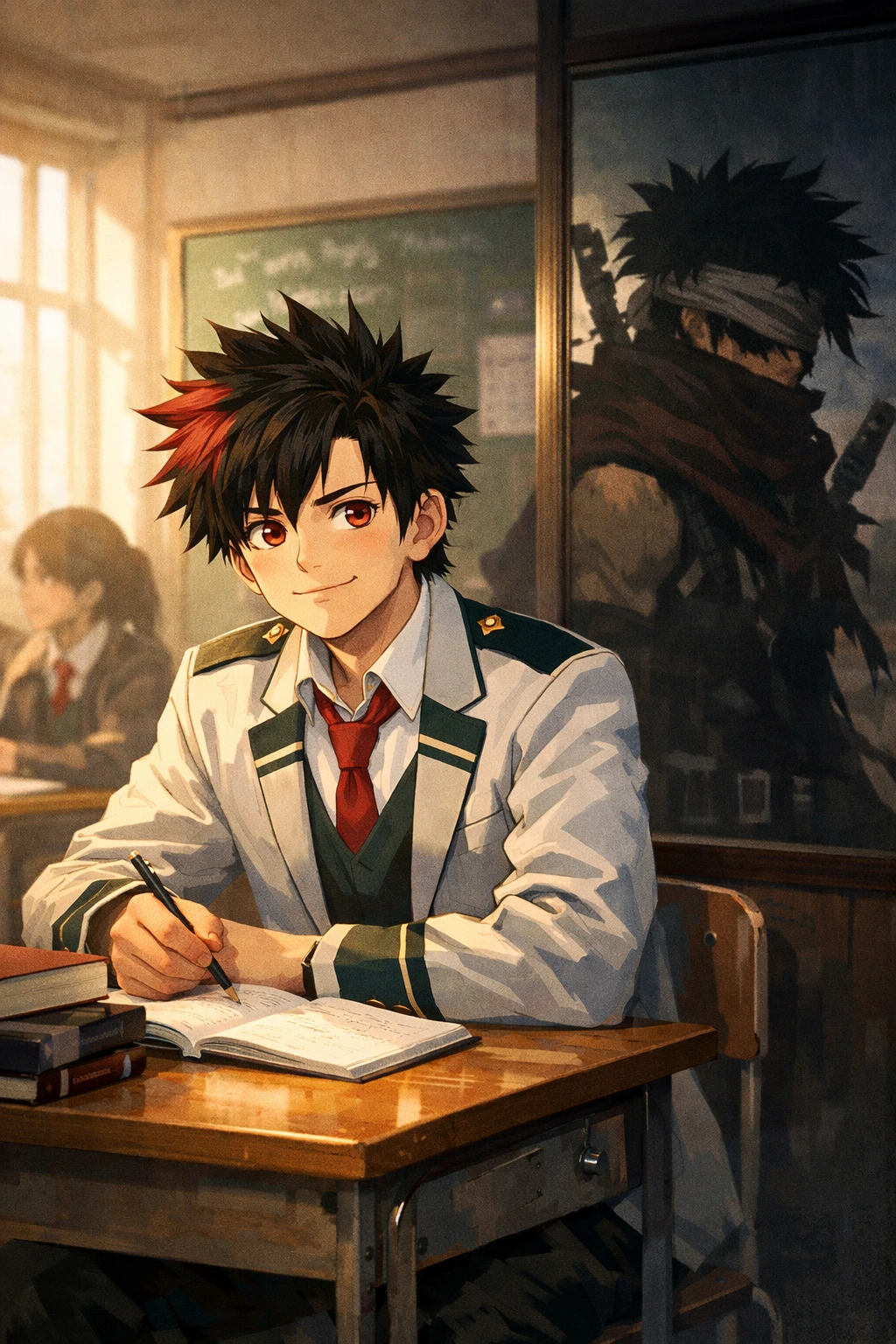
The monster known as the Hero Killer was forged in the crucible of absolute disappointment. Chizome Akaguro’s origin story is rooted in the tragedy of the failed idealist. As a young man, he enrolled in a private high school’s hero course, his heart brimming with a pure, almost religious idolization of All Might.
To the young Chizome, All Might was not just a hero; he was the literal embodiment of altruism, a messianic figure who sacrificed his own well-being purely for the sake of others. However, the reality of the hero course was a shattering blow to his fragile ideology. He looked around his classroom and saw not future saviors, but aspiring celebrities.
His classmates were pursuing the hero profession not out of a sense of noble duty, but for lucrative merchandising deals, media exposure, wealth, and fame. The institution of heroism had been reduced to a bureaucratic, capitalistic career path. Disgusted by this grotesque commercialization of his sacred ideal, Chizome dropped out during his freshman year, fundamentally alienated from his peers.
Following his departure from the hero course, Chizome entered his “Street Preacher Era,” a largely undocumented but critical phase of his psychological development. Before he ever picked up a blade, he attempted to enact change through peaceful protest.
For over a decade, Chizome stood on street corners, distributing pamphlets and delivering impassioned speeches, advocating for a societal purge of “fake” heroes and a return to the pure, self-sacrificing heroism modeled by All Might.
This was his desperate attempt to save society from itself without resorting to bloodshed. However, the tragedy of this era is absolute apathy. The citizens of this superhuman society were far too comfortable, far too addicted to the celebrity culture and the illusion of absolute safety provided by the hero ranking system. They walked past him, ignoring his desperate warnings, treating him as a raving lunatic rather than a prophetic visionary.
This sustained, soul-crushing rejection triggered his ultimate psychological breaking point: the “Action” Epiphany. Chizome came to the horrifying, cold realization that words were utterly useless against a deeply entrenched systemic rot. A society drunk on the spectacle of fake heroes would never voluntarily wake up; they had to be violently shaken from their stupor.
He realized that his message would only be heard, remembered, and feared if it was carved into the flesh of the very idols the public worshipped. He abandoned his name, his past, and his peaceful methods, retreating into the shadows to undergo rigorous, self-taught combat training. When he emerged, the idealistic street preacher was dead.
In his place stood the Hero Killer: Stain, a fundamentalist zealot who understood that to cure a terminal societal disease, he had to become the surgeon’s scalpel, cutting away the infected tissue one fake hero at a time.
The Anatomy of an Ambush (Quirkless Combat Mastery)
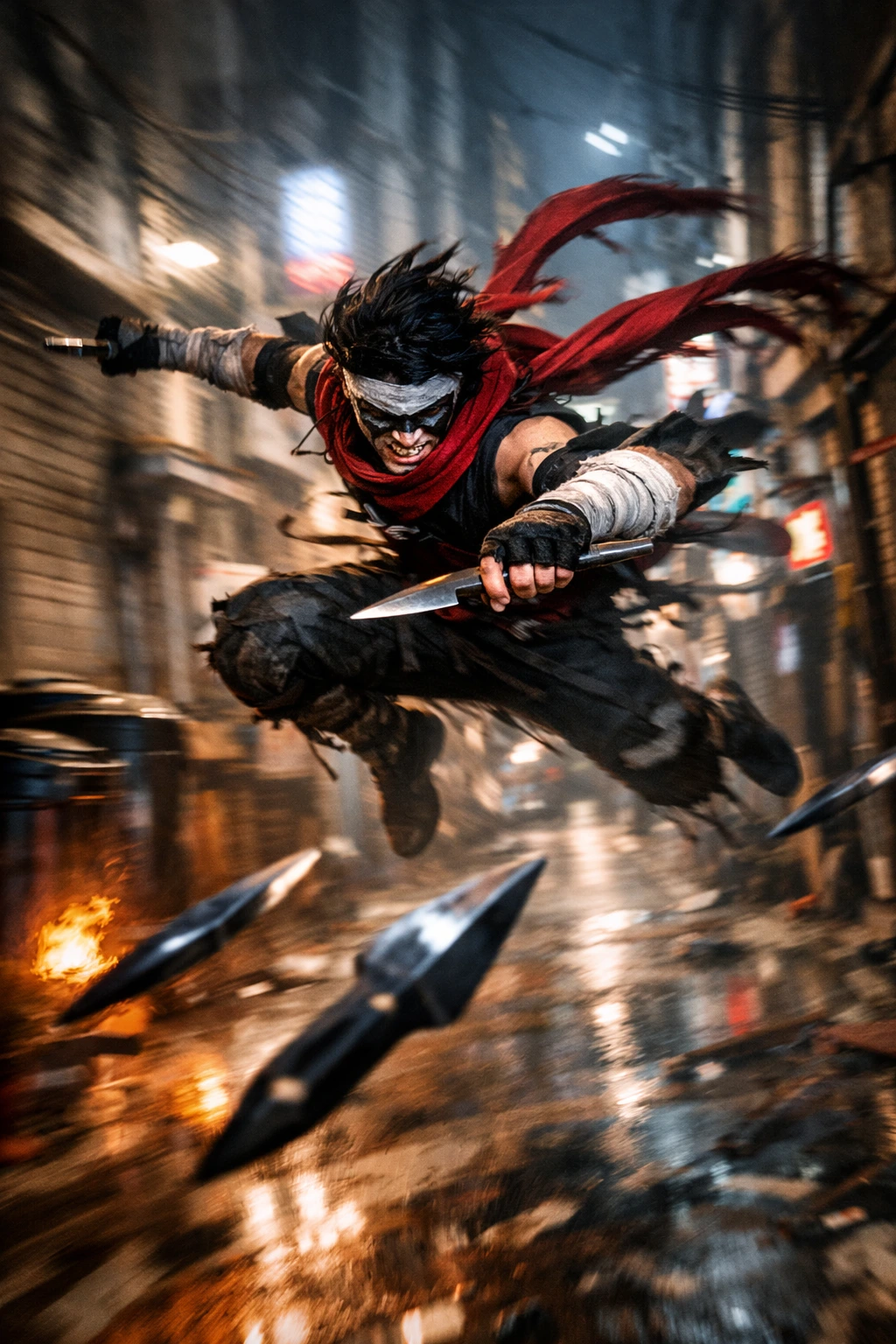
When examining Stain’s methodology, one must analyze the anatomy of his ambush tactics. Because his Quirk requires blood ingestion, his entire approach to combat is predicated on extreme close-quarters lethality and the infliction of superficial, bleeding wounds. A breakdown of his loadout reveals a masterclass in lethal utility.
His arsenal is distinctly lacking in high-tech weaponry or explosive ordinance. Instead, he carries heavily worn, battle-tested steel: a primary katana for reach and parrying, serrated daggers designed specifically to tear flesh and cause heavy bleeding rather than clean cuts, throwing knives for mid-range harassment, and, most terrifyingly, combat boots retrofitted with hidden spikes.
Every single piece of his equipment is specifically designed not necessarily to kill instantly, but to guarantee the shedding of blood. A mere grazing strike from a throwing knife or a kick from his spiked boot is all he needs to activate his win condition.
Because he lacks a physical enhancement Quirk, Chizome’s ability to overpower seasoned Pro Heroes and hyper-fast, prodigy-level students like Tenya Iida and Izuku Midoriya relies entirely on overwhelming speed and psychological intimidation. His movements are described as erratic, animalistic, and terrifyingly efficient.
He moves with a predatory grace, utilizing the environment—walls, narrow alleyways, shadows—to bounce around his targets, disorienting them before they can track his trajectory. But his physical speed is only half the equation; the other half is his weaponized aura. Chizome projects a tangible, suffocating bloodlust that freezes less experienced fighters in their tracks.
He utilizes absolute terror as a secondary Quirk, overwhelming their senses and triggering their primal flight-or-flight responses, ensuring they make a crucial mistake. He paralyzes them with fear before he ever paralyzes them with his Quirk.
The Hosu City Incident stands as the ultimate tactical analysis of Stain’s combat genius. Trapped in a narrow, dimly lit alleyway, he found himself facing off against three highly capable hero-in-training powerhouses: Midoriya (possessing unparalleled brute strength), Todoroki (wielding devastating, wide-area elemental control), and Iida (utilizing blinding speed).
Despite being vastly outgunned in terms of raw Quirk power, Stain systematically broke down their teamwork. He exploited the environment to nullify Todoroki’s massive ice and fire attacks, closing the distance instantly. More importantly, he weaponized their psychological states.
He exposed Tenya Iida’s selfish, blinding desire for revenge over his brother, pointing out that Iida prioritized killing him over saving the paralyzed Native lying bleeding on the ground. Stain didn’t just fight their bodies; he fought their ideologies, using Iida’s emotional instability as a wedge to divide the trio, proving that raw power means nothing without the tactical intellect and absolute conviction required to wield it effectively.
The Manifesto (Defining the “Fake” Hero)
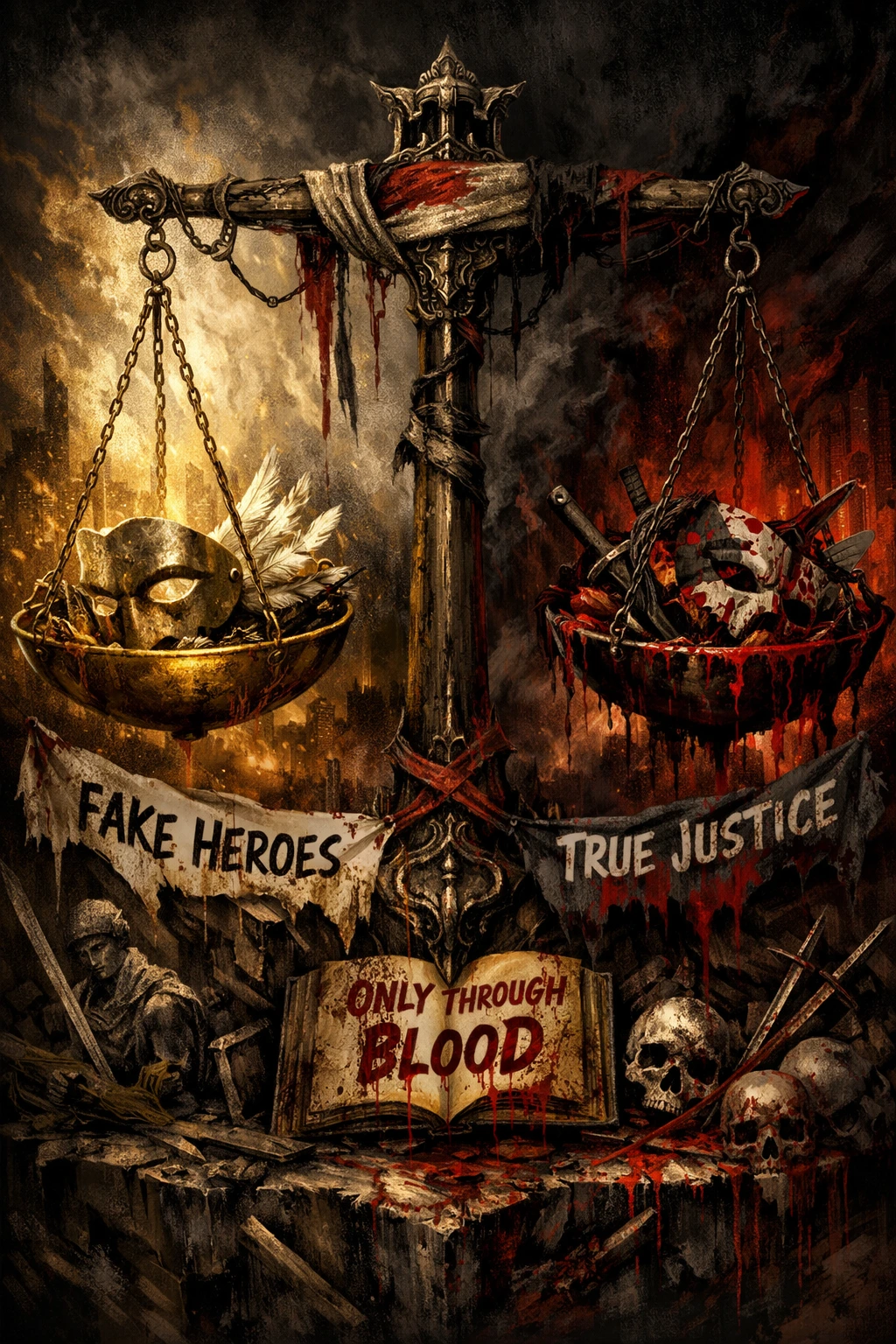
At the core of Chizome Akaguro’s terrifying crusade lies his manifesto—a rigid, uncompromising, and deeply psychotic black-and-white morality that leaves zero room for human error or nuance. To Chizome, the definition of a hero is not a spectrum; it is an absolute binary. His criteria are horrifyingly simple: if an individual expects a reward, a paycheck, fame, or societal adoration for saving a life, they are instantly disqualified from being a hero.
They are reduced to armed civil servants acting out a performance for the cameras. To Stain, true heroism demands absolute, self-destructive altruism. It requires a willingness to throw one’s life away for a stranger in the mud, without hesitation, without an audience, and without the expectation of gratitude. Any deviation from this impossible, messianic standard is not just a moral failing; it is a capital offense punishable by death.
This strict adherence to his own twisted code is what elevates him from a mindless slasher to a terrifyingly principled zealot, perfectly illustrated by his decision to intentionally spare Izuku Midoriya during the Hosu alleyway clash. From the moment Midoriya smashed into the alley to protect Iida, Stain analyzed the boy’s actions.
He noted Midoriya’s reckless self-sacrifice, his desperate attempt to draw Stain’s aggro away from the wounded, and his utter disregard for his own physical safety. In Midoriya, Stain recognized the exact, unadulterated embodiment of All Might’s spirit. Midoriya was not fighting for glory or revenge; he was fighting simply because someone needed saving.
Because Midoriya passed this lethal purity test, Chizome actively held back. He had multiple opportunities to deliver a fatal strike to the green-haired student, but deliberately chose to inflict non-lethal, superficial wounds just to paralyze him. This moment is crucial; it proves Chizome is an ideological purist who is bound by the very rules he preaches.
The absolute terrifying zenith of this conviction occurs at the climax of the Hosu arc: the stand of a true believer. After a brutal, drawn-out battle, Chizome is battered, suffering from broken ribs, severe burns, and a punctured lung caused by a fractured rib piercing his internal organs. He is medically on the verge of death.
Yet, as a flying Nomu attempts to snatch Midoriya, Stain breaks free of his restraints, blitzes the biologically engineered monster, and executes it to save the boy he deemed worthy. Standing in the street, bleeding out, his mask ripped away to reveal his terrifying visage, he unleashes a roar of pure, unadulterated fanaticism.
He declares that the only one allowed to kill him is the true hero, All Might. The sheer, crushing weight of his aura, fueled by a conviction so powerful it transcended his dying biology, literally paralyzed top-tier Pro Heroes, including the current Number Two, Endeavor, in pure, unadulterated fear. A man with no enhancement Quirk brought the most powerful beings in the city to a dead halt through the sheer, terrifying force of his belief.
The Viral Infection (Birth of the Vanguard)
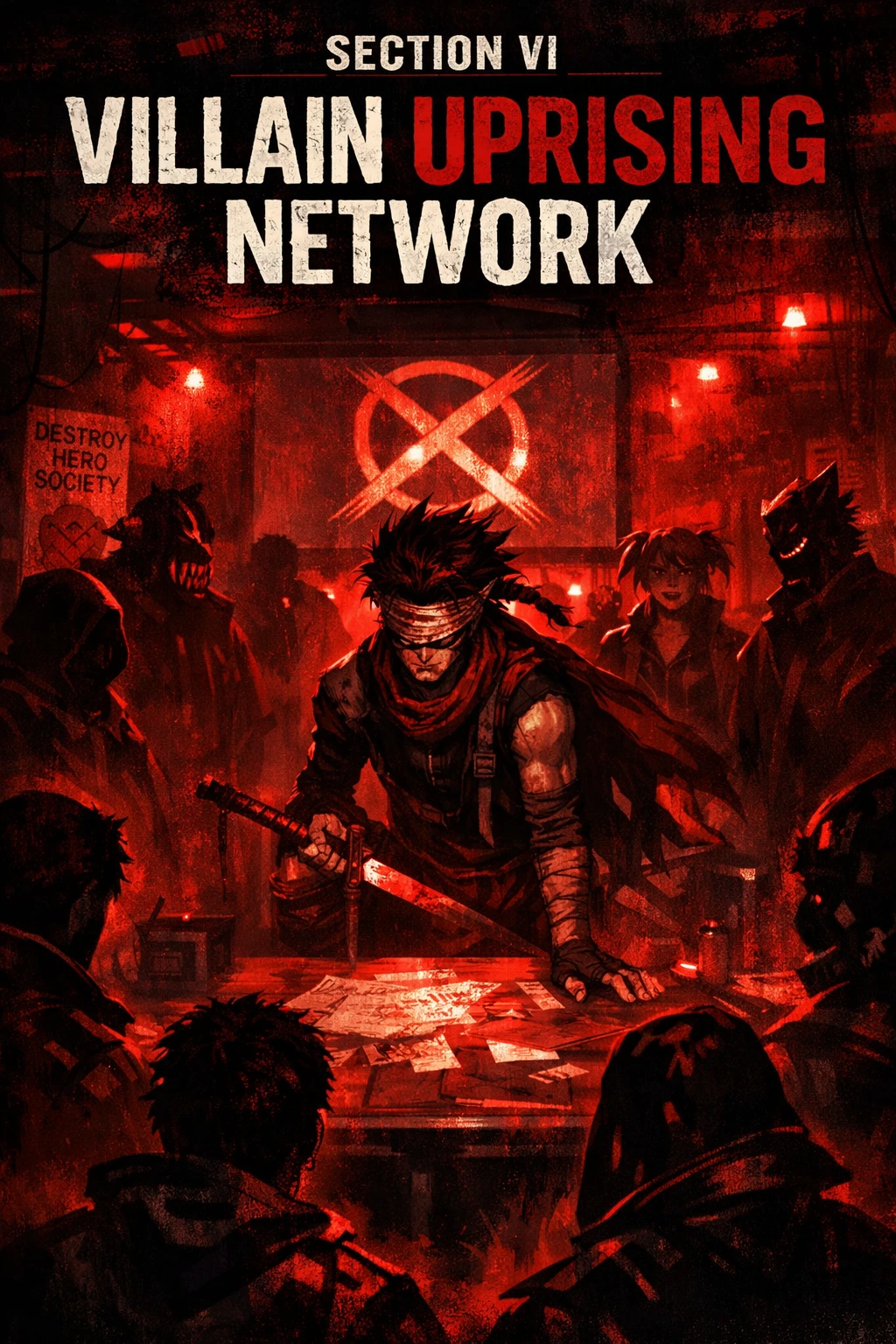
Chizome Akaguro’s physical defeat in the streets of Hosu was not the end of his crusade; paradoxically, it was the moment of his ultimate victory. The Hero Killer became an accidental martyr. In the immediate aftermath of his arrest, a localized crisis mutated into a nationwide ideological contagion.
A sympathizer managed to compile an underground video detailing Stain’s origin, his brutal manifesto, and his terrifying final stand, leaking it onto the internet. In a society brimming with marginalized individuals, people with mutant Quirks who faced daily discrimination, and those utterly disillusioned by the gleaming, hypocritical veneer of the hero industry, this video acted as a spark thrown into a massive powder keg. Stain’s physical body was chained to a hospital bed, but his ideology broke out into the digital ether, infecting the minds of thousands.
This viral spread of his manifesto completely galvanized the criminal underworld. Before Stain, villainy in My Hero Academia was largely portrayed as disorganized, petty thuggery, or the self-serving machinations of isolated crime bosses. Stain’s ideology gave these aimless, societal outcasts something far more dangerous than money or power: a unified purpose.
He gave them a doctrine. This resulted in a direct pipeline from Chizome’s arrest to the rapid expansion of the League of Villains. Individuals who had previously operated in isolation, completely alienated from society, suddenly found a banner to rally behind. This influx of radicalized talent birthed the Vanguard Action Squad.
Characters like Dabi (seeking to expose the hypocrisy of heroes like his father), Himiko Toga (a victim of societal Quirk suppression who found beauty in Stain’s bloody methods), and Spinner (a mutant who literally cosplayed as Stain and adopted his exact weapons) were all direct ideological descendants of the Hero Killer. Stain single-handedly militarized the outcasts.
The supreme irony of this entire phenomenon lies in the philosophical clash between Chizome and the leader of the League, Tomura Shigaraki. When they first met, Shigaraki despised Stain. Shigaraki was a petulant child throwing a tantrum, wishing to destroy society simply because it irritated him. Stain, conversely, was a fanatic who wanted to cure society by destroying its false idols.
Their goals were fundamentally incompatible; Stain wanted reformation through blood, while Shigaraki wanted absolute annihilation. Yet, after Stain’s arrest, Shigaraki was forced to swallow his pride and exploit the Hero Killer’s name.
The recruits who flocked to the League did not come for Shigaraki; they came for the ghost of Stain. Shigaraki had to usurp Stain’s legacy, pretending to harbor his ideals just to build his army. Thus, the greatest threat to hero society was ironically built upon the hijacked philosophy of a man who ultimately wanted to see true heroism restored.
Tartarus and the Purge (The Inescapable Mind)
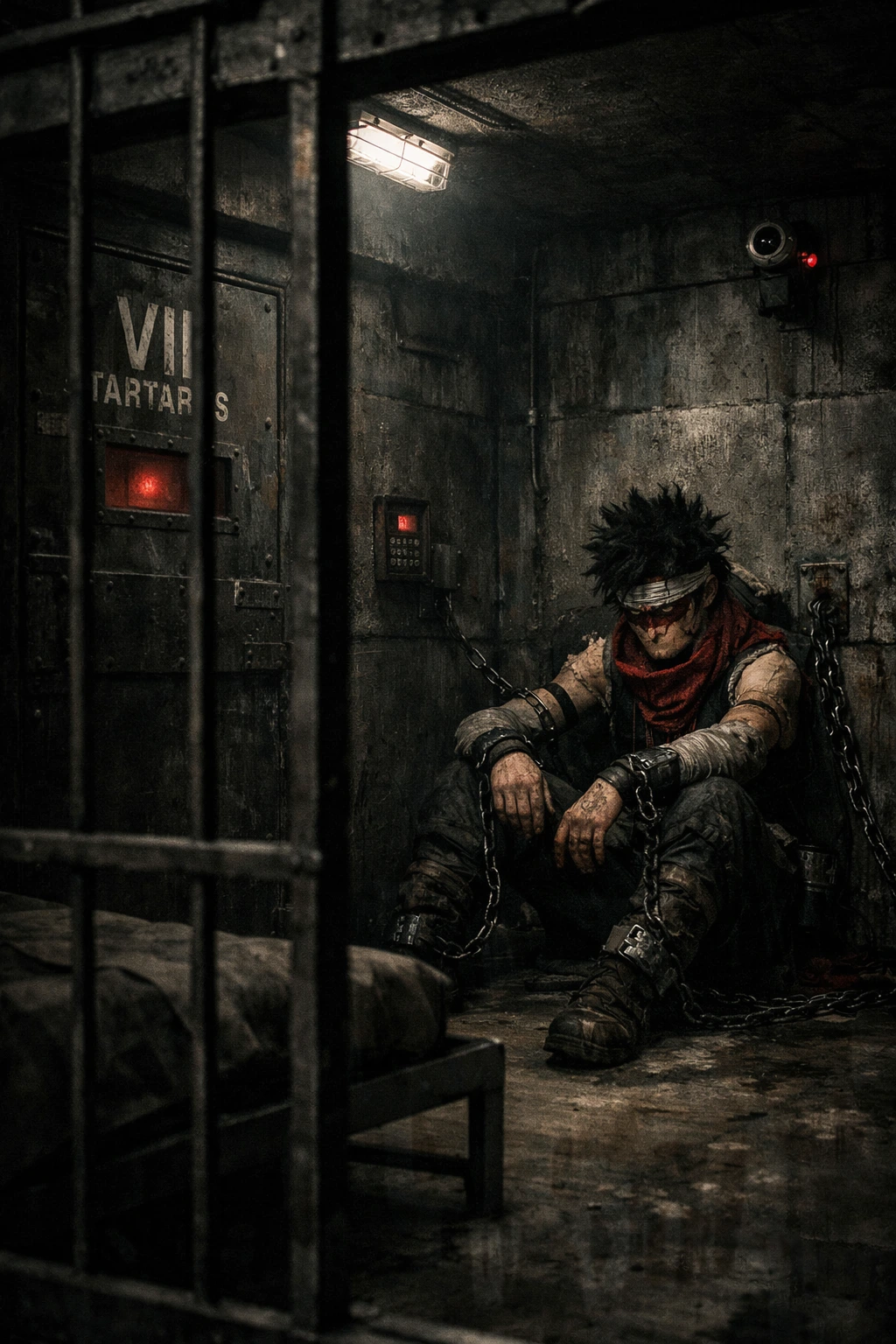
Following his capture, Chizome Akaguro was transferred to Tartarus, the ultimate maximum-security black site reserved for the absolute worst humanity had to offer. The inclusion of Stain in this facility is a fascinating study in threat assessment by the Japanese government.
On a purely physical level, Stain did not belong there. He was surrounded by god-tier threats: All For One, a centuries-old demigod who could level cities; Muscular, a walking tank of pure destructive force; and Overhaul, a mob boss capable of deconstructing matter on a molecular level. Compared to them, a man with a localized, close-combat, blood-ingestion Quirk seems almost quaint.
However, his placement in Tartarus reveals a profound truth: the authorities realized that his physical abilities were irrelevant. Chizome’s mind, his unmatched charisma, and his viral influence were infinitely more dangerous to the hegemony of the government than any physical attack. He had become a meme, a living concept, and as the government realized too late, ideas are bulletproof.
The true nature of Stain’s character was brilliantly reaffirmed during the catastrophic Tartarus jailbreak. When Shigaraki and All For One orchestrated the massive breach, plunging the impenetrable fortress into absolute chaos, the worst monsters in history were set free to ravage the country. Amidst the alarms, the crumbling infrastructure, and the rampant slaughter of guards, Chizome Akaguro calmly stepped out of his cell.
Yet, in a defining moment of ideological consistency, he explicitly rejected the liberation offered by All For One. He did not join the rioting inmates, nor did he swear fealty to the villains destroying the country. He recognized that All For One and Shigaraki were the antithesis of his own goals; they represented mindless destruction, not the surgical purging of false heroes.
Operating purely on his own twisted moral compass, Stain bypassed the villainous alliance, stole a security glider, and escaped into the night alone. In the ensuing apocalyptic wasteland of a collapsed society, the Hero Killer became a rogue variable—a predator unaligned with the heroes, yet fiercely opposed to the villains, beholden only to his own unyielding convictions.
The Final Vigilante (Aiding the True Symbol)
In the bleak, post-war era, with society in ruins and the hero system effectively dismantled, Chizome Akaguro’s role underwent a fascinating evolution. He transitioned from a street-level assassin to a shadow operative, driven by his unwavering loyalty to his sole recognized idol.
During his escape from Tartarus, Stain did not just flee; he utilized his unmatched stealth and tactical awareness to secure highly classified data. He retrieved the Tartarus security logs, gathering vital, decryptable intelligence on the exact timeline of Tomura Shigaraki’s bodily awakening and the mechanical inner workings of All For One’s grand strategy.
Even in the midst of a national collapse, Stain’s mind remained entirely focused on the grander chessboard. He understood that to stop the absolute annihilation of society, this critical information had to reach the only man he believed was worthy of acting upon it.
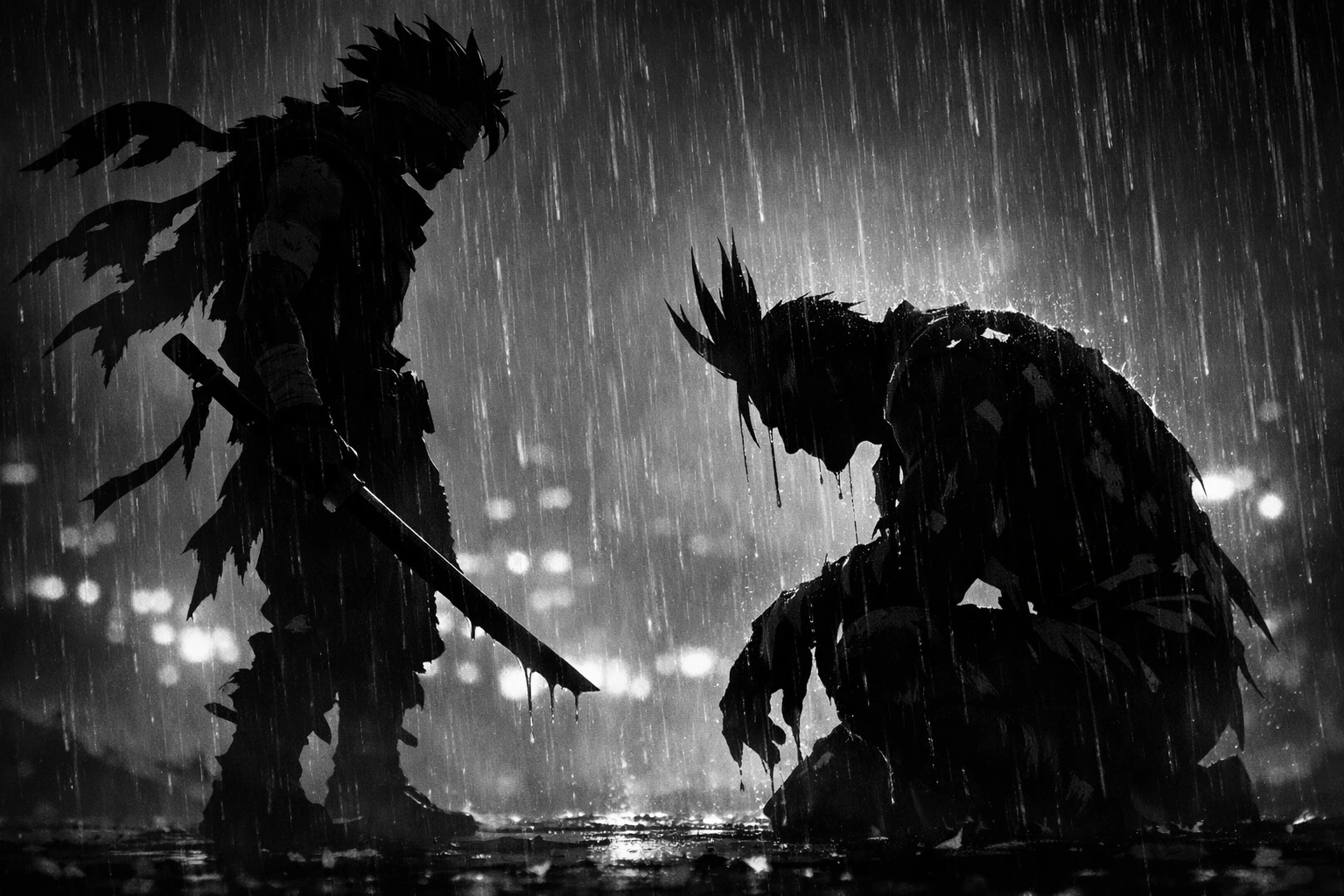
This led to the emotional and psychological climax of his entire narrative arc: the rainy confrontation with Toshinori Yagi, the depowered, emaciated man who was once All Might. In the pouring rain, Toshinori stood before a defaced statue of himself, utterly broken, depressed, and burdened by the crushing guilt of his own perceived uselessness as a Quirkless bystander.
It is here that Stain emerges from the shadows, not as an executioner, but as a twisted savior. The conversation that unfolds is a masterpiece of character writing. Stain refuses to acknowledge the pathetic, broken man before him as “All Might.”
He verbally tears into Toshinori, attacking his self-pity. Stain forces the retired hero to look at a civilian woman desperately trying to clean the defaced statue, proving that the symbol he created still inspires hope, even if the man himself is powerless.
In this poignant, heavily atmospheric scene, the serial killer who terrorized society became the only person on earth capable of reigniting the flame within the Symbol of Peace. Chizome forcefully reminded Toshinori of his true worth, proving a profound thematic point: “All Might” was never about the god-like Quirk, One For All. It was never about the flashing smiles or the merchandising.
“All Might” was the unbreakable, inherent will to save others, regardless of one’s own power or safety. By handing over the encrypted Tartarus data to Toshinori, Stain accepted his own role in the grand narrative. He acknowledged that his hands were forever stained with blood, and he could never stand in the light.
He accepted his destiny as the brutal, bloody stepping stone required to push the true hero back onto the path of justice, a tragic anti-hero validating the very light he could never touch.
Conclusion
In the final analysis, Chizome Akaguro must be understood as the necessary monster of the My Hero Academia universe. He was a creature born entirely from the womb of society’s own hypocrisy. If the hero system had not devolved into a popularity contest, if the purity of self-sacrifice had not been replaced by billboard rankings and corporate sponsorships, the Hero Killer would never have needed to exist.
He forced a comfortable, complacent world to look into a deeply uncomfortable mirror and reckon with the rot at its core. While his methods were undoubtedly psychotic and indefensible, his underlying critique of a commodified justice system was piercingly accurate, leaving a wound on society that refused to heal.
Kohei Horikoshi’s use of Chizome Akaguro represents a permanent, brilliant shift in the moral landscape of the series. Before Stain, the conflicts were largely binary: good heroes punching bad villains. Following the Hosu Incident, the narrative matured, descending into deeply complex, murky shades of gray.
Stain challenged the reader to question the very definition of heroism within a capitalist framework. He remains one of the most enduring, compelling figures in the narrative—not because of the blood he spilled, but because of the terrifying truth he bled for. The Hero Killer ultimately proved that the most dangerous weapon in a world of superhumans is an unbreakable ideology, forever leaving his blood-stained mark on the legacy of true heroes.