
1. The Genetic Trigger: Why Only High-Concentration Demons Evolve
To the untrained eye of a newly forged Demon Slayer, the abilities wielded by the Twelve Kizuki appear as nothing short of mystical incantations—dark magic conjured from the abyss. However, a rigorous physiological examination of the Demon Slayer universe reveals a far more terrifying reality.
Blood Demon Arts (Kekkijutsu) are not spells; they are severe, hyper-advanced cellular mutations triggered by a massive, concentrated overdose of Muzan Kibutsuji’s blood. Muzan’s blood acts not merely as a toxin, but as a hyper-aggressive, mutagenic retrovirus that fundamentally rewrites a human host’s DNA at an unprecedented speed.
The manifestation of a Blood Demon Art is the ultimate biological expression of the demon’s original human psychology, trauma, and suppressed desires physically erupting through weaponized, highly adaptive DNA. When a human is converted into a demon, Muzan’s cells flood the bloodstream, initiating a violent, agonizing war at the cellular level.
The human immune system triggers a catastrophic cytokine storm in a futile attempt to eradicate the foreign pathogen, resulting in the excruciating pain demons report upon transformation. For the vast majority of victims, this process is purely destructive. Lower-level demons remain mindless, feral flesh-eaters because their baseline human physiology cannot withstand the genetic payload. Their bodies adapt just enough to survive and regenerate, but their central nervous systems are irrevocably shattered by the mutation, leaving them as slaves to their base limbic drives—hunger, aggression, and survival.
However, a rare physiological threshold exists. When a human possesses a specific, resilient genetic makeup—often coupled with extreme psychological trauma or obsessive, singular willpower—their body does not just survive the influx of Muzan’s cells; it subjugates them. This is where the blood-brain barrier plays a critical role.
In lower demons, Muzan’s cells easily breach this barrier, overwriting the frontal lobe, obliterating the host’s memory, and destroying their core identity. But in individuals who become High-Concentration Demons (the Upper Moons), their unique brain chemistry interacts synergistically with the mutagen. Their localized neural networks form a symbiotic loop with the demonic cells, shielding their core consciousness from total erasure.
This precarious survival allows for a violent, highly specialized rewiring of the nervous system. The demon’s subconscious mind, their deepest traumas, and their defining human traits become epigenetic triggers. In the field of epigenetics, environmental stress can alter how genes are read by cells. In the case of demons, the “environmental stress” is their human trauma.
The newly mutated DNA searches for a framework to express its newfound, boundless biological energy, and it finds that blueprint in the host’s broken psyche. The human mind literally maps its trauma onto the genome. Consequently, the demon evolves specialized, bio-engineered organs and cellular structures designed to manifest their psychological core into physical reality.
A thief might develop an art based on stealth; a victim of freezing poverty might manifest cryokinesis. The Blood Demon Art is unlocked—a bespoke biological weapon forged in the crucible of human suffering and demonic cellular hyper-evolution. They are no longer just apex predators; they are localized reality-warpers bound by extreme, hyper-accelerated biological mechanics.
2. Thermodynamics of Blood: Douma’s Absolute Zero and Nezuko’s Pyrokinesis
To understand the elemental manifestations of Blood Demon Arts, one must entirely discard the concept of elemental magic and embrace the strict, unforgiving laws of thermodynamics. Elements are not conjured from the aether out of nothingness; they are the result of severe, rapid manipulation of endothermic (heat-absorbing) and exothermic (heat-releasing) chemical reactions fueled by hyper-metabolic demonic biology.
Consider the terrifying cryokinesis of Upper Moon 2, Douma. His ability to generate lethal, razor-sharp ice and freezing fogs is often mistaken for the magical creation of cold. However, in physics, “cold” does not exist as an independent force; there is only the absence of heat.
Douma’s Blood Demon Art is a localized, hyper-accelerated endothermic reaction of apocalyptic proportions. His mutated blood contains specialized, hyper-reactive proteins that, when aerosolized or expelled from his body via his fans, instantaneously absorb massive amounts of ambient kinetic energy (heat) from the surrounding environment.
By aggressively stripping the thermal energy from the air around him, Douma triggers a sudden, localized drop in temperature that approaches cryogenic levels. This flash-freezes the ambient moisture—the water vapor naturally present in the air—into complex, fractal ice crystals. The true horror of his ability lies in its physiological and metallurgical interactions with his opponents.
When a Demon Slayer inhales Douma’s frozen fog, the endothermic reaction continues inside their respiratory system. The demonic ice particles absorb the latent heat of the Slayer’s internal organs, flash-freezing the moisture in their alveoli and bronchioles. The resulting rapid expansion of ice crystals physically shreds the human lungs from the inside out, perfectly neutralizing the Sun Breathing techniques that rely entirely on maximum oxygen intake.
Furthermore, the extreme drop in temperature drastically increases the brittleness of Nichirin steel, making swords more likely to shatter upon impact. Douma is not a wizard of ice; he is a biological heat-sink designed to halt kinetic energy at a molecular level.

Conversely, Nezuko Kamado’s Exploding Blood (Bakketsu) operates on the exact opposite thermodynamic principle. Her ability is a prime example of a hyper-oxygenated, violent exothermic reaction, serving as a biological countermeasure to demonic proliferation.
When Nezuko sheds her blood, she can consciously alter its chemical composition outside her body. By hyper-oxygenating the hemoglobin and combining it with a highly unstable, combustible enzyme generated by her unique demonic mutation, she turns her own vital fluid into a bio-incendiary plasma.
When triggered by her sheer will, this mixture undergoes rapid oxidation, releasing a tremendous amount of thermal energy in the form of brilliant, pink fire. However, the true marvel of Nezuko’s pyrokinesis is its molecular selectivity—a form of highly advanced biological catalysis. Her flames do not adhere to standard combustion physics, which would indiscriminately burn both wood, fabric, and flesh. Instead, her ignited blood acts as a “smart” exothermic reaction.
The combustible enzymes in her blood are specifically keyed to react violently only when they come into contact with the specific protein markers of Muzan Kibutsuji’s cells. Therefore, when her flames engulf a human, the fire finds no demonic cellular structures to react with, rendering the heat completely harmless to human tissue and clothing. But upon contact with demonic flesh or standard Blood Demon Arts (like Gyutaro’s venom), the reaction goes critical, causing violent, localized cellular incineration.
Nezuko’s blood is a self-igniting, targeted biochemical weapon designed to eradicate the very infection that empowers her, acting as a hyper-aggressive demonic antibody.
3. Spatial Warping: The Non-Euclidean Geometry of the Infinity Castle
Perhaps the most mind-bending expressions of Blood Demon Arts are those that manipulate spatial dimensions, seemingly discarding the laws of physics entirely. However, even the reality-bending architecture of the Infinity Castle operates on theoretical principles of localized gravitational displacement and non-Euclidean geometry, requiring a fundamental misunderstanding of spatial logic by the human brain.
The primary architect of this madness is Nakime, the new Upper Moon 4. Her ability transforms her into a biological focal point for a localized dimensional singularity. The Infinity Castle is not a physical building located somewhere beneath the soil of Japan; it is a pocket dimension, a folded spacetime manifold sustained entirely by Nakime’s hyper-active demonic biology.
Her mechanism of control is her biwa. In standard physics, acoustic frequencies can cause physical vibrations, but Nakime’s mutated vocal cords, nervous system, and instrument generate hyper-resonant acoustic waves that interact directly with the localized gravitational field.
Each pluck of a string emits a specific frequency that warps the curvature of spacetime within her domain. She alters gravity vectors, shifts massive architectural mass, and creates visual and physical wormholes (sliding doors) that connect physically distant points in an instant.
She plays the fundamental strings of spatial reality, enforcing non-Euclidean geometry where parallel lines intersect, light bends around corners, and “up” and “down” are mere suggestions dictated by her chords. This creates an M.C. Escher-esque nightmare that renders human navigation and depth perception completely useless, causing profound psychological distress before a fight even begins.
The predecessor to this overwhelming spatial manipulation was Kyogai, the Drum Demon, whose Drum House provided a crude but mechanically similar anomaly. Kyogai’s Blood Demon Art relied on the kinetic and gravitational displacement caused by specific percussive soundwaves.
By striking the tsuzumi drums permanently fused to his mutated biology, he emitted percussive shockwaves that temporarily shifted the localized gravity vector of the room he occupied. Striking the right drum didn’t just spin the room visually; it fundamentally redefined the floor as the ceiling by manipulating the gravitational pull within that confined, box-like space.
This turned a simple physical structure into a violently rotating, disorienting centrifuge. The true lethality of Kyogai’s art was not just the physical trauma of falling, but the catastrophic assault on the human vestibular system. Deep within the human inner ear lie the semicircular canals and otoliths, fluid-filled structures that tell the brain which way is up.
The constant, instantaneous shifts in gravity completely scrambled these otoliths, exhausting the inner ear and the balance centers of a Slayer’s brain. This induced severe spatial disorientation, crippling vertigo, and extreme nausea. It was an assault on the neurological mechanics of human equilibrium, rendering elite swordsmen unable to stand.
However, the biological toll of this spatial warping is staggering. The caloric cost—the sheer amount of Adenosine Triphosphate (ATP) and biological energy required to shift tons of wood, stone, and localized gravity—is mathematically incomprehensible by human standards. To power a localized singularity or a gravitational centrifuge, these demons must possess internal metabolisms resembling miniature nuclear reactors.
This immense energy drain explains a crucial behavioral trait: spatially-altering demons rarely fight in direct, kinetic physical combat. Almost 100% of their biological energy is diverted to maintaining the spatial anomaly and manipulating their environment. If Nakime were forced to engage in high-speed, hand-to-hand combat, the concentration and metabolic energy required to sustain the Infinity Castle would likely collapse, proving that even reality-warping has a strict, finite metabolic budget.
4. Biological Weaponry: Neurotoxins and Aquatic Mutations
While some Upper Moons manipulate energy or space, others direct their hyper-evolution inward, weaponizing their own anatomy to create overwhelming biological payloads. These demons represent the pinnacle of engineered lethality, utilizing complex biochemistry and bio-mass manipulation to bypass traditional physical defenses (like blocking or dodging) entirely.
Upper Moon 6, Gyutaro, is a masterclass in weaponized biochemistry. His Blood Demon Art manifests through the generation of a hyper-aggressive, incredibly complex neurotoxin permanently coating his bone-sickles. From a medical standpoint, Gyutaro’s venom is an absolute nightmare. It does not operate on a single pathway; it is a multi-vector bioweapon, acting simultaneously as a neurotoxin and a hemotoxin.
Upon entering the human bloodstream through even the shallowest scratch, the toxin immediately bypasses the blood-brain barrier to attack the central nervous system. It acts as a potent neuro-inhibitor that violently disrupts neurotransmitter pathways, causing immediate, localized paralysis, agonizing phantom pains, and rapid vision loss.
Simultaneously, the hemotoxic elements of the venom unleash a cocktail of necrotic enzymes. These enzymes trigger rapid, cascading cellular necrosis (cell death) and runaway apoptosis in healthy tissue, breaking down red blood cells and causing internal hemorrhaging.
The victim literally begins to rot and bleed out from the inside out within seconds. The molecular complexity of this poison guarantees death in minutes, making it entirely lethal against 99% of the Demon Slayer Corps. It requires an immediate, Hashira-level pharmacological intervention—or the unique, hyper-evolved shinobi poison resistance of someone like Tengen Uzui.
Tengen survived only because his body had been systematically trained to slow his own metabolic processing of foreign antigens, allowing him to literally force his heart to stop beating to halt the circulation of the venom temporarily.
On a macro-biological scale, Upper Moon 5, Gyokko, showcases the grotesque extreme of aquatic biomass manipulation. Gyokko’s cellular structure defies the human understanding of the conservation of mass. He possesses the ability to compress an essentially infinite amount of biological matter—fish, razor-sharp tentacles, and immense volumes of heavy water—into localized, pocket-dimensional spaces within his ornamental vases.
When he summons his aquatic familiars, he is not teleporting them; he is rapidly uncompressing bio-matter and fluid dynamically grown and stored within his own hyperspatial anatomy.
Gyokko weaponizes hydrodynamics to a lethal degree. By conjuring spheres of water around his enemies, he utilizes the physical laws of hydrostatic pressure (Pascal’s principle) to his advantage. A human trapped in his Water Prison Pot is not just drowning; they are being subjected to crushing pressure from all sides, simulating the physical stress of deep-sea diving without equalization.
At a certain point, the sheer weight of the compressed water threatens to snap ribs and rupture eardrums. Furthermore, the immense viscosity and surface tension of the water completely neutralizes the kinetic momentum required for a Slayer to swing their sword with lethal force. Gyokko essentially creates localized, inescapable deep-sea environments on dry land.
However, the reliance on these overwhelming, automatic biological weapons exposes a critical flaw in demonic psychology: the flaw of arrogance. Demons like Gyutaro and Gyokko become so completely reliant on the lethal gimmicks of their mutations—assuming that a single scratch of venom or a single aquatic trap guarantees absolute victory—that they fundamentally neglect their physical martial arts, spatial awareness, and kinetic conditioning.
They plateau in their evolution. This evolutionary dead-end leaves them critically vulnerable to elite Slayers who possess the specific traits required to bypass the biological gimmick. Tengen’s chemical resistance rendered Gyutaro’s primary win-condition moot, forcing a kinetic brawl the demon wasn’t prepared to dominate alone. Similarly, Muichiro Tokito’s sheer, blinding speed, enhanced by his Demon Slayer Mark, simply outpaced Gyokko’s aquatic summons. It proved that the most complex biological weapon is useless if the user lacks the raw martial discipline and reflexes to land the strike.
5. The Assimilation Protocol: How Blood Battles Rewrite DNA
To understand the terrifying escalation of power within the Twelve Kizuki, one must examine the corporate and military structure of Muzan’s army. The hierarchy is not based on seniority, loyalty, or tactical brilliance; it is a brutal, Darwinian meritocracy governed strictly by the “Blood Battle.”
This ritual is the only legal protocol through which a lower-ranked demon can usurp a higher-ranking superior. It is not merely a fight for a title or a display of dominance; it is a profound biological event driven by the mechanics of cellular assimilation and phagocytosis.
When a Blood Battle concludes, the loser is not simply killed—they are consumed. This is not mere cannibalism driven by hunger; it is a highly efficient process of horizontal gene transfer. The victorious demon absorbs the loser’s entire cellular density, incorporating their bio-mass into their own structure.
More importantly, they assimilate the trace amounts of Muzan’s concentrated blood that belonged to the defeated demon. The dominant DNA of the victor physically engulfs and overwrites the recessive DNA of the loser. This sudden, massive influx of highly concentrated genetic material triggers an immediate, violent secondary mutation in the victor.
Their DNA is rapidly re-sequenced, allowing them to adopt the strengths and adapt the biological blueprints of their fallen rival. The Upper Moons are not just ancient, solitary creatures; they are living amalgamations of centuries of digested rivals, their cellular structures refined through continuous, cannibalistic evolution.
This brings us to the unique and terrifying case of Upper Moon 3, Akaza. Unlike his peers who rely on elemental projection, necrotic venom, or spatial warping, Akaza’s Blood Demon Art—Destructive Death: Compass Needle—is fundamentally different. It is the ultimate expression of martial evolution and sensory enhancement. Akaza’s art is not a magical energy projection; it is a hyper-evolved, localized neurological radar system.
When Akaza deploys his Compass Needle, the massive snowflake-shaped array that illuminates beneath him is merely a visual manifestation of a highly sophisticated bio-telemetry field. Akaza’s mutated brain acts as a hyper-sensitive bio-electric receiver, designed to detect the microscopic bio-magnetic and electrical fluctuations generated by a human opponent’s nervous system.
Every time a human muscle contracts, every time a heart rate accelerates with adrenaline, and every time the nervous system fires an action potential down an axon signaling an intent to attack, it generates a faint, unavoidable electromagnetic signature. In the spiritual terminology of the Demon Slayer world, this is referred to as “fighting spirit” or “battle aura.”
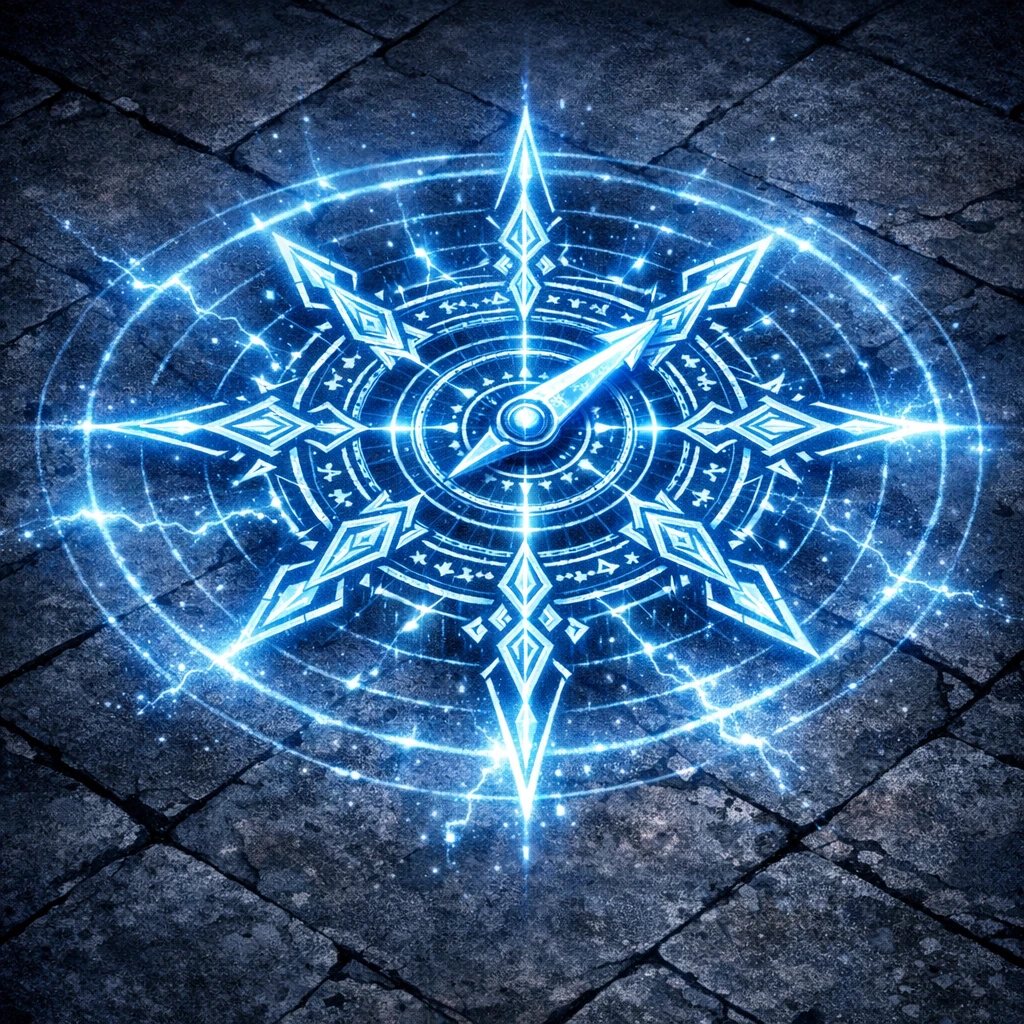
Akaza’s Blood Demon Art reads this physiological data in real-time, operating faster than the speed of human thought. The more aggressive and physically powerful the opponent, the brighter their bio-magnetic signature flares on Akaza’s internal radar. The Compass Needle automatically processes the trajectory, velocity, muscle tension, and lethal intent of an incoming strike before the human has even completed the physical motion.
This allows Akaza’s body to preemptively react with perfect, radar-guided counter-strikes. He does not need to visually see his opponent; his cells literally feel the electromagnetic intent to kill. This makes his martial art functionally flawless, turning the enemy’s own physiological drive to fight into the very beacon that guides their destruction.
It is only when a Slayer entirely suppresses their bio-electric output—entering the state of total emotional and physiological emptiness known as the “Selfless State”—that they become invisible to this radar, suddenly severing Akaza’s connection to their nervous system.
6. Conclusion: The Limits of Cellular Manipulation
Despite the overwhelming complexity, sheer destructive output, and devastating power of Blood Demon Arts, this hyper-evolved biology possesses a fatal, foundational weakness. The entirety of demonic mutation, from their infinite regeneration to their reality-bending arts, is sustained entirely by Muzan Kibutsuji’s cellular influence. And those specific cells are violently, catastrophically allergic to ultraviolet radiation.
The sun is the ultimate sterilizer, capable of instantly breaking down their genetic code. However, the Demon Slayer Corps cannot carry the sun with them into the night, which necessitated the creation of the Nichirin blade.
The Nichirin Nullification process is a fascinating intersection of metallurgy and targeted cellular destruction. Nichirin steel, forged from Scarlet Crimson Iron Sand and Scarlet Ore bathed in year-round sunlight on the highest, sunlight-drenched mountains, acts as a metallurgical solar capacitor. It naturally absorbs and permanently stores specific wavelengths of extreme ultraviolet radiation.
When a Demon Slayer executes a breathing technique, they are not just swinging a sword with fancy visual effects; they are maximizing their cardiovascular output to generate massive kinetic force, delivering this stored UV payload directly into the demon’s anatomy upon impact.
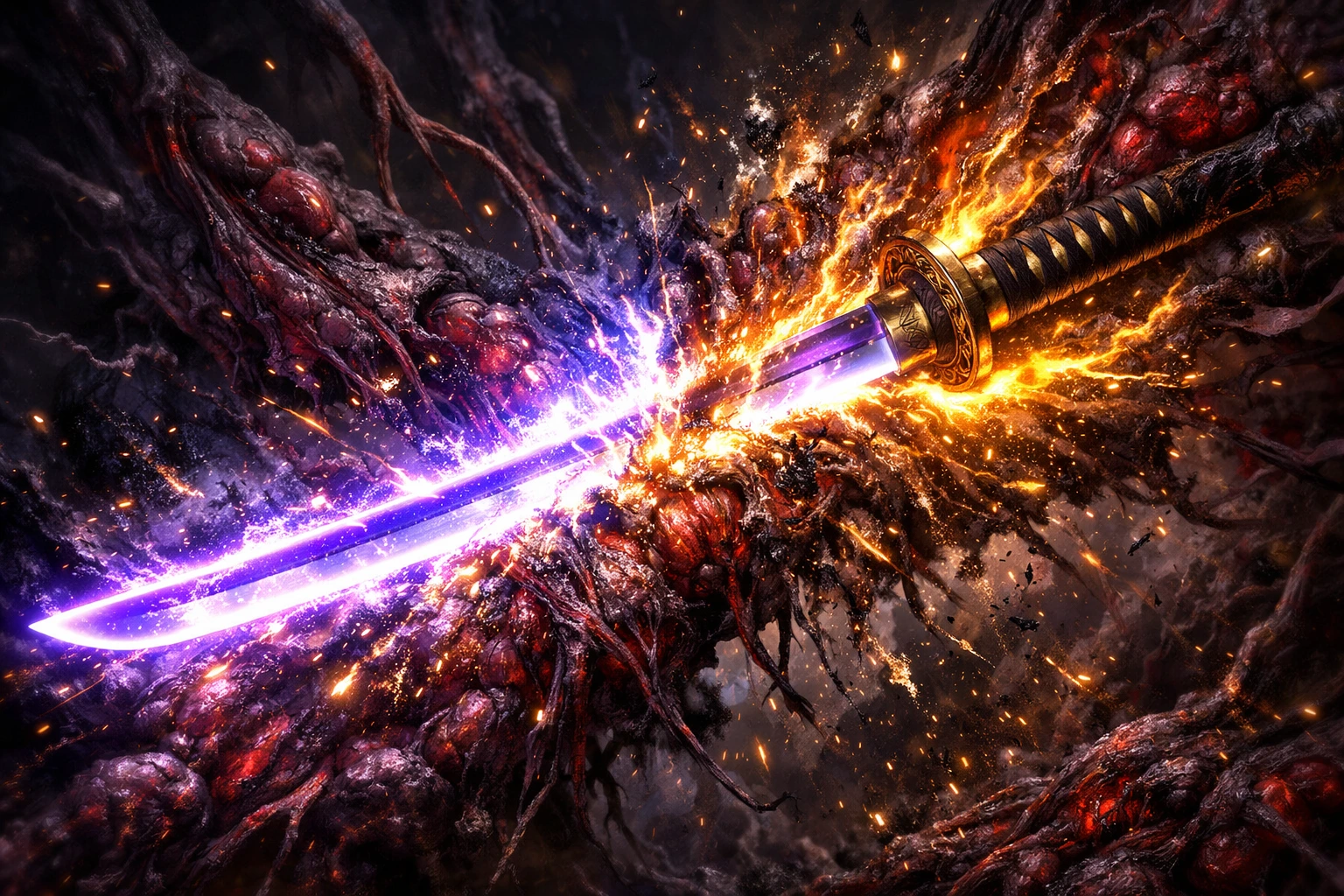
A Nichirin blade does not merely “cut” flesh like a standard katana. When the blade successfully severs a demon’s neck, the kinetic impact releases the stored solar energy directly into the spinal cord and central nervous system—the absolute densest concentration of Muzan’s controlling cells.
This highly specific UV radiation cascades through the demonic tissue, physically shattering the molecular bonds of the mutated DNA through a process similar to photodissociation (where light photons break down chemical bonds). It creates lethal pyrimidine dimers in the demonic genome, destabilizing the regenerative matrix entirely. This permanently shuts off the Blood Demon Art at the source.
Without the genetic instructions from the severed head to continually rebuild the surrounding tissue, the cells undergo rapid, catastrophic combustion, crumbling into ash. The magic is turned off because the biological hardware is irrevocably destroyed.
Ultimately, studying the physics, chemistry, and biology of the Blood Demon Arts reveals a profound psychological core beneath the horror. Every technique, from Douma’s lung-freezing fogs to Gyutaro’s agonizing necrotic venom, is ultimately a twisted physical reflection of the demon’s human tragedy. They are manifestations of ugly, venomous lives, cold, emotionless existences, and desperate, clinging obsessions that outlasted their humanity.
Muzan’s army is not a legion of magical fiends from hell; it is a tragic collection of broken humans forcibly converted into genetically modified bioweapons. They are prisoners of their own hyper-evolved cellular architecture, cursed to repeat their trauma through violence.
Therefore, every decapitation achieved by the Demon Slayer Corps is more than just a tactical martial victory. It is the absolute triumph of sheer, unmutated human endurance, perfected breathing mechanics, and indomitable, selfless will over the very pinnacle of engineered, biological nightmares.