
In the vast landscape of modern manhwa and anime, there is a silhouette that dominates the horizon like a colossus. A figure clad in pitch black, eyes glowing with an ethereal purple luminescence, commanding an army of the dead that stretches as far as the eye can see. Sung Jin-woo, the protagonist of Solo Leveling, is undeniably the face of the “System” genre. He is the standard-bearer for an entire generation of storytelling that blends video game mechanics with urban fantasy.
However, with massive popularity comes a massive, tidal wave of reductionist criticism. If you scroll through Reddit threads, Twitter discourse, or YouTube comment sections, you will inevitably encounter the “Edgelord” accusation. Detractors label Jin-woo as a hollow shell—a character devoid of personality who simply puts his hands in his pockets, delivers “cool” one-liners, and effortlessly decimates his enemies without a drop of sweat. They compare him to Kirito from Sword Art Online, lumping him into the pejorative category of the “Black Swordsman” trope: a character designed solely for male wish fulfillment, who gets the girls, the glory, and the god-like powers without genuine struggle or character depth.
This analysis exists to dismantle that accusation piece by piece.
To view Sung Jin-woo as merely “cool” is to fundamentally misunderstand the tragedy of his character. Jin-woo isn’t “cool” because he tries to be; he is “cold” because he has been systematically traumatized. His journey isn’t about the accumulation of power for the sake of ego; it is a journey of profound isolation, loss, and the desperate attempt to maintain humanity while ascending to godhood.
Unlike the typical Power Fantasy protagonist who seeks to become the King of the Pirates or the Hokage to gain recognition and love, Sung Jin-woo actively runs away from it. He is the Anti-Kirito. He doesn’t fight to be remembered; he fights so he can eventually be forgotten.
This is the comprehensive analysis of the God who desperately tried to stay human.
1. The Trauma of E-Rank: Why He Stopped Smiling
To understand the Shadow Monarch, we must first understand the “World’s Weakest.”
Most Isekai or System protagonists begin their journey at absolute zero, but their “zero” is usually a blank slate. They are reincarnated into a new body, or they wake up in a game world with a fresh start. Sung Jin-woo’s “zero” was a negative integer. He didn’t start with nothing; he started with four years of accumulating hell.
Before the System, before the “Arise,” Jin-woo spent four years as an E-Rank hunter. In the ruthless hierarchy of Solo Leveling, being an E-Rank isn’t just about being weak; it is about being expendable. It means being the bait. It means carrying the luggage while others do the fighting. It means walking into a dungeon knowing that if things go wrong, you are the first one the monsters will eat, and the higher-ranked hunters won’t blink an eye. For four years, Jin-woo was cut, stabbed, burned, and ridiculed. He was the laughingstock of the Association, known mockingly as “The World’s Weakest.”
Why does this matter? Because it explains the silence.
Critics often point to Jin-woo’s stoic expression in the later chapters as proof of bad writing. They ask, “Where is his personality? Why doesn’t he crack jokes anymore?”
His personality was bled out of him in the Double Dungeon.
The Smile That Died in the Cartenon Temple
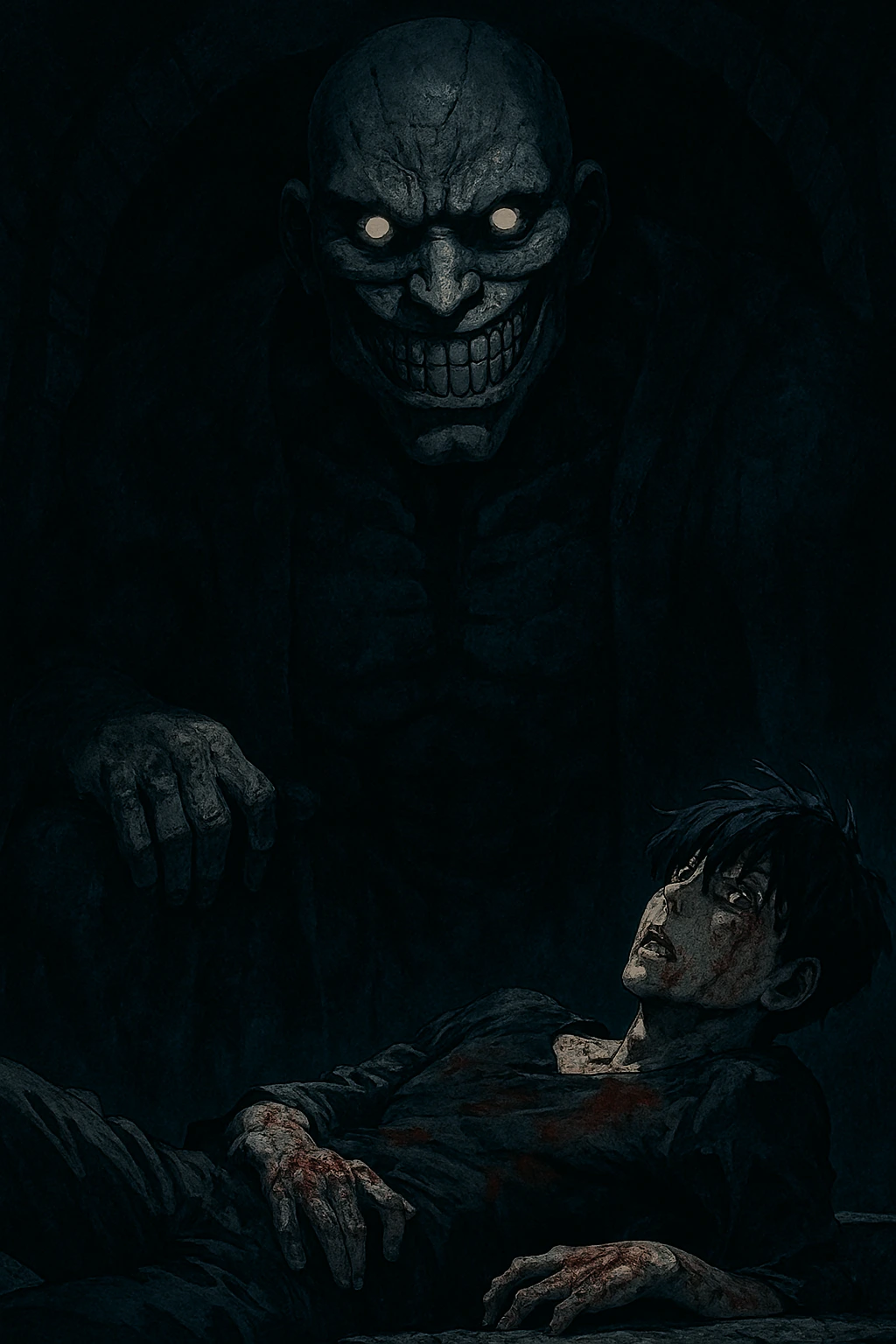
The pivotal moment of Solo Leveling isn’t when he gets the System; it’s the trauma that necessitates the System. The Cartenon Temple arc (the Double Dungeon) is a masterclass in survival horror. This wasn’t a battle; it was a slaughter. Jin-woo watched his colleagues—people he had just shared coffee and jokes with, people who had families and dreams—get decapitated, crushed, and incinerated by the Statue of God.
When Jin-woo looks at the Statue, he experiences a fear so primal that it rewires his brain. The famous “creepy smile” of the Statue is the inverse of Jin-woo’s reaction. In that dungeon, Jin-woo learned a brutal lesson that shattered his naivety: Kindness gets you killed.
The healer, Joohee, whom he tried to save, was paralyzed by fear. The party leader, Song Chi-yul, lost his arm. Other hunters who Jin-woo tried to help abandoned him to save their own skins. In the end, Jin-woo was left alone on the altar, missing a leg, waiting to die as a sacrifice for people who didn’t care about him.
When he re-emerges as a “Player,” he doesn’t become an edgelord overnight. He becomes a survivor. His silence is a survival mechanism. He stops smiling because the world showed him its teeth. Every time he enters a dungeon afterward, he isn’t looking for adventure; he is scanning for the exit. He is constantly assessing threats because he knows exactly how fragile human life is.
The “Dry Saliva” Motif
A subtle detail in the light novel and manhwa that goes unnoticed by casual readers is the recurring mention of “dry saliva.” Even after becoming an S-Rank, even after commanding thousands of shadows and killing dragons, the narration often notes that Jin-woo “swallowed dry saliva.”
This is the physical manifestation of PTSD. His body remembers the fear even when his mind knows he is strong. Unlike Kirito, who often approaches danger with a confident smirk or a “let’s do this” attitude, Jin-woo approaches danger with the calculated caution of a man who knows exactly what it feels like to be eaten alive. He isn’t trying to look cool; he is trying to ensure he never feels that helpless again.
2. The Psychology of the “Gamer” Interface: Dissociation as Armor
One of the most brilliant narrative devices in Solo Leveling is the System itself. To the reader, the blue screens, stat points, and quest logs look like a fun video game mechanic. But to Jin-woo, they serve as a layer of dissociation.
The System gamifies reality. It turns horrifying monsters into “mobs” with names and health bars. It turns life-or-death situations into “Quests.”
The Daily Quest: Survival or Punishment?
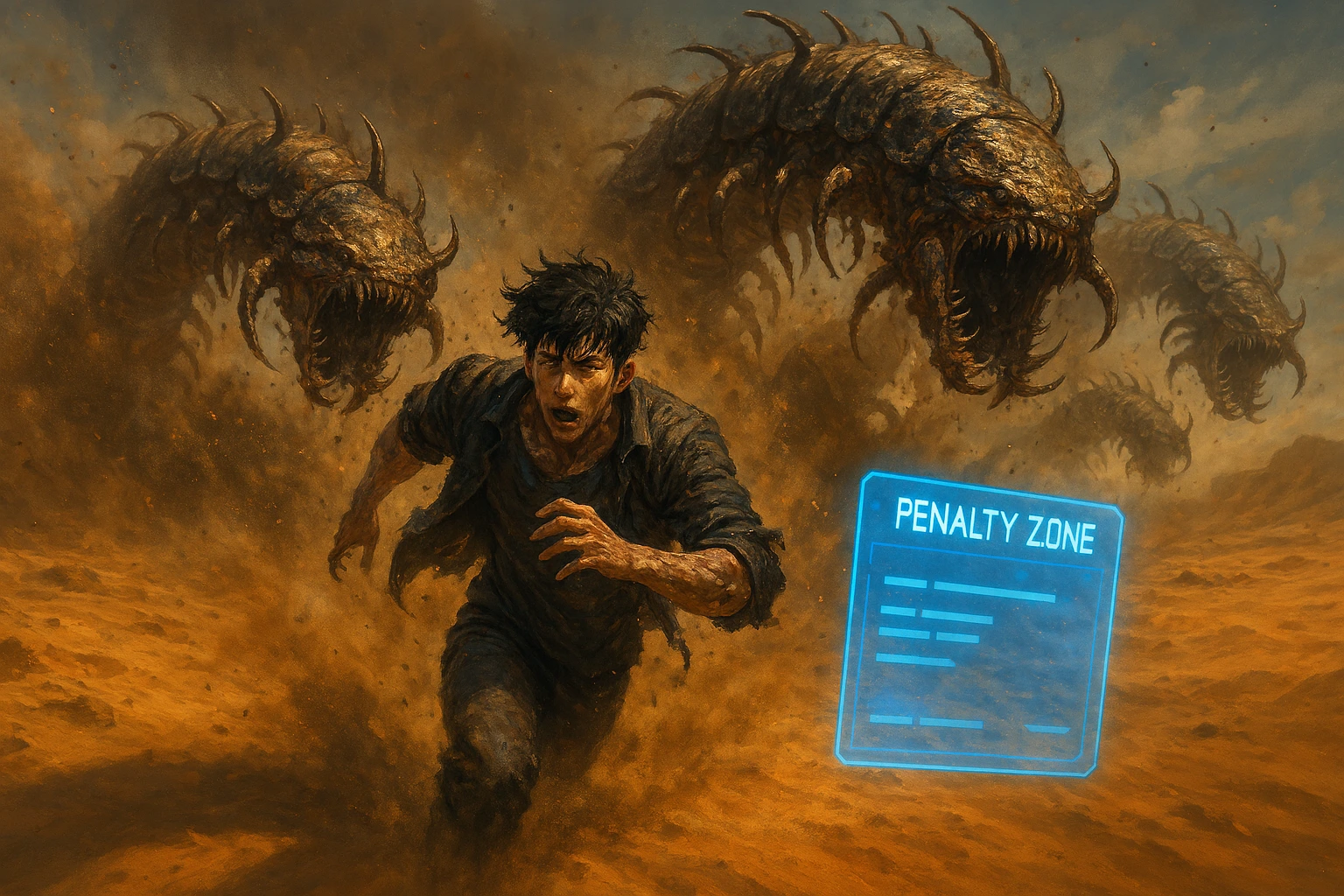
Consider the very first interaction Jin-woo has with the System: The Daily Quest. “Run 10km, 100 Push-ups, 100 Sit-ups, 100 Squats.” It sounds like a generic training montage setup (a nod to One Punch Man). But what happens if he fails?
He isn’t just scolded. He is transported to a “Penalty Zone”—a desert filled with giant centipedes where he must run for his life for hours.
This creates a Pavlovian response. Jin-woo doesn’t train because he wants to look good; he trains because he is terrified of the System’s punishment. The System essentially holds a gun to his head 24/7. This forces him to view the world through a lens of absolute pragmatism. He begins to view other humans as “NPCs” to some extent—not out of malice, but because they exist outside the System that controls his life. This isolation is critical to his character. He is playing a game that no one else can see, and the penalty for losing is death. This naturally separates him from normal human connection.
3. Motivation: Medical Bills vs. Saving the World
In the pantheon of Shonen and Seinen protagonists, motivation is the engine that drives the plot.
- Luffy wants freedom (Pirate King).
- Naruto wants acknowledgement (Hokage).
- Deku wants to be a symbol of peace.
- Asta wants to prove commoners can be strong.
What does Sung Jin-woo want? Money.
This is the most grounding, realistic, and “adult” aspect of his character. It completely separates him from the lofty, idealistic goals of his peers.
The Blue-Collar Hunter
At the beginning of the series, Jin-woo isn’t hunting monsters because he has a sense of justice. He isn’t hunting because he hates magic beasts. He is hunting because his mother is in a coma with “Eternal Slumber” disease, and the life support machines cost a fortune. He is hunting because his sister, Jin-ah, needs school fees and a future.
Jin-woo is a gig worker in the most dangerous industry on Earth. The dungeon is his office, and the monsters are the paperwork.
This financial desperation adds a layer of relatability that is often missing in Power Fantasies. When he gets the System and realizes he can grow stronger, his first thought isn’t, “I can rule the world.” His first thought is, “I can clear higher-rank dungeons and get paid more.”
The Burden of the Head of Household

This motivation dictates his behavior. It’s why he is pragmatic. It’s why he doesn’t hesitate to kill human enemies like Hwang Dong-soo. To Jin-woo, a threat to his life is a threat to his mother’s life support. If he dies, the checks stop coming, and his mother dies.
This raises the stakes significantly. He isn’t fighting for an abstract concept like “honor” or “glory.” He is fighting for the literal survival of his family unit. This makes him ruthless. When Hwang Dong-soo threatens him, Jin-woo doesn’t try to “talk no jutsu” him. He recognizes a predator and prepares to put it down.
Even when he becomes a multi-billionaire through the Ahjin Guild, note his lifestyle. He doesn’t buy a fleet of sports cars. He doesn’t buy a private island. He buys a safe apartment for his sister. He ensures his mother is cared for. He remains functionally modest. The money was never the end goal; it was the means to protect.
This practicality creates a barrier between him and the reader, which some mistake for a lack of personality. But it is actually the personality of a parent or a guardian. He doesn’t have time for the theatrics of a typical hero because he has bills to pay and people to protect.
4. The Philosophy of “Arise”: Empathy for the Dead
The defining ability of Sung Jin-woo is Shadow Extraction. On the surface, this is the ultimate “edgelord” power—necromancy. A dark army of slaves bound to his will. However, if we look closer, Shadow Extraction is the most empathetic ability in the series. It is not slavery; it is therapy.
Understanding the Regret
The mechanics of “Arise” are specific. To extract a shadow, particularly a strong one, Jin-woo often has to resonate with their “regret” or their lingering will. He cannot simply brute-force the command; he has to offer them something.
- Igris the Red: When Jin-woo extracts Igris, he doesn’t threaten him. He speaks to the empty throne. He acknowledges Igris’s chivalry. He basically says, “Your watch is not over. You died defending an empty seat. Come with me, and fight for a real cause.” He offered Igris purpose.
- Tank (Iron): He appealed to the beast’s instinct to be the alpha, to be part of the strongest pack.
- Beru: This is the most poignant. Beru was born to protect the Ant Queen. When the Queen died, Beru’s purpose vanished. He was a weapon without a wielder. Jin-woo didn’t just enslave him; he filled the void left by the Queen. He gave Beru a new King to serve, alleviating the despair of his failure.
The Shadow Family: Comedy in the Dark
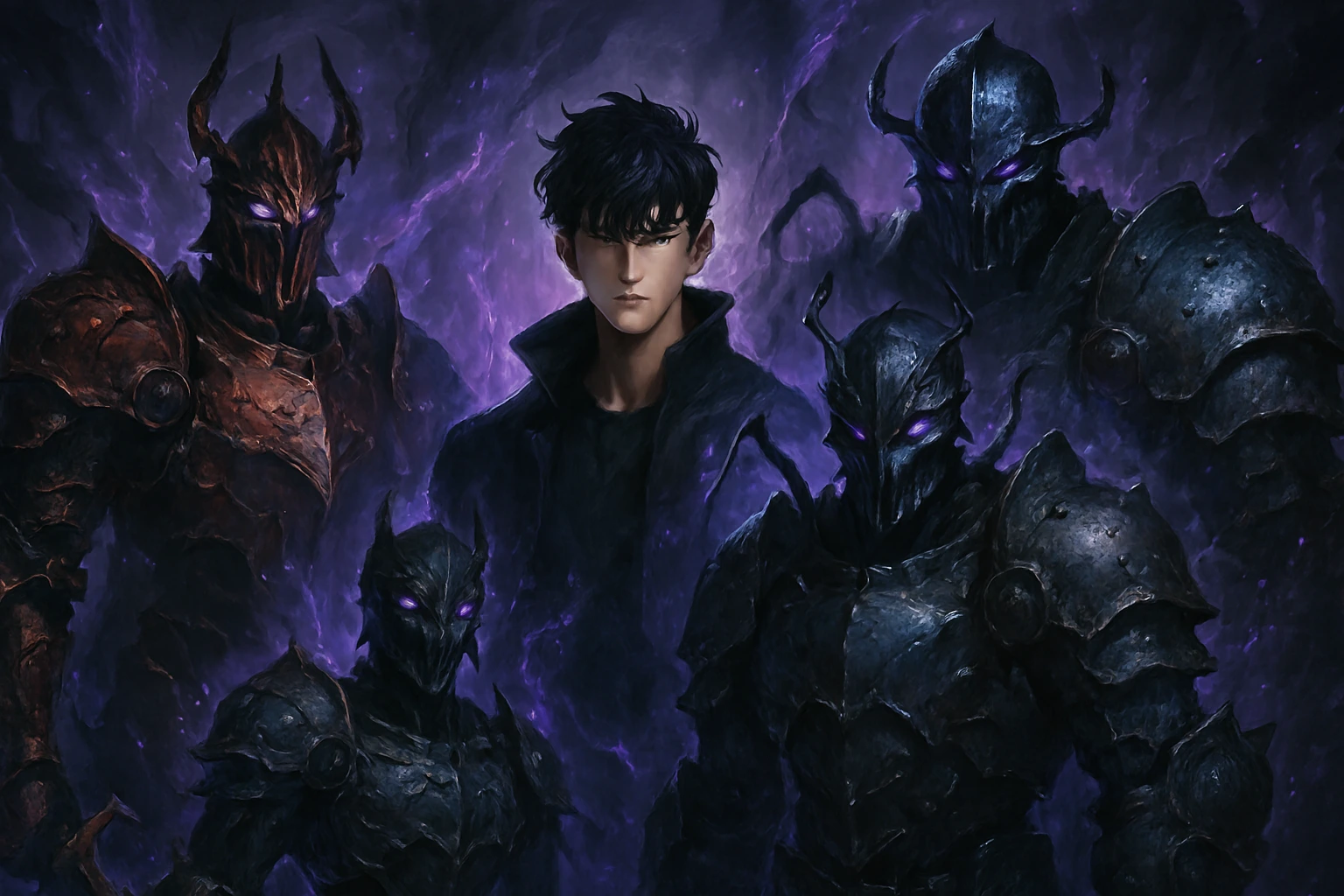
The way Jin-woo interacts with his shadows effectively kills the “emotionless” allegations. He treats them like family.
We see the comedic trio of Iron (the idiot), Igris (the serious student), and Tank. Later, Beru becomes the fan-favorite obsessed loyalist who watches historical dramas to learn how to speak like a courtier. Jin-woo chides them, educates them, and trusts them.
There is a warmth in these interactions that he rarely shows to living humans. Why? Because the Shadows understand him. They share his existence in the darkness. They know his power and his burden without him having to explain it.
Unlike generic necromancers in fiction who treat the undead as disposable tools (exploding them for damage or using them as meat shields), Jin-woo mourns them. When his shadows are destroyed permanently (which is rare but possible if his mana is depleted or the damage is absolute), he feels the loss.
This dynamic reveals that beneath the cold, S-Rank exterior, there is a man desperate for connection. He is lonely. As he ascends in power, he becomes further removed from humanity. The Shadows become the only ones who can walk beside him without dying. His “army” is actually his support group. He surrounds himself with loyalty because he has spent his life being discarded.
5. The Romance of Silence: Cha Hae-in
A critical, often overlooked aspect of Jin-woo’s character is his relationship with Cha Hae-in. Romance in Solo Leveling is sparse, but it is deeply significant.
Cha Hae-in is an S-Rank hunter with a unique condition: she is hyper-sensitive to the smell of mana. To her, other hunters smell terrible—like rotting corpses or sewage. The stronger the hunter, the worse the stench. This forces her to live in a state of constant sensory discomfort, always holding a handkerchief to her nose.
Then she meets Sung Jin-woo.
To her, Jin-woo smells like… nothing. Or rather, a pleasant fragrance. This is because Jin-woo is the host of the Shadow Monarch, a power that exists outside the normal mana system of the Rulers.
The Only Solace
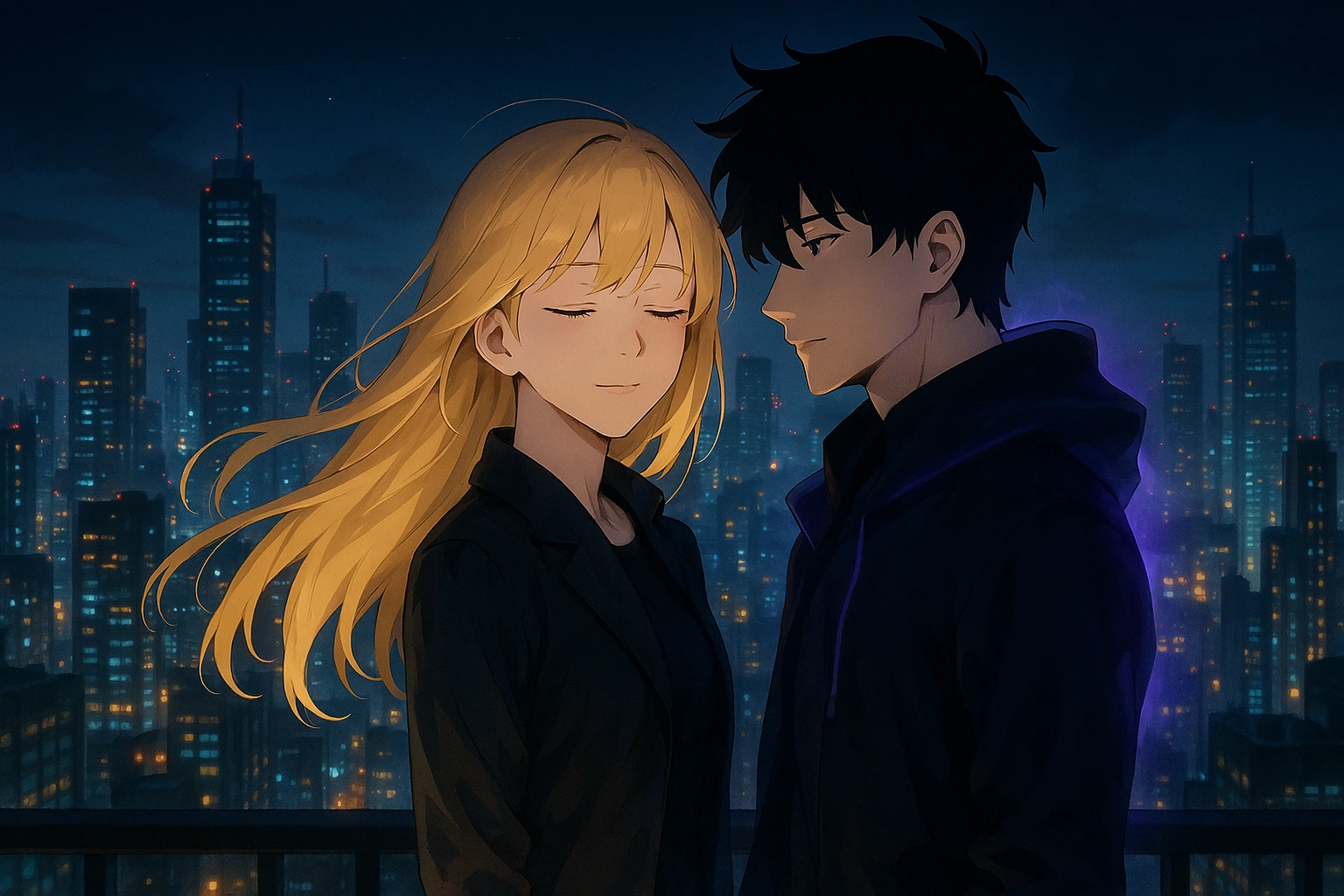
Why does this matter? It makes their connection inherent and biological rather than superficial. Cha Hae-in isn’t attracted to him just because he’s strong (she is strong herself). She is drawn to him because he is the only person in the world who gives her peace. Being near him is the only time she can breathe freely.
And for Jin-woo? Cha Hae-in is the only person who looks at him and sees the man, not the monster. While others are terrified of his shadows, she is curious. She literally dances her way into his shadow army during their spar.
Jin-woo’s rejection of other women and his quiet acceptance of Cha Hae-in reinforces his “Anti-Kirito” status. He doesn’t want a harem. He doesn’t want adoration. He wants peace. He wants someone who understands the silence. Their relationship is one of mutual respite in a chaotic world. It’s mature, understated, and incredibly telling of what Jin-woo values: comfort over passion.
6. Comparison: The “Power Fantasy” Trinity
To truly understand why Jin-woo is unique, we must place him in the context of his peers. We can categorize the modern Power Fantasy protagonists into a Trinity:
- The Wish Fulfillment (Kirito – SAO): Kirito represents the desire to be cool. He plays the game, wins the girls, and saves the day. His struggles are usually external (beating the boss). The narrative bends to make him look good.
- The Corruption (Ainz Ooal Gown – Overlord): Ainz represents the loss of humanity. As he gains power, he loses his moral compass. He becomes the monster. It is a tragedy of corruption.
- The Burden (Sung Jin-woo – Solo Leveling): Jin-woo represents the weight of power. He gains godhood, but he desperately tries to stay human.
Why He is the “Anti-Kirito”
Kirito thrives on recognition. He is the “Black Swordsman” known by all. Jin-woo thrives on anonymity. Throughout a massive portion of the series, he hides his power. He asks the Association to keep his rank secret. He wears a hood. He avoids interviews.
Kirito gathers a harem. Jin-woo actively ignores romantic advances. Ainz Ooal Gown accepts his role as a Supreme Being and looks down on humans. Jin-woo gains the power of the Shadow Monarch—a being that creates death—but uses it to protect life. He never refers to himself as a God. He refers to himself as a Hunter.
The crucial difference is that Jin-woo views his power as a job, not a status symbol. He is the “Adult in the Room.” When the S-Rank gate breaks open in Tokyo, or when the Monarchs descend, Jin-woo doesn’t give a speech about friendship. He shows up, assesses the situation, eliminates the threat, and leaves. He is efficient. He is competent. And that competence is far more compelling than empty bravado.
7. The Ending Choice: The Ultimate Sacrifice
The ending of Solo Leveling (the light novel and the true ending of the manhwa) is the final nail in the coffin of the “selfish power fantasy” argument. It is the moment Jin-woo ascends from a cool character to a tragic hero.
The Cup of Reincarnation
After defeating Antares, the Monarch of Destruction, and saving the world, Jin-woo is given a choice by the Rulers. He has won. He is the hero of humanity. He could stay in this timeline, be worshipped as a god, marry the girl, and live in luxury.
Instead, he asks to use the Cup of Reincarnation.
He chooses to turn back time by 10 years. He chooses to erase the timeline where the Dungeons existed. He chooses to erase the timeline where his father died, where his friends were traumatized, where millions of people were killed by monsters.
But the cost is total erasure of self.
By turning back time, nobody remembers him. Nobody remembers the sacrifices he made. To the world, Sung Jin-woo is just a random student, then a detective. He fights the Monarchs in the dimension gap for 27 years, alone. No cheers. No rewards. No leveling up notifications. Just war.
The 27-Year War
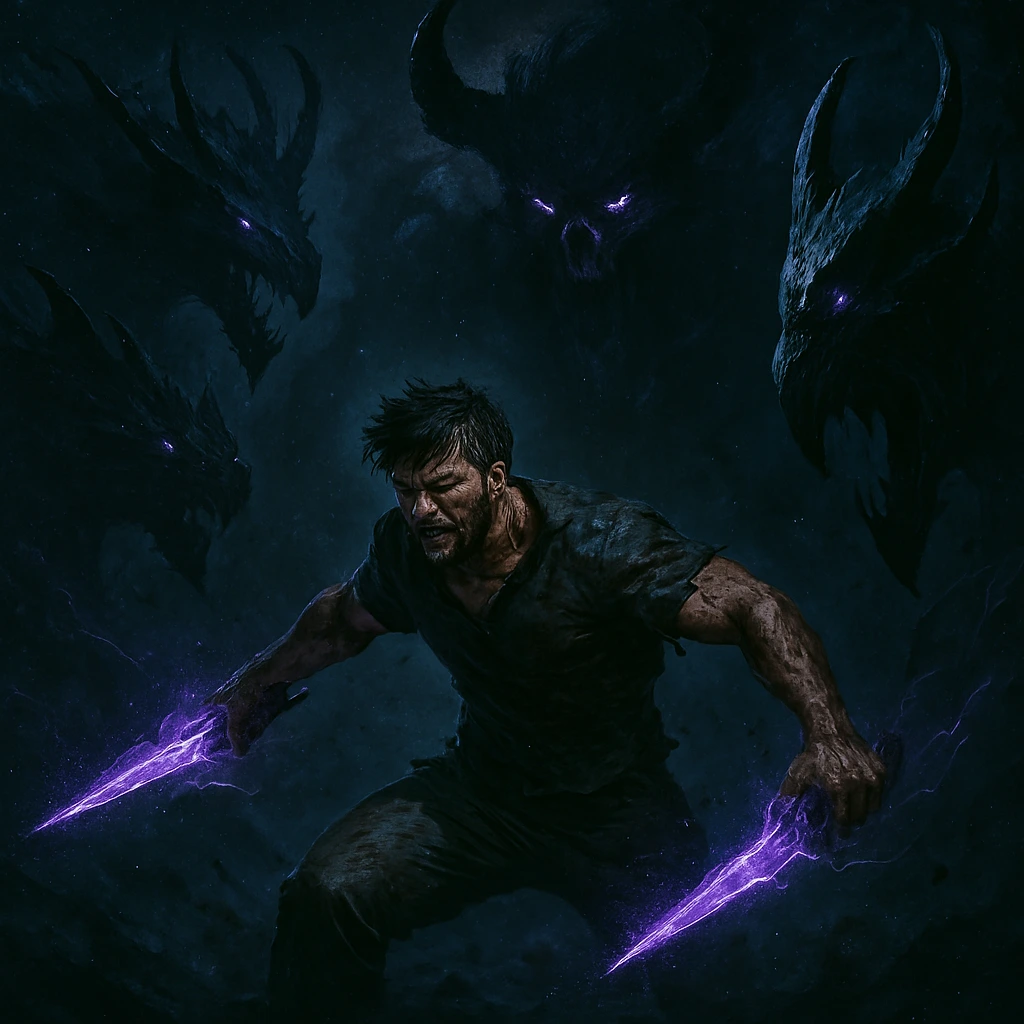
Think about the magnitude of this. Jin-woo spent 27 years fighting in a void, protecting a planet that didn’t know he existed. He grew a beard (in the side stories), he aged, he suffered, and he won. When he returned to Earth, he had to reintegrate as a middle schooler, holding the memories of a veteran war god.
A generic Power Fantasy MC would never do this. Why would they give up the fame? Why would they give up the “Level 99” status in the public eye?
Jin-woo does it because he realizes that a world that needs a hero is a broken world. He wants to give his family a world where Hunters don’t need to exist. He sacrifices his identity to save the innocent. He walks past the people he saved—people who will never know that he died for them a thousand times—and he is content with their ignorance. That is the purest form of heroism. It separates him from the “Edgelords” who act dark for attention. Jin-woo acts in the dark to serve the light.
This decision creates a profound sense of melancholy (Mono no Aware) at the end of the series. The reader knows what he did, but the world doesn’t. We carry the burden of his memory with him.
8. The “Dad Energy” and Ragnarok
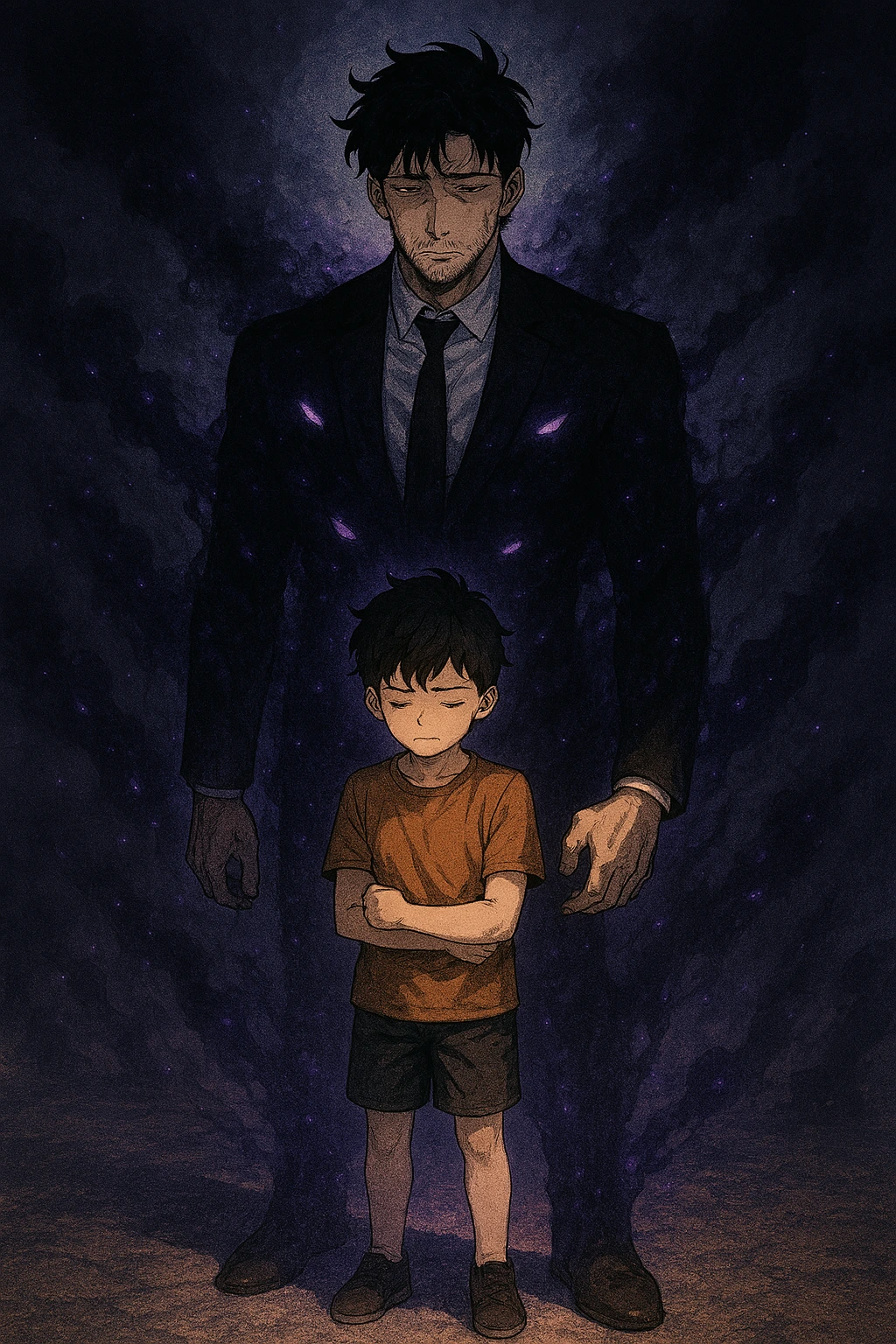
This character trajectory culminates in the sequel, Solo Leveling: Ragnarok. By this point, Jin-woo is literally a father (to Sung Su-ho).
The “Dad Energy” was always there. Even as a teenager, he was parenting his sister and mother. Now, as an actual father, we see his final form. He isn’t an adventurer seeking thrills; he is a tired god trying to ensure his son doesn’t have to suffer the way he did.
He seals Su-ho’s powers to give him a normal childhood. He creates a peaceful world so his son can play video games and go to university instead of fighting for his life in a Double Dungeon. He deliberately weakens his own son to protect his innocence.
This cements the thesis: Jin-woo’s journey was never about becoming the strongest for the sake of strength. It was about becoming strong enough to build a shelter. He is the wall that stands between the monsters and his family. He takes the blows so they don’t have to.
9. Conclusion: The King of Silence
Sung Jin-woo is not a character written to be “fun” like Luffy. He is not written to be “relatable” in a high-school sense like Deku. He is written to be Competent.
In a world full of screaming characters, hysterical villains, and incompetent bureaucrats, Jin-woo is the silence that follows the thunder. He represents the transition from boyhood to manhood—the realization that the world is cruel, and that sometimes, the only way to protect what you love is to become a monster yourself, but a monster with a leash.
He is the Anti-Kirito because he rejects the narrative of the hero. He doesn’t want the spotlight. He wears black not to look cool, but to mourn the boy he used to be—the weak E-Ranker who used to smile.
The next time someone calls Sung Jin-woo an “Edgelord with no personality,” remind them of the choice he made. Remind them that he saved 7 billion people and asked for zero credit. Remind them that he is the God who chose to be forgotten.
And perhaps, in that silence, we find the loudest statement of character in modern anime history.