
In the world of Solo Leveling, strength is absolute. It is a universe rigorously defined by ranks, mana levels, and the brutal, unyielding hierarchy where the weak exist solely to serve the strong. We are introduced to gods who can shatter islands with a gesture, Monarchs who can freeze entire oceans, and a protagonist who eventually commands the army of the dead. Yet, sitting atop the hierarchy of the Korean Hunter Association—the governing body of this chaos—was not a young, vibrant warrior in his prime, nor a mage bristling with visible destructive energy.
It was an old man. A man whose skin was as thin as parchment, whose breath often wheezed through tired lungs, and whose office smelled faintly of sterile medical equipment rather than the sharp ozone of magic.
His name was Go Gun-Hee. To the public, he was the Chairman, the bureaucratic head of South Korea’s hunters, a figurehead of administration and policy. But to those with the eyes to see—to the arrogant S-Rank hunters and the ancient, malevolent entities watching from the shadows—he was something far more terrifying. He was a Titan trapped in a cage of bone and flesh that was rapidly crumbling. He was the “Sky” of Korea, a man who possessed the power to level cities but could not throw a single punch without risking his own immediate death.
This is the tragedy of Go Gun-Hee: The God in a Dying Body. This is the story of why the strongest man in Korea never fought, until the very moment he had to die.
1. Introduction: The Old Man on the Throne
The first time we see Go Gun-Hee, the visual language of the story tells us two contradictory things simultaneously, creating a dissonance that immediately captures the reader. On one hand, we see the undeniable trappings of weakness: the rhythmic beeping of the heart monitor, the weary posture of a man burdened by gravity, and the heavy sighs of a leader carrying the weight of a nation on failing shoulders. He is a man who seemingly belongs in a hospital bed, not a throne room.
But then, we see the reaction of others.
In a world where S-Rank hunters are essentially walking nuclear warheads—beings of immense ego, pride, and unchecked power—figures like Baek Yoon-Ho (the Guild Master of White Tiger) and Choi Jong-In (the Ultimate Soldier) display an uncharacteristic, almost instinctual deference toward the Chairman. This goes far beyond simple professional respect for a government official. In the ecosystem of hunters, the weak do not command the strong; the sheep do not lead the wolves. If Go Gun-Hee were merely a politician, the S-Ranks would tolerate him, manipulate him, or perhaps even ignore him. Instead, they fear him.
The Paradox of Power
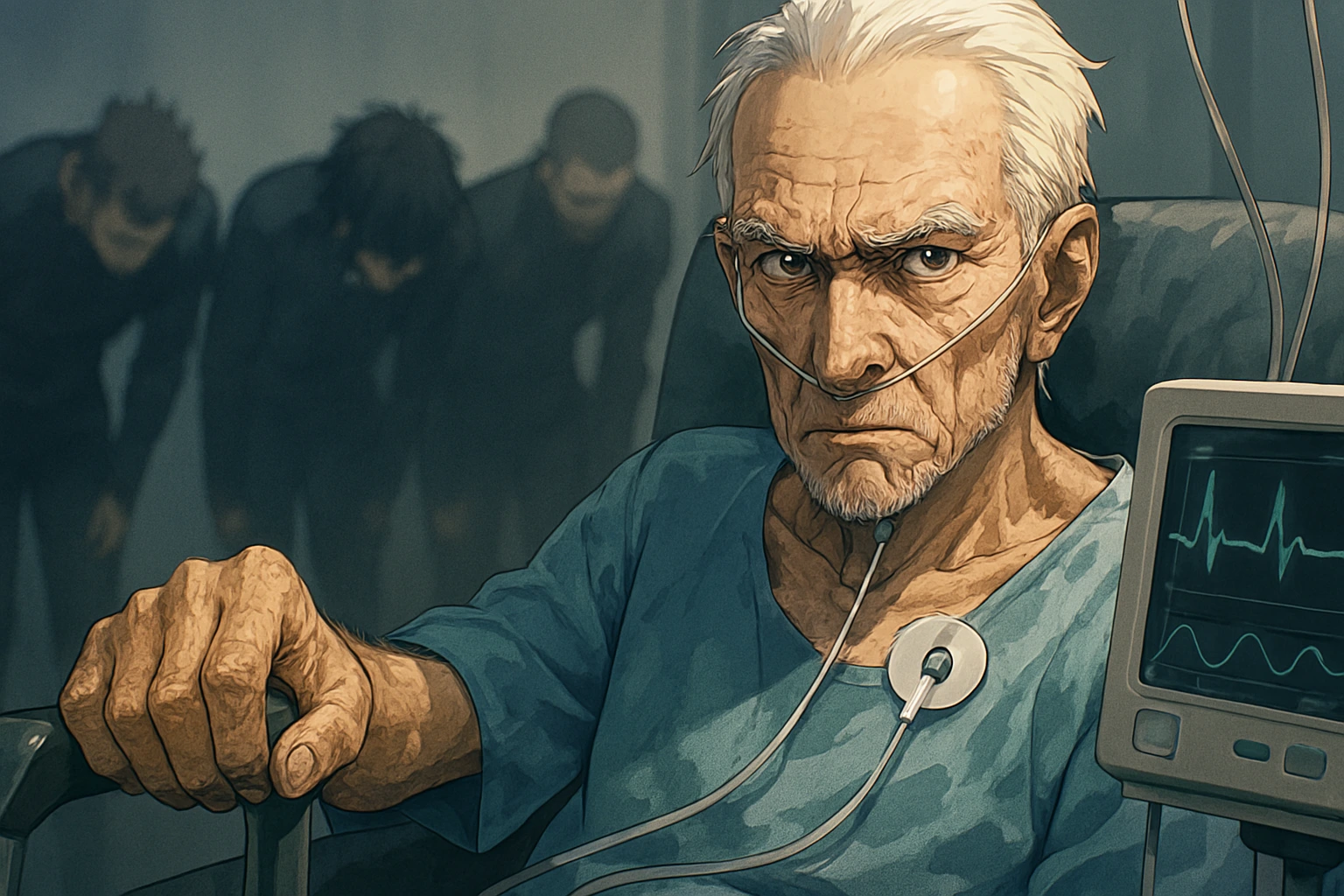
Why was the head of the Hunter Association a man who couldn’t even run a mile? This paradox is the core of his character design. Typically in shonen or power-fantasy manhwa, the “old master” is secretly fit, ripping off his shirt to reveal muscles of steel (like Isaac Netero from Hunter x Hunter or Master Roshi). Go Gun-Hee subverts this trope entirely. He does not hide a healthy body beneath a facade; his frailty is genuine, agonizing, and fatal.
He represents a terrifying “What If?” scenario that haunts the narrative. What if Superman had the failing heart of an 80-year-old cardiac patient? What if the power of a biblical god was poured into a vessel that was already cracked and leaking? It forces us to question the nature of power itself—is it a blessing to hold the power of a star if your body burns every time you touch it?
The Aura of the Dormant Dragon
Even without lifting a finger, Go Gun-Hee emitted a pressure—a “Presence”—that silenced rooms and made the air taste metallic. When he spoke, the atmosphere grew heavy, pressing down on the shoulders of those present. This wasn’t just charisma or political influence; it was the biological reaction of apex predators recognizing a grander, more dangerous entity, even if that entity was wounded.
When he sat in his office, looking out over the Seoul skyline, he wasn’t just an administrator pushing papers. He was a dam holding back a flood. The S-Rank hunters sensed that inside this fragile shell lay a dormant catastrophe. They bowed not to the man’s physical body, but to the colossal spirit and the ocean of mana that dwelled within it. They bowed because they knew that if the “Old Man” ever truly decided to stand up, the consequences would be cataclysmic—mostly for himself, but also for anyone foolish enough to be standing in his way.
This creates an immediate narrative hook: We are desperate to see him fight. We want to see the dam break. But the tragedy is that we also know the cost. We know that for Go Gun-Hee, fighting isn’t just an action; it is a suicide mission.
2. The Curse of the Brilliant Light
To understand the depth of Go Gun-Hee’s suffering, we must peel back the layers of Solo Leveling’s cosmology. He was not just a powerful Awakened human; he was a “Ruler’s Vessel.” And not just any vessel—he was the host for the “Brightest Fragment of Luminosity,” the leader of the Rulers, the most powerful of the angelic beings.
In the lore of Solo Leveling, the Rulers are spiritual beings who fought against the Monarchs to protect the world. Because they lack physical forms in the human dimension, they must borrow the bodies of humans to manifest their will. This possession grants the human host immense, god-like power, elevating them far above the realm of standard hunters.
The Tragedy of the Vessel
We see other vessels in the series, most notably Thomas Andre (The Goliath) and Christopher Reed. These men were physical specimens—hulking giants or prime warriors capable of channeling the Rulers’ power without instantly combusting. Thomas Andre, for instance, could cloak himself in golden, spiritual armor and trade blows with a Monarch because his physical constitution was durable enough to act as a conduit. His body was a fortress built to hold the divine.
Go Gun-Hee did not have that luxury.
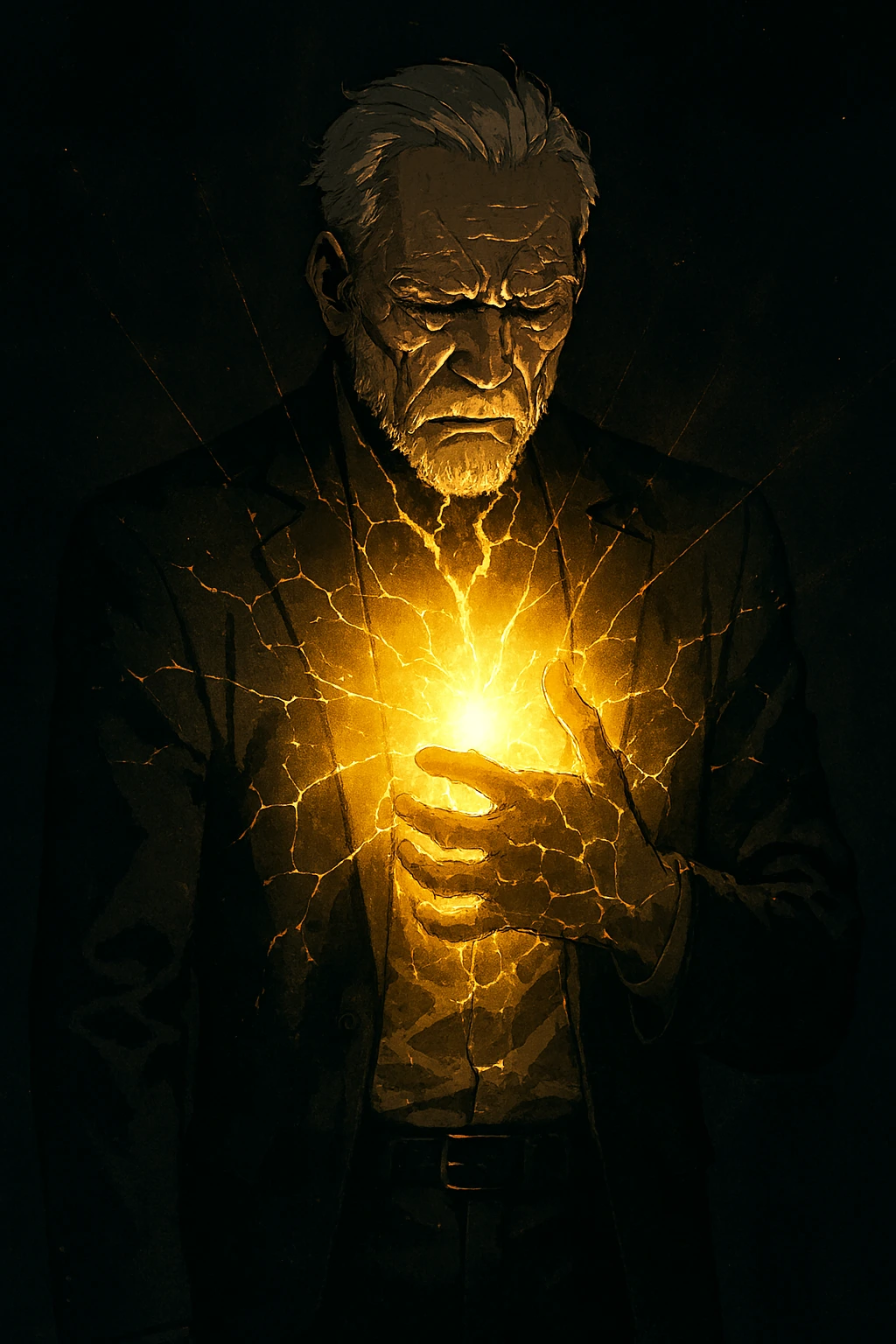
By the time the Awakening happened and the Ruler chose him, Go Gun-Hee was already well past his prime. The power of the “Brightest Fragment” is arguably the greatest among the Rulers—it is a star-like energy, vast, holy, and overwhelming. Putting that level of cosmic energy into the deteriorating body of an elderly man is, metaphorically speaking, like trying to power a space shuttle with a AA battery, or installing a nuclear reactor inside a cardboard box. The mismatch between the fuel and the engine was catastrophic.
The Cracked Heart
The series implies a cruel limitation: Go Gun-Hee’s heart. The heart is often seen as the mana core in hunter physiology, the engine that pumps magic through the veins. For the Chairman, his heart was his ticking clock. Every time he flared his mana, every time he exerted his will, his heart strained under the pressure of the Brilliant Light, threatening to burst.
This paints a picture of constant, agonizing restraint. Imagine having the strength to crush coal into diamonds in your hand, but knowing that if you squeeze, your own bones will shatter first. Go Gun-Hee lived in a state of perpetual “holding back.” He had to navigate a world of violence and monsters while walking on eggshells inside his own skin. He possessed the ultimate sword, but he could never unsheathe it without cutting his own throat.
The Psychological Burden
This physical limitation created a profound psychological burden that weighed on him more than his age. Go Gun-Hee possessed the will to save everyone. He had the spirit of a true guardian. He saw the gates opening, the monsters slaughtering civilians, and he had the power to stop it—but he couldn’t use it.
If he fought a B-Rank gate, he might survive with medical attention. If he fought an S-Rank gate, he would die after one attack. This forced him into the role of the administrator. He had to save Korea through politics, funding, and guild management because he could not save it with his fists. His desk job wasn’t a choice of career; it was a prison sentence mandated by his own biology. He watched young hunters die while sitting in his high tower, burning with a holy light he dared not release, a silent observer to tragedies he had the theoretical power to prevent.
3. The Father Figure: Jin-Woo’s True Mentor
Sung Jin-Woo’s biological father, Sung Il-Hwan, was absent for most of his life, trapped inside a dungeon fighting a war no one knew about. While Il-Hwan loved his son, he could not raise him during his formative years as a hunter. This void was filled, quietly and steadily, by Go Gun-Hee.
The relationship between the Shadow Monarch and the Chairman is the emotional backbone of the series’ second half. It is a relationship built on mutual recognition—game recognizes game, and a king recognizes a king.
The Recruitment Pitch
When Go Gun-Hee first realizes Sung Jin-Woo’s potential (after the re-evaluation reveals him as an S-Rank), his approach is markedly different from the other guilds. The Hunters Guild and Fame Guild offered astronomical sums of money. The White Tiger Guild offered connections and fame. They saw Jin-Woo as a commodity, a weapon to be leased.
Go Gun-Hee offered responsibility.
He brought Jin-Woo to his office and showed him the empty chair of the S-Rank hunter who had defected to the United States. He didn’t say, “Join us and you’ll be rich.” He said, “Korea needs a guardian.” He appealed to Jin-Woo’s morality, not his greed. Although Jin-Woo initially refused the offer to join the Association directly, this interaction planted a seed of immense respect. Jin-Woo realized that unlike the corporate guild masters who saw hunters as assets on a spreadsheet, Go Gun-Hee saw hunters as the shield of humanity.
The Arm Wrestling Match
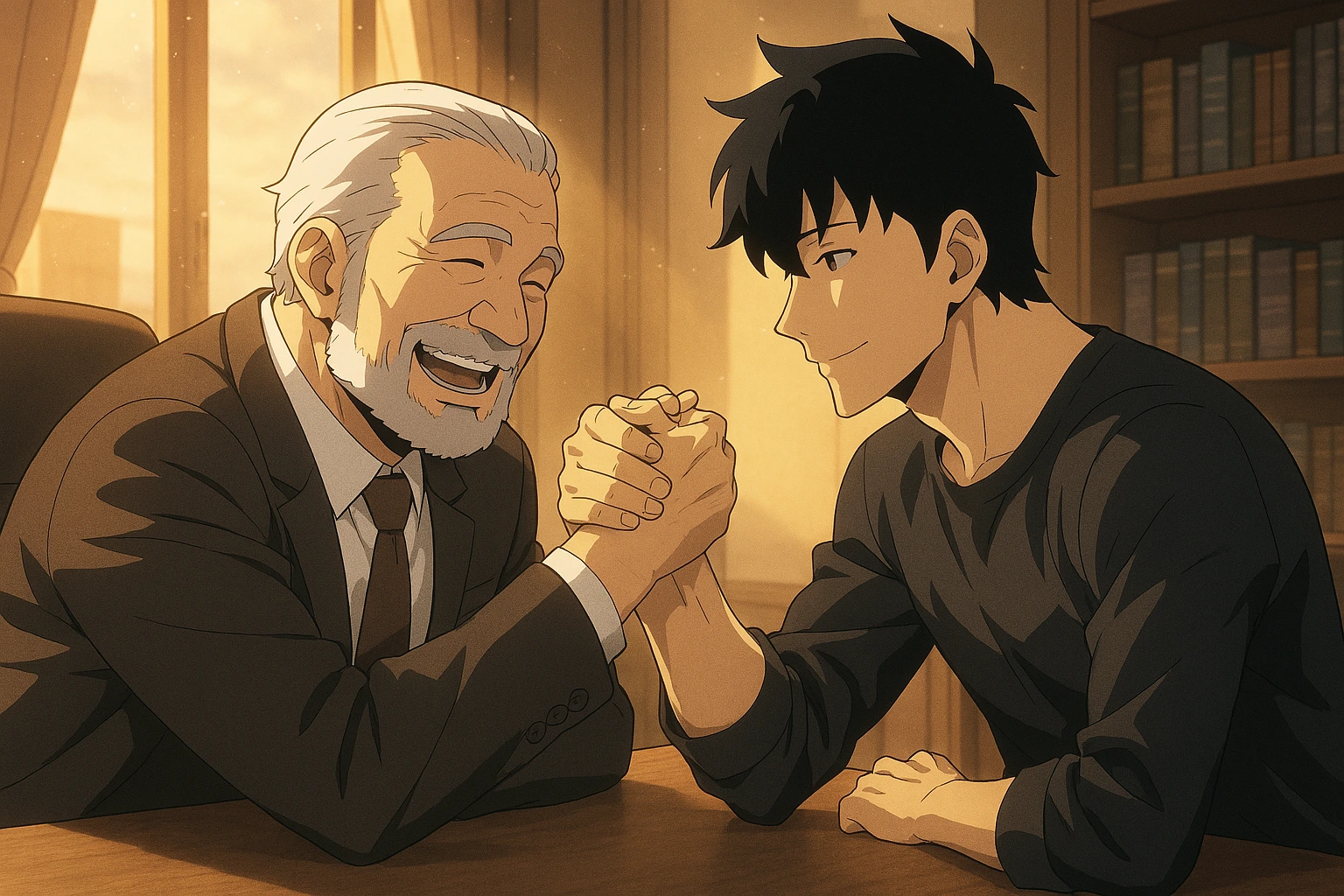
One of the most heartwarming and crucial scenes in the manhwa is the arm-wrestling match. It seems like a casual test, a bit of old-fashioned bonding, but the subtext is heavy with meaning. Go Gun-Hee wants to gauge the young hunter, but he also wants to feel, just for a moment, the thrill of competition against an equal.
When they lock hands, the look in Go Gun-Hee’s eyes changes. For a split second, the “Old Man” vanishes, and the “Ruler’s Vessel” peeks through. The air in the room vibrates. He pushes. Jin-Woo holds. In that grip, a silent conversation happens that words could not capture. Go Gun-Hee realizes that the torch can finally be passed. He realizes he doesn’t have to hold up the sky alone anymore.
The smile Go Gun-Hee gives after losing isn’t one of defeat; it is one of profound relief. He has found his successor. He has found the one person who can carry the burden that was crushing him.
Unwavering Trust
Following this, Go Gun-Hee becomes Jin-Woo’s greatest political shield. When Jin-Woo acts suspiciously, disappears into dungeons, or reveals powers that terrify the world (like the shadow soldiers), the Association is flooded with questions from the government and international bodies.
Go Gun-Hee blocks them all. He allows Jin-Woo to operate with unprecedented autonomy. Why? Because he saw the “future” in Jin-Woo. He recognized that Jin-Woo was fighting a war that the rest of the world didn’t understand yet.
He treated Jin-Woo not as a subordinate, but as a son. He protected him from the media vultures and the government oversight committees. He gave the young Monarch the space to grow, effectively watering the tree that would eventually save the world. In many ways, Go Gun-Hee was the gardener who tended to the Shadow Monarch, ensuring he wasn’t cut down before he could bloom.
4. The Final Stand: The Frost Monarch’s Ambush
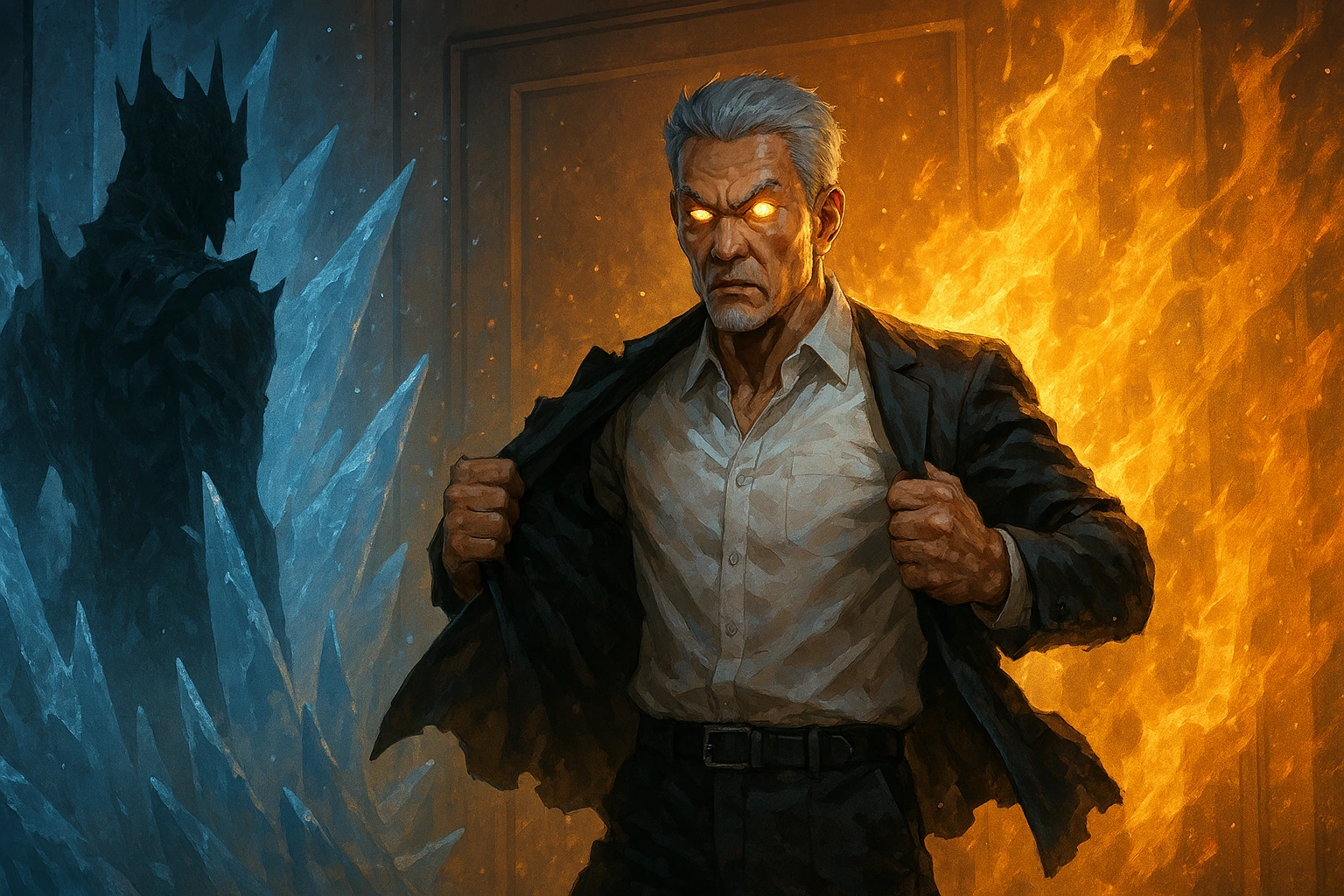
The tragedy of Go Gun-Hee culminates in his final night. The atmosphere of this scene is a masterpiece of tension and horror. It begins with silence. The electronic hum of the office fades. The temperature drops—unnaturally, lethally, turning the moisture in the air into razor-sharp crystals.
The Frost Monarch (the Sovereign of Frost) arrives.
This is not a dungeon break or a random monster attack. This is an assassination. The Monarchs have realized that the Brilliant Light is weak, trapped in a dying vessel, and they have come to snuff it out before it can find a new host or fully awaken. They are predators circling a wounded lion.
The Choice to Lock the Door
When the Frost Monarch appears, Go Gun-Hee has options. He could try to flee. He could trigger an alarm and hope for backup, though no ordinary hunter could stand against a Monarch.
Instead, Go Gun-Hee casts a barrier. He locks the door.
“I will not let you pass.”
This decision is the defining moment of his life. He knows he cannot win. He knows his heart will explode if he fights. But he also knows that if the Frost Monarch is here, the Shadow Monarch (Jin-Woo) is likely a target too, or that the world is in imminent danger. He chooses to fight not to survive, but to buy time. He fights to create a disturbance in the mana flow violent enough that Sung Jin-Woo will sense it. He sacrifices his remaining life minutes to buy seconds for the world.
The Battle of Fire and Ice
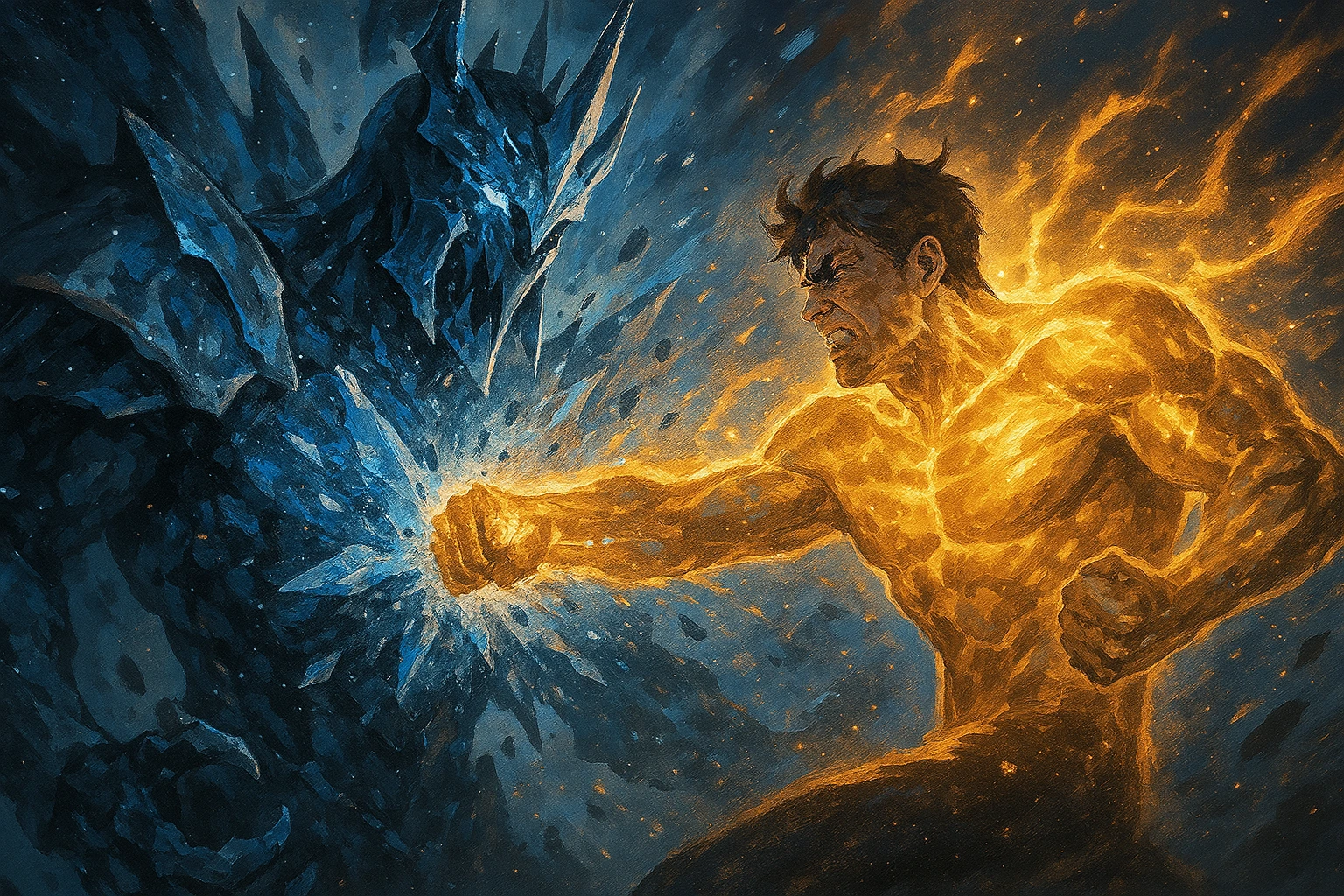
The fight that follows is short, brutal, and blindingly majestic. For the first time, we see the Chairman unleash the restraint he has held for years.
- Phase 1: The Awakening. Go Gun-Hee channels the full power of the Brilliant Light. His frail body is bathed in golden, holy energy. Muscles that have atrophied with age are suddenly surged with divine power. He moves with a speed that belies his years, catching the Frost Monarch off guard. The office transforms into a battlefield of extremes—the absolute zero of the Monarch clashing against the burning sun of the Ruler.
- Phase 2: The Reality. The Frost Monarch is initially shocked. He mocks Go Gun-Hee, calling him a broken vessel. But as the fight progresses, the Monarch feels genuine fear. He realizes that even in this crumbled state, the Ruler’s power is potent enough to threaten him. Go Gun-Hee manages to grab the Monarch, grappling him with strength that cracks the floor of the skyscraper.
The imagery is poignant: burning gold against freezing blue. It is the last flare of a dying star. Go Gun-Hee pours his very life force into his fists. He ignores the tearing of his muscles and the screaming of his heart. He fights with the desperation of a man who knows this is his curtain call.
He lands hits. He forces a literal Monarch—a being who rivals gods—to take a step back. It is a testament to how absurdly powerful Go Gun-Hee would have been in his prime. If he had been twenty years younger, the Frost Monarch might not have left that room alive.
But time is the one enemy he cannot defeat. The biology of a human octogenarian cannot sustain the output of a god.
5. The Death of a Hero
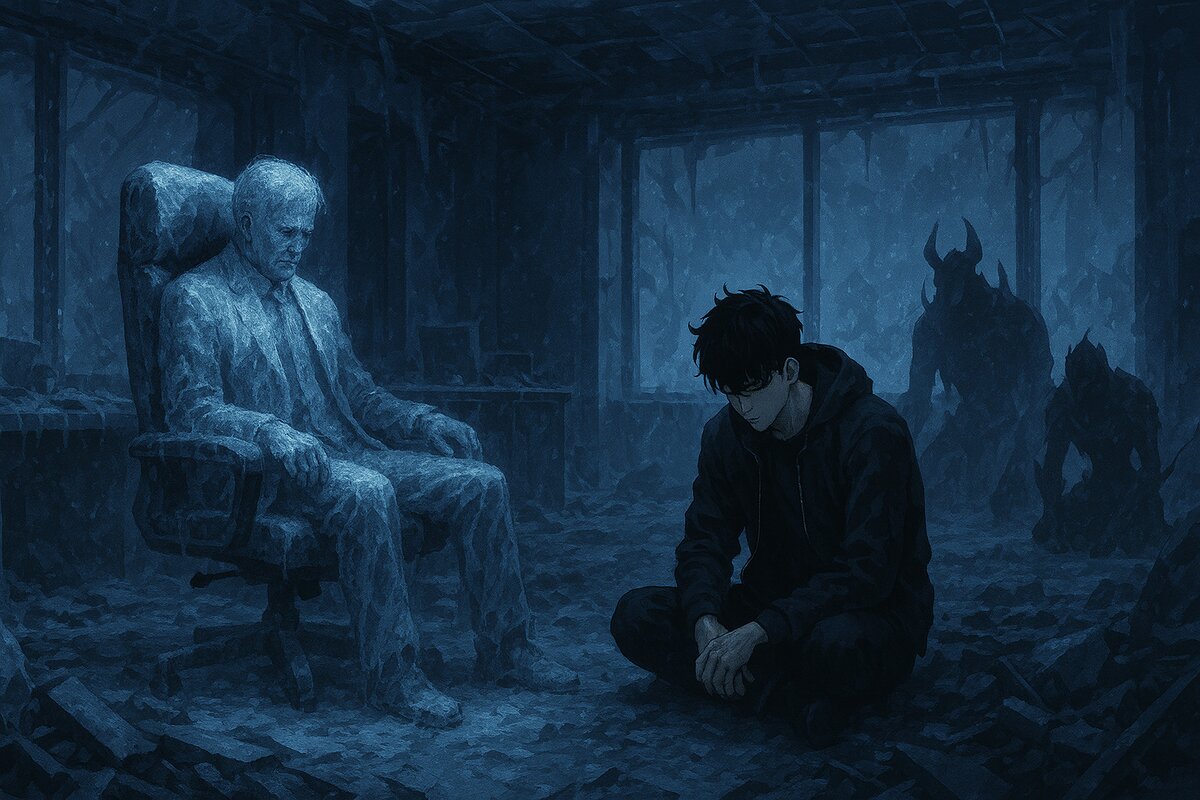
The climax of the battle is not a triumph, but a quiet, devastating end. The body gives out before the spirit does. His heart finally fails. The Frost Monarch exploits the opening. An icicle, sharp and cruel, pierces the Chairman’s chest.
It creates a terrifying silence. The golden light flickers and dies. The heat vanishes, replaced by the biting cold of the Frost Monarch’s mana. The Sky of Korea falls back into his chair, a king dying on his throne.
Jin-Woo’s Arrival: Seconds Too Late
Sung Jin-Woo arrives via Shadow Exchange, sensing the massive fluctuation of mana. But he is seconds too late. He steps into the office to find the room destroyed, frozen over, and the Chairman slumped in his chair, a hole in his chest.
This moment is pivotal for Jin-Woo’s character arc. Throughout the series, Jin-Woo becomes progressively more detached, more “monstrous” as he ascends to Monarch hood. He views death as a mechanic—something to be reversed via Shadow Extraction. He has become desensitized to loss.
But here, looking at Go Gun-Hee, Jin-Woo breaks.
The Rage of the Shadow Monarch
We see a flare of unadulterated rage. Jin-Woo’s mana explodes, shaking the building, cracking the windows. The shadows writhe in sympathy with their master’s fury. This isn’t the calculated anger of a hunter who lost loot; this is the raw grief of a son who lost a father. He chases the Frost Monarch, but the assassin escapes into a gate.
Jin-Woo returns to the body. The system prompts him. He could do it. He could say “Arise.”
He could bring Go Gun-Hee back. He could save his knowledge, his power, and his presence. A Shadow Go Gun-Hee would be an S-Rank soldier, loyal forever. It would be efficient. It would be practical. It would make his army unstoppable.
The Ultimate Respect
But Jin-Woo refuses.
He looks at the man who spent his final years in pain, holding up the weight of a nation with a crumbling body. He realizes that bringing him back as a shadow would be a curse, not a blessing. It would force him to fight forever, denying him the rest he earned a thousand times over.
“Rest now, Chairman. You’ve fought enough.”
Jin-Woo chooses to let Go Gun-Hee die permanently. He prioritizes the old man’s peace over his own gain. This decision cements the bond between them. It acknowledges that Go Gun-Hee was not a tool to be used, but a hero to be honored. The silence in the room as Jin-Woo sits by the body is louder than any battle cry. It is the moment the “Sky” of Korea finally fell, and the Shadow Monarch took up the burden of holding up the heavens in his place.
6. The Legacy of the Chairman
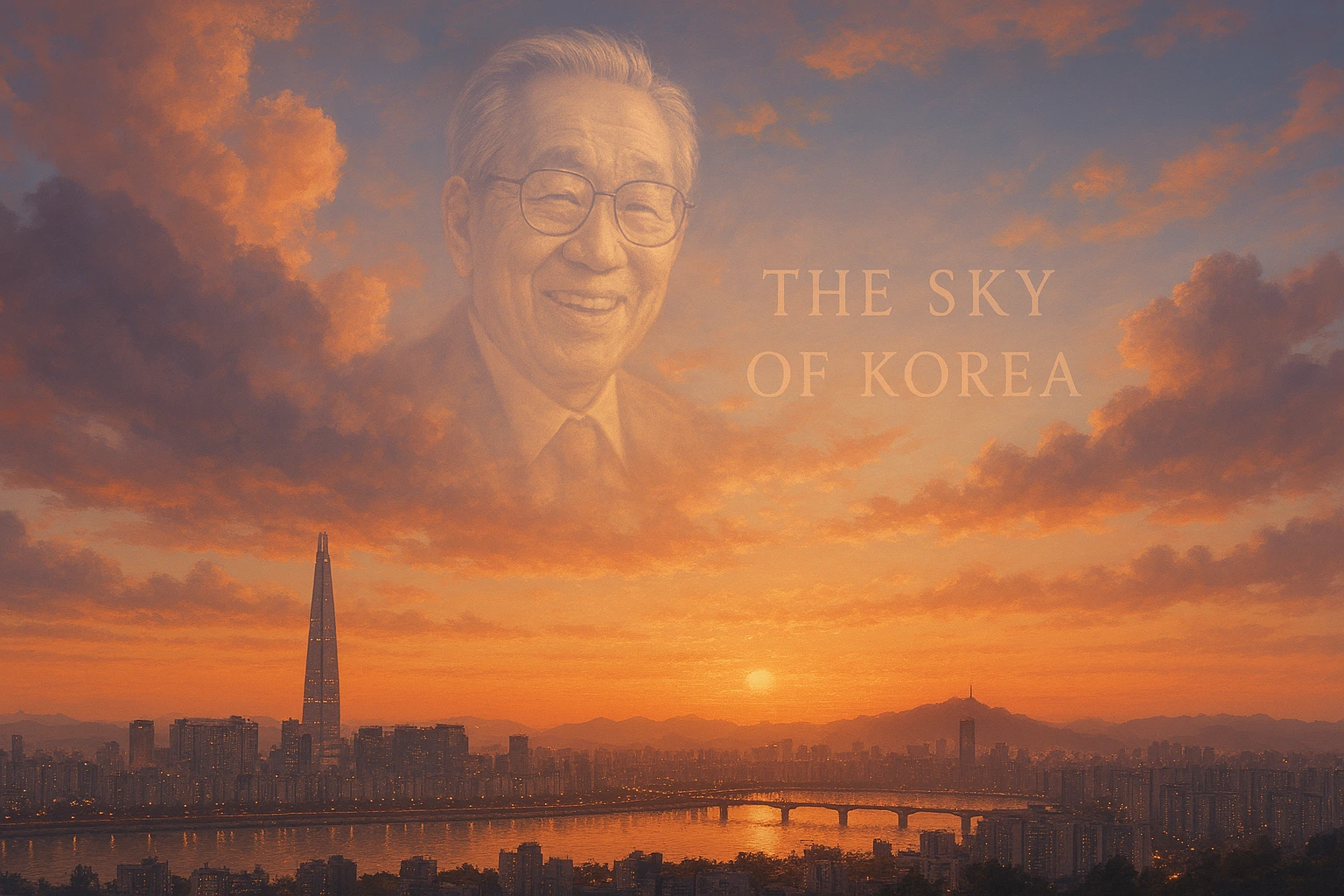
Go Gun-Hee’s death sends shockwaves through the world. The impact is immediate and destabilizing.
The Void Left Behind
With the Chairman gone, the Korean Hunter Association begins to crack. We see Woo Jin-Cheol, his loyal subordinate, struggle to fill those massive shoes. It becomes apparent that Go Gun-Hee’s “soft power”—his diplomatic connections and the respect he commanded—was the only thing keeping the chaotic world of hunters in check. Without the old lion, the hyenas begin to circle.
Hunters from around the globe fly in for the funeral. Thomas Andre, the Goliath, pays his respects, standing in the rain with a solemn expression. The scene highlights that Go Gun-Hee was respected not just as a Korean leader, but as a global pillar of the hunter community.
The Catalyst for the End Game
His death serves as the catalyst for the final war. It removes the safety net. Jin-Woo realizes there are no more adults in the room to handle the politics. The Monarchs are making their move. The war is no longer in the shadows; it is at the front door. Go Gun-Hee’s sacrifice forces Jin-Woo to stop hiding and fully embrace his role as the planet’s defender.
The Timeline Reset: A Happy Ending
However, the true beauty of Go Gun-Hee’s legacy comes at the very end of the series, after Jin-Woo uses the Cup of Reincarnation to rewind time and defeat the Monarchs in the dimensional rift.
In the new timeline, there are no gates. There are no hunters. There is no mana tearing apart bodies.
We see a brief, beautiful glimpse of Go Gun-Hee. He is alive. He is healthy. He is no longer the Chairman of the Hunter Association because such an organization doesn’t need to exist. He is likely a successful businessman or a politician, living out his twilight years in peace, free from the burden of the Brilliant Light.
Jin-Woo watches him from afar. He doesn’t approach him. He doesn’t introduce himself. He just watches, confirming that the old man is happy. This is Jin-Woo’s “Thank You.” The greatest gift the Shadow Monarch gave his mentor was a life where he never had to be a hero. A life where he could just be an old man, enjoying the sun, his heart beating steadily and painlessly in his chest.
7. Conclusion: The Strongest Will
In analyzing the pantheon of Solo Leveling characters, it is easy to get lost in the stats. We count the shadows, measure the mana, and rank the hunters by destruction capability. By those metrics, Go Gun-Hee was a “failure”—a vessel that broke before it could be used.
But Solo Leveling is also a story about will.
Go Gun-Hee proved that strength isn’t just about the durability of the vessel; it is about the integrity of the spirit. Other vessels, like Thomas Andre, fought for pride. Christopher Reed fought for survival. Go Gun-Hee fought for altruism.
He sat on a throne of needles for years, enduring physical agony to ensure his country didn’t fall into chaos. He mentored the next generation when he could have easily become bitter about his own bad luck. And when death kicked down his door, he didn’t beg. He stood up, straightened his suit, and threw a punch that carried the weight of a star.
He was the God in a Dying Body. A man who was physically broken but spiritually invincible.
In the end, Go Gun-Hee was the definition of a true Hunter. He didn’t hunt monsters for money. He didn’t hunt for fame. He hunted the encroaching darkness to protect the light of the future. And even though his heart stopped beating in that frozen office, the fire he ignited in Sung Jin-Woo burned bright enough to save the world.