
Introduction
The Bloody Foundation of Peace To understand the intricate, fractured world of My Hero Academia, one must look beyond the blinding smiles of the top-ranking heroes and peer into the abyssal shadows that allowed those smiles to exist. In this context, Kaina Tsutsumi, universally known as Lady Nagant, is not merely a rogue sniper or a compelling antagonist.
She is the darkest, most closely guarded secret of the Hero Public Safety Commission (HPSC)—the literal blood on the hands of Hero Society. For decades, the public believed that the “Symbol of Peace,” All Might, single-handedly maintained order through his overwhelming power and unwavering morality. However, peace is rarely built on sheer charisma alone.
It is built on a bloody foundation of preemptive strikes, silenced dissent, and buried bodies. Lady Nagant was the architect of this foundation, a government-sanctioned executioner who ensured that the pristine image of Hero Society remained untarnished by permanently erasing its stains before they could ever reach the public eye.
The Fall of an Idealist The tragedy of Lady Nagant lies in her origins; she was not born a remorseless killer, but rather a hopeful, starry-eyed young girl who genuinely believed in the inherent goodness of the hero system. Her trajectory from an idealist who wanted nothing more than to protect the innocent, to the government’s personal wet-work operative, and finally, to a cynical inmate of Tartarus, is one of the most compelling arcs in modern anime and manga.
She represents the death of innocence in a system that demands moral compromise. When the HPSC recognized her lethal potential, they did not nurture a savior; they forged a weapon. Her fall was not a sudden plunge into villainy, but a slow, agonizing descent into madness, driven by the realization that the justice she served was nothing more than a carefully curated illusion.
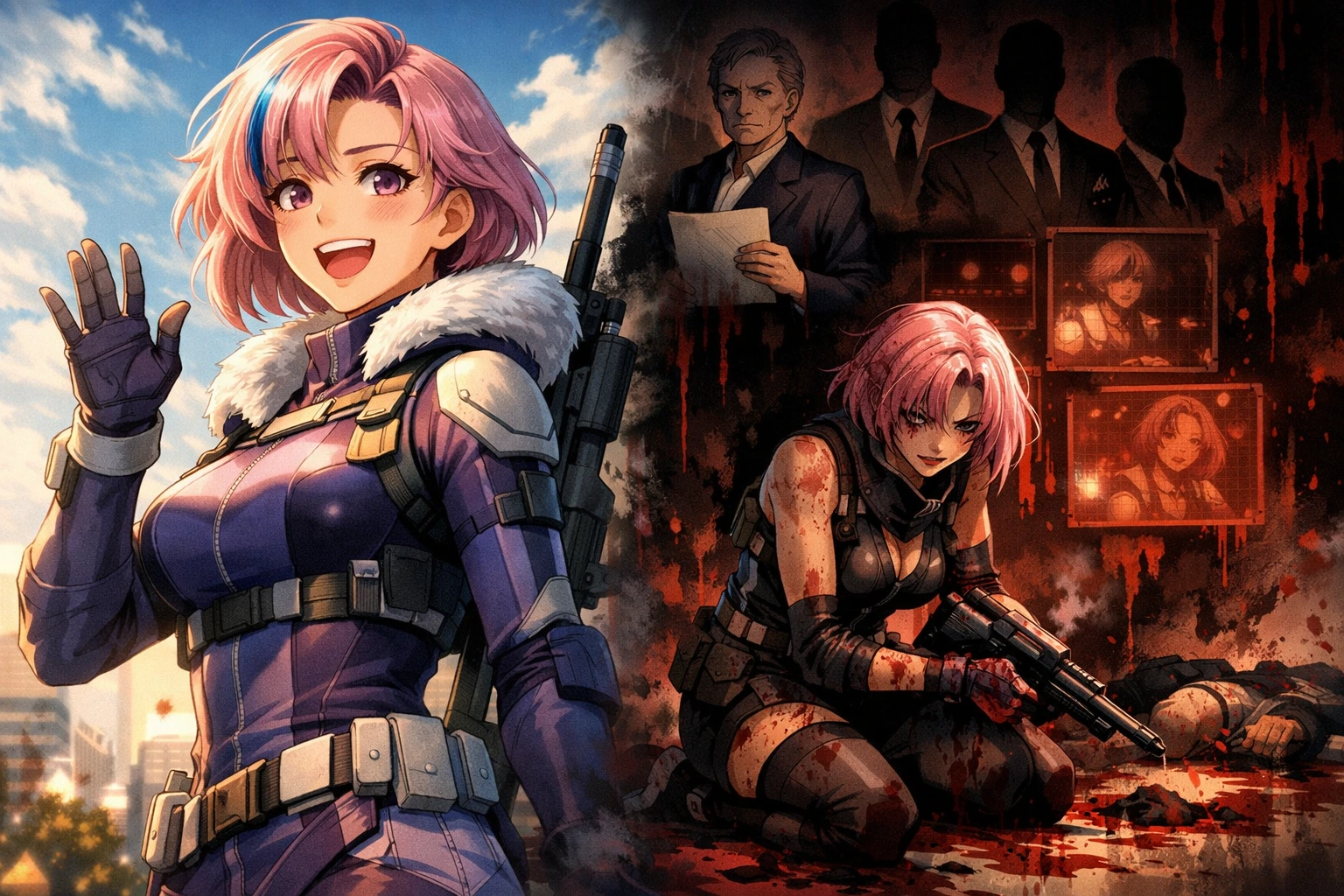
Article Scope This article serves as the definitive, expert-level breakdown of Lady Nagant. It will exhaustively analyze the bio-organic mechanics of her terrifyingly efficient Quirk, dissect the profound psychological horror of her role in state-sanctioned assassinations, and provide a tactical deconstruction of her masterpiece engagement against Izuku Midoriya.
Furthermore, we will explore the thematic weight of her character, proving that Lady Nagant is not just a casualty of a broken system, but the ultimate lens through which the fundamental flaws of My Hero Academia‘s society must be viewed.
The Rifle Quirk: Organic Ballistics & Biometrics
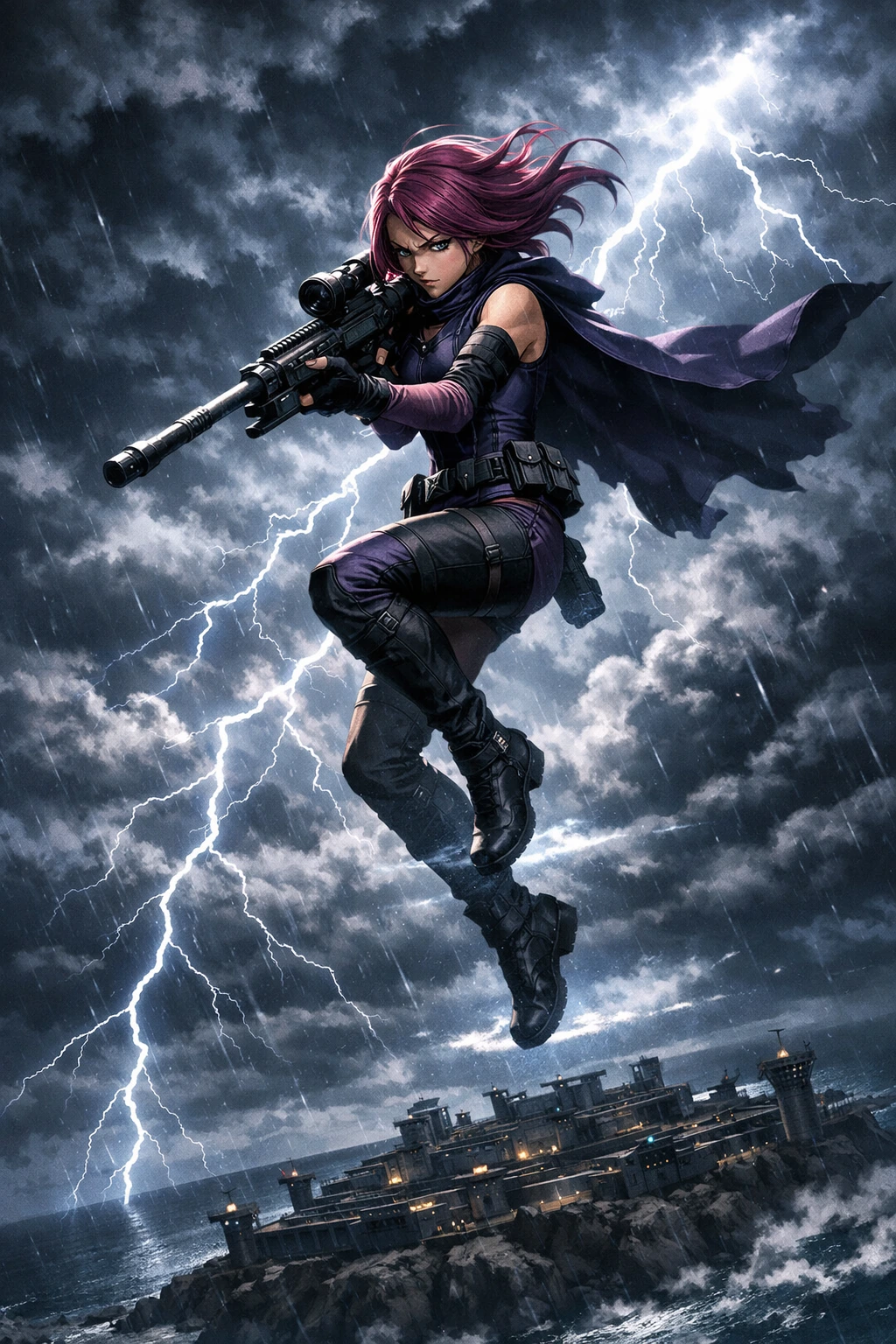
The Hardware of a Sniper At the core of Lady Nagant’s terrifying reputation is her Quirk, simply named “Rifle.” To understand her lethality, we must first deconstruct the visceral, mechanical reality of her biology. Unlike heroes who wield external support items, Nagant’s weaponry is entirely organic. Her right arm physically morphs into a high-caliber sniper rifle, a grotesque yet beautiful fusion of human anatomy and ballistics.
The barrel extends from her elbow joint, requiring her to physically lock her forearm and shoulder into rigid, unnatural positions to serve as the gun’s chassis. The biomechanics required to handle this are staggering. A traditional anti-materiel sniper rifle generates massive recoil, enough to dislocate a normal human shoulder.
To compensate, Nagant’s musculoskeletal system must instantaneously adapt, hyper-densifying her bones and locking her joints with hydraulic-like pressure to absorb the kinetic shockwave of her shots. Her nervous system operates in tandem with this physical transformation, creating a flawless muscle memory that allows her to draw, aim, and fire in fractions of a second, seamlessly transitioning between a human woman and a living weapon.
The Epoxy-Hair Ammunition A rifle is only as effective as its ammunition, and Lady Nagant’s bio-organic bullets elevate her from a mere sharpshooter to an unpredictable, multifaceted threat. Her ammunition is generated by molding her two-tone hair into hardened epoxy-putty rounds.
This fascinating, slightly grotesque biological process means she has a virtually limitless supply of ammunition, provided she does not render herself bald in protracted engagements. More importantly, she can alter the molecular density and aerodynamic shape of these hair-bullets based on how she weaves the strands.
By twisting the keratin structures tightly, she creates armor-piercing rounds capable of punching through reinforced steel. By leaving a hollow core, she crafts hollow-point bullets that expand upon impact, maximizing tissue damage.
Most terrifyingly, she can mold the bullets with asymmetrical grooves and aerodynamic fins, allowing them to curve mid-air, altering their trajectory to strike targets hidden behind cover. This versatility transforms her hair into an arsenal of bespoke, situation-specific munitions.
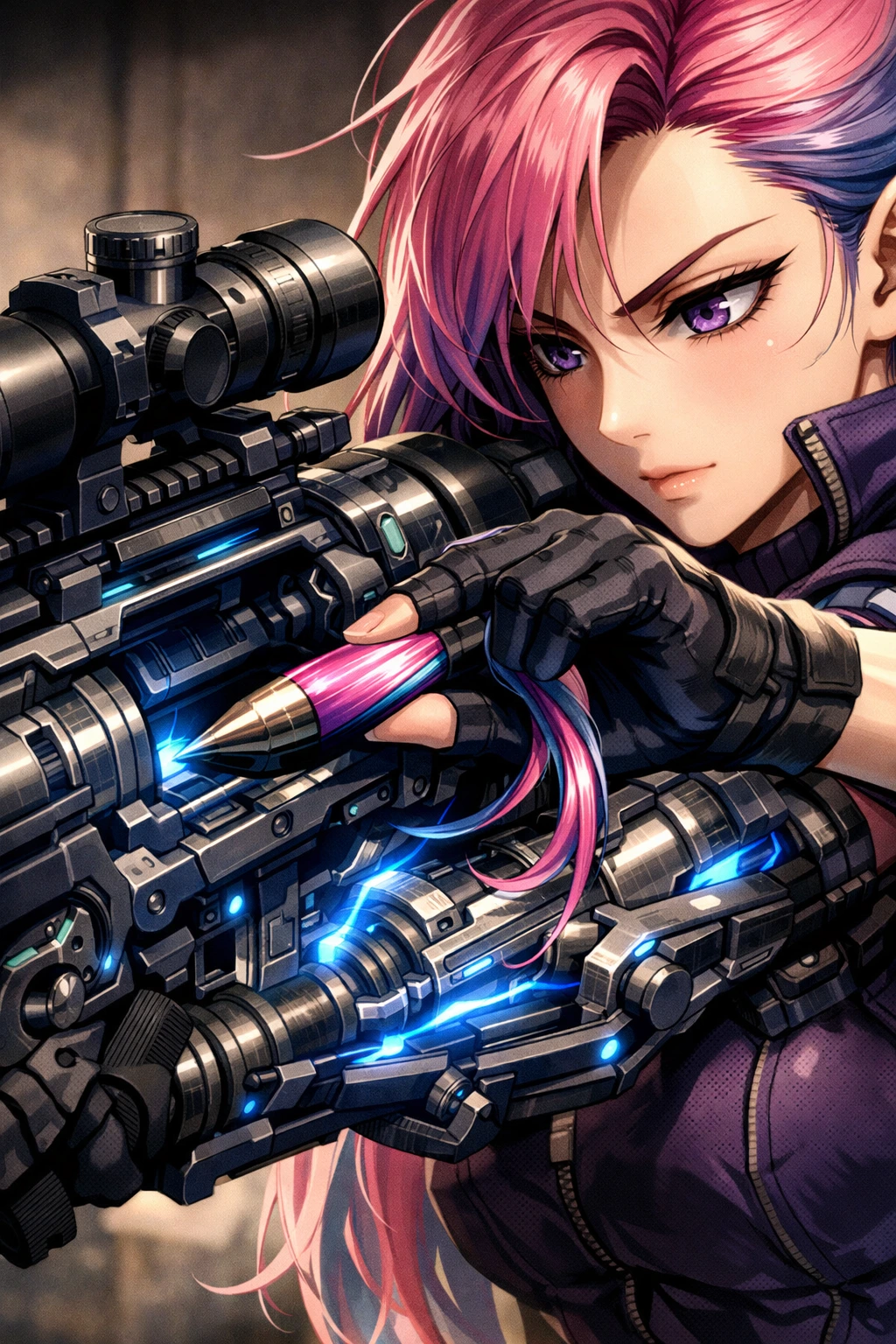
The Telescopic Vision The physical rifle and the epoxy ammunition would be useless without a targeting system capable of matching their range. Lady Nagant possesses a natural, biological telescopic vision that defies human limitations.
Her visual cortex and optic nerves are profoundly enhanced, acting as an integrated, high-powered sniper scope. She does not merely zoom in on a target; her brain acts as a ballistic computer. At distances exceeding three kilometers, she can instantaneously calculate wind speed, barometric pressure, humidity, the Coriolis effect, and the target’s velocity.
While normal snipers require a spotter and extensive mathematical calculations to make a successful long-distance shot, Nagant processes these environmental variables subconsciously. Her eyes adjust to micro-fluctuations in the atmosphere, allowing her to thread a bullet through a chaotic battlefield, hitting a moving target the size of a coin from a neighboring city district.
The HPSC’s Executioner (The Dark Side of Justice)
The Recruitment of Innocence The Hero Public Safety Commission operates on a philosophy of utilitarianism—the greatest good for the greatest number, regardless of the moral cost. When they discovered Kaina Tsutsumi, they did not see a child dreaming of saving people; they saw a Quirk that could kill flawlessly from miles away.
The HPSC specifically targeted her raw talent and her naive, desperate desire to “keep the peace.” They groomed her, manipulating her idealism by convincing her that true peace required terrible sacrifices, and that only someone as strong and righteous as her could bear that burden. It was a masterful, sociopathic exploitation of innocence. They took a girl who wanted to be a hero and convinced her that becoming an assassin was the highest form of heroism.
Extrajudicial Killings Once fully integrated into the HPSC’s shadow operations, Lady Nagant’s existence became one of endless bloodshed. The grim reality of her job was extrajudicial killing. The Commission recognized that the legal justice system was often too slow, too public, and too bound by due process to handle certain threats without causing mass panic.
Therefore, they bypassed the courts entirely. Nagant was ordered to assassinate corrupt heroes who threatened the public’s trust in the system, domestic terrorists plotting in secret, and political threats before they ever had the chance to act.
She was judge, jury, and executioner, guided entirely by the unquestioned directives of the HPSC President. There were no arrests, no trials, and no mercy. If the Commission deemed someone a threat to the fragile illusion of peace, Nagant pulled the trigger, erasing them from existence under the cover of darkness.
The Isolation of the Shadow The psychological toll of this dual existence was catastrophic. By day, Lady Nagant was presented as a Pro Hero, expected to smile for the cameras, shake hands with adoring fans, and inspire the youth. By night, she was a serial killer, carrying out black-ops assassinations.
This forced cognitive dissonance created a profound isolation. She could not confide in her fellow heroes, for they were either blissfully ignorant of the blood keeping their society afloat, or they were the very targets she might be ordered to eliminate next.
She was forced to pat children on the head and preach about justice while her hands were literally stained with the blood of her victims from the night before. This isolation was absolute; she lived in a solitary confinement of the mind, a prisoner of her own horrific secrets, alienated from the very society she was sacrificing her soul to protect.
The Psychological Break: Blood in the Rain
The Hallucinations The human psyche is not designed to withstand the continuous, systematic taking of human life without consequence. Despite her training and her initial commitment to the HPSC’s cause, the continuous murder began to rot Kaina’s mind.
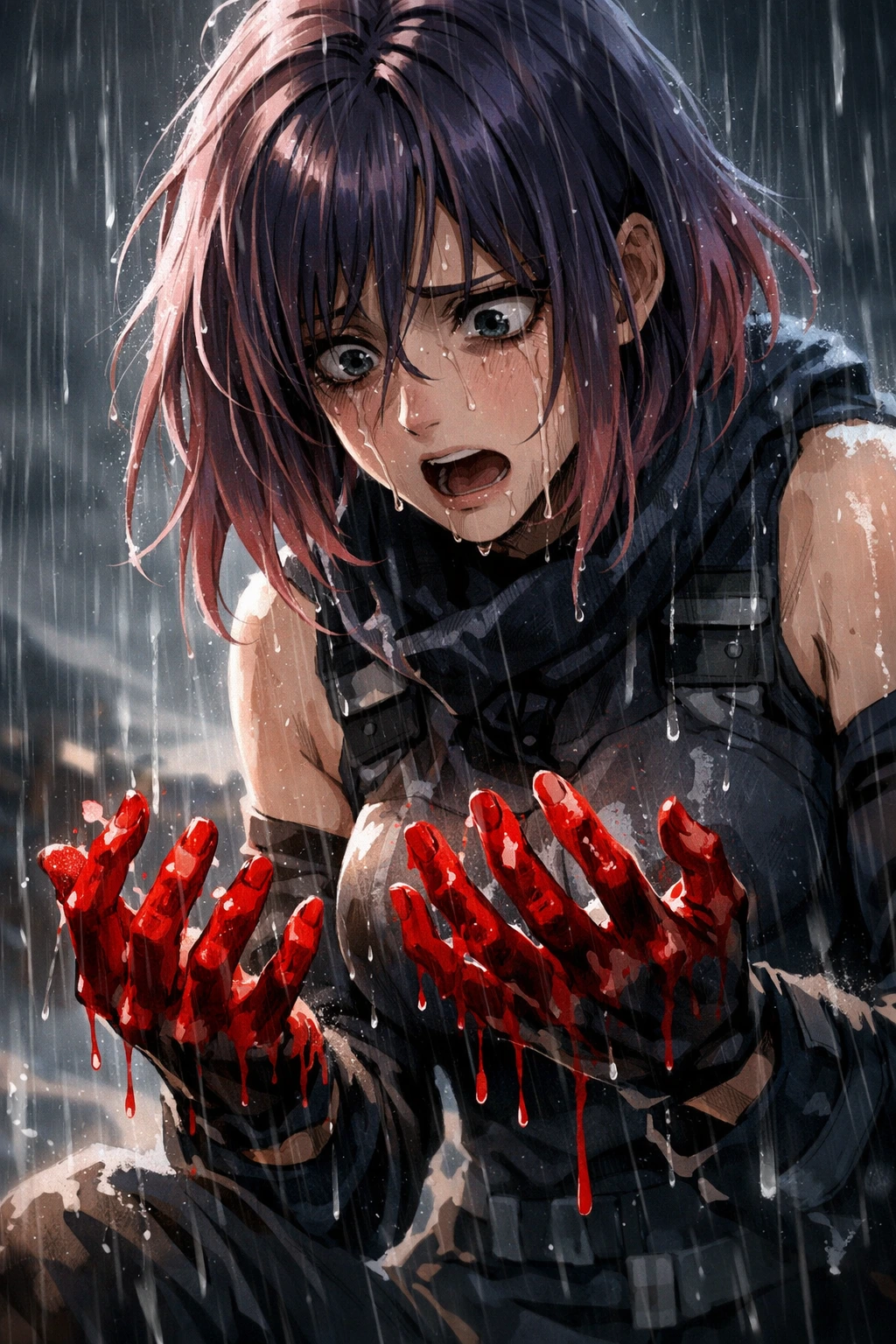
She developed severe Post-Traumatic Stress Disorder (PTSD) and an overwhelming sense of cognitive dissonance. The trauma manifested in terrifying, inescapable hallucinations. She began to suffer from a “Lady Macbeth” syndrome, looking down at her hands and seeing them permanently, irredeemably drenched in blood.
No amount of scrubbing could wash away the phantom crimson. These hallucinations were a physical manifestation of her crushing guilt, a screaming reminder from her subconscious that no matter how the Commission justified it, murder remained murder.
The Illusion of a “Clean” Society The breaking point was not a single difficult mission, but rather the cumulative realization of the grand lie she was perpetuating. As she watched the public cheer for All Might and bask in the glow of the “Symbol of Peace,” she experienced a sickening epiphany. The society she was protecting wasn’t clean; it was built on a foundation of corpses.
All Might was only able to shine so brightly, and the public was only able to sleep so soundly, because she was forced to slaughter everyone in the shadows who threatened the facade. The peace was manufactured. The justice was a lie. She realized she was not a hero protecting the innocent; she was a janitor, sweeping the ugly realities of the world under the rug with a sniper rifle so the masses could continue to live in their ignorant bliss.
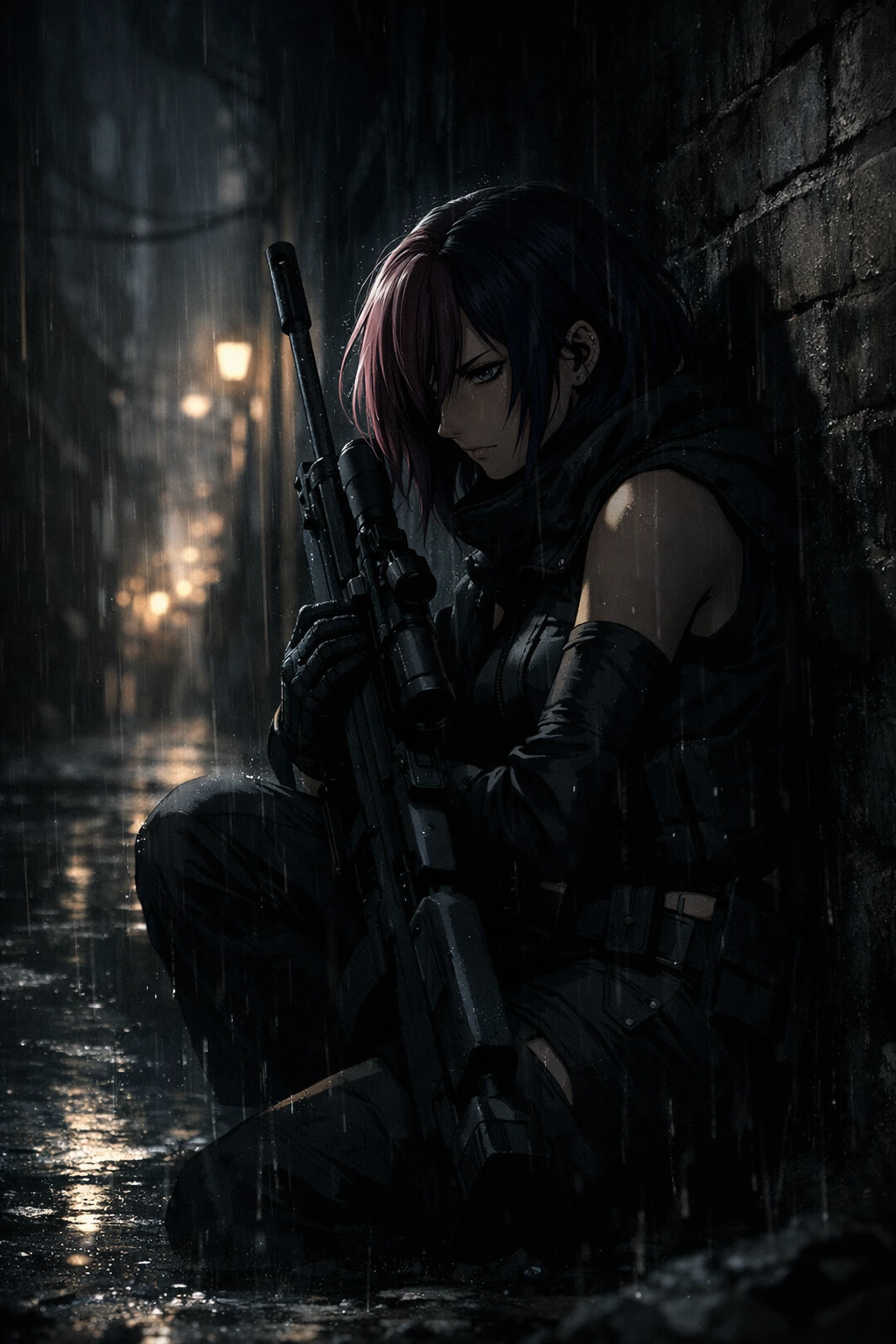
The Assassination of the President The visceral climax of her tenure with the HPSC occurred on a rain-slicked night, confronting the Commission President. When ordered to kill yet another target—and subtly threatened that her own life would be forfeit if she refused—her fractured psyche finally snapped. Executing the HPSC President was not an act of villainy, nor was it a calculated coup.
It was a desperate, violent, and deeply tragic rejection of institutional hypocrisy. As she aimed her weapon at the man who had groomed her, manipulated her, and destroyed her soul, she wasn’t just killing an official; she was trying to kill the system itself. The rain washing over them symbolized a futile attempt to cleanse the corruption, but it only served to mix with the President’s blood. It was the moment Kaina Tsutsumi died, and the infamous villain Lady Nagant was truly born.
The Tartarus Pact & The AFO Contract
The Lesser of Two Evils Sentenced to Tartarus for her treason, Lady Nagant spent years stewing in her cynicism. When the facility was breached and she was offered a contract by All For One (AFO), her decision to accept was rooted in a deeply warped, yet internally consistent, philosophical choice.
She chose to align with the ultimate villain because she viewed him as the lesser of two evils. To Nagant, the HPSC and the Hero Society they upheld were built on deceit, masquerading as righteous while committing atrocities in the dark. All For One, conversely, was transparent.
He did not hide behind a smiling facade or claim moral superiority; he was honest in his cruelty and his desire for control. In Nagant’s traumatized, binary worldview, she preferred a world ruled by an honest monster over one controlled by fake, manufactured “justice.”
The “Air Walk” Upgrade All For One is a master tactician, and his gifts are never random. By granting Lady Nagant the “Air Walk” Quirk, he provided her with the ultimate tactical upgrade, elevating her from a deadly sniper to an apex predator.
The fatal flaw of any sniper is their reliance on static positioning; to take a shot, a sniper must find a vantage point, effectively anchoring themselves and making them vulnerable to close-range ambushes once their position is compromised.
“Air Walk” completely removes this weakness. By allowing her to levitate and walk on invisible footholds in the sky, she gains infinite, omnidirectional high ground. She can reposition instantly, escape ambushes by simply stepping into the atmosphere, and maintain a constant, unassailable line of sight on her targets from the clouds. It turned her into an untouchable, airborne artillery platform.
The Hit on
The contract stipulated a precise mission: capture Izuku Midoriya alive. This was not just a mercenary job for Nagant; it was deeply symbolic. Midoriya, the successor to All Might and the wielder of One For All, embodied the very system she despised.
He was the next generation’s “Symbol of Peace,” the bright, shining light that would necessitate more shadows, more blood, and more child soldiers like herself. Hunting Deku was her way of dismantling the future of the HPSC’s hypocritical society.
She approached the mission with cold, detached professionalism, armed with her upgraded Quirks, her lethal experience, and an unshakable belief that breaking Deku meant breaking the cycle of false justice once and for all.
The Sniper vs. The Speedster (Tactical Masterclass)
The Decoy Strategy The confrontation between Lady Nagant and Izuku Midoriya is a masterclass in psychological warfare and tactical combat. Nagant did not simply wait for Deku to appear; she orchestrated the battlefield.
She utilized Overhaul (Kai Chisaki)—a broken, pathetic remnant of a villain—as a decoy and psychological bait, knowing Deku’s heroic nature would compel him to protect even his worst enemy. Furthermore, she deliberately initiated the engagement in a torrential downpour.
This was a calculated tactical choice: the heavy rain severely masked the sound of her sniper shots, hid the muzzle flash, and degraded Midoriya’s hearing and visibility. She controlled the environment, forcing the speedster to fight in a disorienting, sensory-deprived arena where every shadow could hide a lethal bullet.
Curving the Trajectory Midoriya’s survival relied heavily on “Danger Sense,” a Quirk that alerts him to malicious intent. A lesser sniper would have been rendered useless against this precognition. Nagant, however, demonstrated the sheer, terrifying mastery of her Quirk by outsmarting precognition itself.
Knowing Deku would dodge the linear path of a bullet the moment he sensed it, she utilized her epoxy-hair ammunition to fire ricochet shots and severely curved trajectories. She aimed not at where Deku was, but at his blind spots, forcing him to dodge one bullet only to step directly into the path of another curving around a building behind him. She was playing three-dimensional chess at supersonic speeds, mathematically calculating angles of deflection in the pouring rain to bypass an opponent who could literally sense the future.
The Faux 100% Counter Despite her unparalleled aim and tactical brilliance, Nagant was ultimately outmaneuvered by Midoriya’s sheer ingenuity and raw power. To bypass her flawless defensive perimeter and omnidirectional attacks, Deku had to move faster than the expansion of a sniper bullet.
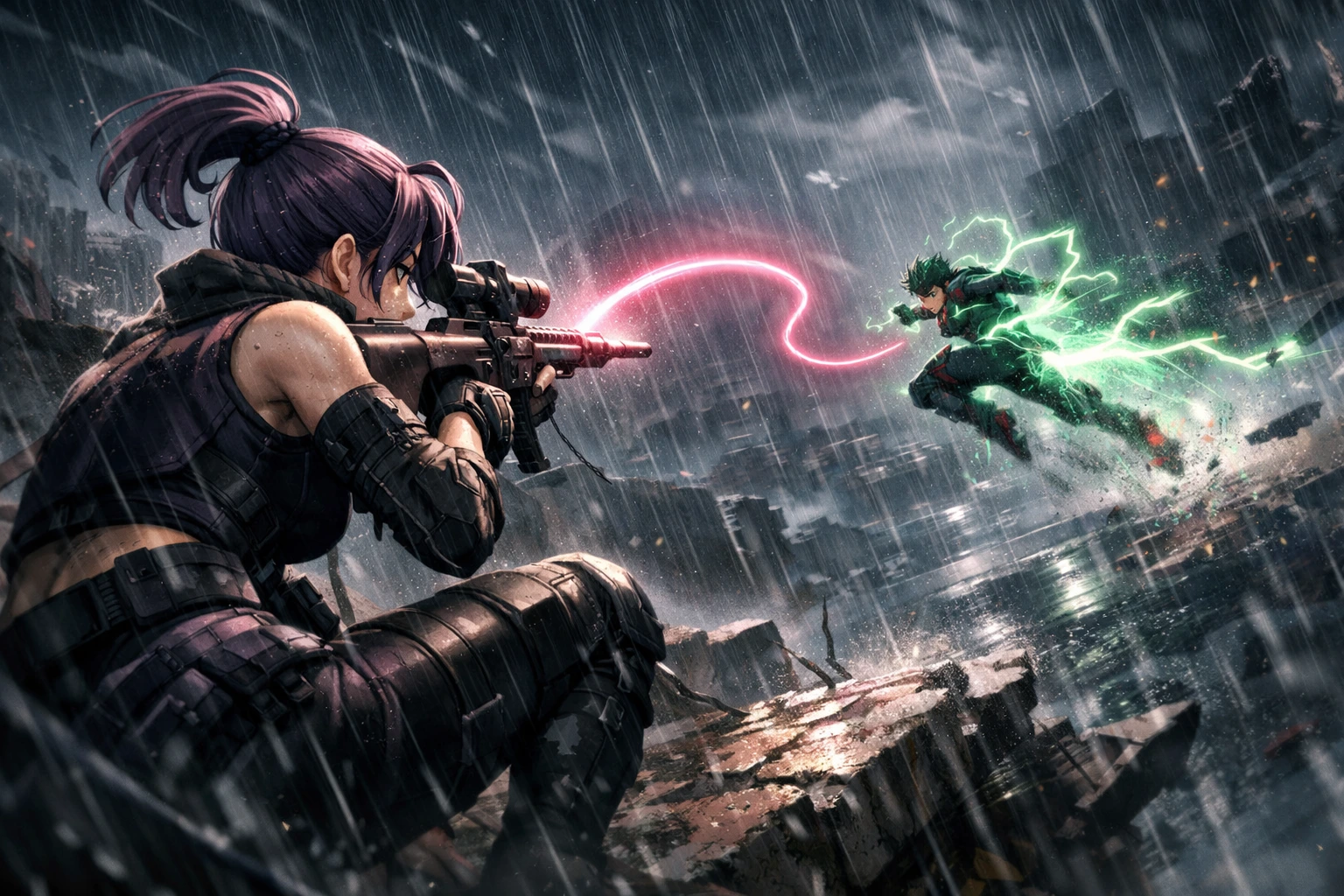
By combining the kinetic energy of “Fa Jin,” the momentum of “Blackwhip,” and the baseline power of One For All, he achieved “Faux 100%”—a burst of speed that momentarily rivaled All Might in his prime.
He broke the sound barrier, entirely bypassing her tracking capabilities. The physical climax of the fight saw Deku closing the kilometer-long gap in a microsecond, shattering her rifle arm entirely. It was a victory not just of power, but of overwhelming, self-sacrificial determination that shattered Nagant’s tactical paradigm.
The Detonation (AFO’s Failsafe)
The Booby-Trapped Quirk Just as Lady Nagant began to waver, struck by Midoriya’s unwavering heroism and genuine desire to understand her rather than just defeat her, the true horror of her contract with All For One was revealed.
AFO, a true sociopath who trusts no one, had booby-trapped the “Air Walk” Quirk. He had secretly woven a secondary, delayed-ignition detonation Quirk into the gift. It was designed to trigger the moment her loyalty to him faltered, or if she failed her mission. This horrifying revelation underscored AFO’s ultimate nature: to him, people are not allies; they are disposable tools, biological time-bombs to be discarded the moment they lose their utility.
The Blast The physical devastation of the detonation was catastrophic. Without warning, Lady Nagant exploded from the inside out. The blast ruptured her internal organs, incinerated her flesh, and sent her plummeting from the sky, a burning husk of the formidable sniper she had been moments before.
As she fell, the agony was not just physical, but profoundly emotional. In her final, fiery descent, she realized the cruelest irony: she had betrayed the HPSC to escape being a pawn, only to become an even more literal, disposable pawn to the villains. She had traded one master who used her for a grand lie, for another who used her for a grand explosion.
The Spark of Hope Yet, in that moment of ultimate despair, the narrative shifts profoundly. As she plummeted toward her death, Izuku Midoriya did not hesitate. Despite her having spent the last hour trying to murder him, Deku launched himself into the air, reaching out desperately to catch her burning body.
This single, unhesitating act of salvation instantly shattered her decades of built-up cynicism. The HPSC President had reached out a hand to use her; Deku reached out a hand to save her, asking for nothing in return. In the boy she had been sent to capture, she finally saw the embodiment of the ideals she thought were a myth. She realized that a “True Hero”—one genuinely untainted by the HPSC’s control or AFO’s malice—actually existed.
The Final Shot (The War of Atonement)
Pushing Past Biological Failure Lady Nagant’s survival should have been biologically impossible. Left comatose with severe, full-body third-degree burns and massive internal trauma, her role in the story seemed concluded. However, during the final war against Tomura Shigaraki and All For One, she makes a miraculous, agonizing return.
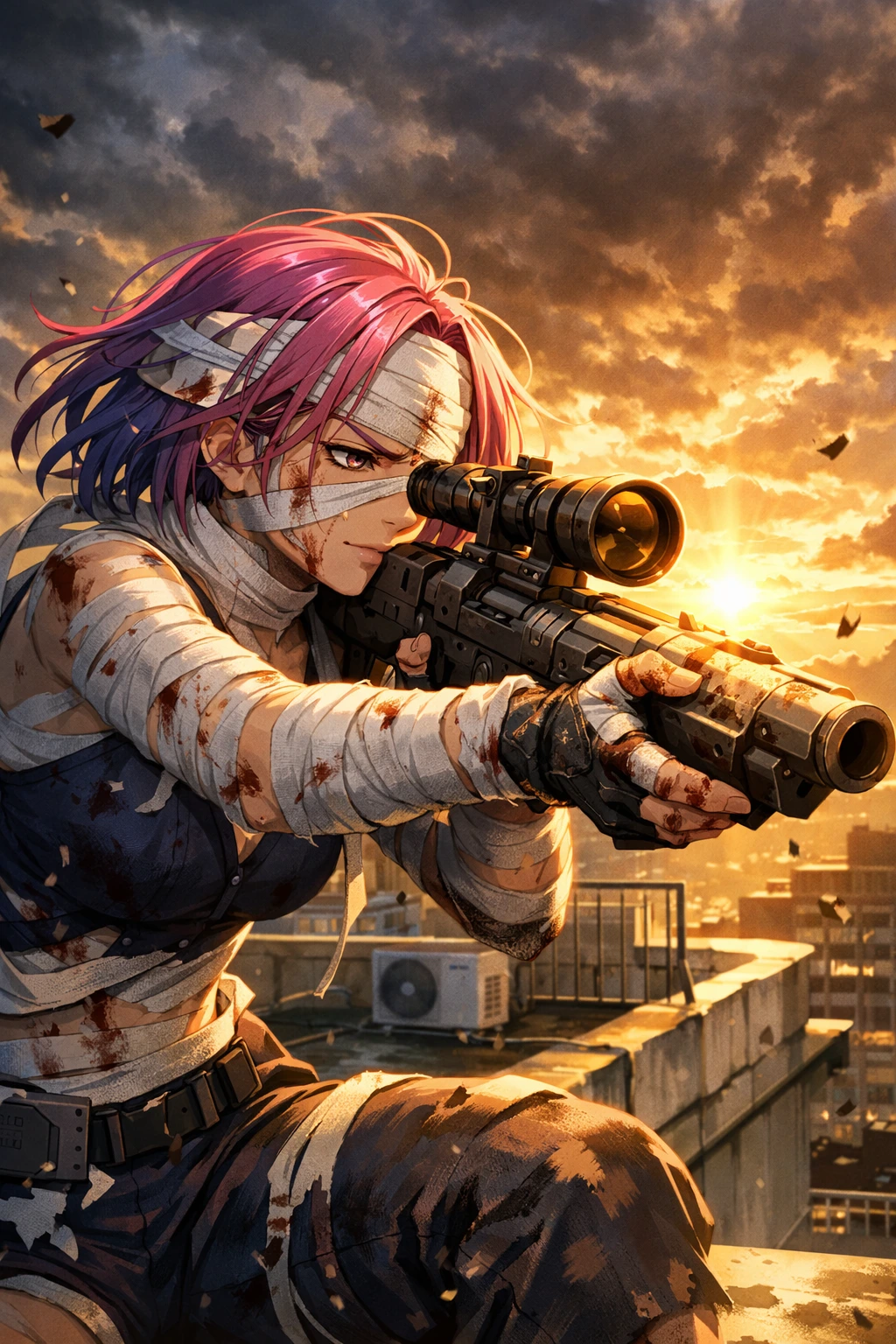
Waking up in a hospital bed, barely able to breathe, she refuses to remain a bystander. The sheer, impossible willpower required to leave that bed defies medical science. Wrapping her ruined, scarred arm in bandages, she literally stitches her biological rifle back together through sheer force of will, overriding the agony of her scorched nerve endings to take up arms one last time.
Saving the Next Generation Her intervention in the final war is a moment of profound poetic justice. Shigaraki, possessed by AFO and possessing overwhelming power, is moments away from executing Katsuki Bakugo. The heroes are grounded, exhausted, and out of options. From kilometers away, standing on the roof of a hospital, Lady Nagant takes aim.
Despite her injuries, despite the wind, and despite the chaos of the battlefield, she fires. The shot is perfect. It violently severs Shigaraki’s hands, blowing them apart just before they can inflict a lethal blow. With a single, masterful pull of the trigger, the former assassin of the old regime saves the life of the explosive, fiery symbol of the new generation.
The Legacy of the Shot The legacy of this final, desperate sniper shot is immense. It is her ultimate act of atonement. For years, her Quirk was used to silence hope and maintain a corrupt status quo. Now, she uses that exact same lethal power to preserve hope and protect the future.
It proves a vital thematic point within My Hero Academia: even the most broken, corrupted tool of the old system can be the exact key needed to save the future. She did not need to become a traditional hero in spandex to find redemption; she simply needed to point her rifle in the right direction, for the right reasons.
Conclusion
The Victim of the Pedestal In summarizing the complex, tragic existence of Kaina Tsutsumi, one must recognize her as the ultimate sacrificial lamb of the Golden Age of Heroes. She was the victim of the pedestal upon which society placed All Might.
To keep that pedestal gleaming, society required someone in the dirt, wallowing in the blood and the shadows, committing unspeakable acts in the name of a sanitized peace. Lady Nagant was punished for bearing the sins of an entire nation.
Her villainy was not born of inherent malice, but of severe trauma and a desperate, violent demand for truth in a world governed by beautiful lies.
Closing Thoughts Kohei Horikoshi’s introduction and handling of Lady Nagant stands as a brilliant, mature pivot in the narrative of My Hero Academia. Through her, he masterfully dismantles the naive, black-and-white morality that defined the early arcs of the universe.
She forces both the protagonist and the audience to confront the uncomfortable reality that justice is rarely clean, and that the line between a hero and an assassin is often dictated solely by who signs the paychecks.
Lady Nagant is a stark, unforgettable reminder that true heroism is not about maintaining a flawless image, but about reaching out a hand to save those who have been burned by the system—even when they are falling from the sky, rigged to explode.