
Introduction
The Hero Who Has Too Much Time on His Hands In the vibrant, hyper-powered society of My Hero Academia, the concept of heroism is largely defined by bombastic displays of power, unwavering smiles in the face of danger, and a dogmatic adherence to the absolute preservation of life.
All Might established this paradigm, creating a “Symbol of Peace” that relied on one man acting as the unbreakable pillar of society. However, Keigo Takami, known to the world as the Wing Hero: Hawks, operates on a fundamentally different, almost paradoxical philosophy.
Hawks is introduced to the audience not with a grand speech about justice, but with a seemingly lazy, aloof declaration: he wants to create a world where heroes have too much free time on their hands. This is not the battle cry of a traditional shonen protagonist; it is the calculated vision of a revolutionary thinker.
Hawks recognizes the inherent flaw in All Might’s system. A society that relies entirely on a singular, ever-vigilant savior is inherently fragile. Hawks’ desire for “free time” is actually a profound commentary on systemic stability. He envisions a self-sustaining societal equilibrium where crime is so thoroughly managed and eradicated at its root that heroes are no longer required to work themselves to death on the front lines.
To achieve this seemingly relaxed utopia, Hawks ironically becomes the most overworked, hyper-vigilant, and rapidly moving entity in the entire hero hierarchy. He sacrifices his own free time, his own identity, and his own moral purity so that the rest of society—including other heroes—can enjoy the peace he so desperately craves.
He is the fastest Pro Hero not just in physical speed, but in his relentless, forward-thinking approach to the structural integrity of hero society.
The Double-Edged Sword Hawks’ existence within the narrative of My Hero Academia is defined by a harrowing duality. On the surface, he is the charismatic, immensely popular Number 2 Hero, beloved by the masses for his casual demeanor, dazzling Quirk, and undeniable effectiveness.
He smiles for the cameras, waves to his fans, and effortlessly dispatches low-level villains with the grace of a celestial being. Yet, beneath this golden boy persona lies his true, agonizing purpose: he is the Hero Public Safety Commission’s (HPSC) ultimate weapon.
Hawks serves as a high-stakes deep-cover agent, tasked with infiltrating the most dangerous villainous organization in modern history, the Paranormal Liberation Front (PLF). This dual role transforms Hawks into a walking double-edged sword.
To the public, he is a beacon of hope and a charismatic icon; to the villains he lives among, he must appear as an ally disillusioned with the very society he is sworn to protect; and to the HPSC, he is a disposable asset, a tool designed to execute the dark, unsavory tasks required to maintain the illusion of absolute peace.
The psychological weight of balancing these conflicting identities creates a character who is constantly living on a razor’s edge, knowing that a single misstep or a fleeting moment of genuine emotion could result in the total collapse of hero society.
Article Scope To truly understand Hawks, one must look far beyond the superficial appeal of his aesthetic and his rank. He is arguably the most complexly written character in Kohei Horikoshi’s masterpiece. This article will serve as the definitive, expert-level analysis of Keigo Takami.
We will systematically deconstruct the fascinating, terrifying biology of his “Fierce Wings” Quirk, examining it not just as a power, but as a sensory network. We will delve into the dark, systematic psychological conditioning he endured under the Hero Public Safety Commission, exploring how a traumatized child was meticulously groomed into a state-sponsored assassin.
Furthermore, we will dissect the agonizing moral weight of his actions during the Paranormal Liberation War, specifically addressing the philosophical and ethical complexities of his confrontation with Twice, and his tragic, identity-shattering clash with Dabi. This is not just a character summary; it is a comprehensive autopsy of the man who flew too close to the sun to keep the world in the light.
Fierce Wings: The Biology of Precision and Speed
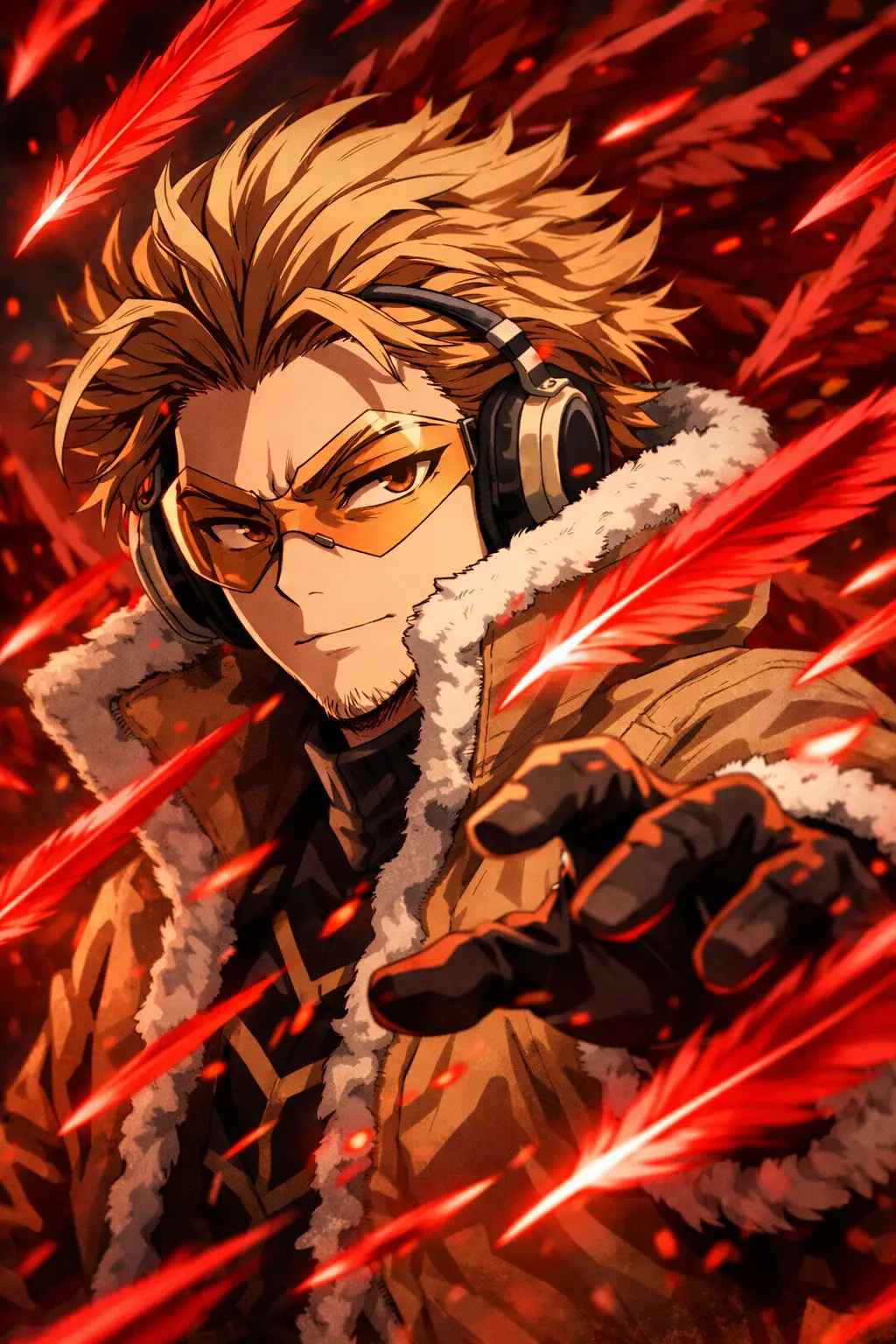
Feather Manipulation At first glance, Hawks’ Quirk, “Fierce Wings,” appears to be a standard mutation-type ability granting him a pair of massive, striking red wings for flight. However, this is a gross oversimplification of one of the most versatile and cognitively demanding Quirks in existence.
Fierce Wings is less about the wings themselves and entirely about the telekinetic manipulation of hundreds of individual feathers. Hawks possesses an extraordinary, almost incomprehensible level of micro-control over his plumage. Every single feather acts as an autonomous unit, capable of being detached, directed, and manipulated with surgical precision.
These feathers possess varying degrees of rigidity and flexibility. A single feather can be softened to gently carry a civilian to safety, or it can be instantly hardened into an aerodynamic, razor-sharp blade capable of slicing through concrete and solid steel.
The cognitive load required to operate this Quirk is staggering. Hawks is essentially multitasking on a superhuman level, simultaneously calculating the trajectory, velocity, and force of dozens, sometimes hundreds, of independent projectiles while maintaining his own evasive flight patterns.
He uses these feathers as swords, shields, projectiles, and even as a makeshift network of support beams to hold up collapsing buildings. His Quirk is a manifestation of pure, weaponized versatility, limited only by his brain’s processing power and the physical number of feathers on his back.
Vibrational Sensitivity The most overlooked and arguably the most terrifying aspect of Fierce Wings is not its offensive capability, but its sensory application. Hawks does not just control his feathers; he feels through them. Each feather acts as an independent, highly sensitive auditory and tactile receptor. When Hawks disperses his feathers across a battlefield or a city block, he creates a massive, invisible radar net.
Through this network, Hawks is capable of detecting microscopic air vibrations and sound waves. He can “feel” the specific frequency of a person breathing beneath tons of rubble, allowing him to conduct rescue operations in zero-visibility environments with flawless accuracy.
More chillingly, he uses this vibrational sensitivity for supreme espionage. By leaving a single, seemingly innocuous feather in a room, Hawks can eavesdrop on highly classified conversations from miles away, decoding the vibrations into audible speech within his own mind.
This pseudo-echolocation grants him a level of spatial awareness that borders on omniscience within his immediate radius. It is this specific biological trait that made him the HPSC’s perfect spy; he is a hero who is literally always listening, gathering data through the very air currents that surround him.
The Weakness of Molting Despite its incredible utility, Fierce Wings possesses a severe, biologically hardwired limitation: it is a finite resource. Unlike heroes who can generate infinite amounts of fire or ice, Hawks operates on a strict ammunition count.
Every feather he detaches and loses in combat diminishes his overall flight capability, speed, and offensive power. If he pushes himself too far, detaching the majority of his plumage to rescue civilians or fight multiple enemies, he is left grounded and drastically weakened.
Furthermore, these feathers do not instantly regenerate. The molting and regrowth cycle is agonizingly slow, requiring days of rest to return to full capacity. This forces Hawks to be a hyper-efficient tactician; he must calculate the exact number of feathers required for a task to avoid depleting his arsenal.
Beyond this finite nature, the feathers are inherently biological constructs composed of keratin, making them acutely vulnerable to extreme elements, most notably fire.
As demonstrated catastrophically in his confrontation with Dabi, intense heat not only incinerates his current arsenal but can permanently damage the follicle roots on his back, crippling his Quirk irreparably. His greatest strength is intrinsically tied to a fragile, flammable biology.
The Speed Metric When Hawks is classified as the “fastest” hero, it is essential to understand that this speed is not derived from raw, muscular explosive power like All Might or Izuku Midoriya. Hawks’ speed is a masterpiece of physics, specifically extreme weight-to-thrust ratios and hyper-fast cognitive processing. By constantly shedding feathers, Hawks makes himself lighter, utilizing the remaining large feathers for maximum aerodynamic thrust. He cuts through the air with zero drag, breaking sound barriers through sheer streamlined efficiency.
However, physical speed is useless without the reaction time to control it. Hawks’ true speed lies in his brain. To fly at supersonic speeds through dense urban environments without turning himself into a smear on a skyscraper requires a visual and cognitive processing speed that defies human biology.
He assesses threats, formulates countermeasures, and executes microscopic bodily adjustments in fractions of a second. His mind operates at the same blistering velocity as his body, allowing him to perceive the world in slow motion while he moves in a blur. This is why he is the fastest: he has mastered the perfect synthesis of aerodynamic biology and hyper-accelerated neurology.
The Grooming of a Golden Boy (Keigo Takami’s Origin)
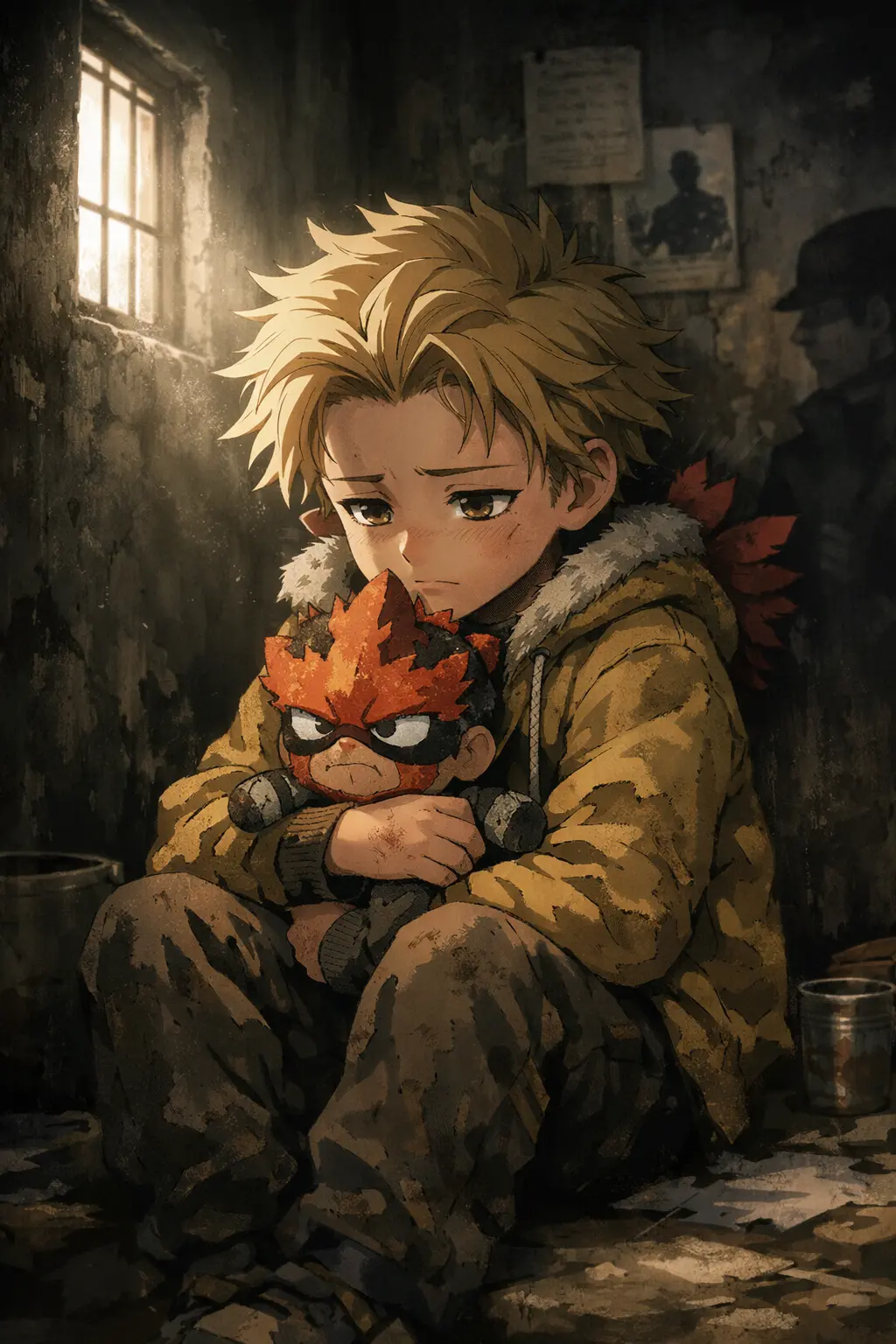
The Sins of the Parents To comprehend the extreme lengths Hawks will go to in the name of duty, one must delve into the squalor and trauma of his genesis. Keigo Takami was not born into a legacy of heroism; he was born into the dark underbelly of a society that had cast his family aside.
His father was a violent, abusive murderer, a fugitive constantly on the run from the law, forcing his family to live in extreme poverty, isolation, and perpetual fear. His mother, broken by the circumstances and her own apathy, was deeply neglectful, offering no comfort or protection.
For young Keigo, the outside world was a terrifying, forbidden place. He was forced to exist as a “non-existent” child, hidden away in a dilapidated shack, legally undocumented and socially invisible. The psychological impact of this environment cannot be overstated.
From infancy, Keigo learned that survival meant silence, that emotional expression invited violence, and that he was entirely alone in the universe. He was a child starved of affection, living in the shadow of his father’s sins, internalizing the belief that his life had no inherent value beyond mere survival.
The HPSC Contract The trajectory of Keigo’s life shifted irreparably when his father was finally apprehended, leaving Keigo and his mother destitute on the streets. It was here that the Hero Public Safety Commission (HPSC), the shadowy, bureaucratic backbone of hero society, intervened. They recognized the unprecedented potential of Keigo’s Fierce Wings Quirk, but their intervention was not an act of charity; it was a cold, calculated transaction.
The HPSC essentially “bought” Keigo from his desperate mother. They offered her a comfortable life in exchange for severing all ties with her son. For Keigo, this meant the complete erasure of his identity. The HPSC stripped him of the name “Keigo Takami,” severing his connection to his criminal lineage, and began molding him into “Hawks.”
He was placed into a brutal, classified training program designed to strip away his childhood innocence and replace it with unyielding loyalty to the state. He was groomed not to be a hero who saves people with a smile, but a perfect operative who executes orders without hesitation, moral qualms, or emotional attachment.
The HPSC weaponized his childhood trauma, filling the void left by his parents with a twisted sense of absolute duty to the government. They created a golden boy out of clay harvested from the gutter.
The Endeavor Connection Amidst the darkness of his early childhood, a singular beacon of hope existed for Keigo, and ironically, it was not the universally beloved All Might. It was Endeavor. In the squalor of his home, Keigo possessed a battered Endeavor plush doll. When his father was finally brought to justice, it was Endeavor who made the arrest.
For the general public, Endeavor was a harsh, terrifying figure, often criticized for his brutality and lack of charisma. But for a broken child living in terror, Endeavor represented a gritty, relentless, unyielding force of justice that could actually reach into the darkness and pull monsters out. All Might was a god in the sky, too distant to understand the dirt of Keigo’s reality. Endeavor was a flawed, burning man who walked through the filth to get the job done.
This traumatic bonding formed the foundation of Hawks’ lifelong admiration for Endeavor. Hawks grew up wanting to support the man who inadvertently saved him, modeling his own relentless work ethic after the Flame Hero. It is a profound, tragic irony that the doll of a deeply flawed, abusive father-figure hero was the only thing that kept a lonely, abused child from completely losing his mind.
The Double Agent’s Tightrope
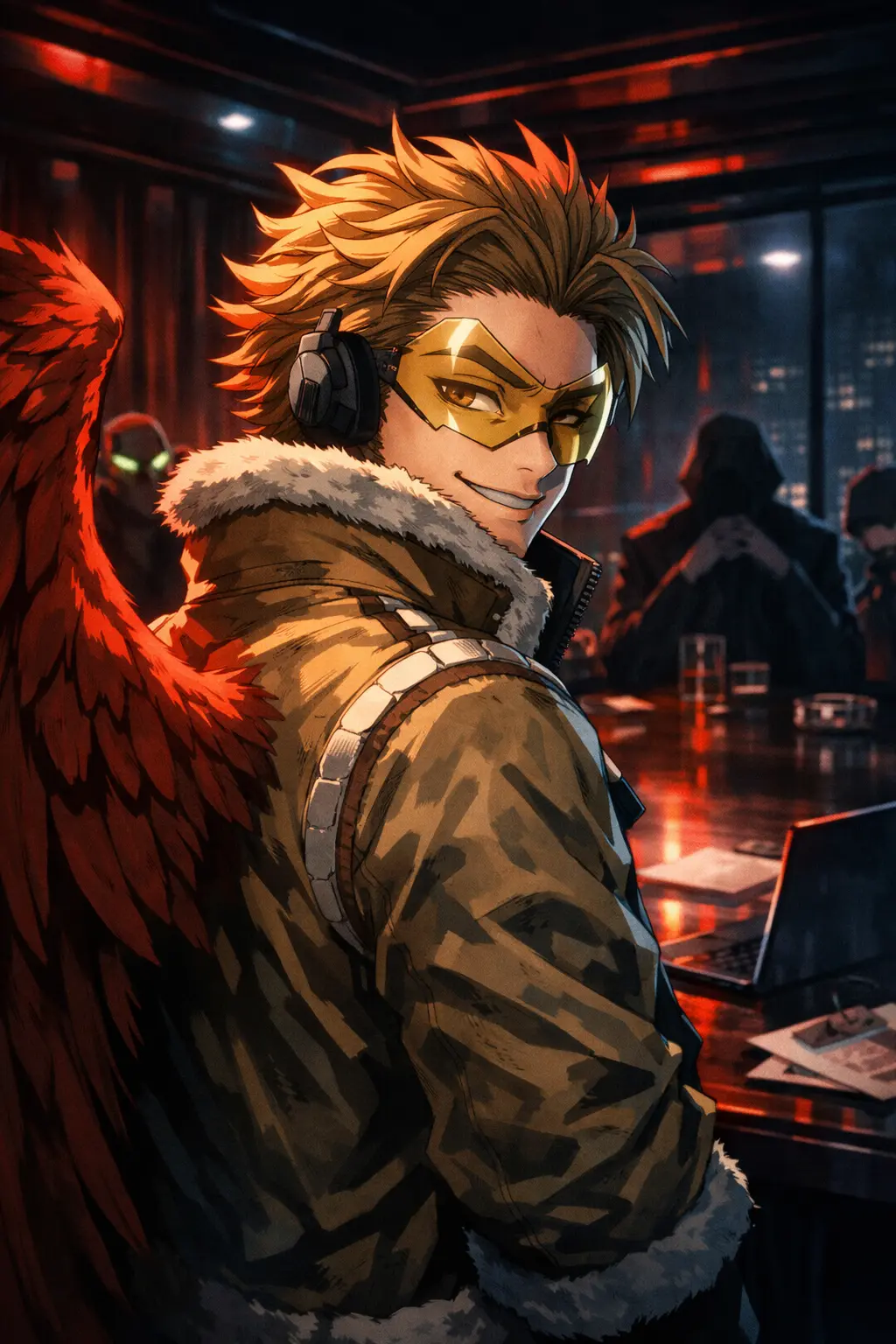
Infiltrating the PLF The true testament to Hawks’ mental fortitude is his assignment to infiltrate the Paranormal Liberation Front. This was not a simple reconnaissance mission; it was a deep-cover operation requiring him to embed himself within an army of radicalized, hyper-lethal terrorists. Hawks had to navigate a psychological minefield, constantly deceiving high-level intellects like the fanatic Re-Destro, the paranoid hacker Skeptic, and the dangerously perceptive Dabi.
To survive, Hawks had to master the art of the perfect lie. He couldn’t just pretend to be a villain; he had to convincingly portray a high-ranking hero who had become utterly disillusioned with the hypocrisies of his own society. He had to agree with their extremist ideologies, nod along to their plans for mass destruction, and offer them valuable hero intelligence—just enough to gain their trust without compromising the ultimate safety of the public. This required suppressing every instinct he had as a hero.
Every conversation was a chess match where a single micro-expression, a drop of sweat, or a slight hesitation in his voice could result in a gruesome death. The mental tax of maintaining this flawless facade, twenty-four hours a day, surrounded by enemies who would gladly flay him alive if they discovered the truth, pushed his psychological endurance to the absolute limit.
The Puppet Master While Hawks was dancing with the devil in the PLF, the strings attached to his back were firmly held by the HPSC President. Hawks’ relationship with the Commission is a chilling exploration of utilitarianism taken to its extreme.
The HPSC operates on the philosophy that the ends absolutely justify the means; if unsavory, illegal, or morally bankrupt actions are required to maintain public peace, they must be executed without hesitation.
Hawks was their instrument of execution. He received cold, detached orders to manipulate, sabotage, and ultimately eliminate threats, regardless of the personal cost to his own soul. The tragedy of Hawks is that he fully bought into this ideology.
He accepted his role as the necessary evil. He viewed himself not as a person, but as a mechanism designed to absorb the darkness so that the public could remain blissfully ignorant in the light. He followed the HPSC’s script perfectly, proving that the brightest, most popular heroes are often the ones tasked with burying the society’s deepest, bloodiest secrets.
The Toll of Deception The life of a double agent is, by definition, an existence of profound isolation. Hawks was trapped in an emotional purgatory. Among the heroes, he was forced to distance himself. He could not confide in Endeavor, his idol, nor could he form genuine bonds with his peers, knowing that his secrets could endanger them or that his actions might eventually disgust them.
Conversely, while living among the villains, he was surrounded by people who accepted him (or the version of him he presented) with open arms. He drank with them, laughed with them, and learned about their tragic pasts, all while secretly plotting their total downfall.
He had to emotionally detach himself from the very real human suffering that drove many of the PLF members to villainy. He became a ghost, haunting both sides of the conflict but belonging to neither.
The psychological toll of this deception is a slow, corrosive rotting of the self. Hawks had to kill his own empathy on a daily basis, a sacrifice that left him fundamentally alienated from the very humanity he was fighting to protect.
The Moral Gray Zone: Hawks vs. Twice
The Mirror Image The overarching tragedy of Hawks’ narrative reaches its devastating crescendo in his relationship with Jin Bubaigawara, known as the villain Twice. In many ways, Hawks and Twice are dark mirror images of one another. Both were men profoundly shaped and broken by a society that failed them. Both experienced deep trauma, isolation, and a desperate need for connection.
However, their paths diverged based entirely on who found them in their darkest hour. When Keigo was in the gutter, the HPSC found him, stripped away his identity, and forged him into a weapon of the state. When Jin was losing his mind, rejected by society and terrified of his own Quirk, the League of Villains found him, accepted his madness, and gave him a family.
They are two sides of the same coin: Hawks, the state-sponsored killer masquerading as a hero, and Twice, a deeply compassionate, loving man driven to terrorism by systemic neglect. Their clash is not a battle of good versus evil; it is a collision of societal failures.
The Attempted Salvation The profound tragedy of their confrontation lies in the fact that Hawks genuinely, desperately did not want to kill Twice. Through his infiltration, Hawks had spent extensive time with Jin. He recognized the innate goodness in the man. He saw a loyal friend who was simply fiercely protective of the people who accepted him. Hawks saw himself in Jin—he saw another victim of circumstance.
Because of this, Hawks breaks his perfect conditioning. He drops the facade. He corners Twice not with immediate lethal force, but with an offer of salvation. He tries to arrest him, promising to advocate for his rehabilitation, to help him start over once he pays for his crimes.
Hawks attempts to play God, trying to save Twice from the HPSC’s predetermined, fatal script for high-level villains. It is a moment of profound vulnerability for Hawks, a desperate plea to solve a problem without bloodshed, proving that beneath the cynical conditioning of the Commission, a genuine, compassionate hero still breathes.
The Assassination But the tragedy of My Hero Academia is that good intentions do not rewrite reality. Jin’s loyalty to the League, particularly to Toga and Shigaraki, is absolute. He rejects Hawks’ offer, realizing he has been betrayed, and unleashes his Quirk.
This forces Hawks into a horrifying utilitarian calculus. Twice’s Quirk, “Double,” specifically his “Sad Man’s Parade,” allows him to create infinite clones of himself and his powerful allies. If Twice escapes that room and joins the battlefield, the heroes will lose the war. Thousands will die. It is a statistical guarantee.
Hawks is faced with an impossible choice: his deontological desire to save a good man, or his utilitarian duty to save thousands of innocent lives. The HPSC conditioning takes over. Hawks makes the cold, mathematically correct, utterly soul-crushing decision.
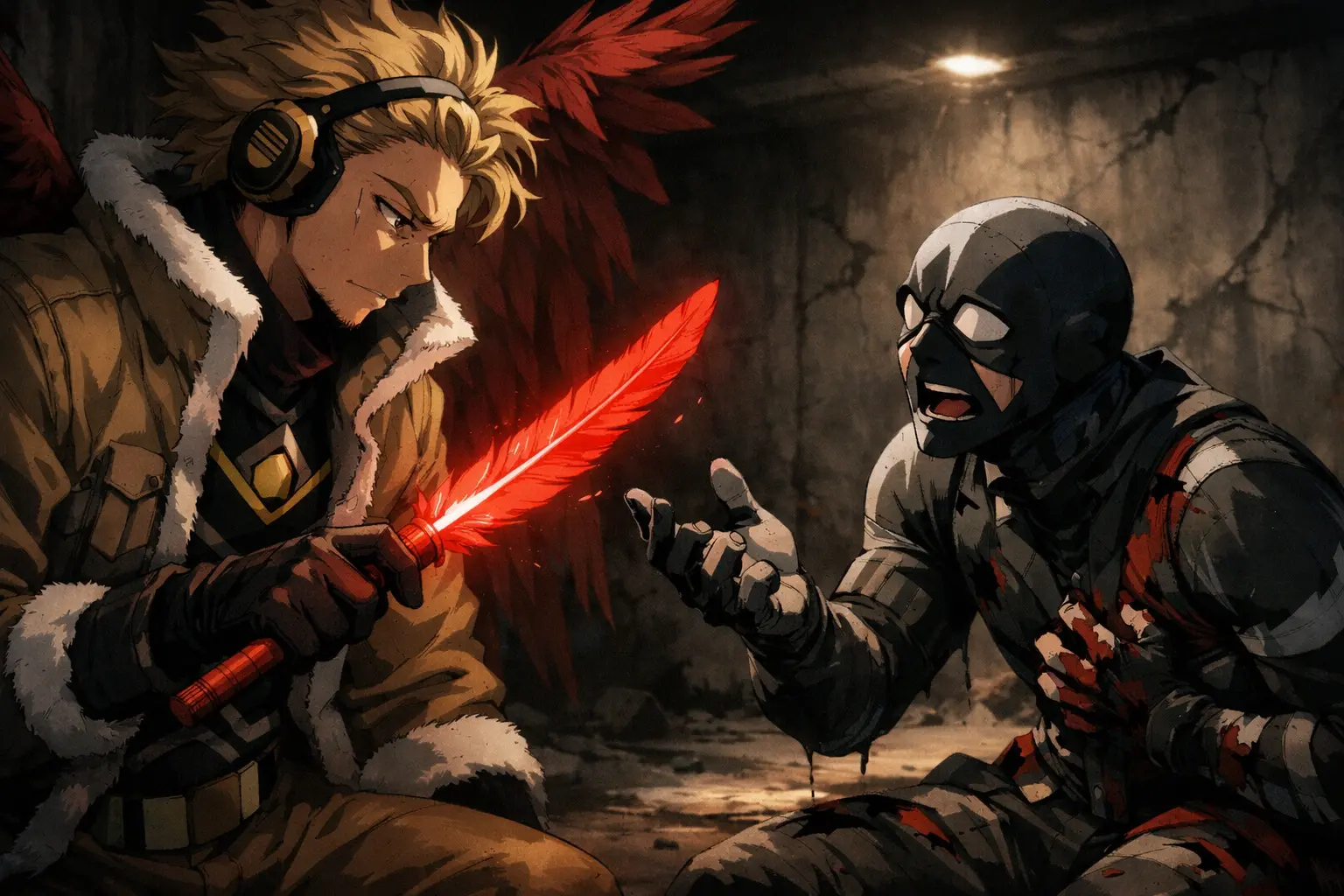
As Twice flees, crying and desperate to save his friends, Hawks strikes him down from behind, driving a feather blade through his back. It is an execution. It is the most controversial, morally ambiguous moment in the series.
Hawks secures the tactical victory for the heroes, but in doing so, he murders the most sympathetic villain in the story, permanently staining his own soul and proving that the line between hero and villain is terrifyingly thin.
The Price of Duty: Confrontation with Dabi
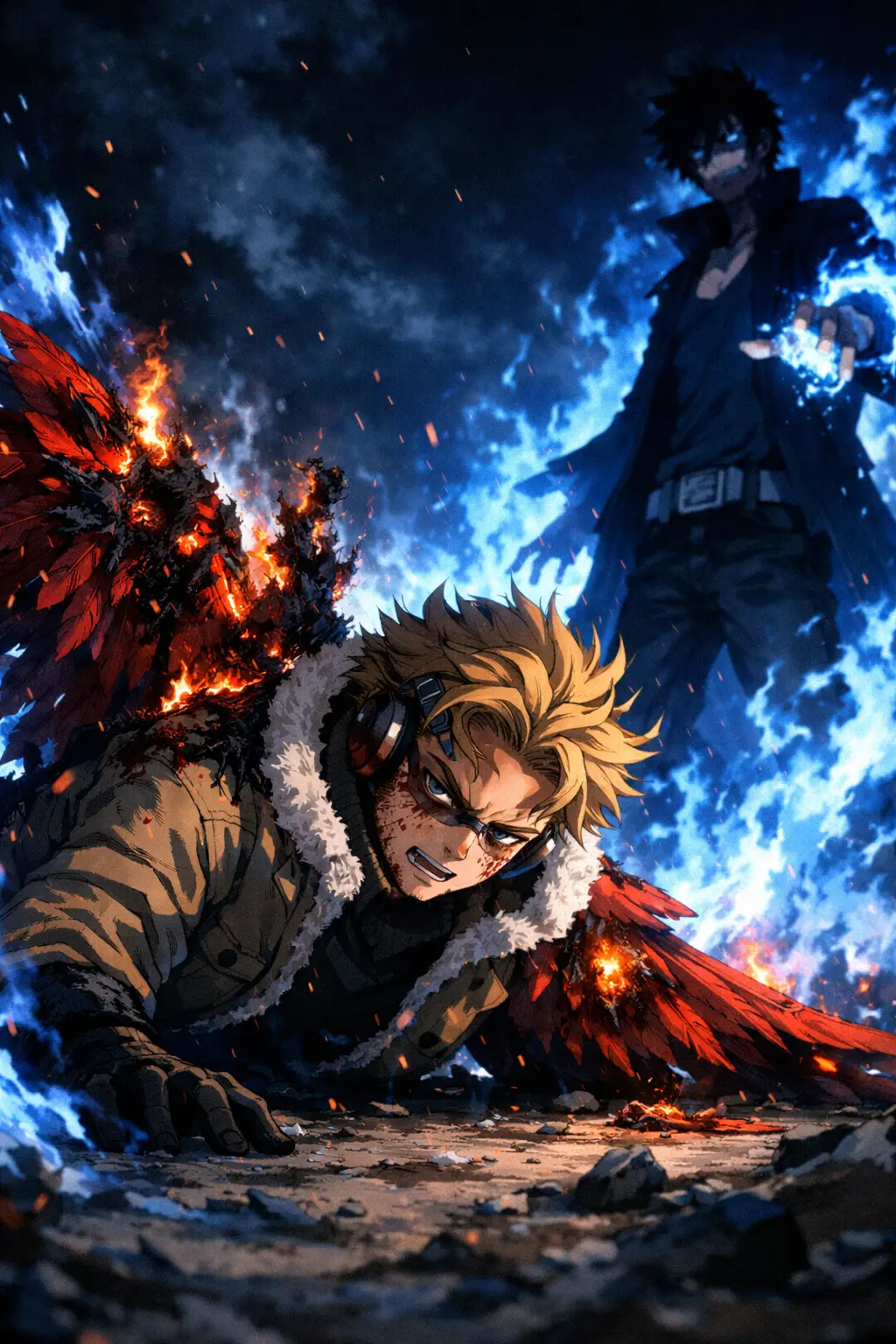
The Burning of the Wings The immediate consequence of Hawks’ assassination of Twice is the arrival of Dabi, and the ensuing confrontation is a masterclass in visceral horror and psychological warfare. Dabi does not just attack Hawks physically; he systematically dismantles him. As Hawks lies pinned, exhausted, and emotionally shattered from killing Twice, Dabi unleashes a torrent of blue flames, the hottest and most destructive fire in the series.
But the physical agony is secondary to the psychological devastation. As Dabi crushes Hawks beneath his foot, he reveals his trump card: he knows Hawks’ true identity. Dabi whispers the name “Keigo Takami.” In that single moment, the entire carefully constructed fortress of Hawks’ identity crumbles.
The HPSC had spent decades burying his past, ensuring his father’s sins could never be used against him. Dabi weaponizes that hidden history, revealing himself to be Toya Todoroki, Endeavor’s supposedly dead son.
Hawks is forced to realize that he has been outplayed, that his espionage was fundamentally flawed, and that the man burning him alive is the son of the hero he idolized his entire life. It is an overwhelming sensory and psychological overload, a perfect nightmare tailored specifically for Keigo Takami.
The Permanent Loss The battle at Gunga Mountain results in a devastating biological and symbolic amputation. Dabi’s blue flames are too intense for Hawks’ keratin-based feathers. They do not just burn the feathers; they incinerate the very follicles on his back. As Hawks is brutally roasted, we witness the permanent destruction of his Fierce Wings.
This loss is profoundly symbolic. Hawks, the man who represented absolute freedom, the “angel” who surveyed the world from the sky, is brutally grounded. His wings, the instruments of his speed, his utility, and his enslavement to the HPSC, are turned to ash. He is stripped of his divine imagery and reduced to a scarred, fragile mortal.
The narrative violently forces him down from the heavens, making him physically experience the grounded, painful reality of the society he had spent his life manipulating from above. He survives, thanks to the intervention of Fumikage Tokoyami, but the Wing Hero is effectively dead.
The Revelation of the Truth The physical destruction of Hawks coincides with the societal destruction of the HPSC’s carefully curated image. Dabi broadcasts his pre-recorded manifesto to the entire nation, revealing his identity as Toya Todoroki and exposing Endeavor’s domestic abuse.
Crucially, Dabi also broadcasts heavily edited footage of Hawks murdering Twice, framing the Number 2 Hero as a cold-blooded, state-sponsored executioner.
Hawks’ desperate, utilitarian choice to save society is suddenly broadcast out of context, turning the public violently against the heroes. The dark operations of the HPSC are dragged into the searing light of public scrutiny.
Hawks becomes the scapegoat, the scarred face of hero corruption. The society he sacrificed his soul and his wings to protect immediately turns its back on him. This revelation shatters the illusion of the flawless hero system, forcing a societal collapse.
For Hawks, it means the end of his government script. Stripped of his secrets, his wings, and his public adoration, he must finally decide who Keigo Takami is when the HPSC is no longer pulling the strings.
The Post-Wing Era: Strategic Leadership
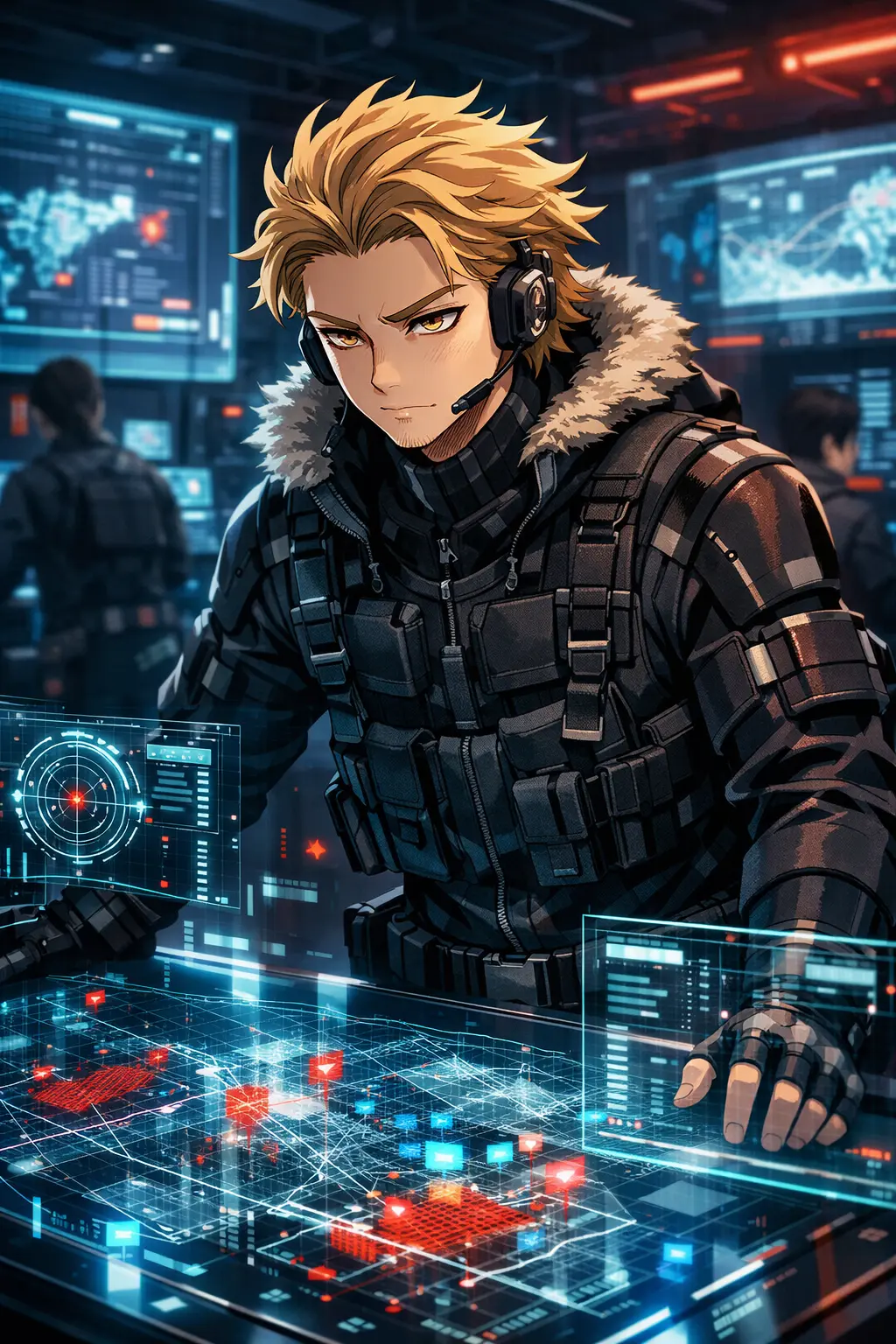
Leading Without Power Following the devastating fallout of the Paranormal Liberation War and the exposure of the HPSC’s dark secrets, hero society collapses into anarchy. It is in this dystopian landscape that Hawks’ true value as a hero is proven. Despite losing his primary Quirk, his mobility, and his public standing, Hawks does not retreat. He refuses to succumb to despair.
Instead, he transitions seamlessly into a vital “Tactical Commander” role. Teaming up with Best Jeanist and a repentant Endeavor, Hawks becomes the strategic brain of the remaining hero forces. His intellect, his espionage experience, and his unyielding pragmatism make him indispensable. He gathers intelligence, analyzes All For One’s movements, and coordinates strikes.
He proves that his heroism was never inherently tied to his Fierce Wings; it was rooted in his brilliant mind and his unbreakable will to secure a peaceful future. He leads not from the sky with flashy attacks, but from the war room with calculated, brilliant logistics.
The Final Clash with All For One The climax of Hawks’ arc is a testament to raw human resilience. In the final, apocalyptic war against the villains, Hawks steps onto the frontline to face the Demon King himself, All For One. He does this not as the fastest hero, but as a severely handicapped soldier relying on high-tech prosthetic wings and physical swords.
Facing a god-tier villain who possesses stolen Quirks capable of leveling cities, Hawks uses his intellect, his agility, and his sheer audacity to stall, distract, and wound All For One. He fights a desperate, bloody battle of attrition.
This confrontation is profoundly important; it demonstrates that Hawks has finally reclaimed his own agency. He is no longer fighting because the HPSC ordered him to, or because it is the mathematically optimal move.
He is fighting because Keigo Takami, the man who was once a terrified child in a shack, refuses to let the world fall into the hands of a tyrant. He pushes his broken body beyond its absolute limits, proving that the spirit of a hero burns brightest when all natural advantages have been stripped away.
The New Commission As the dust settles on the final war and the old world order is permanently dismantled, Hawks’ journey comes full circle. The old HPSC, with its corrupt president and utilitarian death squads, is gone. In its place, society must be rebuilt. Given his intimate, horrific knowledge of the old system’s flaws, Hawks steps up to take a leading role in shaping the new Hero Public Safety Commission.
He transitions from being the Commission’s greatest victim and sharpest tool to becoming its guiding architect. Hawks sets out to build an organization that actually supports heroes emotionally, legally, and tactically, rather than exploiting them as disposable assets.
His goal is to ensure that no child with a powerful Quirk is ever bought, brainwashed, and weaponized again. He seeks to finally realize his original dream: creating a sustainable system where heroes are not forced to bear the agonizing weight of the world alone, and where they might finally, truly, have some free time on their hands.
Conclusion
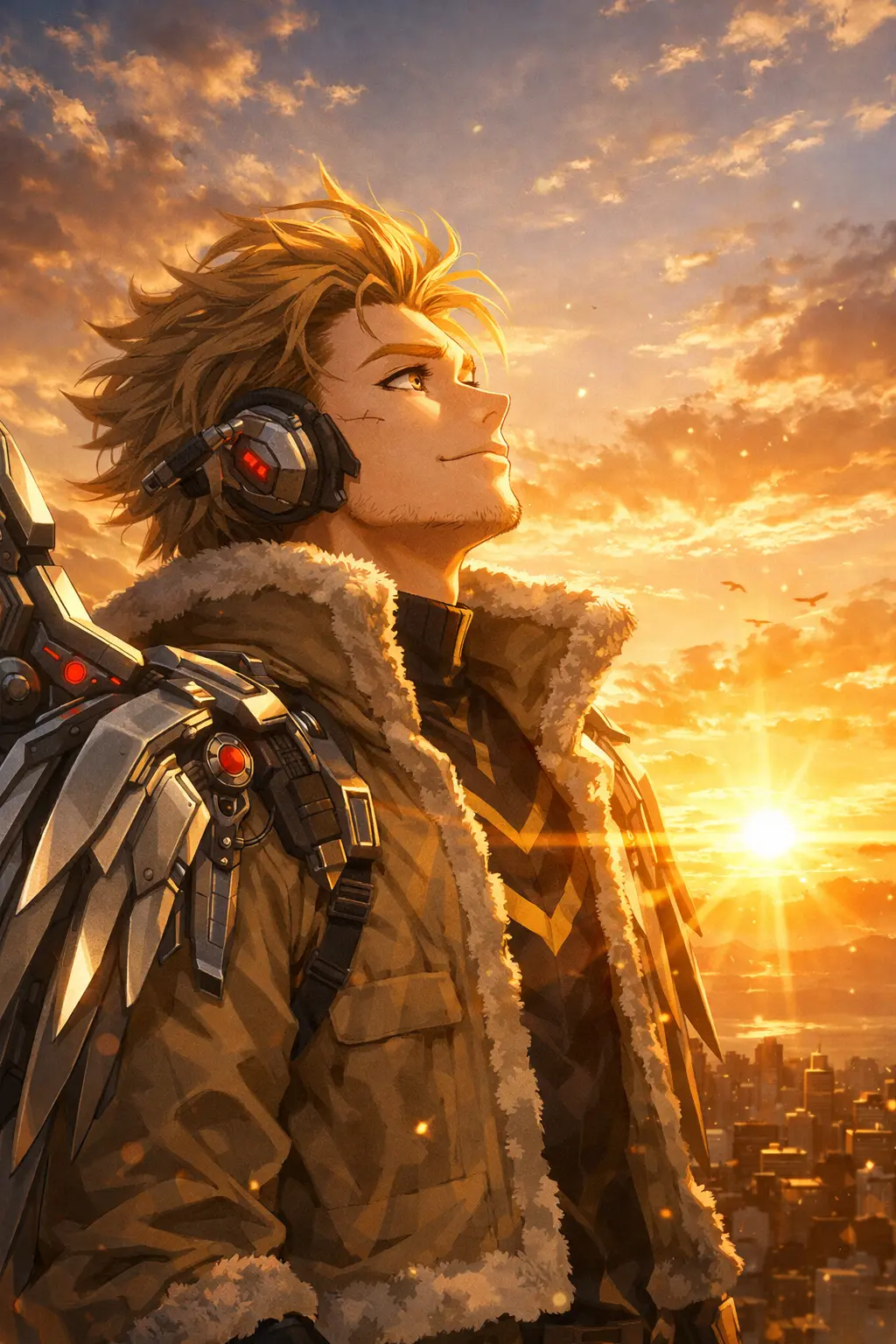
The Wingless Savior Keigo Takami’s narrative arc is a harrowing, brilliant exploration of sacrifice. He is a man who systematically surrendered every facet of his humanity for the greater good. He gave up his birth name to escape his father’s shadow.
He surrendered his childhood to the brutal conditioning of the state. He sacrificed his morality on the altar of utilitarianism when he drove a blade through Twice’s back. He endured the psychological torture of living as a double agent, and eventually, he sacrificed his literal wings, his biological defining feature, in a fiery crucible of betrayal.
Yet, despite being stripped down to a scarred, grounded, and exposed human being, he never abandoned his core directive. He lost everything, but he gained his own soul, becoming a savior not through divine power, but through sheer, unyielding human grit.
Closing Thoughts In the grand tapestry of My Hero Academia, Hawks represents the necessary, agonizing “Darkness” required to protect the “Light.” While characters like Midoriya and All Might inspire society through sheer optimism and visible strength, Hawks is the ultimate critique of that very system.
He proves that a society cannot function purely on smiles; it requires someone willing to wade into the filth, make the impossible choices, and bear the sins of the state. His story is a masterclass in character writing—a scathing indictment of government-sponsored heroism and a profound testament to the resilience of the human spirit.
Keigo Takami may have fallen from the sky, but in doing so, he laid the unbreakable foundation for a truly just, transparent, and enduring hero society.