
Introduction
The Burden of the Summit
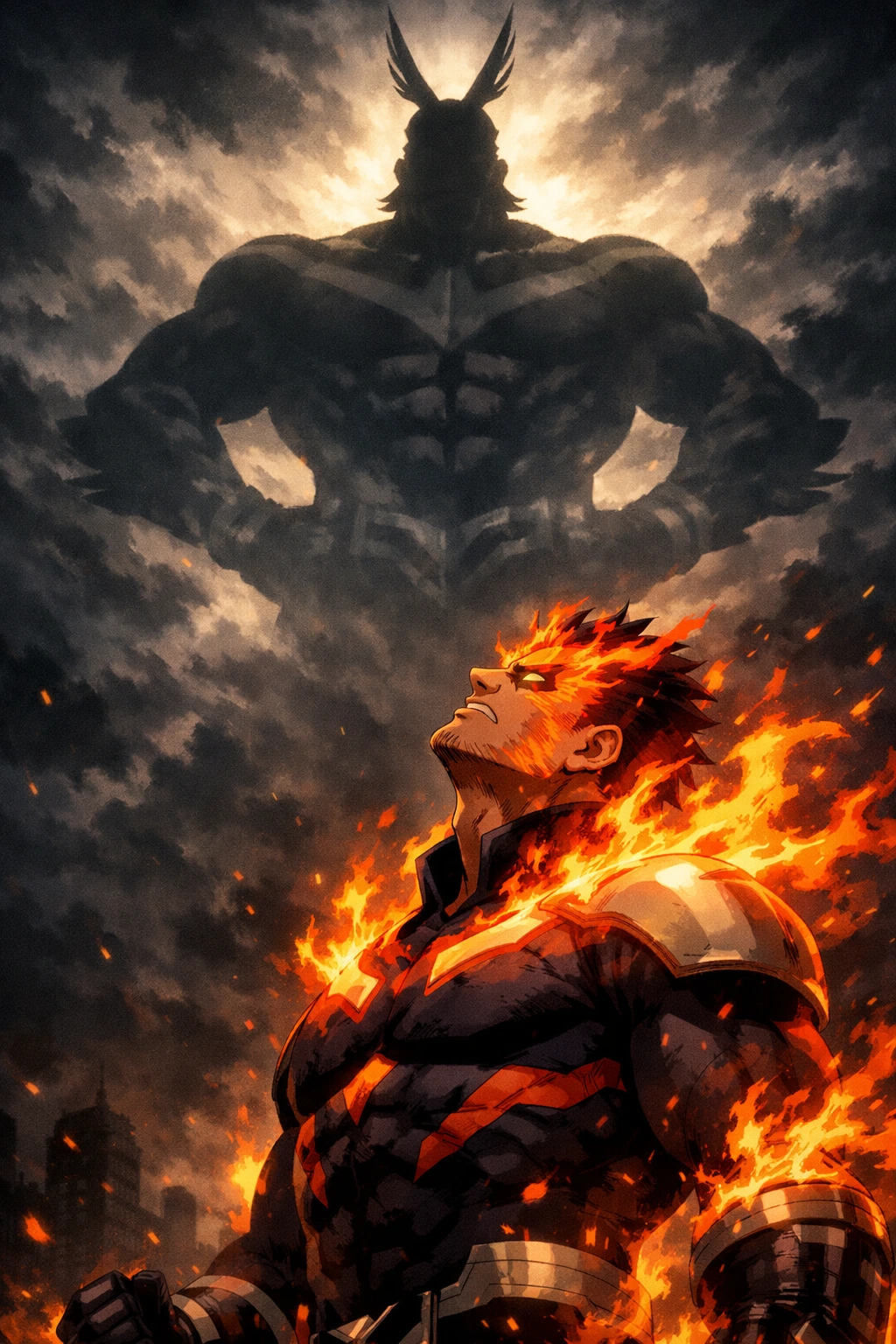
In the sprawling, superhuman-dominated landscape of My Hero Academia, no character embodies the crushing weight of relentless ambition quite like Enji Todoroki, the Flame Hero known as Endeavor. For decades, the societal hierarchy of heroes was defined by a singular, unshakeable pillar: All Might. While the masses looked upon All Might with reverence and comfort, Endeavor looked upon him with a suffocating, almost venomous obsession.
Endeavor was not merely the Number 2 Hero; he was the physical manifestation of raw, unyielding ambition, forever trapped in the shadow of an unreachable god. The summit of Hero Society was never designed to be shared, and Endeavor’s pursuit of that peak became a catastrophic endeavor that burned everything he touched.
His story is not one of a naturally gifted chosen one, but rather the agonizing tale of a man who realized that hard work, no matter how extreme, could not overcome the biological ceiling of his own existence. In his desperate bid to close an impossible gap, Enji Todoroki sacrificed his humanity, transforming his own home into a facility of eugenics and his family into tragic collateral damage in a war only he was fighting.
The Shift in the Symbol
The transition of Endeavor from a resentful, fiercely abusive powerhouse into a deeply flawed, self-reflective man forced to carry the weight of an entire society is arguably the greatest character arc in modern shonen anime. When the Symbol of Peace finally crumbled at Kamino Ward, the public did not simply lose their greatest protector; they lost their psychological safety net.
The mantle of Number 1 fell to Endeavor not by a triumphant victory, but by default—a bitter irony for a man who sacrificed his soul to earn it. Almost overnight, Endeavor was forced to realize that the throne he coveted was actually an electric chair.
Society did not need a man who could incinerate villains; they needed a man who could smile through the apocalypse and make them feel safe. Endeavor, a man whose entire public persona was built on intimidation, power, and an unapproachable fiery grimace, was biologically and psychologically ill-equipped for this role. His evolution from a tyrannical father and a jealous rival into a man desperately trying to stitch together the bleeding wounds of a fractured society is a masterclass in character development. He shifts from a villain in his own home to a tragic, Atlas-like figure holding up a collapsing sky.
Article Scope
This article serves as the definitive, expert-level breakdown of Enji Todoroki. We will move far beyond surface-level character summaries to deconstruct the biological and thermodynamic realities of the Hellflame Quirk. We will analyze the dark, horrifying truth of his eugenics project and the systemic failures of a society that allowed domestic terrorism to happen behind closed doors in the name of “heroism.”
Furthermore, we will dissect the psychological masterclass of his atonement arc, evaluating the tactical brilliance of his most defining battles, and exploring why his journey challenges the very foundation of black-and-white morality in storytelling. This is the anatomical, psychological, and sociological autopsy of the Flame Hero: Endeavor.
The Hellflame Quirk: Power vs. Biology
The Absolute Thermal Output
To understand Endeavor, one must first understand the terrifying reality of his Quirk: Hellflame. In the universe of My Hero Academia, Quirks are physical abilities, bound by the laws of physics, thermodynamics, and cellular biology.
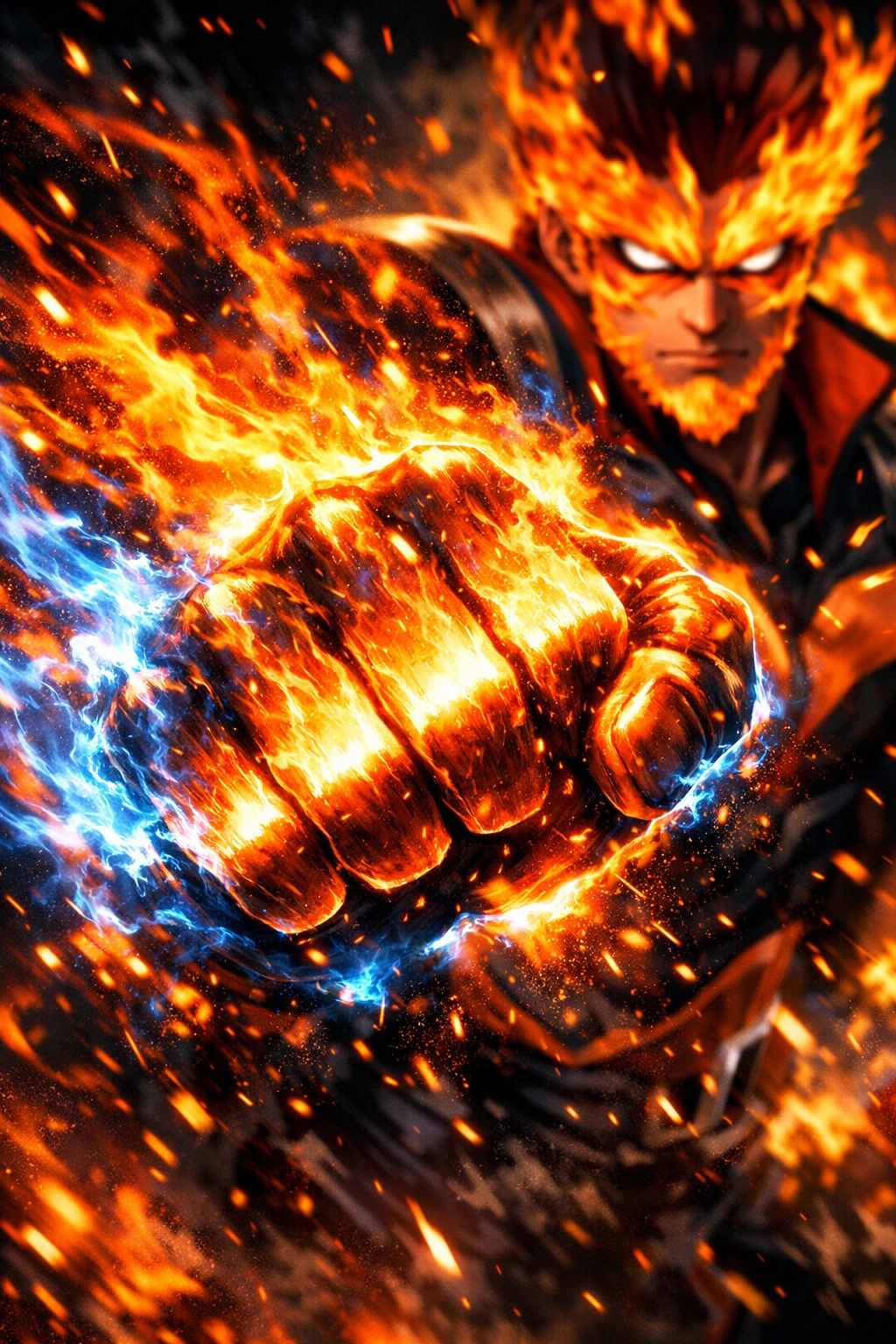
Hellflame is not magic; it is an extreme physiological mutation that allows Enji Todoroki to generate and manipulate phenomenally high temperatures of fire. The absolute thermal output of Hellflame is matched by almost no one in the world. Endeavor does not merely shoot fireballs; he manipulates heat density, thermal radiation, and kinetic energy.
He uses his Quirk for raw, devastating area-of-effect damage, completely incinerating targets at a cellular level, preventing regeneration. But the true mastery of Hellflame lies in its versatility. Endeavor utilizes thermal convection and thrust for high-speed mobility and sustained flight, mimicking the propulsion systems of a jet engine.
He uses localized heat for tactical crowd control, creating walls of impassable fire, and he can even melt solid concrete to alter the battlefield’s topography. His power is a terrifying force of nature, tamed only by decades of brutal, relentless training.
The Hardware Ceiling (The Overheating Flaw)
However, the most crucial aspect of Hellflame is its fatal biological limitation—the “Hardware Ceiling.” A Quirk is a physical appendage, and just like a muscle, it is subject to fatigue and physiological pushback. Endeavor’s body is capable of producing heat that rivals the surface of the sun, but his biological “hardware” (his internal organs, skin, and cellular structure) is not naturally equipped to cool down the massive amounts of heat he generates.
As he continuously uses Hellflame, his core body temperature spikes to lethal levels. This leads to rapid stamina depletion, severe dehydration, compromised cognitive function, and literal cellular damage. During prolonged fights, Endeavor is essentially cooking himself from the inside out. His muscles seize, his reaction times plummet, and his vision blurs.
This biological limitation was the invisible, insurmountable wall between him and All Might. All Might’s power had no immediate physiological drawback that limited his output in his prime; Endeavor’s power actively killed him the longer he used it. It is a cruel irony: the man who wanted to burn brighter than anyone else was limited by his own inability to withstand the heat.
The Flashfire Fist
To circumvent this biological death sentence, Endeavor developed his ultimate technique, a masterpiece of Quirk engineering: The Flashfire Fist. Rather than expelling massive, sweeping waves of fire which rapidly increase his core temperature, Endeavor learned to compress his extreme heat into a singular, hyper-dense point.
By maximizing the thermal density, he changes the nature of the fire from a blunt, widespread force into an ultra-sharp, concentrated cutting edge. The Flashfire Fist maximizes offensive lethality while temporarily minimizing the overall thermal feedback on his own body.
It is an attack born of pure desperation and tactical genius—a way to output maximum damage in a fraction of a second before his internal organs begin to shut down. Techniques like the Hell Spider and Jet Burn are derivations of this principle, showcasing Endeavor’s ability to turn a fundamental biological weakness into a highly specialized, surgically precise arsenal.
The Eugenics Blueprint: The Dark Side of Heroism
The Wall of Despair
The tragedy of the Todoroki family does not begin with malice; it begins with despair. Enji Todoroki reached an age where he realized his physical prime was peaking. He had trained harder than any man alive, solved more cases than any hero in history, and optimized his Quirk to its absolute, bleeding limit. And yet, when he looked at the back of All Might, the gap had not closed by a single inch.
This realization—that hard work is ultimately subordinate to genetic lottery—shattered his psyche. It is the darkest, most unspoken truth in a superhuman society: some people are simply born better. Facing this “Wall of Despair,” Endeavor’s ambition did not die; it mutated into a sickening obsession.
If he could not biologically surpass All Might in his own lifetime, he would engineer an offspring who could. He shifted from being a hero to a genetic architect, sacrificing his own moral compass on the altar of his inescapable inferiority complex.
The Quirk Marriage
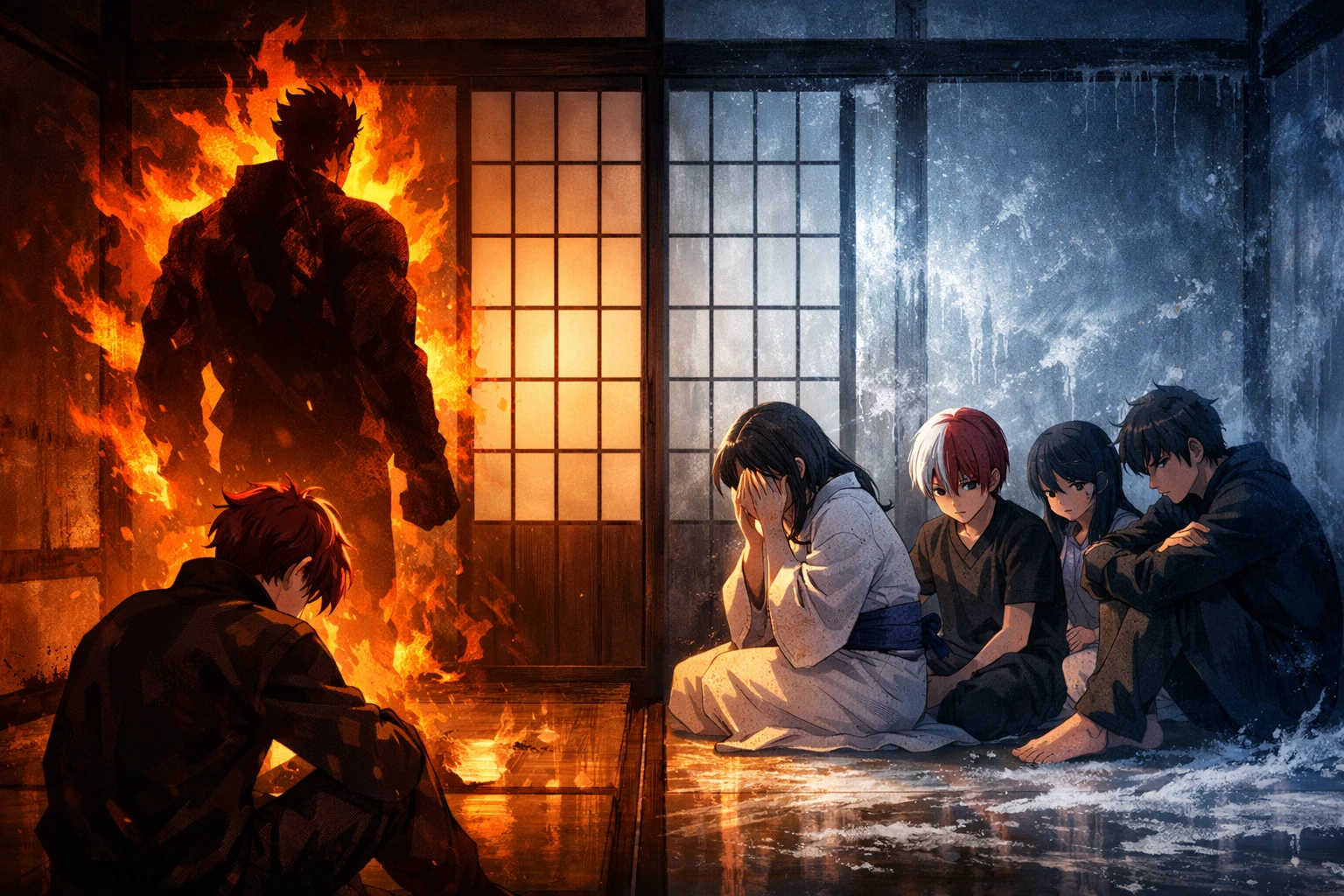
This psychological break led to the institution of the “Quirk Marriage,” a relic of an older, darker era of Hero Society that Endeavor revived for his own selfish purposes. Endeavor treated human reproduction not as the creation of life, but as an engineering project. He targeted the Himura family, specifically Rei, purely for her genetic traits.
He essentially bought her, utilizing his vast wealth and status to absorb her ice-based Quirk into his bloodline. His hypothesis was horrifyingly pragmatic: if he could combine Rei’s ice resistance (the ultimate cooling system, or the “Hardware”) with his devastating Hellflame (the “Software”), he could create a child with infinite thermal output and zero physiological drawbacks.
The marriage was devoid of love; it was a transactional, systemic abuse of power. Rei was removed from her life and reduced to an incubator for Endeavor’s madness, a biological puzzle piece meant to solve the equation that All Might had forced upon him.
The Discarded Prototypes
The execution of this eugenics blueprint resulted in the emotional and physical destruction of his entire family. His children were not viewed as human beings; they were prototypes. The eldest, Touya (who would become Dabi), was the first tragic failure. Touya inherited firepower greater than Endeavor’s, but tragically inherited Rei’s weak, ice-adapted physical constitution.
He was an engine too powerful for its own chassis, burning his own flesh whenever he used his Quirk. When Touya failed to meet the genetic expectations, Endeavor cast him aside, a rejection that would eventually breed the greatest villain of the era. Fuyumi and Natsuo were similarly discarded, treated as invisible failures who merely occupied space in a cold, loveless household.
This generational trauma culminated in the birth of Shoto—the “perfect masterpiece.” Shoto was born with the exact, flawless genetic equilibrium Endeavor had calculated: fire on the left, ice on the right. But the cost of this masterpiece was the sanity of his wife, the “death” of his eldest son, and the absolute destruction of his family’s soul. Endeavor built his legacy on a foundation of discarded children.
The Hood Encounter: The Weight of Number One
The Empty Throne
The retirement of All Might following the Kamino Ward incident sent a shockwave through the very fabric of society. For Endeavor, the moment he had dreamt of for decades finally arrived, but it was hollow, sickening, and devoid of glory. He was handed the Number 1 spot by default, inheriting an “Empty Throne.” The psychological shock was profound.
Endeavor realized immediately that the public did not cheer for him; they looked at him with anxiety. He had spent his entire life cultivating a persona of raw power and fear to intimidate villains, but now, the citizens needed a pillar of hope. They needed someone who could say, “I am here,” and make the terror go away. Endeavor could not do this.
He was entirely ill-equipped to be a Symbol of Peace. This existential crisis forced him into a period of deep, painful introspection. He had achieved his lifelong goal, only to realize that the goal itself was a fundamental misunderstanding of what it meant to be the greatest hero.
The Kyushu Battle (vs. High-End Nomu)
Endeavor’s first true test as the new Number 1 Hero occurred in Kyushu against the High-End Nomu, Hood. This battle was not just a physical brawl; it was a brilliant thematic and tactical narrative. Hood was designed to be a dark mirror to Endeavor.
The Nomu possessed overwhelming power, multiple Quirks, and most terrifyingly, a regenerative ability that granted it the infinite stamina that Endeavor biologically lacked. Hood represented the insurmountable, monstrous obstacle of Endeavor’s own limitations.
As the fight progressed, Endeavor was pushed to his absolute physical limit. His body began to overheat, his movements slowed, and the public watched in horror as their new Number 1 was seemingly outmatched. The battle forced Endeavor to realize that he could not rely solely on raw power anymore. He had to rely on sheer, unbreakable willpower. He had to show the world that even though he wasn’t All Might, he would not let them die.
The Prominence Burn & The Scar
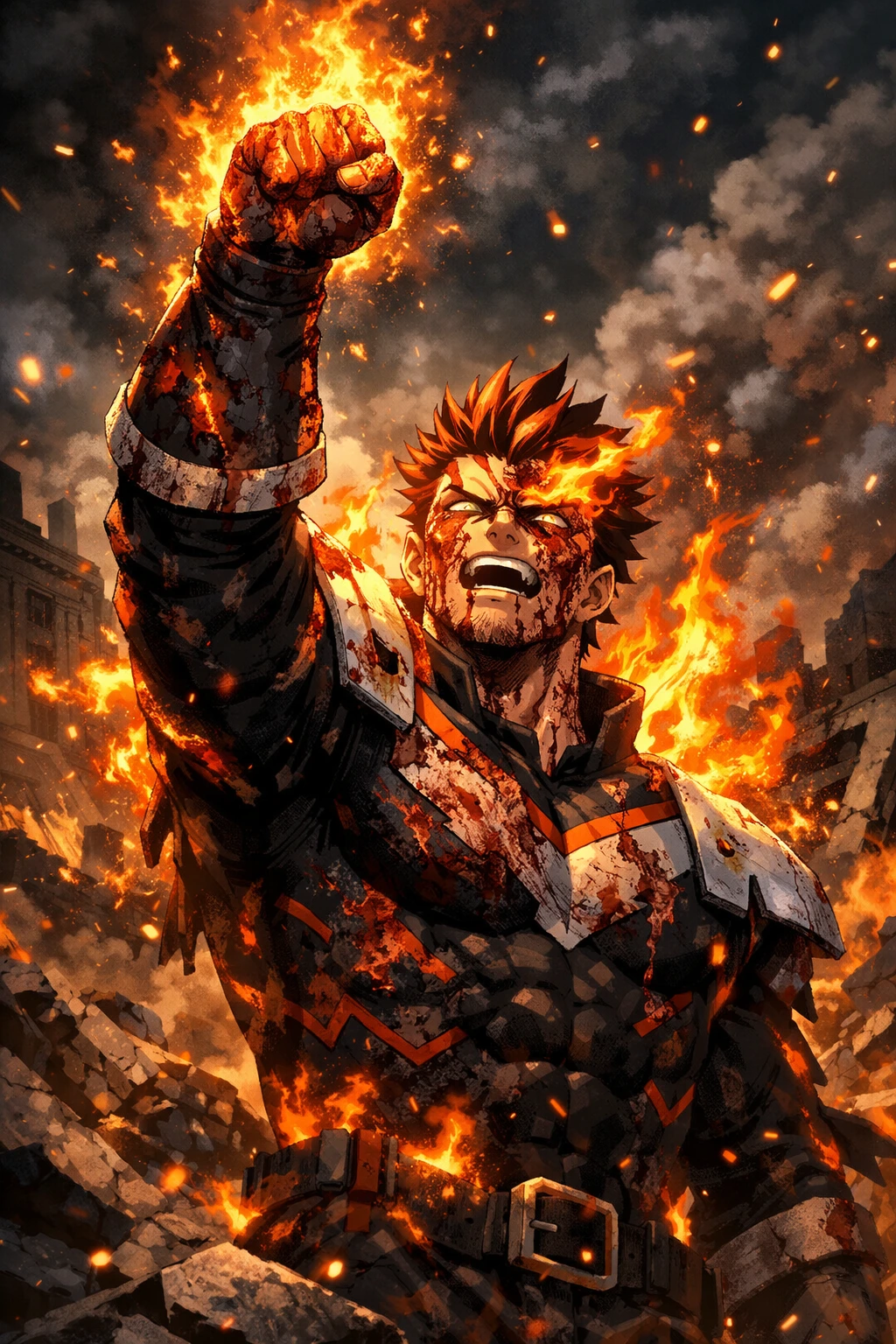
The climax of the Kyushu battle is one of the most iconic moments in My Hero Academia. Pushed to the brink of death, heavily wounded, and with his internal systems failing from heat exhaustion, Endeavor grappled Hood high into the atmosphere to avoid collateral damage to the city below. In a final, desperate move, he unleashed the Plus Ultra Prominence Burn.
To execute this, Endeavor had to consciously override his body’s survival instincts, pushing his internal temperature so high that it caused permanent, disfiguring damage to his own face, specifically destroying his left eye. This scar was not just a battle wound; it was a profound symbol.
It signaled to the terrified public, and to his deeply estranged family watching on television, that Enji Todoroki was willing to literally burn his own life away to protect them. He could not smile like All Might, but he could bleed for them. The scar became a permanent, physical reminder of the heavy toll of his new rank, and his desperate, agonizing first step toward becoming a true hero.
The Atonement Paradigm (Watching vs. Forgiving)
The Rejection of Absolution
Following his near-death experience, Endeavor embarks on a journey that defies traditional anime tropes. In most stories, a villainous character performs a heroic act, apologizes, and is immediately welcomed back into the fold. Horikoshi, however, writes a brilliant rejection of this absolution. When Endeavor faces his family, he does not demand their love.
He explicitly states, “I don’t want your forgiveness, I want to atone.” This is a crucial, mature psychological distinction. Forgiveness is a gift given by the victim to relieve the abuser’s guilt; atonement is the abuser taking responsibility for their actions without expecting anything in return.
Endeavor realizes that the scars he inflicted—both physical, like the burn on Shoto’s face, and psychological, like Rei’s institutionalization—cannot be wiped clean with a simple apology or a heroic battle. He accepts that his sins are permanent, and his redemption is not a destination he will ever reach, but an agonizing, lifelong process of paying a debt that can never fully be cleared.
The Family Dynamic Shift
To facilitate this atonement, Endeavor makes the ultimate sacrifice for a man obsessed with control: he removes himself from the equation. He builds a new home for Rei, Fuyumi, Natsuo, and Shoto, and explicitly states he will not live there with them. He removes his toxic presence so his victims can heal in peace. The family’s reaction to this is remarkably realistic and complex.
Fuyumi, driven by a desperate desire for a normal family, attempts to play the peacemaker, grasping at any sign of her father’s change. Shoto adopts a stance of cautious pragmatism; he acknowledges his father’s skill as a hero and is willing to use him to grow stronger, but remains deeply guarded emotionally.
Natsuo, representing the raw, unhealed trauma of the forgotten children, absolutely refuses to forgive him, harboring a deep, justified resentment for the “death” of Touya and the destruction of their mother. Endeavor accepts all of these reactions without arguing. He simply watches them from afar, enduring the pain of his isolation as a necessary consequence of his past.
The Agency Arc
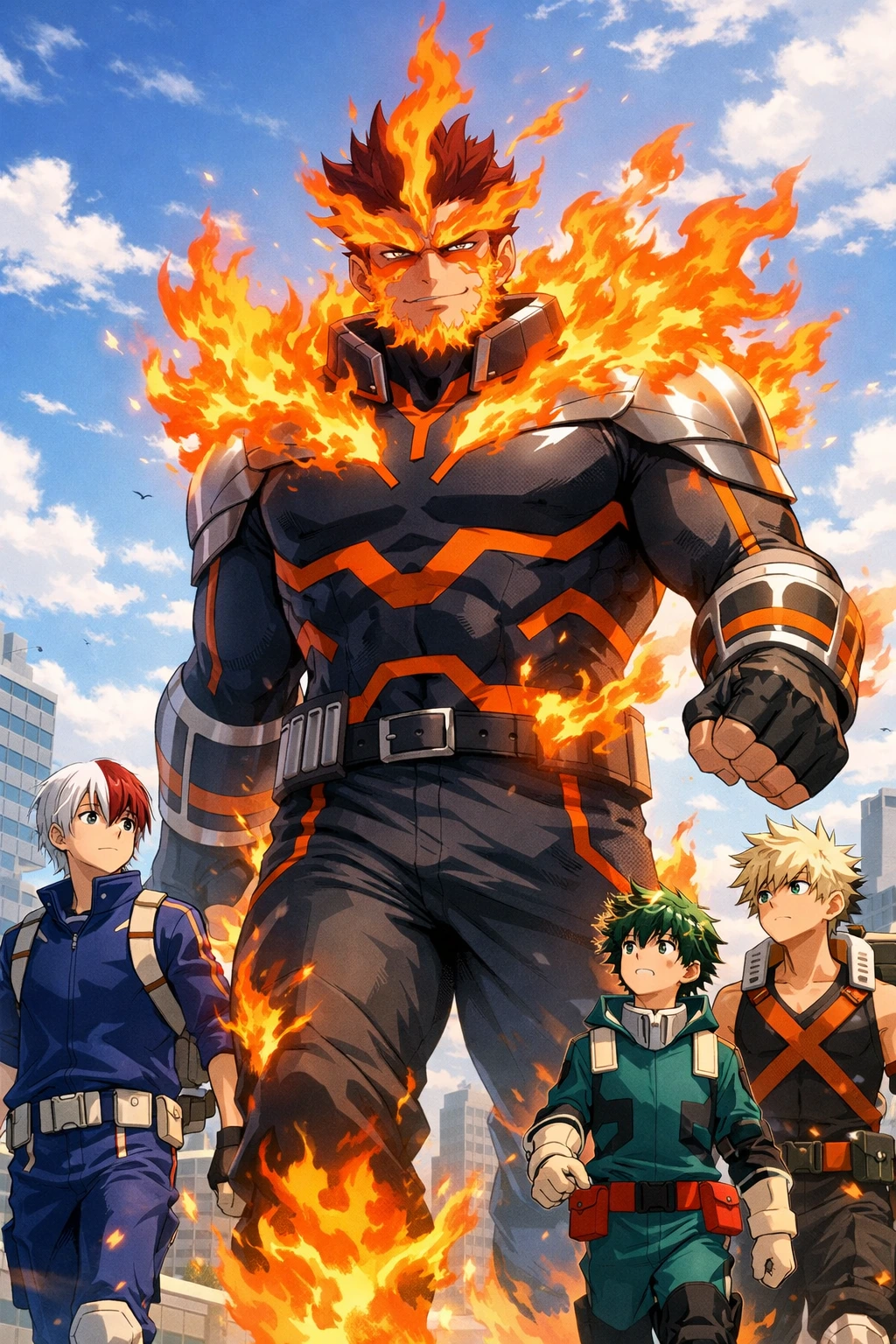
Endeavor’s evolution is further showcased during the Endeavor Agency Arc, where he takes on Izuku Midoriya, Katsuki Bakugo, and Shoto Todoroki as interns. Here, we see a completely different side of the Flame Hero. He transitions from a conqueror to a mentor. Rather than breaking them down, he passes down his unparalleled tactical intellect, his mastery of fundamental hero work, and his observational skills.
He teaches them the concept of parallel processing in combat—how to move, think, and rescue simultaneously. This arc proves his capability as a teacher and leader. He shows incredible patience, particularly with Izuku and Bakugo, proving that the brutal, abusive training he forced upon Shoto in the past was not the only way he knew how to operate.
It was a conscious, terrible choice he made back then. By teaching the next generation the right way, without abuse or cruelty, he takes another step toward systemic atonement, ensuring that the heroes of tomorrow are built on a foundation of skill and wisdom, rather than fear and trauma.
The Dabi Paralysis: When the Past Manifests
The Broadcast of Sins
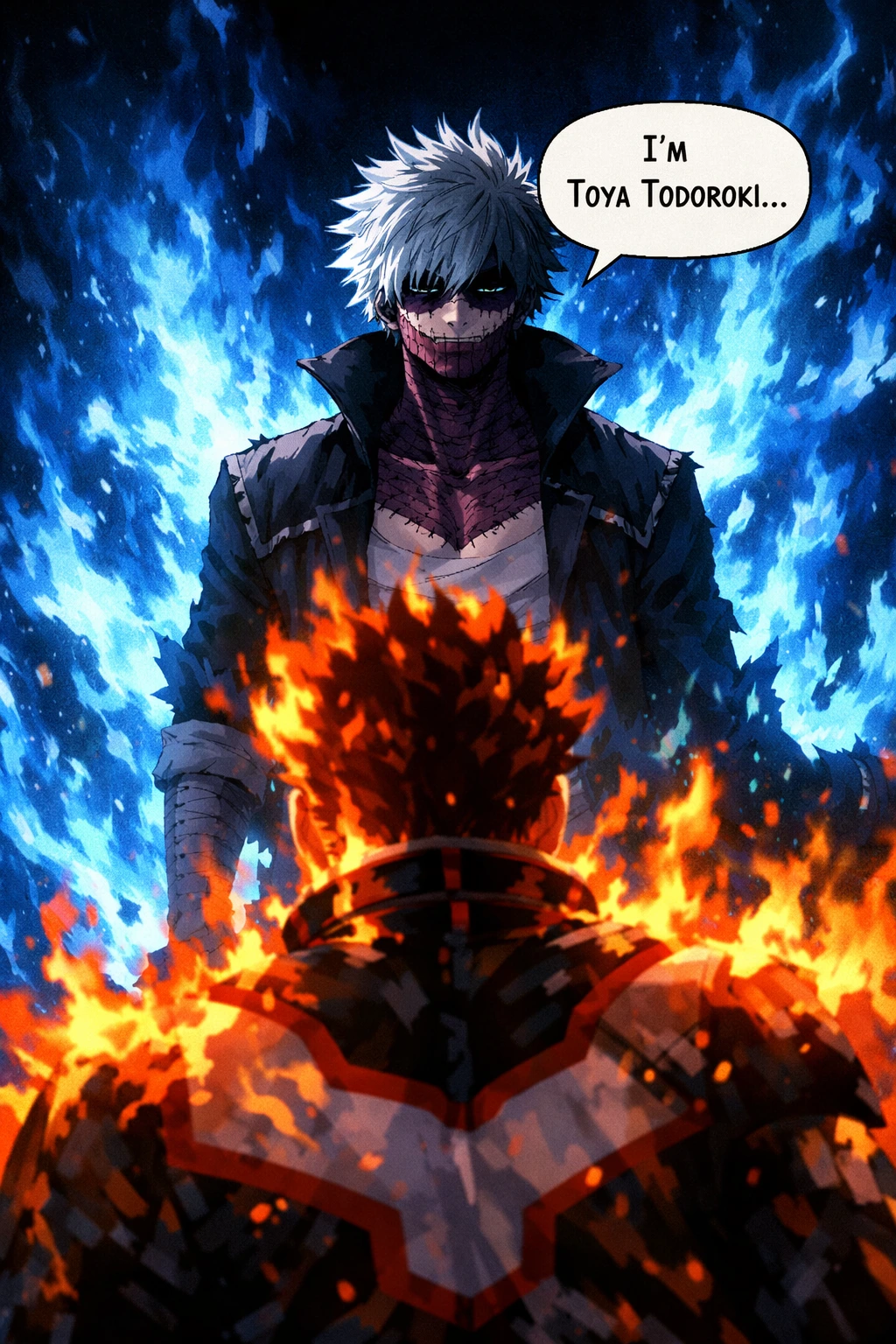
The agonizing progress Endeavor makes toward atonement is violently shattered during the Paranormal Liberation War. In the midst of the most catastrophic battle Hero Society has ever faced, the past physically manifests to destroy him. The villain Dabi, standing atop the battlefield, pours water over his head to wash away his black hair dye, revealing stark white hair. He broadcasts a pre-recorded video to the entire nation, revealing his true identity: Touya Todoroki, Endeavor’s firstborn son. The revelation is a psychological atomic bomb.
The exact moment Enji Todoroki hears the truth, he experiences a complete, catastrophic psychological collapse. The Number 1 Hero, the man who had just stood against the strongest Nomu and the League of Villains, freezes completely.
He is paralyzed on the battlefield. His mind breaks as he realizes that the nation’s greatest, most murderous threat was created by his own hands. The abuse, the neglect, the eugenics project—every sin he thought he was slowly atoning for was standing right in front of him, covered in burns and laughing maniacally.
The Collapse of Society
The fallout from “Dabi’s Dance” extends far beyond the Todoroki family; it is the catalyst for the total macro-collapse of Hero Society. The public, already terrified by the rampant destruction and the retirement of All Might, watches the broadcast in horror.
They realize that their current Symbol of Peace, the man they entrusted with their lives, is a domestic abuser who drove his own wife to madness and his son to mass murder. The faith in the hero system is completely, irrevocably shattered. Endeavor’s personal failures directly cause a sociological collapse.
Heroes begin retiring en masse, unable to handle the public’s vitriol. Civilians take up arms to defend themselves, leading to chaotic vigilante justice. Endeavor is forced to realize the terrifying scope of his actions: his private pursuit of power did not just destroy his family; it ultimately destroyed the entire country he was sworn to protect. He becomes the most hated man in Japan, carrying not only the guilt of a failed father but the burden of a broken nation.
The Final Stand: Pushing Past the Limit
The Broken Hero
Heading into the Final War arc against Tomura Shigaraki and All For One, Endeavor is a fundamentally broken man. He is missing an arm, his reputation is in ashes, his family is fractured, and his body is failing. Yet, he continues to fight.
The motivation behind his actions has entirely shifted. He is no longer fighting for glory, for the Number 1 spot, or to surpass All Might. He is fighting strictly out of a desperate, agonizing need to clean up his own mess. He recognizes that he represents the sins of the previous generation, and it is his absolute duty to ensure those sins do not consume the next generation—specifically Deku, Bakugo, and his own son, Shoto.
His mental state is one of grim determination. He expects to die on the battlefield. For Endeavor, the final war is not a quest for victory; it is an execution sentence he willingly walks into, hoping that his death can buy enough time for the world to heal.
The Battle Against All For One
Endeavor’s tactical confrontation with the Demon Lord, All For One, represents the tragic culmination of his Hellflame Quirk. Facing an enemy with near-infinite power and regenerative capabilities, Endeavor is forced to rely on raw, suicidal determination. He pushes his body beyond any biological limit previously established.
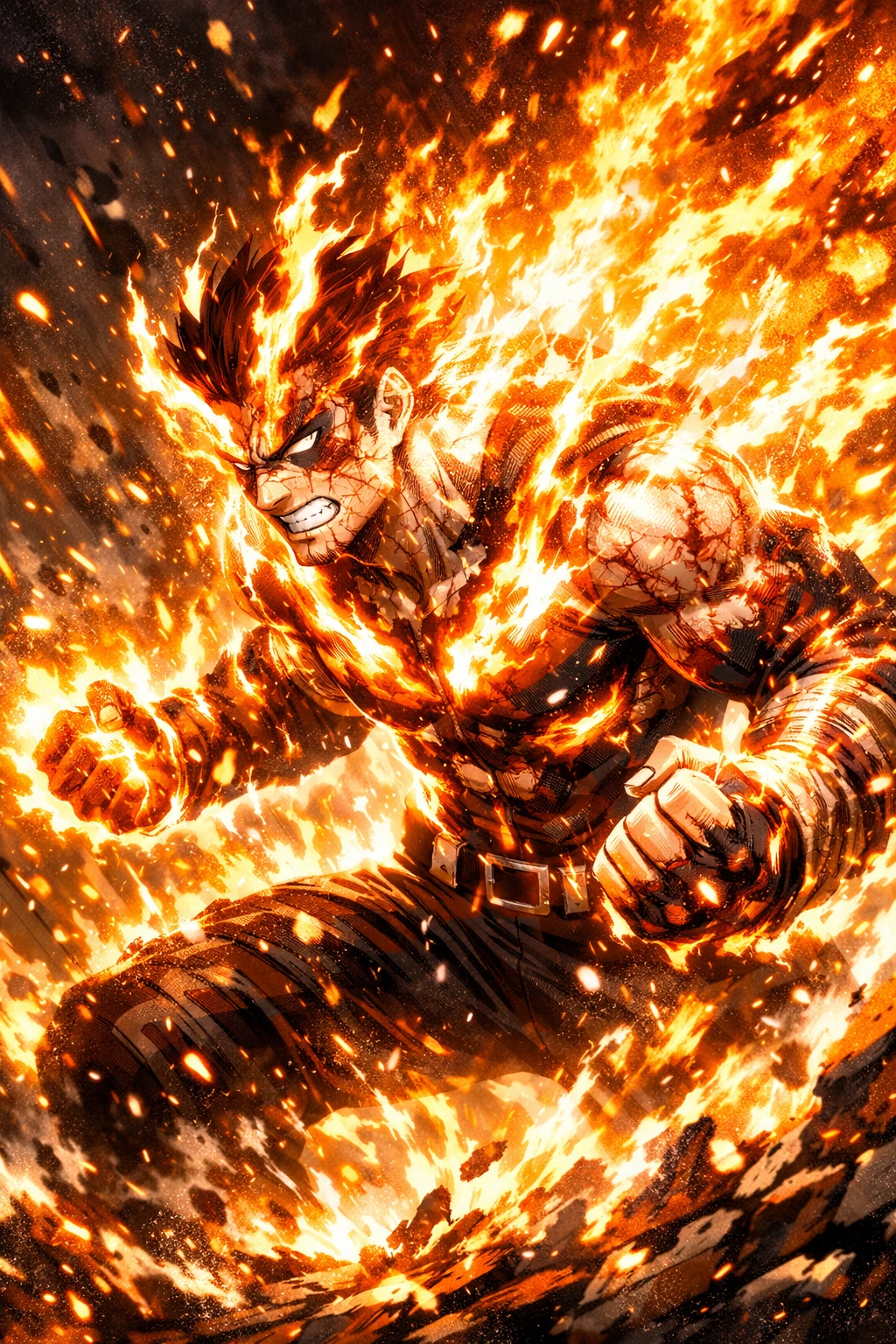
Utilizing techniques like the “Ignited Arrow,” he compresses his flames to a microscopic point to pierce AFO’s defenses. But the cost is catastrophic. Endeavor sacrifices his own body to maintain the assault. He pushes his internal temperature so unimaginably high that his own flesh begins to char, his blood boils, and his internal organs literally begin to fry.
He fights through the searing agony of cooking himself alive because he knows that if he stops, the world ends. It is the ultimate irony: the man who spent his life terrified of his Quirk’s biological limits finally embraces them, weaponizing his own death to protect the future. It is a brutal, visceral, and horrifyingly heroic final stand that cements his legacy not as a perfect Symbol, but as a deeply flawed human who gave everything he had left.
Conclusion
The Most Human Hero
Enji Todoroki, Endeavor, stands as arguably the most realistically flawed, deeply developed, and phenomenally written character in My Hero Academia. He is a stark departure from the traditional archetypes of the genre. He is not purely evil, nor is he purely good.
He is a man who committed monstrous, unforgivable acts in the pursuit of greatness, only to spend the rest of his life bleeding to make up for a fraction of the damage he caused. His character arc is a profound testament to the fact that redemption is not a singular event, but a lifelong, agonizing process.
He proves that while we cannot change the atrocities of our past, we are still responsible for the actions of our future. Endeavor is the most “human” hero in the series because his struggles—jealousy, inadequacy, the desire for control, and the desperate yearning for forgiveness—are raw, ugly, and universally recognizable.
Closing Thoughts
Endeavor’s narrative successfully and radically challenges the black-and-white morality of traditional shonen anime. He forces the audience to grapple with uncomfortable questions: Can an abuser ever truly be a hero? Does saving a million lives erase the destruction of one family?
Horikoshi refuses to provide easy answers. By the end of his journey, Endeavor is not fully forgiven, and his family is not magically fixed. But he is trying. And in a world filled with gods, monsters, and shining symbols of perfection, the sight of a broken, burning man dragging himself through the mud to fix his own mistakes is perhaps the most compelling definition of heroism the series has ever offered.
Endeavor’s fire consumed his life, but from those ashes, a remarkably profound narrative of human struggle was born.