
In the vast, sprawling pantheon of Solo Leveling, where hunters transcend humanity and shadows rise to serve a new lord, there exists a ceiling. A hard limit to power that no mortal logic can surmount. A singular entity that defines the absolute peak of destruction. While Sung Jin-Woo captures our hearts as the underdog who became a god through endless struggle and leveling, there is another figure who demands our awe not through growth, but through static, terrifying perfection. He does not level up; he is the level cap.
He is the oldest evil. The primordial flame. The King of Dragons.
His name is Antares, the Monarch of Destruction.
To understand the lore of Solo Leveling is to understand that the entire story is essentially a collision course toward this one being. He is not merely a villain in the traditional sense; he is a force of nature, an inevitability as certain as death itself. While other Monarchs schemed, plotted, and possessed human vessels to navigate the restrictions of the world, Antares waited. He did not need to scheme. When you are the incarnation of the end times, you do not need a plan—you only need to arrive.
This comprehensive analysis delves into the very essence of the Dragon Emperor, dissecting why he stands unrivaled as the true “King of Dragons” and why his presence elevates the stakes of the series from a hunter’s survival story to a cosmic war for the survival of reality itself.
1. Introduction: The Calamity Incarnate
The Final Boss: Establishing the Strongest Existence
In narrative storytelling, the “Final Boss” is a trope often mishandled. They are frequently introduced too late, given flimsy motivations, or are overshadowed by the protagonist’s sudden power-up. Antares defies this trope by being the looming shadow over the entire narrative. From the moment the concept of “Monarchs” was introduced, the narrative whispered of a leader—a being so powerful that the other Monarchs, creatures of arrogance and immense pride, bowed their heads in genuine fear.
Antares represents the strongest existence in the universe, excluding only the Absolute Being who created him. His strength is not borrowed from a system, nor is it the result of training. It is intrinsic to his existence. In the hierarchy of power, Hunters are at the bottom, National Level Hunters are above them, the Rulers and Monarchs sit in the celestial sphere, and Antares sits upon the throne looking down at them all. To fight him is not to fight a warrior, but to fight the concept of apocalypse itself.
The Titles: “The King of Dragons” and “The Monarch of Destruction”
Names hold power, and Antares bears two titles that define his dual nature, each carrying a weight that bends the reality around him.
- The King of Dragons: This signifies his biological and hierarchical supremacy. He is the progenitor and absolute ruler of the Dragon race, the strongest magical beasts in existence. Every dragon, from the wyverns to the calamitous Kamish, is merely a lesser reflection of Antares. He is the source code from which all draconic might is derived.
- The Monarch of Destruction: This signifies his purpose. He is the concept of entropy given form. He does not destroy out of anger, malice, or a desire for conquest; he destroys because that is his function in the cosmic balance. Just as gravity pulls, Antares destroys. It is a fundamental law of the Solo Leveling
The Aura: Power Over Schemes
Consider the other antagonists Jin-Woo faced. The Architect was a genius-level intellect who built the System to find a vessel. The Monarch of Frost and the Monarch of Beast relied on ambushes, deception, and numbers to try and take down Go Gun-Hee and later Jin-Woo. They were schemers because they were vulnerable. They knew that in a fair fight, they could lose.
Antares has no need for schemes. Throughout the eons of war between the Rulers and the Monarchs, Antares rarely resorted to trickery. His aura is one of suffocating confidence. When he finally descended onto Earth, he didn’t hide in a dungeon or disguise himself as a human. He didn’t mask his presence. He arrived with the subtlety of a supernova, instantly saturating the entire planet’s atmosphere with mana so dense it felt like the sky was collapsing. The very air vibrated with the heat of his existence, signaling to every living thing that the end had arrived.
The Goal: A World of Nothingness
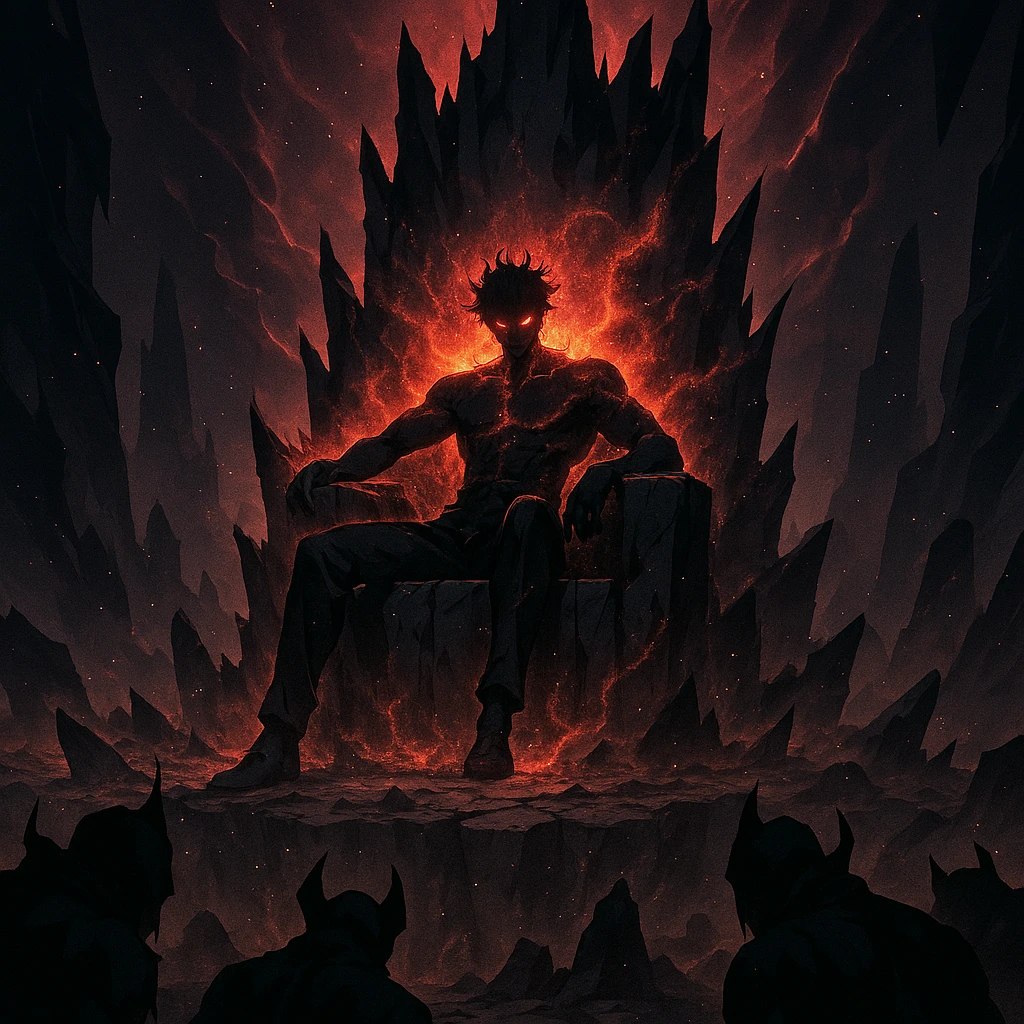
Unlike human villains who want money, political power, or immortality, Antares’ goal is terrifyingly simple and philosophically pure. He was created by the Absolute Being with a single, unyielding directive: Destroy.
He seeks to wipe out all creation—the worlds of the Rulers, the Earth, and eventually, perhaps even himself once his purpose is complete. He desires a silence of existence, a return to the void. This makes him impossible to negotiate with. You cannot bribe a hurricane to stop blowing; you cannot convince a fire not to burn. You can only extinguish it, or be consumed. His motivation is not personal; it is absolute, making him a terrifyingly unstoppable force.
2. Origin and Nature (The Oldest Evil)
Primordial Darkness
In the beginning, there was the Light and the Darkness. The Absolute Being split the darkness into eight fragments, creating the Monarchs. Of these eight, Antares was the strongest. He is the Oldest Evil, the first shadow cast by creation.
This origin story is crucial because it separates him from biological evolution. Antares did not “evolve” into a dragon through natural selection. He defined what a dragon is. He was born from the purest concentration of primordial darkness, designed specifically for war. His very soul is a fusion of mana and malice, forged to be the ultimate weapon against the Emissaries of God (the Rulers). He is the archetype of power, the mold from which all other monsters are cast.
The Monarchs’ Leader
Why do beings like the Monarch of Plagues (Querehsha), who commands armies of insects and decay, or the Monarch of Iron Body, a living fortress, follow him? These are beings capable of destroying nations with a wave of their hand. They are arrogant, selfish, and driven by their own desires. Yet, they follow Antares without question.
The answer lies in the hierarchy of violence. The Monarchs are apex predators, and they recognize the one true king of the jungle. They know that if they were to turn against Antares, they would not be fighting a war; they would be committing suicide. His leadership is not political; it is a law of nature. The strong rule the weak, and Antares is the strongest. Even the treacherous Monarchs who betrayed Ashborn did so only because they feared Ashborn might rival Antares, potentially upsetting the balance of power that kept them safe. They feared the rise of a second supreme power almost as much as they feared Antares himself.
The Dragon Race: His Subjects and Children
In most fantasy tropes, dragons are solitary, greedy creatures guarding hoards of gold. In Solo Leveling, dragons are soldiers. Antares is the commander of the Army of Destruction. Every dragon in existence is linked to him through blood and mana.
This connection goes beyond simple loyalty. It is a biological imperative. The dragons share a lineage of mana with their King. When we look at Kamish, the dragon that decimated the American West Coast and killed the world’s greatest hunters, we must realize a chilling fact: Kamish was a foot soldier. Kamish was merely a subordinate, a fraction of the power Antares wields.
If a lowly soldier like Kamish could bring humanity to its knees, destroying cities and resisting the world’s elite hunters, what does that say about the King? Antares is to Kamish what a nuclear warhead is to a hand grenade. The difference in scale is incomprehensible to the human mind.
Philosophy: “Power is Absolute”
Antares possesses a warped but consistent code of honor. He respects strength above all else. This is why he held a grudging respect for Ashborn (The Shadow Monarch). He viewed the Rulers as hypocrites for trying to maintain peace and order, but he viewed Ashborn as a worthy equal, a fellow warrior forged in the chaos of battle.
His philosophy is that existence is a struggle for dominance. Those who cannot protect their existence deserve to be destroyed. This Darwinian view creates a fascinating dynamic with Jin-Woo. Antares does not hate Jin-Woo for being human; he hates Jin-Woo for being a “container” that limits the true potential of the Shadow Monarch’s power. To Antares, weakness is the only true sin, and strength the only virtue.
3. The Army of Destruction vs. The Shadow Army
Quality over Quantity
The central conflict of Solo Leveling’s finale is the clash of two infinite ideologies: The Shadow Monarch’s Quantity (Death is eternal, numbers are limitless) vs. The Destruction Monarch’s Quality (Absolute power, unbeatable units).
Sung Jin-Woo commands millions. His shadow soldiers can regenerate, hide, swarm, and reassemble. It is a terrifying ocean of ink and darkness that drowns opponents. However, Antares counters this with the “Elite” nature of the Dragon Army. He does not need millions; he has thousands of calamities.
In the final war, we see the disparity clearly. A single breath from a dragon can vaporize hundreds of shadow soldiers instantly. But unlike normal enemies, the dragons don’t just “kill” the shadows; they erase them. The quality of Antares’ forces forces Jin-Woo to fight a desperate battle, proving that infinite numbers mean nothing against absolute power.
Ancient Dragons: More Than Beasts
The Army of Destruction is not composed of mindless beasts acting on instinct. The Ancient Dragons under Antares’ command are intelligent, magic-using entities. They are capable of speech, tactics, and complex spellcasting.
While Jin-Woo’s army (Bellion, Igris, Beru) has personality and individual strength, the average shadow soldier is a drone. The average Ancient Dragon is a calamity. They possess scales that repel magic, claws that shear through dimensional barriers, and the “Dragon’s Breath”—a concentrated beam of mana that rivals the output of modern nuclear weaponry. They function as a highly disciplined military unit, executing Antares’ will with terrifying precision.
Kamish: A Case Study in Servitude
To truly understand Antares, we must revisit Kamish. Kamish was a catastrophe for humanity. It took five National Level Hunters and dozens of S-Ranks to subdue him, and most died in the process. The world trembled at his name.
Yet, in the presence of Antares, Kamish would have bowed instantly. Kamish’s Runestone provided a skill (Dragon’s Fear) that Jin-Woo used to dominate lower beings. Antares uses the original version of this power, not as a skill, but as a passive aura. The difference in scale is astronomical. Kamish was a scout sent ahead to test the waters; Antares is the tsunami that follows. The fact that Kamish is considered a “minion” puts the threat of Antares into a perspective that pure stats cannot convey.
Tactical Disadvantage: The Breath of Destruction

The most terrifying aspect of fighting Antares is that he renders Jin-Woo’s greatest advantage null and void. The Shadow Army is fearsome because it is immortal. Cut down a shadow, and it rises again, reforming from the darkness. Infinite stamina is their hallmark.
However, the Breath of Destruction—the signature attack of Antares and his kin—does not just damage the physical form. It burns the mana itself. It attacks the concept of existence. When a shadow soldier is hit by the Breath of Destruction, they cannot regenerate. They are permanently erased from the Shadow Monarch’s inventory, their existence scrubbed from reality.
This forced Jin-Woo to change his entire strategy. He could not rely on attrition or waves of disposable soldiers. He could not “swarm” Antares. He was fighting a war against an enemy that could permanently delete his army, turning his greatest strength into a finite resource.
4. The Rivalry: Antares and Ashborn
The Ancient War
The relationship between Antares and Ashborn is the emotional anchor of the mythos. Eons ago, they fought side-by-side against the Rulers. They were the two strongest Monarchs—Darkness and Destruction.
They were two sides of the same coin. Ashborn commanded the dead; Antares commanded the destroyers. Together, they were unstoppable. However, the balance shifted when the Rulers used the “Cup of Reincarnation” to rewind time and eventually managed to isolate the Monarchs. Their shared history is one of endless bloodshed, camaraderie in chaos, and an eventual, tragic divergence of paths.
Mutual Respect
Despite being on opposing sides after Ashborn’s complicated history (defecting to the Monarchs, then being betrayed, then becoming a third party), Antares never hated Ashborn. He pitied him.
Antares viewed Ashborn’s desire to protect the Rulers (his former brethren) as a weakness, a flaw in a perfect warrior. Yet, he acknowledged that Ashborn was the only being capable of killing him. This creates a tragic undertone to their rivalry. It is a battle between the only two beings in the universe who can truly understand each other’s burden of power. They are peers in a universe of inferiors, lonely gods at the summit of existence.
The Betrayal
When the Monarchs of Beast and Frost conspired to kill Ashborn, they asked Antares for help. He refused.
This moment defines Antares’ character. He is evil, yes, but he is not a coward. He considered it “beneath him” to gang up on a warrior like Ashborn. He wanted to defeat the Shadow Monarch in single combat, army against army, flame against shadow. He wanted a conquest, not an assassination. This pride is both his greatest virtue and his fatal flaw. He sought a definitive end to their rivalry, one decided by strength rather than treachery.
The Vessel: Disappointment in Humanity
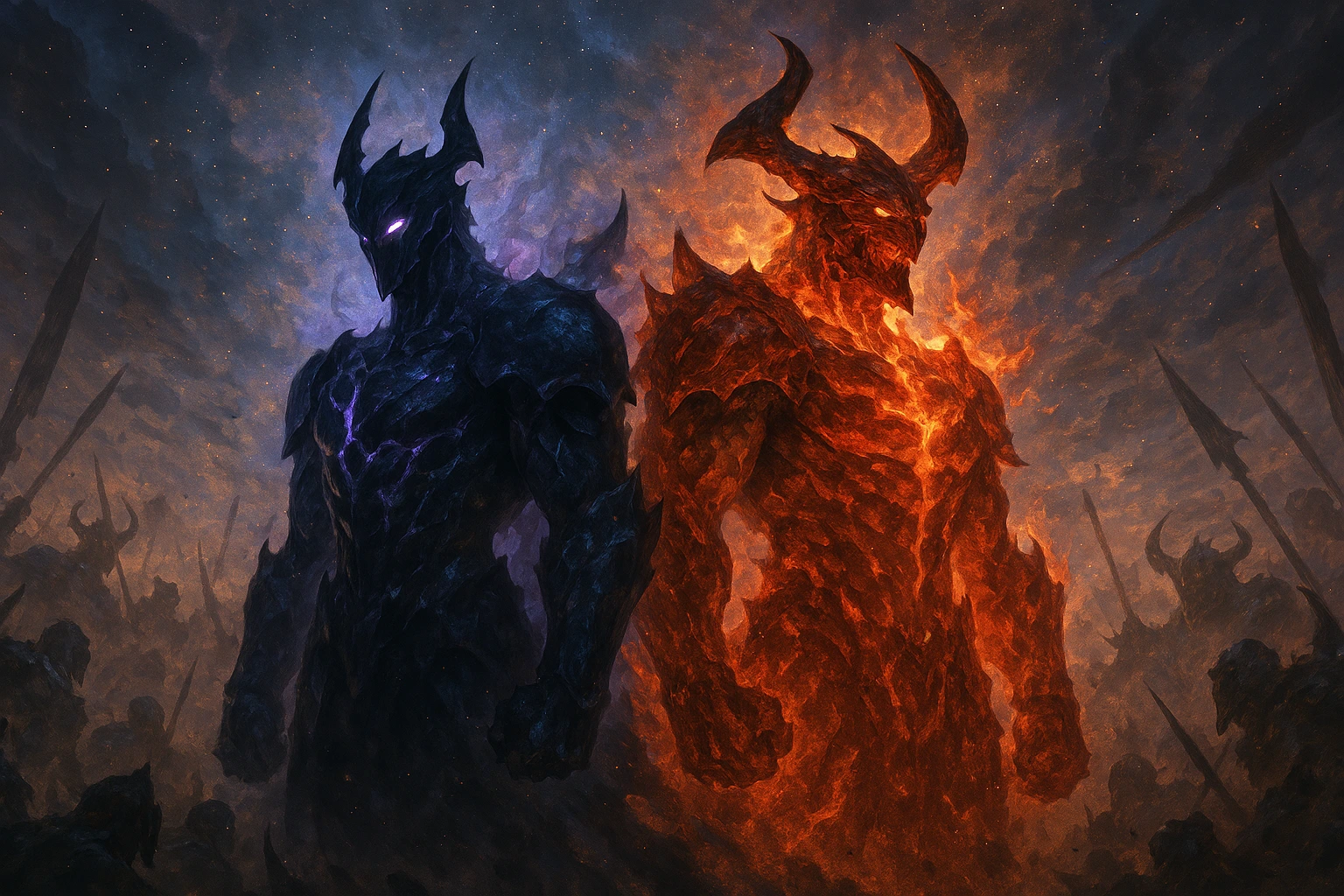
When Antares finally meets Sung Jin-Woo, his initial reaction is palpable disappointment. He does not see a worthy adversary; he sees a human wearing a god’s skin.
He taunts Jin-Woo, constantly referring to him as a “fake” or a distinct entity from Ashborn. Antares wanted to fight his old rival one last time. Instead, he got a clever human. This underestimation stems from his arrogance—he cannot conceive that a human’s adaptability could surpass a Monarch’s raw power. He failed to see that Jin-Woo wasn’t just wearing Ashborn’s power, but evolving it.
5. Powers and Abilities (The Ceiling of the Series)
Dragon’s Fear (Dragon’s Roar)
While Jin-Woo uses “Dominator’s Touch” or general intimidation, Antares possesses the progenitor of all intimidation skills: Dragon’s Fear.
This is not a mind game or a psychological trick. It is a physical pressure wave. When Antares unleashes his killing intent, the air becomes heavier than lead. S-Rank hunters, beings who have faced death countless times, freeze instantly. Their instincts scream at them to die rather than face the source of the fear. It paralyzes the nervous system of anyone lacking sufficient mana to resist it. It strips away courage and logic, leaving only the primal urge to flee or perish.
Breath of Destruction
We have mentioned this before, but it deserves its own analysis. The Breath of Destruction is arguably the strongest offensive attack in the Solo Leveling universe.
It is a concentrated beam of pure thermal and magical energy. It doesn’t just burn; it disintegrates. It erases matter at a molecular level. Against this breath, physical defense is meaningless. Magical barriers are stripped away layer by layer. The only way to survive it is to have an opposing force of equal magnitude (like Jin-Woo’s supreme shadow mana) or to dodge. It is an eraser for the canvas of reality.
Spiritual Body Manifestation: The Red Dragon
Every Monarch has a spiritual body form. Antares’ form is a gigantification that eclipses mountains. He transforms into a colossal, red-scaled European-style dragon.
In this form, his physical strength is immeasurable. A swipe of his claw alters the topography of islands. His scales are impervious to almost all damage, shrugging off attacks that would level cities. He becomes a flying fortress of apocalypse. The visual of this massive red dragon blotting out the sky is the ultimate representation of despair for humanity. He becomes the sky, the fire, and the end.
Spatial Manipulation
Antares is so powerful he does not need Gates to travel in the same way others do. He can tear through dimensional barriers with brute force. He can drag opponents into his own domain or isolate them in a pocket dimension of fire and ash. This spatial control means there is no running from him. If he wants you dead, distance is not a factor; he will bend space itself to bring you within reach of his flames.
6. The Final Battle: Jin-Woo vs. Antares
The Arena: The Deserted Island
The final battle takes place on a deserted island off the coast of Japan. This setting is significant. Jin-Woo lures him there because he knows the clash will wipe the location off the map. It is a gladiatorial arena for gods.
The environment reflects Antares’ power. Within moments of his arrival, the ocean boils, the trees turn to ash, and the ground cracks into magma. He terraforms the world simply by existing. The island ceases to be a part of Earth and becomes a hellscape forged in his image.
The Strategy: Armor vs. Fire
Jin-Woo knows he cannot overpower Antares in a contest of strength. He realizes that Antares is a “tank” with infinite DPS (Damage Per Second).
Jin-Woo’s strategy relies on his “Castle” ability—manifesting a giant armor of shadow mana. He fights a defensive war, using his speed and his daggers to chip away at the Dragon Emperor. It is a battle of agility versus durability. Jin-Woo dances on the edge of a razor; one mistake, one direct hit from the Breath, and it is game over. He relies on precision strikes against an opponent who relies on overwhelming force.
The “Human” Element
Here is where the “King of Dragons” falters. Antares is ancient and changeless. Jin-Woo is human and adaptable.
Jin-Woo uses deception. He feigns weakness. He uses the environment. He drags the fight out, taunting Antares, making the Dragon King emotional. Antares, used to ending fights in seconds, becomes frustrated. His rage makes him sloppy. He begins to focus solely on crushing the insect in front of him, losing sight of the broader battlefield. This human capability for cunning is the one thing Antares never accounted for.
The Kaisel Moment
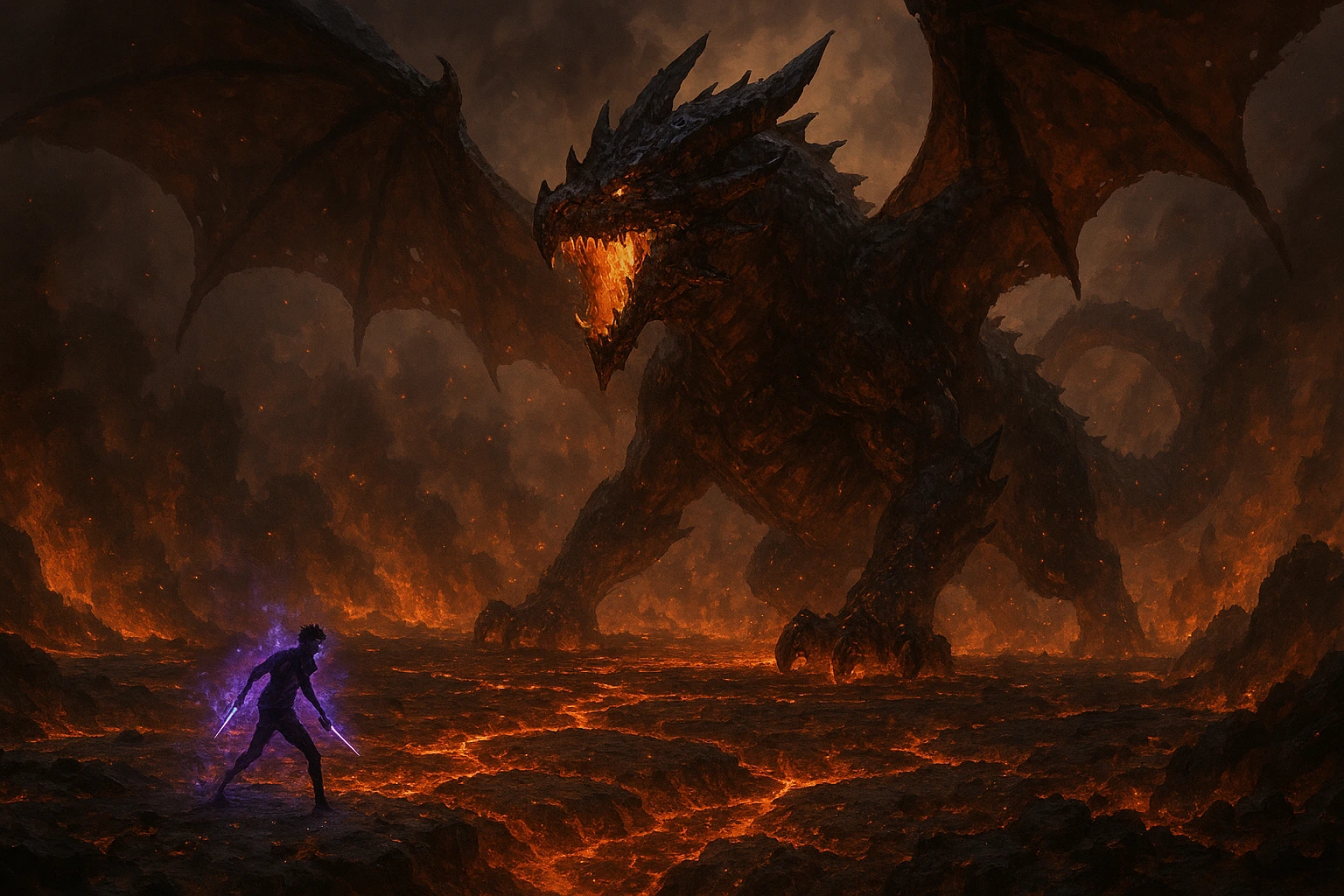
There is a fleeting, heartbreaking moment involving Kaisel, Jin-Woo’s wyvern shadow. Kaisel was originally a mount of the Demon King Baran, a subordinate of Antares.
When Kaisel flies against Antares, it is a fly attacking the sun. Antares destroys Kaisel effortlessly. But this moment symbolizes the shift in loyalty. The dragons, who are biologically programmed to serve Antares, can choose a new master in death. It is a symbolic victory for Jin-Woo’s “Shadow” over Antares’ “Blood,” proving that loyalty earned through leadership is stronger than loyalty demanded by lineage.
7. The Fall of the Dragon King
The Rulers’ Arrival
The climax of the fight reveals Jin-Woo’s true plan. He wasn’t trying to kill Antares alone—he knew he couldn’t. He was stalling. He was the bait.
Antares, blinded by his desire to crush Jin-Woo and prove his superiority, failed to sense the approach of the Rulers’ armies until it was too late. The spears of the Brightest Fragment of Luminosity pierce the sky. The realization hits him not as fear, but as a recognition of a strategic loss. He had been outmaneuvered, not overpowered.
The Death: Dignity in Defeat
Even in the face of certain death—surrounded by the Rulers and faced with a fully powered Shadow Monarch—Antares does not beg. He does not bargain. He does not scream in rage.
He looks at Jin-Woo and acknowledges him. “You have fought well, Shadow Monarch.”
He accepts his fate. He was born to destroy, and he fought until the end. His death is not pathetic; it is the cessation of a storm. As the Rulers stab him, he returns to the nothingness from which he came. He dies as he lived: The King. It is a quiet, dignified exit for the loudest force in the universe.
The Aftermath
With Antares dead, the war ends. The dragons scatter or are destroyed. The ultimate threat is gone. But the scar he leaves on the world (and on Jin-Woo) is permanent. Jin-Woo realizes that to defeat a monster, he had to become one. The death of Antares marks the transition of Jin-Woo from a hero to a myth. The shadow of the Dragon King lingers, reminding the universe that true power is both beautiful and terrifying.
8. Conclusion: The Necessity of Evil
Balance
Antares was a villain, yes, but in the cosmology of Solo Leveling, he was necessary. Light cannot exist without Darkness. Creation has no meaning without Destruction. Antares provided the counterweight that kept the universe in tension. He was the inevitable forest fire that clears the way for new growth, a fundamental aspect of the cycle of existence.
Legacy
Why is Antares the King of Dragons? Because he embodies the terrifying majesty of the species. He is fire, greed, power, and sovereignty wrapped in scales. He is the benchmark against which all other power in the series is measured.
Without Antares, the Rulers would have no purpose. Without Antares, Ashborn would never have sought a successor. Without Antares, Sung Jin-Woo would never have needed to ascend to the absolute peak.
In the end, Antares was the perfect antagonist. He was simple, he was honorable in his own twisted way, and he was terrifyingly powerful. He did not need a tragic backstory or a redemption arc. He was the Monarch of Destruction, and he played his role to perfection. Long live the King.