
1. Introduction: The Concept of “The Weakest”
Context of the Hunter World
To understand the apex, one must first understand the abyss. The world of Solo Leveling is built upon a harsh, unyielding meritocracy dictated by magical energy. In this reality, “Awakening” is a biological lottery, a cosmic roll of the dice that determines a human’s worth in a split second. Once a human awakens as a Hunter, their potential is fixed and immutable. A C-Rank hunter will never naturally become a B-Rank through training; an A-Rank will never ascend to S-Rank through sheer will. The mana capacity measured at the moment of awakening is an absolute ceiling, a biological shackle that defines one’s social standing, income, and lifespan.
This rigidity is what makes the narrative of Sung Jin-woo not just a power fantasy, but a shattering of the world’s fundamental laws. The Hunter Association, the guilds, and the geopolitical landscape are all stabilized by the belief that power is static. Governments calculate national defense based on fixed Hunter counts. When a variable appears that can “level up”—an ability previously restricted to video games and fiction—it doesn’t just change a person; it destabilizes the global balance of power. It introduces the terrifying concept of infinite growth into a world designed around finite limits.
The “E-Rank” Stigma
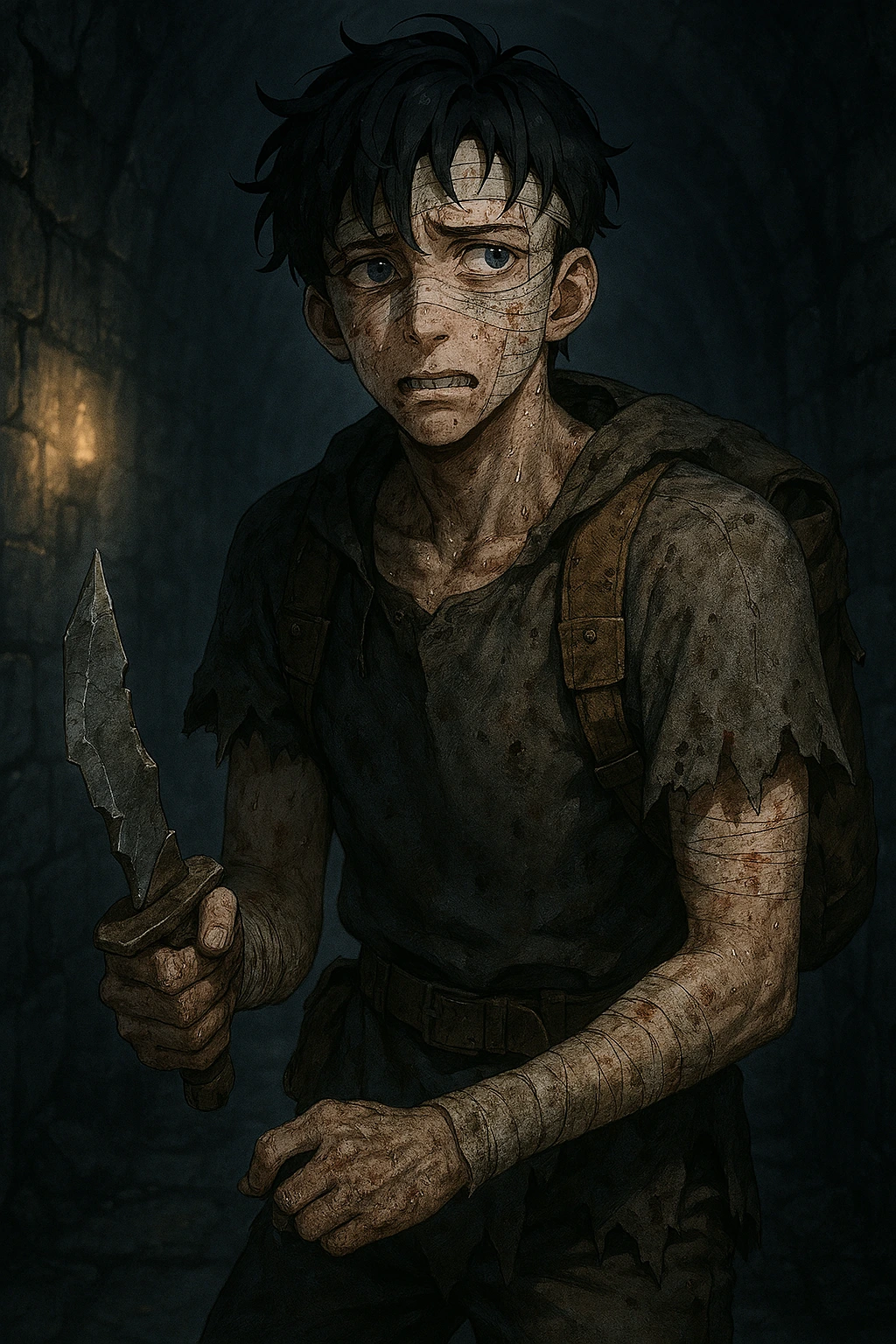
Sung Jin-woo began his journey at the absolute bottom of this hierarchy. The title “The World’s Weakest Hunter” was not a term of endearment; it was a moniker of pity and derision, whispered in guild halls and raid briefings. Being an E-Rank is dangerous, but Jin-woo was statistically an anomaly even among E-Ranks. His durability was barely above that of a civilian. A single strike from a goblin, the weakest of dungeon fodder, required hospitalization. For most, a D-Rank dungeon was a routine clear; for Jin-woo, it was a death sentence.
This stigma created a unique psychological profile. Most low-ranking hunters retire early, recognizing their limits, or take safe jobs in mining or logistics where the risk of combat is minimal. Jin-woo, however, was forced to the front lines. He became a fixture in the local healing wards, known more for his injuries than his contributions. This period of his life defined his high pain tolerance and his observational skills. Because he lacked the strength to fight, he had to develop the eyes to survive—reading attack patterns, sensing shifts in the atmosphere, and noticing details that arrogant, powerful hunters ignored. He learned to read the “mood” of a dungeon, a skill born of pure trauma.
Motivations and Burden
The driving force behind Jin-woo’s reckless behavior—entering dungeons despite knowing he might die—was purely economic desperation, rooted in familial love. His mother suffered from “Eternal Slumber,” a magical disease induced by exposure to mana, requiring expensive life support fueled by Essence Stones. The cost of keeping her alive was astronomical, a monthly debt that no civilian job could cover. With his father missing inside a Gate, Jin-woo was the sole provider for his sister, Jin-ah, and his comatose mother.
This burden stripped him of the luxury of fear. While other hunters raided for glory, fame, or wealth, Jin-woo raided for survival. Every raid was a gamble where the wager was his life, and the payout was a pittance—often just enough to pay the hospital bills for the injuries he sustained earning it. This desperation is crucial to his evolution; without this crushing weight, he never would have developed the mental fortitude required to stare down the God Statue in the Double Dungeon. His weakness was his greatest curse, but his resilience in the face of that weakness became his greatest qualification.
Psychological Profile: Fear vs. Survival
In the beginning, Jin-woo was terrified. The narrative often highlights his shaking hands, his cold sweats, and his internal monologues filled with dread. He was not a stoic hero initially; he was a terrified young man forcing his legs to move. However, distinct from cowardice, Jin-woo possessed a “logical survival instinct.” He didn’t freeze; he calculated. Even as an E-Rank, he was the one who noticed the lack of monsters in the Cartenon Temple hallway. He was the one who deciphered the rules of the statues when stronger men lost their minds.
His mindset was a paradox: he was a man who feared death more than anyone because he was closest to it, yet he was willing to walk alongside it daily. This duality—intense fear overridden by intense responsibility—created the perfect psychological vessel for the Shadow Monarch, a being who rules over death itself. He learned to function within the fear, turning panic into focus, a trait that would later allow him to command armies of the dead without losing his own humanity.
2. The Cartenon Temple Incident: The Turning Point
The Double Dungeon Mechanics
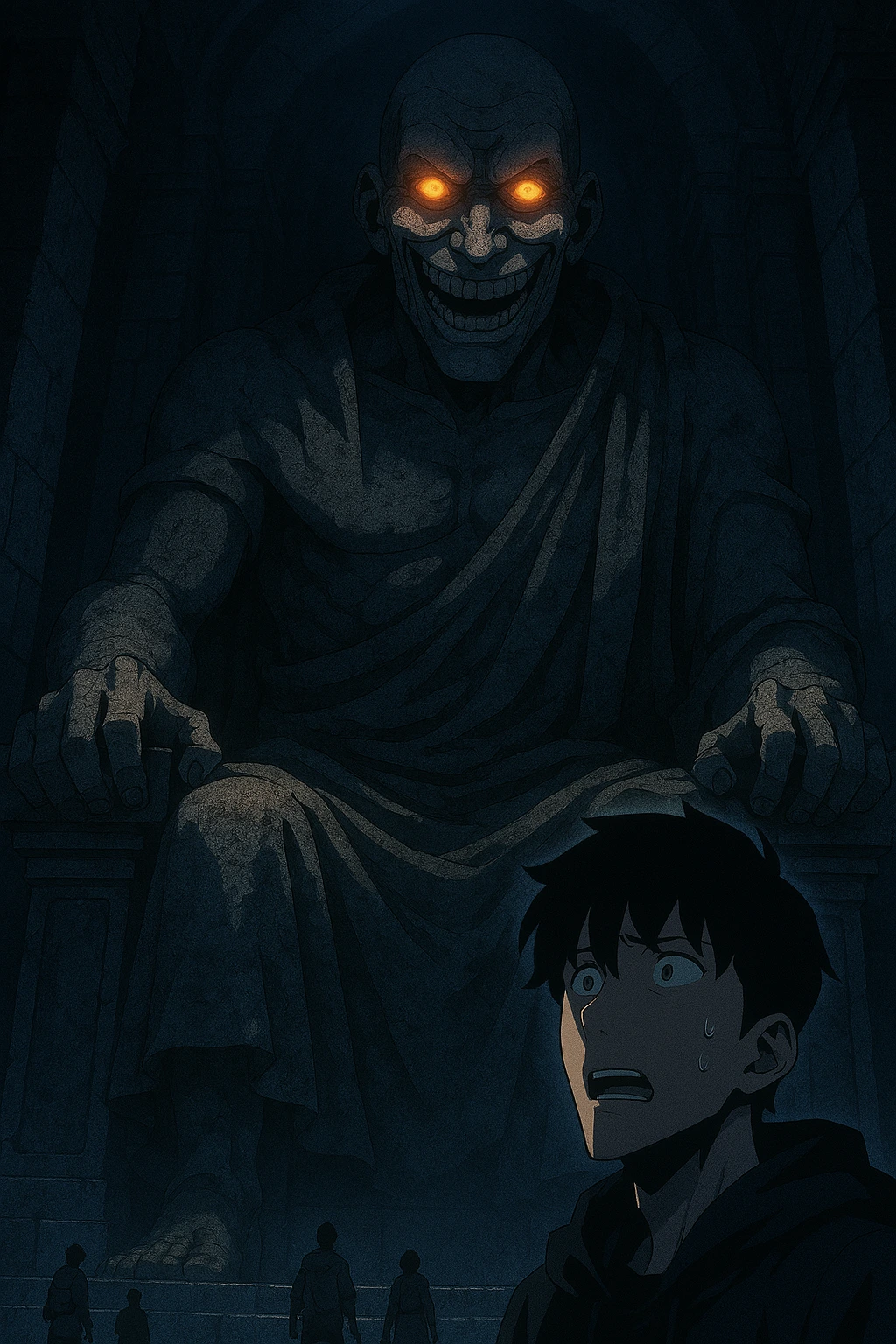
The Cartenon Temple, hidden within a D-Rank dungeon, serves as the crucible of Jin-woo’s rebirth. This was not a standard dungeon; it was a test designed by the Architect, a trap laid specifically to find a successor for the Shadow Monarch. The horror of this sequence lies in its rules, which were archaic, biblical, and merciless in nature. The atmosphere shifted from a standard raid to a cosmic horror story instantly.
The “Three Commandments” of the God Statue were not just puzzles; they were tests of fundamental kingly traits:
- Worship the Lord (Piety/Submission): Recognizing a power greater than oneself. This tested humility and the ability to bow before a superior force to ensure survival.
- Praise the Lord (Courage/Voice): The ability to act despite overwhelming terror. It required not just silence, but active participation in the face of death.
- Prove Your Faith (Sacrifice/Will): The willingness to endure until the end. This was the ultimate test of resolve—staying on the altar while the pendulum of death swung closer.
The mechanics of the statues—eyes that shoot incineration beams when looked at, movement that stops only when observed—forced the party to work as a unit, something high-ranking hunters often fail to do due to ego. The massacre that ensued shattered the group’s morale, leaving the “weakest,” who was used to observing from the sidelines, to solve the riddle.
The Moment of Sacrifice
The climax of the Temple incident is the defining moment of Jin-woo’s character. As the altar required a sacrifice (or rather, the illusion of one), the surviving hunters fled in panic, prioritizing their own lives over the group. Jin-woo, having lost his leg and bleeding out, chose to stay.
This decision wasn’t made out of pure altruism; it was a calculation of inevitability. He knew he couldn’t run on one leg. However, the rage he felt—the anger at the hypocrisy of the “strong” abandoning the “weak”—ignited a spark. As the statues raised their weapons to obliterate him, he didn’t beg. He grabbed a dropped sword and tried to fight a god. That specific defiance, that refusal to accept a dog’s death even when victory was impossible, triggered the hidden conditions of the “Secret Quest: Courage of the Weak.” It was the scream of a dying ant biting the boot that crushes it.
The Selection Process
Why did the Architect (and by extension, Ashborn) choose Sung Jin-woo? The Architect originally sought a strong vessel, looking at S-Rank hunters or National Level Hunters. However, a strong vessel is often filled with its own ego, mana, and established power. Jin-woo was an “empty vessel.” He had been hollowed out by suffering, yet his spirit remained unbroken.
Ashborn, the Shadow Monarch, was not looking for raw power; he had enough power to fill a universe. He was looking for compatibility with death. Jin-woo had lived in the shadow of death for four years. He was intimate with it. He respected it. The Architect’s system was designed to slowly reinforce a human body to hold the Monarch’s power, but the selection of the soul was Ashborn’s choice alone. He chose the one human who had mastered the art of dying without giving up. Jin-woo’s proximity to death gave him a perspective no S-Rank could possess—the understanding of life’s fragility.
The System’s Initialization
As the blade fell, the screen appeared: [You will now become a ‘Player’.] This marked the intrusion of the “System”—a magical interface designed solely for Jin-woo. It gamified his reality. The “Player” status granted him something no other hunter had: growth potential. The immediate physical reset repaired his severed leg and healed his wounds, but more importantly, it digitized his existence. He was no longer bound by biological limits; he was now bound by data, and data can always be increased. The System acted as a user-friendly interface for a power that was otherwise too eldritch for a human mind to comprehend.
3. Phase 1: The Training Arc & Biological Rebirth
Physical Transformation: The Perfect Vessel
Following the “reawakening” (which was technically the System attaching itself to him), Jin-woo’s body began a rapid metamorphosis. This wasn’t instant. The System had to reconstruct him cell by cell to handle the immense mana of the Shadow Monarch. Visually, he grew taller, his muscles became leaner and denser, and his scars vanished. His jawline sharpened, and his aura changed from timid to predatory.
This transformation was the Architect’s design to create a “Perfect Vessel.” A normal human body would explode under the pressure of a Monarch’s mana. The System acted as a regulator, a dam that slowly released water (mana) as the reservoir (Jin-woo’s body) was expanded through leveling up. Each “Level Up” was essentially a biological upgrade, reinforcing his bones and expanding his mana channels to prepare for the eventual download of Ashborn’s full power.
The Daily Quest System
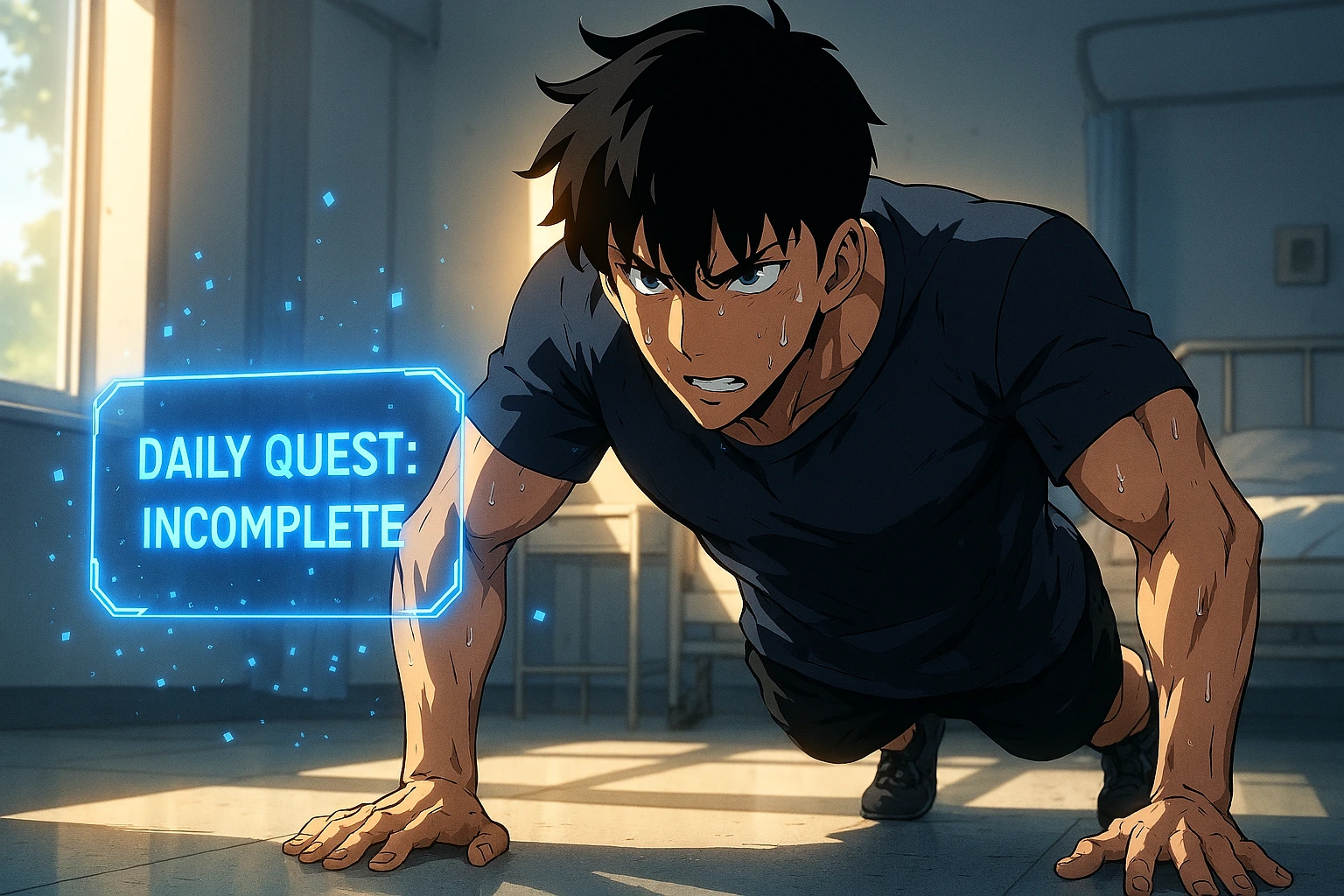
The foundation of his growth was deceptively simple:
- Push-ups: 100
- Sit-ups: 100
- Squats: 100
- Running: 10km
While comedic to the reader (a nod to One Punch Man), the penalty for failure was severe: the “Penalty Zone.” Being transported to a desert to survive against giant centipedes for four hours turned the daily quest from a chore into a desperate battle for survival. This conditioning served two purposes: it built his base stats without relying on mana, and it instilled a discipline of constant, unyielding effort. The “Status Recovery” reward, which healed all fatigue and injuries, became his greatest tactical asset, allowing him to train far beyond human limits, shredding his muscles and instantly repairing them stronger than before.
Instance Dungeons: The Tutorial
The System provided “Instance Dungeons”—private dimensions accessible only to him. This isolated him from the hunter society, allowing him to grow in secret without the Hunter Association monitoring his anomalies.
The first major hurdle was the subway station dungeon and its boss, Rasaka. This fight was pivotal. Jin-woo was still mentally an E-Rank, terrified of the snake’s venom and the claustrophobic environment. However, his victory yielded “Rasaka’s Venom Fang” (a dagger) and a damage reduction buff. This proved that the System’s rewards were tangible items that defied the laws of physics. It taught him that high risk yielded high rewards, conditioning him to seek out stronger opponents rather than avoid them. The fight against Rasaka was the first time he killed a “Boss” solo, shattering the mental block that he needed a team to survive.
Early Stat Allocation
Jin-woo’s distribution of stat points revealed his combat philosophy. While he invested in Strength, he heavily prioritized Agility (Speed) and Sense (Perception).
- Why Agility? As a solo fighter, he had no tank to take hits and no healer to cure him. Not getting hit was the only viable strategy. Speed was his defense. He became a “dodge-tank,” avoiding damage entirely rather than mitigating it.
- Why Sense? In the absence of a party, situational awareness is key. He needed to detect ambushes, hidden bosses, and murderous intent instantly.
This build—a high-speed, high-crit assassin—diverged from the “Shadow Monarch” archetype (usually a mage class) but was essential for his survival before he unlocked his army. He had to be a warrior before he could be a general.
4. Phase 2: From Victim to Predator
The Ethics of Killing
The transition from prey to predator required a moral shedding. This occurred during the Lizardmen arc (the dungeon with Hwang Dong-Suk). When the traitorous hunters tried to kill Jin-woo and Yoo Jinho to steal the loot, the System issued an Emergency Quest: “Kill the Enemies.”
The penalty for not completing the quest was Jin-woo’s own heart stopping. The System forced his hand: Kill or die. This was the moment Jin-woo severed his attachment to conventional societal laws. He realized that the System cared only about the “Player.” Anyone who threatened the Player was merely an obstacle, no different from a monster.
Decapitating the hunters wasn’t just self-defense; it was an execution. This coldness became a defining trait. He wasn’t evil, but he became ruthless. He adopted a simple code: I will protect what is mine, and eliminate anything that threatens it. The hesitation to take a human life vanished, replaced by a predator’s logic.
The Job Change Quest
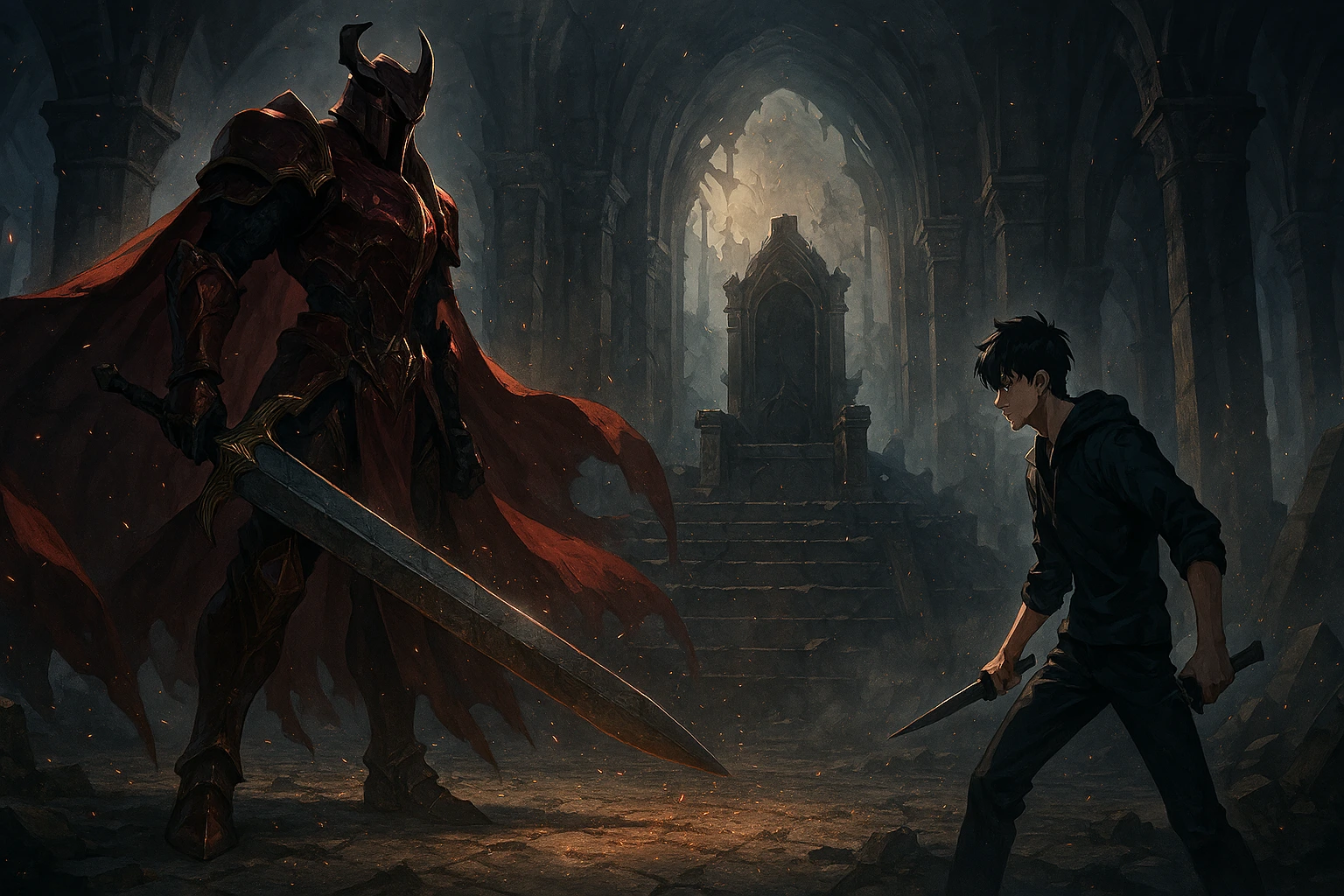
The “Job Change Quest” is arguably the best action sequence in the early series. Entering a dungeon that prevented potion usage and exhausted him endlessly, Jin-woo faced the Blood-Red Commander Igris.
The fight against Igris was a masterclass in humility. Igris was stronger, faster, and more skilled. He fought with honor, discarding his weapons to fight Jin-woo hand-to-hand. Jin-woo won not through overpowering stats, but through desperation and dirty tactics (stabbing the eye, using the environment, taking hits to give hits). He abandoned the idea of an “honorable duel” because honor is a luxury of the living.
Following Igris, the “Endless Horde” tested his stamina. He didn’t survive by winning; he survived by refusing to die until the timer ran out. The System, analyzing his fighting style (Assassination/Stealth) and his unyielding will (leading him to the Necromancer path), calculated his points.
Class Selection: The Necromancer
The System originally designated him a “Necromancer.” Jin-woo was disappointed, thinking of it as a weak mage class that relied on others—ironic given his solo nature. However, because of the bonus points accumulated during the quest (time penalty, no hearthstone used, defeating Igris), he skipped the standard progression.
- Necromancer -> Shadow Lord -> Shadow Monarch.
He instantly ascended to the highest tier of the class. This reveals that the System was rigged from the start; it was always guiding him to this specific point, but his performance determined how much of that power he could access immediately. He didn’t just get a job; he inherited a throne.
First Extraction: “Arise”
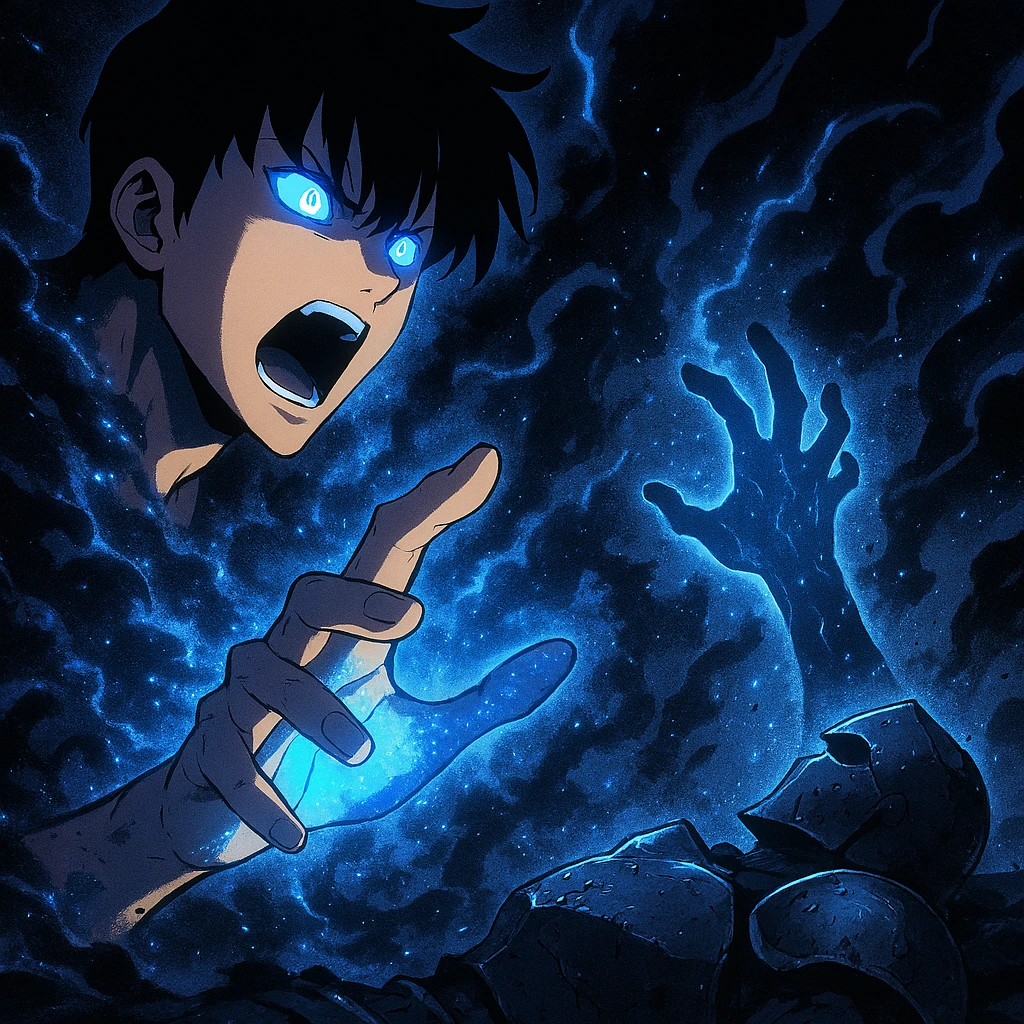
The first use of the command word “Arise” (or Okite in Japanese / Irona in Korean) is iconic. It signifies the shift from fighting alone to fighting as a legion.
Extracting Igris was difficult. The soul of the knight was proud and refused to serve a weak master. Jin-woo’s plea wasn’t a magical incantation; it was a conversation of warriors. He promised Igris that he would not be a master who wasted his sword. When Igris finally rose, wreathed in black and blue mana, Jin-woo felt a profound connection. These weren’t mindless zombies; they were loyal soldiers who shared his emotions. The loneliness of the “Solo” leveler ended here. He was now a Legion, and the shadows were his constant companions in the dark.
5. Phase 3: Breaking the Global Power Ceiling
The Red Gate Crisis
The Red Gate incident involving the Ice Elves and the White Tiger Guild recruits served as Jin-woo’s public (yet secret) debut as a leader. Here, we see the difference between a “statistically strong” hunter and a “battle-hardened” hunter. The A-Rank Kim Chul was physically strong but mentally weak; he panicked, alienated his team, and led them to death. Jin-woo, calm and accustomed to death, led the weaker ranks to survival.
This arc highlighted the utility of the shadows. Tank (the Ice Bear) and Iron (the shadow of Kim Chul) showed that Jin-woo could turn the tide of battle instantly. It also marked the point where he stopped caring about hiding his power from those he deemed trustworthy or irrelevant. He realized that to save people, he had to reveal his monster-like nature.
The Demon Castle Arc
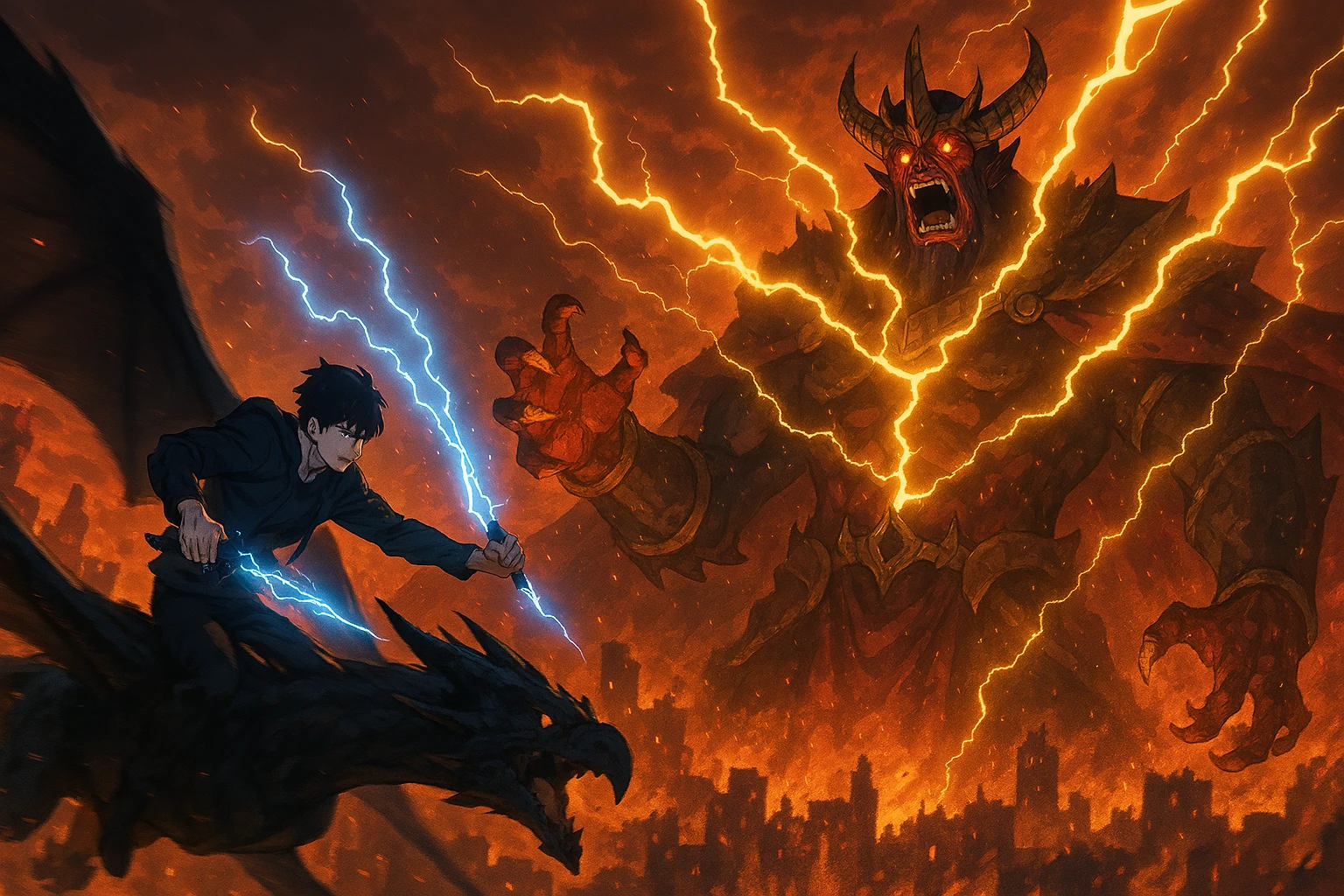
The Demon Castle was a vertical grind—100 floors of hell mirroring a burning city. This arc was crucial for two reasons:
- The Cure: Obtaining the Holy Water of Life to cure his mother. This was his primary motivation, keeping his humanity intact despite his monstrous power growth. It grounded him, reminding him that he was gaining power for someone, not just for himself.
- Level Grinding: This was where he bridged the gap between “A-Rank equivalent” and “National Level.”
The fight against the Demon King Baran (a copy of a Monarch) gave him the experience of fighting higher-dimensional beings. It also supplied him with the “Demon King’s Dagger” and the Longsword, drastically upgrading his arsenal. By the time he exited the castle, he was effectively beyond the standard S-Rank scale, capable of summoning a wyvern (Kaisel) and flying—a feat rare even among top hunters.
The Jeju Island Raid
The Jeju Island Raid is the series’ geopolitical climax. It established the hierarchy of power on a global scale. The S-Rank hunters of Japan (Draw Sword Guild) and Korea were decimated by the mutated Ant King. The despair was palpable; the “strongest” humans were being eaten like snacks on live television. The world watched as their heroes fell.
Jin-woo’s arrival wasn’t just a rescue; it was a divine intervention. He didn’t just defeat the ants; he slaughtered them. The visual of his shadow army overwhelming the ant colony flipped the script—the swarm was no longer the hunter, but the prey. His presence alone suffocated the battlefield, turning a scene of horror into a display of absolute dominance.
Beru’s Extraction
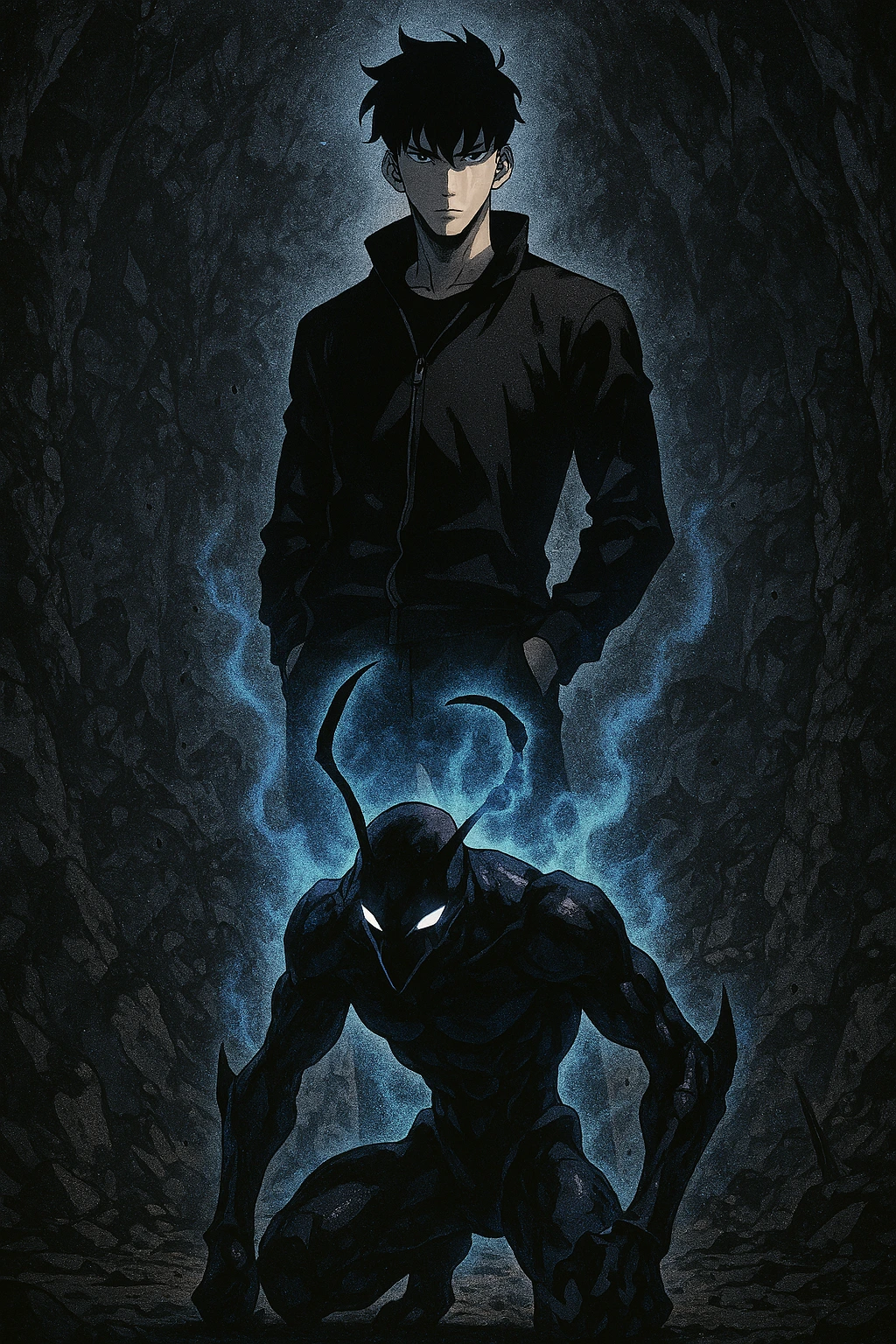
The battle with the Ant King was a clash of apex predators. Jin-woo overpowered the King physically, breaking its exoskeleton with raw strength. The extraction of Beru (the Ant King) changed the dynamic of his army.
- Igris provided chivalry and single-target DPS.
- Tusk provided AoE magic and battlefield control.
- Beru provided absolute savagery, speed, and the unique ability to speak and heal.
Beru’s ability to communicate bridged the gap between Jin-woo and his shadows, adding a layer of comedic loyalty and tactical depth. Beru was the General that the Shadow Army needed to function autonomously, capable of leading independent raids while Jin-woo was elsewhere.
6. Phase 4: Full Ascension and the Black Heart
Return to Cartenon Temple
Returning to the Double Dungeon was the final test. The Architect, revealed to be the statue creator, was furious that Jin-woo had retained his human consciousness. The plan was for Ashborn to take over Jin-woo’s body entirely, erasing the human ego to create a perfect vessel.
Jin-woo’s battle against the Architect was a fight for his own soul. He proved that he wasn’t just a vessel; he was the pilot. By defeating the Architect, he stripped the System of its admin rights. The “System” messages began to glitch and fade because Jin-woo no longer needed a tutorial interface. He had surpassed the need for “Game Mechanics.” He deleted the UI of his own life.
The Black Heart
The most critical lore element is the Black Heart. This was the heart of the original Shadow Monarch, Ashborn. It contained 100,000+ mana, effectively infinite compared to human standards.
When Jin-woo absorbed the Black Heart, he gained a second heartbeat. This wasn’t just a battery; it was a connection to the fundamental force of Death. It allowed him to maintain his entire army indefinitely and use high-tier skills like “Shadow Exchange” without cooldown limits. It marked the biological end of “Sung Jin-woo the Human” and the beginning of “Sung Jin-woo the Higher Being.” He became a mana singularity, a walking dungeon break.
Death and The Void
During the battle with the Beast Monarch and the Frost Monarch, Jin-woo “died.” His human heart was destroyed. This death was necessary. The System was a cage limiting the Black Heart’s full power to prevent the vessel from breaking. When the vessel “broke” (died), the restrictions shattered.
In the void, Jin-woo met Ashborn. This conversation recontextualized the entire series. Ashborn wasn’t a villain; he was a tragic hero, a Ruler who fell and embraced the power of Death to find a new path. Ashborn offered Jin-woo a choice: stay in the illusion of eternal peace or return to the pain of reality.
Jin-woo chose to return. He accepted that power is responsibility. He didn’t borrow Ashborn’s power; he became Ashborn. The two consciousnesses merged, or rather, Ashborn willingly faded, leaving his conceptual authority to Jin-woo. It was an inheritance of will, not just strength.
The Final Merge
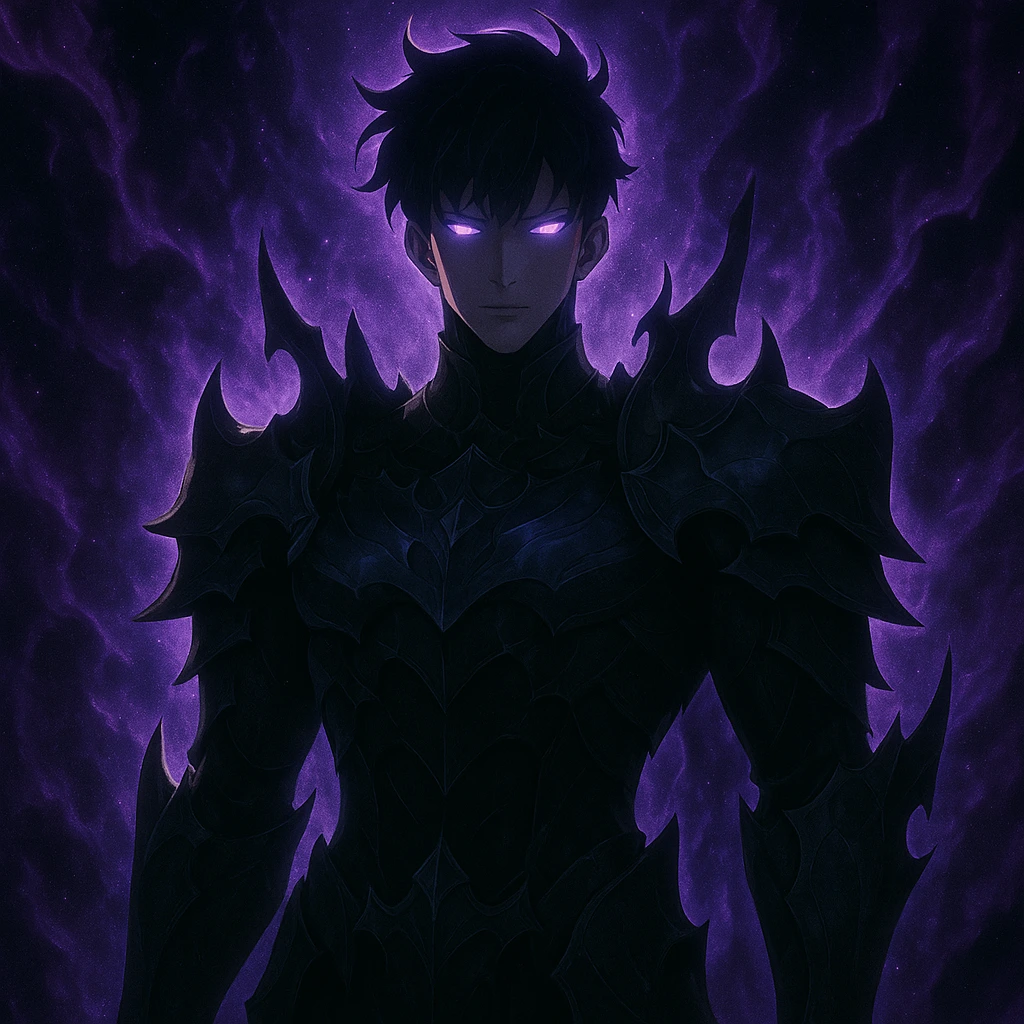
When Jin-woo woke up, the “Player” interface vanished. There were no more Daily Quests. No more Level Ups. He had reached the level of a concept. He was the concept of Death. The phrase “I am the record of your struggles” signifies that the System was merely a compiled history of his growth.
He effortlessly dominated the Beast and Frost Monarchs. He could now alter the landscape with a thought, cancel magical attacks with his presence, and summon the full, unsealed army of the original Shadow Monarch (millions of soldiers, including the dragon Kamish, though Kamish failed to extract due to time). The fight was no longer a battle; it was a correction.
7. Conclusion: The Master of Death
The Philosophy of the Monarch
Sung Jin-woo’s evolution is a journey from powerlessness to omnipotence. However, the true beauty of his arc lies in his benevolence. A being with the power to raise the dead and command an invincible army could easily become a dictator. Yet, Jin-woo remains a protector.
He understands that death is not the opposite of life, but a part of it. His shadows are not slaves; they are given a second purpose. He gives “rest” to those who deserve it and “punishment” to those who don’t. He becomes the silent guardian of Earth, a god who walks among men without demanding worship.
Post-War Evolution
The decision to use the Cup of Reincarnation is the ultimate sacrifice. He erased the timeline where he was a hero. He chose to turn back time to before the Gates opened, effectively deleting his fame, his wealth, and the admiration of the world. He chose to be a nobody so that everyone else could be safe.
He spent 27 years in the “Gap Between Dimensions,” fighting the Monarchs and their armies alone. This “War of the Outer Gods” is where he perfected his powers. He wasn’t leveling up anymore; he was mastering the cosmos. He learned to manipulate space, erase existence, and control the flow of mana on a planetary scale. He waged a war for nearly three decades that no one would ever know about.
Final Form Analysis
By the end of the series (Ragnarok/Epilogue), Sung Jin-woo is:
- Immortal: He does not age, existing outside of time.
- Omnipresent (in his territory): He can sense everything within his shadow, which can expand to cover the planet.
- Army Size: Over 10 million shadow soldiers, including Bellion (Grand-Marshal), Beru, and Igris.
- Power Scale: He defeated the Dragon Monarch Antares, the strongest being created by the Absolute Being (with assistance from the Rulers, but ultimately standing on equal ground).
Summary of the Evolution
Sung Jin-woo’s path was not one of destiny, but of will. He started as a man who couldn’t afford a cup of coffee or a healing potion. He ended as a God who could afford to rewrite history to save the people who once mocked him.
His evolution from E-Rank to Shadow Monarch is a testament to the idea that suffering, when processed through an indomitable will, becomes strength. He did not just conquer the dungeons; he conquered the concept of weakness itself. He is the Shadow that protects the Light, the King of the Dead who fights for the Living. He is the Solo Leveler, and he stands alone at the peak.