
Introduction: The Pillars of Jujutsu Society
To the average citizen of Tokyo, the world is modern, governed by laws, democracy, and technology. But peel back the layer of the visible world, and you find a society that has refused to move past the Heian Era.
The world of Jujutsu Kaisen is not a democracy; it is a feudal aristocracy masquerading as a secret society. At the absolute apex of this hidden world sit the Gosanke—the jujutsu kaisen big Three Families.
The Gojo, Zenin, and Kamo clans are not merely wealthy benefactors or influential politicians. They are the foundational pillars upon which the entire system of Jujutsu rests. They act as the government, the military, and the supreme court of the sorcerer world. Their influence is so pervasive that even the Jujutsu High schools, ostensibly educational institutions, often function as proxy battlegrounds for their political maneuverings.
This consolidation of power is not accidental. It is built upon the most unfair and absolute currency in the Jujutsu world: Blood. In this universe, hard work is often secondary to genetics. A sorcerer’s potential is largely decided the moment they are born, etched into their DNA through inherited Cursed Techniques.
These three families have hoarded the most powerful techniques for over a thousand years, tracing their lineage back to the “Three Great Vengeful Spirits” of Japanese folklore.
The Origin: The Three Great Vengeful Spirits
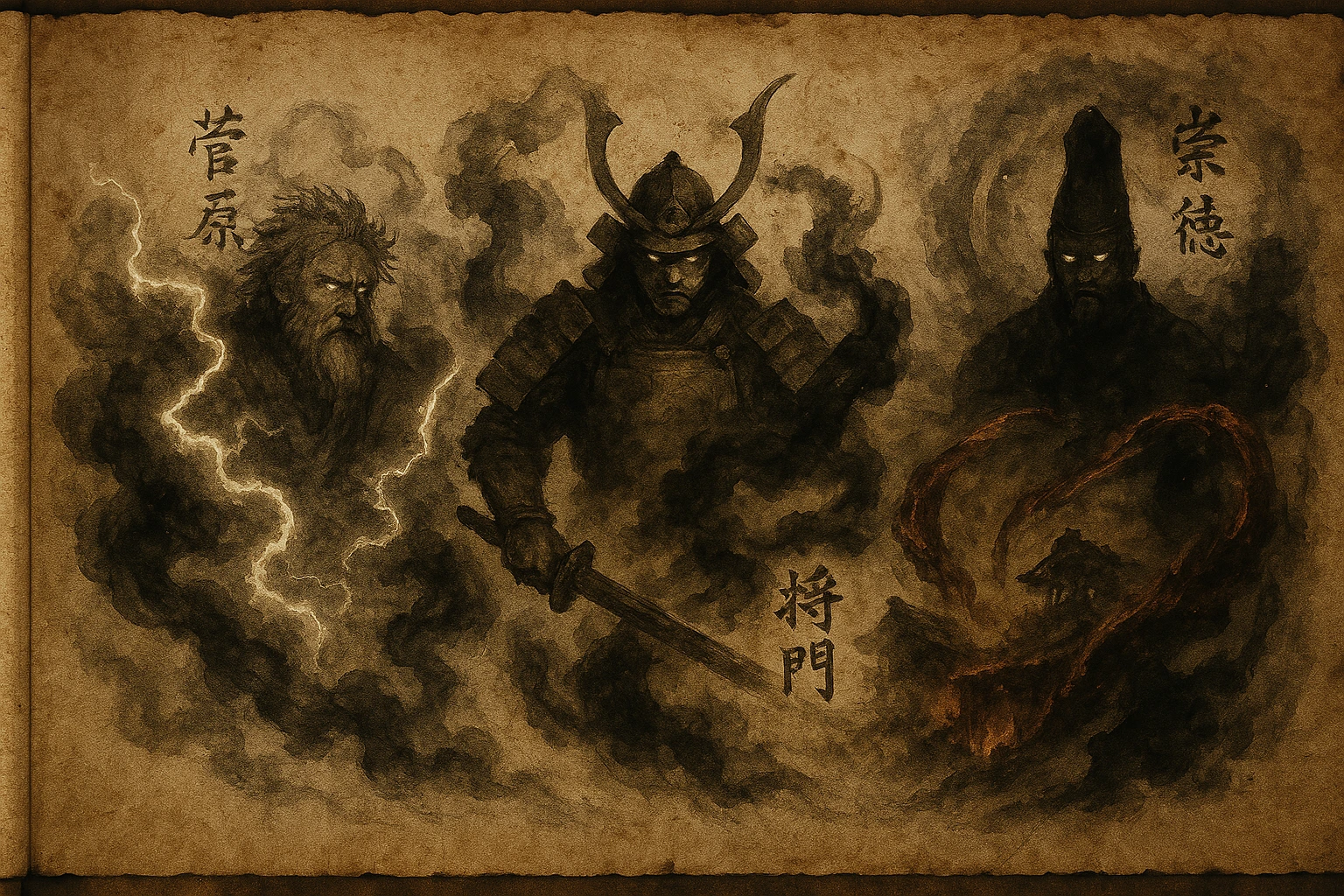
To understand the sheer weight of these bloodlines, we must look at the real-world history Gege Akutami wove into the story. The power of these families isn’t random; it stems from the three most terrifying spirits in Japanese history:
- Sugawara no Michizane (Ancestor of the Gojo Clan): A brilliant scholar and politician in the Heian period who was unjustly exiled. After his death, the capital was struck by massive storms and plagues, and lightning struck the imperial palace, killing his political rivals. He was deified as the God of Learning and Thunder. This connection to “Lightning” and “Sky” mirrors the Gojo clan’s dominance over space and void.
- Taira no Masakado: A samurai who led a rebellion against the central government, declaring himself the “New Emperor.” His head was displayed in Kyoto but famously flew away in a rage. His legacy is one of rebellion and overwhelming martial might, mirroring the Zenin clan’s obsession with physical dominance and combat superiority.
- Emperor Sutoku: A former emperor forced into exile who supposedly wrote scriptures in his own blood and cursed the imperial line, becoming a “Great Demon King.” This connection to blood and resentment is the direct spiritual ancestor of the Kamo clan’s Blood Manipulation and their dark history of secrecy.
Understanding the Big Three is essential to understanding the conflict of the series. The antagonists, like Suguru Geto and later Kenjaku, aren’t just fighting “good guys”; they are fighting a stagnated system upheld by these families. The tragedy of the Shibuya Incident and the chaos of the Culling Game are direct results of the power vacuums and historical sins committed by these clans.
In this deep dive, we will dismantle the history, the complex power systems, and the fatal flaws of the Gojo, Zenin, and Kamo families. We will explore why they are the “Old World” that Satoru Gojo is so desperate to reset.
1. The Gojo Clan: The One-Man Army
The Gojo Clan represents a unique anomaly in political theory. Typically, a clan’s strength lies in its numbers, its vast network of members, and its ability to project power in multiple places at once. The Gojo Clan, however, functions on the principle of the nuclear deterrent. They do not need an army because they possess a god.
Currently, the political standing, immense wealth, and untouchable status of the Gojo family rest entirely on the shoulders of one man: Satoru Gojo.
The Historical Significance & Sugawara no Michizane
The Gojo clan descends from Sugawara no Michizane, as mentioned above. This ancestry is significant because it provides the reservoir of “Boundless Cursed Energy” that flows through the family line. It is this shared blood that connects Satoru Gojo to Yuta Okkotsu, explaining why Yuta—a complete outsider—possesses more cursed energy than even Satoru himself.
However, the Gojo clan operates on a cycle of feast or famine. For centuries, they may be a respected noble family, but they only become the undisputed rulers of the world when a child is born possessing the clan’s two rarest traits simultaneously.
Satoru is the first infant in four hundred years to inherit both the Limitless technique and the Six Eyes. His birth shifted the cosmic balance of the world; Cursed Spirits literally became stronger effectively overnight, evolving just to survive in a world where Satoru Gojo existed.
The Physics of the Limitless (Mukagen)
To understand why the Gojo clan is feared, we must understand the math behind their signature technique. The Limitless is often mistaken for telekinesis or forcefields, but it is actually the manipulation of space through the concept of “Infinity” (based on the paradoxes of the Greek philosopher Zeno).
The Neutral Limitless: Infinity
The base state of the technique brings the concept of “infinity” into reality. In math, you can divide the number 1 infinitely without ever reaching 0 (0.5, 0.25, 0.125…). Satoru applies this to the space around him. When an object—be it a punch, a bullet, or sound waves—approaches him, it hits this barrier of divided space.
The object travels half the distance to his skin, then half of that, then half of that. It continues to travel forward, but because the space is being infinitely divided, it never actually reaches him. To the naked eye, the object stops. In reality, it is simply moving infinitely slowly. This makes the head of the Gojo clan untouchable by conventional means.
Cursed Technique Lapse: Blue (Attraction)
By amplifying the concept of negative numbers and “impossible space,” the user creates a vacuum in reality. The universe, attempting to correct this negative space, forces matter to rush in to fill the gap. This creates a violent magnetic singularity, crushing anything in its center or pulling targets toward the user at high speeds. This allows for high-speed teleportation by compressing the space between the user and their destination.
Cursed Technique Reversal: Red (Repulsion)
This requires the user to multiply negative energy with negative energy to create positive energy (Reverse Cursed Technique). By flowing positive energy into the Limitless, the effect is reversed. Instead of attraction, it brings the divergence of infinity into reality. This creates a powerful repulsive force, effectively a shockwave that blasts everything away with twice the output of Blue.
Hollow Technique: Purple

The secret technique of the Gojo clan. By smashing the “Attraction” of Blue and the “Repulsion” of Red together, the user creates an imaginary mass. When these two opposing infinities collide, they create a singularity that deletes matter from existence. It is not an explosion; it is an erasure.
The Pinnacle: Domain Expansion (Unlimited Void)
The ultimate expression of the Gojo clan’s power is the Domain Expansion: Unlimited Void (Muryōkūsho). This is arguably the most dangerous domain in the series because it guarantees victory the moment it is activated.
Unlike other domains that hit you with physical attacks (like fire or slashes), Unlimited Void attacks the mind. It forces the target’s brain to process an infinite amount of information.
- The Mechanism: The target sees everything, feels everything, and processes “existence” itself infinitely. They can see the entire lifecycle of a star or the biological division of every cell in an instant.
- The Result: The human brain (and even a Curse’s brain) cannot handle this. To protect itself, the brain shuts down all motor functions. The victim is paralyzed, standing catatonic while their mind is flooded with infinite garbage data.
- Lethality: Even 0.2 seconds of exposure was enough to leave non-sorcerers unconscious and requiring months of rehabilitation. A full exposure is instant death or permanent vegetative state. This technique epitomizes the Gojo clan: it is power that transcends physical resistance.
The Six Eyes (Rikugan): The Ultimate CPU
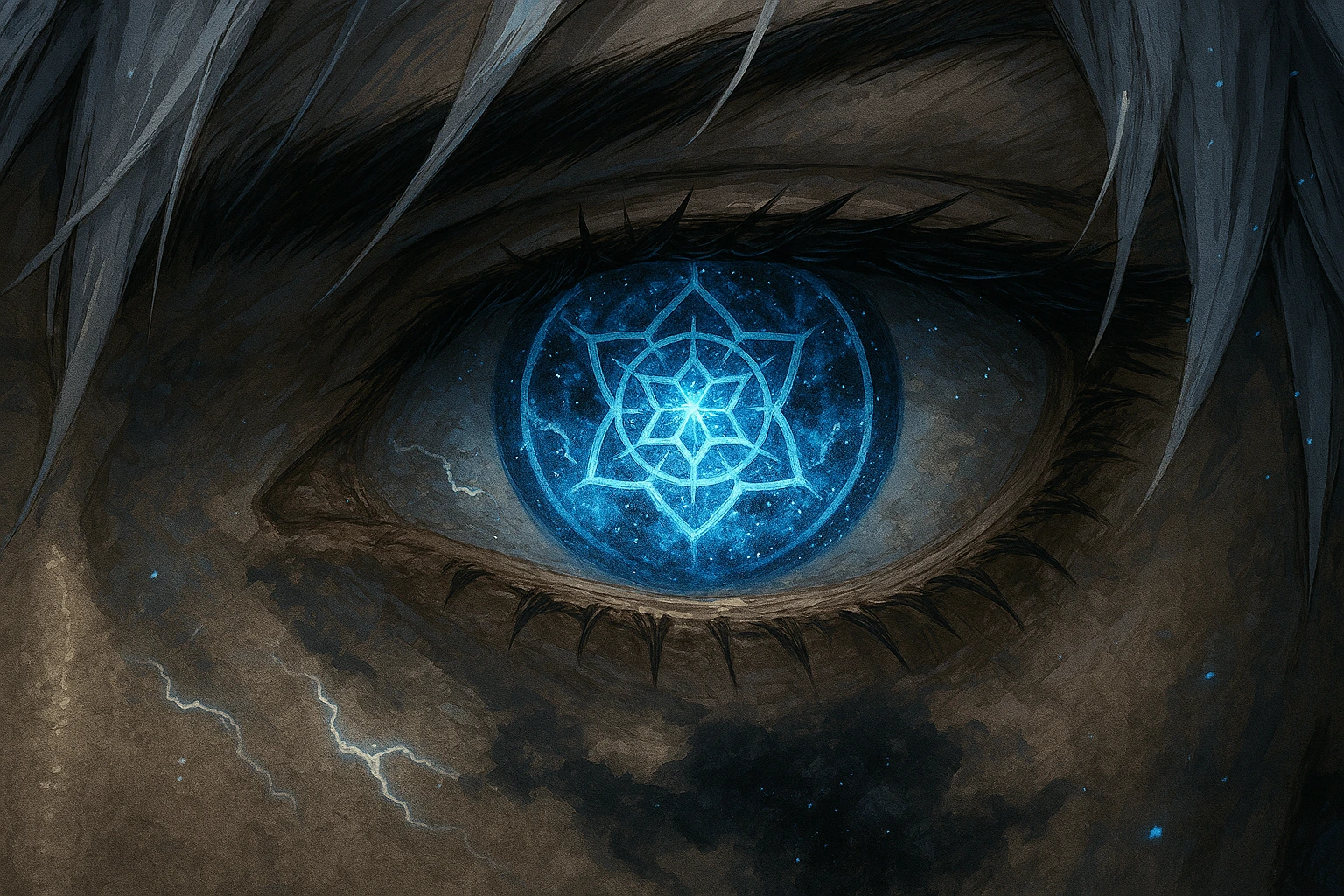
If the Limitless is the most sophisticated software in the world, the Six Eyes are the only hardware capable of running it. Without the Six Eyes, utilizing the Limitless requires such complex calculations that it would fry a normal sorcerer’s brain in moments.
The Six Eyes are a genetic trait that occurs exceptionally rarely. They grant the user perception of the world at an atomic level. Satoru can see the flow of Cursed Energy in high-definition detail, allowing him to analyze techniques, gauge opponent strength, and track energy signatures from miles away.
However, their most critical function is efficiency. The Six Eyes allow Satoru to minimize the loss of cursed energy during technique activation to near zero. While Satoru does not have the highest volume of cursed energy in history (a title likely held by Sukuna or Yuta), he effectively has infinite energy because he never runs out. He regenerates it faster than he spends it.
This gift comes with a curse: sensory overload. Satoru wears a blindfold not to look cool, but to dampen the input. Even with his eyes covered, he sees everything like a high-resolution thermographic camera. Without the blindfold, his brain is constantly bombarded by the visual data of the entire world, leading to rapid fatigue.
The Tragedy of the Strongest
The true cost of the Gojo clan’s power is isolation. Satoru Gojo is often described as “The Strongest,” but this title is a wall. Because he sees the world differently (literally, via the Six Eyes) and exists in a different tier of power, he cannot truly connect with anyone.
- The Geto Split: His best friend, Suguru Geto, fell into darkness because Satoru became “The Strongest” alone. As Satoru mastered his powers, he left Geto behind, creating the gap that eventually led to the Night Parade of a Hundred Demons.
- The One-Man Army: The reliance on Satoru is the Gojo Clan’s fatal flaw. Because he is so powerful, the rest of the clan has become irrelevant. In the current timeline, we rarely see other Gojo clan members because they don’t matter. Satoru protects them, funds them, and gives them status. This creates a fragile system. As seen in the Shibuya Incident, once Satoru is sealed, the Gojo Clan collapses instantly. They have no backup plan, no secondary army, and no political goodwill, as Satoru spent his life bullying the other elders. The “One-Man Army” strategy works only as long as the man is standing.
2. The Zenin Clan: Power, Pride, and Misogyny
If the Gojo Clan is a monarchy ruled by a god, the Zenin Clan is a shark tank. They are the antithesis of the modern world—a rigid, hyper-traditional meritocracy where human value is determined solely by the strength of one’s Cursed Technique.
The family motto, often unspoken but clearly felt, is: “If you are not a Zenin, you are not a sorcerer. If you are not a sorcerer, you are not a human.”
The Structure of Abuse
The Zenin clan is large and highly structured. At the top sits the Head of the Clan (Naobito, and later claimed by Megumi/Naoya). Below them are the elite units:
- The Hei: The supreme combat unit composed of clan members who possess high-grade cursed techniques (Semi-Grade 1 or higher). To enter the Hei is the ultimate goal of any Zenin male.
- The Kukuru: The “trash” unit in the eyes of the clan. This unit is comprised of male members who have no technique. They are treated as foot soldiers and servants, subjected to daily hazing and violence to remind them of their inferiority.
- The Women: In the Zenin worldview, women are unfortunately treated as servants or bargaining chips for marriage alliances, regardless of their talent, unless they possess immense undeniable power.
This toxic environment breeds powerful sorcerers because they must fight for survival from childhood, but it also creates deep-seated trauma and hatred (as seen in Toji, Maki, and Mai).
The Ten Shadows Technique (Tokusa no Kage Bōjutsu)
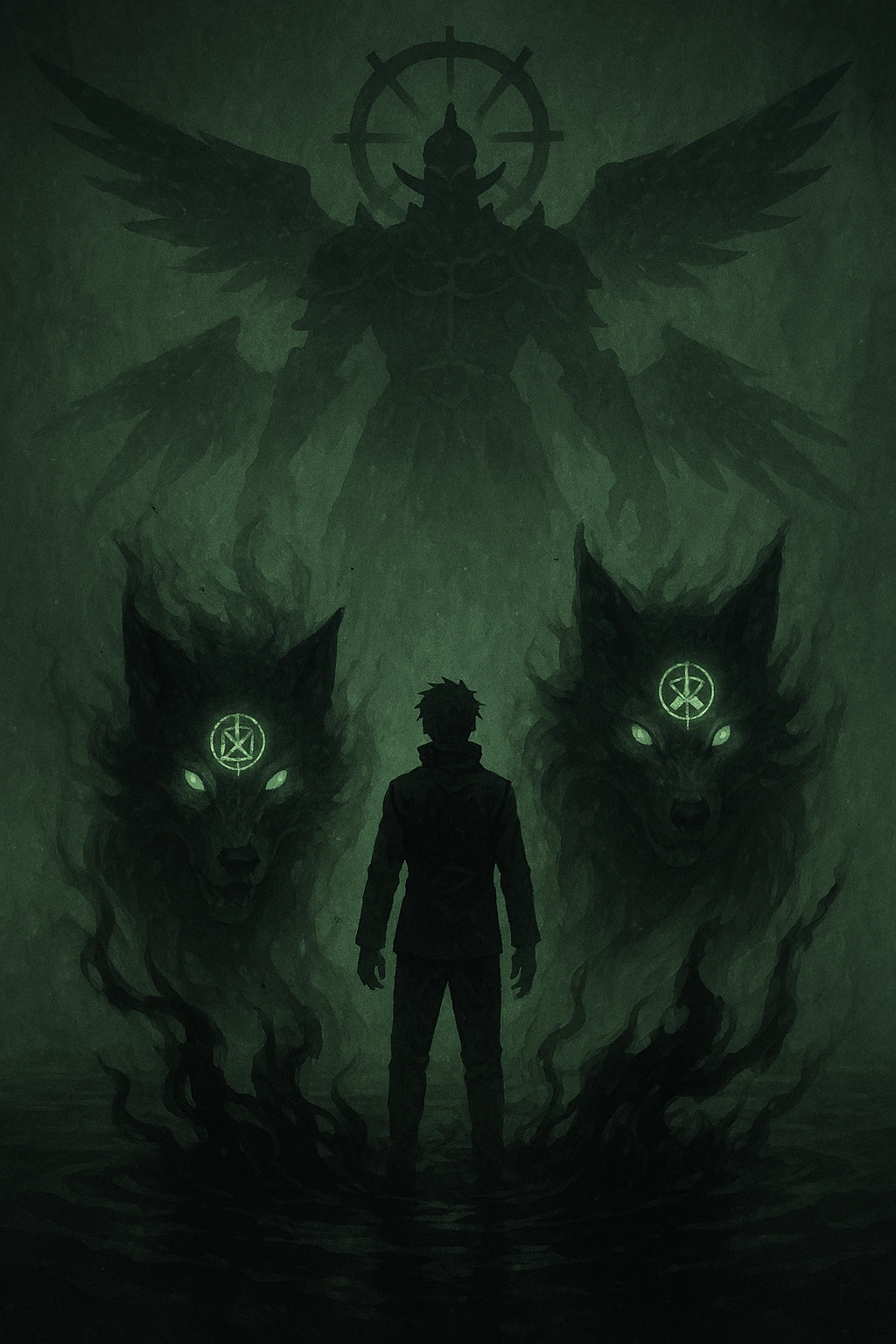
The crown jewel of the Zenin Clan is the Ten Shadows, a technique that rivals the Limitless in potential. Currently wielded by Megumi Fushiguro, this technique is a summoner’s dream.
Unlike simple shikigami users who create dolls, the Ten Shadows user utilizes shadows as a medium.
- Shadow Storage: The user can store weapons, objects, and even themselves within their own shadow, allowing for supreme stealth and inventory management.
- The Ten Shikigami: The user starts with two Divine Dogs. They must defeat other shadows in a ritual to tame them. If a shikigami is destroyed, it cannot be resummoned, but its power is inherited by the remaining shadows (e.g., Divine Dog: Totality).
The Trump Card: Mahoraga
The Eight-Handled Sword Divergent Sila Divine General Mahoraga is the ultimate reason the Zenin clan is feared. Historically, no user has ever tamed Mahoraga. It is used as a suicide move. Mahoraga’s ability is “Adaptation.” If it is hit by an attack, the wheel on its back turns. Once it adapts, it becomes immune to that type of attack and develops a counter.
In the past, a Zenin head summoned Mahoraga to kill a Gojo head (who had Six Eyes and Limitless), resulting in the death of both. This proves the Zenin possess the firepower to mutually assure destruction against the Gojo clan.
Chimera Shadow Garden
While Mahoraga is the history, Chimera Shadow Garden is the future. Megumi’s Domain Expansion differs from others because it is often “incomplete,” lacking a barrier. However, this incompleteness allows him to use the environment itself (like a gymnasium or a cave) as the domain’s shell.
Inside, he can flood the area with liquid shadow, summoning unlimited shikigami and creating clones of himself. It represents the potential of the Ten Shadows to be more fluid and dangerous than the rigid structures of the past.
Projection Sorcery & The Curse of Naoya Zenin

While Ten Shadows is the “heir” technique, the clan is also famous for Projection Sorcery, used by Naobito and his son, Naoya Zenin. Naoya is the perfect embodiment of the Zenin Clan’s rot. He is handsome, wealthy, and incredibly powerful, yet deeply misogynistic and cruel.
His technique is a meta-commentary on animation. The user divides one second into 24 frames. They pre-program a set of movements into those 24 frames within their mind. Once activated, their body executes that movement physically.
- The Advantage: It allows for acceleration that defies physics, making Naobito the “Second Fastest Sorcerer” after Gojo.
- The Rule: If the user creates a movement that is physically impossible (ignoring trajectory), they freeze for one second.
- The Trap: If the user touches an opponent, that opponent must also abide by the 24 FPS rule. Since most people cannot process reality in 24 frames per second, they fail the rule and are frozen in a 2D animation frame, leaving them open to attack.
Naoya’s defeat is poetic. He looked down on Maki because she had no Cursed Energy and was a woman. Yet, he was defeated because he couldn’t track her movements—she moved with a physical prowess that transcended his “frames.” His worldview, like his technique, was too rigid to handle true evolution.
The Heavenly Restriction: The Clan’s Greatest Irony
The Zenin clan creates its own monsters. Their obsession with Cursed Energy caused them to shun those born with Heavenly Restriction—a binding vow at birth where energy is traded for physical prowess.
Toji Fushiguro was the first anomaly. Born with zero cursed energy, he was abused and ostracized. In exchange for zero energy, he gained a body of steel, senses that could see curses without energy, and invisibility to barrier techniques. He became the “Sorcerer Killer,” the man who nearly killed Satoru Gojo.
The tragedy repeated with Maki and Mai Zenin. Twins are considered ill omens in Jujutsu because they split the soul’s potential. Maki wanted to be strong but had little energy; Mai wanted a normal life but had the technique.
They held each other back. In the Perfect Preparation Arc, the Zenin clan’s cruelty forced Mai to sacrifice herself. By dying, she took the last bit of cursed energy away from Maki. This completed Maki’s Heavenly Restriction, turning her into the second Toji.
The destruction of the Zenin clan at the hands of Maki is a thematic masterpiece. The clan that worshipped “Technique” and “Cursed Energy” was systematically slaughtered by a woman with zero cursed energy. It was the ultimate rejection of their ideology.
3. The Kamo Clan: Tradition at Any Cost
The Kamo Clan is the conservative bedrock of the Jujutsu world. While the Gojo are flashy and the Zenin are warlike, the Kamo are political operators. They value tradition, blood purity, and the strict adherence to the laws of Jujutsu. They often hold high positions within the Jujutsu headquarters, manipulating events from the shadows.
However, their obsession with bloodlines is quite literal.
Blood Manipulation (Sekketu Sōjutsu)

The inherited technique of the Kamo clan is Blood Manipulation. Compared to the reality-warping powers of the other two families, this seems grounded in biology, but it is devastatingly effective in mid-to-close-range combat.
The user controls their own blood (and blood on weapons they have coated).
- Flowing Red Scale: By mentally controlling their body temperature, pulse rate, and red blood cell count, the user functions like a doped athlete. They can increase their speed and strength to superhuman levels by pumping blood faster.
- Crimson Binding: Turning blood into nets or ropes to restrain targets.
- Piercing Blood: The ultimate offensive move. The user compresses blood between their hands and fires it at the speed of sound. It is a high-pressure water jet cutter made of plasma.
The Weakness: The limit is the human body. Using too much blood leads to hypovolemic shock (blood loss). Kamo sorcerers, like the Kyoto student Noritoshi, often carry blood bags to supplement their supply.
Technique Nuance: Convergence and Supernova
While the Kamo clan focuses on tradition, the technique itself has room for innovation, as shown by Choso.
- Convergence: This compresses blood to its absolute limit, preparing it for Piercing Blood.
- Supernova: An original technique developed by Choso. After using Convergence to create small, dense orbs of blood, he releases the pressure instantly, turning the blood into a shotgun-like omnidirectional explosion. This illustrates that strict adherence to “traditional” moves (like the Kamo clan prefers) actually limits the technique’s potential.
The Stain of the Meiji Era
The Kamo clan carries the darkest secret in Jujutsu history. Over 150 years ago, during the Meiji Era, the family was led by Noritoshi Kamo (the ancestor). He is recorded as the “Evilest Sorcerer in History.”
History records that he ran cruel experiments on a woman capable of birthing curses, resulting in the nine Cursed Womb: Death Paintings. In reality, we know this was Kenjaku inhabiting Kamo’s body. Kenjaku used the political influence of the Kamo clan to conduct his research on the evolution of Cursed Energy.
This historical shame defines the current generation. The young Noritoshi Kamo (the current student) is obsessed with restoring the clan’s honor. He is an illegitimate child, accepted only because he inherited the technique, while the legitimate wife failed to produce a worthy heir. He bears the name of the “Evilest Sorcerer” as a constant reminder of the sin he must wash away.
The Kamo clan represents the danger of blind conservatism. By strictly adhering to the “old ways” and prioritizing the survival of the bloodline above ethics, they allowed a monster like Kenjaku to infiltrate and rot them from the inside out. By the time of the Culling Game, Kenjaku has effectively seized control of the Kamo clan again, proving that their rigid structures made them easy to conquer.
4. The Power Dynamic: A Three-Way Cold War
The relationship between the Gojo, Zenin, and Kamo families was never friendly; it was a stalemate. A Cold War of magical proportions.’
The Balance of Power
Prior to the series start, the balance was maintained by specific levers:
- The Gojo Clan: Held the “Nuclear Option” (Satoru). They could brute force any issue but lacked political allies. Satoru was often blocked by the conservative council.
- The Kamo Clan: Held the “Administrative Power.” They controlled the narrative, the laws, and the elders. They checked Gojo’s behavior through bureaucracy.
- The Zenin Clan: Held the “Military Power.” With their large numbers of Grade 1 sorcerers, they handled the bulk of dangerous missions. They checked the Kamo clan with their sheer combat utility.
The Historical Feud
The hatred between Gojo and Zenin is not just personality-based; it is blood feuding. It is established that in the past (likely Edo or Keicho era), the Heads of the Gojo and Zenin clans fought in a duel before the Emperor or Shogun. Both died. This confirms that the Ten Shadows and the Six Eyes/Limitless are destined rivals.
This historical precedent is why Satoru shielded Megumi Fushiguro. He knew that if the Zenin got their hands on Megumi, they would turn him into a weapon against the Gojo clan. Satoru broke the cycle by raising his potential killer as a student and ally.
The Collapse & The Culling Game
The narrative of Jujutsu Kaisen is the story of this stalemate breaking. The “Big Three” were meant to be the guardians of the Jujutsu world, but they failed.
- Gojo is sealed in the Prison Realm, removing the Gojo clan from the board and plunging the world into chaos.
- The Zenin are slaughtered by Maki, removing the military power from the board. This creates a power vacuum where curses run rampant without the Zenin suppression squads.
- The Kamo are usurped by Kenjaku, twisting the administrative power into chaos. Kenjaku uses their influence to set up the Culling Game rules.
The Culling Game is only possible because the Three Great Families—the guardians of order—have fallen. The “Order” they protected was flawed, prejudiced, and stagnant, but it was order nonetheless. Their fall marks the return of the Heian Era’s chaos—a survival of the fittest.
Conclusion: The End of an Era
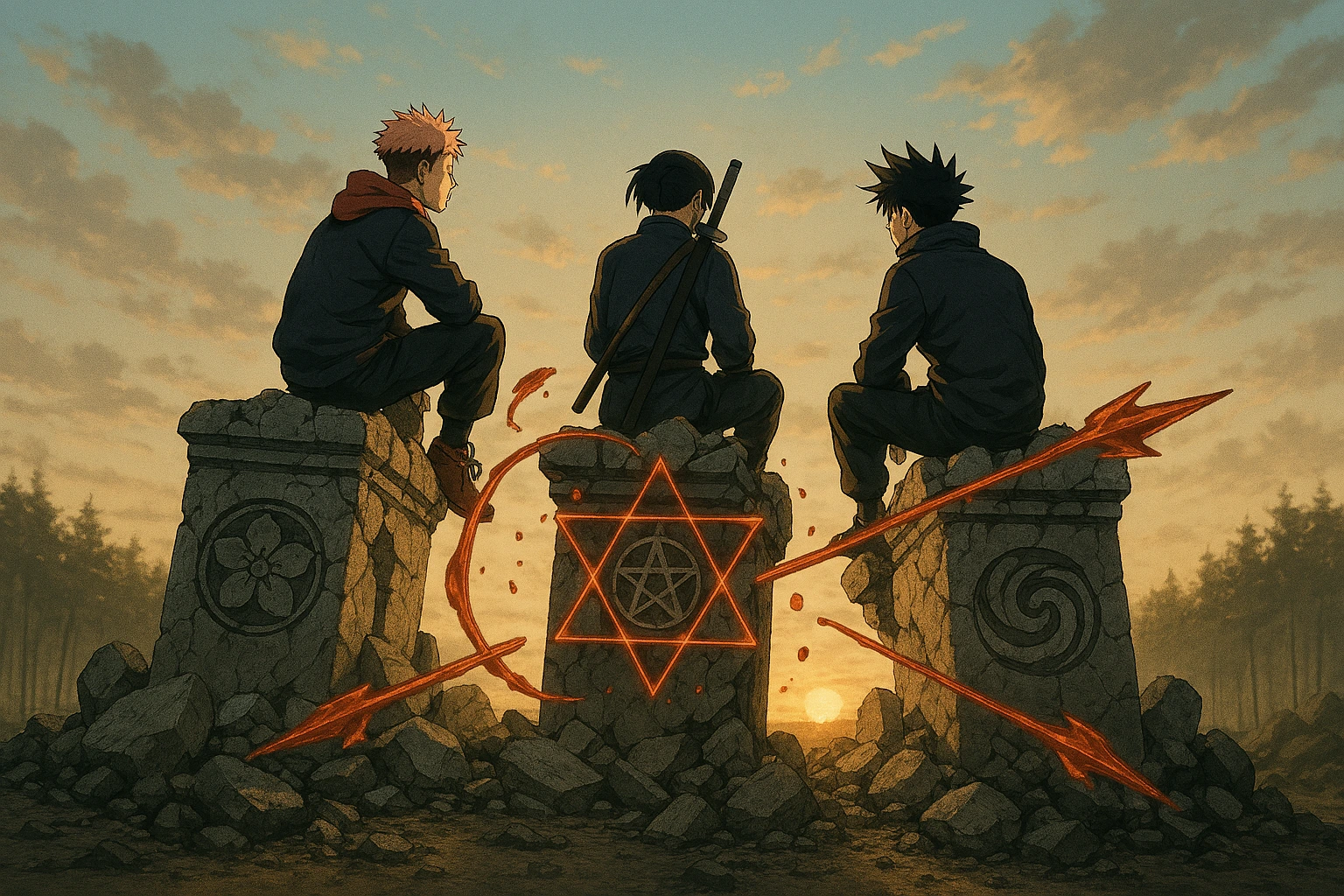
The Jujutsu Kaisen big three families serve as a perfect reflection of the themes Gege Akutami weaves throughout the story. They represent the stagnation of the “Old World.”
The Gojo Clan shows the fragility of placing all hope on one “Great Man.” The Zenin Clan demonstrates how the pursuit of power strips away humanity and love. The Kamo Clan reveals how blind adherence to tradition can hide rotting corruption.
As the story moves toward its climax, the new generation—Hakari, Yuta, Maki, and Yuji—are not rebuilding these families. They are dismantling them. The era of the Gosanke is ending, not because they were weak, but because they refused to change. They were dinosaurs watching the meteor fall, convinced their claws and fangs would save them from the fire.
To truly understand the depth of the evil that Kenjaku represents, and to understand the “Golden Age” that these families try to emulate, we must look further back. We must look to the era that birthed Sukuna.
Next, we will explore The Golden Age of Sorcery: The Heian Era, and the true origin of the King of Curses.